

Antonio Morga (de)

Dr Antonio de Morga Sanchez Garay (29 Nov 1559, Sevilla, Spain — 21 July 1636, Cumbayá Valley near Quito, Viceroyalty of Peru, now in Ecuador) was a Spanish historian, lawyer and colonial official for 43 years in the Philippines, New Spain, and Peru, who stayed in Manila from 1594 to 1604, sailed to Cambodia and Japan, and published in Mexico a major text on the early Spanish colonization in Asia, Sucesos de las Islas Filipinas (1609).
Born from a Basque father and an Andalucian mother, de Morga graduated from the Salamanca and Osuna Universities as Doctor en Derecho [Doctor of Canon Law] in 1580. In 1593, he was appointed Teniente General de Filipinas [Lt-Governor of the Philippines], directly under Governor-General Luis Pérez Dasmariñas y Páez de Sotomayor, who ruled the Filipino colony from 1593 to 1596 and sent unsuccessful expeditions to conquer Cambodia and Mindanao (important island in the Philippines Archipelago), and from 1598 Oidor (Judge of the Royal Audiencias and Chancillerías, originally courts of Kingdom of Castile) until his departure for Mexico in July 1603.
To reach the Philippines, Morga had sailed from Cádiz in February 1594 with his family, an entourage of servants and Black slaves and his personal library, arriving in México in May. There, he recruited 200 soldiers for the garrison in Manila, and left Acapulco on 22 March 1595 with his entourage aboard two ships, reaching Manila on 11 June 1595. If he was immediately involved in the dealings with Cambodia and Siam, he was mostly focusing on developing the trade between Spain and China [the ‘galleon trade’, which had started in 1565 and would last until 1821], as Chinese goods, in particular silk, transited through Manila to be shipped to Spain through Mexican ports, paid in Spanish-Mexican silver which soon became a currency in China.
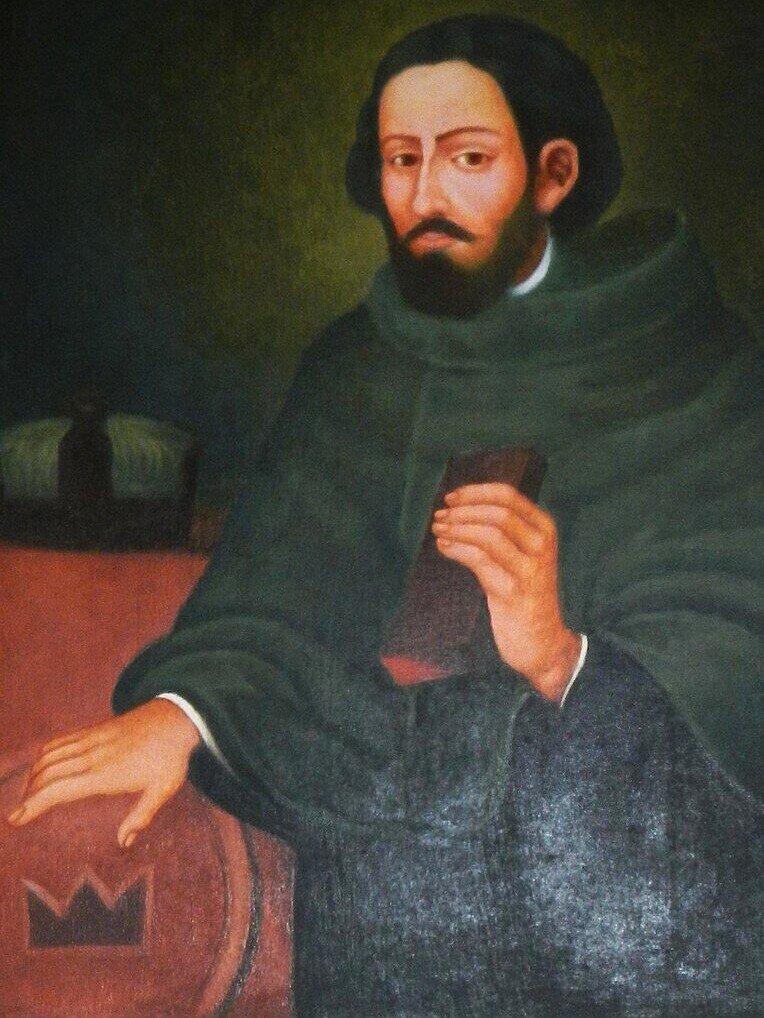
1) Portrait of Antonio de Morga Sanchez Garay, oil painting, Museum of the Filipino People, Mania. 2) Cover of the first edition of Sucesos de la Islas Filipinas, 1609.
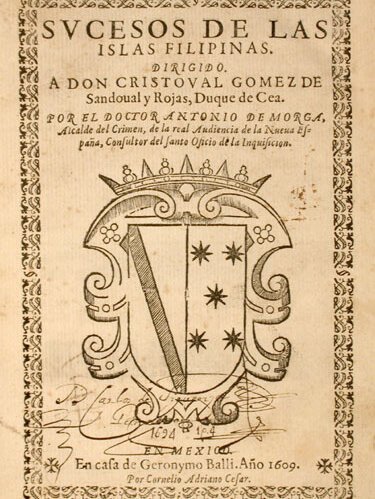
1) Portrait of Antonio de Morga Sanchez Garay, oil painting, Museum of the Filipino People, Mania. 2) Cover of the first edition of Sucesos de la Islas Filipinas, 1609.
1) Portrait of Antonio de Morga Sanchez Garay, oil painting, Museum of the Filipino People, Mania. 2) Cover of the first edition of Sucesos de la Islas Filipinas, 1609.
In 1582, while serving as mayor of Baracaldo in Viscaya he married his first wife, Juana de Briviesca Munatones, who was related to the Duke of Lerma, Philip Ill’s favourite, a useful connection in her husband’s career path. They had nine children — one of their four daughters, Juliana, eloped with a Mexican soldier in Manila, and the ensuing scandal made Morga feel even more acutely that he was ‘in exile’ in the Philippines.
During his mandate in Manila, in October 1600, Morga was assigned to take assemble and command of a small fleet including the San Diego and the San Bartolomé to repel the ships of Dutch corsairs under Olivier van Noort threatening the access to Manila harbor. This resulted in a fiasco as the San Diego was sunk — the wreck and its load were found in 1992 by a French maritime archaeology team, with some of the 34,000 artifacts found in the hull kept at a small museum on Fortune Island, Nasugbu, Batangas, Philippines. The Dutch warship Mauritius escaped the battle and made her way back to Holland, making Van Noort the first Dutchman to circumnavigate the globe.
His version of the event was published in Sucesos de la Islas Filipinas, released in Mexico nine years later. As his first wife had died in 1606, Morga married a widow, Catalina de Alcega, at age 50 and the same year he published his account. The book was later annotated and hailed for its informative — if biased — value by the Filipino independentist leader José Rizal (19 June 1861 – 30 Dec. 1896).
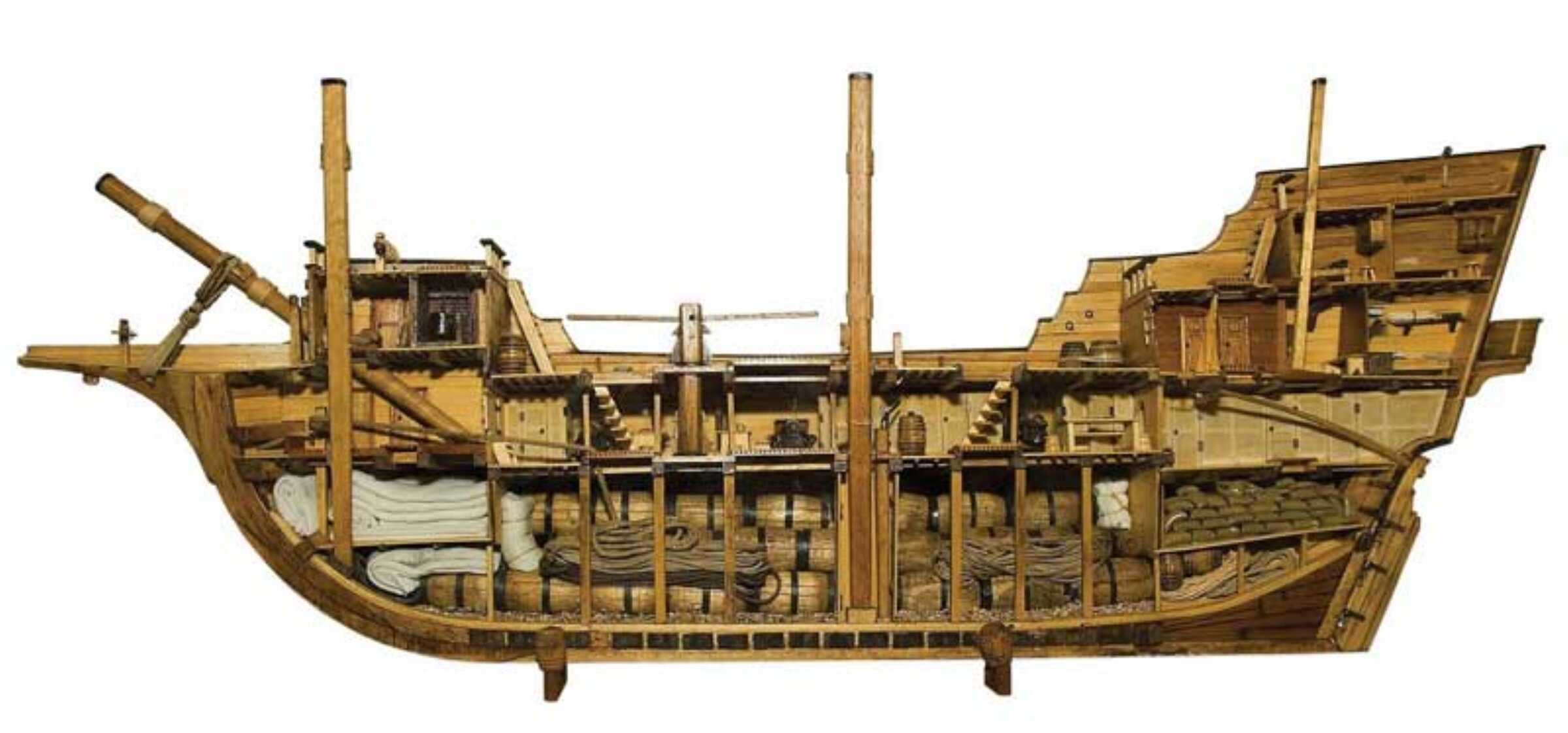
Structure design of ‘el galeón de Manila’, which was called ‘el galeón de Acapulco’ on the docks of Manila. The ship was the horsepower of the first regular trans-Pacific trading route that lasted three centuries. [photo from Amuraworld.]
Structure design of ‘el galeón de Manila’, which was called ‘el galeón de Acapulco’ on the docks of Manila. The ship was the horsepower of the first regular trans-Pacific trading route that lasted three centuries. [photo from Amuraworld.]
After serving as Alcalde del crimen [Attorney General] in Mexico City, Morga was appointed Presidente de la Real Audiencia [Head of the Supreme Court of Justice] in Quito (Ecuador, then part of the Spanish Viceroyalty of Peru) from 30 Sept. 1615. The longest serving magistrate in this position, his quite liberal views on the improvement of the rights of indigenous people were frowned upon by the ‘moral police’ that was the Spanish Inquisition, and the inquisitors piled up evidence of his ‘lewd behavior’, including paying an abortion for a married woman he had cavorted with.
Arrested for corruption in 1625, Morga was cleared of the charges in 1627, and resumed his activities until his death in 1636. Among his misdeeds, it was reported that, when sailing from Mexico to Quito, he had taken out with him some contraband Chinese silk worth 40,000 pesos which he sold for 100,000 after reaching his destination. A notorious gambler, heavily fined for his womanizing, he was blamed for his ‘egoism and greed’ by Spanish observers of South America’s colonization. After the death of wife Catalina — also a compulsive gambler — in 1630, he married for the third time a Creole woman from Lima when we has 72 years old. His censors had not abated, and the Consejo de Indias [Council of the Indies] in Madrid was perusing no less than seventy two charges submitted against him when he departed the Vale of Tears.
Publications
Sucesos de las Islas Filipinas, dirigidos a Don Christoval Gomez de Sandoval y Rojas, Duque de Cea. Por el Doctor Antonio de Morga, Alcalde del crimen de la Real Audiencia de la Nueva España, Consultor del Santo Officio de la Inquisición,
Mexici ad lndios, en casa de Gerónymo Balli, 1609. | Annotated edition by Dr. José Rizal, Paris, 1890 | Annotated edition by Wenceslao E Retana, Madrid, 1910.
ENG: The Philippine Islands, Molucca, Siam, Cambodia, Japan, and China at the close of the sixteenth century, by Antonio de Morga, translated from the Spanish by the Hon. Henry Edward John Stanley de Alderley, London, printed for the Hakluyt Society, 1868. | repr. in Las Islas Filipinas, 1493 – 1898 (en español), Vol. 15 & 16 of 55, ed. and ENG tr. by Emma Helen Blair and James Alexander Robertson, Cleveland, Ohio: Arthur H. Clark Company, 1904. ISBN 978 – 1231213940. | new edition edited by J.S. Cummins, London, The Hakluyt Society, 1971. ISBN 0−521−01035−7.
Further Reading
- Lothar G. Knauth, “Morga: Génesis de un Símbolo”, Historia Mexicana 14 – 2 (54), Oct.-Dec. 1964: 272 – 91.
- J. S. Cummins, “Antonio de Morga and His Sucesos de las Islas Filipinas”, Journal of Southeast Asian History 10 – 3, (International Trade and Politics in Southeast Asia 1500 – 1800), Dec. 1969: 560 – 581. [A researcher with University College of London, J. S. Cummins has authored Jesuit and Friar in the Spanish Expansion to the East, London, Variorum Collected Studies, 1986.]
- Carmen Y. Hsu, “Acerca de la representación del archipiélago filipino en los ‘Sucesos’ de Antonio de Morga”, Hispanófila 157 (special issue), Dec. 2009: 117 – 132.
- José Pardo-Tomás, “Las primeras historias naturales de las Filipinas (1583−1604)”, Nuevo Mundo, 2019.