

Dr. Jacobus X (Louis Jacolliot)
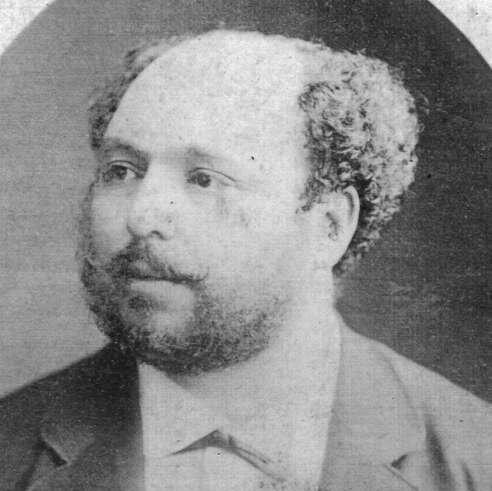
Docteur Jacobus X was the well-kept pseudonym of Louis-François Jacolliot (31 Oct. 1837, Charolles, France — 30 Oct. 1890, Saint-Thibault-des-Vignes, France), a French colonial civil servant and compulsive writer who, while a judge of criminal court in Pondicherry (India) and Tahiti (French Oceania) from 1865 to 1869, and afterwards, dabbled in spiritism and eroticism, developing an uncommon interest in the sexual mores of Indian and Southeast Asian people.
With his wife, Marguerite Faye (1839, Pondicherry, India ‑1884, Dinard, France) — they married in 1867 in Pondicherry, he traveled extensively across the Indian subcontinent and Ceylon [Sri Lanka], including a three-month boating trip on the Ganges River she recalled in her travelogue Trois mois sur le Gange et le Brahmapoutre (1875). They separated in the early 1870s and Marguerite Faye retired to Dinard where she had built for her one of the historic villas of the city, Villa India. Jacolliot went on to work in Tahiti. As he claimed several times, he had worked in Cambodia - in 1866, as indicated in Untrodden Fields of Anthropology (1896) — and in Saigon (then Cochinchina).
Enamored with Indian mythology and philosophy, Jacolliot claimed to have discovered while studying “Sanskrit tabet” the location of the lost continent of Rutas (or Mu), which he placed in the Pacific Ocean. His ‘translation’ of the Manusmṛti (मनुस्मृति), The Laws of Manu) was dismissed as amateurish by Sanskritists and Indianists. His theory on the Indian origin of Christianism, culminating in his essay Christna et le Christ (1874), although criticized by Belgian Orientalist Charles de Harlez, had a lasting influence on Helena Petrovna Blavatsky (née Hahn von Rottenstern, 12 August 1831 – 8 May 1891), often known as Madame Blavatsky, the Russian-American mystic and writer who co-founded the Theosophical Society in 1875 [1].
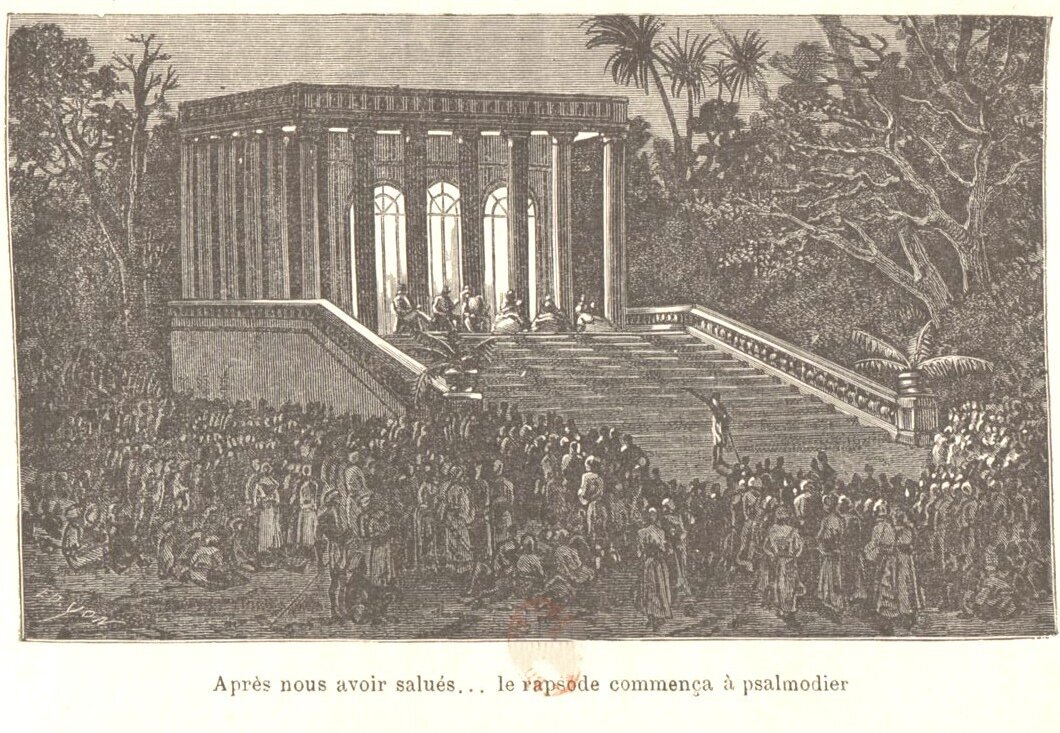
1) “After greeting us, the rhapsode began to chant”, scene on the banks of the Ganges [illustration by E. Yon in Marguerite Faye (Mme Louis Jacolliot), Trois mois sur le Gange…, op. cit.]. 2) Villa India on Saint-Enogat Beach Dinard, France [photo by Pymouss, Wikicommons, 2025].

1) “After greeting us, the rhapsode began to chant”, scene on the banks of the Ganges [illustration by E. Yon in Marguerite Faye (Mme Louis Jacolliot), Trois mois sur le Gange…, op. cit.]. 2) Villa India on Saint-Enogat Beach Dinard, France [photo by Pymouss, Wikicommons, 2025].
1) “After greeting us, the rhapsode began to chant”, scene on the banks of the Ganges [illustration by E. Yon in Marguerite Faye (Mme Louis Jacolliot), Trois mois sur le Gange…, op. cit.]. 2) Villa India on Saint-Enogat Beach Dinard, France [photo by Pymouss, Wikicommons, 2025].
As several contemporary writers, Jacolliot combined esoterism with eroticism, often disguised as “anthropological” or “medical studies”. Hence the pen-name ‘Docteur Jacobus X’, or even more enigmatically ‘A French Army-Surgeon’ — “specialist in genital-urinary organs”, he claimed in the foreword to L’amour aux colonies. It is only in 1988 that two historians of French Polynesia, Paul Griscelli and Maxwell Shekleton, established without doubt that Jacolliot and Jacobus were the same writer [“Qui est le docteur Jacobus X….?”[Who is Dr. Jacobus X?”], Bulletin de la Société d’Etudes Historiques de la Nouvelle-Calédonie 77, 4th quarter 1988] [2].
It was the Southeast Asian experience that triggered a morbid attention to “primitive mores”, later expanded to French Polynesia, the French Indies and the African continent. In L’amour aux colonies (1893, published posthumously at 330 copies only by Isidore Liseux, a collector of erotica such as Fanny Hill (1887), Kama-Sutra (1885), Cheikh Nefaoui’s Perfumed Garden (1886), and for decades relegated in “l’enfer” [‘The Hell’, prohibited book section at Bibliothèque Nationale de France]), he didn’t hide away his racialist prejudice: “C’est le vaincu qui a corrompu l’Européen par son contact, et il a fallu pour cela les circonstances atténuantes du manqué presque absolu de l’élément féminin Européen au début de la colonisation.” [“It was the vanquished who corrupted the European through contact, and this required the mitigating circumstances of the almost absolute lack of the European female element at the beginning of colonization.”][p 82] [3].Quoting from Jean Moura, Dr C. Thorel, Dr. J. Harmand, Etienne Aymonier, Dr. E. Maurel, he was aware of certain customs of Ancient Cambodia then known by very few authors, in particular the ritual defloration of nubile girls reported by Zhou Daguan under the term zhentan. [Abel-Rémusat, the first European translator of Zhou Daguan’s account, had transcribed ‘tchin-than’ and prudently gave the Latin term for it (‘strati dispositio’) in his Nouveaux mélanges asiatiques (1829)] [4].
In his meandering study on Marquis de Sade (published posthumously in 1906), Jacolliot-Jacobus posited that Sad had been “the real founder of naturalism in French literature.” In his pseudo-medical theorization, he claimed that the sexual impulse was “the sixth sense”. Dr Jacobus X’s editor, Charles Carrington, even managed to quote…Jacolliot in his preface to the 2d edition of Untrodden Fields of Anthropology — Observations on the Esoteric Manners.. (1898, signed Dr Jacobus X):
We are far from being the first to use the phrase ‘Sixth Sense’. Jacolliot says — “The most ancient traditions of India, the cradle of Humanity and of Religions, mention and admit a sixth sense. To man, Brahma gave five organs -Touch, Sight, Smell, Taste, Hearing and a sixth, admitted by all Indian philosophers and called Mamas, which is the agent of the union of the sexes.- The Sankhyan philosophy defines it as follows: “An organ by affinity, participating in the qualities of the others, and which serves at once for sensation and action.” [p 10] […] His experiences cover THIRTY LONG YEARS in ASIA, AFRICA, AMERICA, and OCEANIA; and, with the frankness of a medical student, he carefully and without fear, examines the effete civilizations of ANNAM, TONQUIN and CAMBODIA, laying open as with a scalpel, and exposing, the vices of people who have brought depravity almost up to the level of a fine art. [p 20]
Behind the enigmatic author hovered Charles Carrington (born Paul Harry Ferdinando, 11 Nov. 1867, Bethnal Green, England – 1921, Ivry-sur-Seine, from syphilis), a compulsive British publisher of erotica who had moved from London to Paris in 1895 and published books by Oscar Wilde and Anatole France to legitimize his inclination for scandalous, censored writings — for instance Criminal Ethnography, being a Treatise on the Development of Crimes peculiar to the Inhabitants, native and civilized, of the French Colonies of Indo-China, by Dr. Corke (1895), The Memoirs of Dolly Morton (1899), Petronius’ Satyricon (1902), the French series La Flagellation à Travers le Monde, several titles by Jean de Villiot, (pseudonym of Georges Grassal), and more.
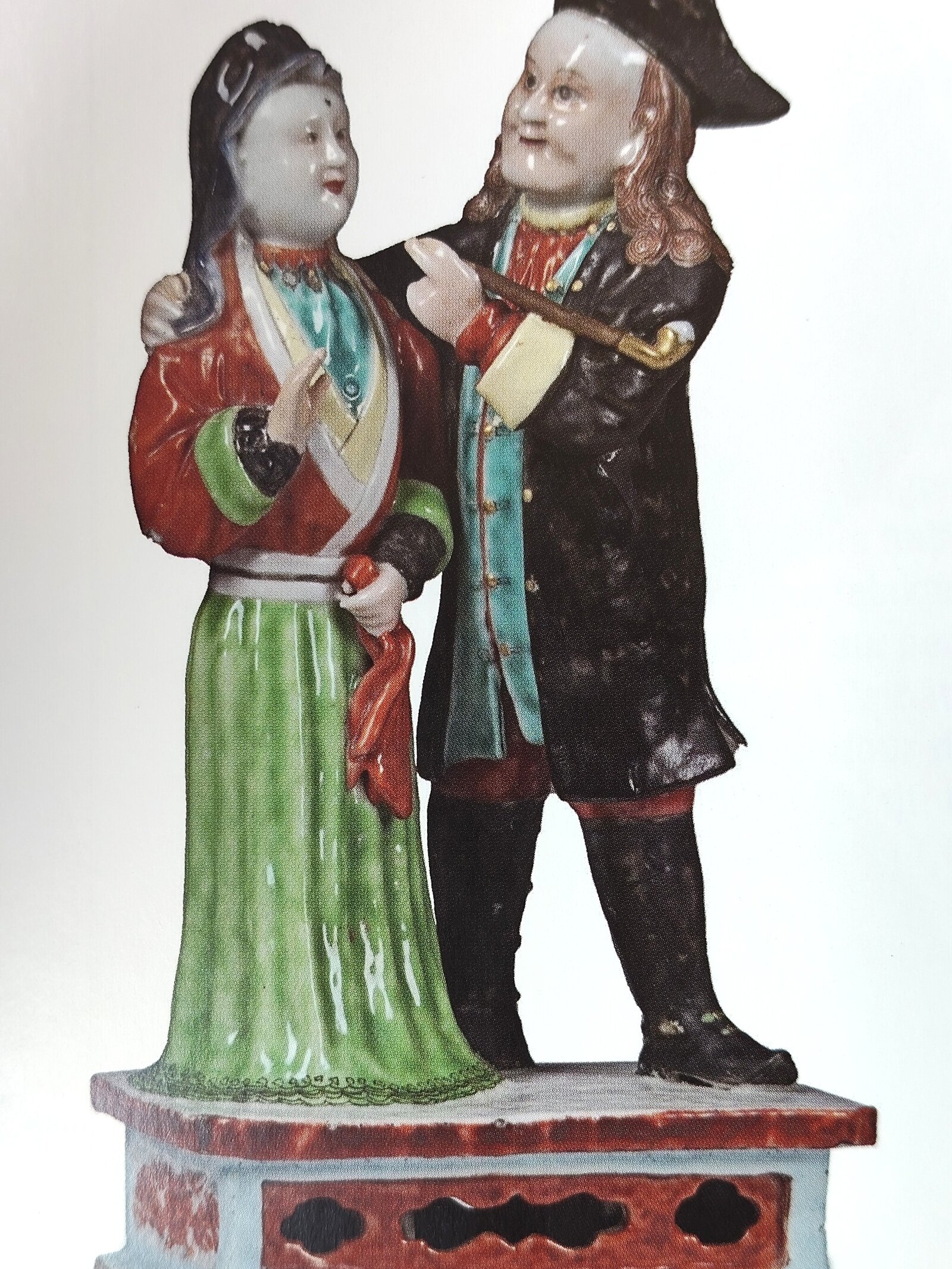
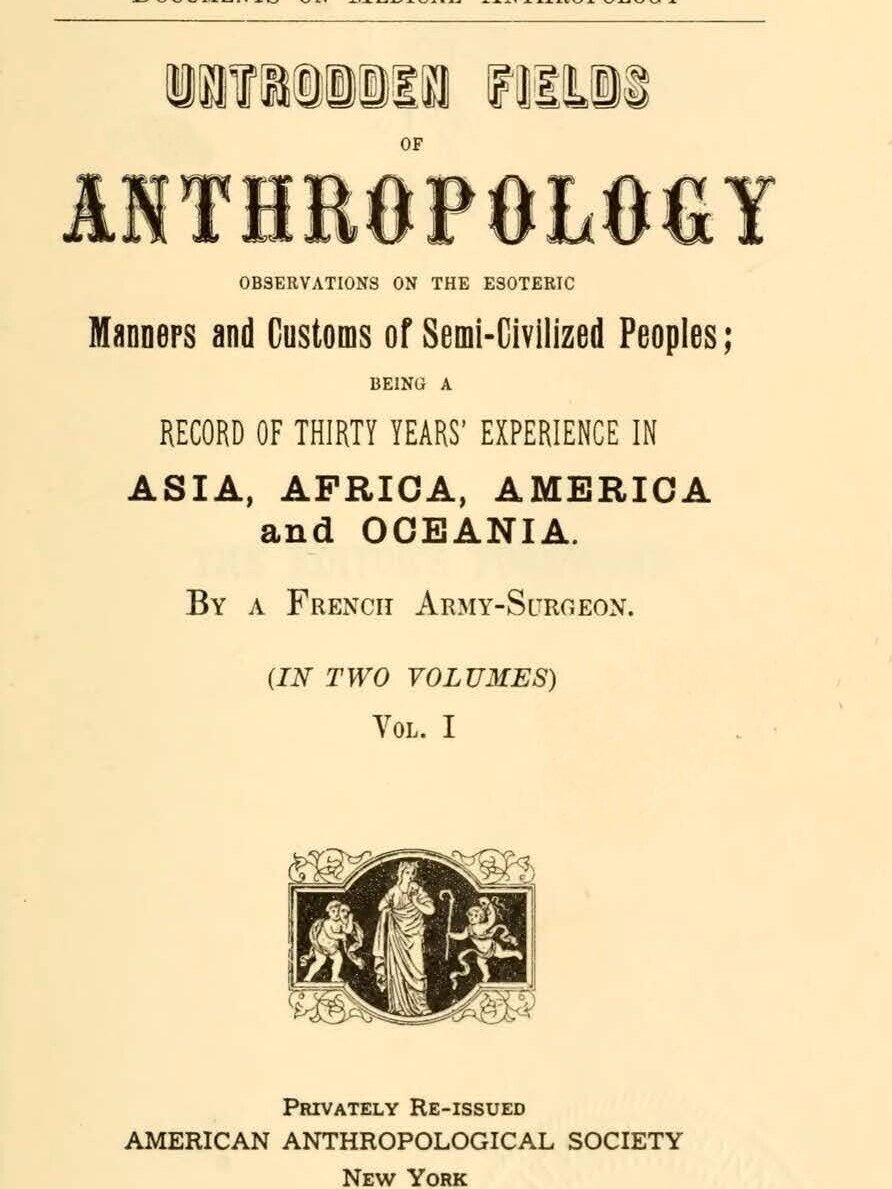
1) ‘European man and Asian woman’, Chinese porcelain, Jingdezhen, 23×12 cm, 1775 – 1780 [illustr. from Sexe, race et colonies, op. cit.]. 2) New York reprint of Untrodden fields…, cover page.
1) ‘European man and Asian woman’, Chinese porcelain, Jingdezhen, 23×12 cm, 1775 – 1780 [illustr. from Sexe, race et colonies, op. cit.]. 2) New York reprint of Untrodden fields…, cover page.
1) ‘European man and Asian woman’, Chinese porcelain, Jingdezhen, 23×12 cm, 1775 – 1780 [illustr. from Sexe, race et colonies, op. cit.]. 2) New York reprint of Untrodden fields…, cover page.
_______________
[1] “On the occasion of the last International Theosophical History Conference (1997) held in London, Daniel Caracostea of Paris delivered a paper on Louis-François Jacolliot, one of the many “experts” cited by H.P. Blavatsky shedding insight on aspects of the Ancient Wisdom. Her high regard for Jacolliot as a scholar of Indian culture and religion is recorded in letters to the New York World (April 6, 1877) and Sun (April 21 and May 13, 1877), and numerous citations in Isis Unveiled. Despite her admiration for him, she was not naïve enough to accept all his opinions uncritically. Blavatsky was aware of the sharp criticism of Jacolliot by two leading Indologists of the day, F. Max Müller and William Dwight Whitney, the latter branding Jacolliot as a “bungler and a humbug” (Isis Unveiled, II.47). She herself observes a dichotomy between the scholarly Jacolliot and the romantic Jacolliot, leaving the impression that she only considered the scholarly Jacolliot to be a worthy source of her reconstruction of the Ancient Wisdom.” [Theosophical History, Vol. IX, No. 1, January 2003]
[2] Griscelli and Shekleton found the definite evidence on the author’s identity in “manuscript notes for the 1937 English translation [Untrodden Fields…] kept at the Bernheim Library, Noumea” (New Caledonia), from which the authorship could be traced to Louis Jacolliot (1837−1890),
curieux personnage qui vécut à Tahiti et dans les comptoirs français de l’Inde, à Chandernagor. C’était un mystique bizarre, à la recherché du ” peuple primitif”, de l’esprit, du “sixième sens” et d’une synthèse religieuse. On le connaît, à Tahiti, pour la part qu’ il prend dans la défense du gouverneur La Roncière, qui fut renvoyé en 1869 au cours d’une assez longue polémique. Jacolliot y était juge, et même président du tribunal, et non pas médecin. [op. cit., p. 56].
[“a curious character who lived in Tahiti and in the French trading posts in India, at Chandernagor. He was a peculiar mystic searching for the “primitive people,” the spirit, the “sixth sense,” and some religious synthesis. In Tahiti, he is known for his role in defending Governor La Roncière, sacked in 1869 after a rather lengthy controversy. Jacolliot was a judge there, even president of the court, and not a doctor.”]
[3] In this sexualized vision of human interaction, however, the opposite may happen, as with “the vahiné corrupted by the European” in one chapter of L’amour aux colonies.
[4] In Untrodden Fields…, “My Sojourn in Cambodia”: I lived several months in Cambodia in 1866, during the civil war caused by the struggle between Norodom, the reigning king, supported by the French, and his brother Pra-Keo-Pha, his rival for the throne. In order not to exceed the scope of this work, and swell the book immoderately, I shall deal very briefly with all those manners, customs, and habits, which do not directly concern sexual intercourse. Ciampa, the ancient Kingdom of the Kmers, was formerly very powerful ; it comprised the whole of Cochin-China, a part of the Empire of Annam, the present Kingdom of Cambodia, and the provinces of Baltambang and Angkor belonging to Siam. These countries formerly possessed a high degree of civilization, which is still shown by the magnificent monuments and buildings, especially by the fine city of Angkor. The present race of Cambodians, degenerate descendants of the old Kmers, cannot decipher the characters in the ancient language engraved on the monuments of their ancestors. […] The Kondadgis (Ceylon), the Cambodgians and other peoples charged their priests with the defloration of their brides. […]Pertunda was another hermaphrodite divinity that Saint Augustine maliciously proposed rather to name the Deus Pretmidus (who strikes first) ; it was carried on to the nuptial bed to aid the bridegroom. “Pertunda in cubiculis praesto est virgnalem scrobem effodientibus maritis.” (Pertunda stands there ready in the bedchamber for the aid of husbands excavating the — phirgin pit in Greek characters — (Arnobius). The Kondadgis (Ceylon), the Cambodgians and other peoples charged their priests with the defloration of their brides. Jäger communicated to the Berlin Anthropological Society a passage from Gemelli Cancri, which mentions a stupratio officialis practised at a certain period among the Bisayos of the Philippine Islands : ” There is no known example of a custom so barbarous as that which had been there established, of having public officials, and even paid very dearly, to take the virginity of young girls, the same being considered to be an obstacle to the pleasures of the husband. As a fact there no longer exists any trace of this infamous practice since the establishment of the Spanish rule… but even to-day a Bisayo feels vexed to find his wife safe from suspicion, because he concludes, that not having excited the desire of anyone, she must have some bad quality which will prevent him from being happy with her.”[p 132 – 4, vol 2].
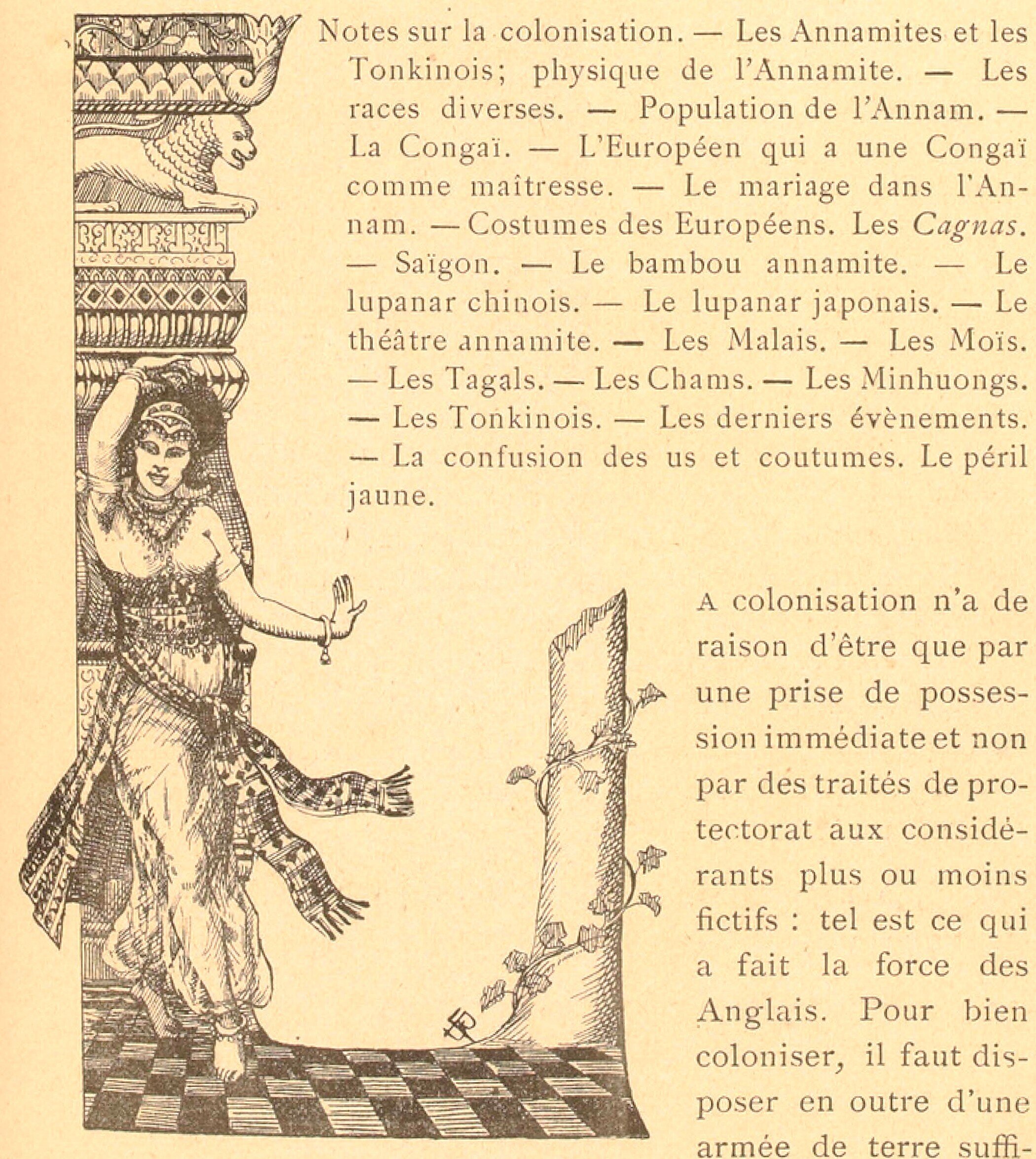
Illustration for the incipit of the chapter on Southeast Asia in Pétrus Durel, La femme dans les colonies françaises…, p. 82.
Illustration for the incipit of the chapter on Southeast Asia in Pétrus Durel, La femme dans les colonies françaises…, p. 82.
Publications as Docteur Jacobus X [posthumous]
- L’amour aux colonies, singularités physiologiques et passionnelles : observées durant trente années de séjour dans les colonies, Cochinchine, Tonkin et Cambodge, Guyane et Martinique, Sénégal et Rivières du sud, Nouvelle-Calédonie, Nouvelles-Hébrides et Tahiti, Paris, Isidore Liseux, 1893, 396 p. ; repr. as L’art d’aimer aux colonies, Paris, Editions Georges-Anquetil, 1927; Anne de Colney, L’amour aux colonies, Paris, Astra, 1932, 24 p; repr. L’Amour aux colonies, singularités physiologiques et passionnelles observées durant trente années, Paris, Hachette/BNF, 2016, 405 p. ISBN13 978 – 2019528348.
- [as ‘A French Army-Surgeon’] Untrodden Fields of Anthropology — Observations on the Esoteric Manners and Customs of Semi-Civilized Peoples; being a Record of Thirty Years Experience in Asia, Africa, America and Oceania, Laon, 1896; repr. as ‘New York, ‘Privately re-issued by the American Anthropological Society’, 1896, 2 vols., 768 p.; 2d ed. Paris, Librairie de Médecine, Folklore et Anthropologie [C. Carrington], 1898, 2 vols, 845 p. [preface by C. Carrington] [email hidden; JavaScript is required]; repr. New York, Falstaff Press, 1937.
- Arcana Anthropologica — The Ethnology Of The Sixth Sense. Studies And Researches Into Its Abuses, Pervasions, Follies, Anomalies, And Crimes, Paris, Charles Carrington, 1899.
- Crossways of Sex: A Study in Eroto-Pathology, Paris, Charles Carrington, 1880; repr. 2002, Amsterdam, Fredonia Books, 396 p. ISBN-13 978 – 1589637375.
- Le Marquis de Sade et son oeuvre devant la science médicale et la littérature moderne, Paris, C. Carrington, 1901, 522 p.
- Lois génitales: Etudes des phénomènes présidant aux fonctions de l’amour normal et de la procréation humaine, Paris, Charles Carrington, 1906, 452 p.
- L’Acte Sexuel dans l’Espèce Humaine: Étude physiologique complète de l’Amour normal et des Abus, Perversions, Folies et Crimes relatifs à l’instinct génital à travers les Peuples et les Ages, Paris, Editions Prima, 1931, 400 p.
- Le livre secret: les lois de l’instinct génital, du bonheur sexuel et du plaisir charnel, Paris, Editions Prima, 1933, 448 p.
- [Charles Carrington using Dr. Jacobus X as an alias], Discipline in School and Cloister, Flogging as an aid to education, Canton, Georgia (USA), Dusty Vault, 2020, 72 p. ISBN 9798643505235.
Publications as Louis Jacolliot
- La Devadassi (Bayadère), Theatre Indou, Comédie en quatre actes traduite du tamoul par Louis Jacolliot, président du tribunal de Chandernagor, Paris, A. Lacroix, 1868, 46 p. [introduction, ADB scan]
- La Bible dans l’Inde, ou la Vie de Iezeus Christna, Paris, A. Lacroix, 1869.
- La vérité sur Taïti. Affaire de La Roncière, Paris, 1869.
- La Bible dans l’Inde, Vie de Iezeus Christna, Paris, A. Lacroix, 1869; repr. 1876.
- Les Moeurs et les femmes de l’Extrême-Orient: Voyage au pays des bayadères, Paris, E. Dentu, 1873, 400 p.; 6th ed. [illustr. by Riou], Paris, E. Dentu, 1882, 386 p.
- Les fils de Dieu, Paris, A. Lacroix, 1873, 362 p.
- Histoire des vierges: les peuples et les continents disparus, Paris, E. Dentu, 1874.
- Christna et le Christ, Lingam, Nara, Spiritus sanctus, Phallus, Priape, le cygne de Léda, la colombe de Marie. Paris: Librairie internationale A. Lacroix, 1874, 380 p.
- Voyage au pays des perles I, Paris, 1874.
- Le spiritisme dans le monde : l’initiation et les sciences occultes dans l’Inde et chez tous les peuples de l’antiquité, Paris, 1875; repr. 1892; repr. Slatkine reprints, 1981.
- Voyage aux ruines de Golconde et à la cité des morts (Indoustan). Paris: Dentu, 1875, 394 pp.
- Voyage au pays de la Liberté : la vie communale aux États-Unis, Paris, 1876.
- Voyage au pays des éléphants II, Paris, 1876.
- Les Législateurs religieux : Manou, Moïse, Mahomet: traditions religieuses comparées, avec commentaire, Paris, A. Lacroix, 1876; repr. 1880.
- Les Traditions indo-asiatiques, Paris, A. Lacroix, 1876.
- Les Traditions indo-européennes et africaines, Paris, A. Lacroix, 1876.
- Le Pariah dans l’Humanité, Paris, A. Lacroix, 1876.
- La côte d’Ébène : le dernier des négriers (2d ed.), Paris, Librairie illustrée, 1876, 329 p.
- Les Traditions indo-européennes et africaines. Paris: Librairie internationale A. Lacroix, 1876, 324 pp.
- Voyage au pays des éléphants (1ere Partie), Paris, E. Dentu (Paris), 1876, 350 p.
- Voyage au pays des perles: Les moeurs et les femmes de l’Extrême Orient, Paris, 1876; 5th edition: Paris, E. Dentu, 1879, 346 p. [5 ed.]
- La femme dans l’Inde : la femme aux temps védiques, aux temps brahmaniques et dans l’Inde de la décadence, Paris, A. Lacroix, 1877, 364 p.
- La Cité des sables: El Temin, Paris, G. Decaux‑R. Dreyfous, 1877 (2nd ed.), 370 p.
- Second voyage au pays des éléphants, Paris: Dentu, 1877, 369 pp.
- Les Mangeurs de feu, Paris, E. Dentu, 1877; repr. [illustr. by A. Parys] C. Marpon et E. Flammarion, 1887, 860 p.
- Taïti. Le crime de Pitcairn. Souvenirs d’un voyage en Océanie, Paris, 1878.
- Voyage au pays des brahmes. Paris: Dentu, 1878, 357 pp.
- Fétichisme, polythéisme, monothéisme. La Genèse de l’humanité. La terre et l’homme. Traditions hindoues et chaldéennes. La légende de la Genèse dans l’Inde. Paris, A. Lacroix, 1879, 376 pp.
- Histoire des vierges, Paris, A. Lacroix, 1879, 368 p.
- Voyage aux rives du Niger, au Bénin et dans le Borgou I, Paris, 1879.
- Voyage aux pays mystérieux. Du Bénin au pays des Yébous ; chez les Yébous — Tchadé II, Paris, 1880.
- Les Mouches du coche, Paris, 1880.
- L’Olympe brahmanique. La mythologie de Manou, Paris, 1881.
- Voyage au pays des fakirs charmeurs [illustr. by Alfred Mouillon & El Geardi], Paris, E. Dentu, 1881, 349 p.
- Voyage au pays du Hatschisch III, Paris, 1883.
- Voyage au pays des singes, Paris, C. Marpon et E. Flammarion, 1883, 292 p.
- Voyage au pays des palmiers, Paris, C. Marpon et E. Flammarion, 1883.
- Ceylan et les Cinghalais, Paris, 1883.
- Les Pêcheurs de nacre IV, Paris, 1883.
- Voyage humoristique au pays des kangourous I, Paris, C. Marpon et E. Flammarion, 1884.
- Voyage dans le buisson australien II, Paris, C. Marpon et E. Flammarion, 1884.
- La Genèse de la terre et de l’humanité I, Paris, 1884.
- Le Monde primitif, les lois naturelles, les lois sociales II, Paris, 1884.
- Voyage dans le buisson australien, Paris, C. Marpon et E. Flammarion, 1884, 323 p.
- Les Animaux sauvages [illustr. by Auguste-André Lançon], Paris, Librairie illustrée, 1884, 799 p.
- Voyage humouristique au pays des kangourous, Paris, C. Marpon et E. Flammarion, 1884, 321 p.
- L’Afrique mystérieuse, 4 vols, Paris, 1884 – 1887.
- Histoire naturelle et sociale de l’humanité. La genèse de la terre et de l’homme [3d ed.]), Paris, 1885, 599 p.
- Voyage aux pays mystérieux : Yébou, Borgou, Niger, Paris, E. Flammarion, 1887, 250 p.
- Les Chasseurs d’esclaves, Paris, C. Marpon et E. Flammarion, 1888, 316 p.
- Le Coureur des jungles [illustr. by Horace Castelli], Paris, C. Marpon et E. Flammarion, 1888, 668 p.
- Le Crime du moulin d’Usor, Paris, 1888.
- Vengeance de forçats, Paris, 1888.
- Voyage au pays des Jungles. Les Femmes dans l’Inde, Paris, 1889.
- L’Affaire de la rue de la Banque. Un mystérieux assassin, Paris, 1890.
- Un Policier de génie. Le mariage de Galuchon, Paris, 1890.
- Les Ravageurs de la mer, Paris, 1890.
- Scènes de la vie de mer. Mémoires d’un lieutenant de vaisseau, Paris, E. Dentu, 1891, 231 p.
- L’Affaire de la rue de la Banque. Le Père Lafouine, Paris, 1892.
- Perdus sur l’océan : les grandes aventures, Paris, E. Flammarion, 1893, 658 p. [illustr. by Clerice].
- Voyage sur les rives du Niger, Paris, E. Flammarion, 1894, 332 p.
- Fakirs et bayadères, Paris, E. Dentu, 1904, 224 p.
See also
- Mme Louis Jacolliot née Marguerite Faye, Trois mois sur le Gange et le Brahmapoutre, Paris, E. Dentu, 1875; repr. 1885, 316 p [illustr. by E. Yon (Edmond Charles Joseph Yon, 1836 – 1897)].
- Alfred Belot, Cinq Cents femmes pour un homme, Paris, Édouard Dentu, 1889. [described the dances at the court of King Norodom as if he had witnessed them.]; Mademoiselle Giraud, ma femme, Paris, E. Dentu, 1878, 53eme édition, 278 p.
- Pétrus Durel, La femme dans les colonies françaises, études sur les mœurs d’un point de vue myologique et social, J. Dulon, 1898, 175 p. [with 22 etchings by Fredilo].
- Louis Brededin [as Dr Jacobus] La vie des seins [Life of the Breasts], Paris, Georges Guillot, 1945 [illustr. by Louis Icart].
- Paul Griscelli & Maxwell Shekleton, “Un anonymat bien gardé: Qui est le docteur Jacobus X….?”, Bulletin de la Société d’Etudes Historiques de la Nouvelle-Calédonie (BSEHNC) 77, 4ème trimestre 1988, p. 55 – 6..
- Julia Clancy-Smith & Frances Gouda, eds., Domesticating the Empire: Race, Gender, and Family Life in French and Dutch Colonialism, Charlottesville: University Press of Virginia, 1998.
- Matt K. Matsuda, Empire of Love: Histories of France and the Pacific, Oxford: Oxford University Press, 2005. Kindle Edition.
- Pascal Blanchard, Nicolas Bancel, Gilles Boëtsch, Dominic Thomas, Christelle Taraud, eds., Sexe, race & colonies: La domination des corps du XVe siècle à nos jours, Paris, La Decouverte, 2018, 544 p. [afterword by Leïla Slimani].