

G. E. Gerini

Colonel Gerolamo Emilio [G. E.] Gerini พระสารสาสน์พลขันธ์ [Phra Sarasana Balakhandh] (1 Mar. 1860, Cisano sul Neva, Savona, Kingdom of Sardinia — 11 Oct. 1913, Turin, Italy) was an Italian military instructor in the Siamese army, an advisor to the Royal Court, a collector of Siamese antiquities and an independent geographer, ethnographer and historian.
The son of a professor of oenology, he entered the Royal Military Academy of Modena, graduating in August 1879 and being assigned to the 13th Regiment “Pinerolo” in Perugia. Moving to Bangkok in September 1881, he reached the rank of lieutenant in the Siamese Army before leaving military service in 1883 to become the secretary of the minister of the northern division, Maha Mala, an uncle of King Chulalongkorn (Rama V). Back in the military from 1887, he was appointed Director General of Military Education and first director of the Royal Cadets’ School.
In Yutthakoth, the official publication of the Royal Thai Armed Forces still in existence nowadays, Gerini published extensively on military subjects and topics of general interest. Along with scholars Oskar Frankfurter and A. Cecil Carter, he worked towards the establishment of the Siam Society in 1904, then under the high patronage of Prince Vajiravudh (later King Rama VI).
A correspondent of École Française d’ Extrême-Orient (EFEO) and the Italian Società degli Orientalisti, Gerini kept alive his European cultural roots, in particular Italian, for instance quoting from Dante’s Inferno, Canto 1 — Nel mezzo del cammin di nostra vita / mi ritrovai per una selva oscura / ché la diritta via era smarrita — in the Introduction to his Researches on Ptolemy’s Geography of Eastern Asia (1909).
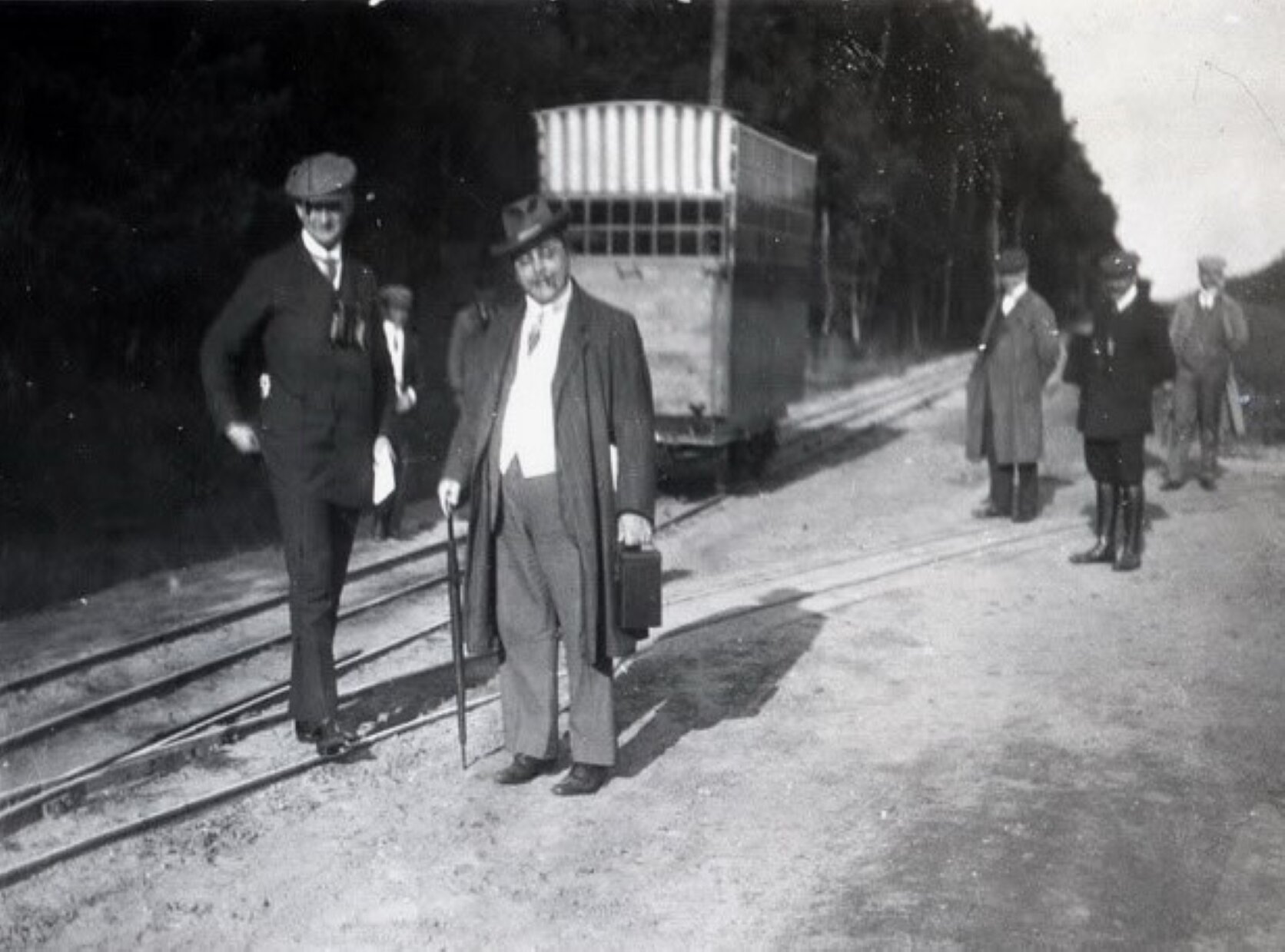
1) Colonel Gerini (center) during his official mission to Krupp factory, Germany, in 1907. 2) His visiting card. [source: GISSAD collection].
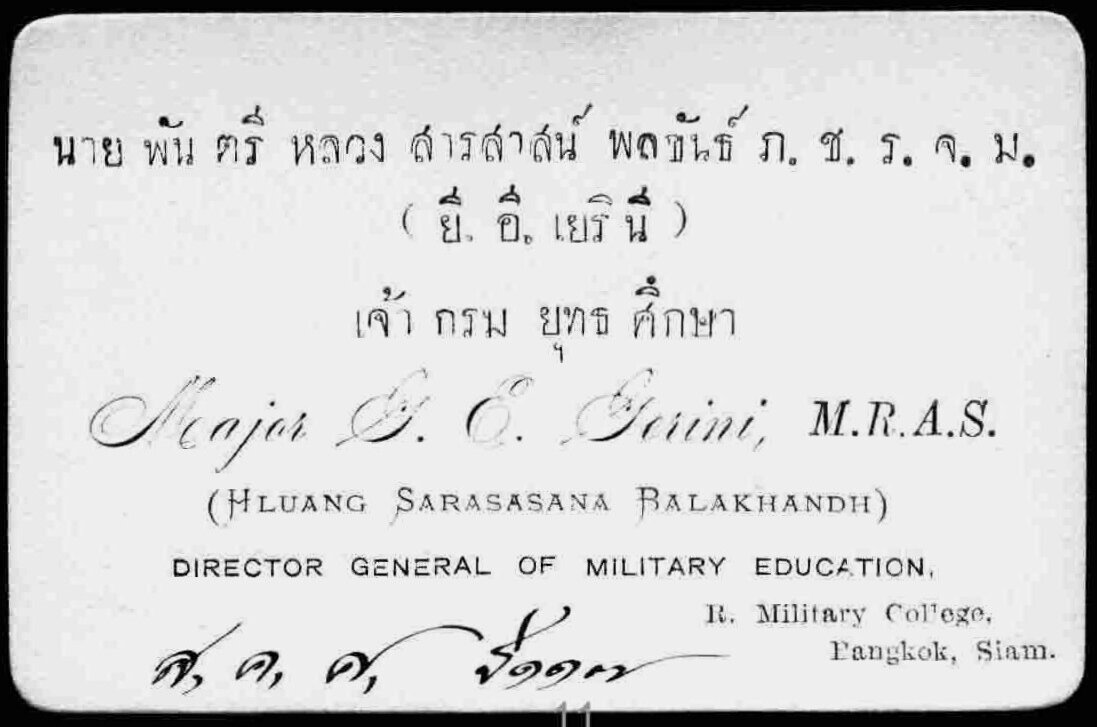
1) Colonel Gerini (center) during his official mission to Krupp factory, Germany, in 1907. 2) His visiting card. [source: GISSAD collection].
1) Colonel Gerini (center) during his official mission to Krupp factory, Germany, in 1907. 2) His visiting card. [source: GISSAD collection].
In his Colonel Gerini’s obituary (BEFEO 1914), Louis Finot noted that he
étudiait avec une curiosité avertie les antiquités des royaumes thaï et collectionnait les matériaux d’une histoire du Siam, qui devait être la grande oeuvre de sa vie et qu’il n’a pas eu le temps d’écrire. [studied with discerning curiosity the antiquities of the Thai kingdoms and collected the materials for a history of Siam, which was to be the great work of his life yet he did not have time to complete.]
In 2004, the Gerini International Siamese Studies Archive and Database (GISSAD) was founded by Dott. Luciano G. Gerini, President of Istituto di Studi Siamesi Phra Sarasasana Balakhandh and Assoc. Prof. Kanokwan Gerini, Faculty of Archaeology, Silpakorn University, Bangkok. It launched a multidisciplinary project entitled Gold Fields of Siam: Collection of Digitized Maps and Diaries of Phra Sarasasana Balakhandh (Colonel G.E. Gerini).
In 2010, the Army Training Command raised a statue of Gerini at its Bangkok headquarters entrance, making him the second Italian officially honored in modern Thailand — after Corrado Feroci (Silpa Bhirasri), the founder of Silpakorn University.
Publications
- “A retrospective View and Account of the Origin of the Thet Maha Chat Ceremony”, 1892.
- Chŭḷăkantamaṅgala or the tonsure ceremony as performed in Siam, Bangkok, IAE 8, 1893; repr. Bangkok, 1895.
- The Art of War: Military Organisation, Weapons and Political Maxims of the Ancient Hindus, Bangkok, Vajrindr Printing Office, 1894 [in Thai].
- Trial by Ordeal in Siam and the Siamese Laws of Ordeals, 1896.
- “Notes on the early Geography of Indochina”, Journal of the Royal Asiatic Society (JRAS), 1897.
- “Shan and Siam” and “Siam’s Intercourse with China — Seventh to Nineteenth Centuries”, JRAS, 1899.
- “A Malay Coin”, JRAS, 1903, p- 339.
- On Siamese Proverbs and Idiomatic Expressions, 1904.
- Archaeology: a Sinoptical Sketch, 1904.
- “Some unidentified toponyms in the Travels of Pedro Teixeira and Tavernier”, JRAS, 1904.
- “A Trip to the Ancient Ruins of Kamboja”, Imperial and Asiatic Quarterly Review (IAQR), 3d series, vol 17: 355 – 398, vol 19: 361 – 394 , vol 20: 89 – 101, Woking, Oriental Institute, April 1904-July 1905.
- “Historical Retrospect of Junkceylon Island”, 1905; repr. as “Old Phuket,” Journal of Siam Society (JSS), 1986.
- “The Nagarakretagama List of countries on the Indochinese mainland, JRAS, 1905.
- Siam’s Intercourse with China, 1906.
- “The Hanoi Exhibition” and “The First International Congress of Far Eastern Studies”, IAQR, 1906.
- Researches on Ptolemy’s geography of Eastern Asia (Further India and Indo-Malay Peninsula), Asiatic Society Monograph 1, London, Royal Asiatic Society & Royal Geographical Society, 1909.
- Chinese riddles on ancient Indian toponymy. I‑II, London, 1910 – 1911 [from Journal of the Royal Asiatic Society, Oct 1910, p 1187 – 1203, and April 1911, p. 437 – 445].
- Catalogo Descrittivo della Mostra Siamese alla Esposizione Internazionale delle Industrie e del Lavoro in Torino, 1911 — Siam and Its Productions, Arts and Manufactures (1911), 1912 (IT/ENG versions); repr. Bangkok, White Lotus, 2000.