ADB Note: The Khmer Surin [kh ខ្មែរសុរិន្ទ, th เขมรสุรินทร์] or Northern Khmer constitute an important yet “invisible” ethnic minority in Thailand (1 to 1.5 million people, according to various estimations [1]), mostly because they tend to speak in Thai or Isan, and write and read in Thai, the only language taught in the schools of the Thailand Lower Northeast (Isan) provinces where they live — Surin (63 pc), Buriram, and Sisaket provinces.
Refugees and migrants from Cambodia in the civil war years and right after the collapse of the Khmer Rouge régime in 1979 added to the Khmer historic settlements in these valleys and hills north of the Dangrek Mountains. In the years 2010s and 2020s, there was also a large addition of economic migrants who were rarely granted Thai citizenship and remained undocumented.
This study was published way before the June-July and Nov-Dec. 2025 border crisis between Thailand and Cambodia. The psychological and material damages inflicted to local communities, the destructions brought upon revered Khmer temples, in particular Prasat Preah Vihear, have consequences that researchers will have to assess in the close future.
At the time of the study (2012), the author thought important to focuse her research on the interaction between the Khmer Surin minorites and other ethnic groups. in particular the Kuy communities, in a general context already supercharged with nationalist crispations [highlights within quotes are all from ADB]:
The revival of Khmer heritage in Thailand is one which promotes a politically charged, nationalist narrative of Thailand’s claims of entitlement to Khmer heritage – particularly the monumental heritage of the Angkorian empire (ninth to fourteenth centuries CE). This narrative is one which relegates the ethnic Khmer to an imagined, illustrious past, inasmuch as it represents the Khmer as bearers of Thailand’s ancient Khmer culture while simultaneously disassociating them from contemporary Cambodia. Second, drawing on Appiah’s cautionary account of the ‘tyrannies of identity’ [see K.A. Appiah, The Ethics of Identity, Princeton, NJ: Princeton University Press, 2004], this chapter will illustrate that the revival of Khmer cultural heritage is taking place in a regional arena of ethnic identity politics, with different minority groups vying for visibility and recognition within the nation-state. Rather than fostering mutual respect among neighbouring ethnic groups, I aim to show that the revival of Khmer heritage has reinforced local discourses of ethnic Khmer superiority over the region’s ethnic Kui and hardened the political boundary dividing Thailand and Cambodia. Finally, returning to the theme of empowerment via culture, this chapter concludes by considering how the revitalisation of Khmer heritage might bring about empowerment in the true sense of the term.
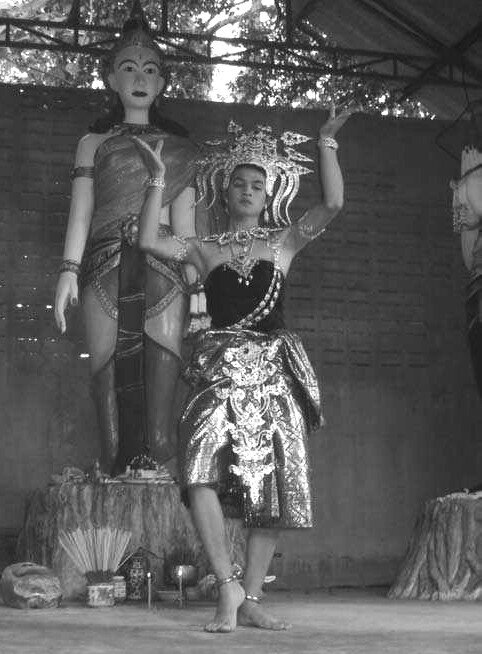
A spirit medium dressed as a female Khmer celestial deity, or apsara (Photo A. Denes).
A spirit medium dressed as a female Khmer celestial deity, or apsara (Photo A. Denes).
Without pretending at a general survey of the complex history of Thai-Khmer interactions, the author briefly traces modern issues back to the ancient mechanisms of cultural appropriation. Amongst her sources, we’ll emphasize the reference essay by Thai historian Charnvit Kasetsiri, ‘Thailand – Cambodia: a love – hate relationship’, Kyoto Review of Southeast Asia, 3, March 2003 [online]:
One of the major ways that early Tai courts absorbed Khmer culture was through warfare and ‘the rhetoric of appropriation’ (Davis 1997). Writing about ‘the rhetoric of appropriation’ in medieval India, Davis showed how the ‘capture and display’ of sacred images was a means of visually substantiating the regional supremacy of a victorious king. Similarly, in their competition for regional supremacy, pre-colonial Southeast Asian polities proclaimed their paramount status in part by encompassing the symbolic and material potency of their rival states. So when the Siamese conquered Angkor in 1431, they asserted their ascendancy by transporting people, religious objects and regalia to Ayutthaya (Chandler 2000).
This victory was not celebrated as a racial triumph of the Tai over the Khmer. Quite to the contrary, as Vickery (1973, 1976), Wilaiwan (2001), Wolters (1966) and Wyatt (1984) have all noted, given the prevalence of Khmer language and cultural practices in the court of Ayutthaya and the claims of succession to Angkor made by its monarchs, the early Ayutthaya period is more accurately characterised as ‘Khmerised’ than Tai. Through a symbolic assimilation of Angkor’s once unrivalled potency, the Siamese monarchs of Ayutthaya fortified their regional suzerainty and legitimated their status as overlords of the weakened, post-Angkorian polities of Cambodia.
This pre-colonial logic of the ‘rhetoric of appropriation’ and the forms of cultural hybridity it generated lost legitimacy during the colonial era, as colonial regimes in Southeast Asia endeavoured to delineate the boundaries of culture groups and author the histories of national races. From this standpoint of the new episteme of racial purity, Siam’s claims of entitlement to Khmer cultural and material capital were not only a violation of the ostensibly universal principle that rights to heritage were determined by race, but also regarded as indicative of Siam’s inferior and derivative status. On the grounds of securing Cambodia’s sovereignty, the French established the Protectorate of Cambodia in 1863 and in 1907, they reclaimed the rest of Khmer territories still under Siamese control, including the northwestern provinces of Siem Riep [Siem Reap], Sisophon and Battambang.
In response to this new discursive and political apparatus of race and territoriality, the Siamese ruling elite delimited the boundaries of the nation and constructed an official narrative according to principles of purity. In this new purified narrative, the first historians of Siam shifted attention away from Ayutthaya and its ‘Khmerised’ culture to focus on constructing a narrative of the Thai race, wherein the Khmer were represented one-dimensionally as one of Siam’s historical enemies (Charnvit 2003). During the era of nation-building, standard nationalist historiography produced negative stereotypes rendering the Khmer of neighbouring Cambodia as backward and treacherous (ibid.).
The Cold War ushered in a period of heightened tensions between Thailand and Cambodia and strong anti-Khmer sentiments propagated by Thailand’s nationalistic military dictators, Field Marshal Phibulsongkram (1938 – 44, 1948 – 57) and Field Marshal Sarit Thanarat (1959 – 63). Tensions during this period manifested most visibly in the bitter dispute over Phreah Vihear, an eleventh century Khmer sanctuary located in Srisaket Province. In 1962, the International Tribunal at The Hague deemed that the temple belonged to the Cambodians, in spite of it geographic location within Thailand. As Keyes (1991) has shown, the loss of Phreah Vihear sparked a public outcry in Thailand and mass demonstrations in protest of the ruling, and shortly thereafter, the Thai government launched a series of anti-Cambodia propaganda campaigns in the Northern Khmer provinces, ordering Northern Khmer villagers to destroy Khmer language materials and forbidding Buddhist sermons in the Khmer language (Vail 2007: 121).
In spite of the turn to a purified national narrative of ‘Thainess’ and the rise of anti-Khmer sentiment following the loss of Preah Vihear, the Thai elite have never fully relinquished their claims to Khmer heritage. Indeed, as Keyes (1991) has pointed out, following the Preah Vihear settlement, the Thai government responded by shifting its attention to Khmer heritage within the nation’s boundaries, funnelling funds and French expertise into the Fine Art’s Department’s restoration of Angkorian heritage sites in the Northeast, most prominently Phimai and Phanom Rung. In other words, this shift of attention from Angkor and Preah Vihear to the Khmer heritage within the nation was a form of displacement, wherein the Khmer heritage in Thailand’s Northeast became a metonymic substitute for the ‘loss’ of Angkor, which once represented a symbol of power and origins within the pre-colonial Siamese empire. [p. 174 – 6]
As tourism became a major factor of economic growth, debates around ‘national cultural heritage’ impacted the social image of Khmer Surin people,a transformation that the author phrased as “from invisible others to bearers of Thailand’s Khmer heritage”:
There are many reasons why the Northern Khmer conceded to invisibility during the Cold War era. One reason was the negative stereotypes found in standard national Thai histories representing the Khmer of Cambodia as traitors and one of Thailand’s historical enemies (Charnvit 2003). Another important reason was that Northern Khmer sought to disassociate themselves from their Cambodian neighbours following the genocidal régime of the Khmer Rouge (1975 – 79). In total, during the nation-building and Cold War eras, the stigma associated with Cambodia created a powerful disincentive to identify openly as ethnic Khmer. This stigma has persisted up to the present, with many Northern Khmer expressing embarrassment about being Khmer, preferring to assert their identity as Thai.
However, beginning in the 1990s, the Northern Khmer began to emerge from obscurity as a result of the state-led revival of Thailand’s Khmer heritage. Several forces precipitated a renewed interest in Khmer cultural heritage in Thailand’s Northeastern provinces. In terms of geopolitics, the most important sea change was the end of the Cold War and the Thai state’s re-establishment of diplomatic and economic ties with Cambodia. Thai Prime Minister Chatchai’s plea in 1989 to turn ‘battlefields into marketplaces’ exemplified the triumphant mood of optimism in post-Cold War Southeast Asia about a future of regional economic cooperation, much of which was focused on the lucrative market of heritage tourism.
The ambition of Thailand’s tourist industry was by no means the sole force behind the state-led revival, however. The post-Cold War era in Thailand also witnessedthe expansion of the localism movement (phumpanya thongthin) – a trend which called for the recovery and celebration of the nation’s local knowledge and regional cultural diversity as an antidote to the many threats of globalisation. In the Northeast in particular, the localism movement stimulated an academic reassessment of the significance of the region’s Khmer heritage, exemplified by the work of a prominent Thai historian, Thida Saraya (1992). Based on her study of the archaeological record of the pre-Angkorian Chenla period (sixth and ninth centuries CE), including epigraphs, moated settlements and artifacts found in the Mun-Chi river basin, Thida concluded that the Northeast was not merely an outpost of Khmer civilisation, but rather the birthplace of the royal lineages that would later move south to establish the civilisation of Angkor. [178 – 9]
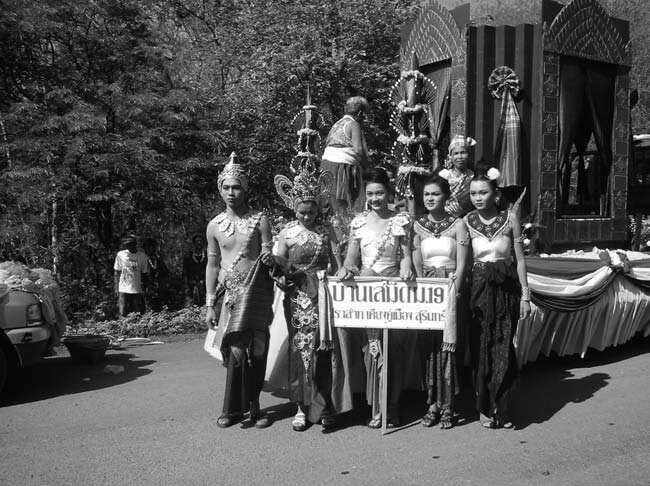
Figure 11.2 Ethnic Khmer posed in front of an ancient Khmer sanctuary float at Phnom Khaw Saway Festival, Surin Province (Photo A. Denes). [ADB: Phnom Khao Sway or Phanom Khaw Saway Forest Park วนอุทยานพนมสวาย is an important pilgrimage and excursion site near Na Bua in Mueang Surin District, Surin District].
Figure 11.2 Ethnic Khmer posed in front of an ancient Khmer sanctuary float at Phnom Khaw Saway Festival, Surin Province (Photo A. Denes). [ADB: Phnom Khao Sway or Phanom Khaw Saway Forest Park วนอุทยานพนมสวาย is an important pilgrimage and excursion site near Na Bua in Mueang Surin District, Surin District].
“Tracing the roots of Thailand’s contested claims to Khmer heritage” had some side effects, for instance :
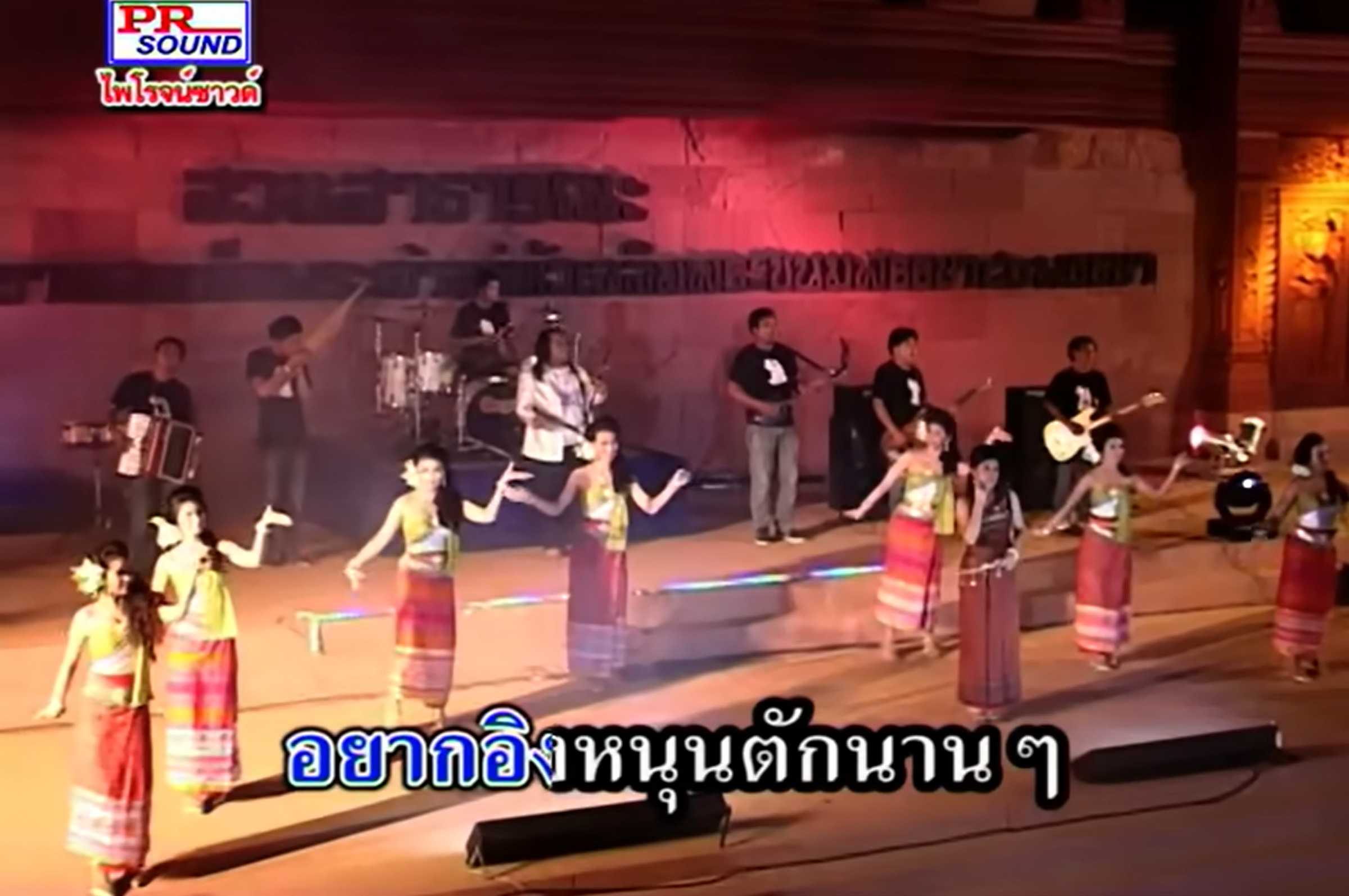
The image of the Northern Khmer as custodians of Khmer antiquity began to feature widely in popular media, such as in Khmer-language kantreum music videos. In one such video, the regionally popular ethnic Khmer folk singer named Nam Phueng Mueang Surin is posed in traditional attire in front of a Khmer sanctuary in Buriram Province called Prasaat Muang Tam. Surrounded by dancers wearing costumes derived from the basreliefs of celestial consorts, or apsara, Nam Pheung walks around the ruin, gesturing to the intricate carvings in stone, while her lyrics beckon her ethnically Khmer listeners to remember their birthright, passed down to them by their ancestors. Around the same time, the figure of the ancient Khmer also began to feature prominently in spirit mediumship rites invoking the spirits of place. [p. 174]
One illustration of this narrative of Khmer ethnic superiority came from a monk and former army colonel named Phra Phantri Amporn, who authored a short history of Surin entitled History of Isaanpura (Muang Surin) (2002). Phra Phantri explained that his primary motivation for writing this booklet was to challenge Surin’s official historiography. Briefly, according to the official provincial narrative, Surin was founded by an ethnic Kui elephant keeper named Chiang Pum, who is credited with recapturing an escaped white elephant belonging to last reigning monarch of Ayutthaya, King Ekathat, in 1757. In recognition of this loyal deed, Chiang Pum was bestowed a royal title and granted the authority to govern Surin as a tributary principality of the Siamese court. Phra Phantri insisted that the biggest error of this official history was the notion that Surin had been founded by an ethnic Kui. Disputing this narrative, Phra Phantri told me that the real founders of Surin were Khmer, not Kui. He argued that the ancient edifices and artefacts found throughout the region were unmistakable proof that Surin was originally settled and dominated by Khmer. [p. 177]
In closing, the author put forward several solutions which seem much harder to implement after the 2025 conflict yet essential to bring some harmony and stability in a region where economic growth has been put to a screeching halt by airborne bombs and nationalist rhetorics:
In light of these issues, what might a different kind of cultural revitalisation of Khmer heritage in Thailand look like? I propose that a revitalisation movement genuinely geared towards empowerment and mutual understanding would have to start by challenging the notions of ethnic and cultural purity, by focusing instead on the history of ethnic change and cultural hybridity. For instance, instead of reifying Kui and Khmer ethnic identity, priority should be placed on researching the dynamic and fluid historical relations between these groups. Second, the revitalisation would have to create a space for open dialogue about the mutual transmission and appropriation of tangible and intangible culture between the Cambodian and Thai empires and how nationalism led to the concealment of this cultural hybridity. Rather than focusing on the Khmer heritage within the borders of the nation, which reinforces competition and fuels tension between Thailand and Cambodia over entitlement to Khmer heritage, the revitalisation would have to do more to explore and affirm the regional, historical and cultural ties that transcend geographical and political boundaries.
Third, revitalisation should include the study of Khmer language, not only because language is a reservoir of cultural knowledge, but also because it would validate Northern Khmer identity as contemporaneous rather than trapped in an idealised past. Finally, to foster understanding, the revitalisation would have to endeavour to create a space to discuss the many silences and stigmas of Khmerness created during the Cold War and nation-building eras and which continue to shape both Khmer self-perceptions as well as views of the Khmer by the dominant Thai. Although by no means easy, such an approach might eventually open up possibilities for these neighbouring nations to recognise Khmer heritage as a shared past, which would go a long way towards improving the current relationship characterised by deep mutual distrust and suspicion. [p 179 – 80]
Jen Saijai ចេនសាយចៃ 2018 song. Distributed by PR Sound Khmer Music.
Kantrum [kh កន្រ្ទឹម th กันตรึม], a popular musical genre that originated within the Khmer community of Southern Isan, has lyrics in Khmer but the video clips, distributed by channels such as PR Sound Khmer Surin, usually come with Thai subtitltes. Some musicologists have claimed that the musical genre is the closest to what music in Ancient Angkor might have been. Listen to this song by Khmer female singer Jen Saijai [kh ចេនសាយចៃ th เจน สายใจ].[screenshot from YouTube clip, 2018.]
Alexandra Denes is a socio-cultural anthropologist specializing in heritage issues in Southeast Asia based in Thailand for over two decades, a Senior Research Associate and the Director of the Intangible Cultural Heritage and Museums Field School, the Culture and Rights Project, and the Visual Anthropology Program at Princess Maha Chakri Sirindhorn Anthropology Centre.
With her primary research centered on cultural heritage as a field of discourse and practice, particularly how ideas of heritage frame constructions of nationhood, regionalism, ethnicity and collective memory across South and Southeast Asia, she has been closely involved since 2008 in the UNESCO 2003 Convention for the Safeguarding of Intangible Cultural Heritage, collaborating with state heritage institutions, organizations and local communities to support the revitalization and safeguarding of living cultural practices through policy and community-based programs, with workshops held in Thailand, Bangladesh, Mongolia, Myanmar, Lao PDR, the Philippines, and Malaysia.
Her 2006 Ph.D. in Anthropology from Cornell University reflected her Fulbright scholarship field research on the revival of Khmer heritage and Khmer ethnic identity in Surin, Thailand, and was entitled “Recovering Khmer Ethnic Identity from the Thai National Past: An Ethnography of the Localism Movement in Thailand.”
Currently working with the Social Research Institute, Chiang Mai, Alexandra Denes is leading a research on cultural heritage rights at the Phnom Rung Historical Park in Buriram Province, focusing on themes such as ethnic identity, ritual, memory, and the politics of cultural heritage revitalization within the context of nationalism.
The Ayutthaya Kingdom or Empire was a Mon and later Siamese kingdom existed in Southeast Asia from 1351 to 1767, with its center Ayutthaya city, in Siam [nowadays Thailand]. Considered as the precursor of modern Thailand.
According to traditions, the kingdom was founded by King Uthong, but the latter's origin is unclear, as he is depicted as "a Northern Thai prince, a fugitive Chinese prince from the sea, a Khmer noble from Angkor, a ruler from one of the gulf cities, or a Chola dignitary."
Kuy, kh កួយ, th กูย, meaning "human being" in Kuy language; possible derivative of Thai/Lao suay, sui or suei, "those of pay tribute".
An indigenous ethnic group with native lands ranging from Khorat Plateau (Northeast Thailand) to the banks of the Mekong River in southern Laos and south to north central Cambodia. One of the "hill tribes", with more than 30,000 identified in modern Cambodia. Known as the "iron masters" of Ancient Cambodia, specializing in iron mining and processing, especially in the Kompong Thom/Preah Vihear area.
Kuy (often Kuay among contemporary linguists) is a Katuic language of the Mon-Khmer language family. Three major dialects of the Kuy language have been identified: ntra, ntua and mla.