The son of noted French sculptor and painter Jean-Baptiste Carpeaux (1827−1875), Charles Carpeaux (23 Apr. 1870, Paris — 28 June 1904, Saigon) went to Angkor for two exploratory missions in 1901 and 1904, before passing away from dysentry and exhaustion.
An artist himself, he entered the Musée du Trocadéro in Paris at a young age, pursuing comparative studies in sculpture and painting, and starting a vast study on his father’s body of work. He also assisted Louis Delaporte at the Musée in cataloguing Khmer sculptures and bas-relief mouldings.
His talented and irascible father, who had died five years after Charles’s birth, had cut his much younger wife and their three children off his will. However, Mme J.B. Carpeaux née Amélie Clothilde de Montfort (1847−1908) managed to have her two sons and daughter grow up in a large builiding on Bd Exelmans in Paris’ posh 16th district.
Sent to Indochina to take part to the preliminary inspections of Khmer temples by EFEO, he rapidly became Head of Technical Services of the Ecole Francaise d’Extreme-Orient (EFEO), while operating as a photographer on digging and restoration sites, in particular for monuments dating back from the Kingdom of Champa. While the “Dufour Missions” - for Henri Dufour — focused on the Bayon, Carpeaux also went to Cham archeological sites with EFEO archaeologist Henri Parmentier.
“Après tant de mois passés dans la brousse, il avait droit au repos: mais il né voulut pas manquer de parole à son ami M. Dufour qui venait d’etre chargé par l’Institut d’une nouvelle campagne au Bayon, ni se dérober à la tache de continuer à relever, pour le compte de l’Ecole, les estampages et les photographies des bas-reliefs. Au lieu de rentrer en France en Mars 1904, il remonta donc péniblement jusqu’a Angkor et, en dépit de la mauvaise saison et de ses forces fléchissantes, se remit courageusement à la besogne. Cependant sa sante s’altérait de plus en plus. et il le cachait à tout le monde. M. Finot, son devoué directeur, finit par avoir connaissance de son état, et, le 19 mai dernier, lui télégraphia de Hanoi de regagner d’urgence Saigon pour s’y embarquer. Il y revint en effet, mais pour y mourir.” [“After so many months spent in the jungle, he deserved rest; but he did not want to break his promise to his friend Mr. Dufour, who had just been entrusted by the Institute with a new campaign at Bayon, nor shirk the task of continuing to record, on behalf of the School, the rubbings and photographs of the bas-reliefs. Instead of returning to France in March 1904, he therefore made his way back, with great difficulty, to Angkor and, despite the bad weather and his failing strength, courageously resumed his work. However, his health was deteriorating even more, and he hid it from everyone. Mr. Finot, his devoted director, finally learned of his condition and, on May 19th, telegraphed him from Hanoi to return urgently to Saigon to embark. He did indeed return, but only to die.”]
Carpeaux had been plagued by bouts of dysentry and paludism since after its arrival in French Indochina. In addition to his archaelogical and artistic work, he left an instructive diary-travelogue, published posthumously in 1908 by his mother — who died of sorrow that same year: Les ruines d’Angkor, de Dong-Duong et de Myson.
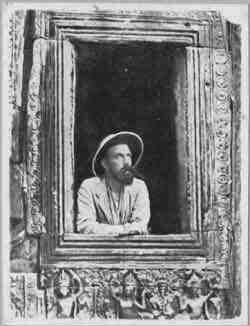
1) Charles Carpeaux “à la fenêtre de la tour de Brahma” [at the window of ‘the Brahma Tower’] in Angkor Thom [photo 3 in Les ruines d’Angkor, Paris, 1908]. 2) A major exhibition supported by Guimet Museum at Musée des Arts et de l’Archéologie de Valenciennes, France — “Charles Carpeaux. L’Indochine révélée”, 12 Oct. 2019 — 12 Jan. 2020. [photo MAAV].
1) Charles Carpeaux “à la fenêtre de la tour de Brahma” [at the window of ‘the Brahma Tower’] in Angkor Thom [photo 3 in Les ruines d’Angkor, Paris, 1908]. 2) A major exhibition supported by Guimet Museum at Musée des Arts et de l’Archéologie de Valenciennes, France — “Charles Carpeaux. L’Indochine révélée”, 12 Oct. 2019 — 12 Jan. 2020. [photo MAAV].
1) Charles Carpeaux “à la fenêtre de la tour de Brahma” [at the window of ‘the Brahma Tower’] in Angkor Thom [photo 3 in Les ruines d’Angkor, Paris, 1908]. 2) A major exhibition supported by Guimet Museum at Musée des Arts et de l’Archéologie de Valenciennes, France — “Charles Carpeaux. L’Indochine révélée”, 12 Oct. 2019 — 12 Jan. 2020. [photo MAAV].
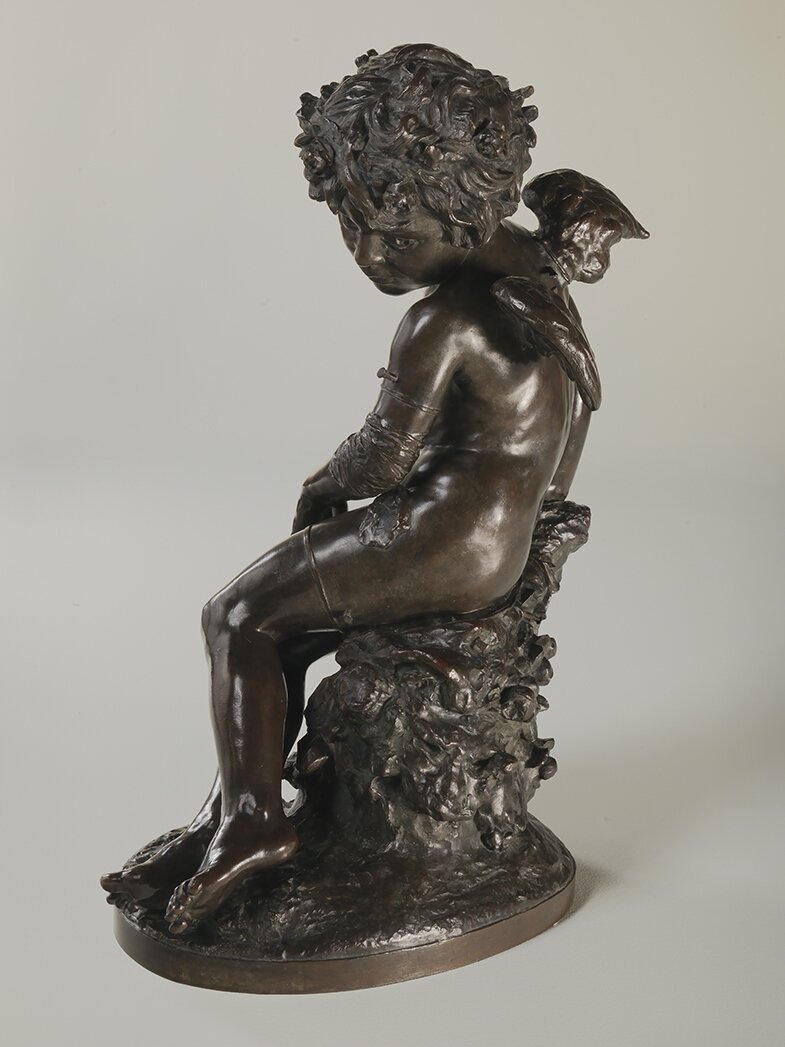
ADB Note: In his tender age, Charles often posed — with and without his mother, Amélie Victorine Marie Clotilde de Montfort (1847−1908) — for his father, the acclaimed sculptor and Prix de Rome (1854) Jean-Baptiste Carpeaux.
1) Charles Carpeaux as Wounded Cupid, by Jean-Baptise Carpeaux [Museu Calouste Gulbenkian, Lisbon]. 2) A bust of Amelie de Montfort by J.-B. Carpeaux [Musée d’Orsay, Paris].
1) Charles Carpeaux as Wounded Cupid, by Jean-Baptise Carpeaux [Museu Calouste Gulbenkian, Lisbon]. 2) A bust of Amelie de Montfort by J.-B. Carpeaux [Musée d’Orsay, Paris].
1) Charles Carpeaux as Wounded Cupid, by Jean-Baptise Carpeaux [Museu Calouste Gulbenkian, Lisbon]. 2) A bust of Amelie de Montfort by J.-B. Carpeaux [Musée d’Orsay, Paris].
Dong is an ancient Chinese term for a mountain valley community, especially in the southern and soutwestern regions abutting to 'historic' mainland China.
In Korea, dong동 has come to refer to a neighborhood or an administrative sub-district.