

Charles Meyer

Charles Meyer (12 March 1923 – 2004) was a French historian, Orientalist, teacher and unofficial diplomat who lived in Cambodia from 1957 to 1970 (out of “25 years in Indochina”, according to his laconic autobiography), was at the time the PR adviser and close counselor to King (then Prince) Norodom Sihanouk and became an outstanding portraitist of the country’s people, culture and traditions.
Charles Meyer started working in French Indochina in 1945 as a topographer with the Service géographique de l’Indochine (SGI), based in Dalat and later Saigon, traveling extensively in Vietnamese and Cambodian areas and developing an expertise on Jarai and Mnong minorities. An urbanist in Saigon from 1953 to 1955, he became a major publicist of the Sangkum Reastr Niyum era, contributing to several publications and directing the edition of the only major book published by the Sangkum, Cambodge (1962). He was the editor-in-chef of La Dépêche de Phnom Penh, a 4‑page biweekly he put together with Chau Seng, Prince Sihanouk’s principal private secretary. He was particularly interested in the history of the Cambodian nationalist movement, as well as the Royal Ballet and the art form of court dance.
Charles Meyer publicly took his distance from Prince Sihanouk in a column published in the New York Times in November 1970 [he was in New York when the coup happened in March 1970]. In it, he wrote:
On Aug. 13, 1969, on the occasion of the investiture of the Lon Nol Government, the Chamber of Deputies raised for the first time some tabooed questions: extortion, contraband, the Pnompenh gambling casino, the administration of nationalized businesses, and the unemployment of youth. This indictment of the errors and abuses of the régime contained the germ of the future coup.[…] The C.I.A. was widely accused of having fomented the coup d’état against Prince Sihanouk. In fact, if there was intervention, it was limited to assurances of American support and the pseudo‐rallying to Sihanouk by the “free Khmers” of Thailand some months earlier. It is necessary, never theless, to add that U.S. agents have become very active with the new authorities. [“One Inside Story,” The New York Times, 20 Nov. 1970, p. 41].
Appearing aside Meyer’s article was ‘Norodom Sihanouk”s [as he signed it] answers to the four questions the US newspaper had addressed to him separately, in which the Cambodian leader stated
All that means that your Government turns up their noses at the interests and the lives of the Khmer [Cambodian] people, decimated by your bombs and by a terrible war which will stop as soon as your Government stops aiding the illegal Government ot Lon Nol. […] After the liberation of our country, the present Government of FUNK will be installed in the capital, Pnompenh. In this Government, as in the United National Front, there will be Communist!, nationalist royalists, non-Communist progressives, etc. The policy of the Government is, and will be, one of independence. and non-alignment. As for me, I will tender my resignation of the function of Chief of State to the people who will choose a new Chief of State, and I will retire to France. [ibid. Read both contributions here.]
Meyer apparently never came back to Cambodia after General Lon Nol’s coup. Following the publication of his ambitious and controversial essay, Derrière le sourire khmer (Plon, Paris, 1971) — often referred to by historian David Chandler -, he refrained himself to comment on Cambodia, adding to the enigma of his long involvement in Cambodian affairs. His personal diplomatic archive — kept in the INLIBRIS collection, Vienna, Austria — holds many documents on Cambodia-China relations in the 1960s and 1970s.
Married to a Chinese citizen, Wang Hongshee 王鸿禧 (also known as Sika), Meyer published several guidebooks on China. He also authored La vie quotidienne des Français en Indochine, 1860 – 1960 and Histoire de la femme chinoise, 4000 ans de pouvoir, a work he dedicated to Wang Hongshee — Sika. In 1961 – 1962, Sika and Charles Meyer socialized with famed specialist of the Indochina Wars Bernard Fall and his wife Dorothy, who spent 10 months in Phnom Penh. Later on, when they moved to France, Sika published a book on her experience as a Chinese woman in France (Hong-shee Wang, Un petit coin de Chine en France: Cuisine, Shopping, Traditions, Julliard, 1973).
Reviewing Meyer’s book in 1973, historian Laura Summers (Cornell University) [“Behind Khmer Smiles : Prospero’s Adventures in Cambodia”, Journal of Siam Society 61, 1973: 310 – 325) remarked in closing
Although it is rich in anecdotal data, occasionally eloquent in description and touching in its romance, the author’s colonial bias is all-pervasive and, as I have attempted to demonstrate, this has a decisive and alarming effect on the analysis and conclusions of his book. Though I have suggested some alternative ways of interpreting the post-independence period in Cambodia, this discussion should be regarded as a preliminary, interim analysis. It is probably too early to comprehend fully the meaning and the significance of the Sihanouk era in modern Cambodian history. In the final analysis, it is necessary to await the assessments of Cambodian scholars; if they, too, sense the in adequacies and biases of Meyer’s study, I would hope this discussion might provoke a long and informative dialogue.
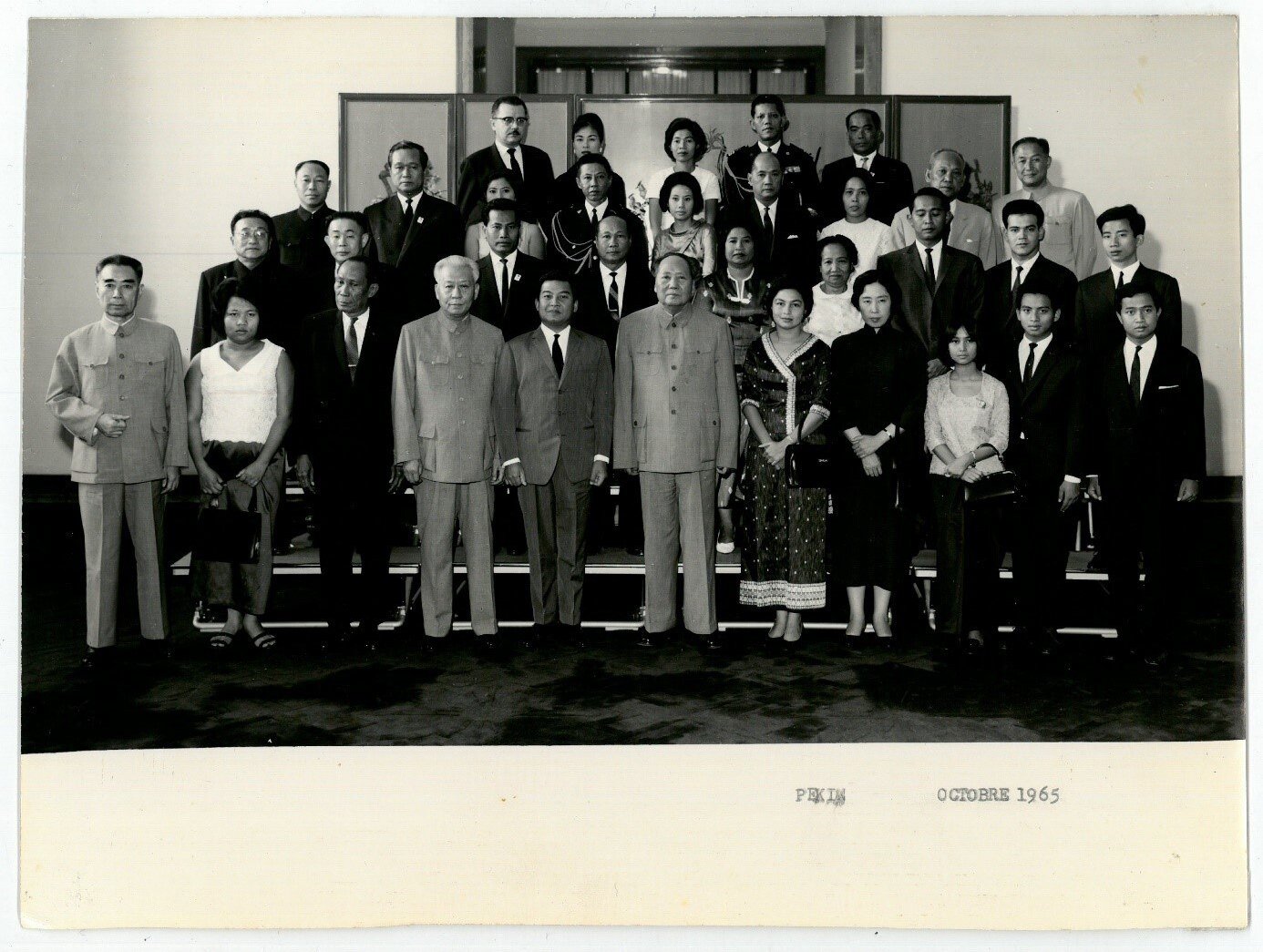
Prince Sihanouk and Princess Monique with Chairman Mao Zhedong in Beijing, 1965. Charles Meyer and wife Wang Hongxi standing on the left, last row. [Charles Meyer Archives]
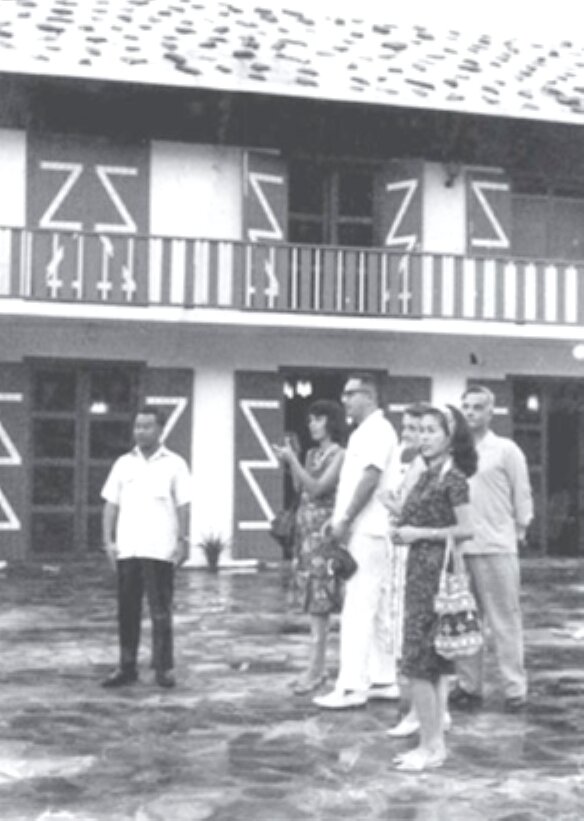
Prince Sihanouk, Bernard & Dorothy Fall, Sika Meyer, Donald Lancaster, at the Prince’s residence on Phnom Pech Nil, ភ្នំពេជនិល, Bokor, Cambodia. [from Dorothy Fall, Bernard Fall: Memories of a Soldier-Scholar, 2006, p. 166.
1) A 1965 photograph of Prince Norodom Sihanouk, Chinese leader Mao Zhedong, their spouses, with Chinese Foreign Minister Zhou Enlai at the far left. The author is standing on the top row, far left, the lady at his side being probably his wife, Wang Hongxi. To date this is the only photographic document where Charles Meyer appears [from Charles Meyer personal archive, thanks to HE Julio Jeldres for helping identifying him].
2) At Prince Sihanouk’s private residence on Bokor Mountain, 1962, from left to right: Prince Norodom Sihanouk, Dorothy Fall, Bernard Fall, an unidentified female visitor, Sika Meyer, American writer Donald Lancaster [from Dorothy Fall, Bernard Fall: Memories of a Soldier-Scholar, 2006, p. 166]
Publications
- [contributor to] Cambodge, Phnom Penh, Ministère de l’Information — Ministry of Information, 1962.
- “Iinsurrections nationales du siècle dernier”, Etudes cambodgiennes 9, 10, 11, 12, 1967.
- “L’insurrection nationale de 1885 – 1886”, Etudes cambodgiennes, 9, 10, 11, 12, 14 1967 – 1968.
- “Le corps de ballet royal”, in Philippe Beaussant ed., Musique et danse au Cambodge, Saint-Michel de Provence, Musique de tous les temps (Booklet with 1 vinyl LP), 1969: 2 – 17. [with photos by Raymond Cauchetier]
- “Cambodian Dances”, Nokor Khmer, Apr-June 1970, n 3, Eng. translation by April Yockney, p. 2 – 27. [with photos by Raymond Cauchetier, Hans Hinz [1] & Luc Ionesco].
- Derrière le sourire khmer [Behind the Khmer Smile], Paris, Plon, 1971.
- A Pékin et en Chine, Paris, Hachette Guides-Bleus-Visa, 1980, 206 p.; repr. 1988.
- Chine (Voir le monde), Paris, Hachette Réalités, 1981, 182 p. ISBN 9782010075872. | ENG ed. China Observed, Oxford University Press, 1981; repr. New York, Gallery, 1986; repr. Oxford University Press, 1987. ISBN 9780831712761.
- [with Marcel Jullian] Histoire de France des commerçants, Paris, Robert Laffont, 1983. ISBN 13: 9782221008652.
- La vie quotidienne des Français en Indochine 1860 – 1910, Paris, Hachette, 1985, 298 p. ISBN 9782010082238; repr. as Les Français en Indochine 1860 – 1914, Paris, Hachette, 1996. ISBN 9782012352506.
- Histoire de la femme chinoise: 4000 ans de pouvoir, Paris, J.C. Lattès, 1986, ISBN 978270960528. | JP ed. 中国女性の歴史, Tankobon, nd. ISBN 9784560028940.
- A history of Germans in Australia, 1839 – 1945, Melbourne, Monash University, 1990, 189 p. ISBN 9780947186999.
- En Chine, à Hong Kong et Macao, Paris, Hachette Guides-Visa, 1998. ISBN 9782010172861.
- Histoire des Français en Chine — 1698 – 1939, Paris, Editions You Feng, 2009. ISBN 9782842794354.
[1] Swiss photographer Hans Hinz was then in Cambodia to take photos for Madeleine Giteau’s Khmer: Kunst Und Kultur Von Angkor (1969).