

John White

John White (1782−1840) was an American shipmaster, a Sailing Master in the US Navy since 1813 (Lieutenant in 1816, Commander in 1937), a merchant mariner working with the East India Company from 1812, and the captain of the brig Franklin, first American vessel to reach Saigon in May 1819.
In Sept. 1806, John White joined the East India Marine Society of Salem, founded in Oct. 1799 by two dozen of the wealthiest mariners of the prosperous Atlantic port, and remained an active member of the EIMS until his death in 1840 [see Walter Muir Whitehill, The East India Marine Society and the Peabody Museum of Salem, A Sesquicentennial History, Salem, Peabody Museum, 1949.]
After serving during the War of 1812 between the USA and Great Britain, John White apparently took a lasting leave of absence from the Navy to pursue his commercial career with the East India Company. When he left Salem for Batavia and Cochinchina at the helm of the Franklin in December 1918, he was provided with a “blank journal” entrusted to him as well as any other captain by the Marine Society with “the mandate that “without any excuse whatsoever” it be completed, submitted, and made available to fellow members.” [John M. Lindgren, “That Every Mariner May Possess the History of the World”: A Cabinet for the East India Marine Society of Salem,” The New England Quarterly 68 – 2, June 1995, p. 182]. He did so at his return in 1820, and was granted permission to publish his account as a book “by subscription” — History of a Voyage to China Sea (1823).
John White donated several pieces brought back from the Far East to a museum which,“with its bizarre artifacts — including a dried Maori head hidden beneath a veil — and strange rituals, gave Salemites the opportunity to taste the wealth of faraway lands and vicariously experience the thrill of their conquest and the mystery of their aura. Thus, Salemites acknowledged the mastery of the city’s merchants and mariners, recognized their own imagined their future through their encounters, rituals, and adventures.” Famed novelist Nathaniel Hawthorne, a frequent visitor the museum, said he was influenced by its “whimsical nations and ludicrous analogies.” [John M. Lindgren, ibid.].
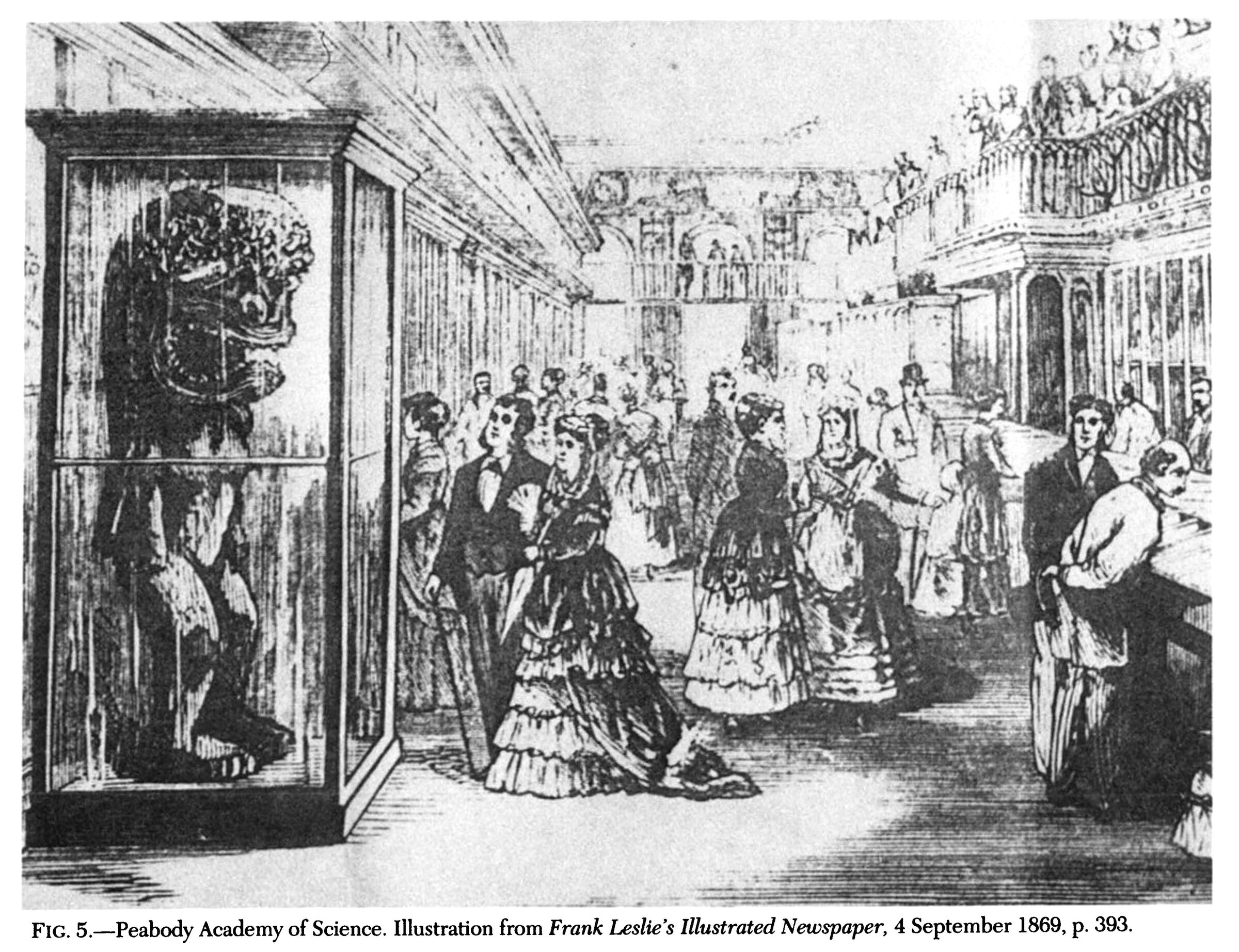
1) The ‘whimsical’ museum in 1869, at a time it was getting some 70,000 visitors per year [illustration reproduced in John M. Lindgren, op. cit.] 2) An exhibition at Peabody Essex Museum, 2023. [photo PEM].
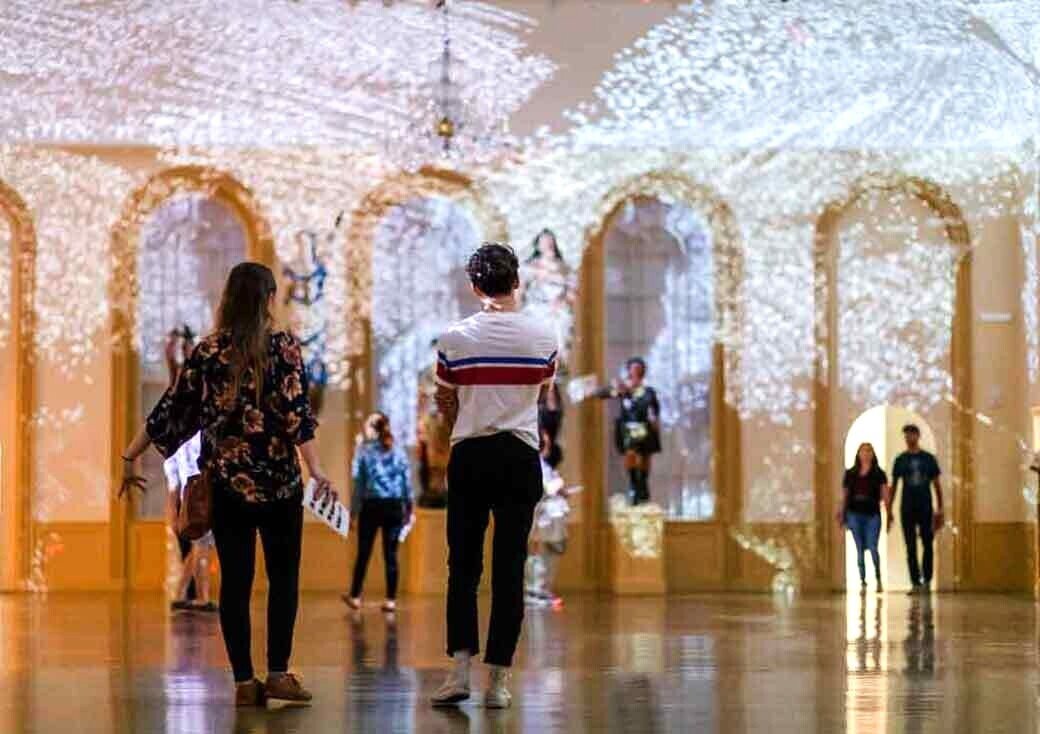
1) The ‘whimsical’ museum in 1869, at a time it was getting some 70,000 visitors per year [illustration reproduced in John M. Lindgren, op. cit.] 2) An exhibition at Peabody Essex Museum, 2023. [photo PEM].
1) The ‘whimsical’ museum in 1869, at a time it was getting some 70,000 visitors per year [illustration reproduced in John M. Lindgren, op. cit.] 2) An exhibition at Peabody Essex Museum, 2023. [photo PEM].
In 1867, the EIMS collection and the Essex Museum were purchased by George Peabody, a native of Massachusetts who had moved to London and established around that time museums of Natural History at Yale and Harvard universities. The institution took the name of Peabody Academy of Science or Peabody Essex Museum (PEM), still active to the day in the McIntire Historic District of Salem. In the collection of more than 850,000 works of art and culture — many of them the first of their kind to be collected in the US -, Chinese, Japanese and Korean artworks can be find along a section of ‘Asian Export Art’ — objects manufacturated in Asia for different markets -, and one of ‘South Asia Art’, with some 20th century artworks from India. The Phillips Library, one of the oldest libraries in the US, is part of PEM.
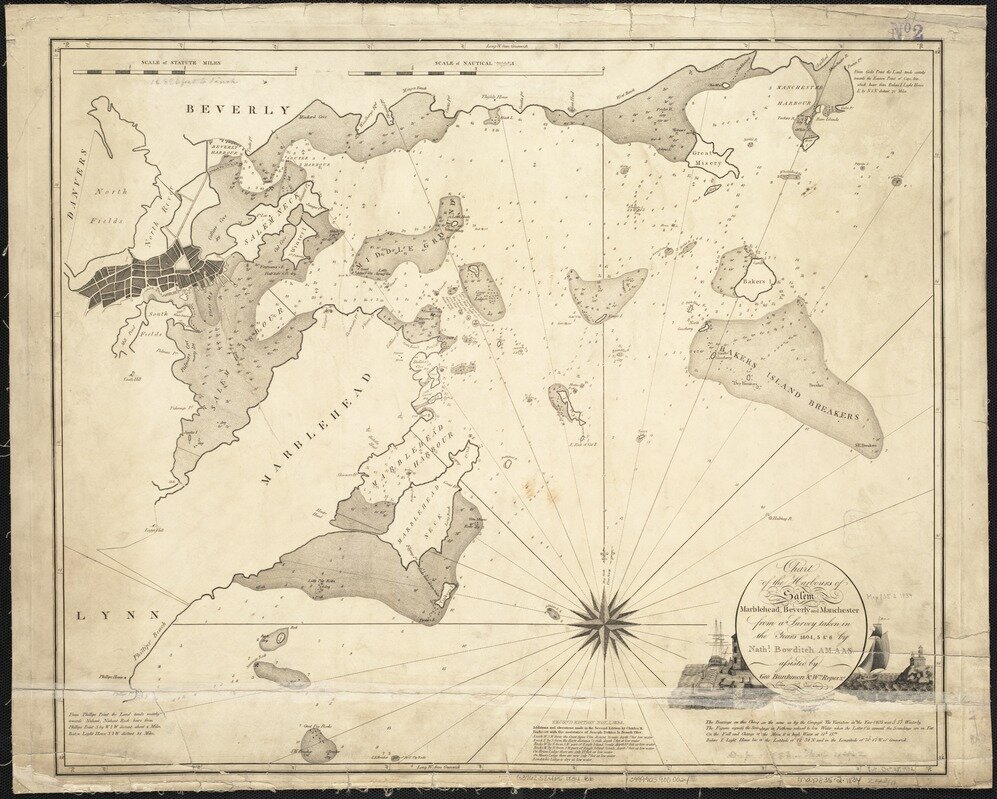
1) Chart of the harbours of Salem, Marblehead, Beverly and Manchester : from a survey taken in the years 1804, 5 & 6, by Nathaniel Bowditch (1773−1838), co-founder of the EIMS. Published in 1834. [source: Boston Public Library, Norman B. Leventhal Map & Education Center]. 2) “Girl Eating Rasagolla”, by K.G. Subramanyan (1924 – 2016, India), 1980 [PEM South Asia Art Collection].
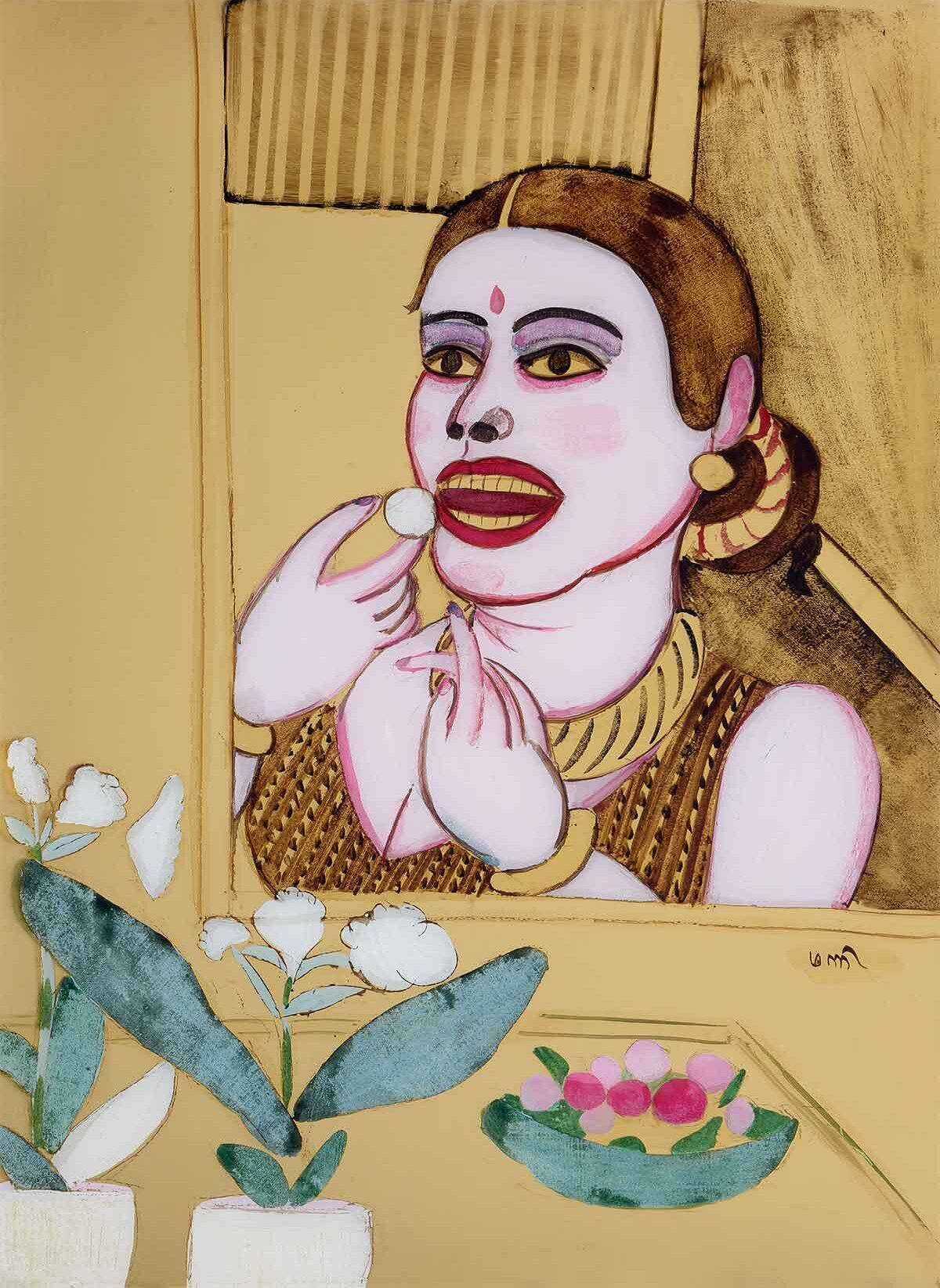
1) Chart of the harbours of Salem, Marblehead, Beverly and Manchester : from a survey taken in the years 1804, 5 & 6, by Nathaniel Bowditch (1773−1838), co-founder of the EIMS. Published in 1834. [source: Boston Public Library, Norman B. Leventhal Map & Education Center]. 2) “Girl Eating Rasagolla”, by K.G. Subramanyan (1924 – 2016, India), 1980 [PEM South Asia Art Collection].
1) Chart of the harbours of Salem, Marblehead, Beverly and Manchester : from a survey taken in the years 1804, 5 & 6, by Nathaniel Bowditch (1773−1838), co-founder of the EIMS. Published in 1834. [source: Boston Public Library, Norman B. Leventhal Map & Education Center]. 2) “Girl Eating Rasagolla”, by K.G. Subramanyan (1924 – 2016, India), 1980 [PEM South Asia Art Collection].