

Publications
ОБ ИЗУЧЕНИИ КАМБОДЖИ В РОССИИ (Cambodian Studies in Russia)
by Elena A. Zapadova
by John White
An early account of Saigon, the Mekong Delta, Cambodia, Malaysia and the Philippines by the first US Navy officer who reached Cochinchina in 1819.

We publish here the important account on insular and continental Southeast Asia at the turn of the 19th century by American Navy officer Lt. John White (1782−1840), onboard the brig Franklin and ship Marmion that had weighed anchor at Salem (USA) on 2 Jan. 1819, sailing southwards, passed the Cape of Good Hope on 14 April, and reached Batavia on 9 May before exploring the China Sea and landing near Saigon on 7 Oct. 1819.
In the introduction, we read that “his volume was not originally intended for publication, but written as a Memoir to be deposited in the archives of the East India Marine Society of Salem.” It aroused interest since they were “the first American ships that ever ascended the Don-nai river [1], and displayed the stars and stripes before the city of Saigon.” While Robert Hopkins Miller [in The United States and Vietnam, 1787 – 1941, National Defense University Press, 1990] wrote this was “a vivid example of an early American reaction to the Vietnamese and their ways,” [as quoted by Tim Doling’s on Historic Vietnam], historian Marguerite Nguyen remarked that the account, suffused with cultural prejudices, was essentially pessimistic:
The Franklin’s interruptions and ultimate commercial failure not only put White behind schedule and trouble hopes for literal “smooth sailing”; they also thwart desires for diplomatic and economic alliance and divert the flow of American capital. “In the present state of the kingdom,” White concludes, “no commercial operations can be expected to result in a manner to warrant further trials” (31). He blames “the tyrannical nature of the government” for having “interdicted all direct commerce between foreigners and that country” (261). Vietnam is a “court of Pandemonium,” an impediment to America’s vision of free and open trade in Southeast Asia. [Marguerite Nguyen, America’s Vietnam: The Longue Durée of U.S. Literature and Empire, Philadelphia/Rome/Tokyo, Temple University Press, 2018. Kindle Edition, p. 12.]
While John White’s account remained unnoticed by French publicists at the time — P. Midan’s study “Les Europeens Qui Ont Vu Le Vieux Hue: John White,” Bulletin des Amis du Vieux Hue 23, April-September 1937, came out more than a century later — its Russian translation in Saint-Petersburg in 1825 is considered to be the first substantial contribution to Cambodian studies in Russia. The Franklin didn’t succeed in returning to the US with any significant commercial load from Cochinchina, loading goods later in Manila and Java, but it paved the way to some American presence in Saigon — under the wary eyes of the French authorities -, a long process culminating with the opening of the first US Consulate in Saigon in 1907.
[While Lt. White was prone to praise the prowess of the men manning the Franklin on the Cochinchinese coast, — noting in his introduction that “several adventurers have been induced to risk voyages there; one of which was from Salem, as early as the year 1803 (“The ship Fame under Captain Jeremiah Briggs’ command”), but they were all totally unsuccessful” -, he didn’t mention that the same ship, 200-ton burden, owned by James Perkins, Thomas H. Perkins and James Dunlap of Boston, had sailed to Java in December 1798, been chartered there by the Dutch East India Company for 30,000 piastres for a voyage to and from Japan, thus becoming the first American vessel to reach the Japanese archipelago. [see Old-Time Ships of Salem, Salem, Essex Institute, 1917, repr. 1922, 94 p.]]
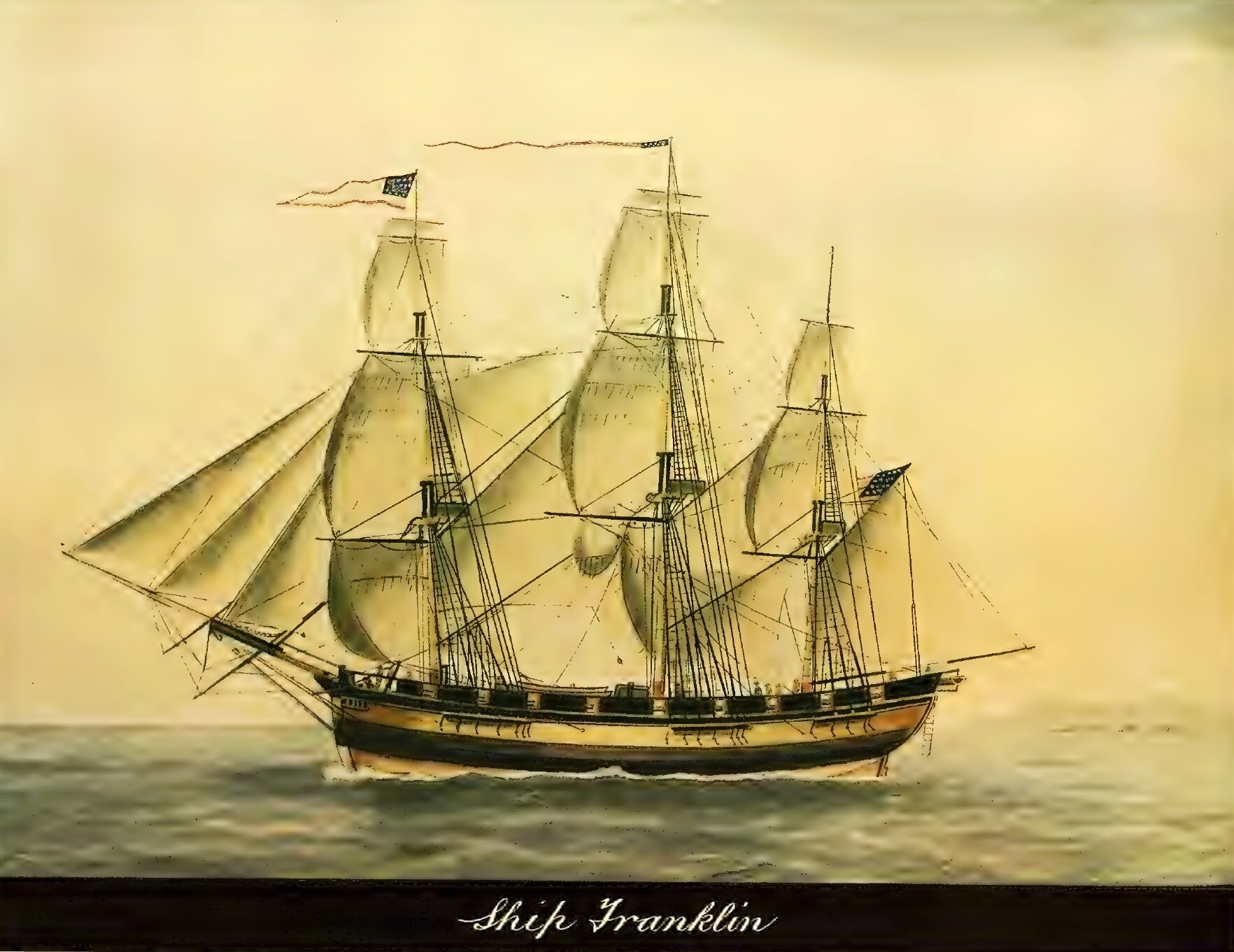
The Franklin, the three-mast US Navy brig which moored near Saigon in 1819. Painting in the possession of Mr. William C. Waters of Salem, made in Japan by a Dutch artist during her mission to Japan in 1799, the first time an American vessel entered the Japanese waters. [from Old-Time Ships of Salem, Salem, Essex, 1917, rep. 1922, 94 p.]
The Franklin, the three-mast US Navy brig which moored near Saigon in 1819. Painting in the possession of Mr. William C. Waters of Salem, made in Japan by a Dutch artist during her mission to Japan in 1799, the first time an American vessel entered the Japanese waters. [from Old-Time Ships of Salem, Salem, Essex Institute, 1917, rep. 1922, 94 p.]
Embarked in a purely commercial mission to Maritime Southeast Asia and the tip of the mainland, the American officer came to assume what his Cochinchinese hosts told him — Cambodia, a vast expanse of forests known for the skins of wild animals, its cinnamon and its gambooge [2], had been entirely submitted by the ‘Onam’ Kindgom, as he called the Annamite principalties on the Vietnamese coast and inland and using either this name or Cochinchina. Hence the brief references to the country which nevertheless lent its name to the largest river in the whole region — the Mekong, then called Cambodia River by European traders -, a land he first saw from the Pulo Condore Island [Côn Sơn in modern Vietnam]:
On the 5th, the breeze had increased to a pleasant gale from south-south-east, and on the same day we made the island of Pulo Oby, which lies a few leagues from the south-east point of Cambodia : on the Oth the island of Pulo Condore was descried, with its lofty summits towering to the clouds. The English had formerly a fort and factory on this island, to facilitate their intercourse with China and the neighbouring coast of Cambodia, which in the year 1705 were destroyed, and all the English massacred by the Macassar soldiers in their employ, who composed a chief part of the garrison; since which time no attempt has been made by any European power to establish a colony there, nor indeed would any advantage arise from such an establishment, as the island is very unhealthy and unproductive, abounding in noxious reptiles, and affording no good fresh water, although it possesses an excellent harbour, and a fine landlocked basin, fit for careening. There are a few miserable inhabitants on the island, governed by a mandarin, tributary to the king of Cochin-China.
But should all these inconveniences be waived, in favour of the commercial advantages which invited the English to settle there in consequence of the vicinity of Cambodia river, the adventurer would be disappointed, as the king of Cochin-China, since the conquest of Cambodia, has interdicted all direct commerce between foreigners and that country, and the city of Saigon on the Don-nai river has been made the emporium of Cambodia and all the southern provinces of Cochin-China ; and, (as will be shown hereafter,) in the present state of the kingdom, no commercial operations can be expected to result in a manner to warrant further trials; consequently, the neighbourhood of Pulo Condore to this latter river is of no advantage to it in a commercial point of view, and the occupation by the English of Pulo Penang and Sincapour renders the island of little value, as a station for the China trade.
We had fine pleasant weather, with a good breeze from the south, and kept along the coast of Cambodia in about ten fathoms water ; and at day-light saw the land bearing from north-north-west to north, at about three leagues distance ; this coast is very low, and in many places cannot be seen more than two leagues from the deck of a merchant vessel. A mud flat commences at Cambodia point, and gradually increases in breadth from the land, till it terminates at the mouth of the Don-nai river, where it extends into the sea about four leagues ; it is not safe to come under five fathoms in sailing along this coast, or in rounding the elbow of the bank, in proceeding to the river.
At 11 A. M. on the 7th we descried Cape St. James, bearing north-north-east. This promontory is the commencement of a chain of mountains which extend along the coast to the north as far as the gulf of Tonquin, and, being the first high land seen in coming from the south, is an excellent mark for the entrance of Donnai river, on the north side of which it is situated. We steered directly for the cape, keeping in from nine to twelve fathoms of water, till within one mile of it, we then hauled to the westward, steering in a parallel direction with the land till we opened a small picturesque semilunar bay, situated at the foot of the mountain, at the bottom of which was a grove of cocoa-nut trees, where was situated the village of Vung-tau, from which the bay takes its name. We here anchored in five fathoms of water, one mile from the village, at 6 o’clock in the evening. This bay is about two and a half miles from the extreme point of the cape, and here, the channel somewhat less than two miles wide, is bounded on the south side by the flat before mentioned, consisting of a mixture of mud and sand, the joint alluvial deposits of the several branches of the Cambodia and Donnai rivers. It is not considered very safe in the south-west monsoon, though the ground is good, but in the opposite season it is an excellent harbour. [p 30 – 2]
Follows a description of Cochinchina at the time that brings some useful information to us, however shaky the historic background patched up by the Navy officer comes across:
The country of Onam [3], or Cochin China, is indebted for its present population to an unsuccessful rebellion — See Dr. Morrison’s “View of China,” p. 80 — of a Tonquinese prince against his sovereign, somewhat less than two centuries ago ; the prince being totally routed, and pursued by the victorious troops of the king of Tonquin, made his escape with his adherents into Cochin China, which was then inhabited by the Lois, or Laos, an ignorant and timid people, who, totally unacquainted with the art of war, fled with precipitation on the approach of these intruders to the mountains of Tsiompa, and left the Tonquinese fugitives in quiet possession of their country. The fertility of the soil, the great number of animals, fowls, and fish, with which the woods, marshes, rivers, lakes, and the neighbouring sea abounded, furnished them most bounteously with the necessaries and comforts of life ; and their population increased in a ratio proportionate to these means, and in a short time they had spread themselves over all the northern section of the country ; nor in fact was it many years before they had penetrated south as far as the borders of Cambodia, where they built the city of Saigon, and subsequently that of Don-nai, about thirty miles to the northward of the former ; and in somewhat less than forty years from the ingress of the invaders, we find them in quiet possession of the whole Onam country, or Cochin China Proper; and many successful inroads had been made by them into Cambodia.
This latter country, however, was inhabited by a more courageous and warlike people than the Lois, or aboriginal occupants of Onam, and they for a long time successfully resisted the yoke of their new and troublesome neighbours; and in their opposition they were greatly facilitated by the nature of their country, which being very low, covered with almost impenetrable forests, and abounding with thick underwood, or jungle, and intersected with innumerable rivers and creeks, afforded them sufficient opportunities for displaying their skill in the art of laying ambuscades, and in various other desultory modes of warfare in use among barbarous nations, and by which their invaders were greatly annoyed; nor were the Cambodians finally subdued by the hostile arms of the Onamese until the reign of the present sovereign, by which conquest Cambodia has become an integral part of Cochin China, and, like that country, it is now divided into provinces.
The whole country, in its present limits, extends from the latitude of 8° 40′ to 17° 0′ north, and from Cape Avarella, in longitude 109° 24′ east, it extends from the coast about one hundred and fifty miles westward. Its average breadth is, however, about one hundred miles from east to west. The kingdom is comprised in three divisions; viz. Don-nai, which is the southernmost, comprehends all Cambodia, and extends northward to about 12° of north latitude ; in this section are situated the cities of Saigon and Don-nai. The centre division lies between the latitudes of 12° and 15° north ; it is called Chang, and contains the cities of Nhiatrang and Quin-hone. The division of Hue, which contains the royal city, or residence of the monarch, called also Hue, or Huefoo, is the most northern, and is bounded to the south by Chang, and to the north by the gulf of Tonquin. These three sections, or divisions, are subdivided into provinces, of whose names, relative situations, and boundaries, we are not sufficiently informed to describe. [p 81 – 83]
Far into the book pops up the description of an unnamed “Cambodian ambassador” that necessarily catches our attention as he so obviously favorably impressed the American observer. It is hard to reconcile the notion of an obscure, vassal nation earlier put forward with the crisp image of a poised, dignified emissary ‘coming from nowhere’, since his position within the court of the King of Cambodia, and his usual place of dwelling, aren’t stated — details cruelly missing as they could have given us an insight on the actual status of Cambodian elites then:
A Cambodian mandarin of high rank, while on a visit to the viceroy’s court, on some diplomatic business, came on board the ships to gratify his curiosity, in regard to our vessels, customs, mode of living, &c., and was highly pleased. He behaved with great decorum, and did not beg any thing of us, but bought a handsome sabre, for which he paid us one hundred quans in silver ingots, and invited us on board his galley to return his visit, where we went on the following day. The internal economy and domestic arrangements of this vessel were admirable ; and a much greater air of convenience and comfort was visible in them, than in any of the houses we had visited in Cochin China. The mandarin had a large household of retainers and domestics, who conducted themselves with the utmost propriety. We were treated with tea, areka, betel, and confectionary ; and the greatest hospitality and attention, to make our visit pleasant to us, were put in practice. He spoke a dialect of the Onamese language, which was imperfectly understood and spoken by Joachim, who attended us. Neither his dress, nor that of his followers,
differed essentially from that worn by people of corresponding rank in Onam ; but they were more cleanly in their persons, and polished in their manners. Our visit was necessarily short, in consequence of the difficulty we experienced from the imperfection of our interlocutory medium, and in about an hour we returned on board. [p. 325 – 6]
The pain Capt. White took to piece together the events leading to Nguyen Anh’s ascendency to the throne in 1802 was really commendable. He surmised the crucial (no pun intended) role played by the Catholic dignitary he called ‘Adran’ — Pierre Pigneau de Behaine, Bá Đa Lộc in Vietnamese (2 Nov. 1741, Origny-en-Thiérache, France — 9 Oct. 1799, of dysentry during the siege of Qui Nhơn, last stronghold ot the Tây Sơn brothers), a French missionary, de facto diplomat and colonizer appointed Bishop of Adran [4] in 1771 by Pope Clement XIV. After teaching in Pondicherry, he was sent as apostolic vicar to Ha Tien (Cochinchina) in 1775, at a time the region was torn by dynastic rivalries. Forced to exile in Cambodia and Poulo Way (Phú Quốc) in 1782, he came back with a new mission — restoring the authority of Nguyễn Phúc Ánh (Cảnh Hưng 景興), the future Emperor Gia Long (1762, Hue — 3 Feb. 1820, Hue) and founder of the last Vietnamese dynasty, the Nguyen, which ended in 1945.
At the period of the rebellion, there resided at Hue a French missionary, of the name of Adran, who called himself the “ Apostolic Vicar of Cochin China.” Caung-shung held him in such great consideration, as to place under his tuition his only son, and heir to the throne. Adran, the prince, his wife, and infant son, on the first burst of the revolt, saw their only hope of safety was in flight ; and by the assistance of Adran, they effected their escape, and took refuge in a forest. As soon as the enemy retired, the unfortunate fugitives made the best of their way to Saigon, where the people flocked to the standard of their legitimate sovereign, whom they crowned under the name of Caung-shung [Canh Hung]. At this time, there was in the port of Saigon, an armed vessel, commanded by a Frenchman, seven Portuguese merchantmen from Macao, and a number of Cochin Chinese junks and row-boats. These the king purchased for the purpose of making an attack on the usurper’s fleet, in the harbour of Quin-hone : this expedition failed ; the king returned to Don-nai ; resistance was vain ; he collected the remains of his family, and a few faithful followers, embarked at Saigon, and proceeded to Pulo Way [Phu Quoc], a small uninhabited island on the north side of the Gulf of Siam, and contiguous to the coast of Cambodia.
Here, in a short time, he was joined by about twelve hundred of his own subjects capable of bearing arms. Caung-shung, fearing an attack from the usurpers, embarked for Siam, by the king of which country he was well received, and while there he received from his friend Adran intelligence that the southern section of the country was favourable to his cause, and at the solicitations of the missionary, he entrusted his son [ADB: Nguyễn Phúc Cảnh] with him, who immediately embarked with his charge for Pondicherry, and from thence sailed for Paris, where they arrived in the year 1787. The young prince was presented at court, and treated with every mark of respect. In the course of a few months, Adran concluded a treaty between Louis XVI and the king of Cochin China, in which the former engaged to lend Caung-shung effectual assistance to restore him to the throne of his ancestors. Adran was promoted to an epispopal see, under the title of “Bishop of Cochin China” and honoured with the appointment of “Ambassador extraordinary and Plenipotentiary” to that court. Matters being thus far concluded in Paris, Adran, and his young charge set sail for Pondicherry in the Medusa frigate. He touched on his passage at Mauritius, where he found lying a ship of fifty guns, seven frigates, and some transports, and that the number of disposable troops was between four and five thousand.
The ships were ordered to be equipped, and the troops to hold themselves in readiness for embarkation, the moment that an advice-boat should arrive from Pondicherry, which he meant to dispatch on his arrival there, with orders to that effect. Some untoward circumstances occurred, which induced the governor-general to send a fast sailing vessel from Pondicherry to the Mauritius, with directions to suspend the armament until further orders should be received from the court of Versailles; and the Revolution, in the mean time, breaking out in France, put a final stop to all their proceedings.
The unforeseen events which had put an end to the expedition, did not, however, deter the bishop from his original design of re-establishing the lawful sovereign of Cochin China, if still living, or the young prince, if his father should be dead, on the throne of his ancestors. He had carried with him from France several officers, who were to have held appointments under the government. With some of these as volunteers, the bishop and prince embarked in a merchant ship, for Cape St. James, where they hoped to receive intelligence of the king. Here they learned that the monarch had been induced to venture a landing in his dominions: that all ranks, forgetting the errors of the father, in their sympathy for the sufferings of his son, had flocked with ardour to his standard, and that he had marched without interruption to Saigon, whose works of defence had been immediately strengthened, and put in good order. This favourable intelligence gave a spur to the exertions of the bishop and the young prince, who joined the king at Saigon, in 1790, and they were followed by a vessel which had been taken up to convey arms and ammunition.
The greater part of the first year was occupied in fortifying Saigon, in recruiting and disciplining the army, and in collecting and equipping a fleet. In 1791, the usurper, Long-niang, died at Hue, leaving behind him a son, about twelve years of age, to succeed him in the government of Tonquin, and the northern parts of Cochin China. The ratification of his title to the kingdom of Tonquin, by the emperor of China, had been the cause of hostilities between the two brothers. In all their skirmishes Yinyac had been worsted, and the limits of his country reduced. In 1792, the king embarked with his fleet, which he had put under the direction of two French officers, and attacked that of Yinyac in the harbour of Quinhone, the greater part of which they captured or destroyed. Yinyac did not long survive the destruction of his fleet, and his son Tai-saun (or Ti-saun) succeeded to the government. Caung-shung, in 1796, resolved to attack the capital by land : the young usurper was enabled to bring against him an army of one hundred thousand men, but the king completely routed it, with a very inferior force, and took possession of Quinhone, and the whole country as far as Turon [ADB: ‘Tourane’, mod. Da Nang] bay.
The other young usurper at Hue still kept possession of that city, and part of Tonquin ; till in 1802, Caung-shung, with a formidable armament, dislodged him, and compelled him to retire into Tonquin; since which time the kingdom of Cochin China has remained in quiet possession of the legitimate sovereign, with a large extension of territory in the southern part of Tonquin, by which his frontier on that side has been greatly extended, and a large portion of the adjacent country rendered tributary to that monarch.The bishop Adran now became the oracle and guide of the king. Under his auspices the country was greatly improved ; and during a short peace, previous to the final termination of the war, he established a manufactory of saltpetre, opened roads, cut canals, held out rewards for the propagation of the silk worm, caused large tracts of land to be cleared for the cultivation of the sugar-cane, established manufactories for the preparation of pitch, tar, rosin, &c. ; opened mines of iron, constructed smelting furnaces, and founderies for cannon. Adran translated into the Onam language a system of European military tactics, for the use of the army. Naval arsenals were established, and a large navy, principally consisting of gun-boats, galleys, &c. was built and equipped. Under his direction a reformation was effected in the system of jurisprudence. He abolished several species of punishments that were disproportionate to the crimes to which they were annexed; he established public schools, and compelled parents to send their children to them at the age of four years ; he drew up commercial regulations, built bridges, caused buoys and sea marks to be laid down in all the dangerous parts of the coast, and surveys to be made of the principal bays and harbours. The officers of the navy were instructed in naval tactics by Frenchmen ; his army was divided into regular regiments ; military schools were established, and the officers taught the science of gunnery. Unfortunately for the country, the death of Adran occurred shortly after this ; and with him expired many of the wholesome laws, institutions, and regulations established by him. [p. 89 – 94]
Later on, the American officer was introduced in Saigon to “an old Christian native, named Polonio, who had been for several years a servant of Bishop Adran, and was with him at the time of his death”, a precious source of information who led our sailor-explorer to an ‘antique temple’ in the outskirts of Saigon which might have very well been an ancient Khmer temple, from the time Saigon was Prey Nokor ព្រៃនគរ, the ‘forest city’, an important port for the Khmer kingdoms:
“Polonio could talk a little Portuguese, write some Latin, and knew a few words of French, and appeared to be a mild tempered old man. I esteemed this acquaintance as valuable, as from him I expected to derive much information concerning Adran. Nor was I disappointed ; for during our stay in the country he related several anecdotes of that great man, described his mode of life, and his handsome residence at Don-nai, which is now converted into a magazine of saltpetre and military stores : from whence it appeared that its general style was similar to those of the mandarins at Saigon, with a mixture of European architecture, and that his demesnes were laid out in the European style, with beautiful gardens, parks, and pleasure-grounds. He further told us that the bishop was a great sportsman, in which pursuit old Polonio had been his constant attendant and pupil ; and as a proof that he had not been a truant, he was still a most excellent shot, and showed great ardour, tempered with sound judgment, in field-sports ; and he frequently accompanied us in our shooting excursions. The old man would frequently point out places in passing, remarkable for some incident connected with his great patron, whose memory he venerated and cherished with the fondness of an affectionate son. Here were the remains of a cannon founder instituted by the bishop. There were the ruins of a school endowed by him. On this spot were formerly saltpetre works, erected by his orders and under his superintendence , and that Christian temple arose and flourished under his auspices.
Polonio never spoke of his old master without tears, and always with the greatest enthusiasm. He described him as a man of a most capacious mind, of mild temper, though firm in his purposes; possessing a form and manner commanding the most profound respect and admiration, and a heart that irresistibly won the love and affection of all. His loss was deeply deplored by all classes in Onam. Indeed it yet remains for time to disclose the full extent of it, and the calamities arising from it. His remains are deposited in the garden fronting his late mansion, and over them is erected a tomb of masonry in the best style of Onamese architecture.
In one of our walks in the environs of the city, in a sequestered spot, at the further end of a romantic pathway, amid the foliage of various kinds of beautiful trees, and situated on a small mound, apparently artificial, we arrived at the largest pagoda we had yet seen in the country. It was of brick, covered with tile, and in a totally different style from others in the city. It bore traces of great antiquity, which with its immense proportions, and a certain air of gothic grandeur and druidical seclusion, were admirably calculated to inspire involuntary awe, and to render it a proper retreat for the most rigid ascetic. An old priest with a grey beard, but no otherwise distinguishable from the laity, accompanied by a young aspirant, advanced a few steps to meet us, and received us with great appearance of cordiality ; and when informed by the linguist [ADB: interpreter-translator, a profession that ethnocentric White came to openly despise, blaming them for distorting what was exchanged for their own interest] that our object was curiosity to see the temple, he readily proceeded to gratify us. In front of the pile were suspended four bells of different sizes and tones, and of the form, and arranged in the manner heretofore mentioned. We entered by a door near the eastern angle, and were ushered into a small apartment, where were suspended from the walls several articles of clothing, which appeared to be the vestments of the priests. From this, by a side door, we entered a spacious vestibule, separated from the nave of the church by a massy partition of polished wood in panel work.
In this place were three immense drums, mounted on frames, and on a table a small brass idol, with an elephant’s proboscis, before which was a brazen censor filled with matches, one end of each of which had been burned. The priest then threw open a large door in the partition, and led the way into the body of the temple. There was no light besides what was admitted through the door by which we had entered, and that was barely sufficient to render “darkness visible:” our eyes were, however, enabled to penetrate the gloom sufficiently to ascertain that its interior proportions were commensurate with the idea that we had formed from its exterior. Several groups of idols, of hideous, and some of colossal proportions, vere visible through the dim twilight that pervaded the temple, and seemed to render them still more hideous and unearthly. In fact, the recollections of this exhibition are more like the traces of an indistinct and feverish dream than reality. It would be as futile to attempt any description of the various monstrosities in this pantheon of pagan divinities, as it would be to repeat their several genealogies, histories, exploits, &c., as delivered to us by the priest through the medium of Polonio. Their divinities, however, were not treated with any great veneration by these guardians of the temple. “This fellow,” the old priest would say, taking hold of the hoof of an ox on the bust of a man with an elephant’s head, “ was famous for his gallantries, and this one,” tweaking a tremendous nose on a human head, stuck upon the body of what appeared to be intended for a tiger, “was celebrated for destroying wild beasts ;” and his history of the capricious amours of some of their deities no longer excited any wonder at the production of these anomalies. [p. 274 – 8]
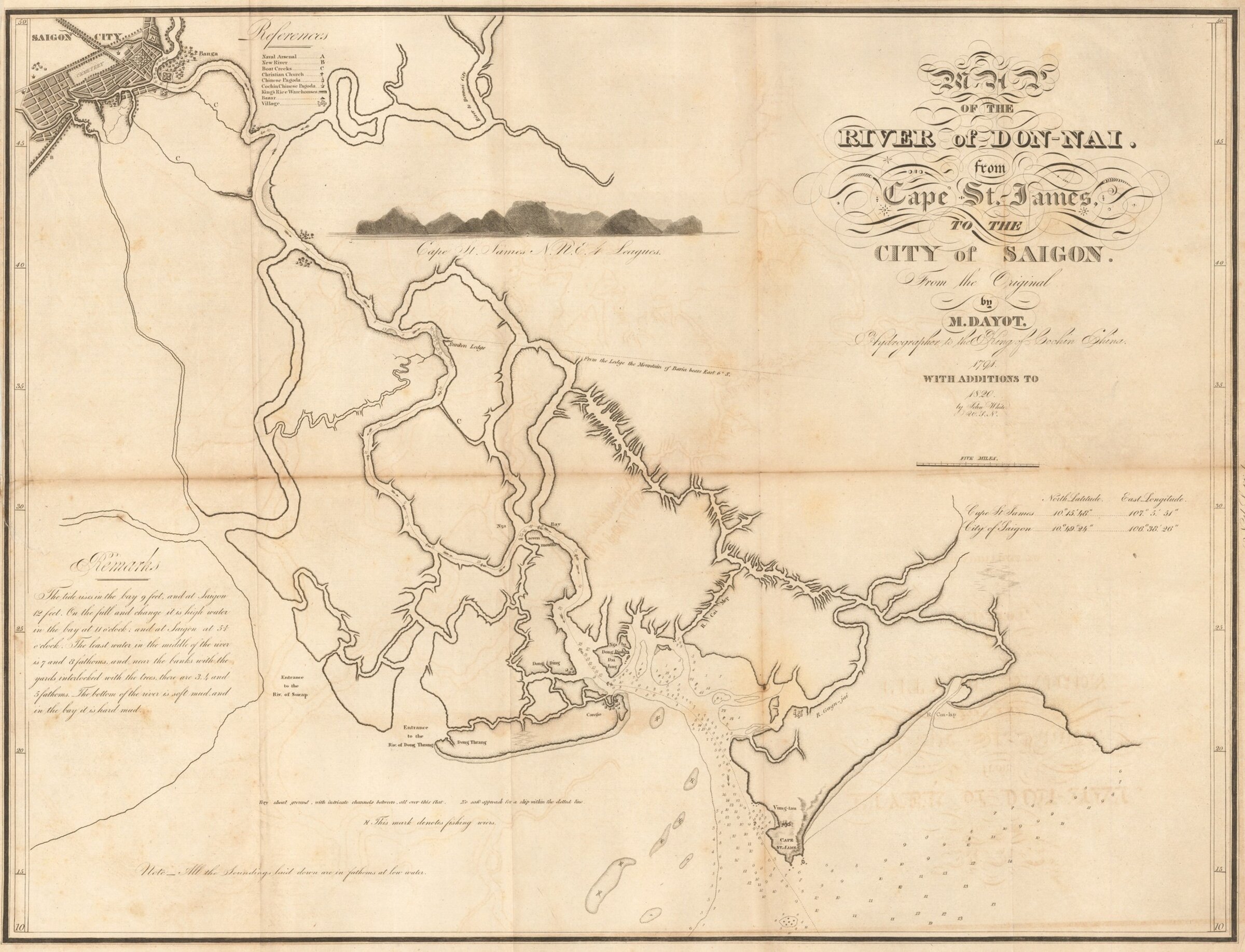
‘Map of the River of Don-Nai [Dong Nai] from Cape St. James to the City of Saigon [Ho-Chi-Minh-City], from the Original by M. Dayot, Geographer to the King of Cochin China (1791) with Additions to 1820 by John White, U.S.N.’ [folded map in History of A Voyage to the China Sea, Boston, 1823, via Barry Lawrence Ruderman Antique Maps Inc.].
‘Map of the River of Don-Nai [Dong Nai] from Cape St. James to the City of Saigon [Ho-Chi-Minh-City], from the Original by M. Dayot, Geographer to the King of Cochin China (1791) with Additions to 1820 by John White, U.S.N.’ [folded map in History of A Voyage to the China Sea, Boston, 1823, via Barry Lawrence Ruderman Antique Maps Inc.].
Note: Jean Baptiste Marie Dayot, known as Nguyễn Văn Trí / 阮文智 (1759 – 1809), was a French Navy officer and an adventurer who went into the service of Nguyễn Ánh (Gia Long), and took part in the 1792 battle of Qui Nhơn, during which the Bishop of Adran took fatally ill. With his brother Felix, he designed several hydrographic maps of the Vietnamese coast. Leaving Saigon for Manila in 1795, he became involved in the trade with Mexico and died at sea in 1809, in the Gulf of Tonkin [source: Wikipedia].
We also get a description of the (unoccupied at that time) ‘Regal Palace’ containing several useful details, for instance the use of a 10-meter high watch-tower, a kind of structure we have found around only in Battambang, for a time occupied by Vietnamese forces in the 18th century:
The regal palace stands in the centre of the city, on a beautiful green, and is, with its grounds of about eight acres, . enclosed by a high paling. It is an oblong building, of about one hundred by sixty feet square, constructed principally of brick, with verandas enclosed with screens of matting : it stands about six feet from the ground, on a foundation of brick, and is accessible by a flight of massy wooden steps. On each side, in front of the palace, and about one hundred feet from it, is a square watch-tower, of about thirty feet high, containing a large bell.
In the rear of the palace, at the distance of about one hundred and fifty feet, is another erection of nearly the same magnitude, containing the apartments of the women, and domestic offices of various kinds ; the roofs covered with glazed tile, and ornamented with dragons, and other monsters, as in China. This establishment is devoted to the use of the king and royal family, who have never visited Saigon since the civil wars. It has, consequently, during that period, not been occupied. It is, however, used as a place of deposit for the provincial archives, and the royal seal ; and all important business, requiring this appendage, is here consummated. On passing these buildings we were directed by the attendant mandarins, who set the example, to lower our umbrellas, by way of salute to the vacant habitation of the “Son of Heaven.”
We shortly arrived before the palace of the governor, and were shown into a guard-house opposite, where we were told we must remain till our arrival should be announced ; for which purpose a mandarin and a linguist were despatched. We had not been long waiting when we were informed that the great personage within was ready to receive us. We entered the enclosure by a gateway in the high paling surrounding the governor’s residence ; in front of which, at the distance of ten feet, was a small oblong building parallel with the gateway, and apparently placed there as a mask. After we had passed this erection, we found ourselves in a spacious court, and directly in front of us, at about one hundred and fifty feet from the entrance, was the governor’s house, a large quadrilateral building, eighty feet square, and covered with tiles. From the eaves in front continued a gently sloping roof of tiles, to the distance of sixty feet, supported by round pillars of rosewood beautifully polished. The sides of this area were hung with screens of bamboo.
At right angles with the main building were placed (three on each side of the centre) platforms, raised about a foot from the floor, which was of hard, smooth earth. These platforms were each about forty-five feet long, and four feet wide, constructed of two planks, five inches thick, nicely joined together and highly polished. Between these two ranges of platforms, at the farther end of’ the area, was another platform, raised three feet from the floor, composed of a single plank, six by ten feet square, and about ten inches thick, resembling boxwood in colour and texture, and from almost constant attrition, reflecting adjacent objects with nearly the fidelity of a mirror. On this elevation was seated, in the Asiatic style, cross-legged, and stroking his thin white beard, the acting governor ; a meagre, wrinkled, cautious looking old man, whose countenance, though relenting into a dubious smile, indicated any thing but fair dealing and sincerity. On the platforms, on each side, were seated, their different degrees of rank indicated by their proximity to the august representative of the sovereign, mandarins and officers of state of various dignity. Files of soldiers, with their two-handed swords, and shields covered with indurated buffalo hides, highly varnished, and studded with iron knobs, were drawn up in various parts of the hall.
We walked directly up in front till we arrived at the entrance of the central vista, between the ranges of platforms on each side of the
throne, when we doffed our beavers, and made three respectful bows in the European style, which salutation was returned by the governor by a slow and profound inclination of the head. After which he directed the linguists to escort us to a bamboo settee on his right hand, in a range with which were also some chairs, of apparently Chinese fabric, which the linguists told us had been placed there expressly for our accommodation. A motion of the governor’s hand indicated a desire that we should be seated, with which we complied. The linguists then proceeded to the foot of the throne with the presents, which they held over their heads, in a kneeling posture, while the different articles were passed to him by several attendants in waiting. After attentively viewing each article separately, with marks of evident pleasure, he expressed great satisfaction, and welcomed us in a very gracious manner, making many enquiries of our health, the length of our voyage, the distance of our country from Onam, the object of our visit, &c. After satisfying him in these particulars, he promised us every facility in the prosecution of our views. Tea, sweetmeats, areka, and betel, were passed to us, and we vainly attempted to introduce the subject of sagouetes [presents], and port-charges for anchorage, tonnage, &c. (the rate of which we wished to have established,) all recurrence to these subjects being artfully waived by him for the present ; and, he promising to satisfy us at the next interview, we took our leave, and, as it was still early in the day, we proceeded to gratify our curiosity by a walk through the city.On our return towards the great southern gate by which we had entered, we passed a large Bungalo (a light airy building, constructed generally of bamboo, and roofed with thatch), under which were arranged about two hundred and fifty pieces of cannon, of various calibres and fashions, many of them brass, and principally of European manufacture, generally mounted on ship-carriages in different stages of decay. Among them we noticed a train of about a dozen pieces of field-artillery, each marked with three fleurs de lys, and bearing an inscription, importing that they were cast in the reign of Louis XIV, in tolerable preservation. Near this place was a sham battery of wooden guns for exercise ; and at the main guard, near the gate, were several soldiers undergoing the punishment of the caungue, and on this occasion we understood that the caungues of the military were made of bamboo, and those used for other offenders were of a species of heavy black wood. On the north side of the eastern gate, was a bastion with a flag-staff) where the Onamese colours are displayed on the first day of the new moon, and on other occasions.
The gates, of which there are four, are very strong, and studded with iron, in the European style; and the bridges thrown across the moat, are decorated with various military and religious bas reliefs on pannels of masons’ work. Over the gates, are square buildings with tiled roofs, and a stairway leading to the top of the ramparts, on each side of the gate, inside the wall. In the western quarter of the area, within the walls, is a cemetery, containing several barbarously splendid mausoleums of mandarins in the Chinese style. Some of them bear inscriptions and effigies on stone, of very tolerable sculpture. In the north-eastern section are six immense buildings, enclosed with palings, separate fromeach other. They are each about one hundred and twenty feet long, by eighty feet wide. The roofs, composed of rafters of great strength, covered with glazed tiles, are supported by abutting columns of brick, the intervals being filled with massy wood-work. The walls are about 18 feet high. These are the magazines of naval and military stores, provisions, arms, &c.
Many small groups of soldiers’ huts were scat, tered about within the walls, situated in a picturesque manner among the foliage of various tropical plants. Among others, we noticed several clumps of the castor bean. Many pleasant walks are laid out in various directions, planted on each side, with the palmaria, a beautiful plant, resembling a pear-tree, bearing a profusion of white odoriferous flowers, which, in October and November, impregnate the air to a great distance with their perfume. From these flowers, the natives extract an oil, which by them is considered a panacea for all kinds of wounds. On the declivity, outside the gate, through which the tortuous covered way is cut, were several of the royal elephants grazing, attended by their drivers, who were sitting on their necks ; some of these beasts were of immense size, indeed much larger than any I had ever seen in any part of India. The drivers, or rather attendants, of these huge animals, are provided with a small tube of wood, closed at each end, equidistant from which is a round lateral aperture, into which they blow, and produce a noise similar to blowing into the bunghole of an empty cask, for the purpose of warning passengers, or others, of their approach, for they seldom give themselves the trouble to turn aside for any small impediment in their path; and it was amusing to see the old women and others in the bazars, on hearing the approach of an elephant horn, gather up their wares, and retreat, muttering, to a respectful distance, while the animal was passing to and from the river-side, where they resorted to drink. On passing us they would slacken their pace, and view, with great apparent interest, objects so unusual as our white faces and European garb presented ; nor were we totally divested of some degree of apprehension at first, from the intense gaze, and marked attention of these enormous beasts.
Indeed, the Onamese appeared to fear some accident might accrue to us from our novel appearance, and advised us to assume the costume of the country, to prevent any accident which advice we generally hereafter complied with, at which they were always highly gratified, viewing it as a compliment. Nor was this unattended with other advantages, for our dresses were those of civil mandarins of the second order, which gained us greater respect from the populace. The dress worn by me is now in the museum of the “East India Marine Society” of Salem. [p. 220 – 7]
Follow several notations on Cochinchinese products, commerce and customs, including this one which echoes ancient observations by Chinese travelers of yore:
Marriage is a verbal contract, made in presence of the respective parents and friends of the parties, and ratified by the exchange of presents: they seldom take more than three wives, one of which is always paramount ; the children of all are, however, equally legitimate. There is no limitation to the number of their concubines, that depending on caprice, and the ability to maintain them. Notwithstanding the severe punishments inflicted on those females who are guilty of a breach of matrimonial fidelity, no opportunities are neglected to evade the laws enacted for its prevention, where there is any reasonable chance of escaping undetected ; and among unmarried females, chastity is scarcely considered a virtue. [p 282]
The author gave some interesting insights on the Spanish rules and regulations of Spain’s colonies in the Far East, including the pattern of direct exchanges between South American and Filipino ports, established in the late 16th century, and the fact that non-Spanish traders had long been prohibited to reside more than six months at a time in the Philippines or in the Spanish settlements in India:
The inhabitants of Manilla have long enjoyed the privilege of sending two annual ships to Acapulco, called Galleons Navios, or Register-ships, with the produce of the Philippines, of China, and other parts of Asia ; in return for which, they receive various articles of the productions of South America; the principal of which is cochineal, merchandise of different descriptions of European origin, and silver in Spanish dollars and ingots, which compose the principal part of the value of their return-cargoes, amounting annually to about three million five hundred thousand Spanish dollars. A large proportion of this property belongs to the convents in Manilla, whose great revenues not only enable them to engage in extensive mercantile operations, but to lend considerable sums to the merchants on bottomry. For the indulgence in this trade, the proprietors pay a large amount of money to the crown.
These ships were of the burden of from twelve to fifteen hundred tons, and were numerously manned, and well-appointed, for defence ; but of late years, since the revolt of the Spanish colonies, which has rendered the navigation of the intermediate seas dangerous to these enterprises, the trade has been greatly interrupted, and instead of risking it in large bodies, private ships of smaller burden have been hired for the purpose of dividing the risk; some of these have been put under foreign colours, plough formerly the galleons wore, by restriction, the royal flag, their officers were commissioned and uniformed like the officers of the navy, and the ships were under the same regulations and discipline. The object, however, of the trade in smaller ships has not been obtained ; for so great are the fears of the owners and agents of their being captured, and so many restrictions laid upon the commanders, that they lie in port the principal part of the time, so that in September, 1819, the ships of the preceding year had not arrived at Manilla ; neither had any been despatched from the latter place for Acapulco, during that time.
These interruptions, and, in fact, the virtual suspension ofthis commerce, will undoubtedly, if a liberal and enlightened policy is pursued, result greatly to the advantage of these islands and the mother-country. Already since the establishment of the Cortes, permitting foreigners to settle permanently at Manilla — Europeans and Americans, previous to this, were permitted to reside in these islands only one monsoon, or six months, at a time; which put them to the inconvenience of visiting Macao, or some other place in China, or India, semi-annually -, great improvements have been made in the productions of the island, and important additions to the revenue. The failure of the annual remittance of dollars from South America to defray the expenses of the colonial government, of which their revenues from the islands were not adequate to meet one half, has been severely felt, and has stimulated them to make some very unusual exertions. Foreign commerce has been more countenanced in consequence of this state of things, and greater encouragement has been given to the growers and manufacturers of their staple exports ; and if the affairs of these islands should in future be properly conducted, the revenge arising from the impost on the single article of coffee will in a few years be amply sufficient to support the government, and leave a net income of the revenue arising from the imposts on all other articles, besides what would acrue from taxes and numerous other resources.
A free commerce with other nations would create a competition, and a consequent reduction in the price of imports, and their articles of export would increase, in proportion to the demand for them. In short, nothing is wanting in this beautiful island, but ability to direct, and energy to execute the most extensive plans of agriculture and commerce, which the bounties of the soil, and its excellent climate and situation, would most certainly render completely successful; and instead of being, as at present it is, a burden to Spain, it would become a source of great wealth to her. [p. 125 – 8]
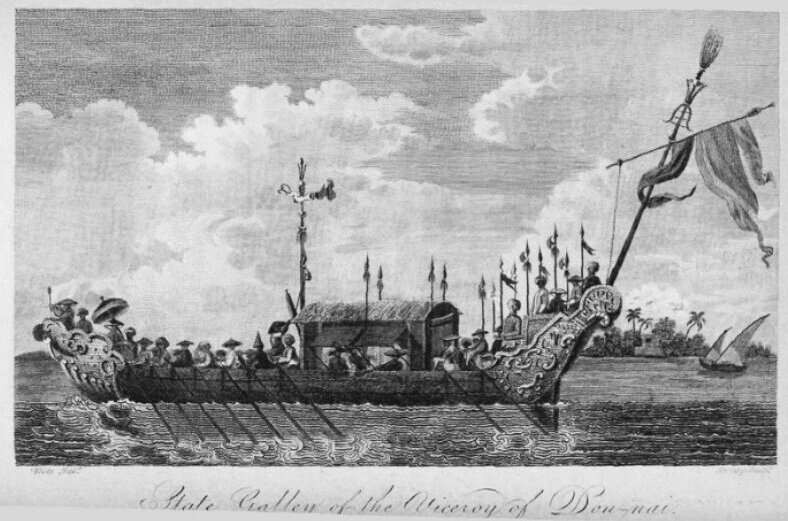
In the first Boston edition, the book carried one folded map and 5 plates: “1) Frontispiece — Map of the Don-nai river. 2) Traders of the Northern and Southern province. 3) Tonquinese Traders. 4) Scene on the Don-nai river
5) State Galley of the Vice-Roy of Don-nai. 6) Specimen of Chinese characters — to follow Father Joseph’s letter in Appendix. No. 1.” For unknown reasons, none of the digital versions found on the Net has kept these illustations. The two above (4 and 5) were reproduced in the blog Windham NH History. Dated 4 Nov. 2016, the post mentions Capt. White was helped in readying his book by his clerk, Frederick Bessel.
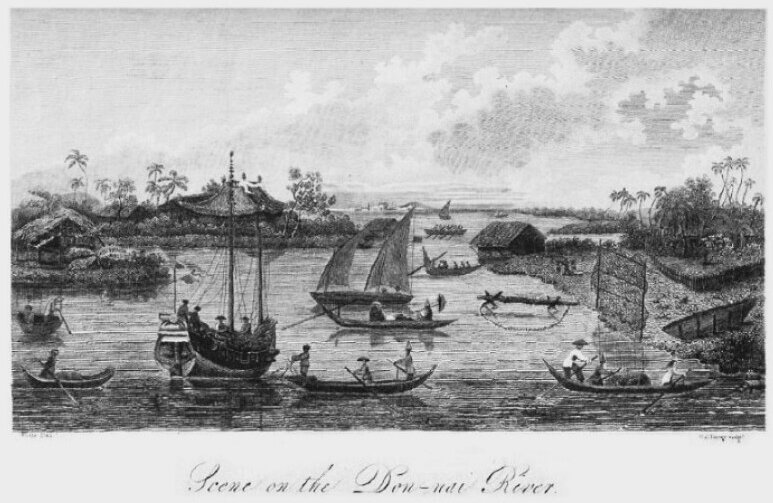
In the first Boston edition, the book carried one folded map and 5 plates: “1) Frontispiece — Map of the Don-nai river. 2) Traders of the Northern and Southern province. 3) Tonquinese Traders. 4) Scene on the Don-nai river
5) State Galley of the Vice-Roy of Don-nai. 6) Specimen of Chinese characters — to follow Father Joseph’s letter in Appendix. No. 1.” For unknown reasons, none of the digital versions found on the Net has kept these illustations. The two above (4 and 5) were reproduced in the blog Windham NH History. Dated 4 Nov. 2016, the post mentions Capt. White was helped in readying his book by his clerk, Frederick Bessel.
In the first Boston edition, the book carried one folded map and 5 plates: “1) Frontispiece — Map of the Don-nai river. 2) Traders of the Northern and Southern province. 3) Tonquinese Traders. 4) Scene on the Don-nai river
5) State Galley of the Vice-Roy of Don-nai. 6) Specimen of Chinese characters — to follow Father Joseph’s letter in Appendix. No. 1.” For unknown reasons, none of the digital versions found on the Net has kept these illustations. The two above (4 and 5) were reproduced in the blog Windham NH History. Dated 4 Nov. 2016, the post mentions Capt. White was helped in readying his book by his clerk, Frederick Bessel.
The US Navy officer couldn’t not refrain from speculating that, even if the situation in mainland Southeast Asia seemed adverse to it, the Philippines might one day be a hot spot of American entrepeneurial liberalism and benefit from that proverbial — if distant — ‘Beacon of Light’ twinkling on the North American shore:
Perhaps no part of the world offers a more eligible site for an independent republic, than these islands : their insular posture, and distance from any rival power, combined with the intrinsic strength of a free representative government, would guarantee their safety and glory ; their intermediate situation, between Asia and the American continent, their proximity to China, Japan, Borneo, the Molucca and Sunda islands, the Malay peninsula, Cochin China, Tonquin, Siam, and the European possessions in the East, would insure them an unbounded commerce, consequently great wealthand power ; and their happiness would be secured by religious toleration and liberal views of civil liberty in the government. It must be confessed, however, that the national character of the Spaniards is not suitable to produce and enjoy in perfection this most desirable state of affairs : it is to be feared that their bigotry would preclude religious toleration ; their indolence continue the present system of slavery, so degrading in a particular manner to a republic ; their want of energy paralyse the operations of commerce ; and their jealousy fetter the efforts of enterprising foreigners among them. No change, however, can be for the worse ; and if all the advantages cannot be reaped by them, which the citizens of our republic would secure, it will be better for them to seize and enjoy such as their genius and talents will entitle them to.
The Spaniards, however, are not alone in this inaptitude to perceive and pursue the proper measures to realise a pure republican form of government; history furnishes many instances of this fact ; and a recent and striking one has been exemplified in France. Whether these failures are to be attributed to moral or physical causes, or both conjoined, it is not my province here to decide. Visionary system-mongers may obtrude their Utopian reveries upon the world ; but America presents a practical example of a free government, framed and put into operation by the inclusive wisdom and power of the nation, whose prosperity, happiness, and glory, it is so eminently calculated to promote. She, like an insulated, adamantine mountain, whose base is lashed by the impotent waves of the ocean, stands firm, fixed, and erect; aloof from the conflicts of European nations ; and, with scarcely an effort, repelling the puny attacks of her enemies ; a living monument of the peculiar favour of the beneficent Creator, who called her into political existence and who, we trust, deigns to direct her councils [p. 138 – 9]
[1] The Đồng Nai, originating in the Central Highlansds, is the longest river entirely located in Vietnam. A confluent of the Saigon River — at which point it is called the Nhà Bè River -, and the Saoi Rap River, it has always been an important connecting way to Cambodia and Laos as its mouth is close to the Mekong River’s one in the Mekong Delta.
[2] Gambooge or Camboge is a richly colored pigment obtained from the gum of a particular species of Guttiferae trees, wildly used in paint since the 8th century but mostly disused since the end of the 19th century due to its toxicity. The greenish fruit of the Garcinia gummi-gutta was also called gambooge or camboge. As for rice, White doesn’t mention whether he attempted to bring seeds to the US, one of the tasks of the failed Fame mission in 1803. American founder Thomas Jefferson, who had read the accounts of French botanist and explorer Pierre Poivre, was convinced that ‘Cochinchinese rice’ could be succcessfully grown on the American continent after rice seed germination.
[3] The author attributed these notations to “Dr Morrison, Vision of China, p. 80.” He was referring to a book published in Macao by Rev. Robet Morrison (1782−1834) shortly before the Franklin visit, A View of China For Philological Purposes, containing a sketch of Chinese Chronology, Geography, Religion & Customs, designed fot the use of Persons who study the Chinese language, Macao, East India Company Press, 1817, 141 p.
[4] Adran was the name of an “évêché” [diocese] in partibus, established in the 18th century after the name of an ancient city of the Arabic Peninsula to represent Christian activities in the Far East, and abolished in 1964. Pigneau de Behaine was the most illustrious holder of the title.
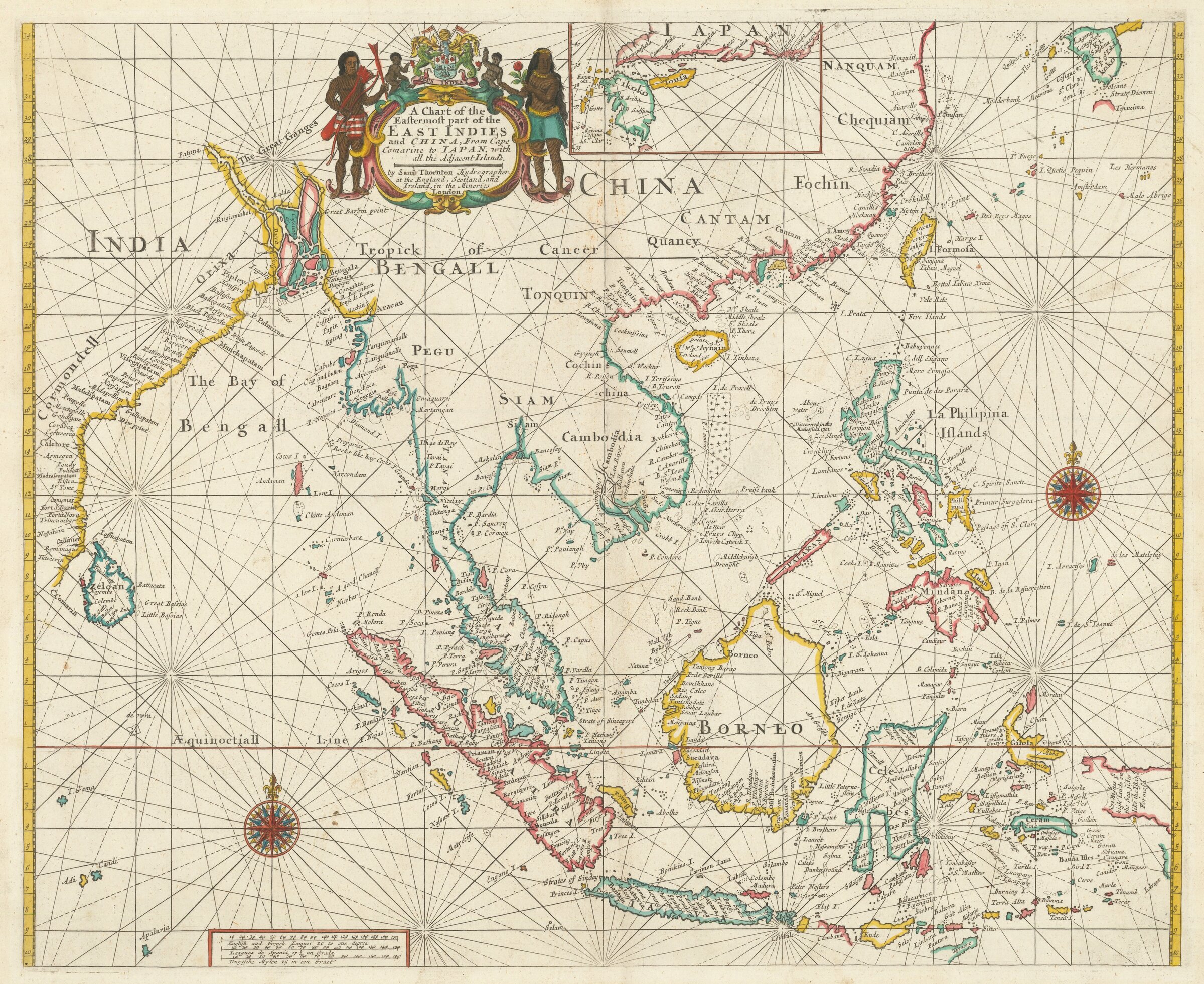
Samuel Thornton’s Chart of the Easternmost part of the East Indies and China, From Cape Comarine to Iapan, with all the Adjacent Islands, London, c. 1706. [see more here].
A Chart of the Easternmost part of the East Indies and China, From Cape Comarine to Iapan, with all the Adjacent Islands, London, c. 1706. [via raremaps.com]
Samuel Thornton (1665 — 1715), the son of famous London chartmaker John Thornton, joined this map to the reprint of his father’s English Pilot: The Third Book…the Oriental Navigation, a navigation handbook still used by American shipmasters of the East India Company like John White at the turn of the 19th century.
Note: John White’s account was published as
Tags: 1810s, 1820s, maritime trade, maritime routes, Cochinchina, Mekong Delta, Saigon, Spanish colonies, Poulo Condor, Modern Cambodia, Malaysia, The Philippines, Manila, American travelers, rice seeds
John White (1782−1840) was an American shipmaster, a Sailing Master in the US Navy since 1813 (Lieutenant in 1816, Commander in 1937), a merchant mariner working with the East India Company from 1812, and the captain of the brig Franklin, first American vessel to reach Saigon in May 1819.
In Sept. 1806, John White joined the East India Marine Society of Salem, founded in Oct. 1799 by two dozen of the wealthiest mariners of the prosperous Atlantic port, and remained an active member of the EIMS until his death in 1840 [see Walter Muir Whitehill, The East India Marine Society and the Peabody Museum of Salem, A Sesquicentennial History, Salem, Peabody Museum, 1949.]
After serving during the War of 1812 between the USA and Great Britain, John White apparently took a lasting leave of absence from the Navy to pursue his commercial career with the East India Company. When he left Salem for Batavia and Cochinchina at the helm of the Franklin in December 1918, he was provided with a “blank journal” entrusted to him as well as any other captain by the Marine Society with “the mandate that “without any excuse whatsoever” it be completed, submitted, and made available to fellow members.” [John M. Lindgren, “That Every Mariner May Possess the History of the World”: A Cabinet for the East India Marine Society of Salem,” The New England Quarterly 68 – 2, June 1995, p. 182]. He did so at his return in 1820, and was granted permission to publish his account as a book “by subscription” — History of a Voyage to China Sea (1823).
John White donated several pieces brought back from the Far East to a museum which,“with its bizarre artifacts — including a dried Maori head hidden beneath a veil — and strange rituals, gave Salemites the opportunity to taste the wealth of faraway lands and vicariously experience the thrill of their conquest and the mystery of their aura. Thus, Salemites acknowledged the mastery of the city’s merchants and mariners, recognized their own imagined their future through their encounters, rituals, and adventures.” Famed novelist Nathaniel Hawthorne, a frequent visitor the museum, said he was influenced by its “whimsical nations and ludicrous analogies.” [John M. Lindgren, ibid.].
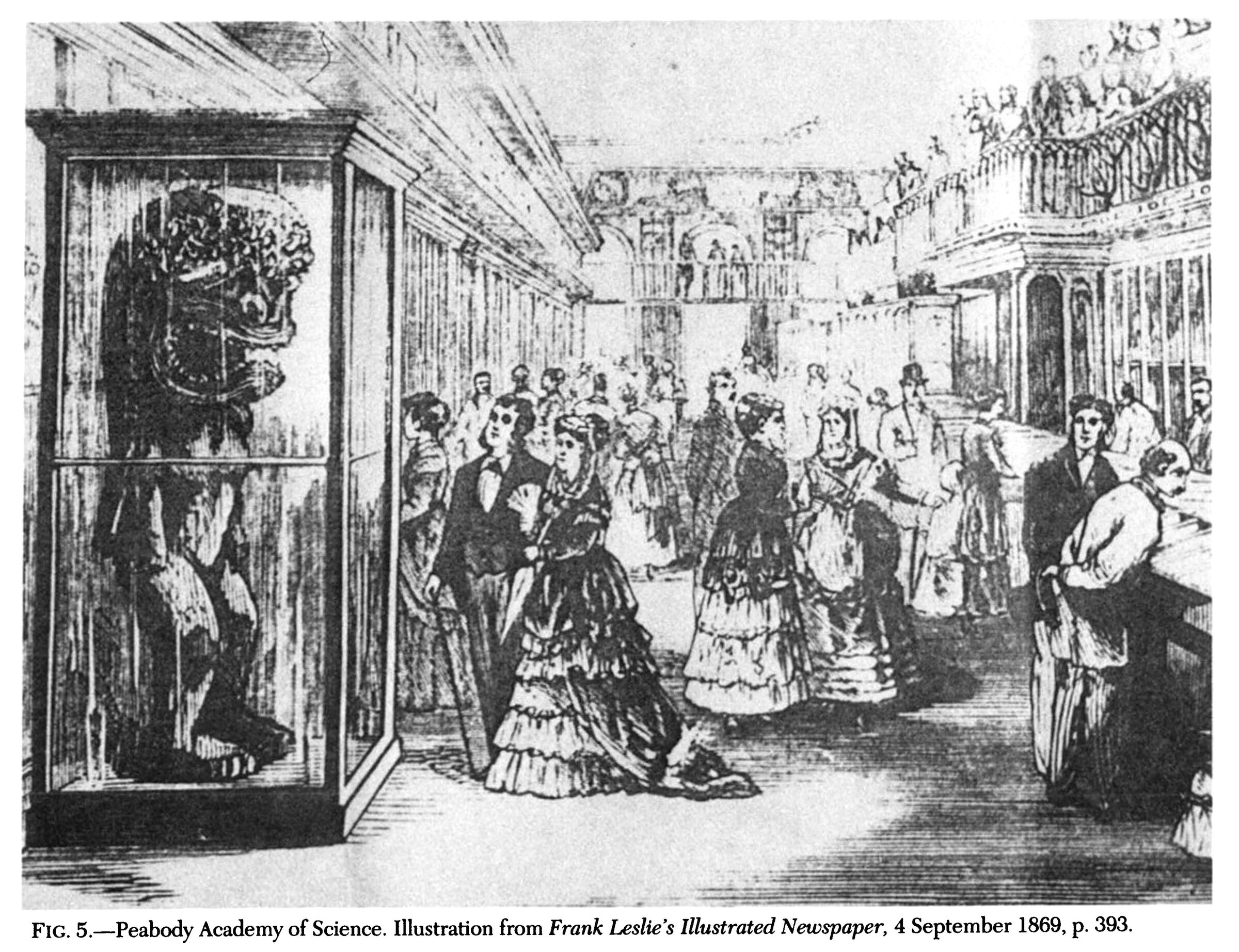
1) The ‘whimsical’ museum in 1869, at a time it was getting some 70,000 visitors per year [illustration reproduced in John M. Lindgren, op. cit.] 2) An exhibition at Peabody Essex Museum, 2023. [photo PEM].

1) The ‘whimsical’ museum in 1869, at a time it was getting some 70,000 visitors per year [illustration reproduced in John M. Lindgren, op. cit.] 2) An exhibition at Peabody Essex Museum, 2023. [photo PEM].
1) The ‘whimsical’ museum in 1869, at a time it was getting some 70,000 visitors per year [illustration reproduced in John M. Lindgren, op. cit.] 2) An exhibition at Peabody Essex Museum, 2023. [photo PEM].
In 1867, the EIMS collection and the Essex Museum were purchased by George Peabody, a native of Massachusetts who had moved to London and established around that time museums of Natural History at Yale and Harvard universities. The institution took the name of Peabody Academy of Science or Peabody Essex Museum (PEM), still active to the day in the McIntire Historic District of Salem. In the collection of more than 850,000 works of art and culture — many of them the first of their kind to be collected in the US -, Chinese, Japanese and Korean artworks can be find along a section of ‘Asian Export Art’ — objects manufacturated in Asia for different markets -, and one of ‘South Asia Art’, with some 20th century artworks from India. The Phillips Library, one of the oldest libraries in the US, is part of PEM.
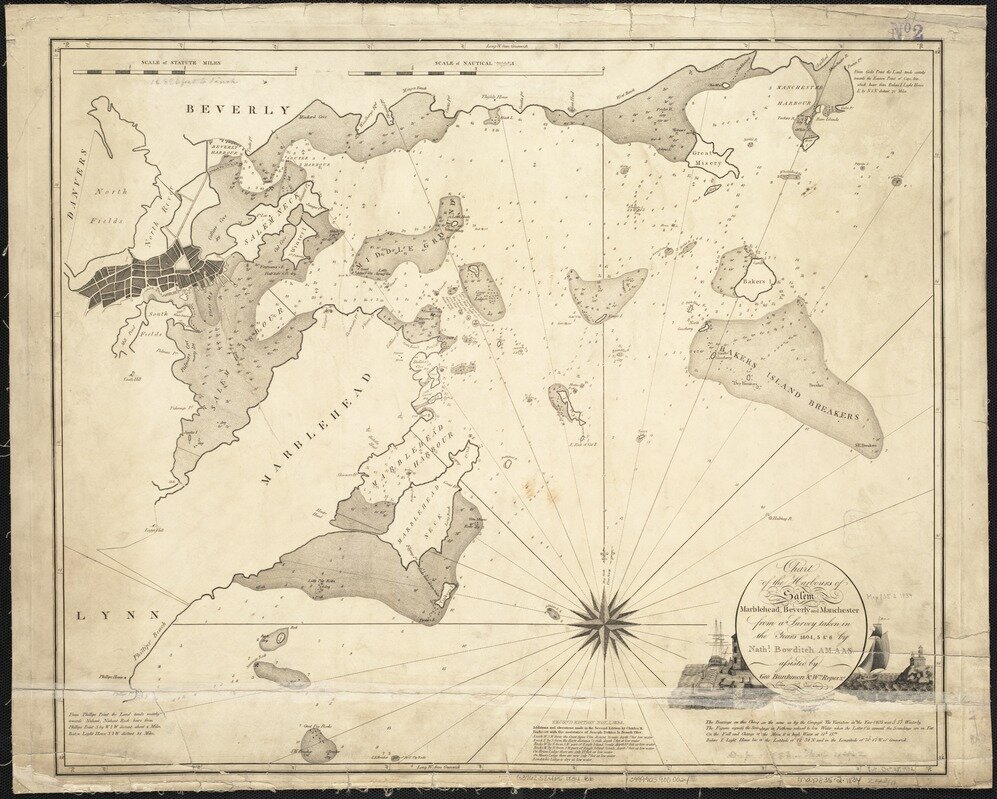
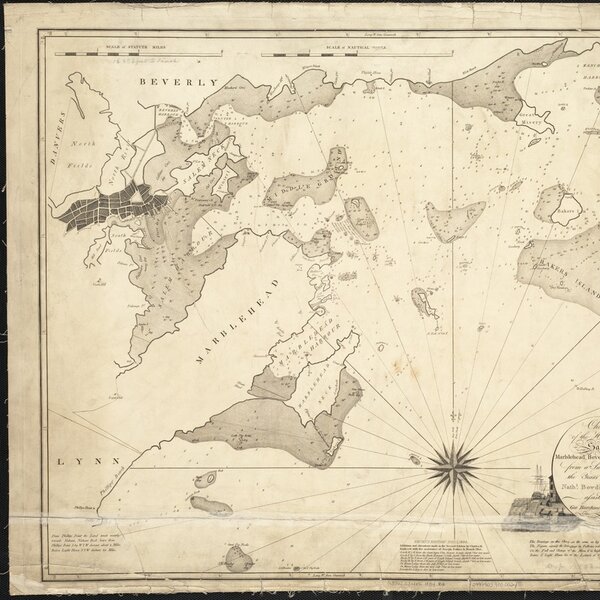
1) Chart of the harbours of Salem, Marblehead, Beverly and Manchester : from a survey taken in the years 1804, 5 & 6, by Nathaniel Bowditch (1773−1838), co-founder of the EIMS. Published in 1834. [source: Boston Public Library, Norman B. Leventhal Map & Education Center]. 2) “Girl Eating Rasagolla”, by K.G. Subramanyan (1924 – 2016, India), 1980 [PEM South Asia Art Collection].
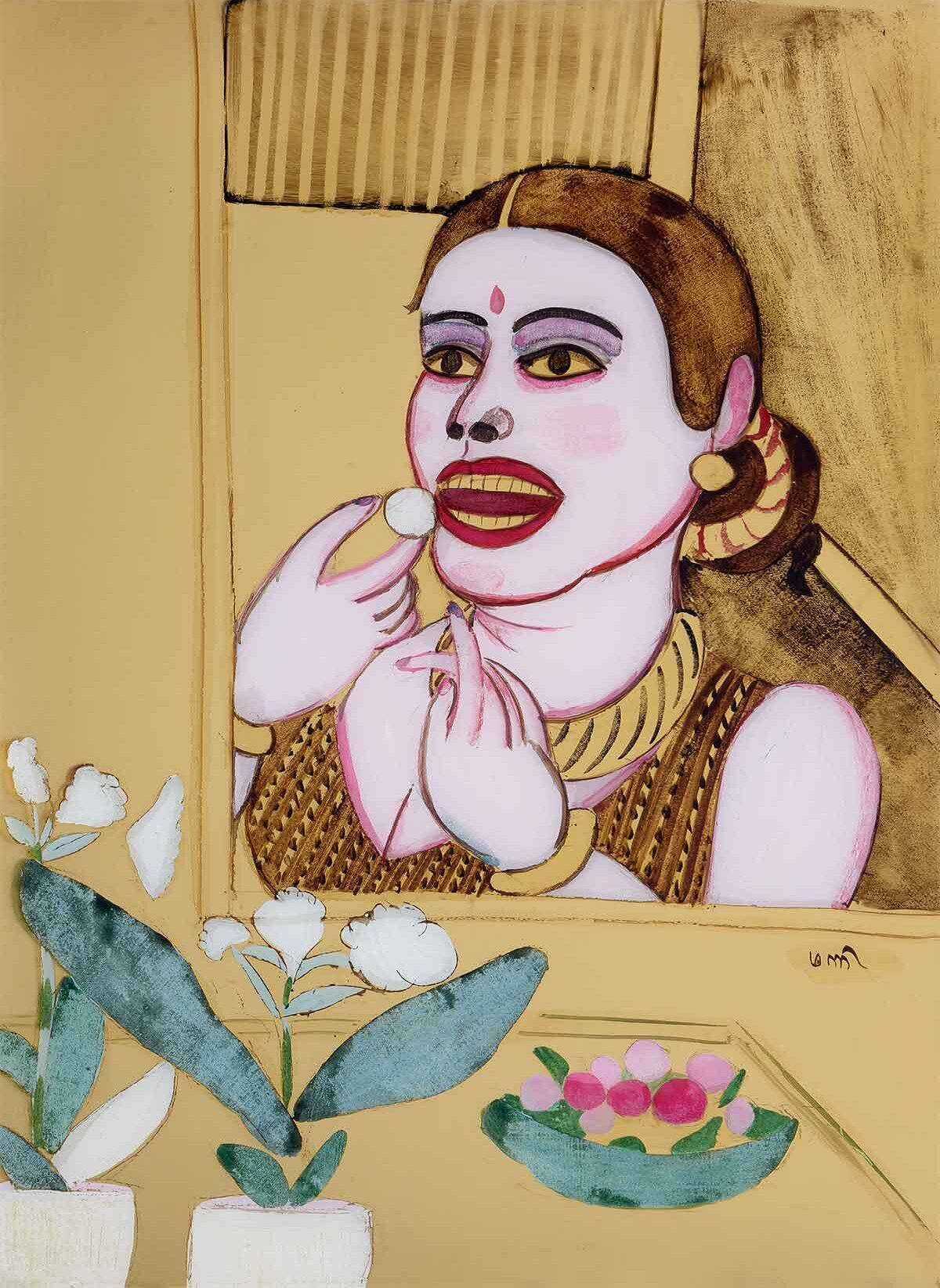
1) Chart of the harbours of Salem, Marblehead, Beverly and Manchester : from a survey taken in the years 1804, 5 & 6, by Nathaniel Bowditch (1773−1838), co-founder of the EIMS. Published in 1834. [source: Boston Public Library, Norman B. Leventhal Map & Education Center]. 2) “Girl Eating Rasagolla”, by K.G. Subramanyan (1924 – 2016, India), 1980 [PEM South Asia Art Collection].
1) Chart of the harbours of Salem, Marblehead, Beverly and Manchester : from a survey taken in the years 1804, 5 & 6, by Nathaniel Bowditch (1773−1838), co-founder of the EIMS. Published in 1834. [source: Boston Public Library, Norman B. Leventhal Map & Education Center]. 2) “Girl Eating Rasagolla”, by K.G. Subramanyan (1924 – 2016, India), 1980 [PEM South Asia Art Collection].
greek "askēsis" originally "physical practice, athletic training".
A sage who practices austerity.
In various Indian philosophies from Shaktism to Ayurveda, the concept of Tapas (तपस्), "penance", "ascetism", "austerity", "practice of self denial" is essential.
In Khmer religious philosophy, អនង្គណ angkana is the state of being without defilement, a person without defilement, pure. ព្រះពុទ្ធអរហន្ត The Buddha Arahant is the great blessing of having all defilements removed.
chs 洞 dong, "cave" | 峒 tong, "dong"
Dong is an ancient Chinese term for a mountain valley community, especially in the southern and soutwestern regions abutting to 'historic' mainland China.
In Korea, dong 동 has come to refer to a neighborhood or an administrative sub-district.
