

Jules Gervais-Courtellemont

Jules Gervais-Courtellemont (1863, Avon, France – 31 Oct. 1931, Paris) was a professional French explorer, photoengraver and photographer whose photographs of French Indochina and Cambodia were widely published, often without his knowledge.
In 1874, the young Jules moved to Algeria with his mother and his stepfather, Jules-Georges Courtellemont — his natural father, Louis Victor Gervais, had died in 1874. At 14 years of age, he was left alone in the family farm in the Relizane Valley as his parents had to hurry back to France for health reasons. As local Algerian peasants helped him manage the farm, he became strongly attached to the culture and religious traditions. In 1888, he opened opened a photographic studio in Algiers in 1888 and became the editor of the illustrated review L’Algérie artistique et pittoresque [1]. After visiting Spain and Syria, where he met and befriend famed French explorer and Islamologist Charles Lallemand in 1892, he converted to Islam and was one of the first Westerners to accomplish the Hajj and photograph Mecca in 1894. That same year, he illustrated and published in Algiers Lallemand’s works, Jérusalem-Damas and Le Caire.
With wife Hélène Lallemand (31 July 1861, Baden, Germany — 15 June 1922, Paris) — Lallemand’s daughter and a professional photographer herself –, he visited Indochina, then Yunnan — from which he seems to have been expelled by the local authorities, according to Charles Francois, an EFEO correspondent, as his interest in the Muslim minorities of Yunnan was seen as suspect — Tibet, and China in 1900 – 1903. Part of their work was exhibited in Hanoi in 1902, and Jules was granted the Gold Medal of the Société géographique de France. He was a lifelong friend of Pierre Loti’s, with whom he shared a passion for the ‘exotic’.
When First World War broke, Courtellemont decided to cover the military actions in France, in particular the involvement of ‘Colonial troops’ in the battles. He applied a technique of color photography known as ‘natural color photography’ or ‘autochrome’, which he had explored since 1907 to the extent he opened in Paris a Palais de l’Autochrome in 1911. His work is kept at the Albert-Kahn Museum in Boulogne-Billancourt — in 1913, he was entrusted with the artistic direction of Kahn’s monumental project, ‘Archives de la Planète’ –, and in the National Geographic archive in Washington, D.C. He also contributed to the French magazine L’Illustration from 1903 to 1923.
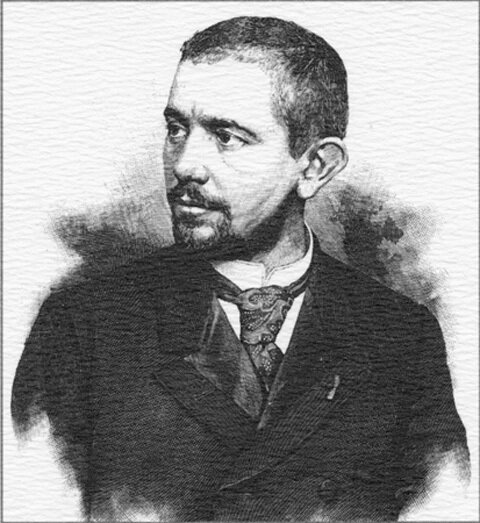
1) A self-portrait of Gervais-Courtellemont published in L’Illustration, 15 Dec. 1894. [source: Emmanuelle Devos, “À travers Le Caire, l’œuvre de Gervais-Courtellemont en Égypte de 1894 à 1911”, in Mercedes Volait (ed.), Le Caire dessiné et photographié au XIXe siècle, Paris, INHA/Picard, 2013, p. 215 – 226. 2) ‘Alger, jeune tisserande devant son métier’, by J. Gervais-Courtellemont, 1909 – 1911 — © Musée Albert-Kahn/A6.
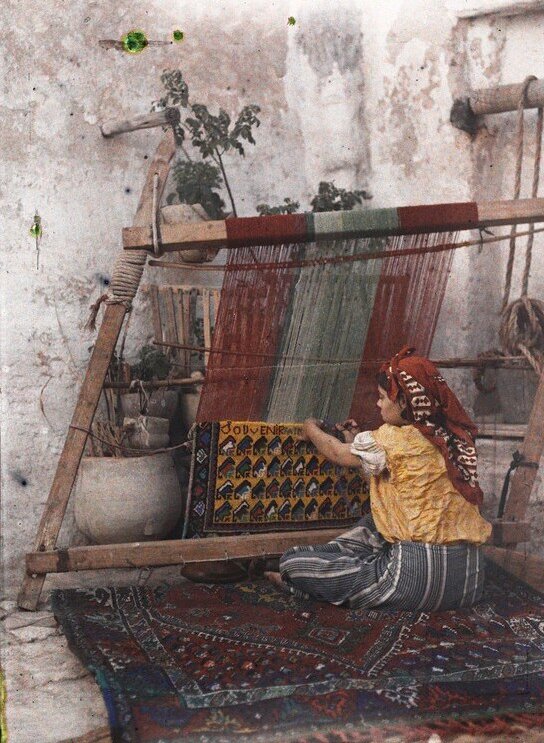
1) A self-portrait of Gervais-Courtellemont published in L’Illustration, 15 Dec. 1894. [source: Emmanuelle Devos, “À travers Le Caire, l’œuvre de Gervais-Courtellemont en Égypte de 1894 à 1911”, in Mercedes Volait (ed.), Le Caire dessiné et photographié au XIXe siècle, Paris, INHA/Picard, 2013, p. 215 – 226. 2) ‘Alger, jeune tisserande devant son métier’, by J. Gervais-Courtellemont, 1909 – 1911 — © Musée Albert-Kahn/A6.
1) A self-portrait of Gervais-Courtellemont published in L’Illustration, 15 Dec. 1894. [source: Emmanuelle Devos, “À travers Le Caire, l’œuvre de Gervais-Courtellemont en Égypte de 1894 à 1911”, in Mercedes Volait (ed.), Le Caire dessiné et photographié au XIXe siècle, Paris, INHA/Picard, 2013, p. 215 – 226. 2) ‘Alger, jeune tisserande devant son métier’, by J. Gervais-Courtellemont, 1909 – 1911 — © Musée Albert-Kahn/A6.
The separation technique used to create printed color images from surimposed screen plates had initially been developed by inventors Louis Ducos de Huron (French patent in 1869), John Joly (British patent in 1894) and James William McDonough (US patent in 1896). Mosaic screen plate process was perfected by the Lumière brothers, who patented the ‘Autochrome Lumière’ in 1903 (France) and 1906 (USA). Autochrome was applied by professional travel photographers such as W. Robert Moore (for the US National Geographic) until the popularization of color photographic films after 1935.
[1] see Béatrice De Paste & Emmanuelle Devos, Les couleurs du voyage: L’œuvre photographique de Jules Gervais-Courtellemont, Paris, Paris Musées/Phileas Fogg, 2002, 127 p.
Selected Publications
- Mon Voyage à la Mecque, Paris, Hachette, 1896, 4 editions [with 34 illustrations].
- [illustrator] Pierre Loti, Les dames de la Kasbah, Paris, Calmann-Lévy, 1896 [139 ‘illustrations d’après nature’].
- Empire colonial de la France. L’Indo-Chine : Cochinchine, Cambodge, Laos, Annam, Tonkin, pref. by Marcel Dubois, texts and photos by Gervais-Courtellemont, Octave Vandelet, etc., Paris, Firmin-Didot/Librairie Coloniale Auguste Challamel, 1901.
- Voyage au Yunnan [dedicated to Paul Doumer], Paris, Plon, 1904, 302 p.
- Verdun!, Paris, nd, text and album of 68 direct photographs.
- Les champs de bataille de la Marne, récit technique et documenté. Photographies directes en couleurs et texte de Gervais-Courtellemont, Paris, L’Edition française illustrée, 202 p., nd.
- La Civilisation — Histoire sociale de l’humanité, nd.
- “The enigma of Cambodia”, 27 natural-color photographs illustrating Robert Casey’s “Four Faces of Shiva: The Mystery of Angkor”, National Geographic LIV/3, Sept. 1928: 302 – 332.
- 1 autochrome photo by G.-C. inserted in W. Robert Moore, “Along the Old Mandarin Road of Indo-China” and “Under the French Tricolor in Indo-China, National Geographic 60 – 2, Aug. 1931: 152 – 99 (plate IV).
- Related Photos