
Martin Stuart-Fox

Portrait of Martin   Stuart-Fox

Martin Stuart-Fox (b. 1939) is a retired Australian professor and journalist specialized in the history of Southeast Asia, primarily Laos, and in Buddhism philosophy and practice. A field reporter for UPI in Laos in 1963, he moved to Vietnam in 1965 – 1966, covering the war along with his brother David Stuart-Fox, who later on settled down in Bali and wrote extensively about Indonesia.

A marine biologist initially, he was sent in Laos in 1963 as an agricultural extension officer by the U.S. Agency for International Development. Two years later, he joined UPI news agency and was assigned to cover the war in Vietnam, sharing a house in Saigon with other young journalists and photographers, like Steve Northup, Simon Dring, Tim Page and Joe Galloway. In 1972, he covered the birth of the State of Bangladesh in Dacca for UPI.

An emeritus professor at the University of Queensland, Stuart-Fox contributed several books on Southeast Asian religion and politics, on Laos and on Pol Pot’s Kampuchea”.

 
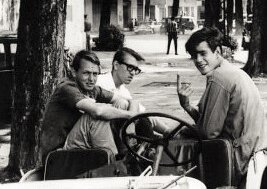
Martin Stuart-Fox, left, with David Stuart-Fox and war correspondent Tim Page (Photo Mekong Review) 

Publications

  1. [ed. & contrib.] Contemporary Laos: studies in the politics and society of the Lao People’s Democratic Republic, St Lucia, University of Queensland Press and New York, St Martin’s Press, 1982, 367 pp. 
  2. Resolving the Kampuchean problem: The case for an alternative regional initiative”. Contemporary Southeast Asia, 4(2), 1982, 210 – 255. [PDF]
  3. [with Ung Bunheang] The Murderous Revolution: life and death in Pol Pot’s Kampuchea, Sydney, Alternative Publishing Cooperative, 1985, 203pp. repub. 1986, White Orchid Press; updated edition Bangkok 1998.
  4. Laos: politics, economics and society, London, Frances Pinter Publishers and Boulder, Lynn Reinner Publishers, 220p, 1986.
  5. [with Rod Bucknell] The Twilight Language: explorations in Buddhist symbolism and meditation, London, Curzon Press and New York, St Martin’s Press. 233pp, 1986. [Italian translation, Rome, Ubaldini Editore, 1997; paperback edition, London: Curzon Press, 1994].
  6. Vietnam in Laos: Hanoi’s model for Kampuchea, Claremont, Keck Center for International Strategic Studies, 52 p, 1987.
  7. The Kampuchean problem: Time for realism”, World Review, 27(2), 1988, 56 – 72. 
  8. Conferences on conflict resolution in Kampuchea” Asian Studies Association of Australia, Review 12 (3), 1989, 58 – 60.
  9. The agony of Cambodia” in C. Mackerras, ed. Eastern Asia: An introductory history. Melbourne: Longman Cheshire, 1992. 556 – 570 {revised for 2nd (US) edition 1995, 3rd edition 2000].
  10. Historical Dictionary of Laos, 1st ed with Mary Kooyman, Metuchen, NJ: Scarecrow Press. 258 p, 1992; 2nd ed., Lanham, MD, Scarecrow Press. 527 p, 2001; 3rd ed. Lanham, MD, Scarecrow Press. 485 pp, 2008.; 4th ed with Simon Creak and Martin Rathie, Lanham, MD, Scarecrow Press, 692 p, 2023. 
  11. Conflicting conceptions of the state: Siam, France and Vietnam in the late nineteenth century”, Journal of the Siam Society (JSS) vol. 82, 1994, p 135 – 144. 
  12. Buddhist Kingdom Marxist State: the making of modern Laos, 1st ed Bangkok, White Lotus Press. 310 p, 1996; 2nd ed Bangkok, White Lotus Press, 419 p, 2002.
  13. A History of Laos, Cambridge, New York and Melbourne, Cambridge University Press. 253 p, 1997 [updated Japanese and Thai translations, 2010].
  14. The Lao Kingdom of Lan Xang: Rise and Decline, Bangkok, White Lotus Press, 200 p, 1998.
  15. A Short History of China and Southeast Asia: Tribute, Trade and Influence, NSW, Allen & Unwin, 278 p, 2003.
  16. [with photos by Steve Northup] Naga Cities of the Mekong: a guide to the temples, legends and history of Laos, Singapore, Media Masters, 128 p, 2006.
  17. The Persistence of Political Culture in Laos and Cambodia” Sudostasien Aktuell, no. 3, 2008, 33 – 57. [PDF]
  18. [with Somsanouk Mixay, photos by Steve Northup) Festivals of Laos, Chiang Mai, Silkworm Press, 92 p, 2010.
  19. The A to Z of Laos, Lanham, MD, Scarecrow Press, 485 p, 2010.
  20. Symbolism in city planning in Cambodia from Angkor to Phnom Penh” (with Paul Reeve) Journal of the Siam Society 99, 2011, 105 – 138. [PDF]
  21. City planning in Cambodia’, Encyclopaedia of the History of Science, Technology and Medicine in Non-Western Cultures (with Paul Reeve), 2014, 1259 – 1268. [PDF]
  22. [with Trude Jacobsen] Power and political culture in Cambodia”, Asia Research Institute Working Paper Series 200, 2013. [PDF]
  23. Sihanouk’s legacy”, New Mandala 26 February 2013.
  24. The Origins of Causal Cognition in Early Hominins”, Philosophy and Biology 30, 2, 2015, p 247 – 266.
  25. Numerous articles on Laos, Cambodia, China, Southeast Asia.
  26. Major transitions in human evolutionary history”, World Futures, 2022.

    Engaging Asia: Essays on Laos and Beyond in Honour of Martin Stuart-Fox, ed. by Delsey Goldston, Singapore, NIAS Press, 2019.

    Martin Stuart-Fox website.

Glossary Terms

  • Kamboja, Kambuja, Kampuchea

    sk काम्बोज kāmboja | prakrit कंबोय | [कम्बुजदेशः kambujadesa, 'land of Kambuja' | oldkh កម្វុជទេឝ, midkh កម្ពុជទេស mkh កម្ពុជា kampuchea, Cambodia 

    1. Kāmboja, a kingdom often mentioned in the Mahābhārata and in the Ramayana, with supposed location in the northwestern part of India, in modern Kabul area, renowned for its warriors and fine horses. Later on, a country visited by Asokas missionaries.
    2. In ancient Indian astrology, a Kādi (subdivision) belonging to Nairṛtī (south-western division referring  to a country possibly identified with the Cambodia of Cochin China according to the Bṛhatsaṃhitā (chapter 14), an encyclopedic Sanskrit work written by Varāhamihira.
    3. One of the two Mahājanapadas of the Uttarāpatha (Northern District) of ancient India, as recorded in the Pāli Buddhist texts, presumably not far from Gandhāra, with Nandipura as the only city of the Kambojas mentioned in the inscriptions. "Home of horses," a term related to horses and elephants.
    4. In Ayurvedic medicine, a plant defined with Coccinia grandis. White mimosa.
    5. Kambujadesa, the land of कम्बु Kambu: according to 10th-century traditions, the union between hermit Kambu Swayambhuva and the celestial nymph Mera founded the Cambodian solar royal dynasty (Kambu-Mera), beginning with Chenla ruler Srutavarman and his son Sreshthavarman.
    6. [Kambhoji or Kambodhi, a raga or ragani mode in Carnatic music, derived from 28th mela Hari Kambhoji, widely known and developed since the 7th century, often dedicated to Lord Ganesha. Defined as "majestic, auspicious in the devotional register" by Dr. Charulatha Mani and by famed Bollywood music composer A.R. Rahman. Etymology unknown, Kāmbhojī काम्भोजी being one name for Guñjā गुञ्जा, Abrus Precatorius, "red bean" plant. Carnatic music scholars do not exclude the possibility that the name might derive from Cambodia-Kampuchea.]
  • Mandala

    sk मण्डल mandala "circle", "center"

    Maṇḍala is a Sanskrit term primarily referring to what is circular thus whole, complete. 

    1/ In the Arthaśāstra and other legal texts, the mandala is circle of twelve neighbouring kings, some friendly and others unfriendly, in relation to a king desirous of conquest. The term could also be used for the territory under the possession of a feudatory.

    2/In Shaivism, maṇḍala, cakra, and yantra are often translated as a “mystical diagram” figuring the space for rituals and the apparition of deities. Mandala can also be a disc, the lunar disc.

    3/ In ancient Indian epics, it is the deployment of an army in a circular shape. The term also refers to a part of the Rig-Veda, a combination of dance sequences in the Natyashastra [Treaty on Dance], and in some texts (Kulakaulinimata, for instance) to "round" meaning "breasts".

    4/ The Buddhist mandala is a circular picture, sometimes a symbol of the universe, a place of enlightnment or the symbolization of a meritous deed, to be contemplated in meditation or prayer.

    5/ The term has been used by some modern historians of Southeast Asia to describe pre-State polities or areas of influences, "circles of allegiance".

View all glossary terms →