

Po Dharma Quang

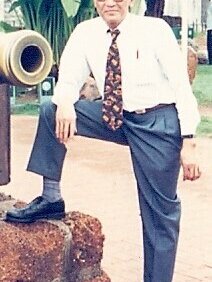
Po Dharma Quang [born Quảng Văn Đủ] (9 Oct. 1948, Chất Thường Village (Cham: Palei Baoh Dana), Ninh Thuận Province, Vietnam — 22 Feb. 2019, Toulouse, France) was a researcher in Southeast Asian history specializing in ethnic minorities — Cham in particular -, a human rights activist and a member of EFEO since 1982. He signed his publications with his nom de guerre, Po Dharma.
Born in a poor village of the coastal province of Ninh Thuận, where the Cham principality of Pāṇḍuraṅga had prospered — theme of his future studies -, prisoner of the South Vietnamese forces who suspected him to be a member of FULRO (Front unifié de lutte des races opprimées, United Front for the Liberation of Oppressed Races, Mặt trận Thống nhất Đấu tranh của các Sắc tộc bị Áp bức) [1], Po Dharma escaped to Cambodia in 1969, joining he 5th special brigade of the army of rebel Marshal Lon Non, made exclusively of Cham volunteers under the command of Colonel-General Lès Kosem (?-1976), known as Po Nagar, to fight against the Khmer Rouge. He joined the technical staff of EFEO in in Cambodia in 1972 before going to France to further his studies in ethnology and linguistics, with two diplomas from Ecole Pratique des Hautes Etudes (EPHE) in 1978 and 1980, and a PhD at Paris III University in 1986.
Full member of EFEO since 1982, Po Dharma went to Kuala Lumpur (Malaysia) in 1987 to open and head the EFEO mission, staying in Malaysia until 1993 and again from 1999 until 2006 after working as visiting professor at EHESS, Paris. The Malaysian mission allowed him to further the research on ancient Champa in the 1980s, in particular with his work on the Royal Archive of Campā, more than 5,000 pages of documents dated between 1702 and 1850 and kept at the Société Asiatique in Paris, and with his contribution to the research unit on Champa founded by Prof. Pierre-Bernard Lafont at EPHE Paris (Péninsule Indochinoise section). The multi-ethnic confederation of Champa, as he had already contributed to prove, had multiple linguistical and cultural connections with the ‘Malay world’. Insisting of the multiethnic character of this historic entity, he argued that it would be better to speak of ‘Champa people’ instead of ‘Cham’.
Until his retirement in 2016, Po Dharma furthered his research within the program “monde malais – monde indochinois”, with publications and symposiums associating French and Malaysian institutions. He coordinated the series Collection des manuscrits cam / Koleksi Manuskrip Melayu Campa with texts in Ancient Cham and Cham romanized and bilingual notices in French and Indonesian. His contribution to Cham linguistics and culture studies was furthered with his work towards the extensive publication of some 5,000 pages of the Royal Archive of Champa, a collection of official documents dated between 1702 and 1850 kept at Société Asiatique in Paris, in cooperation with the Malaya University of Kuala Lumpur. The publication has not happened so far, even if two volumes of the General Index were published.
A pioneer in research reflecting the historic links between continental and peninsular Southeast Asia, Po Dharma was also deeply involved in depicting the contemporary condition of the Cham minority in modern Vietnam and abroad, their struggle for their identity. Founder of the review Champaka in 1999, he launched in 2012 the website Champasak.info, which seems to have disappeared in the 2020s. He was never allowed to return to Vietnam, and the academic platform Cham Studies mentions him only briefly.
[1] FULRO was a symbolic alliance of indigenous and ethnic groups including the Montagnards in the Central Highlands, the Chams in Central Vietnam, and the Khmer Krom in Southern Vietnam (including Kampuchea Krom) who started to evolve into a loose guerilla formation fighting both the South Vietnamese régime and the National Liberation Front. It was initially supported by Prince Norodom Sihanouk.
Publications
[based on Jean Baffie, ‘Quang Po Dharma (1945−2019), figure majeure du renouveau des études sur le Champa en France et éminent promoteur de la culture chame’, Moussons 35, 2020: 7 – 15, and Nicolas Weber, ‘In Memoriam Po Dharma’, Péninsule 78, 2019: 5 – 10.]
- [with Nara Vija] “État des manuscrits caṃ (fonds de l’EFEO)”, in Actes de XXIXe Congrès international des Orientalistes. Asie du Sud-Est continentale, II, Paris, L’Asiathèque, 1976: 136 – 140.
- [with Pierre-Bernard Lafont & Nara Vija] Catalogue des manuscrits cam des bibliothèques françaises, Paris, EFEO (PEFEO, 114), 1977.
- Complément au catalogue des manuscrits cam des bibliothèques françaises, Paris, PEFEO 133, 1981.
- “Notes sur les Caṃ du Cambodge”, Seksa Khmer 3 – 4, Dec. 1981: 161 – 183.
- “Notes sur les Caṃ du Cambodge : religion et organisation”, Seksa Khmer 5, 1982: 103 – 116.
- “Notes on Cham literature”, Shiroku 15, 1982: 46 – 47.
- “Études cam (V). A propos de l’exil d’un roi cam au Cambodge”, BEFEO 72, 1983: 253 – 266.
- “Les Cam”, in Introduction à la connaissance de la Péninsule indochinoise, Paris, Travaux du Centre d’histoire et civilisations de la Péninsule indochinoise (CHCPI), 1983, p. 125 – 130.
- [ed.] Introduction à la connaissance de la péninsule indochinoise, Paris, CHCPI, 1983, 173 p.
- [with Mak Phoeun] “La première intervention militaire vietnamienne au Cambodge (1658−1659)”, BEFEO 73, 1984 : 285 – 318 [1].
- [with Ismail Hussein & Pierre-Bernard Lafont] Dunia Melayu Dan Dunia Indocina, Kuala Lumpur, Dewan Bahasa dan Pustaka, 1985. ASIN
B0DN7B1CGF [in Malay]. - Le Pânduranga (Campâ), 1802 – 1835. Ses rapports avec le Vietnam, 2 vol., Paris, EFEO (PEFEO, 149), 1987. | In Vietnamese: Vương quốc Chămpa — Lịch sử 33 năm cuối cùng (1802−1835), International Office of Champa, San José (California), 2013.
- “État des dernières recherches sur l’absorption du Campā par le Vietnam”, Actes du séminaire sur le Campa organisé à l’université de Copenhague le 23 mai 1987, Paris : Travaux du Centre d’histoire et civilisations de la Péninsule indochinoise, 1988, p. 59 – 70.
- [with Mak Phoeun] “La deuxième intervention militaire vietnamienne au Cambodge (1673−1679)”, BEFEO 77, 1988 : 229 – 262. [1]
- ‘Les frontières du Campa (dernier état des recherches)’, in Les frontières du Vietnam: Histoire des frontières de la peninsule indochinoise, Pierre-Bernard Lafont (ed.), Paris, L’Harmattan/CNRS, 1989: 128 – 36.
- [with P.-B. Laffont] Bibliographie Campā et Caṃ, Paris, L’Harmattan, 1989, 131 p.
- “Peranan Kelantan dalam pergerakan Islam du Campa 1833- 1834”, Warisan Kelantan VIII, 1989 : 79 – 88.
- “Deux princes malais au Campa. Leur rôle dans la vie socio-politique et religieuse de ce pays”, in Le Monde indochinois et la Péninsule malaise, Kuala Lumpur : Contributions de la Délégation française au Deuxième Congrès international sur la civilisation malaise organisé par le ministère de la Culture et du Tourisme de Malaisie, 1990, p. 19 – 27.
- “Le Déclin du Campā entre le XVIe et le XIXe siècle”, Le Campā et le monde malais. Actes de la Conférence internationale sur le Campā et le Monde Malais organisée à l’Université de Californie, Berkeley, 30 – 31 août 1990, Paris, Publications du CHCPI, 1991, p. 47 – 63.
- “Le FULRO : moment de l’histoire ou tradition de lutte des peuples du Sud du Champa”, Deuxième symposium franco-soviétique sur l’Asie du Sud-Est, 1991, p. 270 – 277.
- “Études Cam (VI). Note sur six lexiques malais-cam se trouvant dans les bibliothèques françaises”, BEFEO 79 – 1, 1993 : 265 – 268.
- “Survol de l’histoire du Campa depuis le IIe siècle”, Le Musée de sculpture cam de Da Nang, Paris : AFAO-EFEO, 1997, p. 39 – 55.
- [with G. Moussay & Nasir Abdoul Carime), Akayet Inra Patra, Kuala Lumpur, EFEO/Perpustakaan Negara Malaysia (Collection des manuscrits cam, 1 & 2), 1997.
- Quatre lexiques malais-cam anciens, rédigés au Campâ, Paris, PEFEO, 1999, 397 p. | Malay tr.: 2000.
- [with G. Moussay & Nasir Abdul Karim], Nai Mai Mang Makah, Tuan Puteri dari Kelantan [Nai Mai Mang Makah, The Princess Who Came from Kelantan], Kuala Lumpur, EFEO/Kementerian Kebudayaan (Collection des manuscrits cam 3), 2000, 162 p. ISBN 9789679030266.
- “L’Insulinde malaise et le Campā”, BEFEO 87 – 1, 2000 : 339 – 381.
- “État du patrimoine culturel immatériel dans les deux provinces de Ninh Thuan et Binh Thuan”, in Diversité culturelle au Viet Nam : enjeux multiples, approches plurielles, Actes du colloque sur la sauvegarde et la promotion du patrimoine immatériel des ethnies minoritaires du Viet Nam (Hanoi, 1994), Oscar Salemink, éd., Paris : Éditions UNESCO, coll. “Mémoire des peuples”, 2001, p. 261 – 264.
- [with Mak Phoeun] Péninsule indochinoise et Monde malais (Relations historiques et culturelles), Actes du colloque organisé à Kuala Lumpur les 21 – 22 novembre 2000, Kuala Lumpur, Ministry of Culture, Arts and Tourism, 2003.
- “Le Campā dans le chapitre XIV de la “Version Raffles, Ms 18” du Sejarah Melayu”, ibid., 2003, p. 109 – 126.
- [with Abdul Karim, Nicolas Weber & Majid Junos] Contes, épopées, textes versifiés: Reproduction des manuscrits cam n°1, Kuala Lumpur : Department of Museums and Antiquities of Malaysia/EFEO, 2003 [electronic version].
- “L’idéologie de l’État vietnamien et les pratiques religieuses des Cam actuels de 1975 à 1988”, in Religions et États en Indochine contemporaine, Gilles Delouche ed., Paris, Publications du CHCPI, 2003, p. 77 – 92.
- [with Mak Phoeun] “La troisième intervention vietnamienne au Cambodge (1679−1688)”, BEFEO 92, 2005 : 183 – 192. [1]
- Quatre lexiques malais-cam anciens rédigés au Campā, Paris, PEFEO, hors-série, 2005.
- Du FLM au FULRO, une lutte des minorités du sud indochinois, 1955 – 1975 [From FLM to FULRO, A Fight of the Minorities from South Indochina], Paris, Les Indes Savantes, 2006. | VN version in Champaka 7, 2007.
- [with Nicolas Weber & Abdullah Zachariah bin Ghazali], Akayet Um Marup [Hikayat Um Marup: Um Marup Saga], Kuala Lumpur, EFEO/Kementarian Kebudaayan, Collection des manuscrits cam 5, 2007, 214 p.
[1] The three articles in this series published from 1984 to 2005 have been collected in one single pdf edited by Angkor Database.