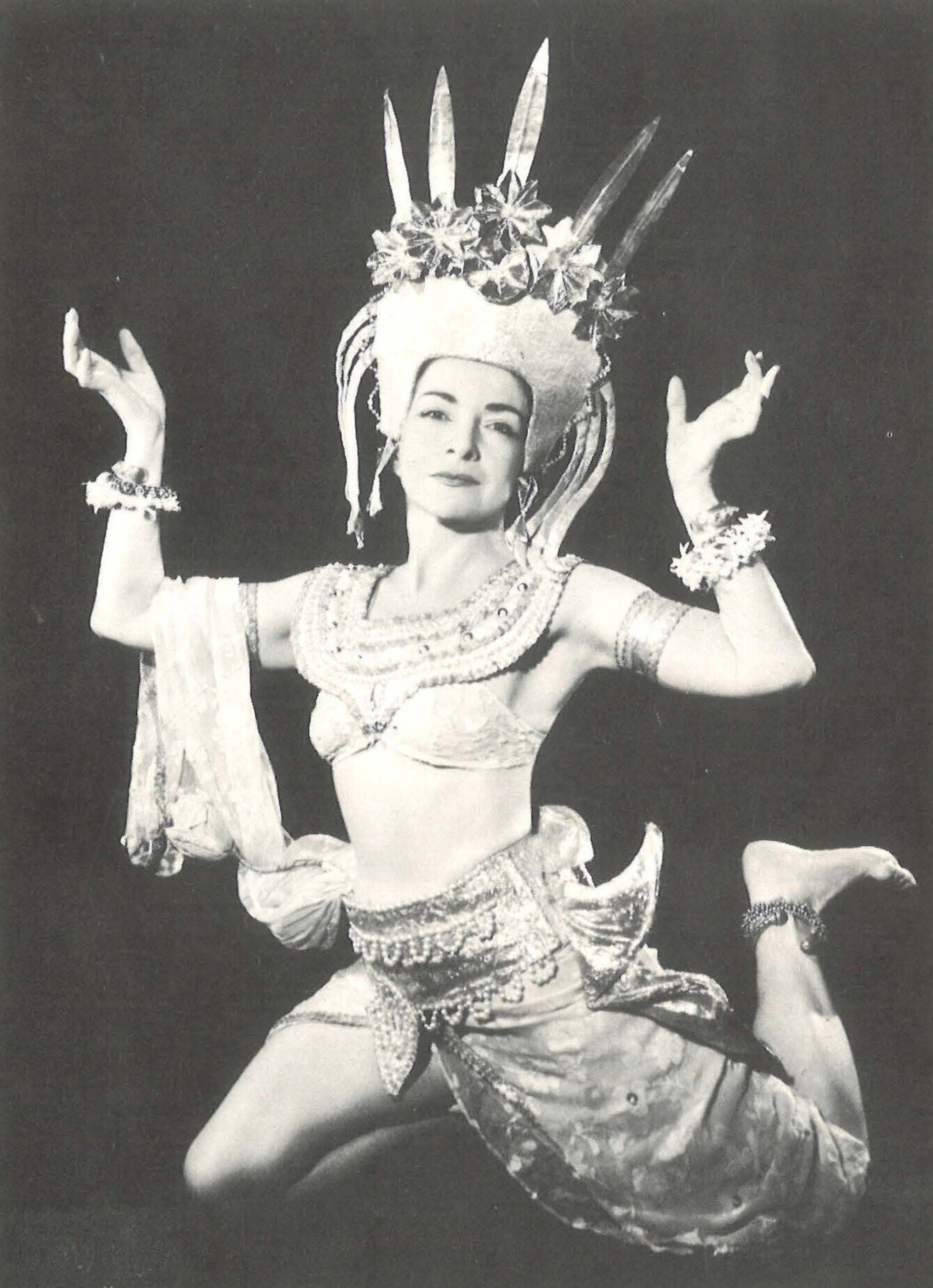
Xenia Zarina born June Zimmerman (1903, Wisconsin, USA – August 15, 1967, Mexico City) was an American dancer and dance instructor who studied in depth the classic dances of Southeast Asia, India and Japan.
The daughter of Russian-born emigres whose father, Oliver Brunner Zimmerman, was a professor at University of Wisconsin and a military engineer during World War I, she studied ballet dancing with famed Russian choreographer and dancer Mikhail (Michel) Fokine (11 April 1880 – 22 August 1942) in Chicago.
After numerous appearances in the US as a classical and “interpretative” performer, first with the Chicago Opera Civic Ballet, and appeared as a dancer in the movies Morning Judge (1926) and Chucho el Roto (1934. Moving to Mexico, where she headed the dance division of the Department of Fine Arts of the Mexican Government, For her New York début at the Guild Theater in January 1935, she performed Mexican regional dances and original compositions such as “Dance of the Goddess Xochiquetzal” or “Prayer to the Brown Virgin.”
Unlike Kentucky-born dancer-choreographer La Meri — Russell Meriwether Hughes,13 May 1899 – 7 Janu. 1988), who claimed to have coined the term “ethnic dance”, performed at Bangalore’s Opera House in 1937, and made her name by abundantly publishing texts on the subject, Xeni Zarina focused on mastering the techniques and prioritizing teaching over performing.
At that time, she started to travel extensively across Asia to better understand the ‘technique and soul of the classic dances of the Orient’, studying, teaching and performing the dance forms of each country she visited. In India, she befriended St-Petersburg-born Magda Nachman Acharya (20 July 1889-12 February 1951), a Russian visual artist and theater set designer who had met and married the Indian nationalist M.P.T. Acharyawa in 1921 in Moscow, moved with him and Berlin and took refuge from the Nazis in Bombay in 1934. Xenia was particularly interested in South Indian Bharatanatyam dance form.
The experience was followed by Thailand, Cambodia (1937) — where she studied with Princess Song Sangvann’s ballet in Phnom Penh and Angkor -, Bali, Java and Japan, where she was initiated to Nihan Buyo art by master Matsumoto Kōshirō. As World War II was preventing international travels, she stayed in Iran, becoming dance instructor to the daughter of the Shah and working with the Ministry of Education.
Back to Mexico and the US, Xenia Zarina gave some performances but mostly concentrated on her educational activities. Her book, Classic Dances of the Orient, was published in New York in 1967 shortly before her death in Mexico City on 15 August 1967.
1) Xenia Zarina in full-bloom lotus expression at Angkor Wat in 1937 [photo credited to ‘Lindquist’ in Classic Dances of the Orient]. 2) In the ‘Apsara flying posture’ later in Xenia Zarina’s life, after her return to Mexico [photo by Semo, ibid.].
1) Xenia Zarina in full-bloom lotus expression at Angkor Wat in 1937 [photo credited to ‘Lindquist’ in Classic Dances of the Orient]. 2) In the ‘Apsara flying posture’ later in Xenia Zarina’s life, after her return to Mexico [photo by Semo, ibid.].
1) Xenia Zarina in full-bloom lotus expression at Angkor Wat in 1937 [photo credited to ‘Lindquist’ in Classic Dances of the Orient]. 2) In the ‘Apsara flying posture’ later in Xenia Zarina’s life, after her return to Mexico [photo by Semo, ibid.].