Classic Dances of the Orient: Royal Cambodian Dances
by Xenia Zarina
An informed and perceptive study on 'dances of the Orient', notably Cambodian, by a Russian-American professional dancer who visited the region in the 1930s.
Author
Xenia Zarina
Publisher
New York, Crown Publishing Inc.
Published
1967
Book Edition
Chapters on Cambodia, Thailand, Java, Bali (130 p), digitized by Angkor Database (2025)
Sir Gerald Kelly, the Irish painter, visited Cambodia in 1936 – 1937 during a world tour, painting several portraits of dancers from the Phnom Penh Royal Ballet which got often confused with Burmese dancers as the renowned artist had spent several years in Burma (nowadays Myanmar). At the same time, dancer Xenia Zarina reached Phnom Penh, herself coming from Siam-Thailand, part of her own Asian tour to get a better grasp of what had been labeled “Oriental — or, especially in America, Exotic dance’. In her book written two decades later (published in 1967), she showed a rare perceptiveness in the description of Cambodian classical dance, and we’ll start with the chapter on Cambodia — coming after the one dedicated to the ‘Royal Thai Ballet’ and before the one on ‘Court Dance of Java’ [p 58 – 88] -, developing this entry later with the author’s considerations on Indian, Thai, Balinese, Javanese and Japanese dances at the time.
This how the author relates her first exposure to the Phnom Penh dance scene in 1937 — probably in November and December, as she vividly described the Water Festival celebrations (see below) and was invited to a dance performance on King Sisowath Monivong’s birthday, 27 December — :
In 1937 George Groslier was director of the lovely Albert Sarraut Museum at Pnompenh. A distinguished artist, painter, writer, and connoisseur of Cambodian arts who has done invaluable work for Cambodia, M. Groslier has also written and illustrated a splendid book, Danseuses Cambodgiennes. He arranged for me to have lessons with Princess Say Sang Van [or Sangvann], the favorite dancer in the Royal Ballet. She was married to the brother of the King of Cambodia, but after domestic disagreements, she left the court. The French Colonial Government had for some time been in an embarrassing position: the fame and beauty of the Cambodian dances had spread to Europe, and now distinguished visitors came to visit Cambodia and wanted to see the dances. They had made a long and difficult journey, and the Cambodian dancers were a strong drawing card. The French Colonial Government could not ask the King to produce the Royal Ballet, which was part of his royal household, just to please strangers he had never heard of. So the visitors most often had to leave Cambodia disappointed in their hope of seeing the Cambodian ballet.
Now Princess Say Sang Van was just the solution to the problem. The French were delighted by her change in social position, and were quick to endow her to organize a ballet trained in the court tradition which would be available to the French Colonial Government when needed. This meant security for the Princess and satisfaction for the visitors, as well as new stimulation of Cambodian dance art. But for this happy circumstance, I would have had the utmost difficulty in studying Cambodian dance. As it was, it took half my energy to have even irregular lessons. Often I would go on the appointed day only to find that the Princess and the whole ballet had vanished. The servant did not speak any French, and explained to me by waving his hands in the air. Presumably the ballet had flown off to other regions, like the carved Apsarases at Angkor where whole ballets soar joyously across the skies, arms and feet daintily raised in the “flying” pose. Then, suddenly, the Princess and ballet would reappear and my lessons would continue until the next “flight.” [p 61]
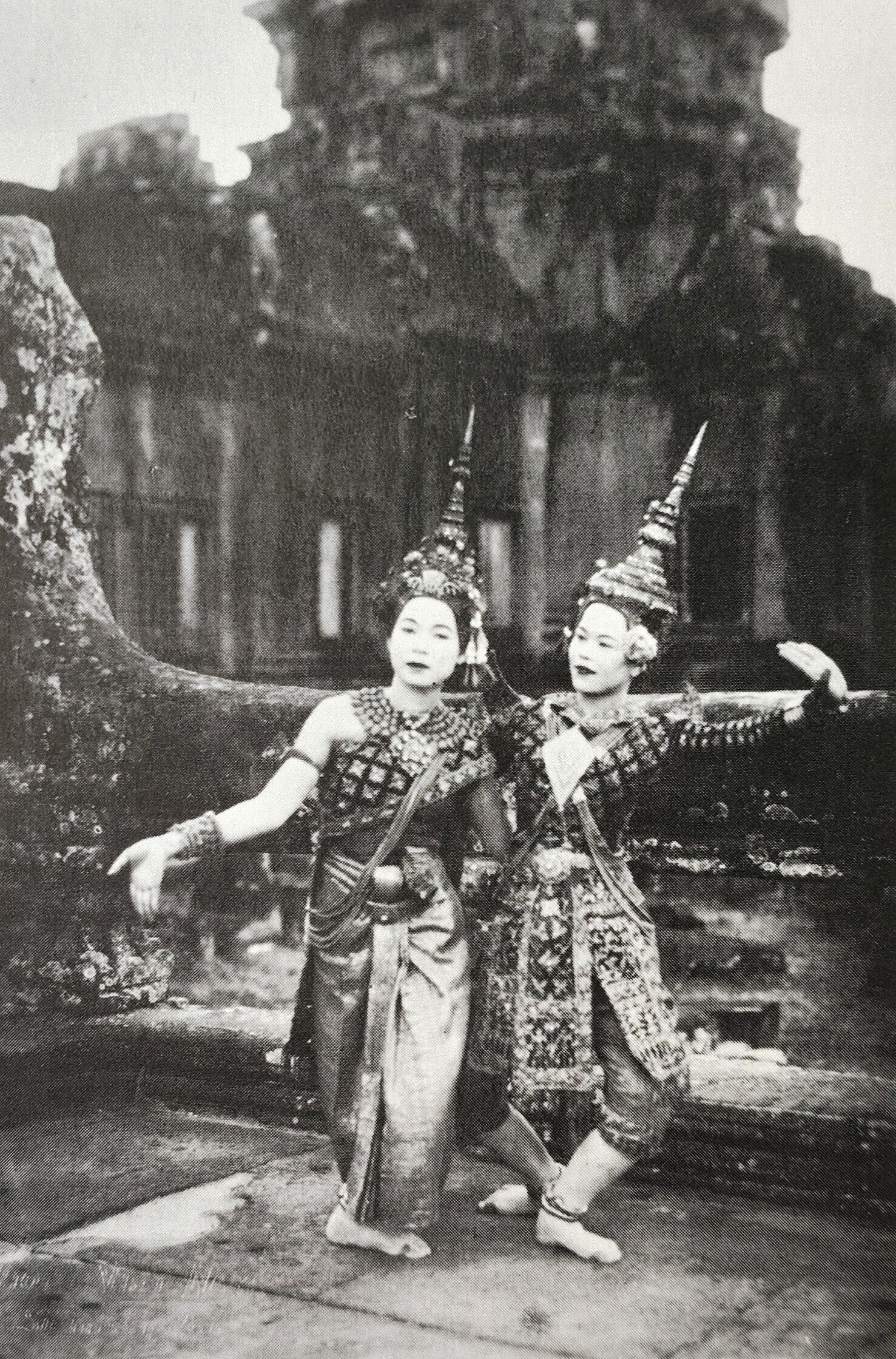
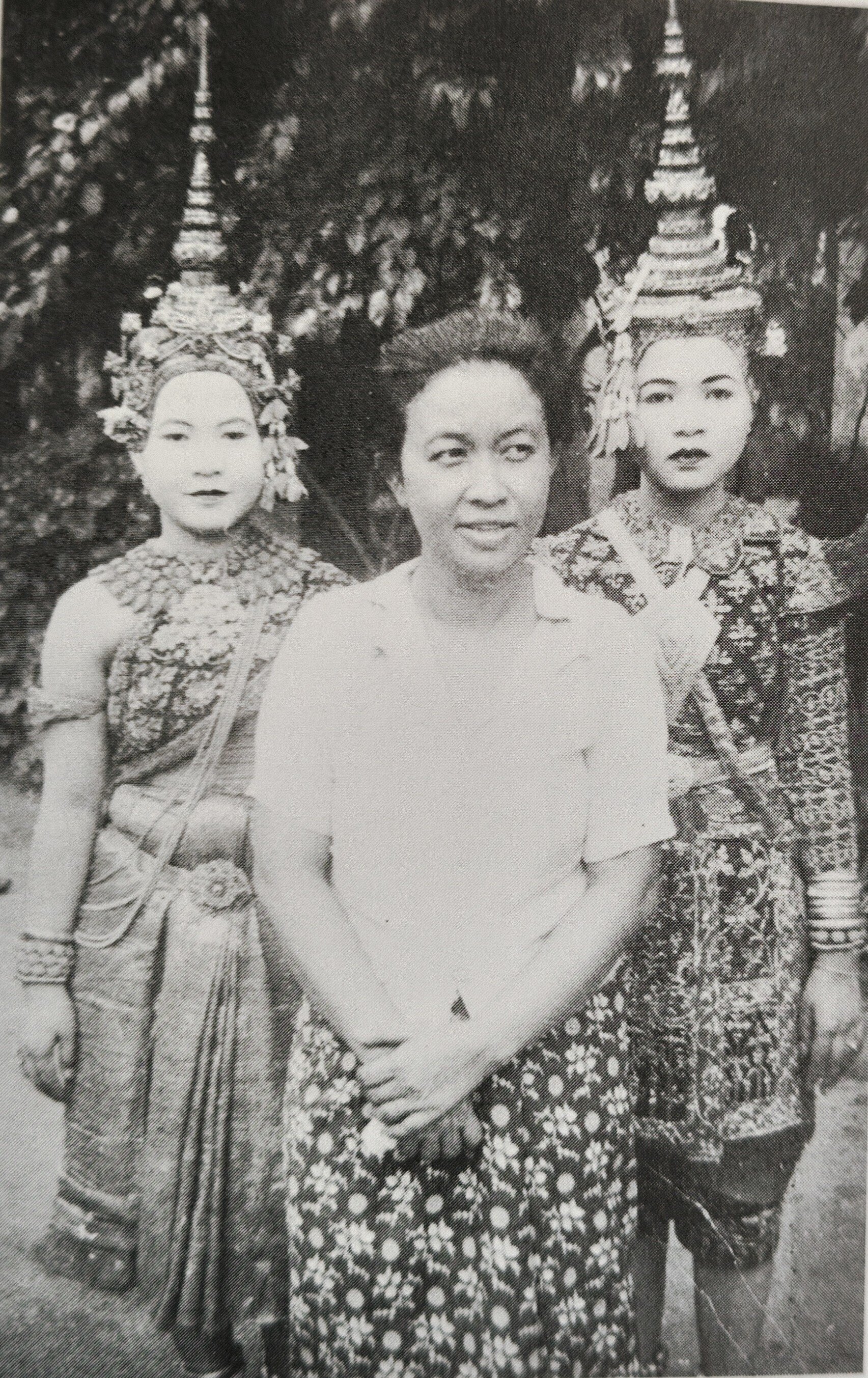
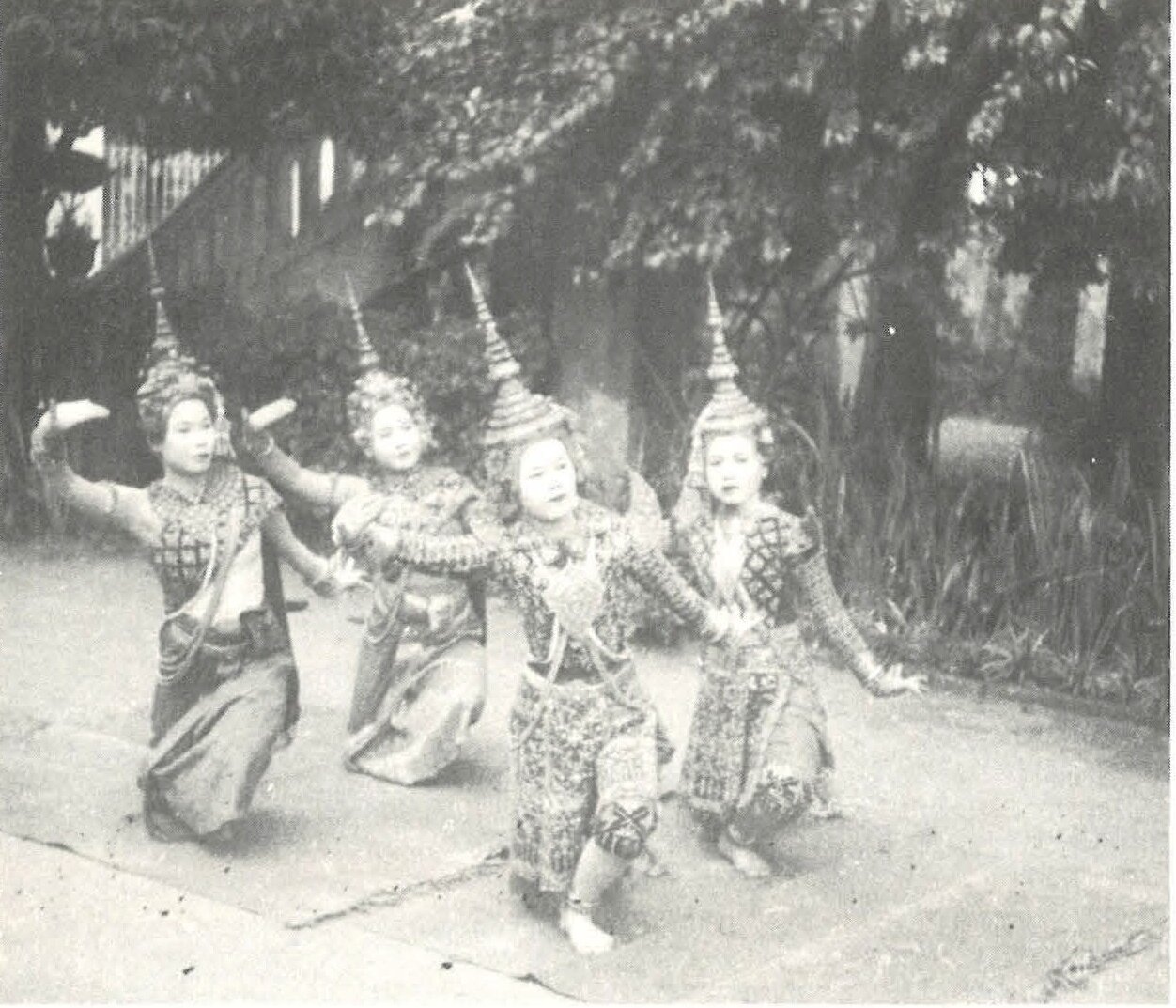
2) ‘Elopement scene at Angkor’ by the Princess’ ballet. [‘photo by Siemréap-Angkor’]. 1) Princess Say Sangvann and two of her dancers [uncredited photo in the book, seemingly taken in Paris and given to the author by Princess Say Sangvann].
2) ‘Elopement scene at Angkor’ by the Princess’ ballet. [‘photo by Siemréap-Angkor’]. 1) Princess Say Sangvann and two of her dancers [uncredited photo in the book, seemingly taken in Paris and given to the author by Princess Say Sangvann].
2) ‘Elopement scene at Angkor’ by the Princess’ ballet. [‘photo by Siemréap-Angkor’]. 1) Princess Say Sangvann and two of her dancers [uncredited photo in the book, seemingly taken in Paris and given to the author by Princess Say Sangvann].
A note on Princess Say Sang Van and Saem (Sem), one of her dancers
A former dancer of the Cambodian Royal Ballet herself, Princess Say Sangvann អ្នកម្នាង សយ សង្វាន was the then estranged wife of Prince Sisowath Vongskhat ស៊ីសុវត្ថិ វង្សខាត់ (1887- 29 Jan. 1948),King Sisowath Monivong’s youngest brother, son of King Sisowath and the sovereign’s fifteenth (out of twenty) wife, Anak Munang Samrit [they had been married supposedly in 1927]. Secretary and Adjutant to the King in 1927 – 1932.
Princess Sangvann had directly experienced the crisis inside the Royal Ballet provoked by the attempts of the French colonial administration to take control over the royal troupe, as documented by George Groslier in 1927 – 1928. When Xenia Zarina spent several weeks with the Princess and her 18 dancers, the new troupe was trying to find its own voice between lealty to the king and the French administration’s push to transform it in an attraction for privileged tourists.
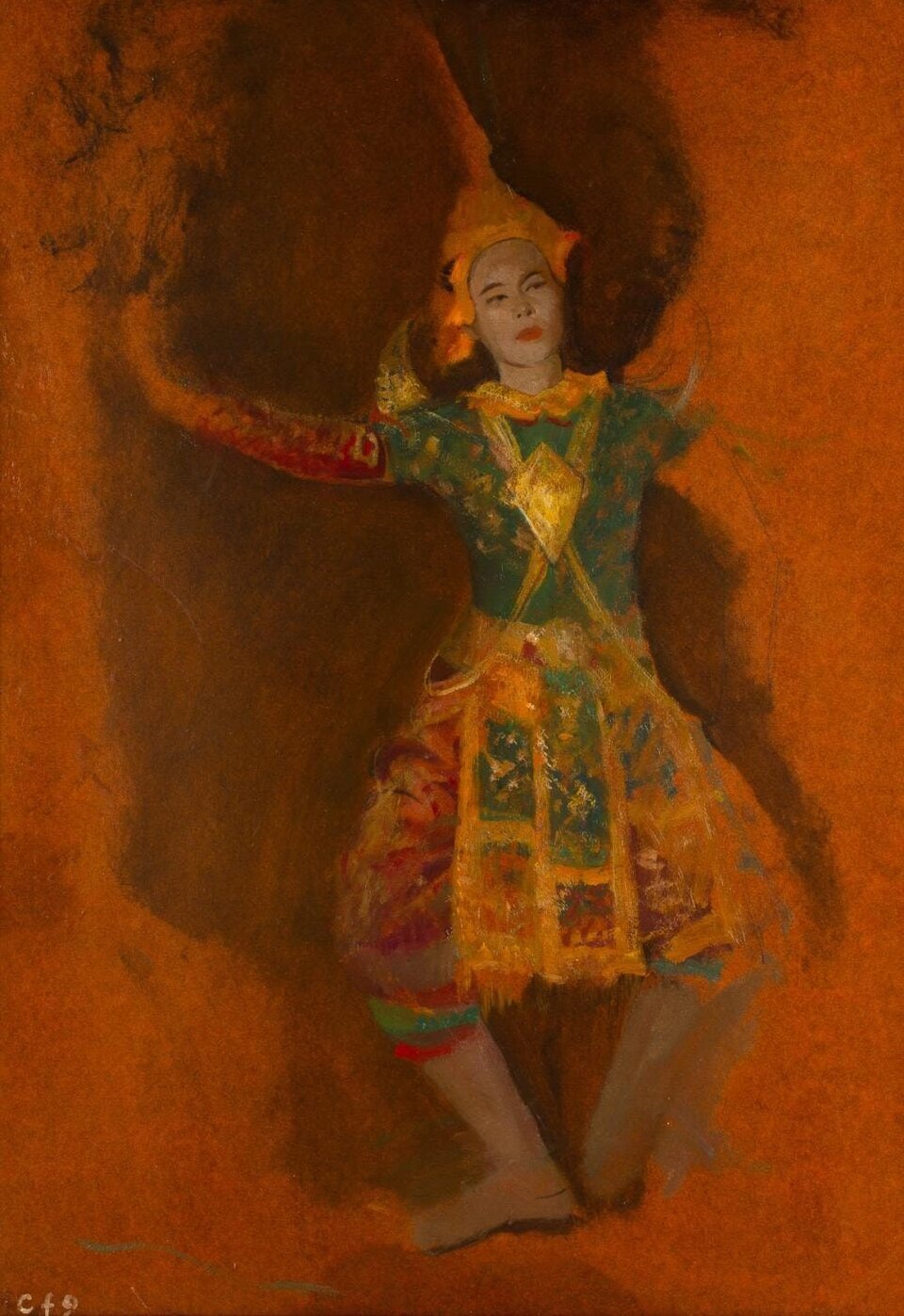
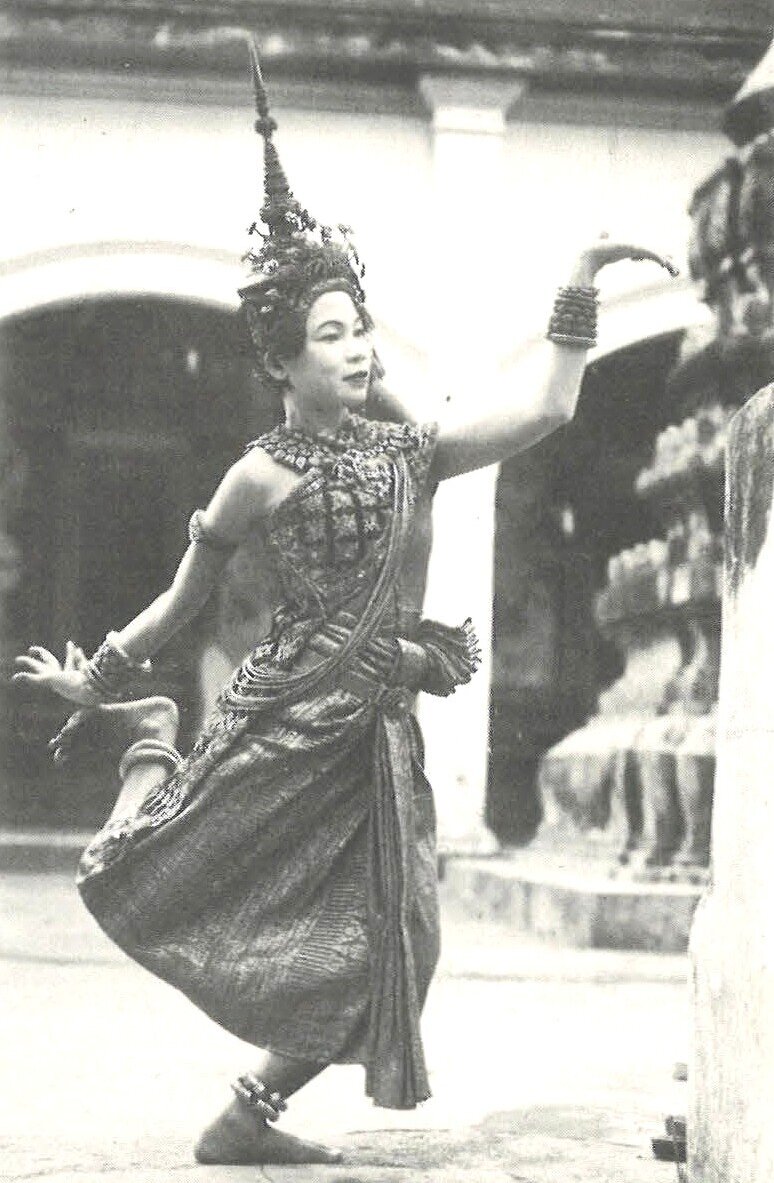
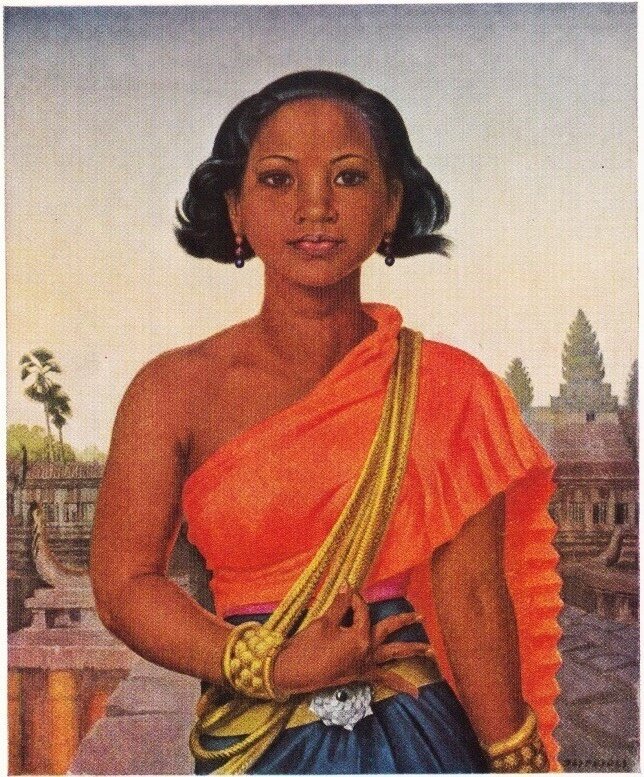
The visiting dancer and authoress of the book remarked, without naming her, “the star of Princess Say Sangvann’s troupe in flying attitude, right hand in hamsasya, left hand pataka.” At about the same time, Sir Gerald Kelly was painting sketches of the same dancer, ‘Sem’, Saem សាអែម, whom the princess had adopted as a foster child. And, also in 1937, French artist Jean Despujols portrayed Saem on a bridge at Angkor Wat, as researcher Kent Davis was able to identify her on a iconic painting.
1) Sketch for a portrait of ‘Sem’ by Sir Gerald Kelly, 1937. 2) ‘Star of Princess Say Sang Van’s troupe in flying attitude, right hand in hamsasya, left hand pataka’ [1937 uncredited photograph from Xenia Zarina’s book, probably taken in Siem Reap, p 82] 3) A painting of a Cambodian dancer near Angkor Wat, by Jean Despujols, 1937.
1) Sketch for a portrait of ‘Sem’ by Sir Gerald Kelly, 1937. 2) ‘Star of Princess Say Sang Van’s troupe in flying attitude, right hand in hamsasya, left hand pataka’ [1937 uncredited photograph from Xenia Zarina’s book, probably taken in Siem Reap, p 82] 3) A painting of a Cambodian dancer near Angkor Wat, by Jean Despujols, 1937.
1) Sketch for a portrait of ‘Sem’ by Sir Gerald Kelly, 1937. 2) ‘Star of Princess Say Sang Van’s troupe in flying attitude, right hand in hamsasya, left hand pataka’ [1937 uncredited photograph from Xenia Zarina’s book, probably taken in Siem Reap, p 82] 3) A painting of a Cambodian dancer near Angkor Wat, by Jean Despujols, 1937.
1) Sketch for a portrait of ‘Sem’ by Sir Gerald Kelly, 1937. 2) ‘Star of Princess Say Sang Van’s troupe in flying attitude, right hand in hamsasya, left hand pataka’ [1937 uncredited photograph from Xenia Zarina’s book, probably taken in Siem Reap, p 82] 3) A painting of a Cambodian dancer near Angkor Wat, by Jean Despujols, 1937.
Being a Khmer classical dancer in the 1930s
We can find precise and elegant notations on the routine of the troupe, the teaching sessions for younger girls, the rehearsals, all held at the Princess’ house when the ballet was not touring, especially during the touristic season. After quoting from Danses Camnbodgiennes “by His Excellency Samdach Chaufea Veang Thiounn who was Prime Minister at the time of my visit to Cambodia, and an ardent devotee of the Cambodian dance”, the author remarks
This elaborate ceremony takes place inside the Royal Palace. At Princess Say Sang Van’s, the same ceremony in simpler form is enacted. My own lessons were accomplished thus : After watching the ballet practice in slow and fast tempos, and rehearse dances or a ballet dance drama for a coming performance, I had a private lesson in slow tempo, fast tempo, and in excerpts from dances and miming. The Prima Ballerina danced and I followed, Madame Say Sang Van following me and correcting my positions as I danced. This was an excellent system, and I learned rapidly in a short time. Later the Princess invited me to follow the dancers during their rehearsals. This was extremely interesting and valuable as training, for I suddenly found myself part of a group, coordinating my movements with theirs and with the music. The Prima Ballerina [certainly Saem, then] was an exquisite dancer, kind and helpful as well. We became very good friends although we could hardly converse. I could understand and speak only a few words of Cambodian; she, who had gone to Paris to dance in the Colonial Exposition of 1931, knew about as much French as I knew Cambodian. However, the dance is an international language, and we understood each other perfectly in that. After my lesson, at Princess Say Sang Van’s request, I would demonstrate and teach her and the Prima Ballerina classic European ballet.
A candle and incense are always lit at the beginning of a lesson and rehearsal, and burn on until the lesson is over. The dances are recorded in precious handwritten books, some of them very old, and kept wrapped in fine silks and brocades. These books are never opened without the ceremonial salute, the Anjali, being made before them. The royal dancers live in the palace enclosure and never leave it except on certain occasions or by special permission, since they form part of the royal household, but Madame Say Sang Van’s ballet of eighteen dancers lives in her house. They are much freer than the palace dancers, and even go shopping at times. While not dancing or rehearsing, they make themselves useful in other ways: caring for the house and garden and making new costumes. One day when I arrived for a lesson, several were working at frames, sewing pure gold beads in ancient patterns onto velvet for new scarf-capes. The Princess showed me a small but heavy package of pure yellow-gold beads, and complained how expensive they had become.
The dancers also flex each other, bending back fingers, wrists, elbows, and toe joints. The fingers are turned back nearly to touch the forearm, although in actual dance so extreme a flexation is never used, just as ballet dancers execute certain stretching exercises in the studio that they never show on the stage, for aesthetic reasons. When a dancer becomes old or incapacitated, she may retire to her former home, or remain in the palace as teacher or wardrobe mistress.
The Royal Ballet traditionally has been composed of 8 ballet mistresses, 108 dancers, 2 comic mimes ( the only masculine elements in the ballet), 2 teachers of singing, 2 first singers, 2 readers, 24 choristers, 12 dressers, 4 guardians of jewels and costumes, 9 male musicians, and two chefs d’orchestre who are also considered part of the Royal Ballet. As already mentioned, regional governors sometimes maintain their own ballets. There are also some small troupes in different localities of local girls trained by a retired palace dancer, who dance for Cambodian festivals.
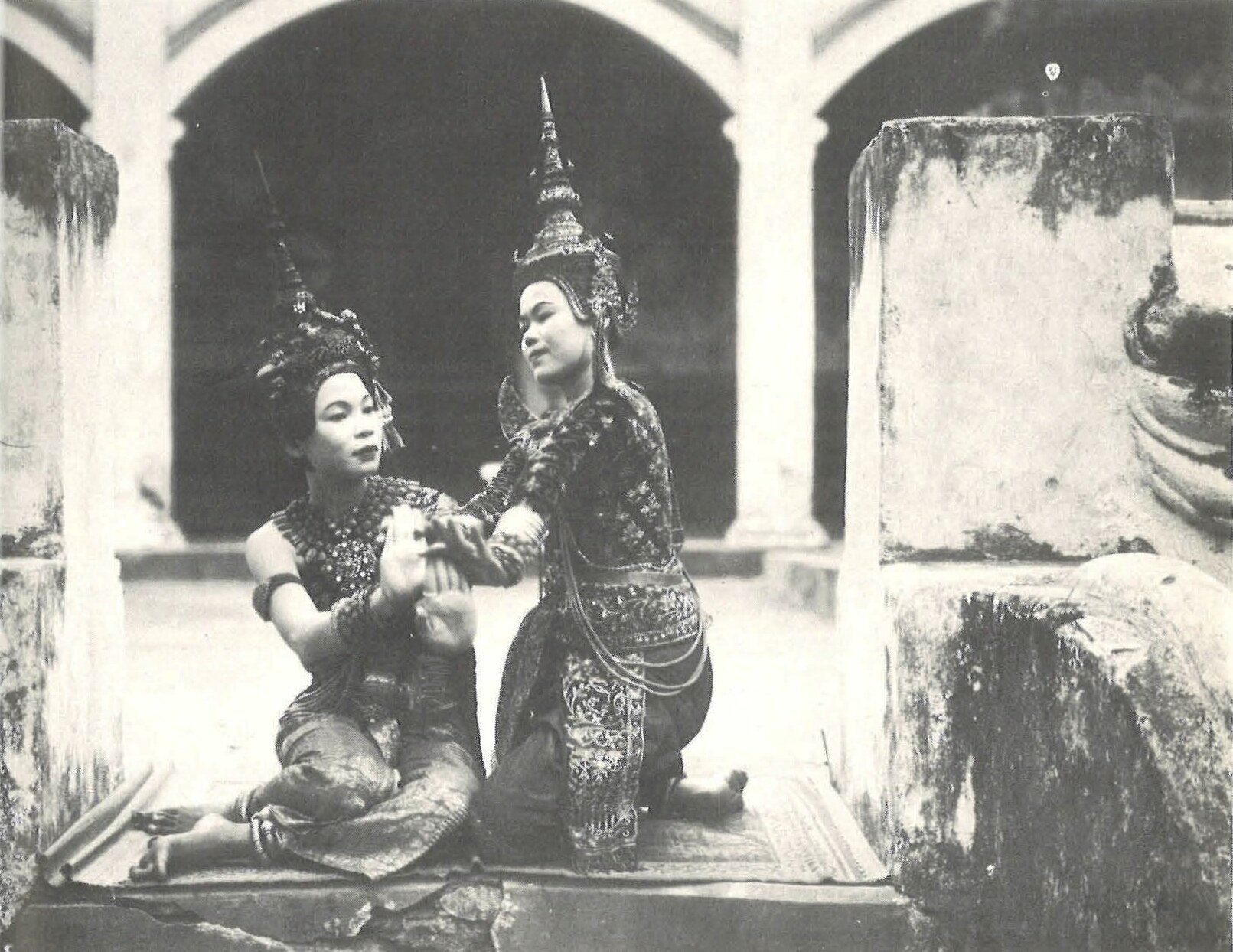
1) ‘Princess Say Sangvann’s ballet, right hand in pataka, left in hamsasya.’ [uncredited photo in the book]. 2) ‘Love scene between a prince and a princess (hands in pataka mudra). (photo by Siemreap- Angkor).
1) ‘Princess Say Sangvann’s ballet, right hand in pataka, left in hamsasya.’ [uncredited photo in the book]. 2) ‘Love scene between a prince and a princess (hands in pataka mudra). (photo by Siemreap- Angkor).
1) ‘Princess Say Sangvann’s ballet, right hand in pataka, left in hamsasya.’ [uncredited photo in the book]. 2) ‘Love scene between a prince and a princess (hands in pataka mudra). (photo by Siemreap- Angkor).
The life of these dancers is quite different from that of the royal dancers. They live in towns or villages, and engage freely in any occupation usual for a Cambodian woman. Some are even married. Their repertoire is the same as that of the royal dancers, but the technique is naturally less fine and the costumes less beautiful and expensive. As in all lands and at all times, there are also itinerant troupes. In Cambodia, the classic dance is called Lakhon and is the same as the Thai Lakhon, the classic dance performed by women. Dance mistresses are also called Lakhons. Th.-B. van Lelyveld, in his book on Javanese dance, quotes a statement that Thai are engaged to teach the dance to the Royal Cambodian ballet. This is often true, for the dance is brilliantly preserved in Thailand, and is practiced and understood more thoroughly than in Cambodia. On pages 39 and 40 of his book La Danse dans le Theatre Javanais he makes, however, several statements regarding the Cambodian dance that are inexact. Javanese dance does not “resemble” Cambodian dance, but is vastly different. Further, Cambodian dancers have no marche a grands pas like the Javanese actor-dancers, and they do not wear a sarong for the dance or in daily life. The sarong is a Malay garment, worn exclusively by Malay peoples in the Malay States, Sumatra, Java, and all of Indonesia, Thailand, and Cambodia. But native Cambodians and Cambodian dancers wear the sampot or the panung, a garment different in size, pattern, and manner of wearing. [p 64 – 5]
The first Cambodian dance performance I saw was one whose presentation was directed by impeccable French taste. It was Princess Say Sang Van’s ballet, and was danced at the foot of the Pnom on a platform built for the purpose. The pale-gray stupa in the background high above was lit by floodlights hidden among the trees. The soft Cambodian wind was perfumed with the scent of flowering trees. The dancers, in gold brocade and jeweled costumes lit by spotlights, were entrancing in that natural setting. Their golden headdresses repeated again the form of the stupa in the background, and the stupa itself, under the floodlights, appeared translucent — a faery thing. The next occasion was during the Fête des Eaux, the “Fête of the Waters.” [see below] [p 61 – 2, 64]
Origins, and Women’s preeminence in Khmer classical dance
Opening her chapter on the Royal Thai Ballet, the authoress had clearly stated
Historically, the dance came to Thailand through the great Khmer Empire. Extinct a thousand years now, the superb ruins of the Khmer cities lay lost in the rampant forest until Henri Mouhot rediscovered them in 1860, and brought these amazing wonders to the attention of the world. […] When the Thai (Siamese) attacked and conquered the Khmer Empire (ancient Cambodia), they were themselves conquered by the beauty of Khmer arts. Among the 90,000 prisoners of war were artists and artisans whom the Thai carried home with them to embellish their capital. But of all the arts, it was especially the dance that the Thai loved and cultivated.
The dance had come to the Khmers with the Siva cult from India. Those great temples scattered through the forest for hundreds of miles were built to the glory of Siva. One of the temples supported, according to record, a ballet of 625, including musicians, since the dance played a very important part in the Siva ritual. The kings, nobles, and provincial governors also had their private ballets for entertainments on festive occasions. When the purifying wave of Buddhism rolled over the land, the temple rituals were simplified and the dance excluded from religious services, but it continued at the courts, and probably each village had its local ballet as many do today. These ballets were, and still are, the theatre of the people. Dance dramas are the theatre and much more, for they contain the literature, the poetry, the history, the beloved myths and legends of a glorious past. [p 34]
With much perceptiveness, the book developed the distinctive yet interweaving ways the dance form, stressing the centrality of women in dance performance and its representations. Interestingly, the author is led by thistrait ‘back to ancient India’, while modern researchers have stressed that it is more indicative of ancient, vernacular social traditions :
The sculptured walls of the Khmer cities decaying in the forest testify to the place the dance held in that civilization. There are literally thousands of carved dance scenes: religious ritual dances, court dances, dancers at play in a garden, celestial dances, as well as decorative friezes of dancing girls (Apsarases) , and Tevadas or Devatas (celestial beings) , standing serenely in their niches with enigmatic smiles on their lovely sensuous faces. The Bayon (temple of Siva) in Angkor Thom has a wall carved with one especially intriguing scene: a large panel representing the daily life of court dancers. Amid luxuriant vegetation in a closed garden, the dancers are bathing, arranging their hair, being massaged, exercising, and playing.
A point to remark is that all these thousands of sculptured dancers are always female. I did not see a single representation of a male dancer in any of the ruins I visited in and around Angkor. This is accounted for by the fact that the Khmer temples were dedicated to Siva and Vishnu (later to Buddhism) and these two cults employed girl dancers (Devadasis) in the temple ceremonies, a tradition still observed in South India today. The Court dancers were undoubtedly part of the “harem” of the king or noble, as they are to this day in the Royal Palace of Cambodia. The Royal Ballet is, in fact, under the absolute direction of the king’s first wife. Since the dance played such an important part in Khmer life, it is reasonable to suppose that even the great disaster that made them abandon their sumptuous cities could not entirely destroy their beloved dance art. The Siva cult still needed ritual dances, and kings and courtiers still craved the diversion of the dance, for it was much more than mere entertainment. They carried the dance with them wherever they fled, and preserved it tenaciously. When they settled again under Siamese rule, Cambodian kings and princes became local governors, and maintained their private ballets as they still do today.
As in the past, the ballets are always composed of women dancers.This is remarkable since in Japan, China, Java, Bali, and Thailand it is always the men who are the great actors and dancers, who carry on the most classic traditions of the dance drama. In certain lands and epochs, women have been entirely banned from appearing in theatrical entertainments. In Thailand, which shares the same cultural heritage as Cambodia, the most classic form of the dance, the Khon, is always danced by men. The explanation of this Cambodian dance phenomenon opens a trail leading back to ancient India with its traditions and customs relating to the dance. [p 60 – 1]
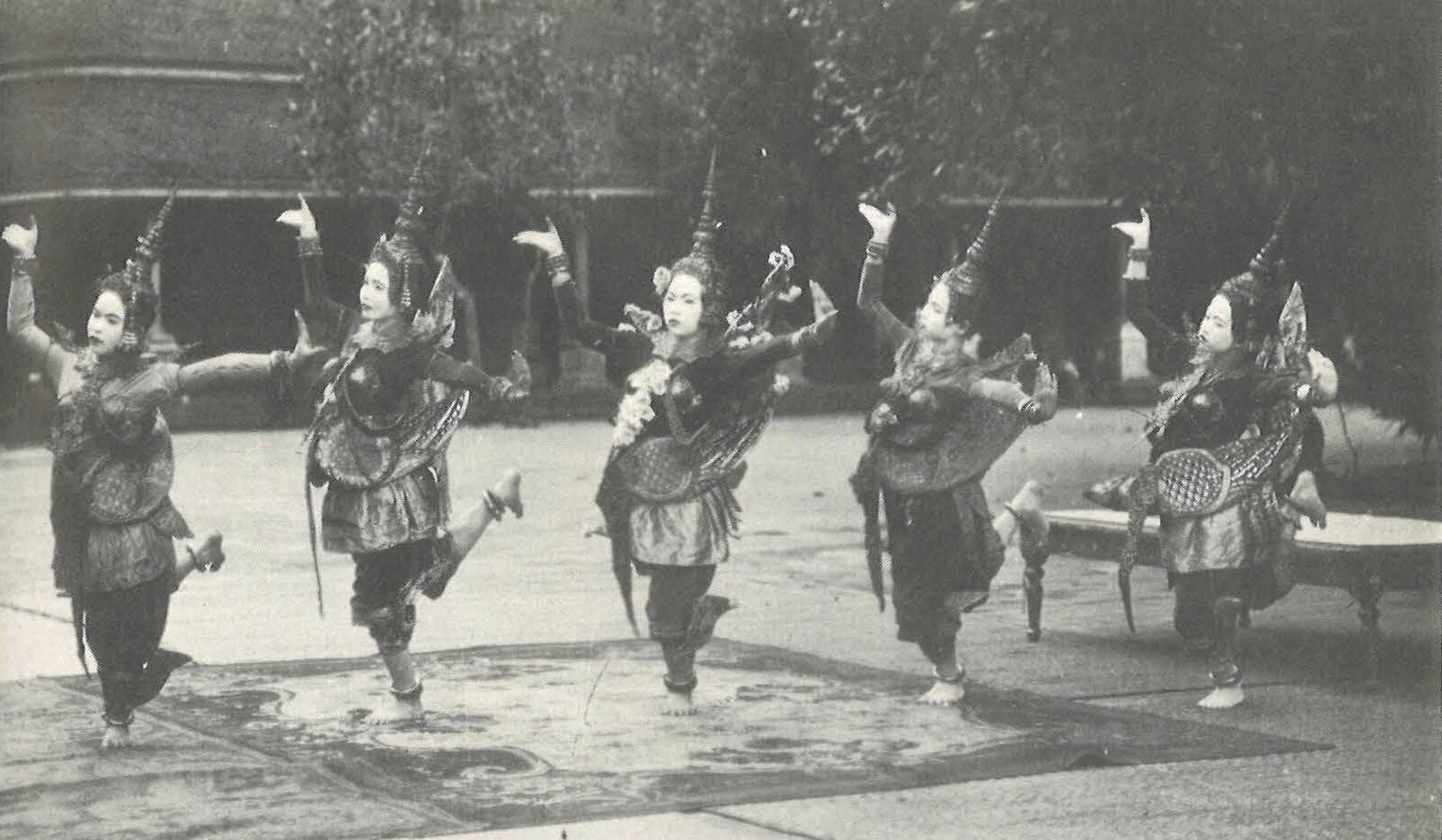
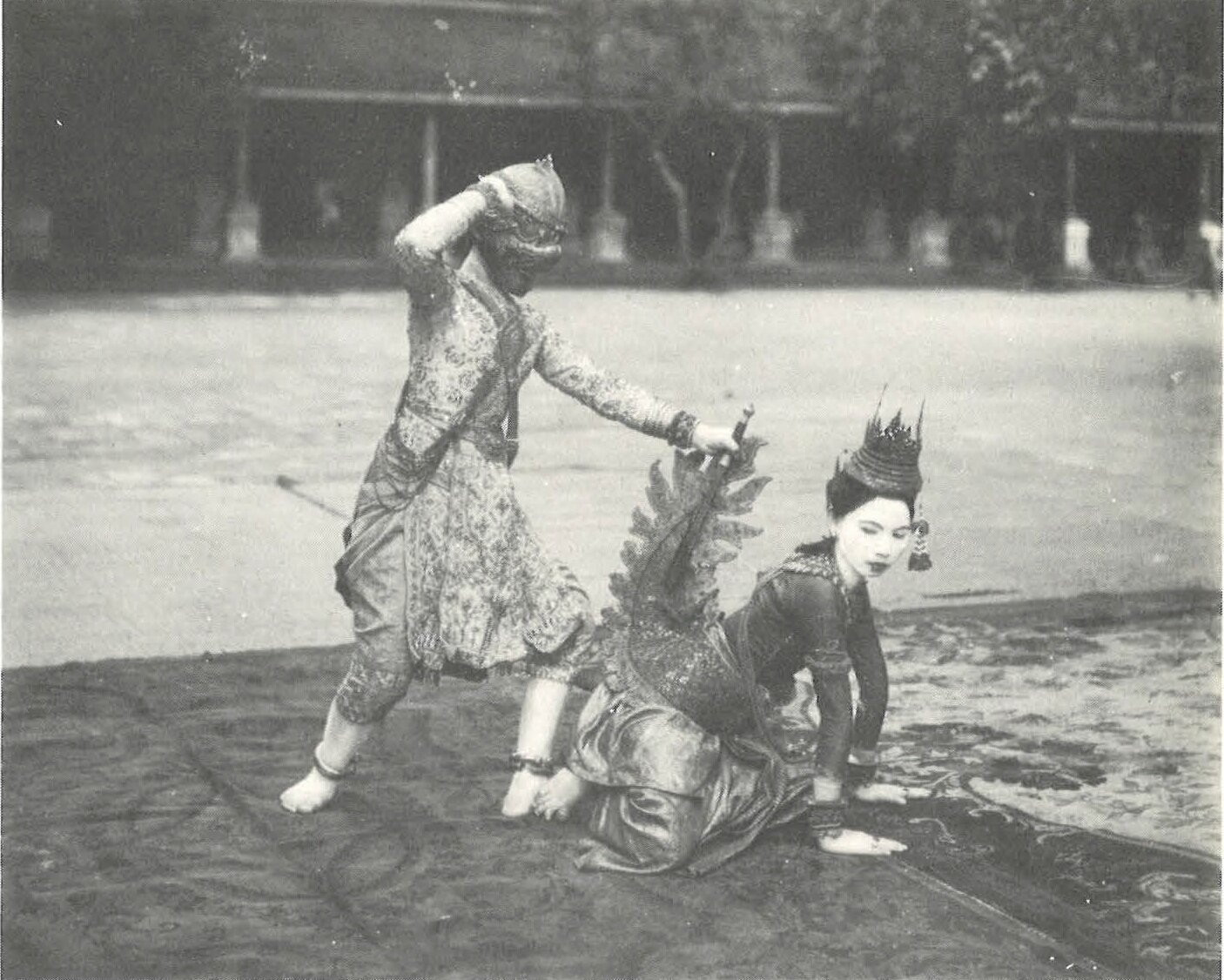
1) ‘Kinnari “flying” in a patio of the Royal Palace, Pnompenh, Cambodia. (photo by Musée Economique). 2) ‘Love scene between Hanuman and Nang-Ma-Tcha. Photo taken in a patio of the Royal Palace, Pnompenh, Cambodia. (photo by Musée Economique)’ [ADB: this scene from the Reakmer presents the encounter between Hanuman and mermaid Neang Maccha or Sovann Maccha. The Sovann Maccha Dance របាំសុវណ្ណមច្ឆា has always been highly appreciated in Cambodia.]
1) ‘Kinnari “flying” in a patio of the Royal Palace, Pnompenh, Cambodia. (photo by Musée Economique). 2) ‘Love scene between Hanuman and Nang-Ma-Tcha. Photo taken in a patio of the Royal Palace, Pnompenh, Cambodia. (photo by Musée Economique)’ [ADB: this scene from the Reakmer presents the encounter between Hanuman and mermaid Neang Maccha or Sovann Maccha. The Sovann Maccha Dance របាំសុវណ្ណមច្ឆា has always been highly appreciated in Cambodia.]
1) ‘Kinnari “flying” in a patio of the Royal Palace, Pnompenh, Cambodia. (photo by Musée Economique). 2) ‘Love scene between Hanuman and Nang-Ma-Tcha. Photo taken in a patio of the Royal Palace, Pnompenh, Cambodia. (photo by Musée Economique)’ [ADB: this scene from the Reakmer presents the encounter between Hanuman and mermaid Neang Maccha or Sovann Maccha. The Sovann Maccha Dance របាំសុវណ្ណមច្ឆា has always been highly appreciated in Cambodia.]
Water Festival 1937
The author had recounted the first performance of Princess Say Sangvann’s ballet she had seen at the foot of the Phnom (hill) in Phnom Penh, and she went one with the “the next occasion, during the Fête des Eaux, the “Fête of the Waters,” giving us a detailed account of the celebrations:
This takes place once a year when the great Mekong River (one of the longest rivers in the world, which flows from the Tanglha Range in Eastern Tibet into the South China Sea) pauses for a moment and begins to flow backward. The astronomers know what day and what hour this phenomenon will occur, and as the life of Cambodia is intimately connected with the Mekong, everyone takes part in the traditional celebrations, which last a whole week. The town of Pnompenh is decorated.
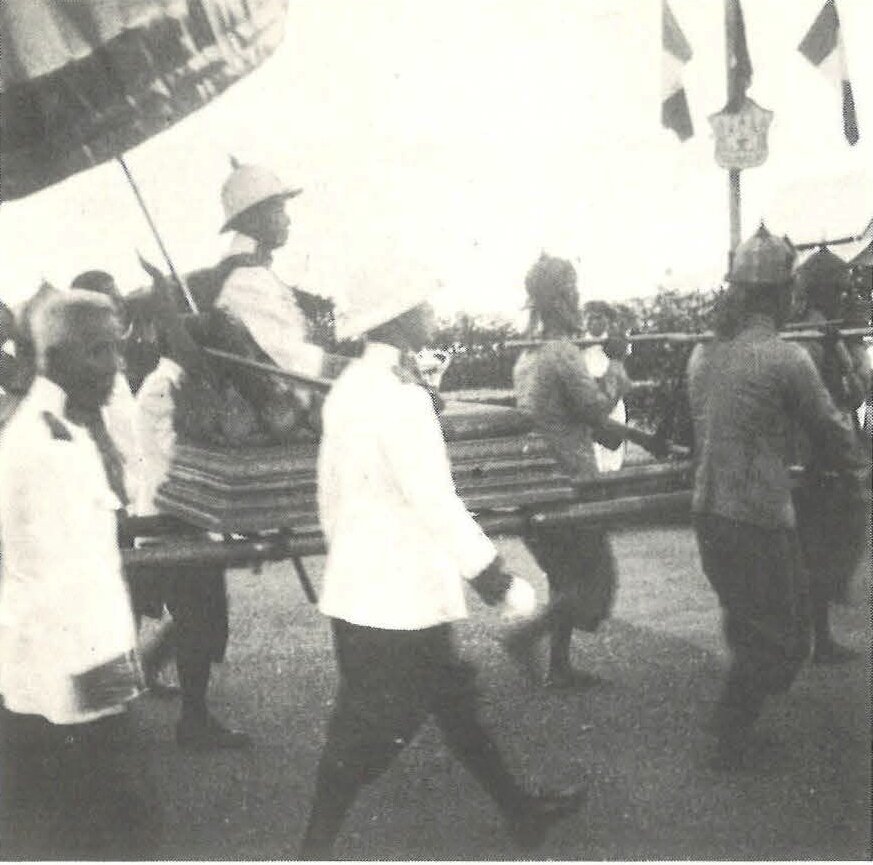
The King changes his residence from the pink-walled palace to the royal houseboat on the river. In a procession of elephants in elaborate trappings, beflowered motorcars, and decorated officials, His Majesty is carried on a golden throne on a gold-lacquered platform borne on the shoulders of many servitors. High over the King is carried the traditional golden parasol, symbol of royalty and sanctity since ancient times throughout the East. The sculptured kings of Angkor have identical parasols over their precious heads. The Achaemenidian kings of Persia, 2,500 years ago, sat under such parasols, and they took their customs from Bablyonians, Assyrians, and Egpytians whose kings were also sheltered by parasols. In the palaces of Java today, the sacred texts and the books wherein the dance and music are recorded are carried under parasols even for rehearsals.
For the Fête des Eaux Cambodians come from far and near, from every province, to take part in or to witness the celebrations. Fireworks and street processions of amusing and clever paper figures, with lantern processions at night, make the town gay. Within the pink-red crenelated walls of the palace enclosure, in a spacious pavilion beside the famous Silver Pagoda, provincial ballets requested for the festivities dance all day. Anyone may come and watch. As the pavilion is open on three sides, the spectators sit where they wish, or where there is room to sit or stand.
The ballets I saw there had excellent and well-costumed star dancers. They danced their very best, for if they pleased some palace talent scout they might be chosen for the King’s ballet which would be a great honor, and their families would be well provided for ever after. There appeared to be quite a large membership in the ballets I saw, and in certain scenes representing processions or a trip to another locality, the whole troupe took part following the leading dancers, getting smaller and younger and less adept and less well costumed until the last tiny tots stumblingly brought up the rear, practically in rags, and doing their best not to forget the dance figures.
On the concluding day of the Fête des Eaux there is a beautiful regatta on the Mekong. Each canoe, extremely long and slender, is painted a different color. The rowers are dressed in uniforms that contrast harmoniously with the color of their canoe, and the oars are painted all of a color on one side with gold or silver on the other, so that their dipping and flashing in the sun are the more accentuated. All these canoes moving down the river are a uniquely beautiful sight. During the race their speed is amazing: each canoe does its best to win the yearly prize, and honor the village or community from which it comes. During the regatta the King and his guests watch from the royal houseboat where the King lives the whole week of the festival.
At the end of the regatta, the winners row alongside the royal houseboat and the King personally bestows the prizes. In the evening after the regatta, there is a display of fireworks on the water; and then, out of the darkness over the river, appears a sight straight from the land of legends: the royal dancers, gleaming in their golden, jeweled costumes, dancing on a floating platform. They drift past the royal barge, past the pavilions on the riverbanks crowded with spectators, and disappear again into the darkness and distance. Only the tinkling, rippling music that accompanied them comes floating back to us. So brief, so lovely, so intangible, the passing of the Royal Ballet, apparently dancing on the water, seemed a mirage — an imagined vision. [p 68 – 9]
Angkor and the contemporary status of classical dance
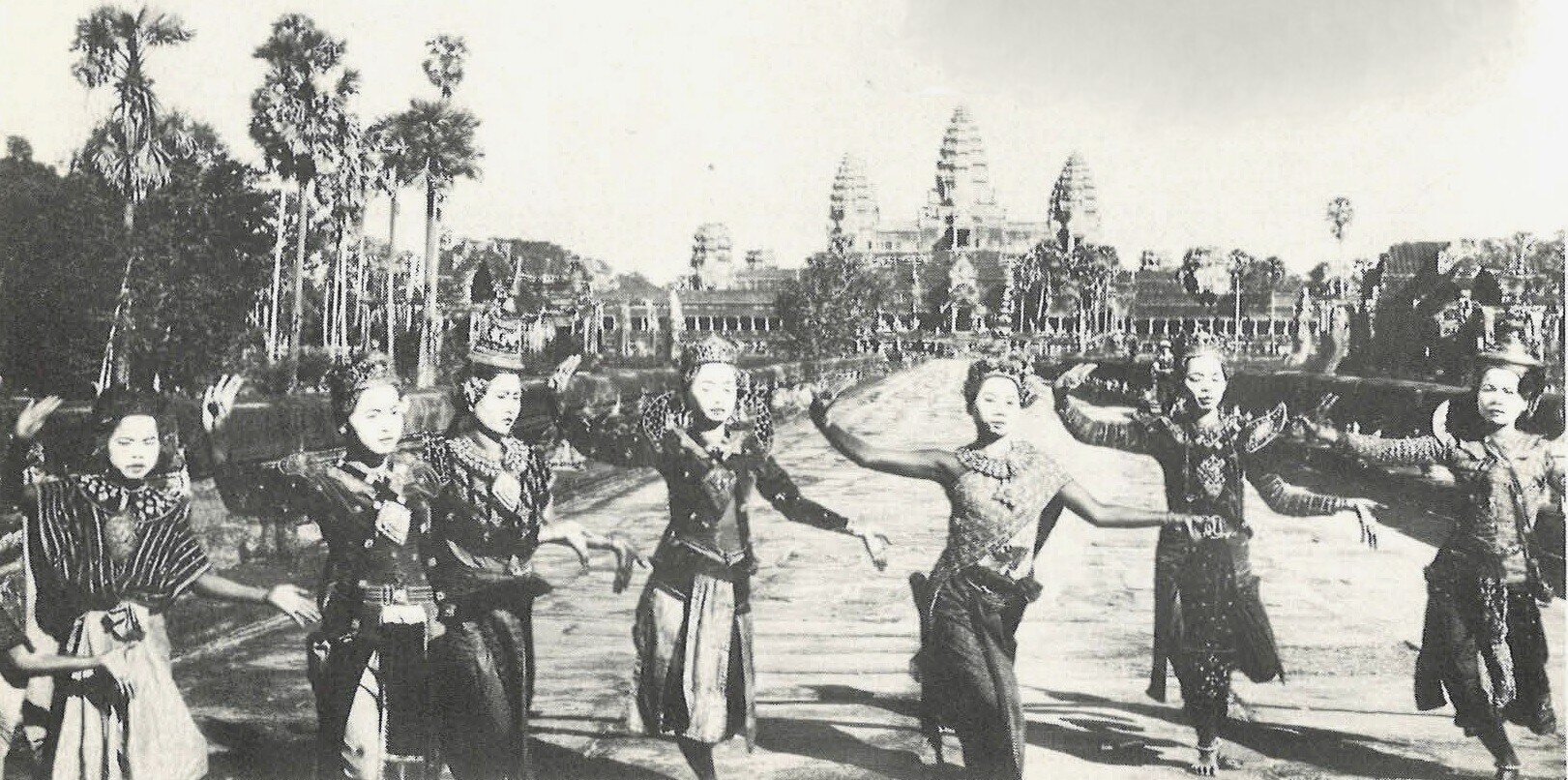
“During my visit to Angkor, Madame Say Sang Van’s troupes came up to dance a series of performances in the evenings on the broad terraces of Angkor Vat, the famed Temple of Angkor”, reported Xenia Zarina [68 – 69] who followed suit and meditated in front of the temples. She was obviously impressed and moved by the performances at Angkor Wat, yet she had this insightul remark:
The idea of having a living Cambodian ballet dance in front of the sculptured walls of their ancestors, the Khmers, was an example of the French aesthetic sense. Magnificently impressive it was, and I have met people on the other side of the world who, when Angkor is mentioned, catch their breath and exclaim: “Oh, I saw the Cambodian ballet dance there one night .… ” But my feeling was that to appreciate fully the art of Cambodian dance, it should be seen in a less imposing setting, for the delicate play of fingers, toes, and eyes was overwhelmed by the stupenduous background of Angkor Vat. [p 70]
The opportunity of this ‘full appreciation’ was her invitation to see the dance performance given at “the charmingly illuminated Royal Palace” of Phnom Penh for King Monivong’s birthday, on 27 Dec. 1937. After describing the setting at Chanchaya Palace and the invited crowd — noting quite smartly that first “the musicians played the Cambodian national anthem and the Marseillaise, the latter, played on Cambodian instruments, sounding very well indeed, although more celestial than martial,” [p 71], she recalled
The orchestra began to play, and suddenly the floor between us and the King was filled with the most exquisite creatures imaginable. They were aglow with gold and little mirrors that flashed lights; the air was filled with the perfume of champaka flowers hanging from their golden mokots (headdresses) and from the jasmine flower bracelets on their wrists. The features of their white-painted faces were dainty, and their expressions of expressionlessness were fascinating. I remembered what Princess Say Sang Van had told me one day during a lesson: “Don’t smile with your mouth. Smile with your eyes.” That was what these royal dancers were doing-smiling with their eyes. How beautiful! The “impersonal” faces were each alive with individuality-with a light that shone from within.
Attendant on the dancers, according to ancient tradition, are two old women. They represent “guardians,” and pick up fallen jewels, straighten costumes, and make themselves useful in other ways during the dance. In Java, also, the tradition of two guardians for the court dancers is conserved.
As the music of the roneats rippled and purred or tinkled like fairy bells or cascaded like celestial rivulets, the ballet moved through lovely groupings: ensemble dances, solos, duets, with intervals of speaking gestures performed on the bed-tables to tell the story of the ballet. The postures were perfect in sculptural harmony and rhythmic flow. There was a love scene on one bed-table enacted by a prince and a princess. According to tradition, the “princess,” with dainty gestures and little screams, rejected the amorous advances of the “prince.”
The King was especially delighted with the girl, a real beauty, who played the part of the prince. He watched her, constantly smiling, and many times during the ballet, beckoned to one of the two guardians, who came hurrying across the dance floor, crouching amid the dancers as inconspicuously as possible, to the King, where she knelt before His Majesty with her hands in Anjali. The King then handed her a package of money, indicating the dancer on whom he wished to bestow it. The old woman would place it on a silver tray, and crouching again inconspicuously among the dancers, would kneel before the chosen one, proffering the tray and the present. The dancer, with no sign of recognition other than a lowering of the eyes to rest for a brief second upon the offering, danced straight on. The old attendant then carried the tray and package to the exit door where the dancer would claim it after the ballet.
The “princess” received such awards twice; two secondary dancers, once each; but I lost count of the kingly favors to his favorite, the “prince.” The ballet lasted about two hours and was by far the most beautiful Cambodian dancing I had seen. [p 71 – 2].
1) ‘The king is carried to the royal houseboat on a golden throne, under a golden parasol.’ [uncredited photo]. 2) Dance at the entrance of Angkor Wat causeway [uncredited photo from the book.]
1) ‘The king is carried to the royal houseboat on a golden throne, under a golden parasol.’ [uncredited photo]. 2) Dance at the entrance of Angkor Wat causeway [uncredited photo from the book.]
1) ‘The king is carried to the royal houseboat on a golden throne, under a golden parasol.’ [uncredited photo]. 2) Dance at the entrance of Angkor Wat causeway [uncredited photo from the book.]
Exercises
In addition, the authoress gave detailed descriptions for stretching and warming-up exercises that would certainly be of interest for Khmer classical dance students and instructors nowadays [p 76 – 79]:
Exercise I. Stand on left foot, right foot one-half toe, fifth position in front of left foot. | Left hand pataka, arm raised at left to shoulder height. | Right hand hamsasya, right arm extended down at right. | Starting from this pose, looking at hamsasya hand continually: Step on right one-half toe, extending right elbow to right (on count 1). Step on left heel, bending right elbow ( on count 2). Step on right one-half toe behind left foot, extend right elbow (on count 3). Step on left heel, bending right elbow ( on count 4). | Repeat for 14 counts, stamp right foot, and reverse to left. Continue repeating until perfection is attained.
Exercise II. Step forward on right foot, raising arms with pataka hands (on count 1). | Tap left foot one-half toe behind right foot, with wrist movements so that left hand comes into pataka, palm up; and right hand comes into hamsasya, extended to right side, shoulder height. Look at hamsasya hand (on count 2). | Step forward on left foot, raising arms with pataka hands (on count 3). | Tap right foot one-half toe behind left foot with wrist movements so that right hand comes into pataka, palm up at right side; and left hand comes into hamsasya extended to left side, shoulder height. | Look left at hamsasya hand (on count 4). | Repeat until perfection is attained.
Exercise III. Step forward on right foot, ra1smg arms, elbows completely extended with hands in pataka ( on count 1); look front; plié on right knee, simultaneously lifting left foot in “flying pose,” and with turn of left wrist so that left hand comes into pataka, palm up at left side, elbow at shoulder height; right hand comes to pataka, palm facing right, right elbow bent in right angle (90-degree angle) at right side (count “and”). | Holding this posture, arms motionless, alternately straighten and flex (plié) right knee to the utmost, for 16 counts: 1 and; 2 and; 3 and; 4 and; 5 and; 6 and; 7 and; 8 and; 9 and; 10 and; 11 and; 12 and; 13 and; 14 and; 15 and; 16 ; stamp on right, reverse to left. | The accent is always the upward movement, that is, on the straightened knee. The upward accent gives lightness, an aerial effect. | Repeat until perfection of posture and equilibrium are achieved.
Exercise IV. Repeat Exercise III, turning in a circle to the right for 8 counts; reverse to left foot, and turn in a circle to the left for 8 counts. | Continue this exercise until perfect equilibrium and control are attained.
Exercise V. Step forward on right foot, ra1smg arms, elbows extended, hands in pataka ( on count 1). | Look front. Plié on right knee, simultaneously lifting left foot into “flying pose, and turning left wrist so that left hand comes into pataka, palm up, at left side, elbow at shoulder height; and right hand comes into hamsasya, palm up, right arm extended backward, right wrist almost touching left heel. | In this pose, alternately straighten and plié right knee to the utmost 16 counts, as in Exercise III. | Stamp right foot, and reverse to left. | Continue this exercise until perfect equilibrium, ease, and control are attained.
Exercise VI. Repeat Exercise V, turning m a circle to the right for 8 counts; reverse to left foot, and turn in a circle to the left for 8 counts. |Continue this exercise until perfect equilibrium, ease, and control are attained.
Exercise VII. Step forward on right foot, raising arms, elbows extended, hands pataka. Look forward (on count 1). | Plié on right knee, simultaneously lifting left foot in “flying pose” and turning wrists so that hands come into hamsasya at shoulders, thumbs and index fingers of hamsasya touching shoulders. Straighten right knee, | extending arms completely to sides, hands remaining hamsasya (on count 2) . | Plié right knee, bringing hamsasya hands in to touch shoulders (count “and”); continue plié, facing front, for 16 counts; stamp right foot, and reverse on left foot. | Continue until perfect poise, equilibrium, and control are attained.
Exercise VIII. Repeat Exercise VII, turning in a circle to the right for 8 counts; reverse to left foot, and turn in a circle to the left for 8 counts. | Continue until perfect equilibrium, control, and poise are attained.
Xenia Zarina born June Zimmerman (1903, Wisconsin, USA – August 15, 1967, Mexico City) was an American dancer and dance instructor who studied in depth the classic dances of Southeast Asia, India and Japan.
The daughter of Russian-born emigres whose father, Oliver Brunner Zimmerman, was a professor at University of Wisconsin and a military engineer during World War I, she studied ballet dancing with famed Russian choreographer and dancer Mikhail (Michel) Fokine (11 April 1880 – 22 August 1942) in Chicago.
After numerous appearances in the US as a classical and “interpretative” performer, first with the Chicago Opera Civic Ballet, and appeared as a dancer in the movies Morning Judge (1926) and Chucho el Roto (1934. Moving to Mexico, where she headed the dance division of the Department of Fine Arts of the Mexican Government, For her New York début at the Guild Theater in January 1935, she performed Mexican regional dances and original compositions such as “Dance of the Goddess Xochiquetzal” or “Prayer to the Brown Virgin.”
Unlike Kentucky-born dancer-choreographer La Meri — Russell Meriwether Hughes,13 May 1899 – 7 Janu. 1988), who claimed to have coined the term “ethnic dance”, performed at Bangalore’s Opera House in 1937, and made her name by abundantly publishing texts on the subject, Xeni Zarina focused on mastering the techniques and prioritizing teaching over performing.
At that time, she started to travel extensively across Asia to better understand the ‘technique and soul of the classic dances of the Orient’, studying, teaching and performing the dance forms of each country she visited. In India, she befriended St-Petersburg-born Magda Nachman Acharya (20 July 1889-12 February 1951), a Russian visual artist and theater set designer who had met and married the Indian nationalist M.P.T. Acharyawa in 1921 in Moscow, moved with him and Berlin and took refuge from the Nazis in Bombay in 1934. Xenia was particularly interested in South Indian Bharatanatyam dance form.
The experience was followed by Thailand, Cambodia (1937) — where she studied with Princess Song Sangvann’s ballet in Phnom Penh and Angkor -, Bali, Java and Japan, where she was initiated to Nihan Buyo art by master Matsumoto Kōshirō. As World War II was preventing international travels, she stayed in Iran, becoming dance instructor to the daughter of the Shah and working with the Ministry of Education.
Back to Mexico and the US, Xenia Zarina gave some performances but mostly concentrated on her educational activities. Her book, Classic Dances of the Orient, was published in New York in 1967 shortly before her death in Mexico City on 15 August 1967.
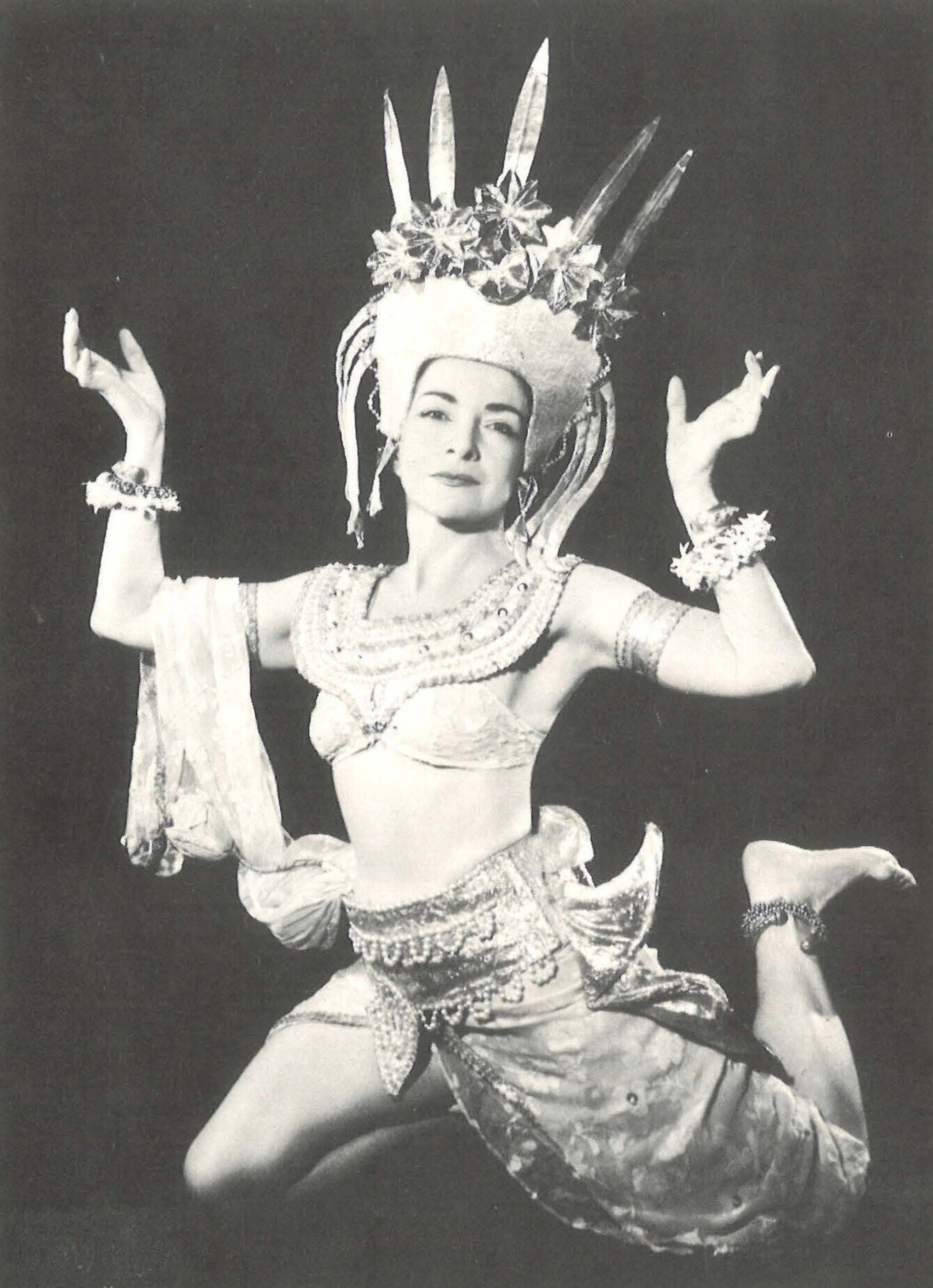
1) Xenia Zarina in full-bloom lotus expression at Angkor Wat in 1937 [photo credited to ‘Lindquist’ in Classic Dances of the Orient]. 2) In the ‘Apsara flying posture’ later in Xenia Zarina’s life, after her return to Mexico [photo by Semo, ibid.].
1) Xenia Zarina in full-bloom lotus expression at Angkor Wat in 1937 [photo credited to ‘Lindquist’ in Classic Dances of the Orient]. 2) In the ‘Apsara flying posture’ later in Xenia Zarina’s life, after her return to Mexico [photo by Semo, ibid.].
1) Xenia Zarina in full-bloom lotus expression at Angkor Wat in 1937 [photo credited to ‘Lindquist’ in Classic Dances of the Orient]. 2) In the ‘Apsara flying posture’ later in Xenia Zarina’s life, after her return to Mexico [photo by Semo, ibid.].
ល្ខោនខោលl'khon khol, 'Masked theater', with a repertoire from the Reamker. In Cambodian masked theater, derived from ancient royal dance, each character bears a specific color: green for Ream (Rama), yellow for Preah Leak (Lakshmana), red for Seyda (Sita), white for Hanuman and its 18 monkey warriors, brick red for Krong Reap (Ravana), blue for Tupi (King of Buffaloes).
ល្ខោនគែនl'kon ken, a theater and dance form developed during the first reign of King Sihanouk (1945-195), in which the ken, a traditional Mon-Khmer and Laotian reed music instrument, played a central part.
A Thai traditional garment consisting in a a long strip of cloth wrapped around the waist and often tucked at the back after being passed between the legs.
sk स्तूप, stupa, "heap" | pa thupa | kh ចេតិយ chedi, cha-dey | th เจดีย์ cedyi, "stupa", "mausoleum".
A Buddhist mound-like or hemispherical structure containing relics, originally from the Buddha or from Buddhist monks or nuns, in modern times the remains of distinguished departed people, where one can come to meditate.
Thought to be derived from the ancient ritual of building tumuli, the stupa was designed to allow circumambulation [pradakhshina] around the structure, as seen until these days at Shewanagon Pagoda (Myanmar), the Abayagiri Dageba (Sri Lanka) or Borobodur Temple (Indonesia).
In Cambodia, royal stupas in pagodas (Oudong, Wat Ounalom, Wat Phnom...) and at the Royal Palace (Kantha Boppha chedi, King Suramarit...) have a distinctive style, different from Thai cedyis. In Khmer, the word originally meant "sign" [of a sacred place], and went to refer only to a structure containing relics.