

Yukio Mishima

Yukio Mishima — Mishima Yukio 三島 由紀夫 [pen name of Hiraoka Kimitake 平岡 公威, 14 Jan. 1925, Tokyo, Japan – 25 Nov. 1970, Tokyo) was a worldwide acclaimed Japanese novelist, playwright and essayist whose death by ceremonial seppuku reflected his complex character and the cultural crisis in post-war Japan.
A compulsive adept of manga, seafood, kendo, scifi, body-building, movie stardom, large American cars, he held an impossible ideal of traditional Japanese values, including the cult of the Emperor, chastising his fellow countrymen for giving up to the “green snake” [the US dollar] and losing their cultural identity. Henry Scott-Stokes (b. 15 June 1938, Glastonbury, England), London Times bureau chief in Tokyo when he met and befriend the flamboyant author in 1966, recalled Mishima calling in at his home on 3 Sept. 1970 and claiming “Japan has lost its spiritual tradition. There is a green snake in the bosom of Japan. There is no way to escape this curse.” [The Life and Death of Yukio Mishima, New York, Farrar, Strauss & Giroux, 1974, p. 22. Scott-Stokes’s biography was the first one ever published in the West.]
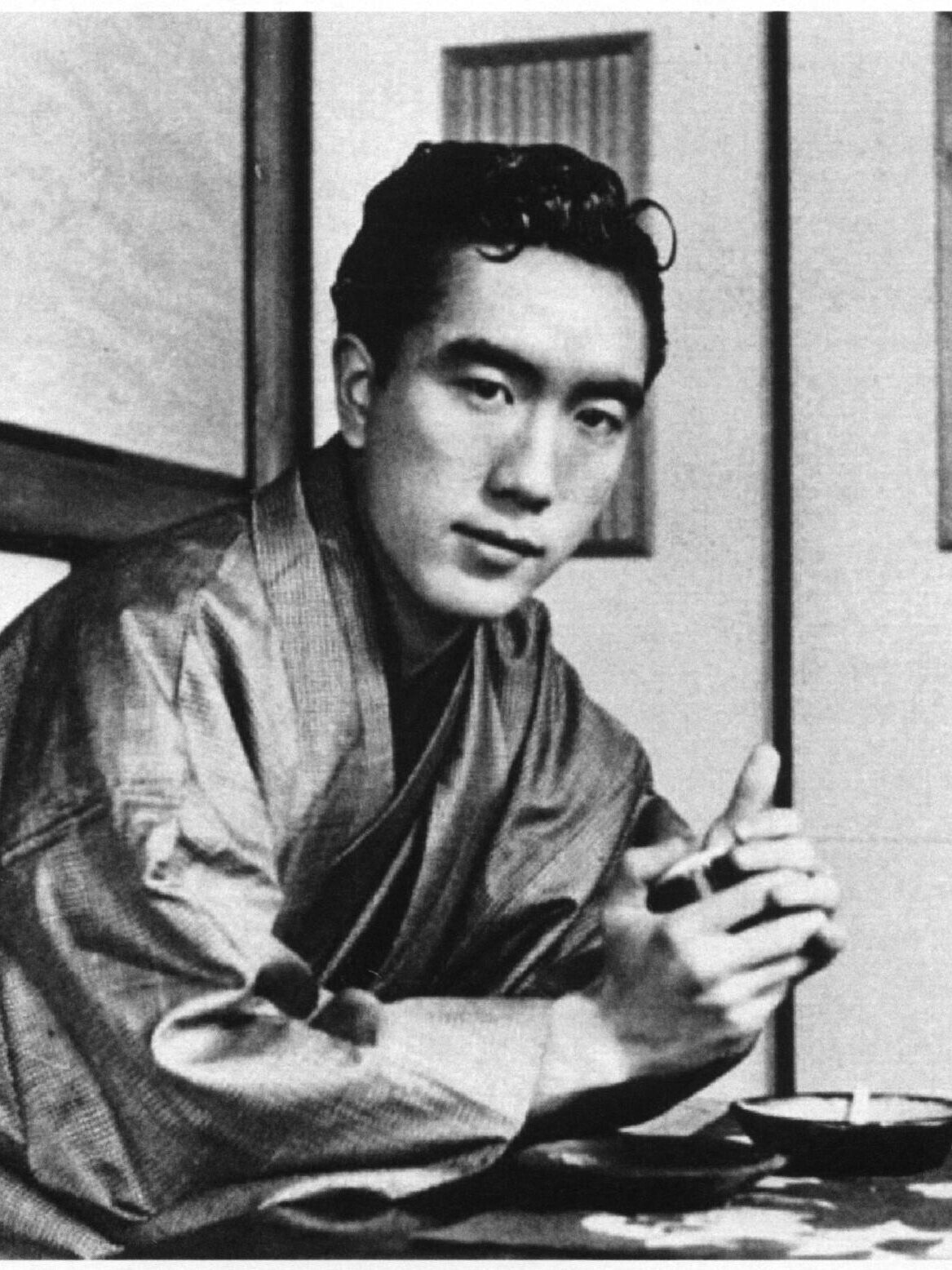
1) Yukio Mishima in 1948 [from Andrew Rankin, “A Wildean Theory of Yukio Mishima”, The Wildean 43, July 2013: 38 – 48]. 2) On 1 June 1958 at his wedding with Yōko 瑤子, the eldest daughter of artist Yasushi Sugiyama, later known as Yoko Hiraoka (13 Fev. 1937, Mejirodai, Tokyo — 31 July 1995, Tokyo). They had two children, daughter Noriko (紀子, b. 2 June 1959) and son Ichirō (威一郎, b. 2 May 1962).
Before their marriage, Mishima had been romantically involved with Sadako Toyoda (豊田貞子), who became the model for some of his main female characters, and possibly with Michiko Shōda (正田 美智子), who later married then Crown Prince Akihito and became Empress Michiko (later Empress Emerita of Japan since 1 May 2019).
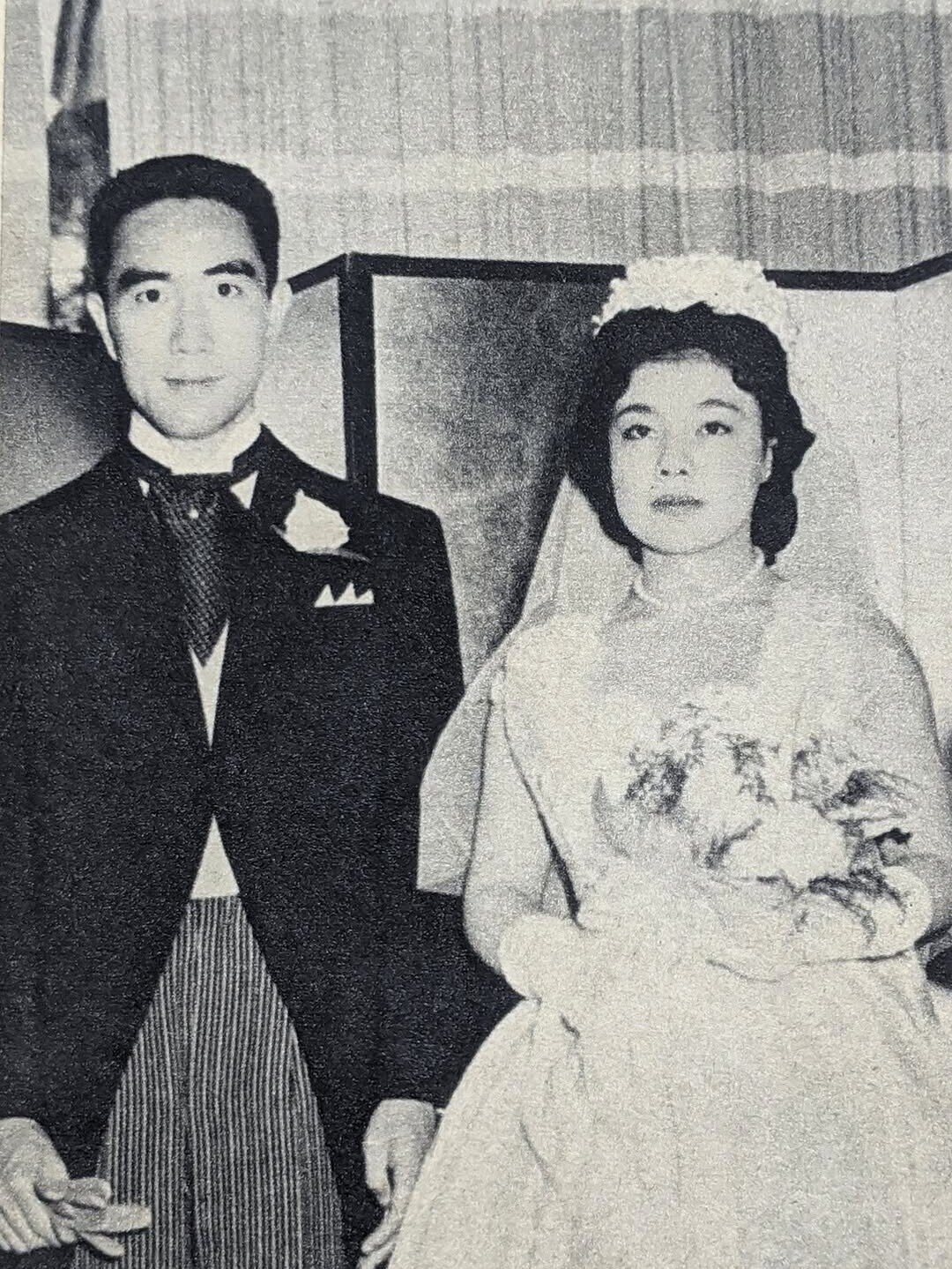
1) Yukio Mishima in 1948 [from Andrew Rankin, “A Wildean Theory of Yukio Mishima”, The Wildean 43, July 2013: 38 – 48]. 2) On 1 June 1958 at his wedding with Yōko 瑤子, the eldest daughter of artist Yasushi Sugiyama, later known as Yoko Hiraoka (13 Fev. 1937, Mejirodai, Tokyo — 31 July 1995, Tokyo). They had two children, daughter Noriko (紀子, b. 2 June 1959) and son Ichirō (威一郎, b. 2 May 1962).
Before their marriage, Mishima had been romantically involved with Sadako Toyoda (豊田貞子), who became the model for some of his main female characters, and possibly with Michiko Shōda (正田 美智子), who later married then Crown Prince Akihito and became Empress Michiko (later Empress Emerita of Japan since 1 May 2019).
1) Yukio Mishima in 1948 [from Andrew Rankin, “A Wildean Theory of Yukio Mishima”, The Wildean 43, July 2013: 38 – 48]. 2) On 1 June 1958 at his wedding with Yōko 瑤子, the eldest daughter of artist Yasushi Sugiyama, later known as Yoko Hiraoka (13 Fev. 1937, Mejirodai, Tokyo — 31 July 1995, Tokyo). They had two children, daughter Noriko (紀子, b. 2 June 1959) and son Ichirō (威一郎, b. 2 May 1962).
Before their marriage, Mishima had been romantically involved with Sadako Toyoda (豊田貞子), who became the model for some of his main female characters, and possibly with Michiko Shōda (正田 美智子), who later married then Crown Prince Akihito and became Empress Michiko (later Empress Emerita of Japan since 1 May 2019).
Chided by his father for being “effeminate” — as a teenager he was writing poetry and developed a life-long fascination with English decadent author Oscar Wilde -, he had his first short story collection — The Forest in Full Bloom 花ざかりの森 (Hanazakari no Mori) — published in 1944, when WWII was still raging. In it, he wrote about the young scion of samurai and aristocrat lineage taking care of his ailing grand mother as the world was devastated by a mysterious illness, ‘The Disease’. The whole landscape of his life was set there: even if his own family were commoners, he fantasized about aristocratic ancestors, and came to think that physical decay was ultimately less lethal than moral corruption.
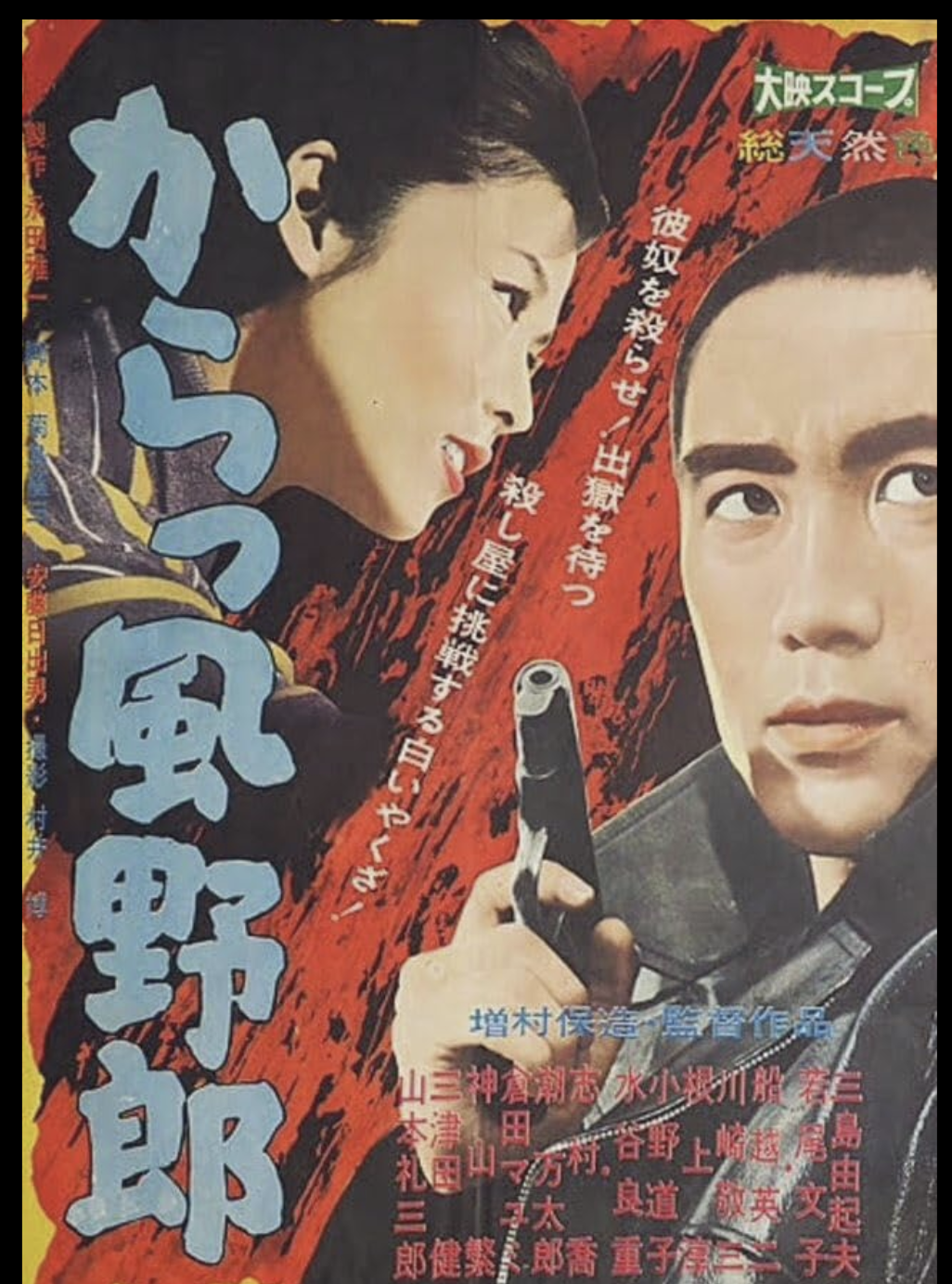
Mishima’s most notable foray into the acting role and movie stardom was Afraid to Die (first titled A Man Blown by the Windからっ風野郎, 1960) directed by Yasuzo Masumura 増村 保造 (1924−1986), in which he played a frantic, macho yakuza who is bullying his new girlfriend — played by superstar Ayako Wakao 若尾 文子 (b. 1933) — to the extent that Nagisa Oshima, director of the feminist and internationally acclaimed In the Realm of the Senses 愛のコリーダ [FR L’Empire des Senses] (1976), rejected the movie entirely. His experience on the silver screen led him to write the novella Star, also published in 1960. [translated into English by Sam Bett, New Directions, 2019, 96 p. ISBN 978 – 0811228428].
Although quite belated — he was in his forties — Mishima’s exposure to Indian and Southeast Asian cultures, first through a visit to Bangkok and Angkor in 1965, then with a month-long visit to India in September-October 1967, opened new horizons to his creativity. It gave him a chance to extirpate himself from his country’s dualistic conundrum — aggressive Americanization or nostalgy for a foregone national prestige. The Terrace of the Leper King (1969), inspired by King Jayavarman VII and the Bayon, was his last published and performed theater play.
He had explored the whole gamut of theater: the Japanase forms (shingeki, modern noh, kabuki, buyō), the childhood wonderment (Arabian Nights, adapted for the Japanese stage in 1967), the European classics (his own version of Racine’s Britannicus, 1957; Victor Hugo’s Ruy Blas, 1966; Oscar Wilde’s Salome, 1960; Goethe’s Proserpina, 1962; Puccini’s Tosca, 1963; Gabriele d’Annunzio’s Le Martyre de Saint Sébastien, 1965; Jean Cocteau’s Orphée (1956) and L’Aigle à deux têtes (1967)), and his two most provocative plays, Madame de Sade (1965) and My Friend Hitler (1968). The latter two works are above all experiments on gender dynamics, as Madame de Sade staged an all-female cast and My Friend… an all-male one.
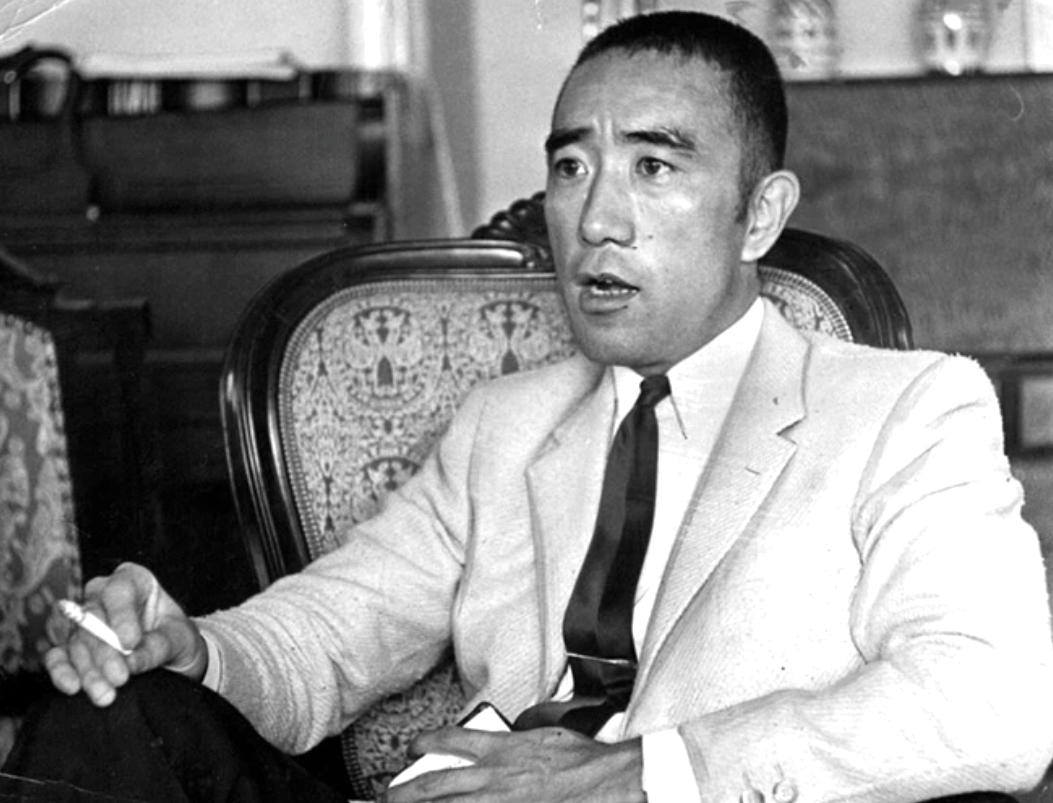
Two-faced man: 1) Yukio Mishima on 26 July 1967 [Asahi Shimbun file photo]. 2) In the 1960s, when the “spindly, pale youngster turned into a healthy, sun-tanned specimen of Japanese manhood” (H. Scott-Stokes) [photo Mainichi].
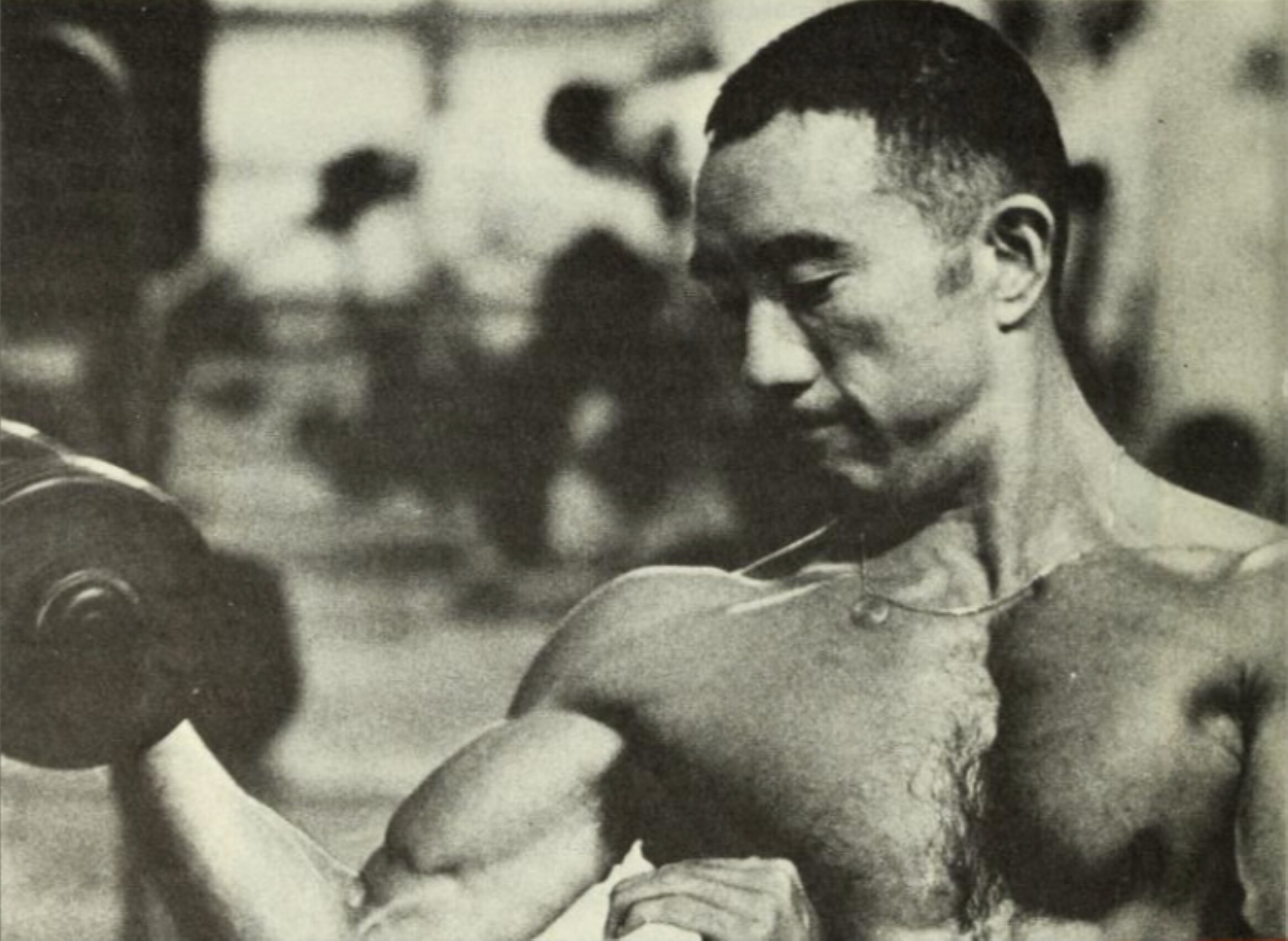
Two-faced man: 1) Yukio Mishima on 26 July 1967 [Asahi Shimbun file photo]. 2) In the 1960s, when the “spindly, pale youngster turned into a healthy, sun-tanned specimen of Japanese manhood” (H. Scott-Stokes) [photo Mainichi].
Two-faced man: 1) Yukio Mishima on 26 July 1967 [Asahi Shimbun file photo]. 2) In the 1960s, when the “spindly, pale youngster turned into a healthy, sun-tanned specimen of Japanese manhood” (H. Scott-Stokes) [photo Mainichi].
On 5 Oct. 1968, Mishima formed the Tatenokai 楯の會 (“Shield Society”), a private militia composed of right-wing college students. An attempted coup aimed at restoring the Emperor in his former glory, which became (or not so much) history as the “Mishima Incident” (三島事件, Mishima jiken), failed miserably, and Mishima ended his life. But in hindsight what remains of the author’s last months on earth are his remarks on the American military debacle in Vietnam, on Paris May 1968 students’ uprising, on his exploration of Mayana Buddhism as he had just completed the last volume of his tetralogy The Sea of Fertility, and his comments around the opening of the Yukio Mishima Exhibition at Tobu Department Store (12−17 Nov. 1970, with a daily average of 10,000 visitors) : that his life was “a four-river flow”, the book, the stage, the body, the action, and “this river of action and the river of the book frontally collide. However you may be for ‘both literary and martial arts,’ the coexistence of the two may occur only at the moment of death.” [quoted by Inose Naoki, Persona: A Biography of Yukio Mishima, tr. by Hiroaki Sato, Berkeley (CA), Stone Bridge Press, 2012, p. 707.]
Upon seeing the statue of the Leper King at Angkor Thom, “drenched in tropical sun”, he had formed one daring notion — “The body is eternal, youth immortal,” as proclaimed in the last lines of Terrace of the Leper King. At the age of 45, he took the ultimate leap of faith. As a conclusion for probably the most perceptive biography of Mishima — referred to above -, Naoki Inose quotes Yasunari Kawabata, the master of Japanese modern literature the rebellious Mishima profundly revered, himself quoting Confucius : “I have yet to know what life is; how can I know what death is?”
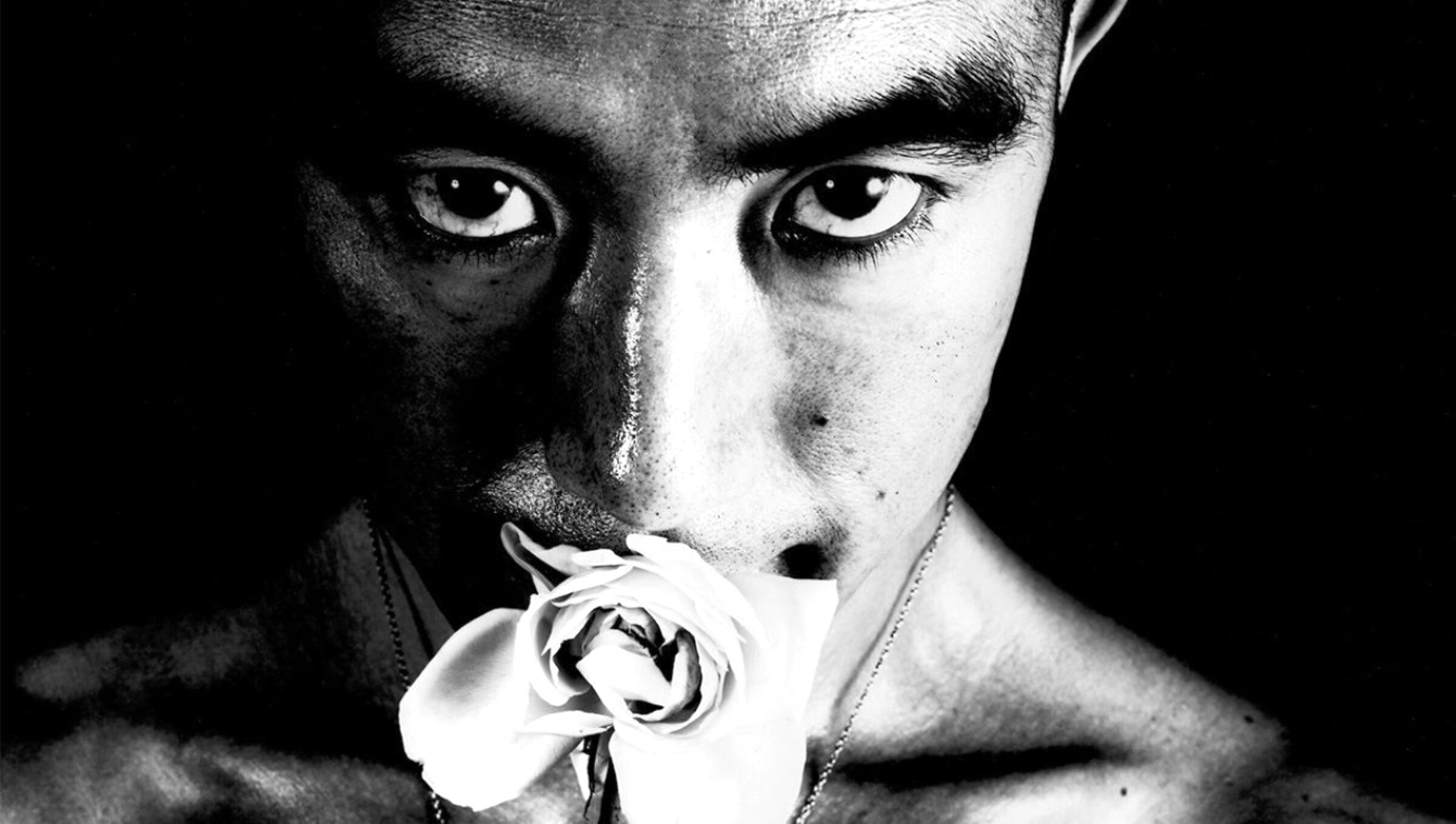
Yukio Mishima photographed by Eikoh Hosoe 細江 英公 (1933−2024) for the photo-album 薔薇刑 [Barakei: Ordeal by roses], Tokyo, Shueisha, 1963, repr. 1971; ENG 薔薇刑 = Ba*ra*kei = Ordeal by roses: photographs of Yukio Mishima, New York: Aperture, 1985. ISBN 0−89381−169−6.
Yukio Mishima photographed by Eikoh Hosoe 細江 英公 (1933−2024) for the photo-album 薔薇刑 [Barakei: Ordeal by roses], Tokyo, Shueisha, 1963, repr. 1971; ENG 薔薇刑 = Ba*ra*kei = Ordeal by roses: photographs of Yukio Mishima, New York: Aperture, 1985. ISBN 0−89381−169−6.
Publications
Yukio Mishima’s complete bibliography and filmography [on WIkipedia].
- Related Books