

Amitabha
sk अमिताभ Amitābha
Buddha of the higher spirit, represented on the headdress of bodhisattvas.
by Yukio Mishima
A powerful meditation on royal power, artistic creation, ageing, death and the "beautiful statue of a young king sitting silently under the scorching sun."

癩王のテラス [Raio no Terasu Jō, The Terrace of the Leper King] was the last of his theater plays Yukio Mishima watched opening at Tokyo Imperial Theatre on 4 July 1969, at a time he was already planning his suicide by ceremonial seppuku one year later. Death, and not even a flicker of possible redemption, looms large on a work inspired by the author’s visit to Angkor in October 1965 in which art (his own, and the Bayon of Angkor Thom) might be the only force able to transcend it.
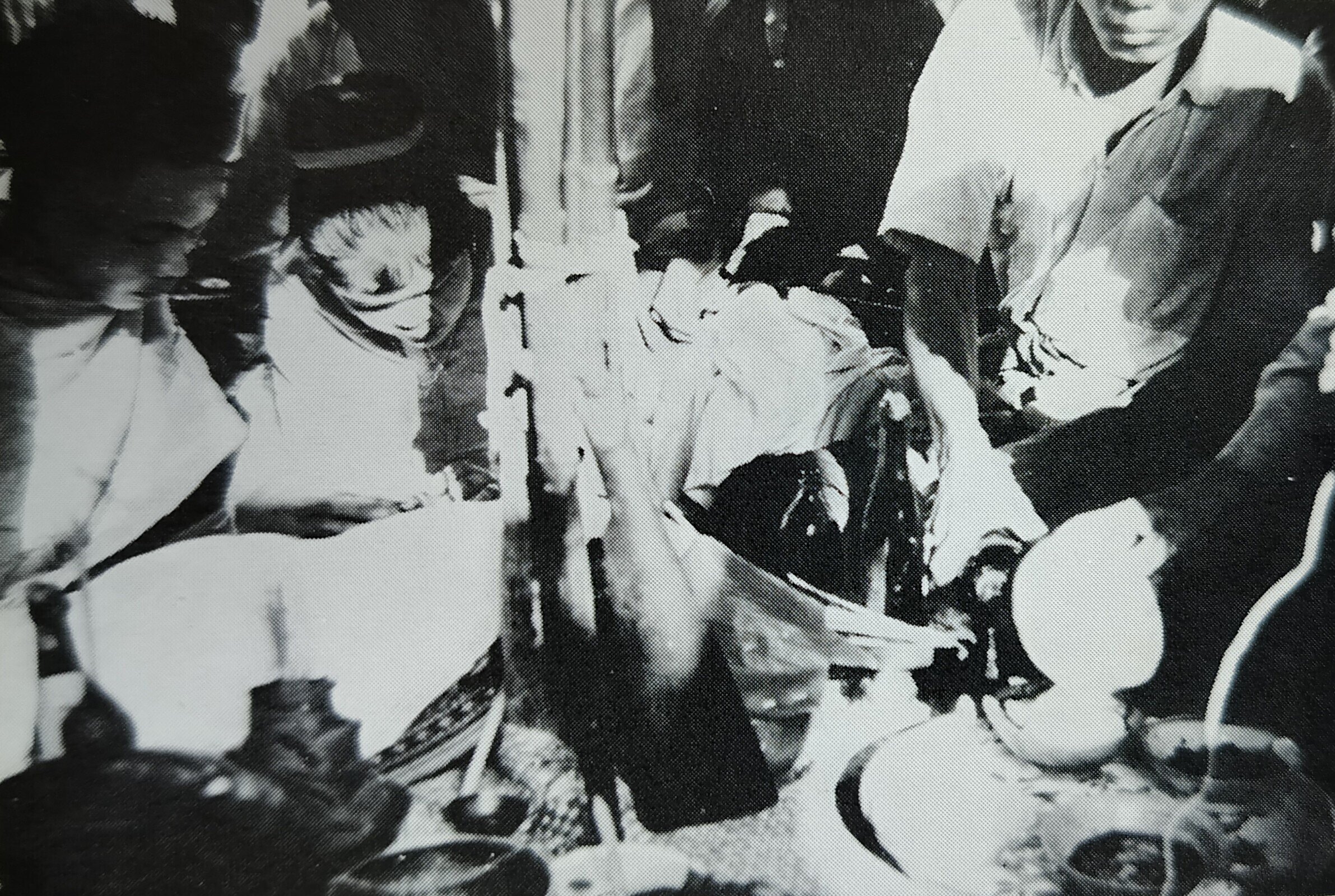
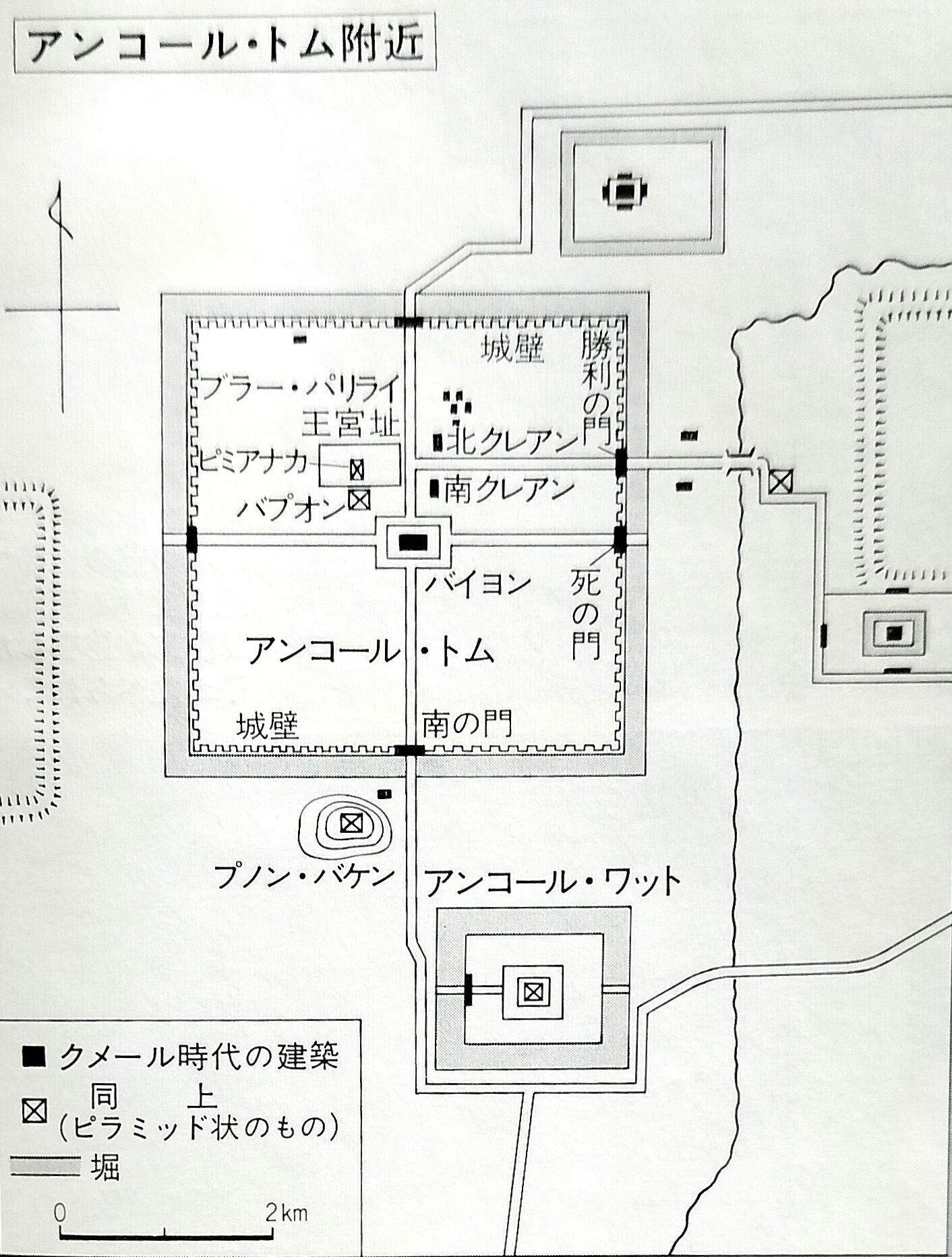
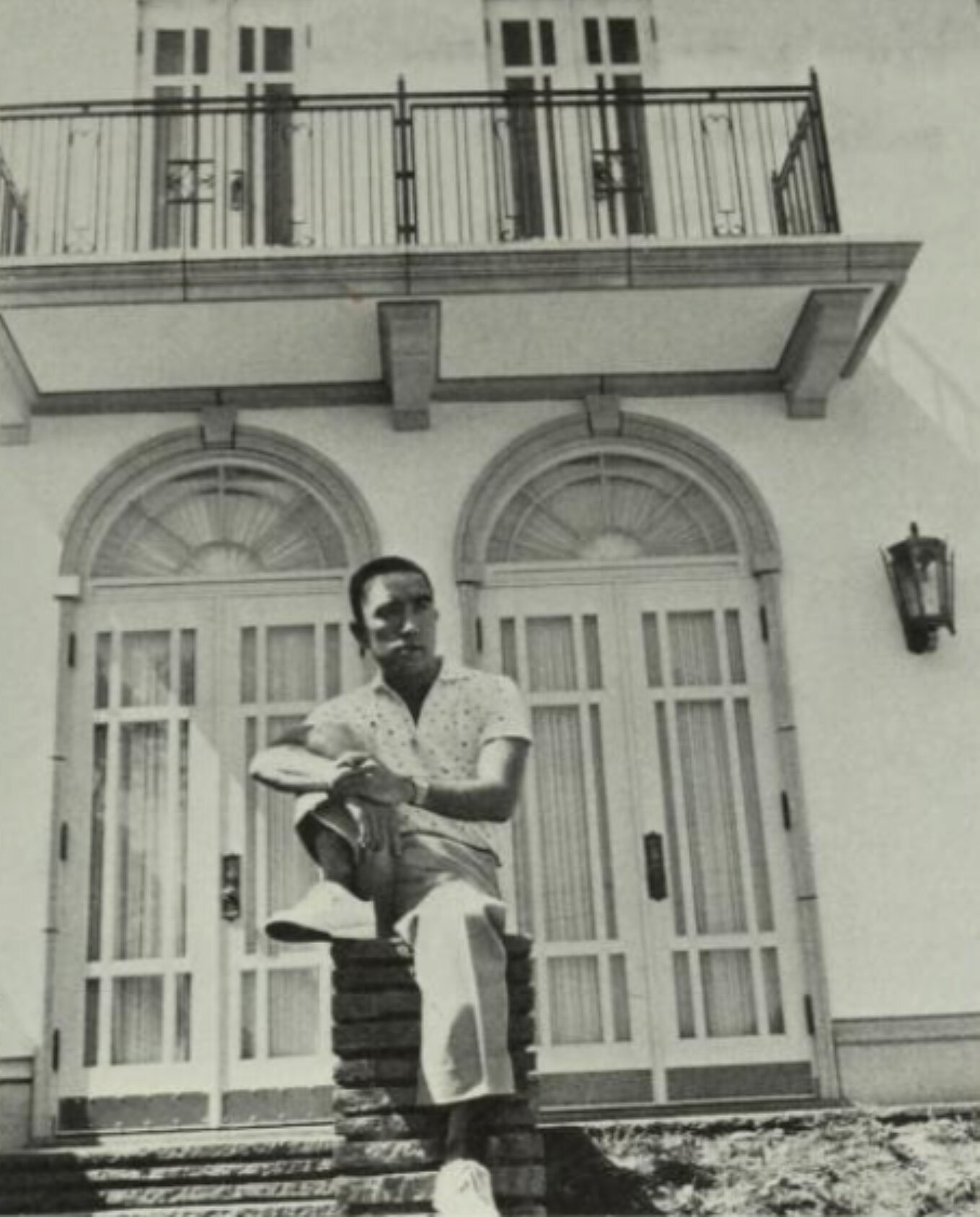
The present edition [1], released shortly before the première of Terrace and three months after Mishima had completed his manuscript — it appeared in the literary magazine Umi (海) at the same time -, was supervised by the author, who made sure the book was printed in Tategaki fashion, text running top to bottom, right to left, as ancient Chinese publications would, and added several photos taken around the same time than his visit to Angkor with his wife Yoko Sugiyama 杉山 陽子 (13 Feb 1937, Tokyo — 31 Jul 1995, Tokyo). He selected:
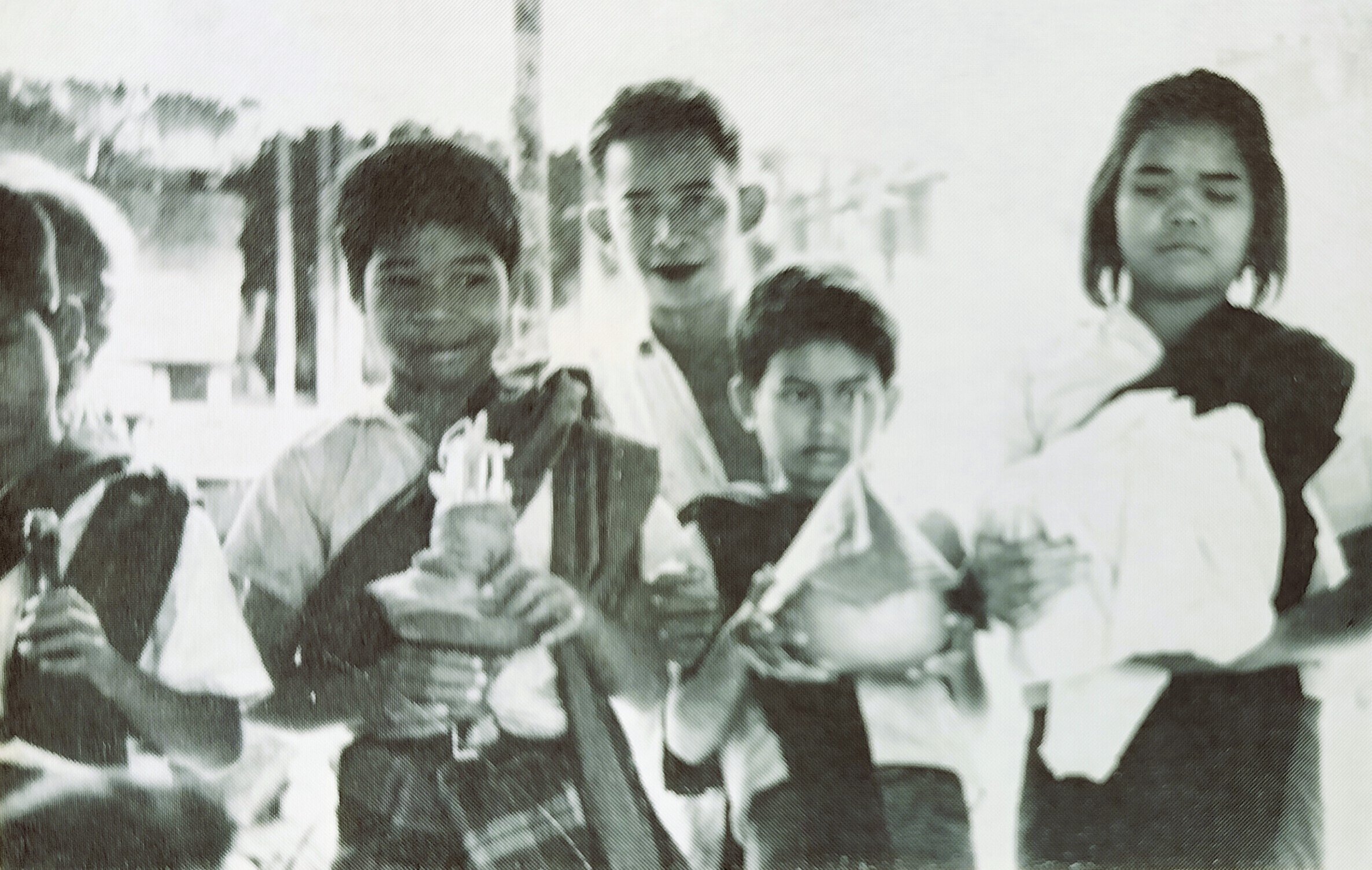
1, 2) photos of a Khmer wedding illustrating the book. 3) Angkor Thom map in the book. The outer walls of the city are noted as 城鹽 , “citadel”. 4) Mishima in front of his 3‑storey suburban house in Tokyo, in 1965, the year of his visit to Angkor [photo Shinchosha]. 5) The “Cambodian royal court dancer” photographed by Izuo Ishii.
1, 2) photos of a Khmer wedding illustrating the book. 3) Angkor Thom map in the book. The outer walls of the city are noted as 城鹽 , “citadel”. 4) Mishima in front of his 3‑storey suburban house in Tokyo, in 1965, the year of his visit to Angkor [photo Shinchosha]. 5) The “Cambodian royal court dancer” photographed by Izuo Ishii.
1, 2) photos of a Khmer wedding illustrating the book. 3) Angkor Thom map in the book. The outer walls of the city are noted as 城鹽 , “citadel”. 4) Mishima in front of his 3‑storey suburban house in Tokyo, in 1965, the year of his visit to Angkor [photo Shinchosha]. 5) The “Cambodian royal court dancer” photographed by Izuo Ishii.
1, 2) photos of a Khmer wedding illustrating the book. 3) Angkor Thom map in the book. The outer walls of the city are noted as 城鹽 , “citadel”. 4) Mishima in front of his 3‑storey suburban house in Tokyo, in 1965, the year of his visit to Angkor [photo Shinchosha]. 5) The “Cambodian royal court dancer” photographed by Izuo Ishii.
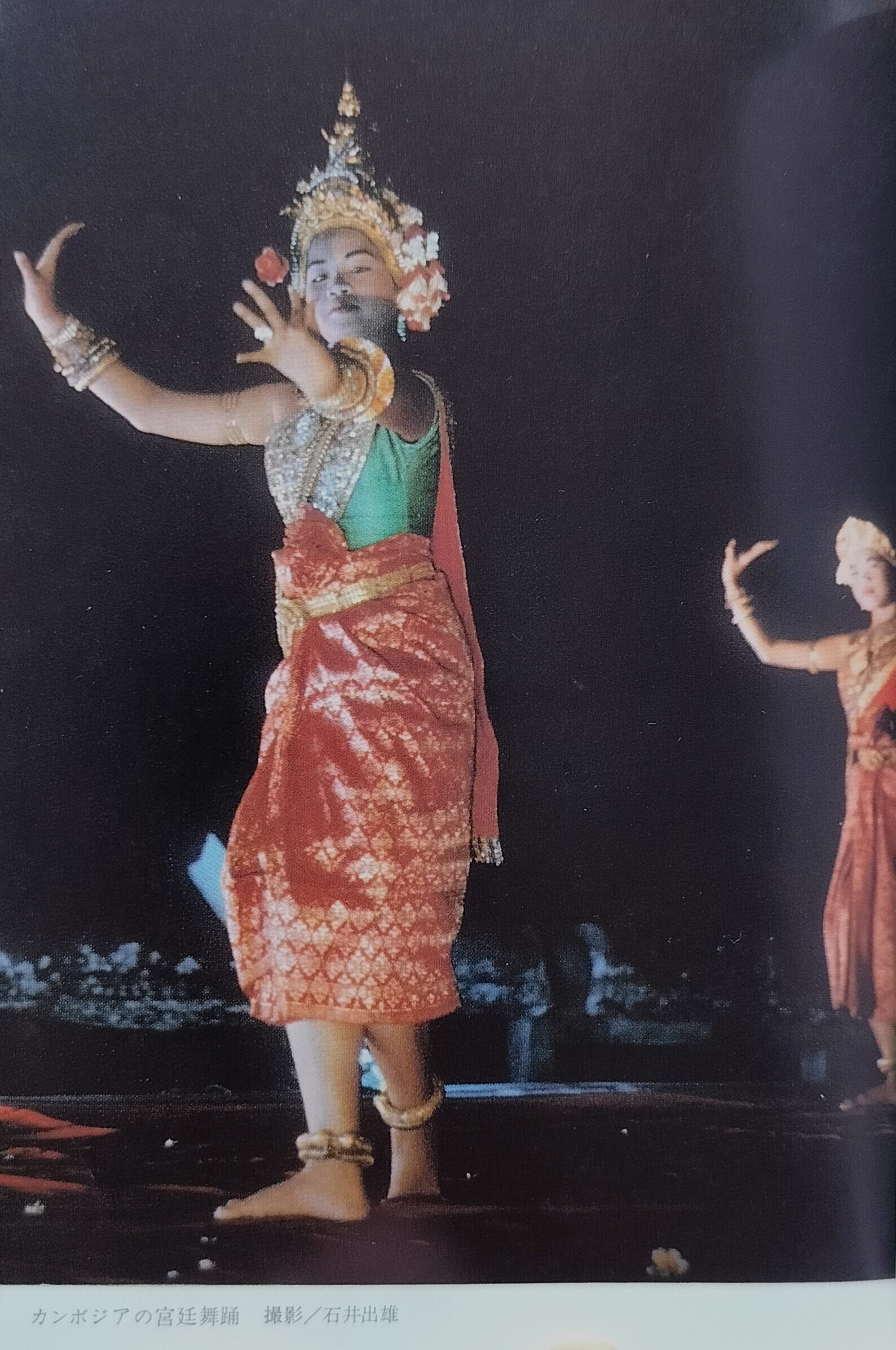
1, 2) photos of a Khmer wedding illustrating the book. 3) Angkor Thom map in the book. The outer walls of the city are noted as 城鹽 , “citadel”. 4) Mishima in front of his 3‑storey suburban house in Tokyo, in 1965, the year of his visit to Angkor [photo Shinchosha]. 5) The “Cambodian royal court dancer” photographed by Izuo Ishii.
1, 2) photos of a Khmer wedding illustrating the book. 3) Angkor Thom map in the book. The outer walls of the city are noted as 城鹽 , “citadel”. 4) Mishima in front of his 3‑storey suburban house in Tokyo, in 1965, the year of his visit to Angkor [photo Shinchosha]. 5) The “Cambodian royal court dancer” photographed by Izuo Ishii.
1965 was a year of traveling for Mishima. Early 1965, he was invited to England by the British Council, staying there a few weeks — no joy. Then, as the speculation around his possible nomination for the Nobel Prize in Literature — a recurrent, never fulfilled expectation throughout his adult life, he embarked with Yoko on a world tour (5 Sept.-31 Oct.) that took them to New York, Stockholm, Paris, Hamburg, Bangkok — to which he returned in October 1968, after visiting India at the invitation of Indian President Zakir Hussain and Prime Minister Indira Gandhi, in both cases to research Wat Arum pagoda at the core of his Sea of Fertility project — and Angkor. Temple of Dawn 暁の寺 (Akatsuki no tera), Mishima’s last novel, was written from late summer 1968 to close to its release in 1970. Inspired by Wat Arun in Bangkok, dealt (quite heavily) with metempsychosis and reincarnation.
The writer has detailed how the Terrace project slowly inserted itself in the creation process [“About the Terrrace of the Leper King”, Mainichi Shinbun, 10 July 1969]:
The inspiration came to me during a trip to Cambodia in 1965, when I glimpsed, in the deserted ruins of Angkor Thom, the statue of this young monarch in the half-lotus position, bathed in tropical sunlight. Sometimes the most sinister combines with the sacred, the most tragic with opulence and nobility. The Duke of Portland, by the Comte de L’Isle-Adam, is a masterpiece that blends leprosy with a sumptuous and supremely chivalrous story; but associating the most extreme dereliction with the most extreme splendor was, in any case, a common inclination in late Romanticism.
The legend that Jayavarman VII, builder of the Bayon temple, contracted leprosy deeply moved me. I saw, in this terrible contrast between the creation of a great religious monument and the simultaneous collapse of the body, a metaphor for the lives of artists who destroy themselves by surrendering their entire existence to their work.
The visitor to Angkor Thom, standing before these masterpieces of extravagant charm, these destroyers of all life that powerfully allow their tranquility to float beneath a blazing sun, cannot help but be struck by the indecency of the works of art, the obscenity of their eternity that transcends the human. There was something splendid and sinister there, something utterly sublime yet capable, at the same time, of making you feel nauseous. A neo-romantic music immediately sprang within me, and that night, from my room at the Temple Inn located at the entrance to Angkor Wat, I jotted down the outline of my play.
For a long time, I refrained from continuing this work, waiting until it was possible to perfectly stage a drama for which I demanded specific staging requirements. A primary condition was that, at the dénouement, the complete and radiant form of the Bayon temple must be revealed to the audience. Without this, even if the other requirements I stipulated had been perfectly met, I could not have fulfilled my dream of staging The Terrace of the Leper King. This required a theater with a gigantic stage machinery; but then it becomes impossible to avoid the common-sense compromises inherent in expensive productions. Normally, this type of dilemma can never be resolved, and in this respect, it was an unexpected stroke of luck to work with the Imperial Theater, which went to great lengths to bring my project to fruition.
I employed numerous kabuki techniques to craft a plot that culminates in such a dénouement, carefully developing the play’s theme within a visual dramatic composition that, in a way, belongs to modern kabuki. The play’s subject is King Jayavarman’s quest for the absolute. On the very day the monarch’s mind is seized by absolute love and absolute faith (both of which are to be embodied in the absolute beauty represented by the Bayon temple), he is afflicted by the first symptoms of leprosy. Furthermore, his two grand designs — love and faith — both fail in this world. The alms he gives to the people only fuel his resentment. An earthly woman (his first wife) thwarts his passion for the Naga, the invisible young serpent goddess, which he expresses in these words: “You know no pity. You know no jealousy. You are nothing but love, the infinite love of a peaceful sea, which brings me comfort.” Meanwhile, politics and finances slow the construction of the Bayon… Leprosy slowly eats away at the king’s flesh, and when the temple is finally completed, the dying, blind monarch can only imagine it.
However, beauty, bearing no relation whatsoever to the king’s state of mind, inaugurates its existence, brilliantly inaugurating this eternity that is his own, an eternity that transcends humanity and is simultaneously inhuman. The Bayon must then appear before the audience, not through the subjectivity of the characters, but as an objective presence. In this instance, I drew upon the theocratic cult of Devarāja, which was prevalent in ancient Cambodia, for the dénouement. It constitutes, in fact, the fundamental impetus behind the construction of Angkor Wat; according to this cult, the king became one with the god venerated in the great temple he had built. On stage, this union is manifested in the resurrection of the adolescent body — young, handsome, and virile — of King Jayavarman VII.
As I wrote this play, the countless sounds that intermittently pierced the sweltering calm of Angkor Thom kept returning to my ears. The beating of swarms of insects on the terrace of the Naga. The showers of dead leaves that, from the jungle peaks, slid through the branches before crashing to the ground. The cries of wild monkeys leaping between branches. The harsh, intrusive squawks of parrots and other colorful tropical birds. The wooden bells attached to the necks of buffaloes, their echoes resonating throughout the forest. And constantly before my eyes floated the yellow butterflies fluttering at the entrance to the ruins, the colors of the burnt stones of the venerable Bayon, the white, aerial roots, like human flesh, of the strange, gigantic kapok trees, which demolished the walls by their sheer force, or the shimmering garments of the pretty young girls who, as evening fell, by torchlight, performed ancient royal court dances on the terraces of Angkor Wat. All of this I have incorporated into this play.
Whereas in the case of a tightly plotted play, relying on the text and staged in a small theater, I would banish all superfluous elements, even refusing any background music or sound effects, I allowed myself, for The Terrace of the Leper King, to introduce all the visual and sound effects capable of plunging the audience of a large theater into a dream, for the duration of an evening. If one must consider the space of the theater as a whole, I would say that I have already largely, through works like Madame de Sade or My Friend Hitler, explored a microcosmic totality, and that this time I wanted to experience a macrocosmic totality.
[1] A paperback edition issued in 1975 was banned in Japan and rapidly sold out on the black market.
[2] Naoki Inose, Persona: A Biography of Yukio Mishima, tr. from Japanese intoto English by Hiroaki Sato, Berkeley (CA), Stone Bridge Press, 2012, 853 p. [Kindle Edition]
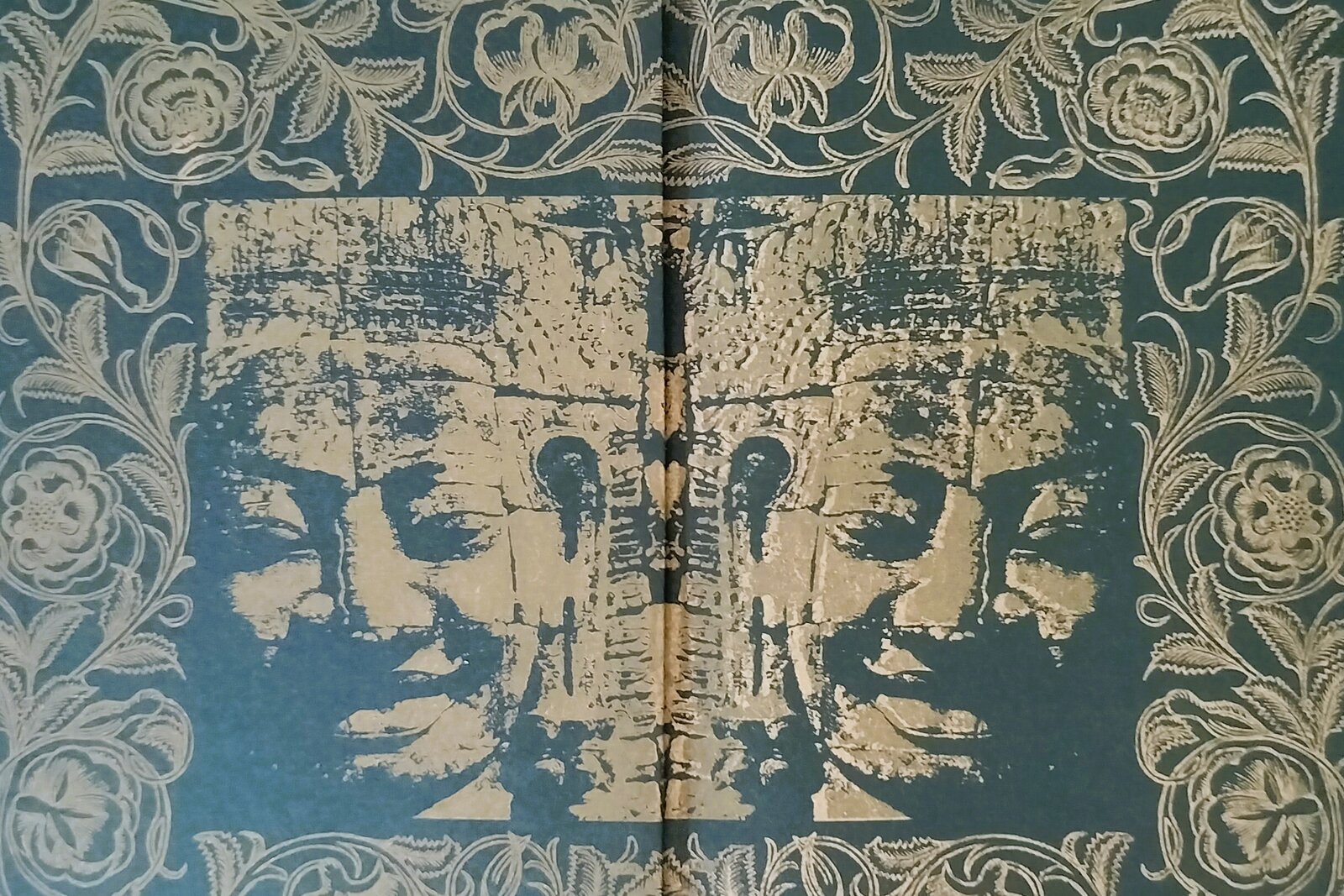
1) Interior cover of the 1969 original edition. 2) The Teigeki (Imperial Theatre) in 1966.
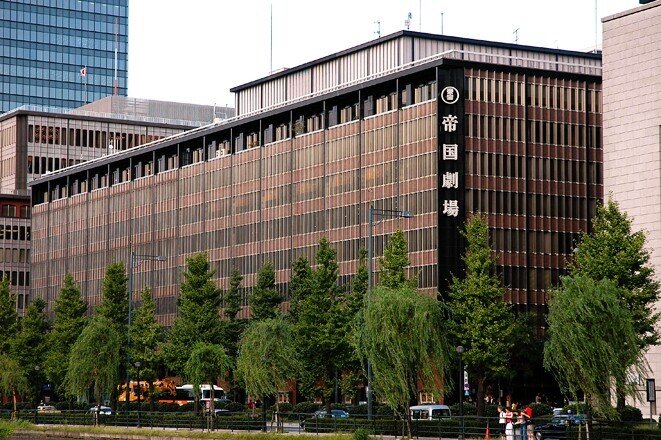
1) Interior cover of the 1969 original edition. 2) The Teigeki (Imperial Theatre) in 1966.
1) Interior cover of the 1969 original edition. 2) The Teigeki (Imperial Theatre) in 1966.
The play in 3 acts is set “at the end of the 12th century”, around the presumed date of King Jayavarman VII’ date and exactly one century before Zhou Daguan’s 1296 – 1297 stay in Angkor — Mishima haddrawn many details from the Chinese traveler’s account, and like many authors he had assumed that the society Zhou Daguan so vividly described hadn’t substantially changed within this 100-year span. One of the characters, Chinese Ambassador Liu Ma-fu (劉 万福), obviously referred to Zhou.
Unity of time, and unity of place, as the plot unfolds in the perimeter of the center of Angkor Thom: Act I, scene 1 is set in a forest “near Angkor in Cambodia”, scene 2 is “a banquet at the Royal Palace of Angkor,”; Act II, scene 1, “construction site of Bayon Temple”, scene 2, “apartments of the First Queen,”, scene 3, “Tower of the nāgas”; Act III, scene 1, “Terrace overlooking the Bayon”, scene 2, Bayon.
In the Afterword [1] of the screenplay published here, he shared these important remarks:
Difficult stage conditions prevented a performance, and I hesitated to begin writing for four years. Kinya Kitaoji was considered a perfect fit for the protagonist in every respect, and I had already asked him to perform two scenes in his “Arabian Nights” production —“The Tale of the King of the Black Island” and “The City of Brass” [2] — as a tryout for the stage techniques I would eventually use in The Terrace of the Leper King. Four years later, I finally had the opportunity to perform the play at the Imperial Theater, and I began writing.
My understanding is that King Javarman VII had an unfortunate mentality, one that was only attracted to “absolute” love. In other words, this play is not a play about illness, but a play about “absolute illness.”
The only things the king needed on earth were these two: the daughter of the snake god, as his absolute love, and Bayon, as his absolute faith. Everything else was merely an insignificant relative existence. Such a mentality of the king could not go unintentionally noticed by those around him. His absolute love aroused the jealousy of the earthly woman (his first wife), and was softly imitated by the chastity of his second wife, thwarting him in both hard and soft ways. Finally, with the death of his first wife, he was overcome by earthly love. Meanwhile, the construction of Bayon as absolute faith is hindered by earthly politics and economics, but when all obstacles have been overcome and it is completed, the king will no longer be able to see it with his own eyes.
Once again, the king’s tragedy is not essentially the tragedy of the leper. Rather, the pattern revealed the true nature of the king’s tragedy, or rather, the king’s illness, and the pattern as an “absolute illness” perfectly embodied the king’s spirit, which was infected by “absolute illness.” Therefore, the illness was by no means a chance incident but the king’s destiny. There is no earthly cure for it.
This is because the only thing that can ultimately cure it is the restoration of the body as eternal, immortal beauty. This is the significance of Bayon as the embodiment of the king’s veneration, and it is for this reason that, in the end, the king’s beautiful body declares, “I am Bayon.”
While circumventing the various constraints of a large-scale theater production and daring to provide a variety of services, I wrote this play because I wanted to write this climax, and to focus all my efforts on utilizing the extensive stage machinery.
Apart from some “over-the-top” dramatic effects — the first Queen bursting in flames and ending in a heap of ashes after entering the tower chamber and challenging the King’s love for the Nagi -, Mishima tried to stick to realism and historical accuracy. For instance, regarding the wedding taking place on stage, he noted: “The wedding ceremony of the third day is performed following Cambodian tradition. A description of the ceremony may be found in the three-volume book on Cambodian folk beliefs and rituals by G. Porée and E. Maspero, Étude sur les rites agraires des cambodgiens. What follows is a summary of the moves and gestures to· be made, as well as props used.” [Mishima read Maspero’s book in the Japanese translation by Õiwa Makoto and Asami Atsushi.]
At that time, ‘Khmerology’ studies in Japan was probably more developed than Western researchers thought. In the preface of his Society, Economics and Politics in pre-Angkor Cambodia (1998), Michael Vickery observed:
I would like to call the attention of students of early Cambodia to a pioneering study of pre-Angkor Cambodia by a Japanese scholar whose untimely death prevented him from bringing his work to completion. This is “On the Puras (town) in Pre-Angkor Period of Cambodia” by Yoshio Kanayama, published in 1960 and based on his 1958 MA thesis for the University of Tokyo. If his work had been translated into English then, study of early Cambodian history might have made more rapid and more significant progress.” [p. 7]
We know that Mishima compared notes on Ancient Angkor with independent researcher Shinji Soya (1925−1991), a Japanese novelist and doctor who was to publish two books on the subject. As for the Khmer devaraja, while Khmerologists still debated whether the term should be interpreted as a cult to ‘the King made God’ or as the deity specially attached to the person of the king, he surmised the latter interpretation, laid out later by Claude Jacques and Au Chhieng — devarāja being seen as a living magical entity [ទេវ teva in Khmer] of the living person of the King.
We can certainly find echoes of Soya Shinji’s idiosyncrasic take on ancient Khmer civilization, for instance the notion that the Bayon was “Dionysian” in opposition to “Apollonian” Angkor Wat. However, as James Raeside has noted in 2003, Mishima didn’t completely embrace the latter’s inclination
to interpret this period of Cambodian history as a parable for modern Japan. In [Shinji’s] telling of it, we have the story of a great and warlike nation, founded upon a successful marriage of animism and a line of god-kings, brought to its knees by a religion advocating human equality and charity, as well as by an improvident use of the country’s resources. [James Raeside, “This death in life: leprosy in Mishima Yukio’s Rai no terasu and beyond,” Japan Forum 15/1, 2003: 99 – 123 (p. 117) — email hidden; JavaScript is required]
In certainly the most subtle analysis of the play to date, the same author added:
If we return to Mishima’s own account of the meaning of the play, then it can be seen as the triumph of the immediate and sensual over the theoretical and rational or, to put it in terms that Mishima liked even better, of the actor over the observer. But to put it in these terms is to do the subtlety of the play itself a disservice. […] Leprosy was one of the themes that Mishima frequently turned to in his work, and one that came, if one can use such a metaphor, to a kind of flowering in this play, where the first signs of leprosy are as beautiful as roses and where, as ever in Mishima, the themes of beauty and ugliness, of desire and death are so cunningly wrought together. It is a daring paradox whereby the two central notions of leprosy as either a form of corruption or a form of divine suffering are overturned by suggesting that what is corrupt is the soul or the need for a soul. [James Raeside, ibid., p. 119.]
Here again, Mishima’s staging indications are telling: “The Bayon begins to turn. Its back side also has a great array of statues ef Avalokitesvara. Just as the turning stops, the King, leaning against the top of the Bayon, suddenly comes into view. Wearing nothing but a golden loincloth, his nude Body has a glittering beauty brimming with youthfulness, freshness. It is the Body of the King, as opposed to the feeble voice coming out of the palanquin, which is his Soul.” And in the 2016’s production by Amon Miyamoto [see below], it is the teva gliding over the stage who voices the last lines:
Look! The Soul has died. Dazzling blue sky, betel palms, birds with beautiful wings, and Bayon protected by these! I rule this country again. Youth never perishes, the Body is deathless… I’ve won. Because I am the Bayon.
[1] あとがき 一九六五年十月、カンボジャのアンコール・トムを訪れ、熱帶の日の下に默然と坐してゐる若き王の美しい彫像を見たときから、私の心の中で、この戯曲の構想はたちまち成った。その後、舞臺條件のむつかしさから、上演の機會が得られぬままに、執筆を問躇しつつ、足かけ四年が経つた。北大路欣也君が、あらゆる點で、 この主人公にふきはしいと考へられたから、すでに「アラビアン・ナイト」の彼の舞奈で、「黒島の王の物語の場」と「真鍮の都の場」の二景を、「獄王のテラス」にいづれ使ふべき舞臺技巧のトライ・アウトとして演じてもらつたことがある。かくて、四年後に、帝劇の上演といふ機會を得、はじめて執筆にかかったのである。
書きジャャ・ヴァルマン七世王は、「絕對」にしか惹かれぬ不幸な心性を持つてめた、といふのが、私の設定である。すなはちこの芝居は、敷病の芝居ではなくて 「絕對病」の芝居なのである。
オーガ絕對の愛としての蛇神の娘、絕對の信仰としてのバイヨン、この二つのものだけが、王にとつては地上で必要だつた。他のあらゆるものは、いはばどうでもよい相對的存在にすぎなかつた。このやうな王の心性が、周圍の人々に直感されぬ筈はない。絕對の愛は地上の女(第一夫人)の嫉視を呼び、さらに第二夫人の貞淑によつて柔らかに模倣され、硬軟兩様の方法で邪魔されるが、つひに第一夫人の死によつて、地上の愛に犯されてしまふ。一方、絕對の信仰としてのバイョン建立は、地上の政治により經濟によつて邪魔されるが、それがあらゆる障害を拂つて完成されたとき、王はもはや自分の目でそれを見ることはできないのである。
王の悲劇は、(くりかへすが、)質は癩者の悲劇ではない。むしろ敷が、王の悲劇、 あるひは王の病の本質をあばいたのであり、「絶對の病気」としての轍が、「絕對病」に犯された王の精神を、完全に體現したのである。従ってその發病は、決して偶然の罹患ではなくて、王の運命であつた。これを癒やす築は地上に存在しない。
これを最終的に癒やすものは、永遠不朽の美としての肉體の復元のほかにありえないからである。王郎身崇拜の具現たるバイヨンの意味はここにあり、さればこそ、王の美しい肉體は、最後に、バイヨンは私だ、と宣言することになるのである。
大劇場演劇の種々の制約をかいくぐり、さまざまなサーヴィスも敢てしながら、私はこの大詰を書きたいために、そしてその大がかりな舞臺機構の活用へすべてを集中するために、この戯曲を書いた。– 三島由紀夫
[2] Mishima Yukio’s musical drama Arabian Naito (The Arabian Nights) was presented in November 1966, with Mishima himself acting as “the poet’s slave” and Kitaōji Kinya starring. That was when Mishima resolved to give the future role of Jayavarman VII to Kitaoji Kinya, for “his youth and beauty.” The famous tale had also inspired アラビアンナイト・シンドバッドの冒険 [Arabian Nights — The Adventures of Sinbad] directed by Taiji Yabushita and Yoshio Kuroda (1962), and 千夜一夜物語 [One Thousand and One Nights], animated film directed by Ozamu Tezuka’s 1969 and the “sexy manga” produced from it.
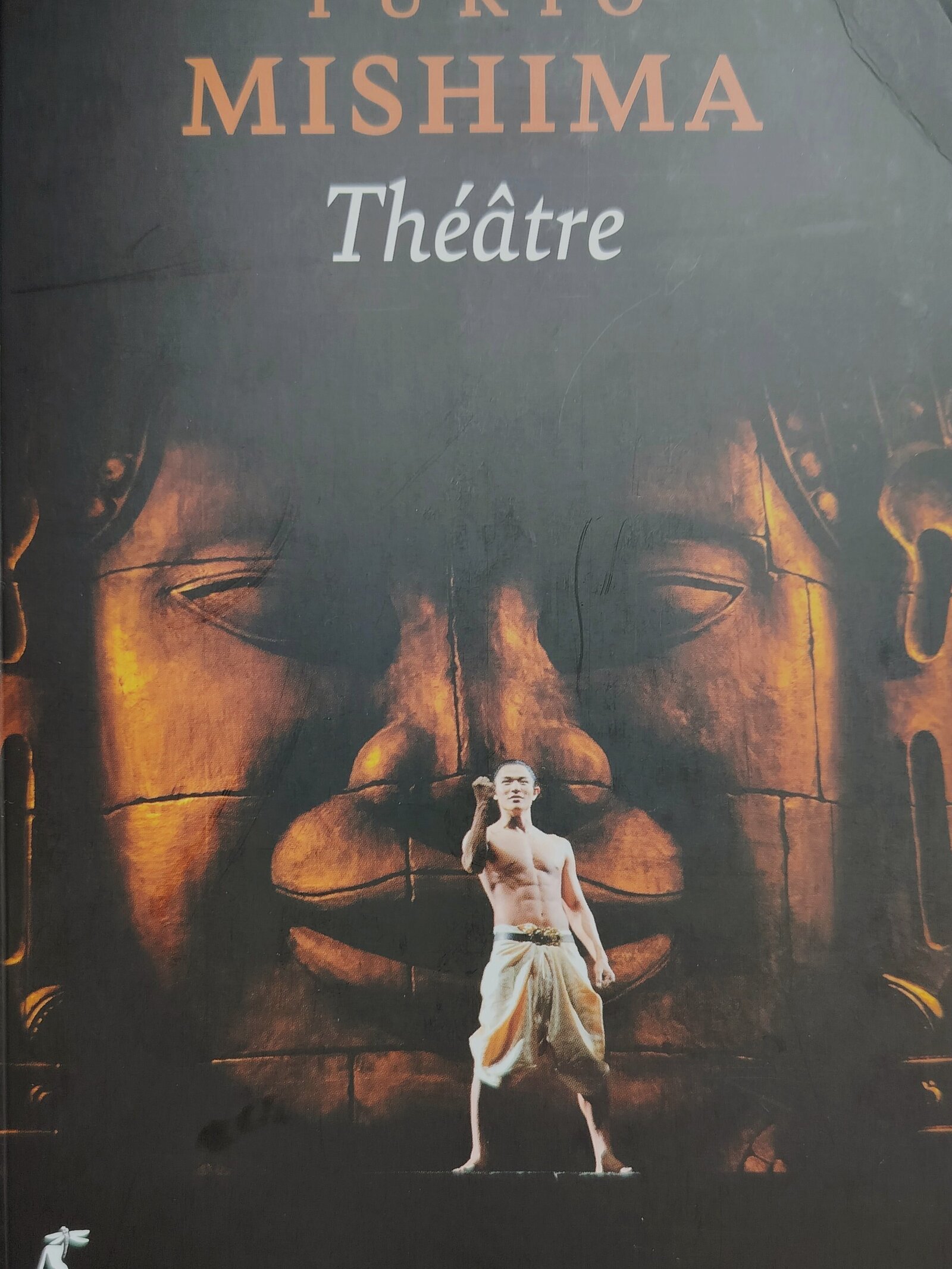
1) Sato Hiroaki, My friend Hitler and other plays of Yukio Mishima (The Rokumeikan — Backstage essays — The decline and fall of the Suzaku — My friend Hitler — The terrace of the leper King — The flower of evil: Kabuki — A wonder tale: the moonbow), New York: Columbia University Press, 2002, p 164 – 208. ISBN 978−0−231−12633−5. [Book available at Angkor Database Library. A pdf of The Terrace’s translation is available email hidden; JavaScript is required] 2) Yukio Mishima, Le théâtre selon Mishima, Thomas Garcin & Corinne Quentin eds., Paris, Atelier Akatombo, 2023, 2 vols. ISBN13 978 – 2379271656. [Full text of Mishima’s script translated as La terrasse du roi lépreux by Alice Hureau (p 317 – 415)]. Vol 1: Théâtre: Jeunesse, lève-toi et marche! | Un nid de termites | Le Koto du bonheur | La Terrasse du roi lépreux. Vol 2: Écrits sur le théâtre: Pourquoi les romanciers japonais n’écrivent-ils pas de pièces de théâtre ?; Le théâtre et moi; La tentation du drame; Réflexions sur le théâtre rédigées en coulisses; Kabuki, shingeki et théâtre américain; Ressusciter « le plaisir du théâtre »; Renaissance du drame romantique; À propos de Tennessee Williams; La peur du théâtre; À propos de Britannicus; Sur la mise en scène de Salomé; Les Bonnes de Genet ; L’art comporte des épines; Du rapport de la danse d’avant-garde aux objets; Quand je m’agite; À propos de Madame de Sade et autres textes. Cover photo: © 渡部孝弘 Watanabe Takahiro.
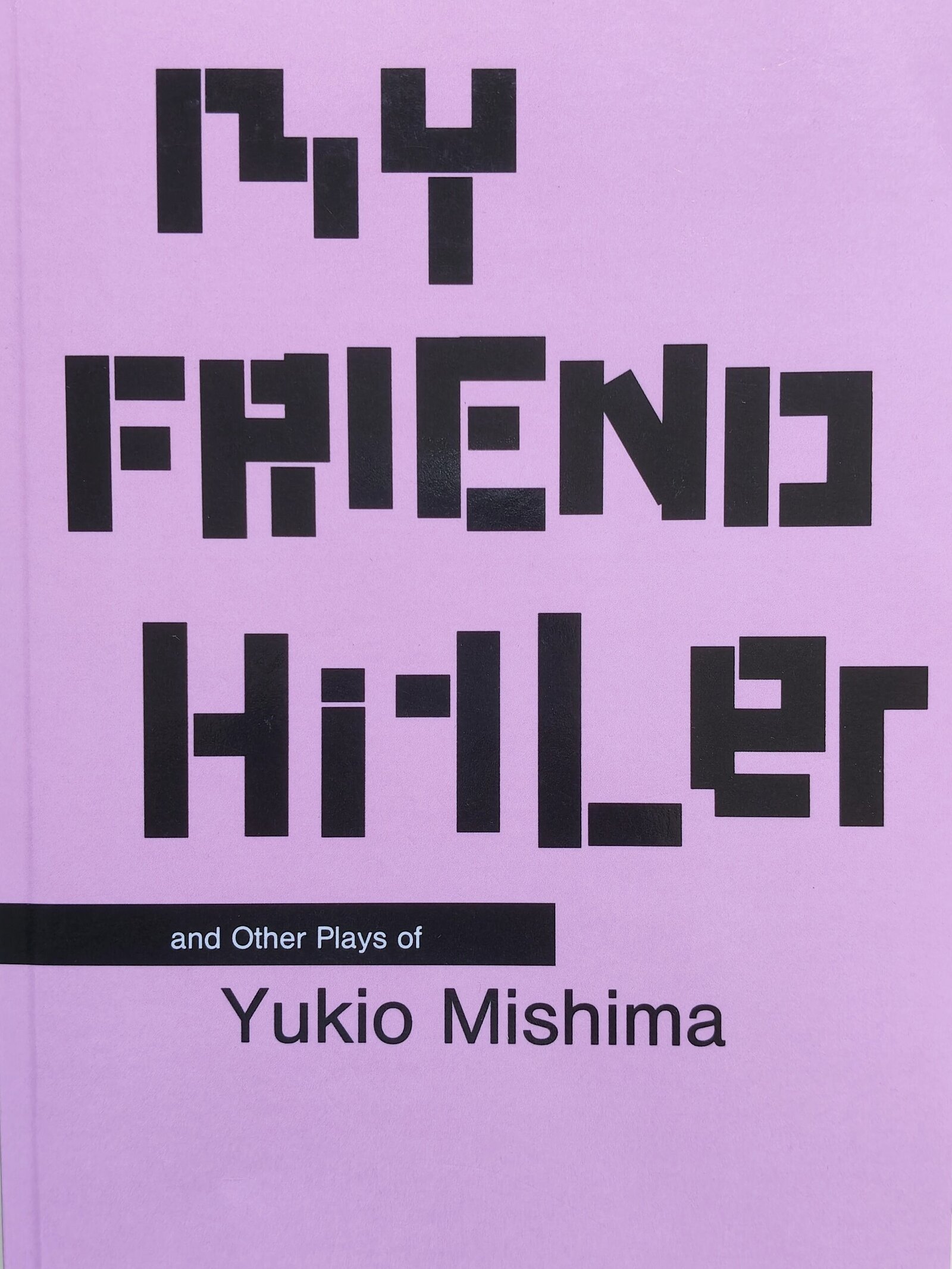
1) Sato Hiroaki, My friend Hitler and other plays of Yukio Mishima (The Rokumeikan — Backstage essays — The decline and fall of the Suzaku — My friend Hitler — The terrace of the leper King — The flower of evil: Kabuki — A wonder tale: the moonbow), New York: Columbia University Press, 2002, p 164 – 208. ISBN 978−0−231−12633−5. [Book available at Angkor Database Library. A pdf of The Terrace’s translation is available email hidden; JavaScript is required] 2) Yukio Mishima, Le théâtre selon Mishima, Thomas Garcin & Corinne Quentin eds., Paris, Atelier Akatombo, 2023, 2 vols. ISBN13 978 – 2379271656. [Full text of Mishima’s script translated as La terrasse du roi lépreux by Alice Hureau (p 317 – 415)]. Vol 1: Théâtre: Jeunesse, lève-toi et marche! | Un nid de termites | Le Koto du bonheur | La Terrasse du roi lépreux. Vol 2: Écrits sur le théâtre: Pourquoi les romanciers japonais n’écrivent-ils pas de pièces de théâtre ?; Le théâtre et moi; La tentation du drame; Réflexions sur le théâtre rédigées en coulisses; Kabuki, shingeki et théâtre américain; Ressusciter « le plaisir du théâtre »; Renaissance du drame romantique; À propos de Tennessee Williams; La peur du théâtre; À propos de Britannicus; Sur la mise en scène de Salomé; Les Bonnes de Genet ; L’art comporte des épines; Du rapport de la danse d’avant-garde aux objets; Quand je m’agite; À propos de Madame de Sade et autres textes. Cover photo: © 渡部孝弘 Watanabe Takahiro.
1) Sato Hiroaki, My friend Hitler and other plays of Yukio Mishima (The Rokumeikan — Backstage essays — The decline and fall of the Suzaku — My friend Hitler — The terrace of the leper King — The flower of evil: Kabuki — A wonder tale: the moonbow), New York: Columbia University Press, 2002, p 164 – 208. ISBN 978−0−231−12633−5. [Book available at Angkor Database Library. A pdf of The Terrace’s translation is available email hidden; JavaScript is required] 2) Yukio Mishima, Le théâtre selon Mishima, Thomas Garcin & Corinne Quentin eds., Paris, Atelier Akatombo, 2023, 2 vols. ISBN13 978 – 2379271656. [Full text of Mishima’s script translated as La terrasse du roi lépreux by Alice Hureau (p 317 – 415)]. Vol 1: Théâtre: Jeunesse, lève-toi et marche! | Un nid de termites | Le Koto du bonheur | La Terrasse du roi lépreux. Vol 2: Écrits sur le théâtre: Pourquoi les romanciers japonais n’écrivent-ils pas de pièces de théâtre ?; Le théâtre et moi; La tentation du drame; Réflexions sur le théâtre rédigées en coulisses; Kabuki, shingeki et théâtre américain; Ressusciter « le plaisir du théâtre »; Renaissance du drame romantique; À propos de Tennessee Williams; La peur du théâtre; À propos de Britannicus; Sur la mise en scène de Salomé; Les Bonnes de Genet ; L’art comporte des épines; Du rapport de la danse d’avant-garde aux objets; Quand je m’agite; À propos de Madame de Sade et autres textes. Cover photo: © 渡部孝弘 Watanabe Takahiro.
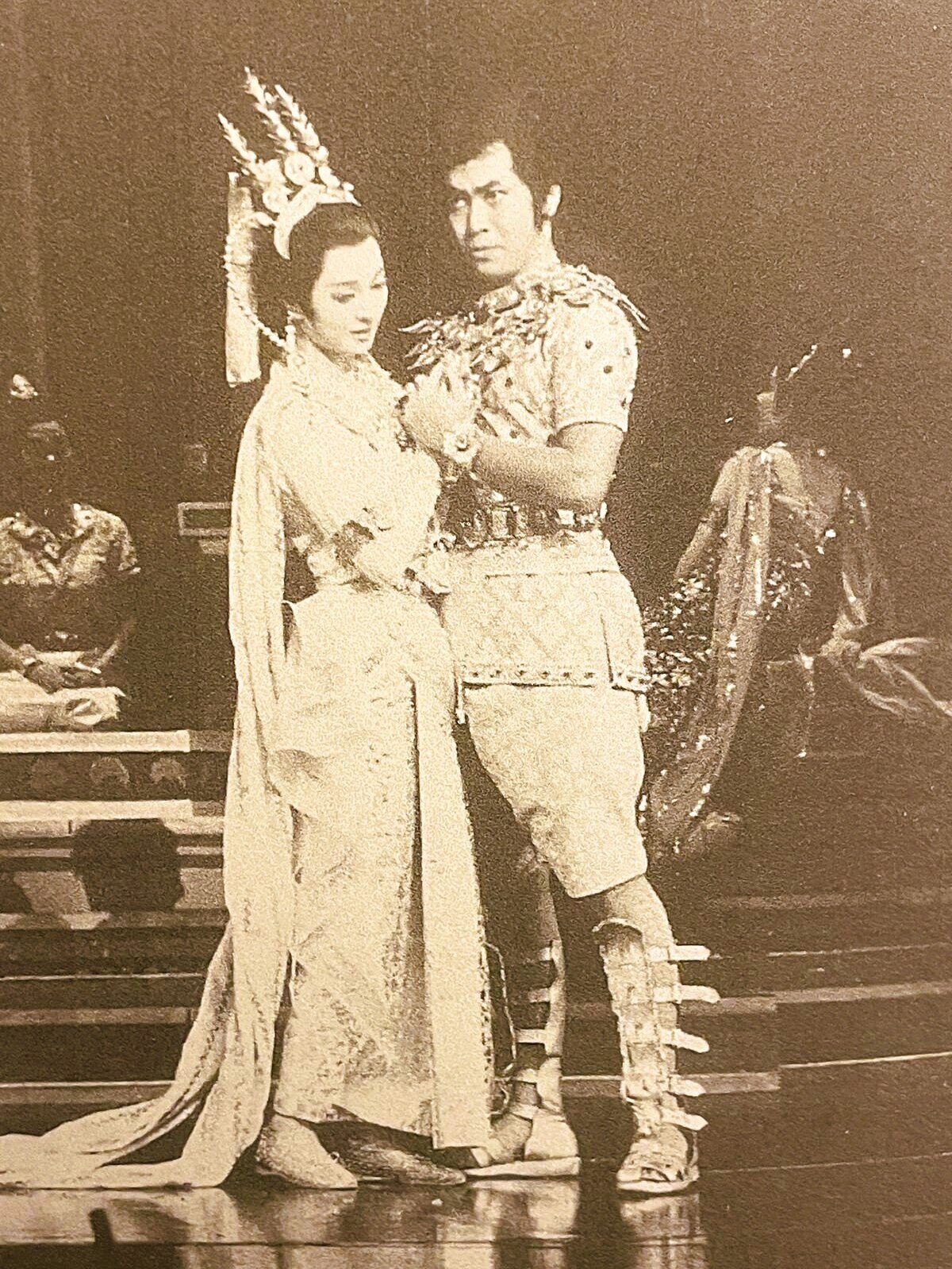
1) Second Queen Rajendradevi, played by Muramatsu Eiko, and Jayvarman VII, played by Kitaoji Kin’ya. Teikoku Geikijo (Imperial Theatre), July 1969. [courtesy of Miramastu Eiko, by permission of Gekidan Kumo and Kitaoji Kin’ya, published in Sato Hiraroki, My Friend…, 2002, op. cit., p 164]. 2) Mishima at a reception shortly before his death by seppuku in 1970. [photo from H.S. Stokes, op. cit.].
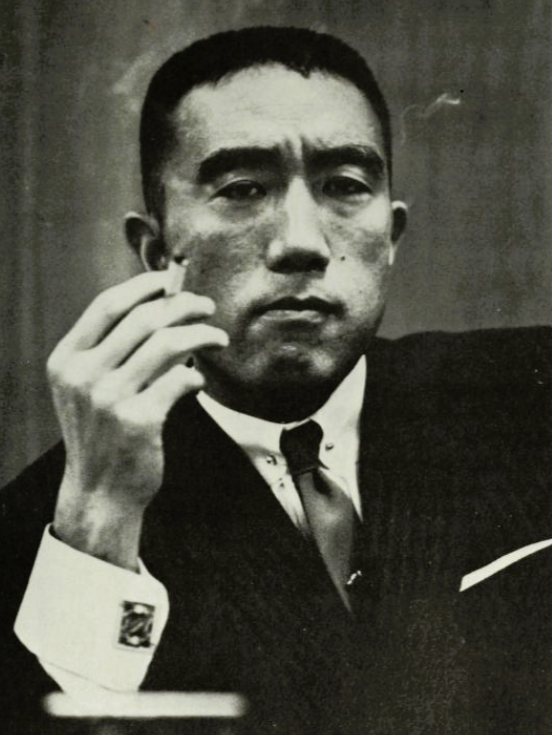
1) Second Queen Rajendradevi, played by Muramatsu Eiko, and Jayvarman VII, played by Kitaoji Kin’ya. Teikoku Geikijo (Imperial Theatre), July 1969. [courtesy of Miramastu Eiko, by permission of Gekidan Kumo and Kitaoji Kin’ya, published in Sato Hiraroki, My Friend…, 2002, op. cit., p 164]. 2) Mishima at a reception shortly before his death by seppuku in 1970. [photo from H.S. Stokes, op. cit.].
1) Second Queen Rajendradevi, played by Muramatsu Eiko, and Jayvarman VII, played by Kitaoji Kin’ya. Teikoku Geikijo (Imperial Theatre), July 1969. [courtesy of Miramastu Eiko, by permission of Gekidan Kumo and Kitaoji Kin’ya, published in Sato Hiraroki, My Friend…, 2002, op. cit., p 164]. 2) Mishima at a reception shortly before his death by seppuku in 1970. [photo from H.S. Stokes, op. cit.].
Was Mishima foreseeing that The Terrace would be his last performed play? From the start of the project, he had wanted to produce it at the Imperial Theatre 帝国劇場 (Teikoku Gekijō), the ‘Teigeki’. Designed and completed in 1911 by architect Yokogawa Tamisuke in the Tokyo district of Chiyoda, it had been damaged by the 1923 Kanto earthquake, rebuilt in 1924 under the direction of the same architect, demolished in 1964 an replaced in 1966 with a new building designed by Taniguchi Yoshiro, operated by Toho company. [Renovated in July 2018, it closed temporarily in Feb. 2025 for major refurbishing].
In his ‘Reminiscing Kishida Kunio’ (NLT Program, Oct. 1968) [The Neo Littérature Théâtre (NLT) was the French name Mishima gave to the theater company he founded in 1964 after breaking from another experimental company, the Bungaku-za.], Mishima gave some important indications on his own conceptions of the dramatist’s art while commenting on one of his literary mentors, Kishida Kunio 岸田 國士, 2 Nov. 1890 – 5 March 1954): “His dramas were akin to chamber music. In that way, he was certainly distancing himself from the sublime cruelty, the barbaric energy ever lurking in the depths of theater, yet on the other hand his plays perpetuate to our days some sort of “absolute calmness” that theater must also possess.” [Kunio’s daughter, Kishida Kyōko, was to perform in Terrace at the 1969 opening.]
The play opened on 7 July 1969 at the Teigeki, with Matsura Takeo (1926−1998) as stage director. Henry Scott Stokes, an American press correspondent in Japan whom Mishima had befriended around 1965, gave an eyewitness account of the Terrace’s première in his 1974 book. After recalling that Mishima had hoped in vain his earlier theater play, Madame de Sade, would be produced in Broadway,
Mishima’s last play for the modern theater was Raio no Terrasu (“The Terrace of the Leper King”, 1969). He had invited me to the première and I remember how he looked that evening — he was wearing all-white evening attire and was accompanied by [his wife] Yoko. Tennessee Williams was supposed to put in an appearance and there was an empty seat near Mishima’s where he should have been. The performance itself went well enough. Raio no Terrasu is an untranslated play about the Khmer king Jayavarman III [sic], the builder of the temple of Bayon at Angkor Wat [sic]. The monarch suffered from leprosy; Bayon is his monument. Mishima used the tale to make the point that the material triumphs over the immaterial, the Body over the Spirit — Bayon alone remains. He was especially proud of the last scene, an exchange on the steps of the newly constructed Bayon between the Body — the youthful image of the king — and the Spirit, represented by the voice of the dying, leprous king (a sepulchral, tape-recorded voice in the Teigeki production we saw) — BODY: King, dying king. Can you see me?/ SPIRIT: Who is calling me? I remember the voice. That brilliant voice./ B. It’s me. Do you see?/ S: No. Of course not. I’m blind./ B: Why should the Spirit need eyes? It has been your source of pride that you see things without using your eyes!/ S: Such harsh words. Who are you?/ B: I’m the king./ S: Absurd! That’s me./ B: We share the same name. King, I am your Body./ S: Who am I then?/ B: You are my Spirit. The Spirit that resolved to build this Bayon. What is dying is not the Body of the king./ S: My Body was rotten and has vanished. You cannot be my Body, speaking so proudly and boldly.
The actor who played the part of the Body was heavily suntanned and wore a short tunic with straps across his bare chest. As he spoke his lines, he strode about the terrace of the temple, flourishing his arms. Behind him was a giant face made of foot-high blocks of stone, one of many such faces at the temple of Bayon. The actor, Kinya Kitaoji, was slightly overweight, his voice boomed out cheerfully, while the groaning Spirit endeavored to reply: [here, transcription of the last part of the dialogue] […] Not long before he killed himself, Mishima arranged a shelf of objects in his upstairs sitting room at home in Magome. These were a Greek vase, a small bronze nude of himself, a collection of translations of his books, and a stage model for the last scene of Raio no Terrasu. One evening he showed this display to some friends. “How do you like it?” he asked them in an ironic tone. “This really sums up my life, don’t you think?” And he burst into laughter. [Henry Scott Stokes, The Life and Death of Yukio Mishima, New York, Farrar, Straus and Giroux, 1974, 392 p. (p 212 – 3)]
Stokes recalled another occasion when Mishima alluded to The Terrace in front of him, during the drive back to Tokyo from a visit to the Tatenokai Camp Fuji, at some point in 1968:
The car passed the first of the succession of big industrial plants which we would see on our return to the capital, still an hour away at least. There was no beach below us, only a dreary series of massive reinforced-concrete tetrapods, intended to break the force of the sea as it hit the mighty wall below us. “I believe in culture as form and not as spirit,” said Mishima, referring to the theme of a drama on which he was then working, the story of the leprous Khmer monarch Jayavarman III and his building of one of the temples of Angkor Wat, Bayon. He seemed very tired as he talked. “I want to keep the Japanese spirit alive,” he added, as if unaware that he was contradicting himself. His voice drifted on. The Emperor, he said, was “the supreme cultural form”; his “physical body” was the form of culture. In the unique Japanese Imperial institution, with its long tradition of poetry, he found the ultimate value. And he added: “I do not believe in the non-material, only in the actual.” A few minutes later, he cradled his head in his left arm, leaning back in his seat, and fell fast asleep. [ibid., p 274]
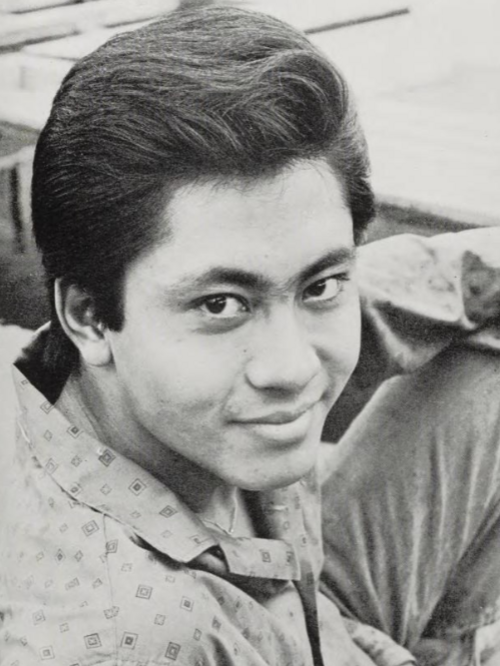
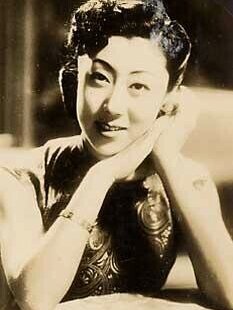
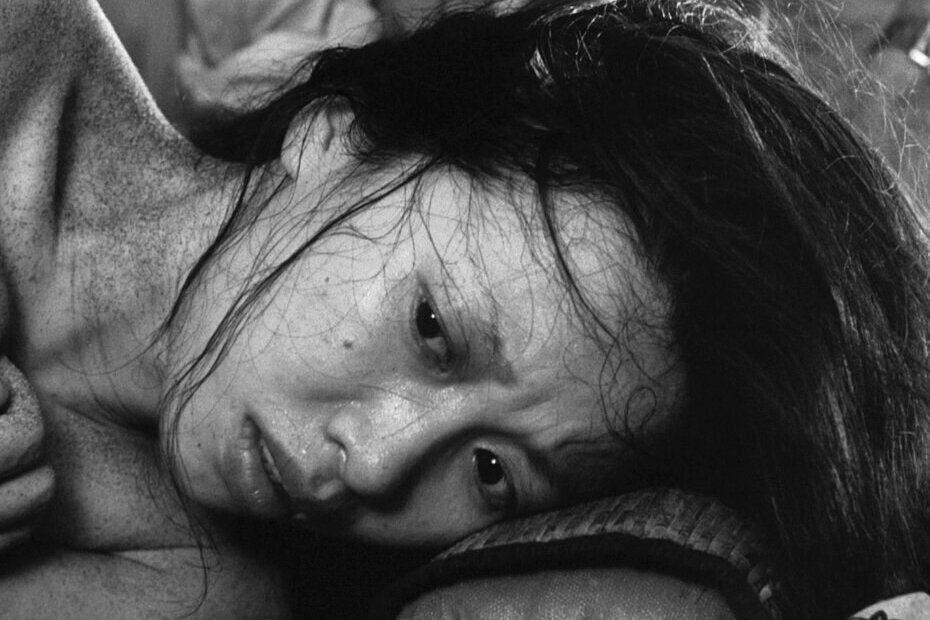
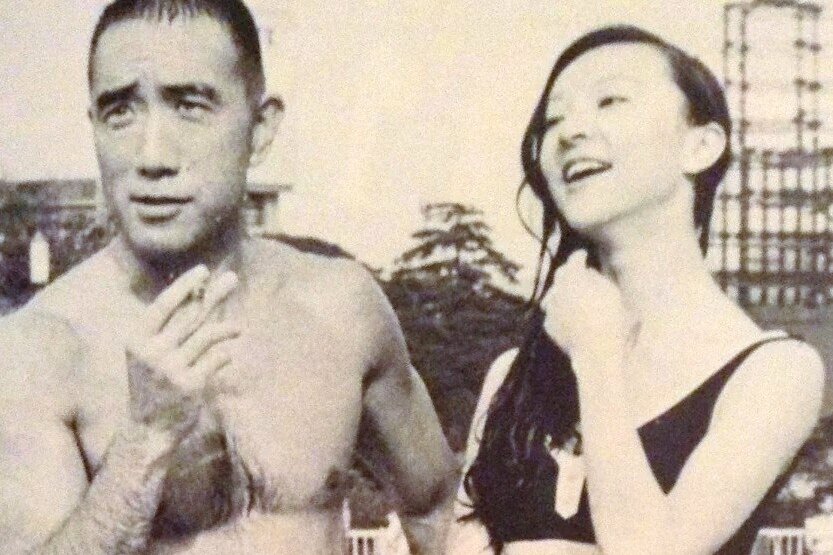
1) Kitaoji Kinya. 2) Yamada Isuzu. 3) Kishida Kyoko. 4) Muramatsu Eiko with Mishima Yukio at a swimming pool c. 1965.
1) Kitaoji Kinya. 2) Yamada Isuzu. 3) Kishida Kyoko. 4) Muramatsu Eiko with Mishima Yukio at a swimming pool c. 1965.
1) Kitaoji Kinya. 2) Yamada Isuzu. 3) Kishida Kyoko. 4) Muramatsu Eiko with Mishima Yukio at a swimming pool c. 1965.
(J) Kitaōji Kinya 北大路 欣也 (b. 23 Feb. 1943, Kyoto), a Japanese actor famous for his roles in period dramas — like his father, the kabuki actor Ichikawa Utaemon — had performed that same year in the movie Shinsengumi (新撰組, Assassins of Honor, 1969), a jidaigeki (period drama) film starring Toshiro Mifune. He was still performing in the years 2000s.
© Yamada Isuzu 山田 五十鈴 (5 Feb. 1917, Osaka – 9 July 2012, Tokyo) had reached movie stardom while being directed by Kenji Mizoguchi, and played in Akira Kurosawa’s Ojimbo (1961),
(I) Kishida Kyōko 岸田今日子 (29 April 1930, Tokyo – 17 December 2006, Tokyo) was a Japanese actress and voice actress. She starred in the cult movie “Woman in the Dunes”, directed by Hiroshi Teshigahara and released in 1964, with a special award at Cannes Film Festival.
® Muramatsu Eiko 村松英子 (b. 31 March 1938, Tokyo) an actresss and poetess, had made her stage debut in 1956 in Onna no Ishho (女の一生, Life of a Woman), based on French writer Guy de Maupassant’s Une vie. Active in several theatre companies such as Bungakuza, Kumo, Group NLT, she co-founded the Roman Gekijo in 1968. A protégée of Yukio Mishima, she made a noted appearance at the reception on the rooftop of the National Theatre on 3 Nov. 1969, following the ‘paramilitary parade’ Mishima had wished to organize for the Shield Society. She tagged along with glamorous Baishō Mitsuko, who had starred with Mishima in Kill!, and the very young Atsumi Mari, who had “performed in soft porn films: All to Mishima’s taste!” [according to Inose Naoki, op. cit., p. 654.]
[1] Jayavarman VII in fact had married Indradevi after her sister and his previous wife, Rajendradevi, had passed away. About the two queens, see here.
The encounter between the Leper King [ស្តេចគម្លង់, sdech komlung, komlung meaning also ‘deaf’ in Middle Khmer] of Angkor Thom and the Japanese man of letters (and action) conflated different directions in his self-questioning. The statue Mishima saw on the eponymous terrace in 1965 was by itself ambiguous: was it an image of King Yasovarman I [ព្រះបាទយសោវរ្ម័នទី១, r. 889 – 910 CE], the founder of Angkor sometimes called ‘The Leper King’? Or one of Jayavarman VII [ជ័យវរ្ម័នទី៧, r. 1181 — 1218 or 1219 CE]? Or has it always been, since time immemorial, the icon of Lord Yama, the King of Death — or Dhamaraja, lit. King of the Path, as identified in a Middel Period inscriptiom — revered as such at the Northeastern corner of the Royal Palace, facing the cardinal direction that in Khmer cosmology represents reincarnation [1]? One sure thing: the statue Mishima had marveled upon in 1965 was transfered to the Phnom Penh National Museum and substituted with a replica two years later, in October 1967, at the time the Japanese author was visiting Bangkok to complete his documenting for his last novel, The Temple of Dawn (1969). According to the Museum curators, the substitution was triggered by the fact that someone had attempted to saw off the head, so characteristic with its two pointed eye teeth.
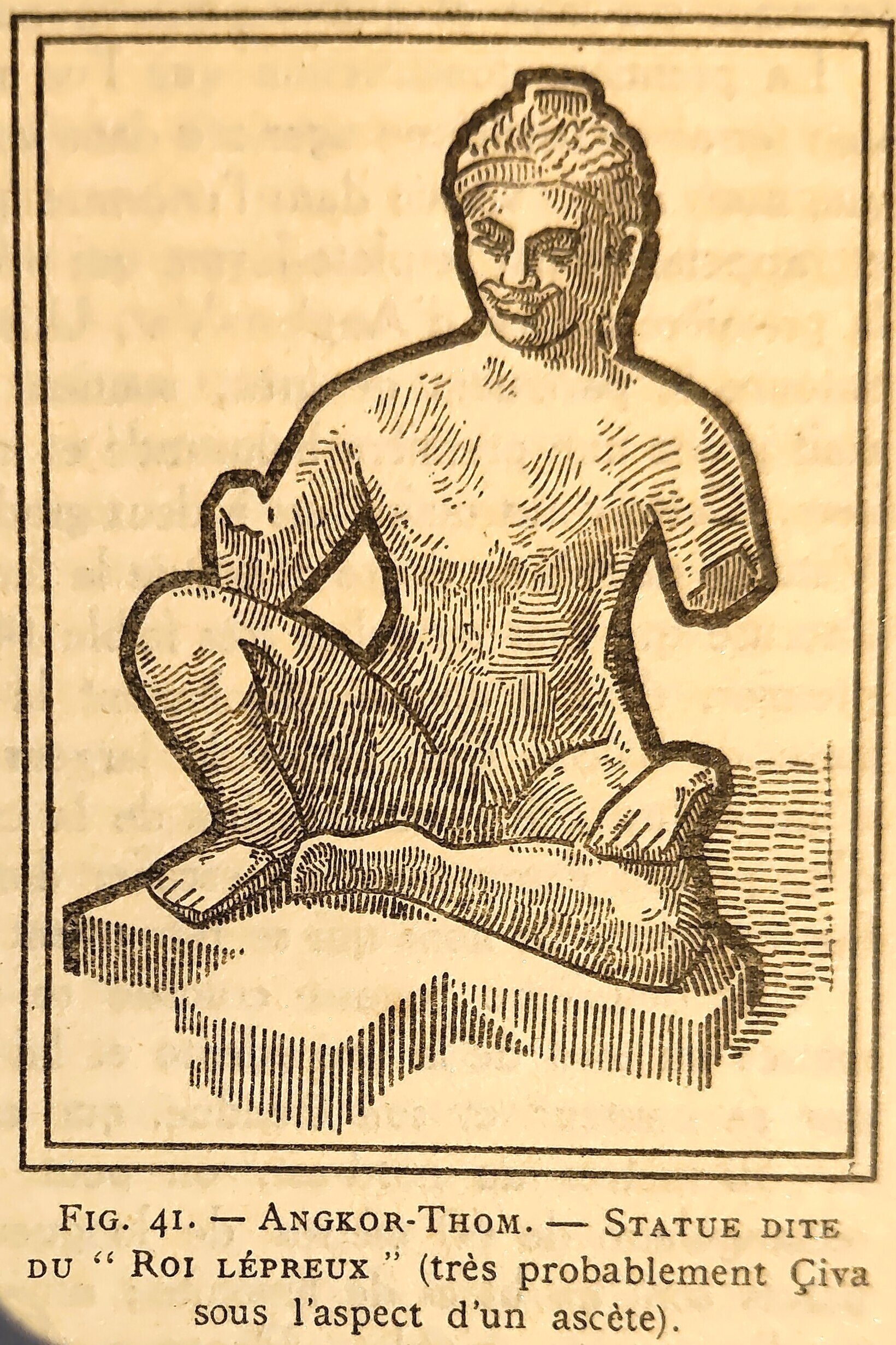
1) “The statue said ot King Leper”, most probably Shiva depicted as an ascet” [in Jean Commaille, Guide aux Ruines d’Angkor, 1912, p. 189. 2) Statue of the Leper King [癩王の] in the Japanese edition [photo by Iwamiya Takeji 岩宮武二, date unknown]. Iwamiya (1920−1989 was a renowned photographer who later published a photo-album reflecting his work in Angkor — アンコール 岩宮武二写真集 [Angkor: Iwamiya Takeji Photo Collection], Tokyo: Iwanami Shoten, 1984. ISBN 4−00−008022−9, texts by Yoshiaki Ishizawa 石沢良昭)]. 3) Offerings to the statue (Yama), photographed by Micheline Dullin in 1963, 2 years before Mishima’s visit. [from Cambodge 1958 – 1964]
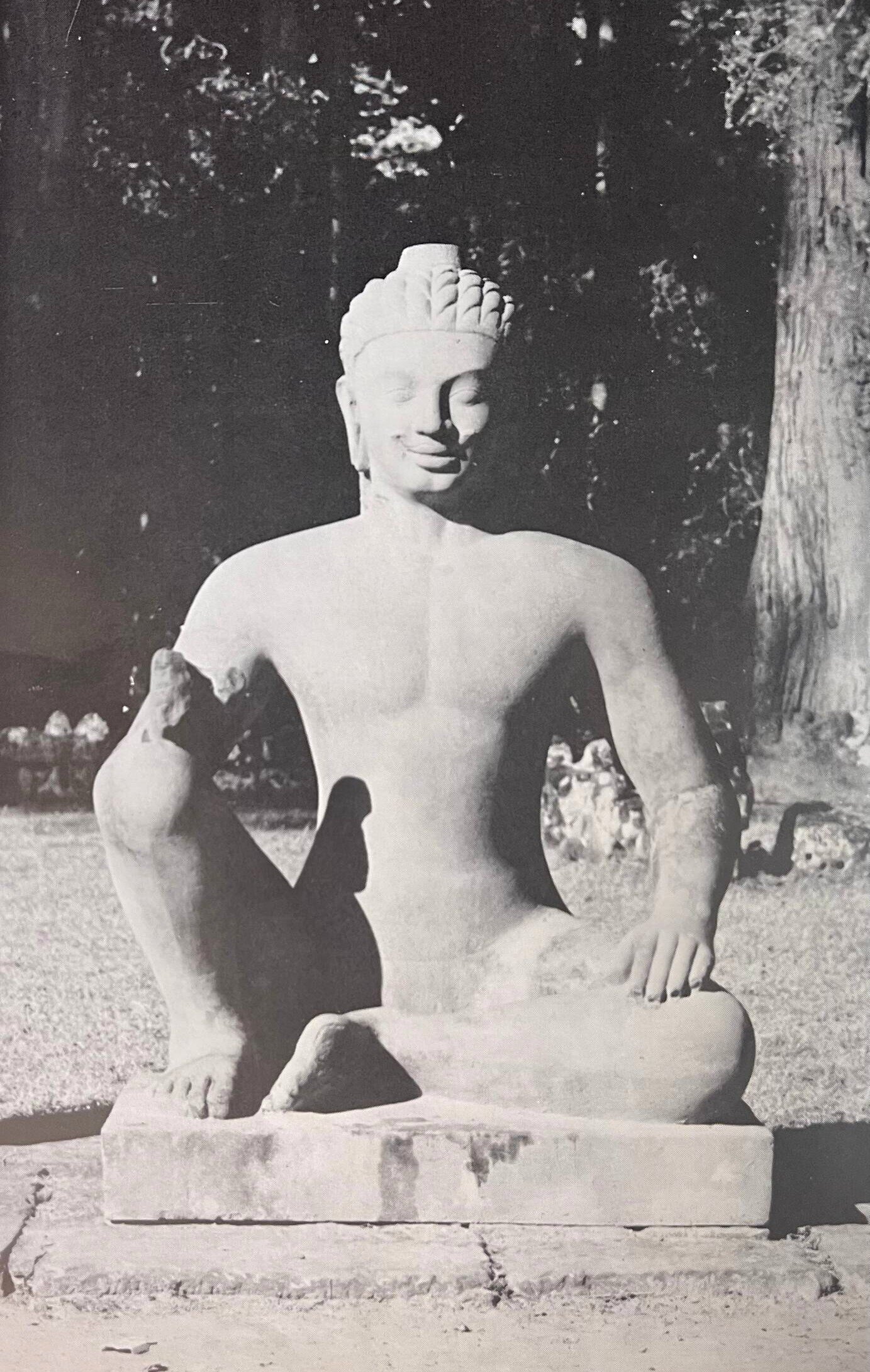
1) “The statue said ot King Leper”, most probably Shiva depicted as an ascet” [in Jean Commaille, Guide aux Ruines d’Angkor, 1912, p. 189. 2) Statue of the Leper King [癩王の] in the Japanese edition [photo by Iwamiya Takeji 岩宮武二, date unknown]. Iwamiya (1920−1989 was a renowned photographer who later published a photo-album reflecting his work in Angkor — アンコール 岩宮武二写真集 [Angkor: Iwamiya Takeji Photo Collection], Tokyo: Iwanami Shoten, 1984. ISBN 4−00−008022−9, texts by Yoshiaki Ishizawa 石沢良昭)]. 3) Offerings to the statue (Yama), photographed by Micheline Dullin in 1963, 2 years before Mishima’s visit. [from Cambodge 1958 – 1964]
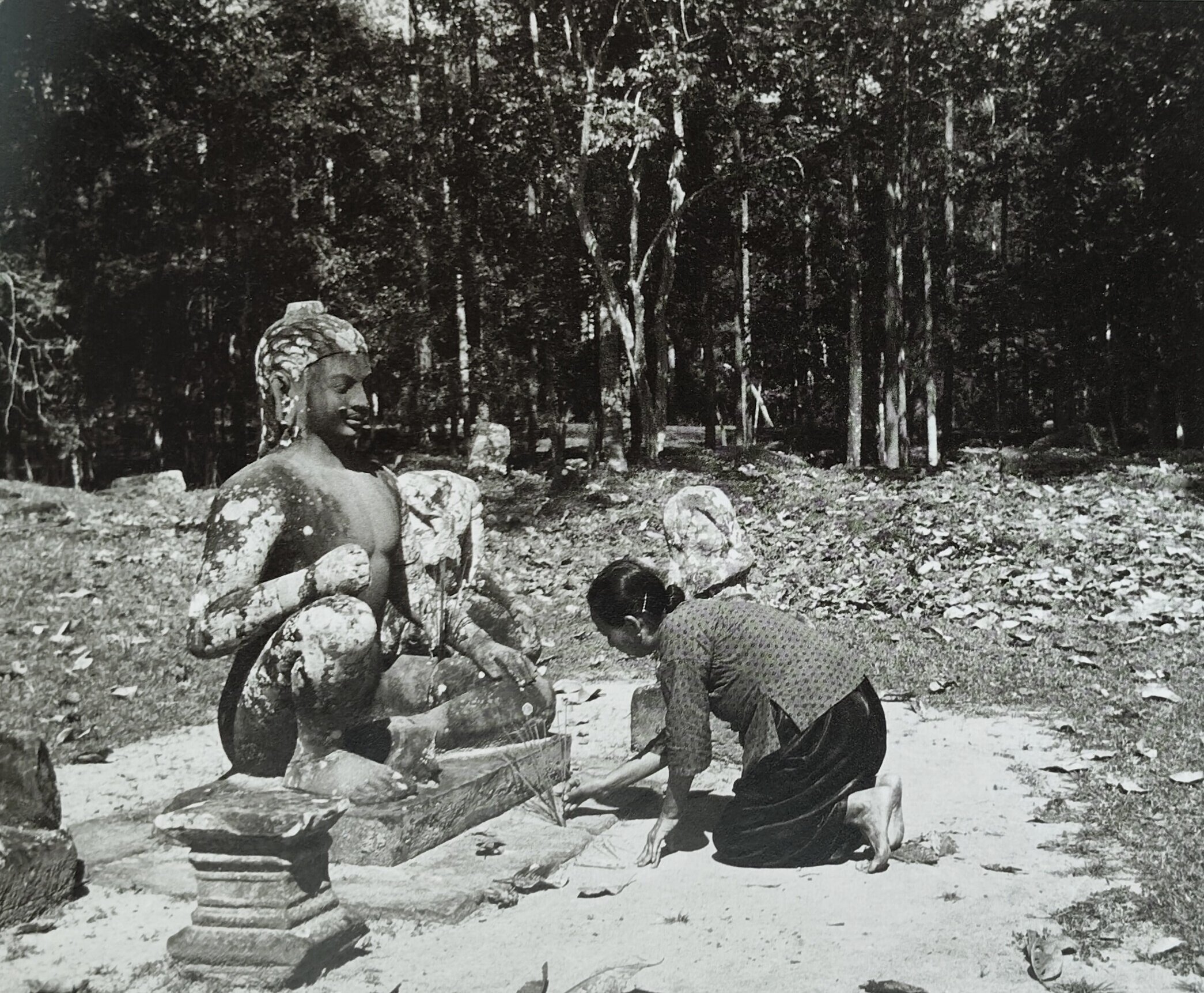
1) “The statue said ot King Leper”, most probably Shiva depicted as an ascet” [in Jean Commaille, Guide aux Ruines d’Angkor, 1912, p. 189. 2) Statue of the Leper King [癩王の] in the Japanese edition [photo by Iwamiya Takeji 岩宮武二, date unknown]. Iwamiya (1920−1989 was a renowned photographer who later published a photo-album reflecting his work in Angkor — アンコール 岩宮武二写真集 [Angkor: Iwamiya Takeji Photo Collection], Tokyo: Iwanami Shoten, 1984. ISBN 4−00−008022−9, texts by Yoshiaki Ishizawa 石沢良昭)]. 3) Offerings to the statue (Yama), photographed by Micheline Dullin in 1963, 2 years before Mishima’s visit. [from Cambodge 1958 – 1964]
1) “The statue said ot King Leper”, most probably Shiva depicted as an ascet” [in Jean Commaille, Guide aux Ruines d’Angkor, 1912, p. 189. 2) Statue of the Leper King [癩王の] in the Japanese edition [photo by Iwamiya Takeji 岩宮武二, date unknown]. Iwamiya (1920−1989 was a renowned photographer who later published a photo-album reflecting his work in Angkor — アンコール 岩宮武二写真集 [Angkor: Iwamiya Takeji Photo Collection], Tokyo: Iwanami Shoten, 1984. ISBN 4−00−008022−9, texts by Yoshiaki Ishizawa 石沢良昭)]. 3) Offerings to the statue (Yama), photographed by Micheline Dullin in 1963, 2 years before Mishima’s visit. [from Cambodge 1958 – 1964]
Between the initial revelation of the statue and the completion of the play in the first months of 1969, the visit to India in the fall 1967 added a powerful experience at Benares [now Varanasi] bathing ghats: the theme of “spiritual — or karmic — disease”, present in Mishima’s works since his young age, as constant as his fascination for the Wildean fear of physical decay, started to weave itself into the notion that leper was not a metaphor but a real, tangible form of physical corruption-transfiguration. Shigekuni Honda, the main character in Temple of Dawn would recall a vision at Benares that had been very much seen through Mishima’s eyes [2]:
His eyes were rapturously transfixed, as though no one existed about him, and he gazed vacuously at the sky above the opposite bank. His right hand slowly stretched heavenward in adoration. The skin of the face, chest, and abdomen was a fresh pinkish white in the evening light, and his nobility completely removed him from his surroundings. But remnants of the black skin of this world remained here and there on the upper half of his arms, on the backs of his hands, or on his thighs, almost peeling off, but still forming blotches, marks and stripes. These remnants made his glowing pink body appear even more sublime. He was a white leper.
Blotches of color, like the yellowish lichen on the statue’s grey statue. This is an “extraordinary mixture of the pure and the diseased, the beautiful and the foul” — to quote James Raeside who, in his 2003 essay, showed how Mishima departed from Shinju Soya’s strict (even rigid) interpretation of the leper as tenkeibyō (‘disease of heavenly punishment’) inflicted to a King more preoccupied by prestigious buildings than the welfare of his people. From his own reading of Zhou Daguan’s account [3] and other historical essays on Ancient Angkor, Mishima has opted for a truly Cambodian plot: the Bayon as ‘Ba-yant’, ancestral yantra symbolizing the universe and the role of the royal Khmer dynasty in it, building of the temple of Bayon, is as much a sign of the King’s compassion as the dozens of hospitals [4] he and his wives would build to cure ‘real’ patients, including many suffering from leper. It is with the giant heads of the Bodhisattva Avalokitesvara [Lokeshvara in Cambodia, Chinese-Japanese Kannon (観音), more formally Kanzeon (観世音), the name used by Mishima in his play] that the principles of compassion and punya - charitable deed — triumph in Angkor.
Quite skillfully, Mishima had the ‘old-school’ outlook in Angkor expressed by the Dowager Queen, Jayavarman VII’s mother, thought to be so convinced of the Cambodian king as literal embodiment of the Kingdom that she was in favor to kill him, so his diseased body wouldn’t bring curse and calamity on the country. Was creating magnificent temples ultimately an act of vanity, an unecessary burden brought upon the Cambodian people already threatened by wars? In Terrace..., Mishima went back to the iconoclastic pulsion treated in his Temple of the Golden Pavilion (金閣寺, Kinkaku-ji, 1956) ), loosely based on the arson of the Reliquary of Kinkaku-ji Temple in Kyoto by a young Buddhist acolyte in 1950., a story of destruction of a work of beauty and object of devotion. In the play, however, the Bayon and its beauty survive the mortally ill man who had envisioned it. Moreover, the dying king in the play understands that “as my body gradually collapses, the temple of
Bayon slowly approaches completion, and I gradually give myself over to the temple. That’s it! In his infinite compassion Avalokitesvara [Kannon or Kanzeon] must wish for this. In that case I will never be able to stand before the completed shrine. Why? Because when my flesh meets its last hour then, for the first time, I will be given over entirely to the temple: this temple of my soul, Bayon, this temple unmatched throughout world, will no doubt be completed … but it is precisely then that I will become one with Avalokitesvara.”
In Angkor, Mishima also found out his own reasons to reinterpret the strict Japanese Buddhist tradition. Being compassionate to lepers is a pious act in Japanese Buddhism — see the story of Empress Kōmyō licking the pus from the body of a leper who had told her it would cure him, and witnessing him turning out to be an incarnation of the Buddha Amitabha -, yet the 12th century Khmer kingdom went farther, establishing a real “state-funded” general health care system, at a time hospitals in Europe were fully operated and controlled by the Church. And for the Japanese novelist, the image of Leper King-Yama’s undecipherable smile and naked body ended up blending with his vision of Benares he had added to the manuscript of The Temple of Dawn in 1968: “Swarms of lepers who had come on pilgrimage from all over the country, now begging while awaiting their deaths. …The languidness of the purification to return to the four elements, the useless fragrance that remains even after the human flesh that resists it dies [in cremation]…”
James Raeside reported another instance of the novelist and playwright opting for not following the “Angkor expert” Shinji Shoya’s reading:
Soya Shinji, in his commentary on the tankobon edition of the play, relates how he told Mishima another version of the Cambodian snake-legend, derived from his interpretation of one of the scenes depicted in relief on the Bayon temple. In this story, the king Yasovarman (889 – 900), who founded the original city of Angkor (called Yasodharapura after him until the fourteenth century), battles in the coils of a giant snake. He eventually kills it, but the blood which splatters onto his skin carries with it the curse of leprosy. Soya, who believes, against most current opinion, that the ‘leper king’ statue is supposed to be of Yasovarman, relates that he wanted to emphasize to Mishima the abiding importance of the Naga, as the ancestral earth god of the Khmer people, and the idea that Jayavarman reaped the fruits of the curse laid upon the founder of Angkor by the serpent. In Mishima’s play, however, one of the first things we learn about the king is his punctiliousness in paying respects to the Nagi. Nor does Jayavarman himself seem to relate his leprosy to the Naga, whether as the result of present displeasure or of ancient curse. [James Raeside, op. cit., p 113].
As an adept of esoteric Buddhism and traditional martial arts, Mishima was aware of the ancient Japanese “ritual of subduing the serpents” (byakuja-hō) as a way to become immune of the “three Poisons”: Desire (ton 貪), Anger (jin 瞋), and Ignorance (chi 痴) [5]. But he also came to realize that the Naga, in Cambodian culture, was the very essence of the collective identity, the spirits presiding to the receding of high waters at the end of the rainy season, the female principle from which the “Khmer country” originated. At the end of the first act, when the earliest signs of leprosy appear flowers on the king’s skin, the First Queen bitterly comments that they certainly are the marks of kisses left by the Naga princess whom the King joins every night in his golden tower — legend reported by Zhou Daguan -, and the king dismisses this piqué with a laugh. Isn’t it because the queens envy the Naga maiden for the fact that she acts at the end more womanly than themselves, being able to content and reinvigorate the ailing male?
The Nagas, coming from the realm of water to nurture the earth, represent the primeval Cambodia, before it became Indianized, before other beliefs and rites were peacefully adopted and adapted. In Angkor, they have managed to befriend their stubborn enemies in the Indian traditions, the Garudas. And they are still there, in spite and within illness and death. In his Archaeological Guide to the Angkor Temples (1928), Henri Marchal disclosed a recent archaeological discovery at the Terrace of the Leper King:
Un hasard seul a permis de retrouver derrière le mur extérieur des façades Sud et Est de la terrasse, un second mur, situé à peine à deux mètres de distance du premier et reproduisant fidèlement le même décor sculpté: divinités, princesses, géants alignés sur six ou sept registres superposés. Ce mur, complètement bloqué dans la maçonnerie du mur exté-rieur, a été dégagé en ménageant un étroit couloir entre les deux pour qu’on puisse voir les sculptures qui, préservées des intempéries, sont apparues comme neuves au dégagement. La finesse et la beauté de certains visages où parfois le type asia-tique se fait très peu sentir, met ces bas-reliefs au nombre des meilleurs morceaux de l’art khmèr. Au registre inférieur sont d’énormes nâgas dont les têtes s’épanouissent en éventail au milieu de princes et princesses nâgas chaperonnés de ser-pents qui rappellent ceux du grand bassin au Nord du Phiméanakas. [[p 126 – 7].
[“It was pure chance that led to the discovery, behind the outer wall of the south and east facades of the terrace, of a second wall, located barely two meters from the first and faithfully reproducing the same sculpted decoration: deities, princesses, and giants arranged in six or seven superimposed registers. This wall, completely embedded in the masonry of the outer wall, was uncovered by creating a narrow passage between the two so that the sculptures could be seen. Preserved from the elements, they appeared as good as new upon excavation. The delicacy and beauty of some of the faces, where the Asian type is sometimes barely perceptible, place these bas-reliefs among the finest examples of Khmer art. In the lower register are enormous nagas whose heads fan out amidst naga princes and princesses chaperoned by serpents, reminiscent of those in the large basin north of the Phimeanakas.”]
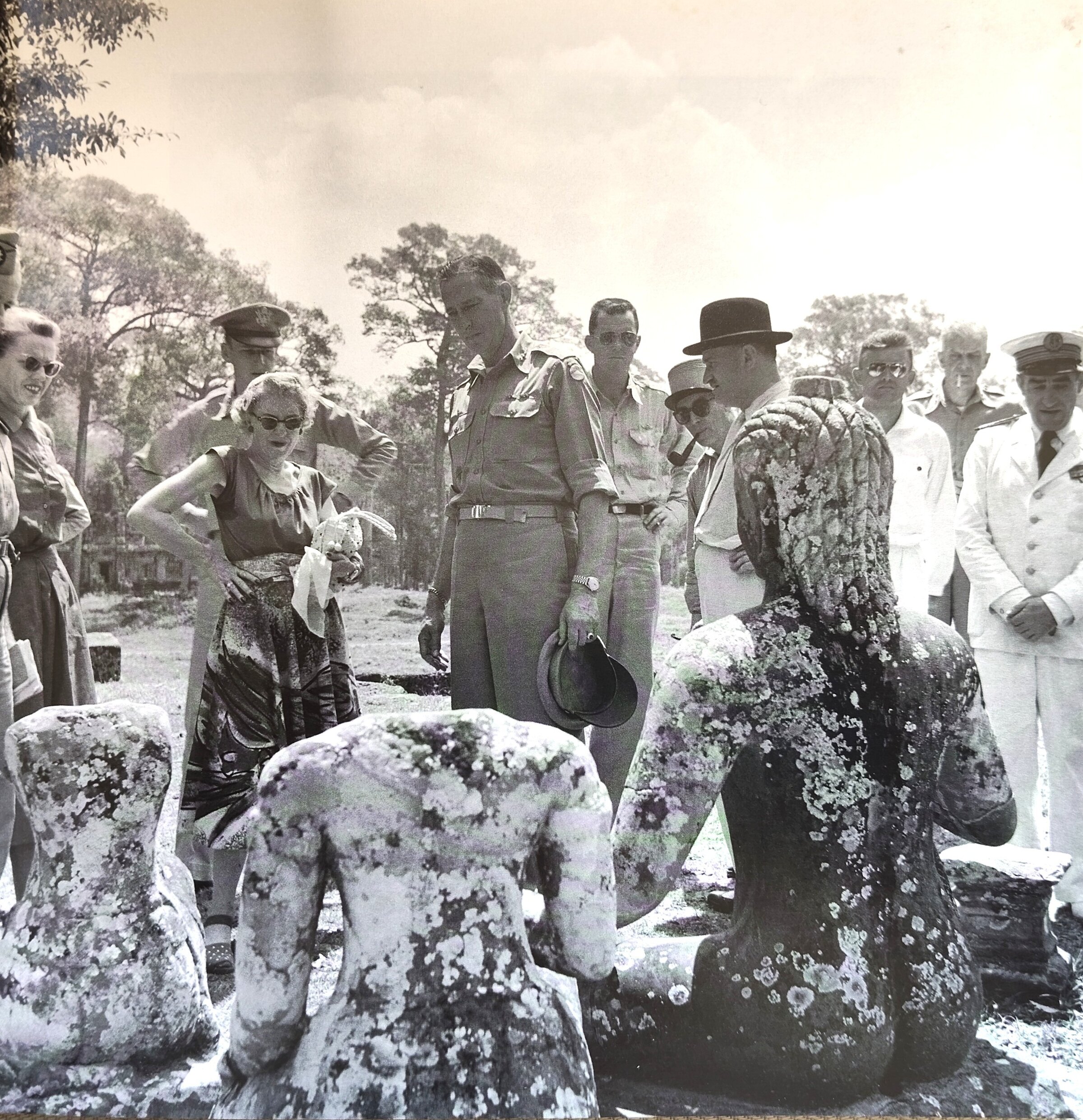
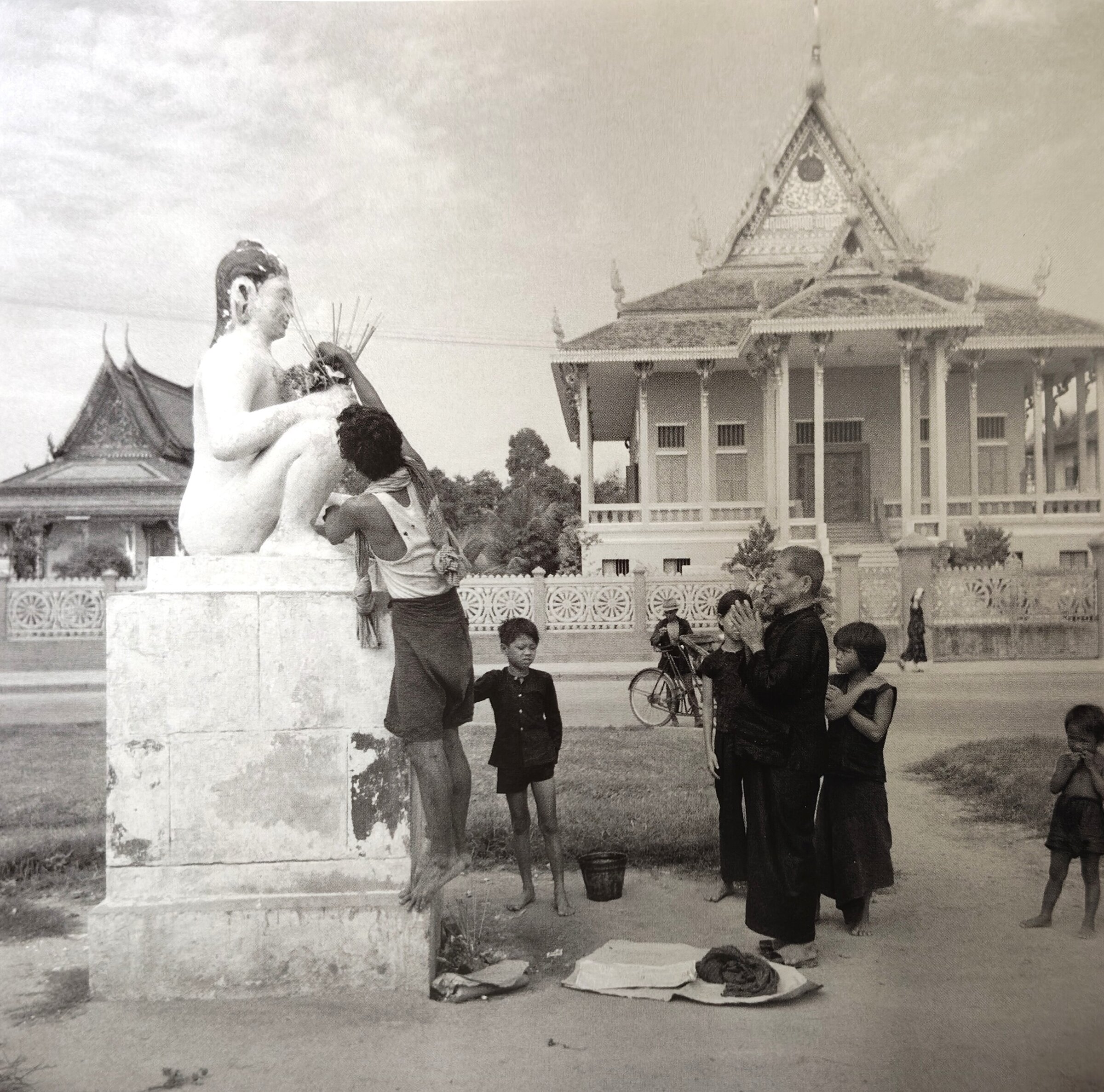
1) General Clark, Commander of the American forces in the Far Eastr and the UN Forces in Korea, in front of Yama-King Leper statue, 21 March 1951. Note that 2 of the 3 statues of Yama’s aides can still be seen near Lord Yama’s image. [photo by Jean Peraud/SPI/ECPAD, from Images du Cambodge 1900 – 1993, Ivry-sur-Seine, ECPAD, 2022.] 2) Offering to one of Phnom Penh City’s protective spirits represented in the form of the King Leper, 29 Sept. 1953 [photo by Jacques Surel/SPI/ECPAD, from Images du Cambodge 1900 – 1993, op. cit.]
1) General Clark, Commander of the American forces in the Far Eastr and the UN Forces in Korea, in front of Yama-King Leper statue, 21 March 1951. Note that 2 of the 3 statues of Yama’s aides can still be seen near Lord Yama’s image. [photo by Jean Peraud/SPI/ECPAD, from Images du Cambodge 1900 – 1993, Ivry-sur-Seine, ECPAD, 2022.] 2) Offering to one of Phnom Penh City’s protective spirits represented in the form of the King Leper, 29 Sept. 1953 [photo by Jacques Surel/SPI/ECPAD, from Images du Cambodge 1900 – 1993, op. cit.]
1) General Clark, Commander of the American forces in the Far Eastr and the UN Forces in Korea, in front of Yama-King Leper statue, 21 March 1951. Note that 2 of the 3 statues of Yama’s aides can still be seen near Lord Yama’s image. [photo by Jean Peraud/SPI/ECPAD, from Images du Cambodge 1900 – 1993, Ivry-sur-Seine, ECPAD, 2022.] 2) Offering to one of Phnom Penh City’s protective spirits represented in the form of the King Leper, 29 Sept. 1953 [photo by Jacques Surel/SPI/ECPAD, from Images du Cambodge 1900 – 1993, op. cit.]
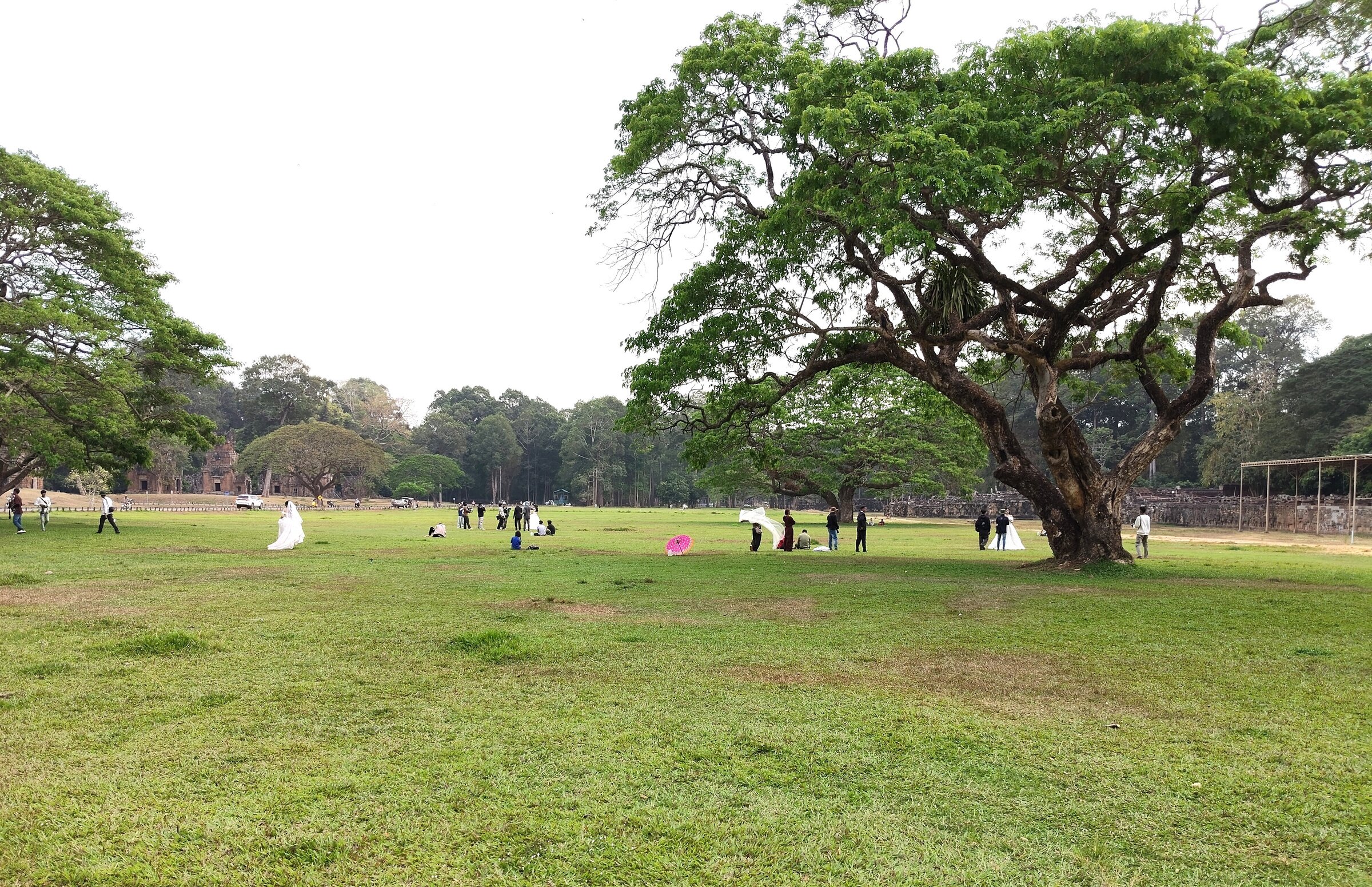
Below the Leper King Terrace, Angkor Thom, favorite spot for pre-wedding photographs [photo by Angkor Database, April 2025].
Below the Leper King Terrace, Angkor Thom, favorite spot for pre-wedding photographs [photo by Angkor Database, April 2025].
There would be more to add about the Khmer word គម្លង់ kumlong, which in Modern Khmer means “deaf” but in earlier times referred to “leper”. And there is a question that Prof. Ang Choulean, in his latest manual of Khmer history and historiography, addressed to his students:
ប្រការមួយទៀតដែលទាញអារម្មណ៍យើងខ្លាំង គឺលោក Y. Mishima ដែលជាអ្នក និពន្ធជប៉ុនល្បីល្បាញម្នាក់ ក៏មានគំនិតដូច្នេះដែរ។ លោកធ្លាប់មកទស្សនាអង្គរក្នុងទសវត្ស ១៩៦០ តែលោកពុំមែនជាអ្នកសិក្សាស្រាវជ្រាវអំពីអង្គរអ្វីសោះឡើយ។ នៅក្រុងតូក្យូ ក្នុង ឆ្នាំ១៩៦៨ លោកដឹកនាំរឿងល្ខោនមួយដែលលោកតែង ហើយឲ្យឈ្មោះថា «លានស្ដេចគម្លង់»។ ក្នុងនោះគឺព្រះបាទជ័យវម៌ទី៧រងនឹងជម្ងឺឃ្លង់រហូតដល់អស់ព្រះជន្ម។ ពិតហើយថាជារឿងតែងសុទ្ធសាធ តែហេតុម្តេចបានជាគិតទៅយ៉ាងនេះដែរ? [ប្រវត្តិសាស្ត្រកម្ពុជាសម័យអង្គ័រ (មូលដ្ឋានរៀននិងស្រាវជ្រាវ) [The History of Cambodia during the Angkor Period (Foundation study and research)], Yosothor, Phnom Penh, 2025, p. 219]
[“Mr. Y. Mishima, a famous Japanese writer, had visited Angkor in the 1960s, but he was not a researcher of Angkor at all. In 1968 [1969] in Tokyo he directed a play he had written, called The Terrace of the Leper King. In it, King Jayavarman VII is depicted as suffering from leprosy until the end of his life. Granted, this was a work of fiction but do you think it is also fictional?]
Earlier, the Cambodian anthropologist mentioned the legend (or real fact?) of King Ashoka of India being leper-afflicted, and the fact that George Coedès was “the first researcher to raise the question of whether the statue was an image of King Jayavarman VII,
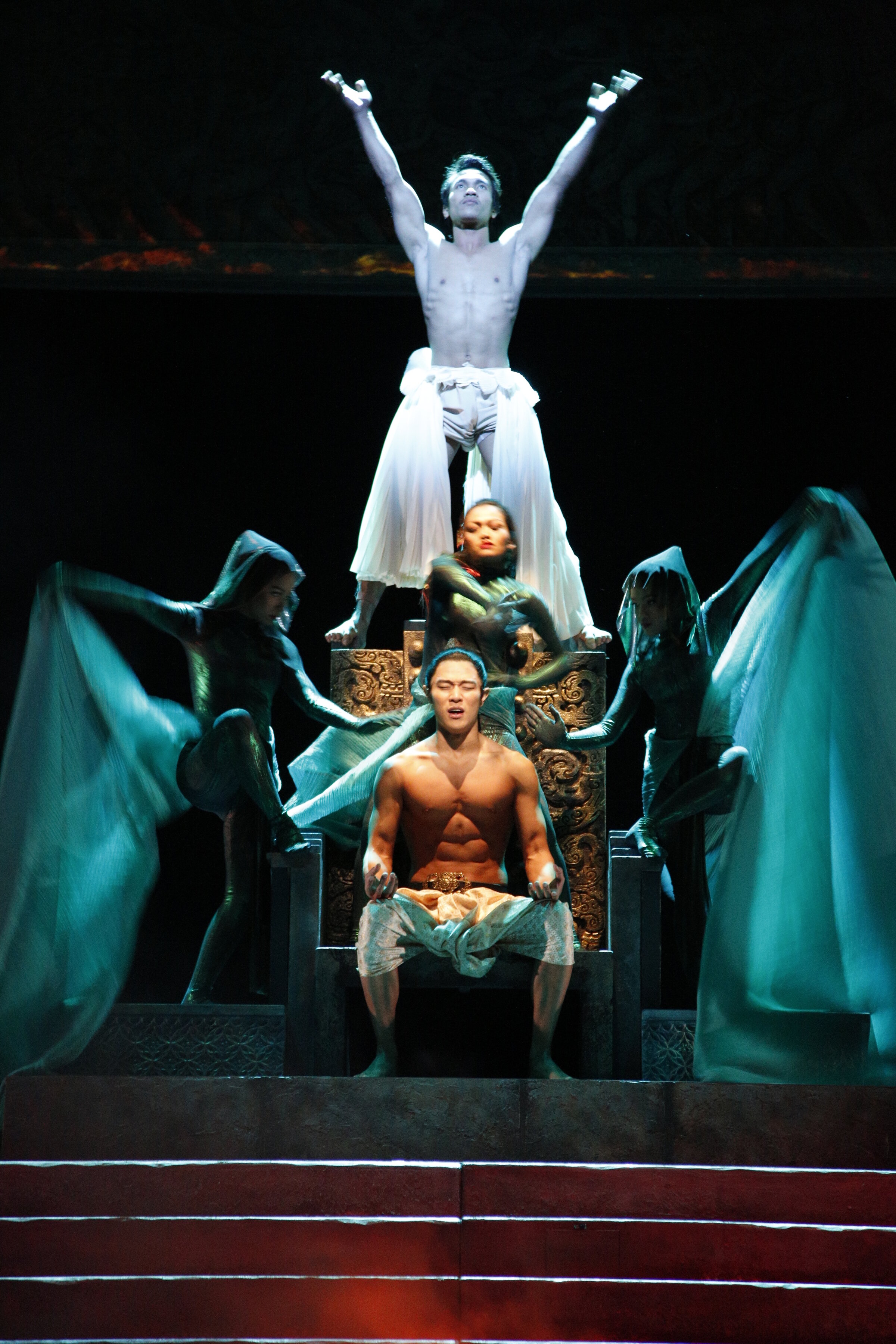
Two moments of the 2016 production (see below). Bo Rotha (top) above Ryohei Suzuki, the latter surrounded by the three Cambodian dancers, left to right: Chy Lina, Chap Chamroeun Tola, ‘Belle’ Chumvan Sodhachivy . [photos by Watanabe Takahiro 渡部孝弘 (©) HoriPro Inc., Tokyo — with thanks to Chihiro Yoshinaga, Manager Live Entertainment Department, HoriPro Inc.].
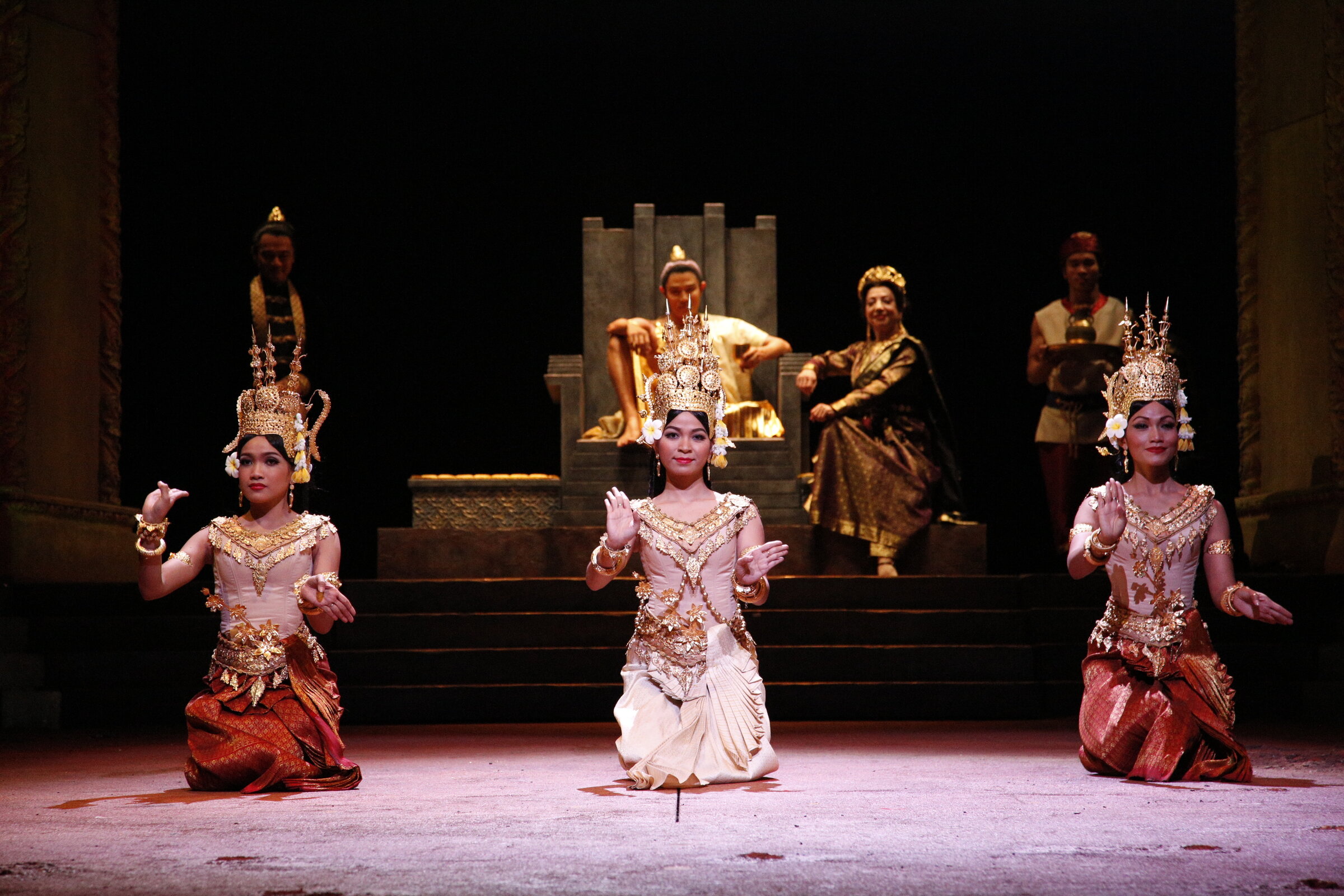
Two moments of the 2016 production (see below). Bo Rotha (top) above Ryohei Suzuki, the latter surrounded by the three Cambodian dancers, left to right: Chy Lina, Chap Chamroeun Tola, ‘Belle’ Chumvan Sodhachivy . [photos by Watanabe Takahiro 渡部孝弘 (©) HoriPro Inc., Tokyo — with thanks to Chihiro Yoshinaga, Manager Live Entertainment Department, HoriPro Inc.].
Two moments of the 2016 production (see below). Bo Rotha (top) above Ryohei Suzuki, the latter surrounded by the three Cambodian dancers, left to right: Chy Lina, Chap Chamroeun Tola, ‘Belle’ Chumvan Sodhachivy . [photos by Watanabe Takahiro 渡部孝弘 (©) HoriPro Inc., Tokyo — with thanks to Chihiro Yoshinaga, Manager Live Entertainment Department, HoriPro Inc.].
_______________
[1] “There is a noteworthy and recurring parallel in the inscriptional corpus between the king, on the one hand, inflicting punishment in the earthly realm and Yama, on the other hand, passing judgement in the afterlife. Each, in their own domain, is the preserver and guarantor of dharma, or ‘order’. The comparison is made explicit in K. 598, dating from 1006 CE, which warns the reader to respect a judgement passed down by a tribunal, and endorsed by the king, in relation to a land dispute: ‘If they do [disregard the deed] they will be punished by the kings; in the hereafter, they will be punished by Vraḥ Yama through sentence of the hells, starting with a stay in Avīci until the dissolution of the world’. Indeed, in the Indian tradition, as far back as the Vedic Period (ca. 1500 to ca. 500 BCE), Yama was regarded as somewhat analogous to a human king: Macdonnell (1897), for example, notes that ‘Yama is a god. He is, however, not expressly called a god, but only a king who rules the dead’. (Ang Choulean, “Yama, the God Closest to the Khmers”, chap 34 in The Angkorian World, eds Mitch Hendrickson, Miriam T. Stark, Damian Evans, Taylor & Francis, 2024, p. 614.
[2] The theme of leprosy as a parable had been explored in Japanese literature before, for instance by Shimaki Kensaku in his short story “Leprosy” (1934; English translation).
[3] “The people of this country are frequently ill, and can often cure themselves by immersing themselves in water and repeatedly washing their head. At the same time there are a lot of lepers — they are everywhere on the roads — and local people think nothing of sleeping and eating in their company. They sometimes say the disease occurs because of particular local conditions. It is also said that a king once contracted the disease, so people are not troubled by it.” [Zhou Daguan, A record of Cambodia, Its Land and Its People, tr. by Ian Harris, 2008.]
[4] See Rethy Kieth Chhem, “Bhaisajyaguru and Tantric Medicine in Jayavarman VII Hospitals”, 2005.
[5] see Steven Trenson, “Cutting Serpents: Esoteric Buddhist Dimensions of the Classical Martial Art of Drawing the Sword”, Analecta Nipponica, Journal of Polish Association for Japanese Studies, 4/2014, 2012: 40 – 41.
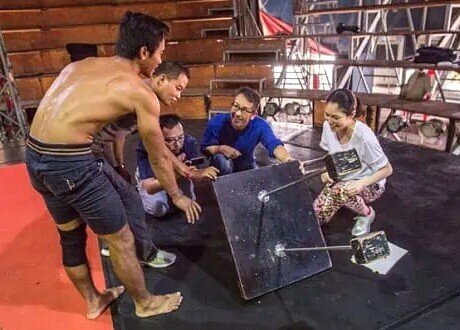
In November 2015, Amon Miyamoto came to Cambodia in order to rehearse with aerial balance artist Bo Rotha at Phare School, Battambang [1) photo by Scott Sharick] and to meet the dancers ahead of the Tokyo performance [2) photo by Amrita Performing Arts].
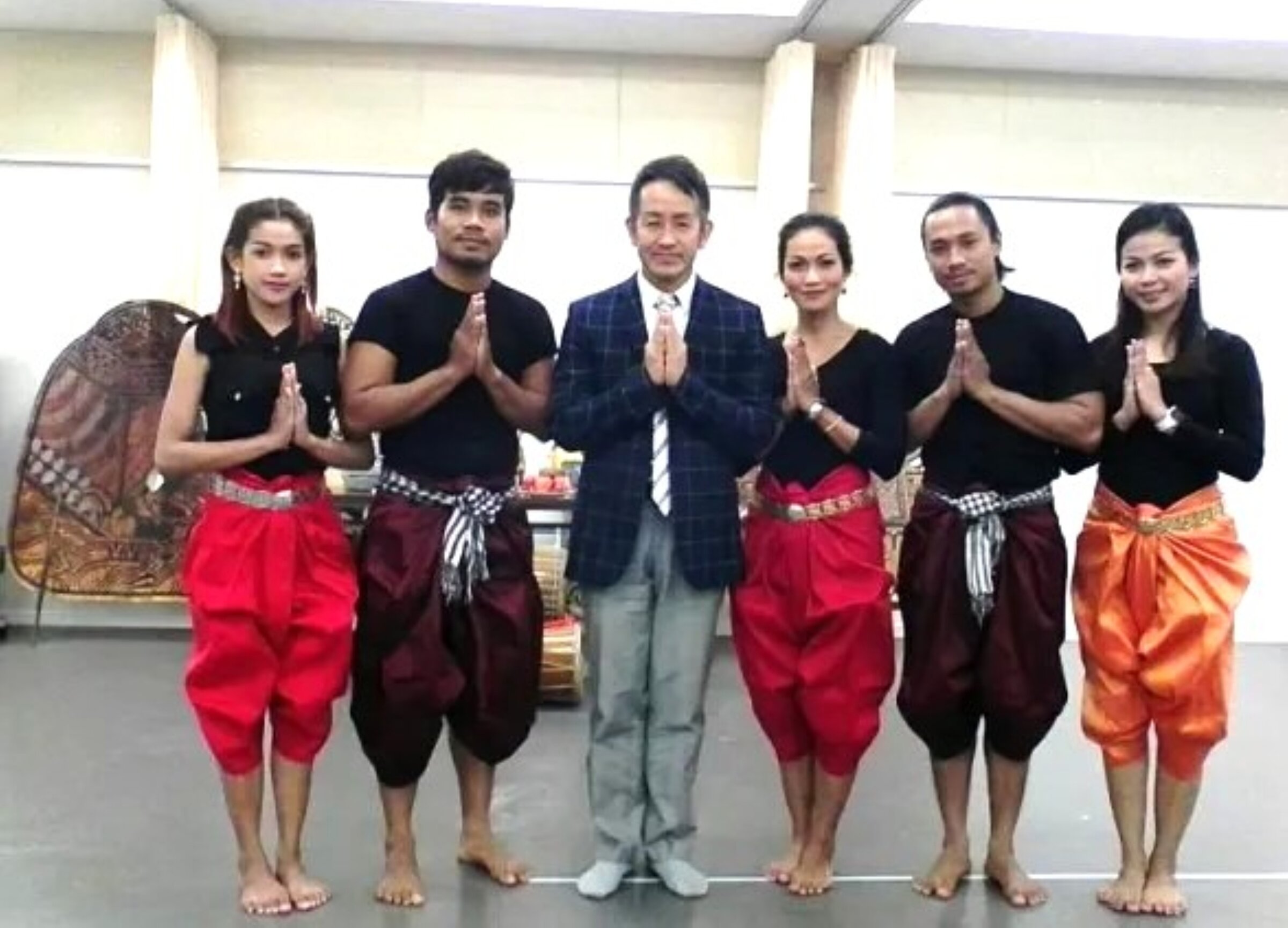
In November 2015, Amon Miyamoto came to Cambodia in order to rehearse with aerial balance artist Bo Rotha at Phare School, Battambang [1) photo by Scott Sharick] and to meet the dancers ahead of the Tokyo performance [2) photo by Amrita Performing Arts].
In November 2015, Amon Miyamoto came to Cambodia in order to rehearse with aerial balance artist Bo Rotha at Phare School, Battambang [1) photo by Scott Sharick] and to meet the dancers ahead of the Tokyo performance [2) photo by Amrita Performing Arts].
If Khmer dance was an intrinsic part of the first production of the play — Mishima’s script evoked the “roofs that arch like a dancer’s back, roofs that bulge like a dancer’s breast’ -, the idea of involving actual Cambodian artists into the staging came to Japanese theater and opera director Amon Miyamoto (宮本亞門, b. 4 Jan. 1958, Tokyo).
‘Amon’, as the Cambodian cast affectionately mentioned him in our talks 10 years later, had become in 2004 the first Japanese director to direct a musical on Broadway with the revival of Pacific Overtures — a famous musical by composer Stephen Sondheim -, nominated four times at the Tony Awards. He was the artistic director of Kanagawa Arts Theater (KAAT) from 2010 to 2014. His theater adaptation of Mishima’s novel The Temple of the Golden Pavilion (1956) was staged at the Lincoln Center Festival, New York City, in 2011. He has directed several opera productions in Europe, including his take on Puccini’s Madame Butterfly. His play YUGEN: The Hidden Beauty of Japan, “the world’s first 3D live theater” featuring Japanese Noh theater, was produced in Singapore in 2016 and two years later in Versailles, with the attendances of the leaders of France and Japan. He directed the pre-Broadway world première of Karate Kid: The Musical in May 2022 in St. Louis, USA.
A former dancer and choreographer, Amon Miyamoto envisioned a high-octane operatic version of Mishima’s play, with the “deity” performed by a circus artist (Bo Ratha (Rotha) from Phare Ponleu Arts School, Battambang) and with the Cambodian dancers not only performing Khmer royal court and village dances but impersonating the Naga (female spirits) surrounding the ailing king of Angkor.
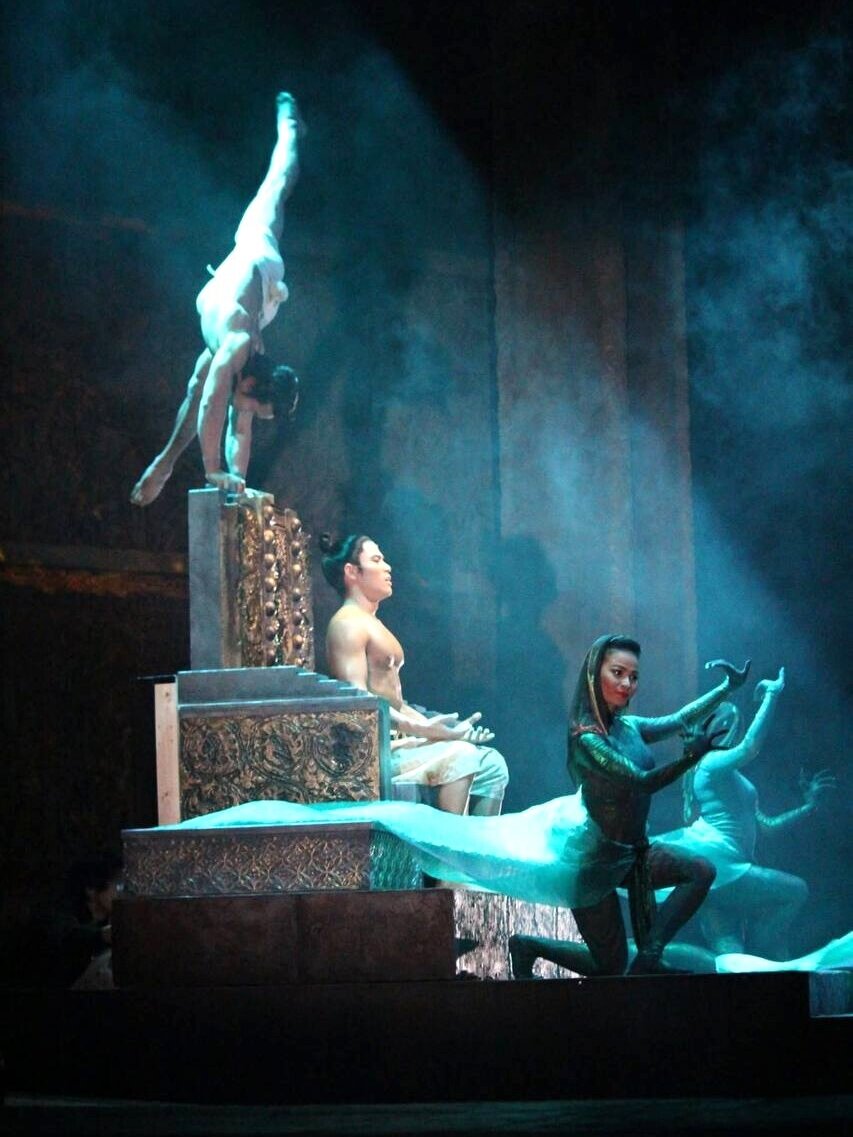
Dance of the Nagas in Mishima’s Terrace of the Leper King adaptation by Amon Miyamoto, ACT Theater, Tokyo, March 2016. Provided by Chap Chamroeun Tola.
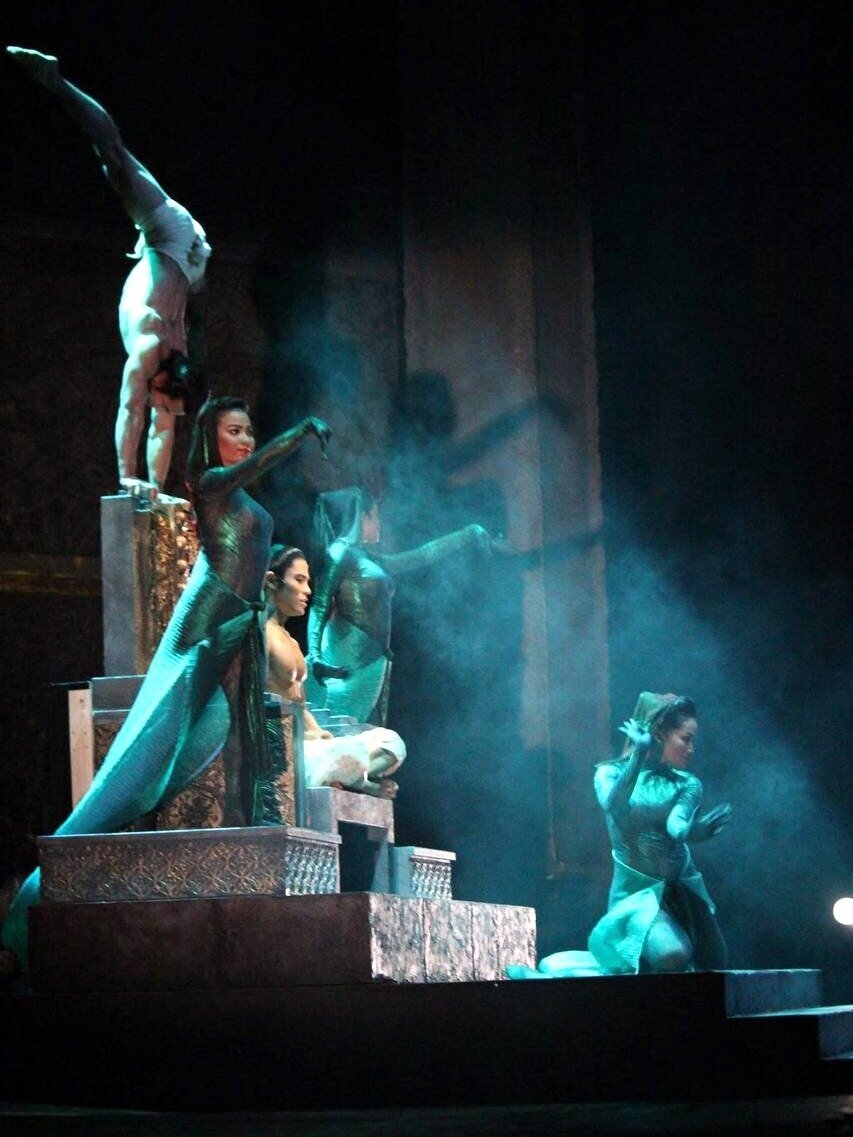
Dance of the Nagas in Mishima’s Terrace of the Leper King adaptation by Amon Miyamoto, ACT Theater, Tokyo, March 2016. Provided by Chap Chamroeun Tola.
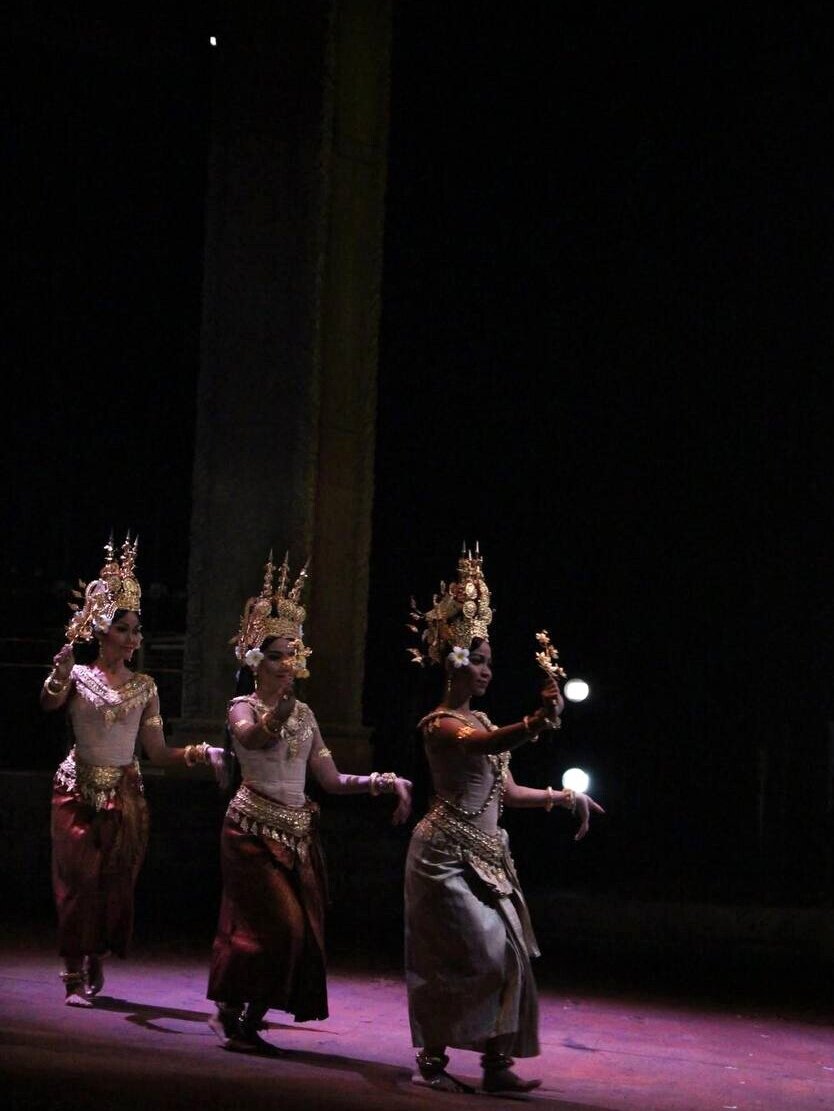
Bön Suon Dance in Mishima’s Terrace of the Leper King adaptation by Amon Miyamoto, ACT Theater, Tokyo, March 2016. Provided by Chap Chamroeun Tola.
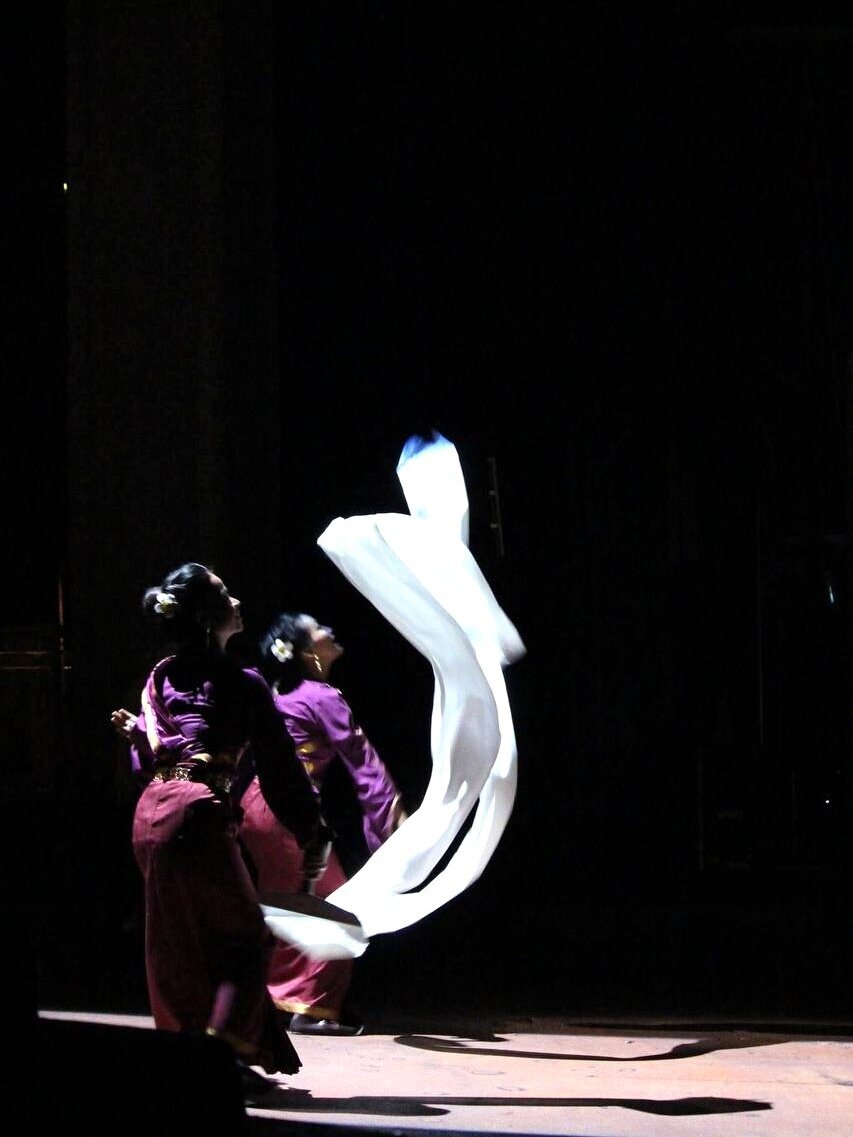
Villager dance in Mishima’s Terrace of the Leper King adaptation by Amon Miyamoto, ACT Theater, Tokyo, March 2016. Provided by Chap Chamroeun Tola.
Moments of the 2016 production [all photos courtesy of Tola Chap (Chap Chamroeun Tola)].
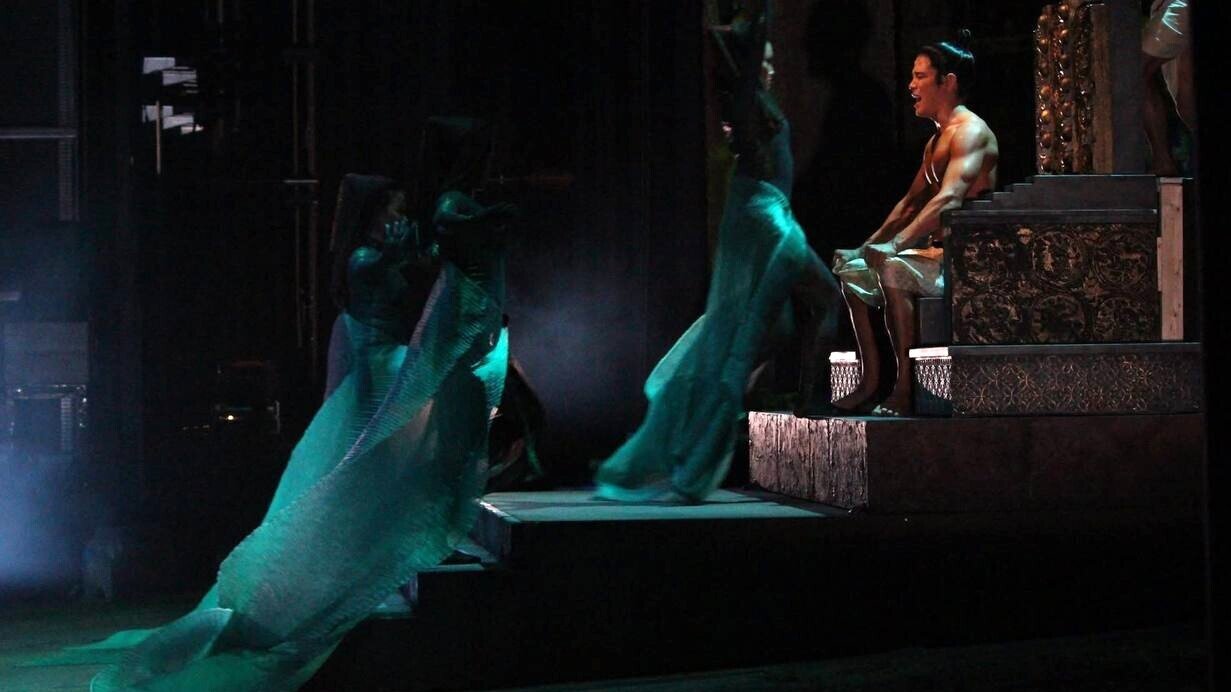
[all photos courtesy of Tola Chap].
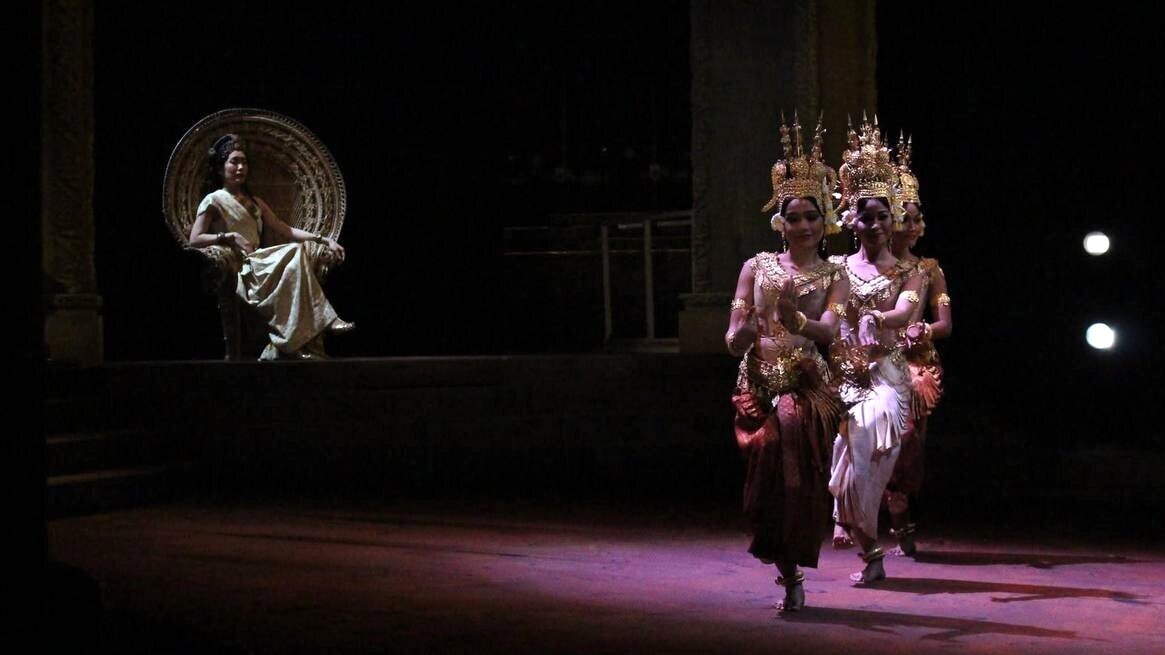
[all photos courtesy of Tola Chap].
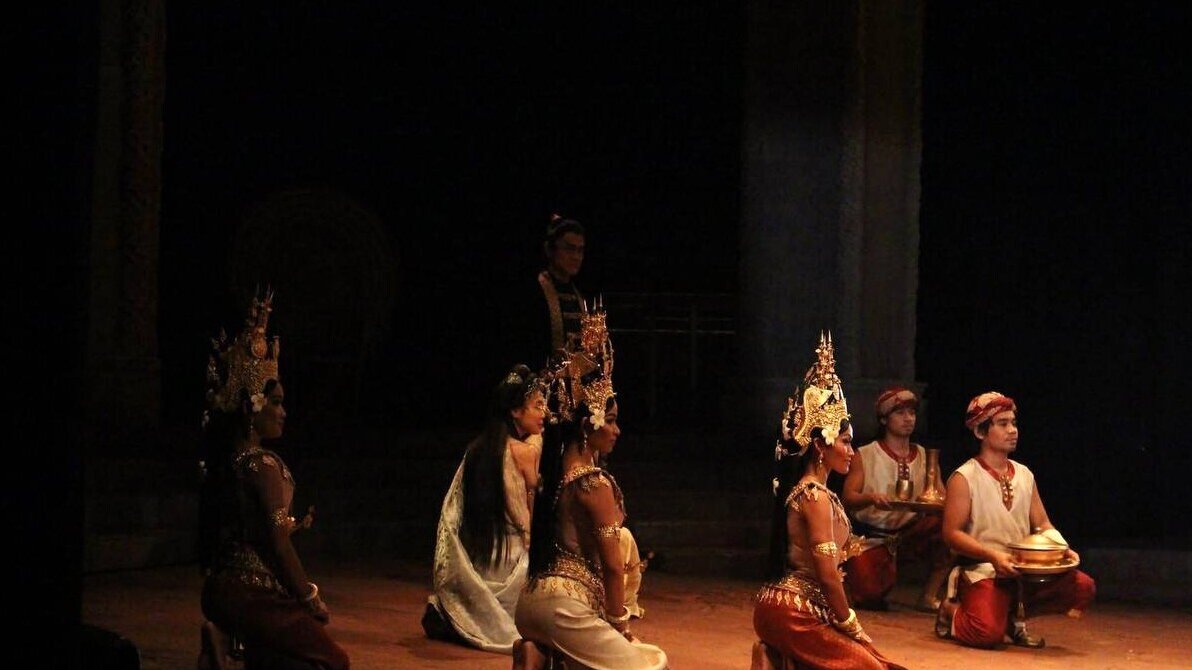
[all photos courtesy of Tola Chap].
[all photos courtesy of Tola Chap].
To quote Amon Miyamoto, “This play is full of Yukio Mishima’s literature and packed with the best of Cambodia and Japan.” [NatalieMu Stage ステージナタリー ]
CAST
CAMBODIAN ARTISTS
“We lived in an apartment about 30 minutes from the theater, the interaction with the Japanese cast and crew was always warm and cordial”. Rotha is no longer involved in Phare, and drives a tuk-tuk in Siem Reap to support his young family.
“In 2015, the Minister of Culture put me on the list for auditions towards the project Japanese director Amon Miyamoto had submitted to Princess Buppha Devi and Phare company. I was quite nervous, because I’m essentially a classical dancer and contrary to Belle and Lina I had no previous experience in contemporary acting-dance. We were invited to do a 3‑minute Robam Choun Por (Blessing Dance) on the King’s return from the war [against the Cham armies], two or three numbers of village dance and two modern choreographies figuring Nagas surrounding the King.
When we arrived in Tokyo, we had 2 weeks to rehearse, coordinate with the Cambodian brothers who were the mask dancers, with Rotha from Phare, with the Japanese actors and actresses — we all got along easily -, and talk with Amon. He wanted only dance movements and gestures from the Khmer repertoire, but for the Naga dances the costumes were extremely revealing, you really felt naked on stage, that wasn’t possible and after discussing the matter with the Princess on the phone and with Amon the costume designer came up with something more adapted to the Cambodian way. There were some acrobatic requirements, too, for instance at some point we had to jump off the stage and they had pillows arranged on the floor to avoid accidents.
We gave some 15 performances, always with the theater hall packed. To feel this genuine interest in Cambodian history and arts was really uplifting. All along, our Cambodian interpreter, Bandith Pich បណ្ឌិត ពេជ្រ, was really helpful and knowledgeable.” [from a conversation with Angkor Database].
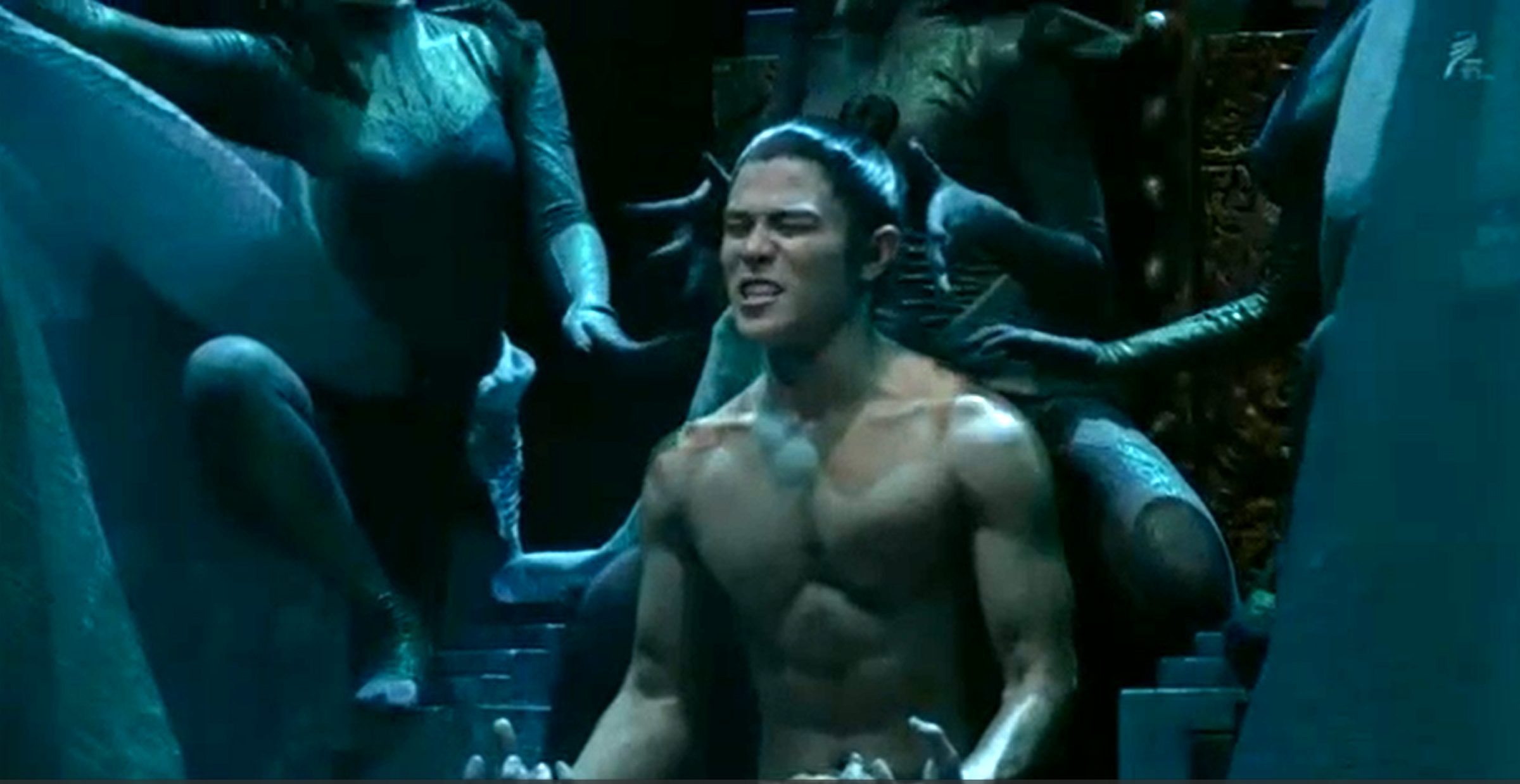
The Cambodian king (played by Ryohei Suzuki) transfixed by the dancing Nagis [from a video clip of the 5 March 2016 performance, courtesy of Tola Chap (Chap Chamroeun Tola].
The Cambodian king (played by Ryohei Suzuki) transfixed by the dancing Nagis [from a video clip of the 5 March 2016 performance, courtesy of Tola Chap (Chap Chamroeun Tola].
Tags: Jayavarman VII, Japanese literature, Leper King, Angkor in world literature, Bayon, translations, Japanese cinema, Japanese theater, leprosy, Buddhism, Avalokitesvara, Kanno, dance, dancers, disease
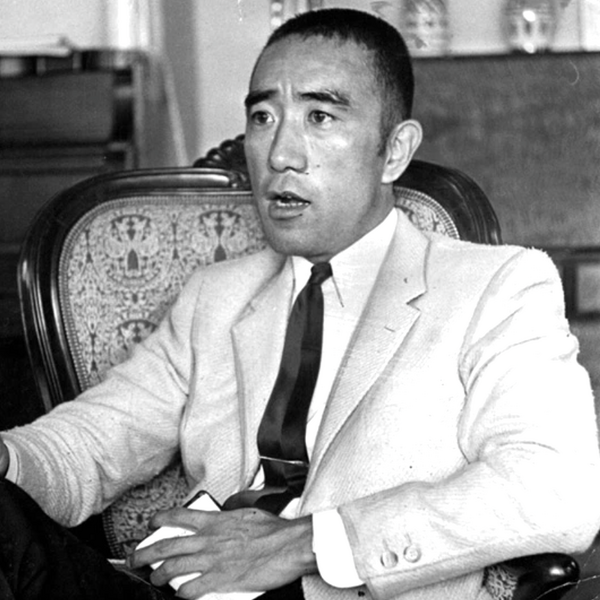
Yukio Mishima — Mishima Yukio 三島 由紀夫 [pen name of Hiraoka Kimitake 平岡 公威, 14 Jan. 1925, Tokyo, Japan – 25 Nov. 1970, Tokyo) was a worldwide acclaimed Japanese novelist, playwright and essayist whose death by ceremonial seppuku reflected his complex character and the cultural crisis in post-war Japan.
A compulsive adept of manga, seafood, kendo, scifi, body-building, movie stardom, large American cars, he held an impossible ideal of traditional Japanese values, including the cult of the Emperor, chastising his fellow countrymen for giving up to the “green snake” [the US dollar] and losing their cultural identity. Henry Scott-Stokes (b. 15 June 1938, Glastonbury, England), London Times bureau chief in Tokyo when he met and befriend the flamboyant author in 1966, recalled Mishima calling in at his home on 3 Sept. 1970 and claiming “Japan has lost its spiritual tradition. There is a green snake in the bosom of Japan. There is no way to escape this curse.” [The Life and Death of Yukio Mishima, New York, Farrar, Strauss & Giroux, 1974, p. 22. Scott-Stokes’s biography was the first one ever published in the West.]
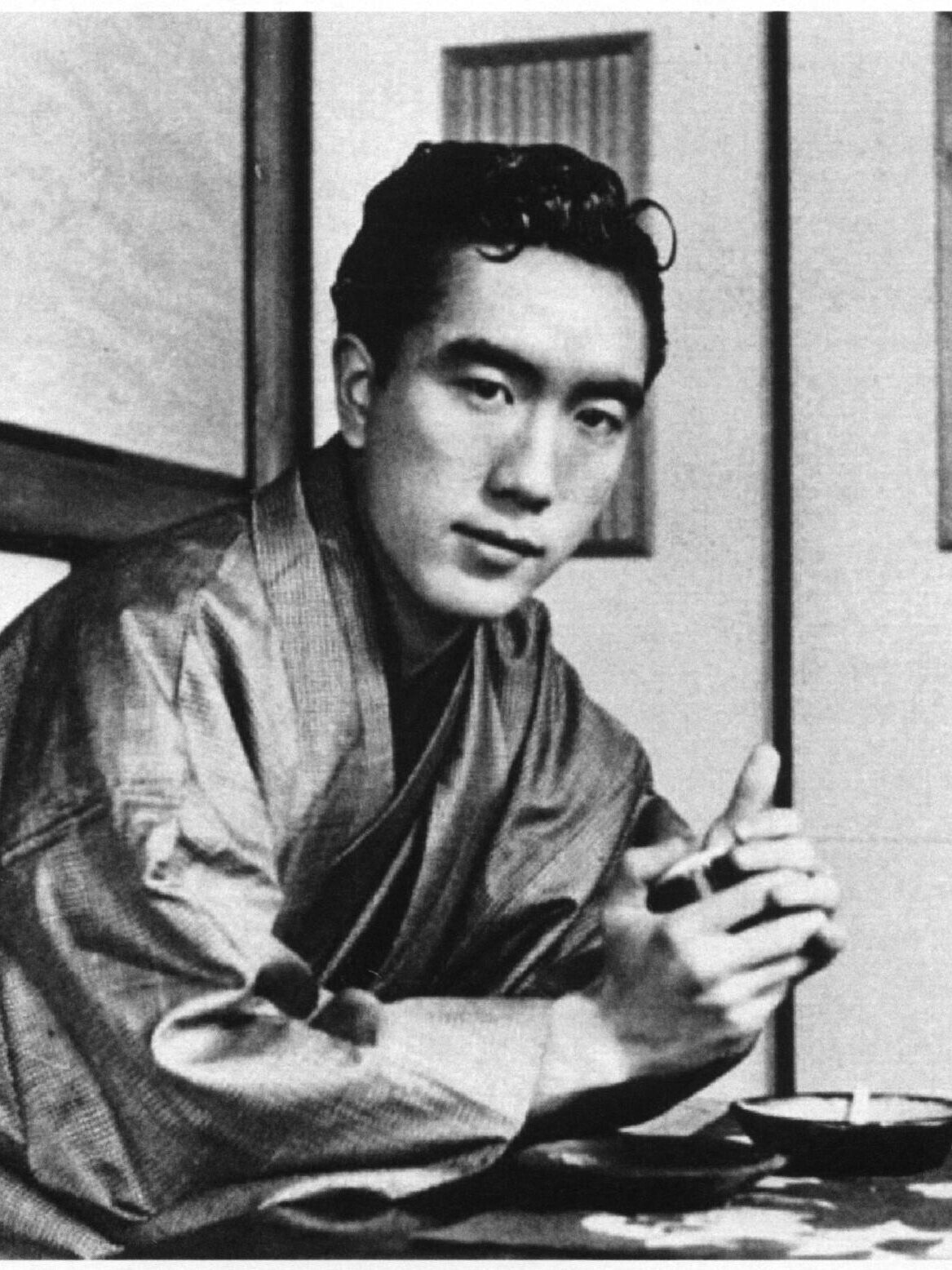
1) Yukio Mishima in 1948 [from Andrew Rankin, “A Wildean Theory of Yukio Mishima”, The Wildean 43, July 2013: 38 – 48]. 2) On 1 June 1958 at his wedding with Yōko 瑤子, the eldest daughter of artist Yasushi Sugiyama, later known as Yoko Hiraoka (13 Fev. 1937, Mejirodai, Tokyo — 31 July 1995, Tokyo). They had two children, daughter Noriko (紀子, b. 2 June 1959) and son Ichirō (威一郎, b. 2 May 1962).
Before their marriage, Mishima had been romantically involved with Sadako Toyoda (豊田貞子), who became the model for some of his main female characters, and possibly with Michiko Shōda (正田 美智子), who later married then Crown Prince Akihito and became Empress Michiko (later Empress Emerita of Japan since 1 May 2019).
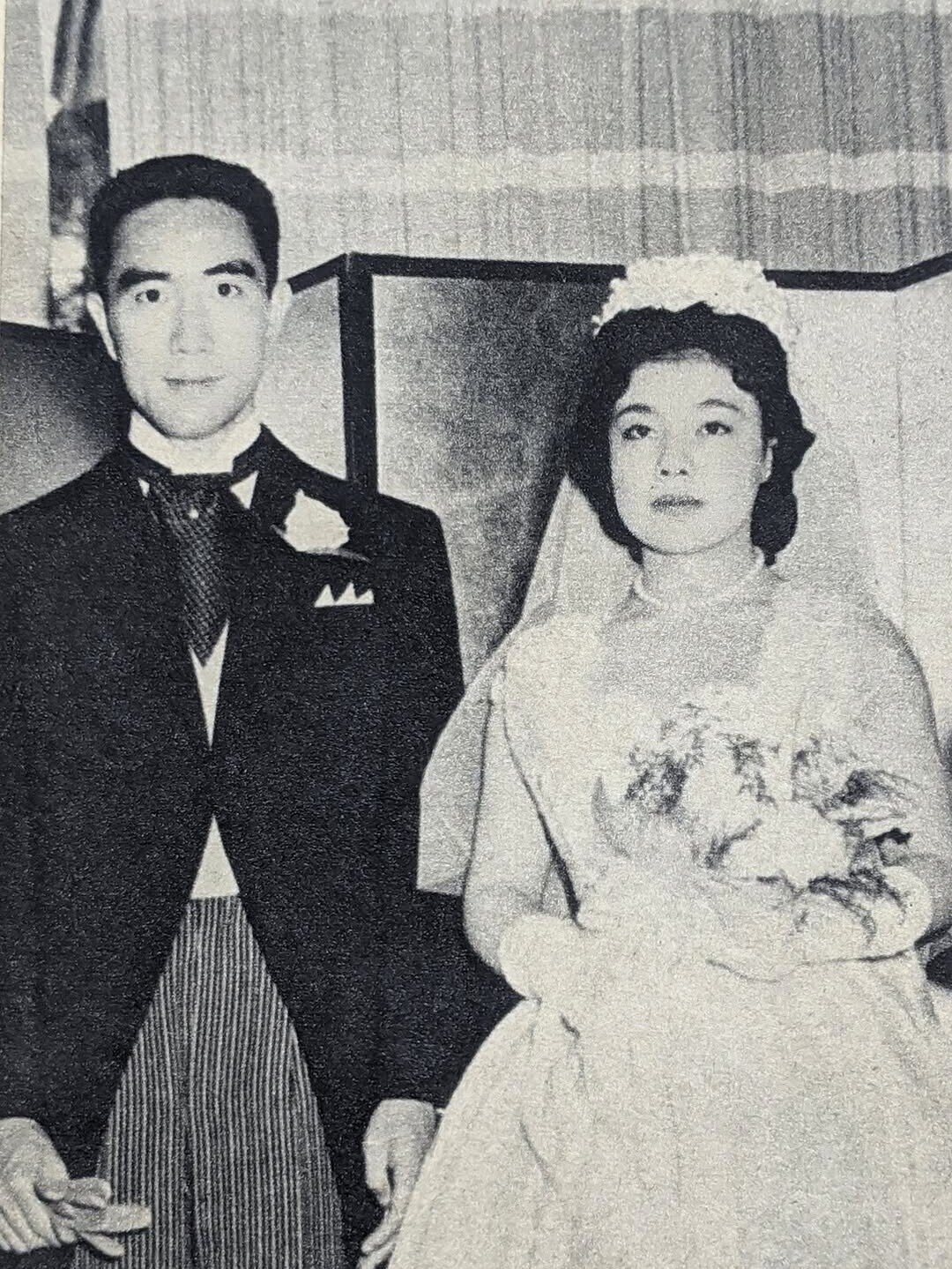
1) Yukio Mishima in 1948 [from Andrew Rankin, “A Wildean Theory of Yukio Mishima”, The Wildean 43, July 2013: 38 – 48]. 2) On 1 June 1958 at his wedding with Yōko 瑤子, the eldest daughter of artist Yasushi Sugiyama, later known as Yoko Hiraoka (13 Fev. 1937, Mejirodai, Tokyo — 31 July 1995, Tokyo). They had two children, daughter Noriko (紀子, b. 2 June 1959) and son Ichirō (威一郎, b. 2 May 1962).
Before their marriage, Mishima had been romantically involved with Sadako Toyoda (豊田貞子), who became the model for some of his main female characters, and possibly with Michiko Shōda (正田 美智子), who later married then Crown Prince Akihito and became Empress Michiko (later Empress Emerita of Japan since 1 May 2019).
1) Yukio Mishima in 1948 [from Andrew Rankin, “A Wildean Theory of Yukio Mishima”, The Wildean 43, July 2013: 38 – 48]. 2) On 1 June 1958 at his wedding with Yōko 瑤子, the eldest daughter of artist Yasushi Sugiyama, later known as Yoko Hiraoka (13 Fev. 1937, Mejirodai, Tokyo — 31 July 1995, Tokyo). They had two children, daughter Noriko (紀子, b. 2 June 1959) and son Ichirō (威一郎, b. 2 May 1962).
Before their marriage, Mishima had been romantically involved with Sadako Toyoda (豊田貞子), who became the model for some of his main female characters, and possibly with Michiko Shōda (正田 美智子), who later married then Crown Prince Akihito and became Empress Michiko (later Empress Emerita of Japan since 1 May 2019).
Chided by his father for being “effeminate” — as a teenager he was writing poetry and developed a life-long fascination with English decadent author Oscar Wilde -, he had his first short story collection — The Forest in Full Bloom 花ざかりの森 (Hanazakari no Mori) — published in 1944, when WWII was still raging. In it, he wrote about the young scion of samurai and aristocrat lineage taking care of his ailing grand mother as the world was devastated by a mysterious illness, ‘The Disease’. The whole landscape of his life was set there: even if his own family were commoners, he fantasized about aristocratic ancestors, and came to think that physical decay was ultimately less lethal than moral corruption.
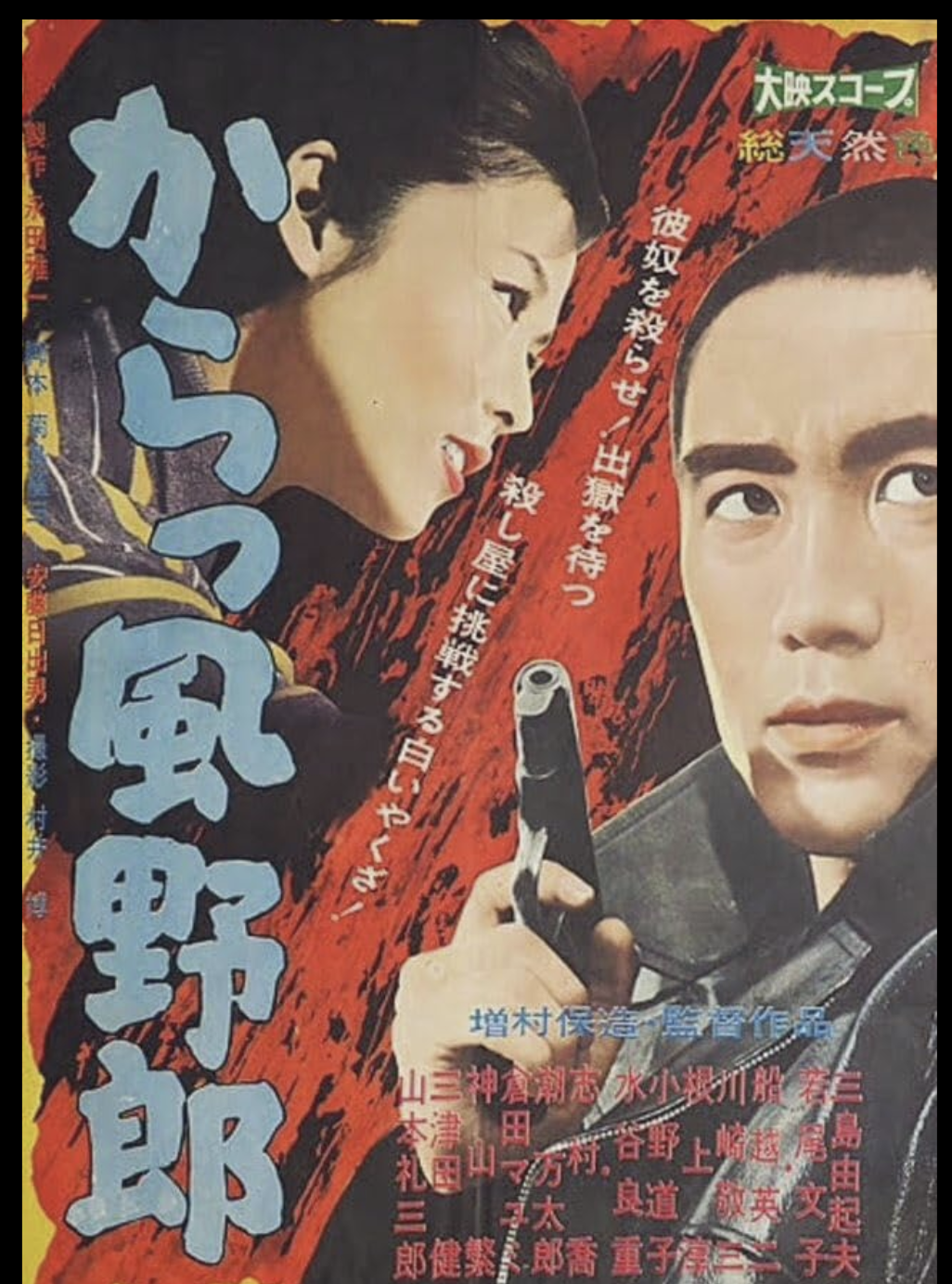
Mishima’s most notable foray into the acting role and movie stardom was Afraid to Die (first titled A Man Blown by the Windからっ風野郎, 1960) directed by Yasuzo Masumura 増村 保造 (1924−1986), in which he played a frantic, macho yakuza who is bullying his new girlfriend — played by superstar Ayako Wakao 若尾 文子 (b. 1933) — to the extent that Nagisa Oshima, director of the feminist and internationally acclaimed In the Realm of the Senses 愛のコリーダ [FR L’Empire des Senses] (1976), rejected the movie entirely. His experience on the silver screen led him to write the novella Star, also published in 1960. [translated into English by Sam Bett, New Directions, 2019, 96 p. ISBN 978 – 0811228428].
Although quite belated — he was in his forties — Mishima’s exposure to Indian and Southeast Asian cultures, first through a visit to Bangkok and Angkor in 1965, then with a month-long visit to India in September-October 1967, opened new horizons to his creativity. It gave him a chance to extirpate himself from his country’s dualistic conundrum — aggressive Americanization or nostalgy for a foregone national prestige. The Terrace of the Leper King (1969), inspired by King Jayavarman VII and the Bayon, was his last published and performed theater play.
He had explored the whole gamut of theater: the Japanase forms (shingeki, modern noh, kabuki, buyō), the childhood wonderment (Arabian Nights, adapted for the Japanese stage in 1967), the European classics (his own version of Racine’s Britannicus, 1957; Victor Hugo’s Ruy Blas, 1966; Oscar Wilde’s Salome, 1960; Goethe’s Proserpina, 1962; Puccini’s Tosca, 1963; Gabriele d’Annunzio’s Le Martyre de Saint Sébastien, 1965; Jean Cocteau’s Orphée (1956) and L’Aigle à deux têtes (1967)), and his two most provocative plays, Madame de Sade (1965) and My Friend Hitler (1968). The latter two works are above all experiments on gender dynamics, as Madame de Sade staged an all-female cast and My Friend… an all-male one.
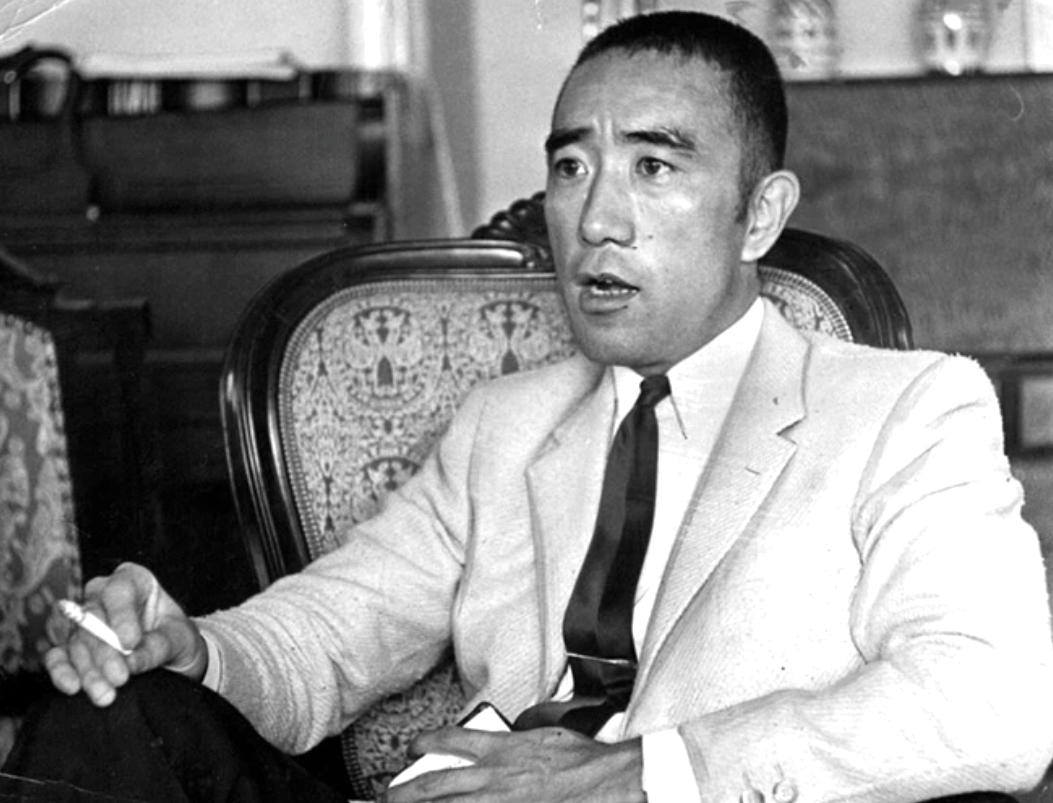
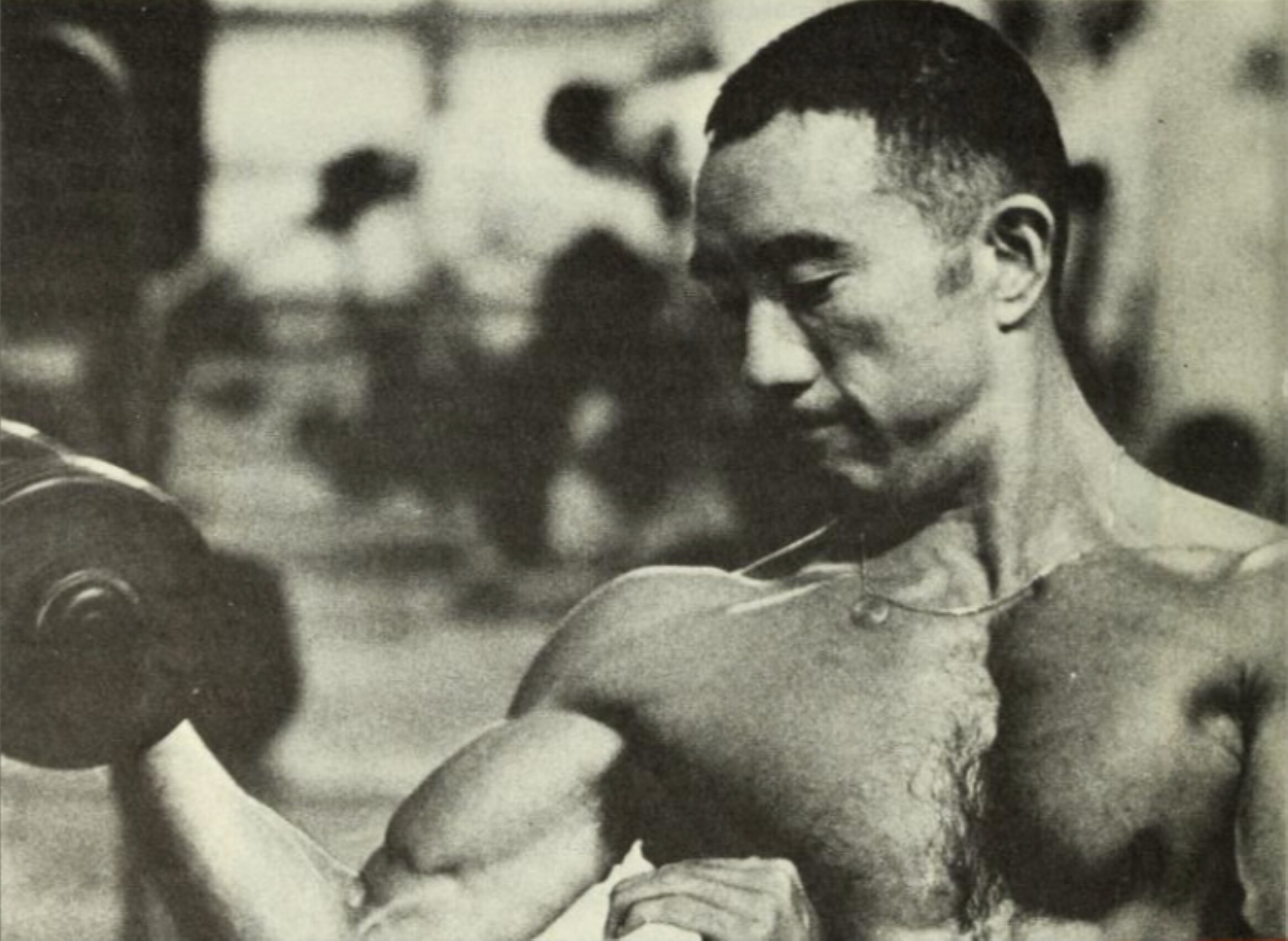
Two-faced man: 1) Yukio Mishima on 26 July 1967 [Asahi Shimbun file photo]. 2) In the 1960s, when the “spindly, pale youngster turned into a healthy, sun-tanned specimen of Japanese manhood” (H. Scott-Stokes) [photo Mainichi].
Two-faced man: 1) Yukio Mishima on 26 July 1967 [Asahi Shimbun file photo]. 2) In the 1960s, when the “spindly, pale youngster turned into a healthy, sun-tanned specimen of Japanese manhood” (H. Scott-Stokes) [photo Mainichi].
Two-faced man: 1) Yukio Mishima on 26 July 1967 [Asahi Shimbun file photo]. 2) In the 1960s, when the “spindly, pale youngster turned into a healthy, sun-tanned specimen of Japanese manhood” (H. Scott-Stokes) [photo Mainichi].
On 5 Oct. 1968, Mishima formed the Tatenokai 楯の會 (“Shield Society”), a private militia composed of right-wing college students. An attempted coup aimed at restoring the Emperor in his former glory, which became (or not so much) history as the “Mishima Incident” (三島事件, Mishima jiken), failed miserably, and Mishima ended his life. But in hindsight what remains of the author’s last months on earth are his remarks on the American military debacle in Vietnam, on Paris May 1968 students’ uprising, on his exploration of Mayana Buddhism as he had just completed the last volume of his tetralogy The Sea of Fertility, and his comments around the opening of the Yukio Mishima Exhibition at Tobu Department Store (12−17 Nov. 1970, with a daily average of 10,000 visitors) : that his life was “a four-river flow”, the book, the stage, the body, the action, and “this river of action and the river of the book frontally collide. However you may be for ‘both literary and martial arts,’ the coexistence of the two may occur only at the moment of death.” [quoted by Inose Naoki, Persona: A Biography of Yukio Mishima, tr. by Hiroaki Sato, Berkeley (CA), Stone Bridge Press, 2012, p. 707.]
Upon seeing the statue of the Leper King at Angkor Thom, “drenched in tropical sun”, he had formed one daring notion — “The body is eternal, youth immortal,” as proclaimed in the last lines of Terrace of the Leper King. At the age of 45, he took the ultimate leap of faith. As a conclusion for probably the most perceptive biography of Mishima — referred to above -, Naoki Inose quotes Yasunari Kawabata, the master of Japanese modern literature the rebellious Mishima profundly revered, himself quoting Confucius : “I have yet to know what life is; how can I know what death is?”
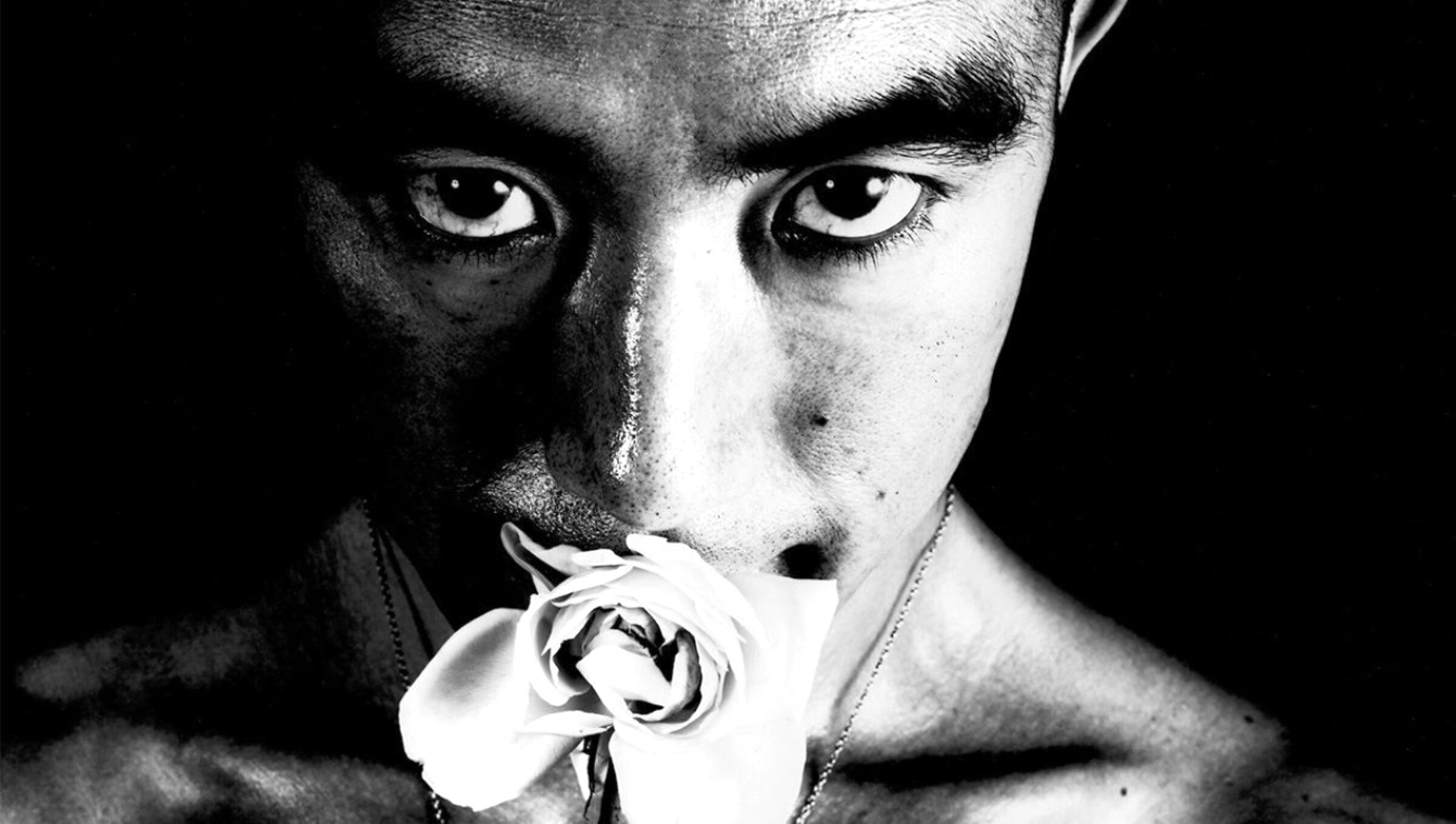
Yukio Mishima photographed by Eikoh Hosoe 細江 英公 (1933−2024) for the photo-album 薔薇刑 [Barakei: Ordeal by roses], Tokyo, Shueisha, 1963, repr. 1971; ENG 薔薇刑 = Ba*ra*kei = Ordeal by roses: photographs of Yukio Mishima, New York: Aperture, 1985. ISBN 0−89381−169−6.
Yukio Mishima photographed by Eikoh Hosoe 細江 英公 (1933−2024) for the photo-album 薔薇刑 [Barakei: Ordeal by roses], Tokyo, Shueisha, 1963, repr. 1971; ENG 薔薇刑 = Ba*ra*kei = Ordeal by roses: photographs of Yukio Mishima, New York: Aperture, 1985. ISBN 0−89381−169−6.
Yukio Mishima’s complete bibliography and filmography [on WIkipedia].
sk अमिताभ Amitābha
Buddha of the higher spirit, represented on the headdress of bodhisattvas.
sk अमृत amṛta, "nectar," "ambrosia" | kh អម្រឹត amrut, essence of pure water
Elixir of life, the nectar of immortality created from the churning of the Ocean of Milk.
In Khmer, the word is related to អមត amt, "immortal", "that does not die, does not know death; that does not cease, does not decay (that is always there)", and "the path of death, to nirvana". Like in India, there is a flower called "amrita" [Hoya Amrita], អម្រឹតបុស្ប amritabupa.
In Ayurvedic medicine, name given to several medicinal plants.
sk अरुणा aruṇā, "red", "reddish brown", personal name, dawn; pl aruṇa "dawn"; kh អរុណ arun, "dawn", "morning".
In Sanskrit literartue, Aruṇā is a personal name, male or female associated with the red or reddish brown color and the sky hues at dawn. In Shaktism, Aruna, “she who is red in complexion”, applies to the Goddesses of accomplishments. There is one Apsara called Aruna in the Mahabharata.
In ancient Indian iconography, Aruna is the charioteer of Surya the sun-god.
In Khmer, Arun refers to dawn, morning, lit. "when the sun is red". Used in modern Khmer only for greetings, ie Arunaposa, good morning.
Indian ruler who unified India through the Maurya Empire and ruled from c. 269 BCE to c. 232 BCE. During his reign Buddhism was adopted as the state religion. He sent Buddhist missionaries to Sri Lanka and Southeast Asia, in particular.
Ashoka hailed from Magadha, Maurya dynasty's home province, and came to be called Devanampriya Priyadarsi Raja, ‘the king who is the beloved of the gods and who glances graciously upon al, or simply Devanampriya, or king Priyadarsi, or Priyadarsana [‘one having an amiable appearance’]. Tradition says that the fuller form of Asoka’s name was Asokavardhana.
"Gautama the Buddha and the Maurya emperor Asoka are two of the greatest sons of India and the world, and their lives and achievements stand among India’s best contributions to human civilization", wrote Indian scholar D.C. Sircar.
His important Edicts were inscribed on stone in Prakrit, Greek and Aramaic languages.
Ashoka Chakra, "the wheel of Righteousness" (Dharma in Sanskrit, Dhamma in Pali), adorns India's national flag.
sk अवलोकितेश्वर Avalokiteśvara (" lord who looks down and watches [the world]") | लोकेश्वरः Lokeśvara ("Lord of the World") | also पद्मापाणी Padmapāni ("Holder of the Lotus")
kh លោកេស្វរៈ Lokesvara [Sealang Dictionary] | អវលោកិតេស្វរៈ Avaloketesvara "who anticipates as great", លោកេស្វរៈ Loksvara [Chhuon Nath Dictionary]
ch 觀音 Guanyin /Kuan Yin (female deity) | tl நாதா Nātha | vn Quan Am (female deity) | tb སྤྱན་རས་གཟིགས Chenrezig ("eye looks with continuity", male and female) | bh Avalokitesvara
Lokeśvara ("Lord of the World") and Chenrezig (in Tibetan) is a tenth-level bodhisattva associated with great compassion (mahakaruṇā), and often with Amitabha Buddha in Mahayana Buddhism. Avalokiteśvara has numerous manifestations and is depicted in various forms and styles. In some texts, he is even considered to be the source of all Hindu deities (such as Vishnu, Shiva, Saraswati, Brahma, etc).
In modern Cambodia, the four faces of Avalokitesvara (or Avaloksvara, Loksvara) are usually represented at the top of a pagoda or a stupa, as protector of all the planets. When Brahmanism was popular, these faces were considered as the faces of Brahma. In ancient Khmer art, he is represented with two, four, six or eight arms in freestanding sculptures, and ten arms in temple bas-reliefs such those at Banteay Chhmar. The massive stone faces of Bayon are believed to represent Lokeshvara.
Khmer worship of Lokeshvara reached a peak during the reign of Jayavarman VII. Due to his healing powers, the he was given a predominant position in the scenes carved on the chapels of the hospitals built by this king. Lokeshvara was also omnipresent at Neak Poan Temple, whose waters could cleanse the sins and diseases of the pilgrims. Jayavarman VII dedicated the temple of Preah Khan Temple to the memory of his father, deified in the likeness of Lokeshvara.
A sculpture from Prei Monti (Roluos), late 12th-early 13th century, at the National Museum of Cambodia (piece Ga.2424), represents three adorned divinities: Buddha shelled by the Naga in the middle, Lokesvara to the right of the Buddha, and Prajnaparamita to the left. Lokesvara's attributes are the lotus bud, rosary, vase with water of immortality (amrta) and book. Those of Prajnaparamita include the book and the lotus bud.
While Avalokiteśvara was depicted as male in India, and male or female in Tibetan tradition, the deity is often depicted as a female figure in East Asian Buddhism, known as Guanyin /Kuan Yin in Chinese, Kannon in Japanese, Gwaneum in Korean and Quan Am in Vietnamese. In Sri Lanka, Natha literally means ‘no form’ or ‘no shape’, thus associating Avalokiteśvara with Maitreya, the next Buddha
Avalokiteśvara is also known for his popular mantra, oṃ maṇi padme hūṃ, which is the most popular mantra in Tibetan Buddhism.
sk यम yama 'The Binder', 'self-restraint', 'patience' | kh យមរាជ yomreach 'Lord Yom', 'Lord of Death'
Yama (यम)
In Cambodia, Yama (kh យមរាជ) is the king of the Dead, son of Surya reigning over the subterranean world. According to ethnologist Ang Choulean, Vraḥ Yamarāj or ‘King Yama’ is "the God closest to the Khmers", the one to these days invoked in "annual Pchum Ben (Fortnight of the Dead) and mortuary rituals. Yama astride his buffalo looms large in Angkorian lintels across the centuries as the god of death and justice and as the subject in imprecations aimed at transgressors and temple vandals." Prof. Ang Choulean remarked that in Cambodia, Yama's representations and altars, originally facing south like in Indian traditions, started to be oriented in the northeast direction from the 13th-14th centuries, emphasizing the promise of reincarnation over physical death.
sk यन्त्र yantra "sign", "diagram", "design", "device". | pa yant | kh យ័ន្ដ yan't "protective bareer"; សាក់យ័ន្ដ sakyant, "tattooed symbol".
