
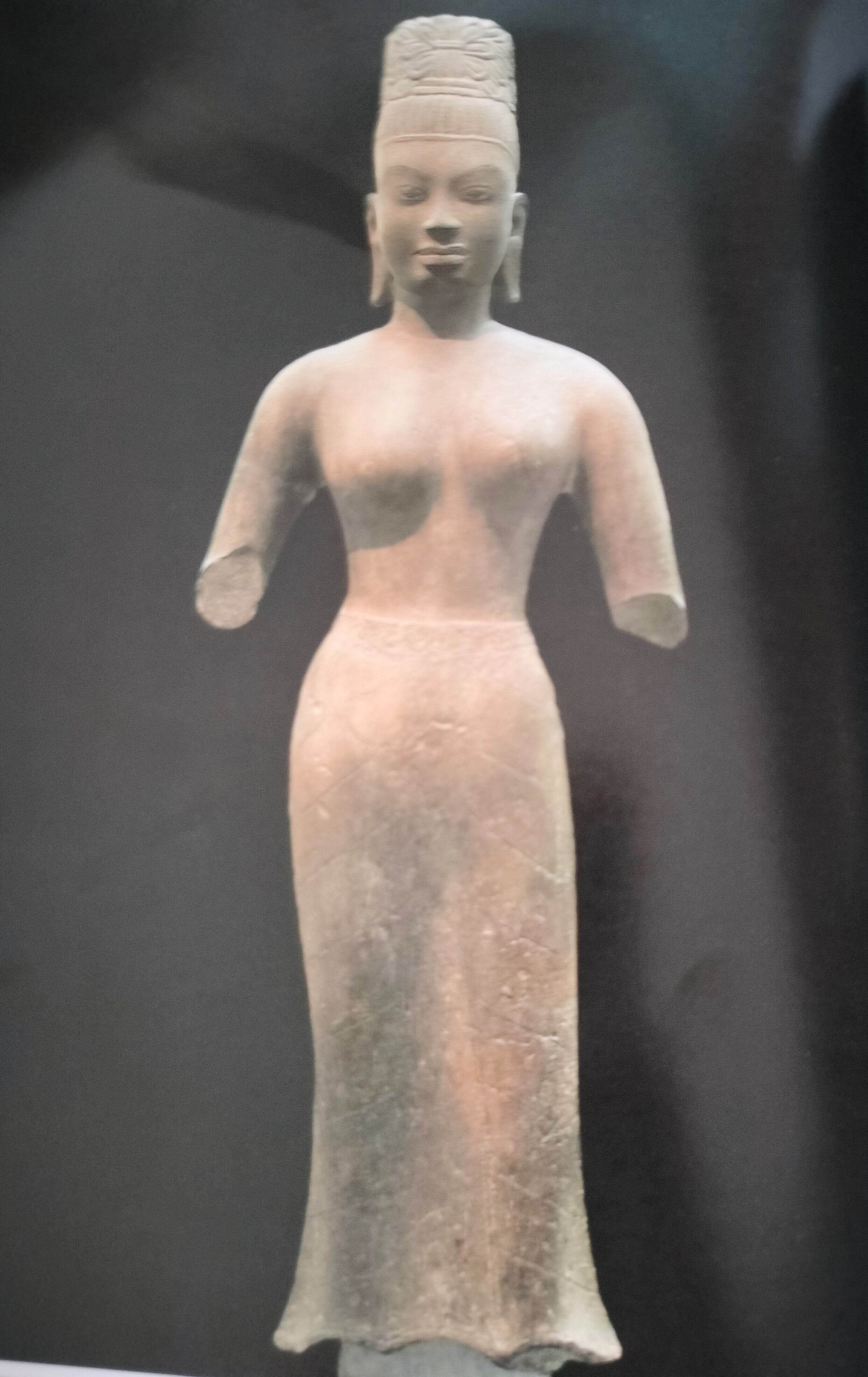

The Measured Art: A Proportional Analysis of Early Khmer Sculpture

by Nancy H. Dowling

A proposed new periodization for pre-Angkorean sculptures.

 
Formats
ADB Physical Library, hardback
Publisher
White Lotus Press, Bangkok
Published
2011
Author
Nancy H. Dowling
Pages
159
ISBN
978-974-480-171-5
Language
English

Focusing on 40 stunning artworks from the National Museum of Cambodia Early Khmer collection and from Musée Guimet in Paris, the author, who studied Khmer statuary in situ in the 1950s and later on was inspired by a chance encounter in 1997 with two Southeast Asian art historians at the National Gallery of Washington”, USA, compares width and height measurements (constructional system) used in Khmer art with the canon of Indian sculptural art.

Challenging the chronological framework established by George Coedès in 1944, and the conventional classification of early Khmer art in five geographically-defined categories — Phnom Da, Sambor, Prei Kmeng, Prasat Andet and Kompong Preah –, the author offers a new chronology relying on stylistic analysis […] for periods spanning approximately 200 years:

  1. Early to mid-seventh century.
  2. Mid- to late seventh century.
  3. Early to mid-eighth century.
  4. Mid- to third quarter of the eighth century.
  5. Third-quarter to late eighth century.
  6. Late eighth to early ninth century.

Quoting Ulrich von Schroeder’s work [Buddhist Sculptures of Sri Lanka, Visual Dharma Publications, Hong Kong, 1990], the author notes that several Angkor Borei-style images are imports or copies from South India or Sri Lanka,” while pointing out that several Khmer art images, in particular at Wat Romlok, represent a synthesis of artistic traditions from North and South India or Sri Lanka.”

 
The magnificent Durga image of Koh Krieng (Kratie), Guimet Museum 

Note: some may contest as phallo-centric the measurement spot of Meḍhra (मेढ्र, phallus or male genital organ in Sanskrit) for the genitalia area, including in the case of female statues.

Tags: pre-Angkorean, sculpture, Khmer art, chronology, statues, statuary, Sri Lanka, North India, South India

About the Author

Nancy dowling

Nancy H. Dowling

Dr. Nancy Dowling is a Southeast Asia Art consultant and a retired professor of South and Southeast Asian Art at the University of Hawaii in Manoa. 

In 1995 she became a member of a multi-disciplinary team of University of Hawaii and East-West Center scholars, who conducted archaeological fieldwork in Cambodia in collaboration with the Ministry of Culture and the Royal University of Fine Arts in Phnom Penh. Later on, she started her own consultancy business, assisting museums and collectors in authenticating Southeast Asian sculpture (www.dowling art​con​sul​tant​.com, the link was no longer active in 2023).

Glossary Terms

  • Durga

    sk दुर्गा Durga "invicible", "fortress-like", "beyond defeat" | sk दुर्गा महिषासुर मर्दिनी Durga Mahishasura Mardini "who defeats Mahishasura". | kh ព្រះម៉ែទុគា Preah Me Thuka, ព្រះនាងទុរគ្គា Preah Tureka, ចៅម៉ែទុគ៌ា Chao Methuka, ព្រះម៉ែទុគ៌ា Preah Maa Tukra, "Preah Maa Durga" ["Goddess Mother Durga"] | th เจ้าแม่ดูร์กา Cea mae Durka "Goddess Durga" | jv Loro Jonggrang "slender maiden"

    Durga is a major Hindu goddess, worshipped as a principal avatar of mother goddess Mahadevi, associated with protection, strength, motherhood, destruction, and wars. She has different names, including Durgā, Bhadrakālī, Vijayā, Vaiṣṇavī, Kumudā, Caṇḍikā, Kṛṣṇā, Mādhavī, Kanyakā, Māyā, Nārāyaṇī, Īśānī, Śāradā and Ambikā. 

    In Shaktism (goddess-centric sect), she is Devi (the Goddess), primordial creator of the universe, and in the Bhagavata purana she is Vishnu's younger sister. In Indian representations - in particular at Aihole Temple - Mahishasura Mardini Durga has eight arms, carrying the weapons and attributes given to her by male deities: the trident (given by Shiva), the Chakra (Vishnu), the conch (Varuna), the Pasha an iron rod (Yama), the dart (Agni), the bow (Vayu), the quiver and arrows (Surya), the thuderbolt (Indra), the mace (Kubera), the rosary and a water pot (Brahma), the sword and shield (Kala), the battle axe (Vishwakarma), the lion (Himavan), a disc and a lotus, a bell, etc...She is standing in the Tribhanga pose (three bends), legs apart, left leg pressing down the buffalo demon.

    Across Indonesian islands, Durga was the most common representation among ancient sculptures of female deities. Durga statues have been discovered at stone temples and archaeological sites in Vietnam, likely related to Champa or Cham dynasty era. 

    In Cambodian art, Durga, in particular in the Mahishasurmardini form, was revered since the oldest recorded times. An 1.65 meter-high statue was retrieved at what has been supposed to be the site of the main temple of King Ishanavarman of Chenla (r. c. 615–628 C.E.) in Ishanapura (Sambor Prei Kuk)

    In modern Cambodia, the Indian community has started to give social resonance to the celebration of Durga Puja, the festival observed usually in September or October, from the sixth (Shashti) to the tenth day of the bright lunar fortnight in the Hindu lunar calendar month of Ashvin, concluding with Durga Visarjan (immersion of the idol).

View all glossary terms →