
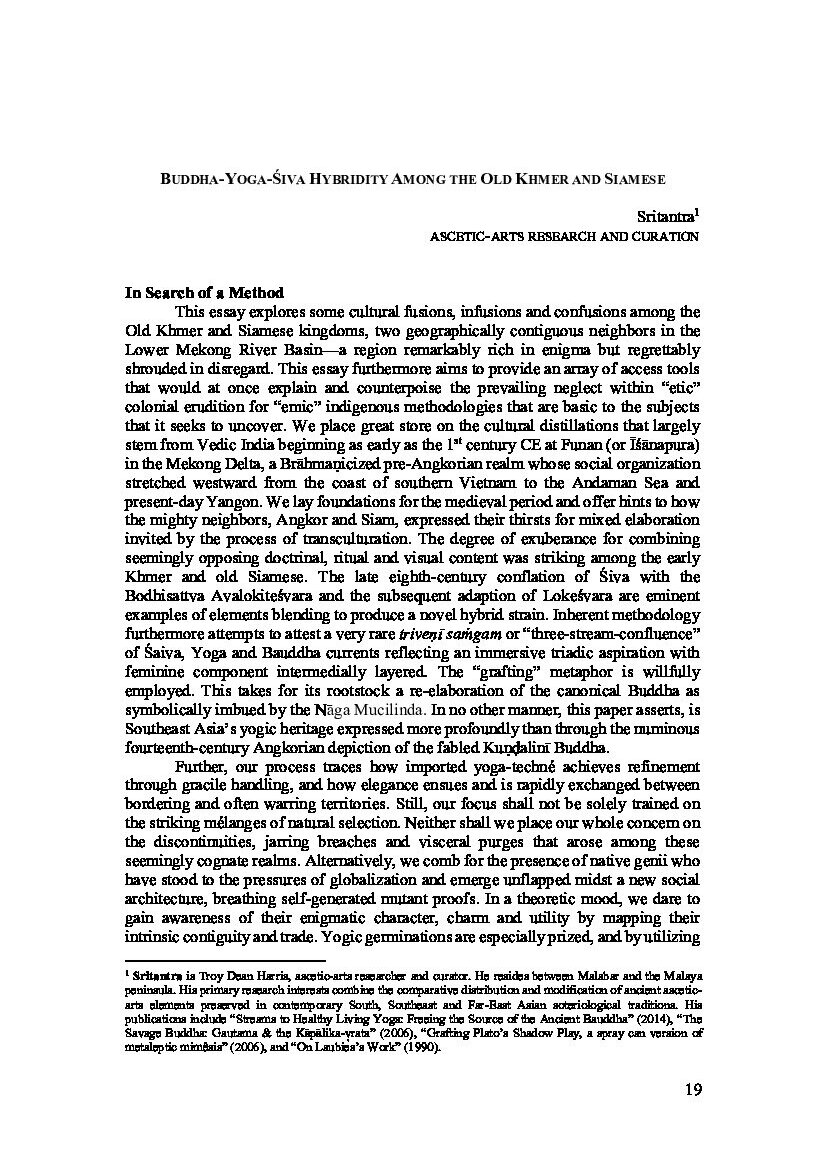

Buddha-Yoga-Siva Hybridity Among The Old Khmer and Siamese

by Troy Dean Harris

An essay on ascetic arts and Indic influences in ancient Cambodia and Siam.

 
Publication
Journal of the International Association of Buddhist Universities JIABU, Volume V, pp 20-64
Published
2015
Author
Troy Dean Harris
Pages
46
Language
English
View publication

pdf 691.5 KB

This somehow arduous and deliberately unconventional essay stresses the lasting influence of Brahmanism on Khmer and Siamese-Thai cultures, including the caste (varna)-based social organization and the persistence of ascetic values.

Early Cambodia-Kampuchea was a citadel of Indianization”, the author claims, while religious beliefs developed by the Siamese aggregated many Indic influences. 

Also, notes the author, yoga and asceticism enjoyed great favor in Old Khmer society. Sacred places were set aside and announced in royal epigraphy. Śiva was regarded as the ascetic-yogi par excellence and Cambodia’s national god. Grottoes for ascetic practice (tapas, tapasyā) are often mentioned. Speculations on the syllable OM frequently appear in early Khmer writing. The Vat Phu temple overlooking the Mekong River at a distance of about six kilometers was a special place for yoga practice.”

Advocating for the use of hybridity’ instead of syncretism’, the author concludes that the Southeast-Asian peninsula presented, in George Coedès’ own words, a marvelous variety of civilizing forces existing simultaneously and successively in this region [that] make for a fascinating study and research.

Tags: religion, Siam, Old Khmer, Funan, Chenla, yoga

About the Author

Sritantra

Troy Dean Harris

Troy Dean Harris, ascetic-arts researcher and curator, is the founder of the Sritantra Project, under which name he has published several studies. 

He resides between Malabar and the Malaya peninsula. His primary research interests combine the comparative distribution and modification of ancient ascetic-arts elements preserved in contemporary South, Southeast and Far-East Asian soteriological traditions. 

Sritantra’s publications include Streams to Healthy Living Yoga: Freeing the Source of the Ancient Bauddha” (2014), The Savage Buddha: Gautama & the Kāpālika-vrata” (2006), Grafting Plato’s Shadow Play, a spray can version of metaleptic mimêsis” (2006), and On Laubiès’s Work” (1990).

In 2018, the Sritantra Project held a yoga meditation at dawn at Angkor Wat, aimed at contemplating on the cosmic aspects” reflected by the Khmer temple.

Glossary Terms

  • ascetic

    greek "askēsis" originally "physical practice, athletic training".

    A sage who practices austerity. 

    In various Indian philosophies from Shaktism to Ayurveda, the concept of Tapas (तपस्), "penance", "ascetism", "austerity", "practice of self denial" is essential. 

    In Khmer religious philosophy, អនង្គណ angkana is the state of being without defilement, a person without defilement, pure. ព្រះពុទ្ធអរហន្ត The Buddha Arahant is the great blessing of having all defilements removed. 

  • Kamboja, Kambuja, Kampuchea

    sk काम्बोज kāmboja | prakrit कंबोय | [कम्बुजदेशः kambujadesa, 'land of Kambuja' | oldkh កម្វុជទេឝ, midkh កម្ពុជទេស mkh កម្ពុជា kampuchea, Cambodia 

    1. Kāmboja, a kingdom often mentioned in the Mahābhārata and in the Ramayana, with supposed location in the northwestern part of India, in modern Kabul area, renowned for its warriors and fine horses. Later on, a country visited by Asokas missionaries.
    2. In ancient Indian astrology, a Kādi (subdivision) belonging to Nairṛtī (south-western division referring  to a country possibly identified with the Cambodia of Cochin China according to the Bṛhatsaṃhitā (chapter 14), an encyclopedic Sanskrit work written by Varāhamihira.
    3. One of the two Mahājanapadas of the Uttarāpatha (Northern District) of ancient India, as recorded in the Pāli Buddhist texts, presumably not far from Gandhāra, with Nandipura as the only city of the Kambojas mentioned in the inscriptions. "Home of horses," a term related to horses and elephants.
    4. In Ayurvedic medicine, a plant defined with Coccinia grandis. White mimosa.
    5. Kambujadesa, the land of कम्बु Kambu: according to 10th-century traditions, the union between hermit Kambu Swayambhuva and the celestial nymph Mera founded the Cambodian solar royal dynasty (Kambu-Mera), beginning with Chenla ruler Srutavarman and his son Sreshthavarman.
    6. [Kambhoji or Kambodhi, a raga or ragani mode in Carnatic music, derived from 28th mela Hari Kambhoji, widely known and developed since the 7th century, often dedicated to Lord Ganesha. Defined as "majestic, auspicious in the devotional register" by Dr. Charulatha Mani and by famed Bollywood music composer A.R. Rahman. Etymology unknown, Kāmbhojī काम्भोजी being one name for Guñjā गुञ्जा, Abrus Precatorius, "red bean" plant. Carnatic music scholars do not exclude the possibility that the name might derive from Cambodia-Kampuchea.]
View all glossary terms →