

Contacts between the Upper Thai-Malay Peninsula and the Mediterranean World
by Brigitte Borell-Seidel & Bérénice Bellina & Boonyarit Chaisuwan

- Authors
- Brigitte Borell-Seidel, Bérénice Bellina & Boonyarit Chaisuwan
- Publication
- In Before Siam, Essays in Art and Archaeology, ed. Nicolas Revire & Stephen A. Murphy, River Books, Bangkok
- Published
- 2014
- Pages
- 10
- Language
- English
pdf 600.1 KB
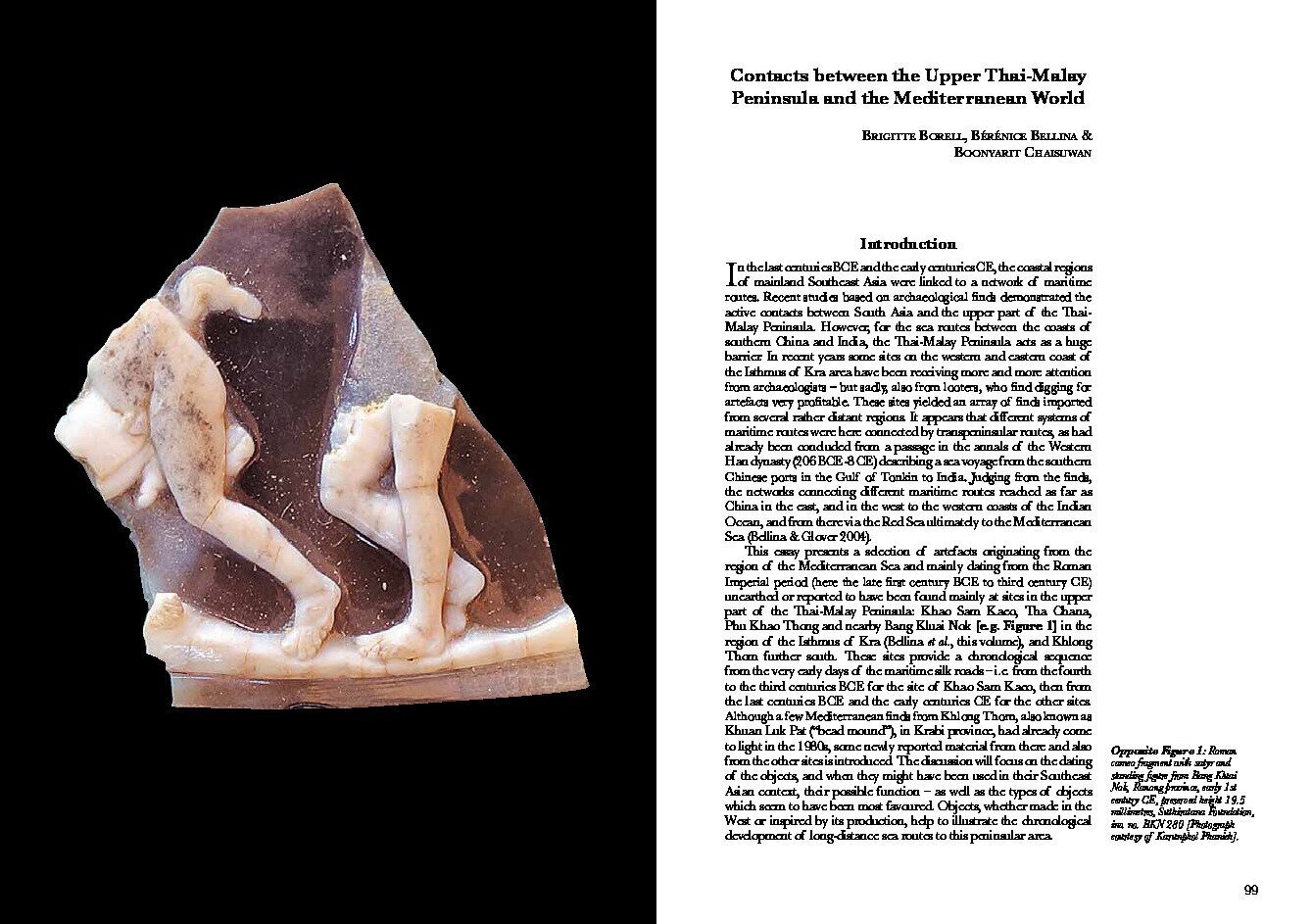
This essay presents a selection of artefacts originating from the region of the Mediterranean Sea and mainly dating from the Roman Imperial period (here the late irst century BCE to third century CE) unearthed or reported to have been found mainly at sites in the upper part of the Thai-Malay Peninsula: Khao Sam Kaeo, Tha Chana, Phu Khao Thong and nearby Bang Kluai Nok.
Photo: Han style ceramics recovered at Khao Sam Kaeo (Photo by Bérénice Bellina)
Tags: Roman Empire, maritime routes, Thailand, Malaysia, underwater archaeology, money, Silk Road, Han Dynasty, marine archaeology
About the Authors

Brigitte Borell-Seidel
Dr. Brigitte Borell-Seidel is a independent researcher associated with the Institute for Classical and Byzantine Archeology, University of Heidelberg, Germany, who lived several years in Southeast Asia.
She has extensively studied glassware and artefacts from Ancient China and Southeast Asia, and the Maritime Silk Road in the early centuries CE.

Bérénice Bellina
A senior researcher with Centre National de la Recherché Scientifique (CNRS) [French National Center for Scientific Research], and a faculty member of Université Paris Nanterre (Section Technologie et Ethnologie des mondes préhistoriques), Dr. Bérénice Bellina [Bellina-Pryce] has directed since 2005 the Thai-French Archaeological Mission in Upper Thai-Malay Peninsula, excavating and surveying in the Chumphon and Ranong provinces.
Her research focuses on exchange and technological and cultural transfer processes around the Indian Ocean during prehistoric and protohistoric times, and more specifically between the Bay of Bengal and the South China Sea, using technological analysis of industries as a means to comprehend sociopolitical transformations, and to reconstruct the impact of long-distance exchange and local resource acquisition on ethnicity and identity construction.
Selected Publications
- Les réseaux d‘échanges entre le sous-continent indien et l’Asie du Sud-Est à travers le material archéologique des perles en cornaline et des sceaux de marchands en pierre dure (VIe siècle ap. J.C.). Paris, Sorbonne-Novelle-Paris III, 2001 [thesis].2
- “Beads, Social Change and Interaction between India and South-east Asia”. Antiquity 77, 2003: 286 – 97.
- [with Ian Glover] The Archaeology of Early Contact with India and the Mediterranean World, from the Fourth Century BC to the Fourth Century AD. In Southeast Asia from Prehistory to History, ed. I. Glover and P. Bellwood, 68 – 88. London: Routledge Curzon, 2004.
- [with P. Silapanth] ‘Khao Sam Kaeo and the Upper Thai Peninsula: Understanding the Mechanisms of Early Trans-Asiatic Trade and Cultural Exchange.’ In Uncovering Southeast Asia’s Past: Selected Papers from the Tenth Biennial Conference of the European Association of Southeast Asian Archaeologists, London, 14th-17th September 2004, ed. E. A. Bacus, I. C. Glover, and V. C. Pigott, 379 – 92. Singapore: National Univ. Press, 2006.
- [ed. with E. Bacus, J. Wisseman Christie, T.O. Pryce] 50 years of-Archaeology: Homage to Ian Glover, Bangkok, River Books, 2010, 318 p. ISBN 978 6167339023.
- [with Sorathach Rotchanarat, N. H. Tan & Olivier E. Evrard] “Coastal heritage: Exploring caves and indigenous knowledge in the Lanta Bay (Southern Thailand)”. Journal of Indo-Pacific Archaeology 45, 2021 :25 – 41.
- [ed. with Roger Blench & Jean-Christophe Galipaud] Sea Nomads of Southeast Asia: From the Past to the Present, Singapore, NUS Press, 2021, 378 p. ISBN 978−981−3251−25−0.
- [with Olivier Évrard & Sorathach Rotchanarat] “Engaging with the heritage of maritime populations of the Lanta Bay: a community-based archaeological and ethnographic project (the Lanta Bay project, Thailand)”, in Transformative Practices in Archaeology: Empowering Communities and Shaping Sustainable Futures: 229- 252, ed. Alok Kumar Kanungo, Claire Smith, and Nishaant Choksi. Singapore: SpringerNature, 2024.
- [with Frank Muyard] “Indigenous Archaeology in Asia and the Pacific: Regional Specificities and Colonial Legacies,”
Asian Perspectives 65:1, 2026 [advance online publication].

Boonyarit Chaisuwan
Capt. Boonyarit Chaisuwan is the Director of the Underwater Archaeology Division, Royal Thai Fine Arts Department. A graduate in archaeology from Silpakorn University, Bangkok, he first worked as a curator at the History and Military Museum, Thailand Ministry of Defense, before being transferred to the FAD (Ministry of Culture) as an archaeologist in Suphan Buri, Ayutthaya and Phuket provinces.
Since its launch in 1974, the division has found 46 sites in the Andaman Sea and the Gulf of Thailand. In addition to Koh Khram in Chon Buri and Koh Kluay in Ranong, wreck sites in Krabi and Samut Sakhon, as well as the Chao Phraya River in Ayutthaya were also located and identified.
Currently the head of the Mueang Sing Historical Park in Kanchanaburi province, he has co-authored with Rarai Naiyawat “Thung Tuk: A Settlement Linking Together the Maritime Silk Route” (Trio Creation, 2009).
A profile in The Bangkok Post (3 Sep. 2018).