

The Ecology of Angkor: Evidence from the Khmer inscriptions

- Publication
- in Nature and Man in South East Asia, ed. P.A. Stott, School of Oriental and African Studies, University of London: 280-298. [via sealang.net]
- Published
- 1978
- Pages
- 19
- Language
- English
pdf 6.3 MB
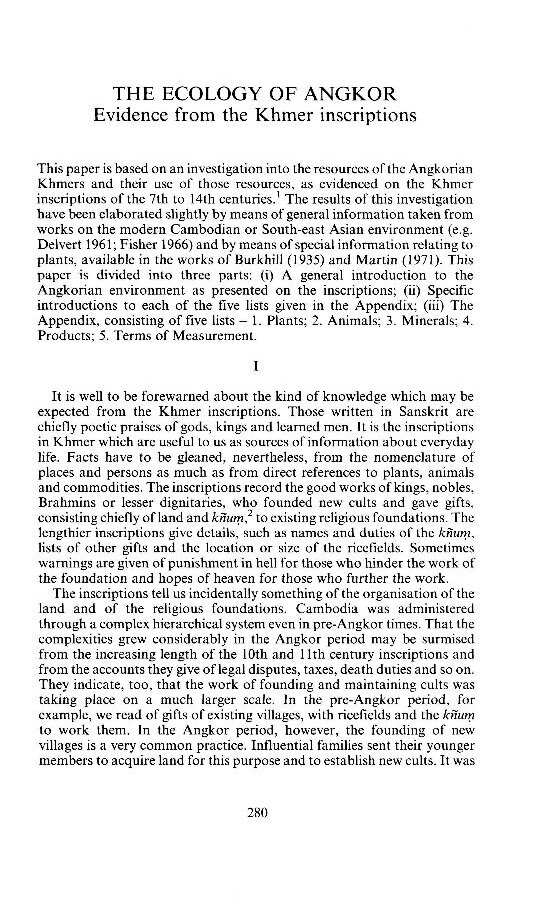
‘This paper is based on an investigation into the resources of the Angkorian Khmers and their use of those resources, as evidenced on the Khmer inscriptions of the 7th to 14th centuries. The results of this investigation have been elaborated slightly by means of general information taken from works on the modern Cambodian or South-east Asian environment (e.g. J. Delvert [Le paysan Cambodgien. Paris: Mouton, 1961]; C.A. Fisher [South-East Asia. A social, economic and political geography. (2nd edn). London: Methuen,1966) and by means of special information relating to plants, available in the works of I.H. Burkhill [A dictionary of the economic products of the Malay peninsula. London: for S.S. & F.M.S. Governments by Crown Agents for the Colonies, 1935] and M. A. Martin [Introduction à l’ethnobotanique du Cambodge. Paris: Centre National de la Recherché Scientifique,1971).’ [From the presentation]
Among the author’s observations:
Measurements, Pricing
The inscriptions are concerned with measurements chiefly in connection with the size of ricefields; the amount of silver, cloth or paddy used in exchange for the ricefields; and the quantities of commodities such as beans, sesamum, honey or wax provided for a foundation. Riceland is measured in several different ways: by length; by area, using both Khmer and Sanskrit terms; by the amount of seed needed to sow it, again using both Khmer and Sanskrit terms and finally apparently in feet (pāda), though the term may perhaps be best translated as “piece” since there is usually only one pāda of riceland. The practice of measuring ricefields by sowing capacity was common in India and Burma and probably in other parts of South East Asia. In connection with measurements of length and dry capacity, a disconcerting habit of omitting the term for the larger measurement is found on the inscriptions, e.g. “riceland, 6 and 3 thlās”. For weight measurements, Sanskrit bhāra and tula are mixed with Khmer jyan “balance” and lin “ounce”. Other Khmer terms which are understandable are the length measurement, vlah “double”; the area measurement sare sanre, an infixed derivative of sre “ricefield”; and the dry capacity measurement je probably related to Modern Khmer kañj “60-litre basket”. The word for a fluid measure, anton, now means a “well”.
Many of the statements about measurements on the inscriptions are involved with the exchange values of the land or commodities. There were no fixed prices in ancient Cambodia. The goods offered by a buyer or claimed by a seller were presumably the object of as much Oriental bargaining then as now. The dignitary who urged local squires to give up riceland to the foundation as part of his (the dignitary’s) work of merit had to give to each squire individually acceptable barter. The goods which are recorded as being given are gold (in ounces); objects worked in silver, copper or tin; jewellery; cloth; practical objects such as a cart, blocks of laterite, a quantity of husked rice; and in one case a large quantity of alcohol. Payment includes “the right to let goats graze on the embankments” and “the right to let pigs look for food in the ricefield”.
Some idea of relative values may be obtained by considering the cost of a few kñum and comparing the result with the cost of ricefields. Chou TaKouan (1967) tells us that the rate for a strong young slave captured from the hills and destined to belong to a private family was 100 pieces of cloth. If we keep to temple prices, we have several records of barter given for a female kñum: 20 measures of paddy for one, a spittoon for another, a buffalo for a third. A buffalo is exchanged on one occasion for 5 ounces of silver and on another for 41 measures of paddy. For a buffalo one could also buy a modest ricefield. Another modest ricefield is valued at two women and some cloth. These simple transactions are the usual procedure. In one or two cases, however, although the riceland is evaluated in terms of silver and cloth, the actual payment is made in paddy to the value of that silver and cloth. [p 286]
Fish
It is astounding how few references there are to fish in a country which surely holds some world record in that connection. Once or twice a fishery is mentioned — using a Sanskrit loanword! One person is “sent to catch fish” and one injunction “not to eat the fish from here” is recorded. But we must imagine that the flooding Tonle brought as many fish into the Great Lake then as now, just waiting to float down into the fish-traps contrived of creeper, bamboo and branches as the current changed and the water receded. [p 285]
Gold, Silver, Copper, Jewels, Tin
Long lists of precious objects of gold and silver, often set with scores of pearls, dozens of sapphires or with rubies and other gems, are found in the inscriptions. Some were intended as offerings to a particular god, some were to be temple treasure and some were for ritual purposes. Among them are crowns, bracelets, anklets, rings, earrings, chains and shoelaces. Objects of practical use include a gold palanquin, a “large Chinese mirror” and numerous trays, pitchers, bowls, cups, candlesticks and fly-swatters made of silver, copper, bronze and iron. Perhaps the Chinese mirror was traded for the hides, horns or perfume which Cambodia traditionally exported to China.
The Angkorian Khmers may have obtained gold and silver roughly 250 miles north-east of the Tonle Sap, in modern North Vietnam. Malaya also has gold. Jewels have been found at Pailin in north-west Cambodia. Tin is mentioned rarely, using a Sanskrit term; this metal is also present in North Vietnam, in Thailand and in Malaya. Iron is to be found at Kompung
Thom (part of the Angkor kingdom, just south-east of the Tonle Sap) where there are villages which have the tradition of making iron rims for cart-wheels. There is also plenty of iron in present-day Thailand. In Bati, South of Phnom Penh, traditional ironwork has been concentrated on the making of weapons. Production of silverwork, in the shape of cups, betel boxes and, in the 20th century, cigarette packet covers, has been a local craft in certain villages for as long as can be remembered. Copper has still been used in modern times to make funeral urns, cooking pots, bells and bowls for the rice offered to monks. [p 284 – 5]
ADB Note: About knhum
The author noted about the Old Khmer (OK) term “Knhum”: “Kñum might be translated as “slave” since these workers were bought and sold or as “serf’ in so far as they were tied to the land which was given to temples but, since they carried out the work of the gods, are listed with name and title and include workers who are actually in the temples, the complex term is left untranslated.” Claude Jacques (Angkor, 1994) remarked that the term in Ancient Cambodia was too generic to be interpreted as “slave” in the modern sense, ie “deprived of freedom, submitted to forced labor”. It might be that knum referred to any person engaged in some sort of non-ritualistic activity. Pou Saveros (“Lexicographie vieux-khmère”, Seksa Khmer 7, 1984, p. 93) noted that OK ghoda [MK kamloh] referred to ‘strong men’ [derived from SK gho, “horse”, and OK kloh, “virile, strong”], and formed the first category of ‘slaves’ [workers], right after the amrah. And Chhuon Nath’s Dictionary, while stating that MK ខ្ញុំ khnhom, “I”, “me”, did derivate from OK knhum, remarked that as first person pronoun it was initially used to mention oneself in front of someone deserving respect [somewhat like “your humble servant”, “yours truly”] and as a noun referred only to someone “who takes himself to give back the borrowed debt”, and “in ancient times times only to a slave”, with the following addition: “The polite words in Pali were ទាសា (daesa) for a man and ទាសី (daesi) for a woman.”
List of Plants
In addition, the author established a useful list of Plants [with scientific names] mentioned in Khmer inscriptions either as names [N] or toponyms, or as nouns in Old (OK) and Middle (MK) Khmer [1]:
- Aegle marmelos (L.) Corrêa (Rutaceae). Bael fruit or Malabar orange. vinau, MK bhnau. Hill, place, reservoir, village.
- Afzelia xylocarpa Craib (Caesalpinaceae). peň, MK peň. Place name.
- Aganonerion polymorphum Pierre ex Spire (Apocynaceae). thnin, MK thnuun. Forest.
- Alpinia galanga (L.) Willd. (Zingiberaceae). Greater Galangal or Siamese ginger. ramtyan, MK ramten. Lake.
- Alstonia scholaris R. Br. (Apocynaceae). Skt. saptaparna. Place name.
- Amomum kravanh Pierre ex Gagnep. (Zingiberaceae). A cardomom, kravan, MK kravāñ. N.
- Anisoptera scaphula (Roxb.) Pierre (Dipterocarpaceae). phtyāk, MK phtiǝk. God.
- Anthocephalus chinensis (Lam.) A. Rich. ex Walp. (Rubiaceae), thkū, MK thkūv. Place name, lake, dam.
- Aporusa sphaerosperma Gagnep. (Euphorbiaceae). gran, MK gran’. Ricefield.
- Areca catechu L. (Arecaceae) (Palmae). Areca palm, Betel nut. slā, MK slā. Lake, irrigation canal, plantations given.
- Artocarpus heterophyllus Lam. (Moraceae). Jackfruit, jak. knur, MK khnur. N.
- Averrhoa carambola L. (Averrhoaceae) (Oxalidaceae). Carambola, carambolier. svi, MK sbu. Village.
- Azadirachta indica A. Juss. (Meliacaeae). Margosier, nim. stau, Mk stau. N. Baccaurea sapida Muell. — Arg. (Euphorbiaceae). phñau, MK phñiəv. Ricefield.
- Bambusa spp. (Bambusaceae/Gramineae-Bambusoidea). Bamboos. ransi, MK russi. Lake, cok.
- Benincase hispida (Thunb.) Cogn. (Cucurbitaceae). Wax gourd. tralāc, MK tralāc. Part of place name.
- Bombax ceiba L. (Bombacaceae). Cotton-tree. rakā, MK rakā. Forest, place name.
- Borassus flabbellifer L. (Palmae). Sugar palm, Palmyra palm. tunnot, MK tnot. Lake, village, cok, chok.
- Brassica chinensis L. var. brassicata (Lour.) Burk. (Cruciferae). Chinese cabbage, pak-choi cabbage. svai, MK sbai. Gift.
- Calamus viminalis Willd. (Palmae). Cane. ptau, MK ptau. Forest, ricefield.
- Citrullus lanatus (Thunb.) Mans. (Cucurbitaceae). Water melon. anlik, MK ulik. N.
- Citrus spp. (Rutaceae). Citrus fruit trees. kroc, MK krūc. Reservoir, ricefield, stream, place name.
- Cocos nucifera (Palmae). Coconut palm. ton, MK țūn. Gift, consisting of plantation.
- Colona auriculata Craib (Tiliaceae). vrāl, MK brāl canloh. Stream, chok.
- Combretum quadrangulare Kurz (Combretaceae). sanke, MK sankɛ. Headland, ricefield, space, chok, place name.
- Commelina communis L. (Commelinaceae). kanteň, MK kanțiən. Place name, N. Corypha sp. (Palmae). cāk, MK cāk. N.
- Croton joufra Roxb. (Euphorbiaceae). tamvun, tamννaή, ΜΚ dambun. Forest.
- Cucumis sativus L. (Cucurbitaceae). Cucumber. trasok, MK trasak’. N. Cucurbita maxima Duch. (Cucurbitaceae). Pumpkin. rvau, MK Ibau. Reservoir.
- Curcuma longa L. (Zingiberaceae). Turmeric. rmyat, MK ramiət, lamiət. Forest.
- Dalbergia aff. cochinchinensis Pierre ex Laness. (Leguminosae). grañvaň, MK kranūń, kranuñ. Reservoir.
- Desmodium gangeticum (L.) DC. (Leguminsoae). guha (identification of G. Coedès). Reservoir.
- Diospyros sp. (Ebenaceae). tanko, MK tańko. Hill, place name.
- Diospyros hermaphroditica (Zoll.) Bakh. vlen, MK jhx bhlyn Part of N.
- Dipterocarpus intricatus Dyer (Dipterocarpaceae). trāc, MK trāc. Reservoir, lake.
- Dipterocarpus obtusifolius Teijsm. (Dipterocarpaceae). tpen, MK tpεn. Forest, ricefield.
- Dipterocarpus tuberculatus Roxb. (Dipterocarpaceae). khluň, MK khluň. Lake, hill, orchard, reservoir.
- Elaeococca vernicia (Eurphorbiaceae). cãr, MK cār. Headland.
- Entada sp. (Leguminosae). angañ, MK anguñ. Place name.
- Erythrina orientalis Merr. (Leguminosae). ramnlvas, raluəs. Forest.
- Feroniella lucida (Teijsm. et Binnend ex Scheff.) Swingle (Rutaceae). krasaň, MK krasamn. Reservoir, place.
- Ficus sp. (Moraceae). Fig. lvā, MK Ivā, ricefield, andjrai, MK jrai, village, river, garden, place name.
- Ficus sp. (Moraceae). kantrān (kan is a name prefix), MK trān. N.
- Ficus religiosa L. (Moraceae). peepul or bo-tree, bodhi tree. vo, MK bodhi. Headland.
- Garcinia merguensis Wight (Guttiferae). santān, MK sanțān’. N.
- Gossypium arboreum L. (Malvaceae). Cotton. krapās, MK krapās, kappās. Forest, place.
- Grass (Gramineae). Smau, MK smau. N. Mentioned as being looked after at a temple.
- Hopea odorata Roxb. (Dipterocarpaceae). gargyar, MK gagī. chok.
- Hydnocarpus anthelmintica Pierre ex Laness. (Flacourtiaceae). False chaulmoogra, Lukrabo, Ta-Fung-Tsze seeds. krapau, MK kraраs. Ricefield, forest.
- Hymenocardia wallichii Tul. (Hymenocardiaceae). vinvnen, MK bhnam bhn n. Lake, reservoir.
- Imperata cylindrica (L.) P. Beauv. (Gramineae). Lalang. chpū, MK spūv. Reservoir.
- Ipomoea aquatica Forssk. (Convolvulaceae). Water bindweed. trakvān, MK trakuən. chok.
- Irvingia malayana Oliv. ex Benn. (Ixonanthaceae). campok, MK campak’. Waterfront, hill. N. of God.
- Kaempferia pandurata Roxb. (Zingiberaceae). kajāy, MK khjāy. N.
- Lagerstroemia floribunda Jack. (Lythraceae). trapek, MK trapɛk. Lake, reservoir, forest, chok.
- Lemna minor L. (Lemnaceae). cak, MK cak. lanlan (>MK anlan’, watery hollow, deep place in bed of river, lake, etc.).
- Mangifera sp. (Anacardiaceae). Mango. svāy, MK svāy. Lake, reservoir, dam, river, grassy place, space, chok.
- Mariscus sp. (Cyperaceae). kak, kok, MK kak’. Lake.
- Melientha suavis Pers. (Opiliaceae). vrac, MK brec. River, stream.
- Melodorum schefferi (Pierre ex Finet ex Gagnep. (Anacardiaceae). trel, MK triəl N.
- Memecylon edule Roxb. var. scutellata C.B. Clark in Hook. (Memecylaceae). Scutula tree. vlań, vloň, MK phlun. Reservoir, village.
- Merremia hederacea (Burm f.) Hallier f. (Convolvulaceae). ta-ek, MK toek. N.
- Mitragyna brunonis (Wall. ex. G. don.) Craib. (Naucleaceae Rubiaceae). kadamva, MK khdam. River, lake, reservoir.
- Morus australis Poir (Moraceae) Mulberry. mon, Mk man. N.
- Musa spp. (Musaceae) Banana. cyak, MK cek. Ricefield, God.
- Myristica fragrans Houtt. (Myristicaceae). Nutmeg. Skt. jātiphala. Gift.
- Niebuhria siamensis Kurz cen, MK ceἠ. Marks place where boundary stone is laid.
- Oriza sativa L. (Gramineae). Rice, paddy. sru, MK srūv; given as barter. Wild rice. то, MK тиa; N.
- Pandanus pierrei Martelli. (Pandanaceae). ramcyak, MK ramcek. Reservoir, stream.
- Peltophorum dasyrachis (Miq.) Kurz (Leguminosae). trasek, MK trasek. N.
- Pentacme siamensis (Miq.) Kurz. (= Shorea siamensis Miq.) (Dipterocarpaceae). rān, MK rāmn. Hill. Phaseolus aureu Roxb. (Leguminosae). Mung. santek, MK santɛk. Gift.
- Phyllanthus acidus (L.) Skeels (Euphorbiaceae) Malay gooseberry. kamdvat, MK kantuət. God, hill, reservoir. Piper betle L. (Piperaceae). Betel. amlo, MK mlū. Gift.
- Piper nigram L. (Piperaceae). Black pepper. Skt. marica, MK mrec. N.
- Pterocarpus sp. (Leguminosae). dnan, MK dhnah’. Hill. Randia dasycarpa (Kurz) Bakh. f. (Rubiaceae). ravyan, MK raviən. Hill.
- Ricinus communis L. (Euphorbiaceae). Castor-oil plant. lhan, MK lhun preň. (preň ‘oil’) Forest.
- Saccharum officinarum L. (Gramineae). Sugar cane. amvau, MK ambau. N.
- Santalum album L. (Santalaceae). True sandalwood. candana Skt., MK cand. Gift, N.
- Sesamum indicum L. (Pedaliaceae). Sesame. lno, MK lňa. Provision.
- Sesbania javanica Miq. (Leguminosae). sno, MK sno. Lake.
- Shorea obtusa Wall. ex Blume (Dipterocarpaceae). phcik, MK phcuk. Hill.
- Sindora siamensis Teijsm ex Miq. (Caesalpinaceae). kukah, MK kakoh, krakoh. Hill, N.
- Solanum melongena L. (Solanaceae). Egg-plant. trap, MK trap’. Ricefield, N.
- Sorghum vulgare Pers. (Gramineae). Millet, guinea corn. tvau, MK thbau. Provision.
- Sterculia foetida L. (Sterculiaceae). samron, MK samroń preń. (pren ‘oil’). Place, village.
- Streblus asper Lour. (Moraceae). suňnāy, MK snāy. Place. Syzygium (Myrtaceae). Eugenia. vryan, MK brin. Ricefield, space, corner, lake.
- Syzygium zeylanicum (L.) DC. (Myrtaceae). smac, MK smāc’. Forest.
- Tamarindus indica L. (Leguminosae). Tamarind. amvil, MK ambil. Ricefield, hill, lake, reservoir, place, N.
- Terminalia sp. (Combretaceae). tao, MK t‑uə. N.
- Terminalia alata Heyne ex Roth (Combretaceae). jlyak, MK jhlik. Village.
- Vitex pubescens Vahl (Verbenaceae). valvval, MK babūl. Place name.
- Zingiber cassumunar Roxb. (Zingiberaceae) Ginger. vanli, MK banlai, Gift. Zingiber officinale Rosc. (Zingiberaceae) Ginger. Skt. çunthī. Provision.
- Zizyphus mauritiana Lam. (Rhamnaceae). Indian jujube. Skit. vadarā, MK budrā. Reservoir.
[1] See also lists of animals (domestic and wild), ustensils, products, minerals, and measurements in the article.
—-
Photo: Angkor countryside [photo ADB, June 2026]
Tags: fish, fishing, botanic, ecology, Khmer inscriptions, Sanskrit, Old Khmer, epigraphy, Middle Khmer, Modern Khmer, flora, fauna and flora, material culture