

Albert Sallet

Albert Sallet (1877, La Souterraine — 1948, Samatan, France) was a French physician who served in the Navy in French Indochina, a botanist who studied traditional medicine in Vietnam and Laos, a researcher in Cham history, a numismatic collector and museum curator in Vietnam and in France, as well as a talented amateur photographer in many locations, including Angkor.
From 1919 (when he became a corresponding member of Ecole française d’Extrême-Orient) to 1924, he convinced medecine-men and healers from Tonkin and Annam, in particular from Cham communities, to share with him their techniques and images in magical protection and exorcism, gathering more than 500 pictures and amulets and also studying botanics. After retiring from the direction of French Colonial Health Service (Tonkin and Annam) in 1925, the EFEO trusted him with the direction of the preservation of the historic monuments of Annam, and the direction of the Cham Museum, founded in 1919 – 1920 in Tourane (mod. Danang) as Musée Henri Parmentier, presently Museum of Cham Sculpture (Bảo tàng Điêu khắc Chăm).
A founding member (in 1913) and first secretary of the learned society Association des Amis du Vieux Hué (AAVH), Albert Sallet contributed to the collective book L’Annam, issued on the occasion of the 1931 Exposition Coloniale et Internationale, authoring the chapter on ‘Annam’s touristic resources’ (including the Cham ruins of My So’n) and the one on ‘France’s medical assistance to Indochina’. He also prepared a two-volume report presented at the 1931 Exhitbition, L’Officine sino-annamite en Annam, Livre I : Le médecin annamite et la préparation des remèdes, the second one remaining in his personal paper due to budgetary constraints.
Under special recommendation from Resident-Superieur (and future Governor-General) Pierre Pasquier, the ‘distinguished botanist’ Albert Sallet was appointed chief of the Mission on the regulation of the Sino-Annamite pharmacopoeia in Central Vietnam on 10 Dec. 1926, for a three-year-period. pharmacopée sino-annamite. In 1910, he had married Amélie Morin, then the young administrator of the Morin-Frères Hotels in Tourane and Hue. While she came to supervise the whole Morin hotel chain in Vietnam, Sallet pursued his research, leading more scientific surveys with the help of young Vietnamese students-officers.

1) Amélie Sallet née Morin in Albert Sallet’s laboratory in Tourane (Danang) in 1910, the year of their marriage. She would pass away at age 49 in Toulouse, 1933. [photo Collection Nouvelle Association des Amis du Vieux Hue (AAVH)]. 2) The Georges-Labit Museum in after it closed for structural renovation in Sept 2022. It hadn’t reopened as of Sept. 2026 [photo Actu Toulouse]. 2) The ‘Henri Parmentier Museum’ c. 1918 [photo EFEO/Tourane, Wikicommons.]
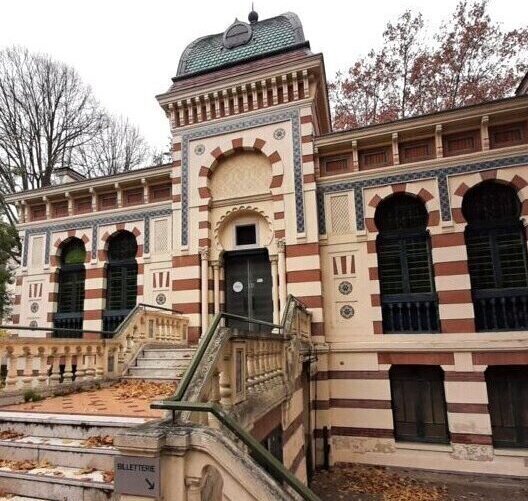
1) Amélie Sallet née Morin in Albert Sallet’s laboratory in Tourane (Danang) in 1910, the year of their marriage. She would pass away at age 49 in Toulouse, 1933. [photo Collection Nouvelle Association des Amis du Vieux Hue (AAVH)]. 2) The Georges-Labit Museum in after it closed for structural renovation in Sept 2022. It hadn’t reopened as of Sept. 2026 [photo Actu Toulouse]. 2) The ‘Henri Parmentier Museum’ c. 1918 [photo EFEO/Tourane, Wikicommons.]
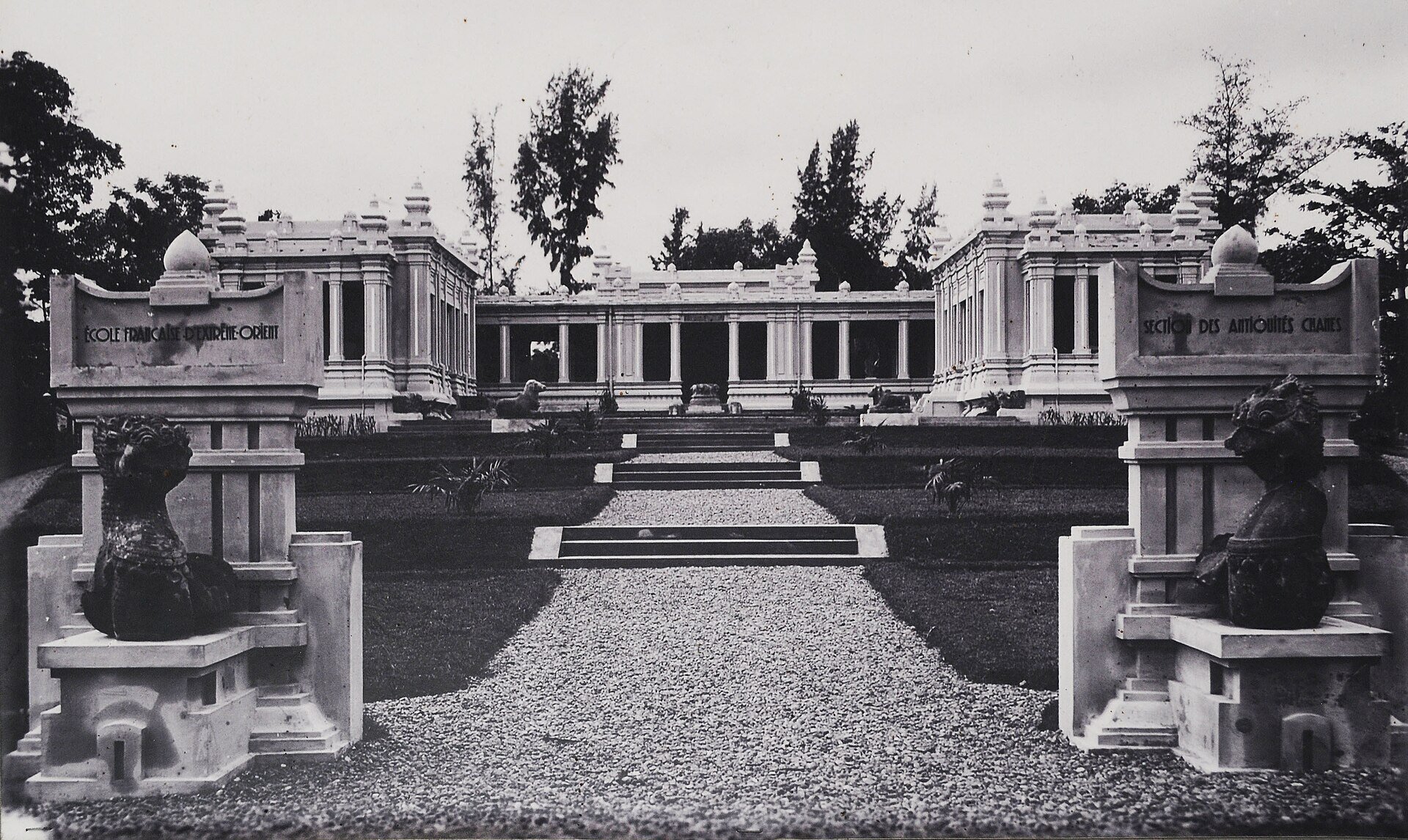
1) Amélie Sallet née Morin in Albert Sallet’s laboratory in Tourane (Danang) in 1910, the year of their marriage. She would pass away at age 49 in Toulouse, 1933. [photo Collection Nouvelle Association des Amis du Vieux Hue (AAVH)]. 2) The Georges-Labit Museum in after it closed for structural renovation in Sept 2022. It hadn’t reopened as of Sept. 2026 [photo Actu Toulouse]. 2) The ‘Henri Parmentier Museum’ c. 1918 [photo EFEO/Tourane, Wikicommons.]
1) Amélie Sallet née Morin in Albert Sallet’s laboratory in Tourane (Danang) in 1910, the year of their marriage. She would pass away at age 49 in Toulouse, 1933. [photo Collection Nouvelle Association des Amis du Vieux Hue (AAVH)]. 2) The Georges-Labit Museum in after it closed for structural renovation in Sept 2022. It hadn’t reopened as of Sept. 2026 [photo Actu Toulouse]. 2) The ‘Henri Parmentier Museum’ c. 1918 [photo EFEO/Tourane, Wikicommons.]
Back in France in 1931, Albert Sallet settled in Toulouse and took interest in the creation of a museum hosting the private collections of Georges Labit (1862−1912), becoming the curator of the Georges Labit Museum of Asian Art and Egyptian Antiquities in 1935. Under his direction, the Toulouse museum exchanged with Guimet Museum in Paris — Sallet had exchanged a lengthy correspondence with Khmer art expert Gilberte de Coral-Rémusat for many years. During WWII, he ensured that Jewish refugees could take shelter in the building in order to escape Nazi persecutions (art historian and Guimet curator Philippe Stern, in particular).
Long after Sallet’s death, curator and museologist Jeanne Guillevic impulsed a new phase starting from 1969, when she was apppointed Head Curator. In the 2020s, the Museum showcased five beautiful statues to illustrate their ‘Cambodian collection’, four of them labeled ‘don de l’Ecole Française d’Extrême Orient’ [EFEO donation]. The avenue on which the Museum is located, along the Canal du Midi, has been named Promenade Albert-Sallet in the 1990s.
In 2014, one century after the founding of AAVH, Albert Sallet’s medical research notes and reported were donated to the Archives nationales d’outré-mer by his grandson, Jean Cousso, the president of the Nouvelle Association des Amis du Vieux Hué (NAAVH) until 2023 — later honorary president. Most of Sallet’s personal library, his photographs and maps, and his diary, as well as his collection of ancient coins from Vietnam and China (some 5,800 pieces) are kept by the NAAVH [Note: as of September 2026, its website hasn’t been accessible for several months].
More about Musée Georges-Lambit and Albert Sallet
- Jeanne C. Guillevic, Collections du Musée Georges-Lambit, vol I: preface by Jeannine Auboyer, Toulouse, 1971, 280 p. | vol 2: Additif au catalogue des arts d’Asie, 1976, 55 p.
- Jeanne Guillevic, Musée Georges Labit : Arts d’Asie, t. 2, Toulouse, Musée Georges Labit, 1984, 180 p. ISBN 2−901439−01−2.
- Genevière Lefèvre, Georges Labit : un globe-trotter toulousain 1862 – 1899, Editions Daniel Briand, novembre 1994. ISBN 2−903716−46−3.
- [texts by Violette Fris-Larrouy, Nathalie Bazin, Marie Dominique Labails] Les collections du Musée Georges-Labit, Violette Fris-Larrouy ed., Toulouse, Musée Georges Labit, 1997.
- Violette Fris-Larrouy, Arts de Chine : La collection chinoise du musée Georges-Labit, Toulouse/Paris, Musée Georges Labit/A. Biro, 1999, 175 p. ISBN 2−87660−245−8.
- Jean Penent, conservateur du musée Paul-Dupuis et du musée Georges-Labit, Les collections du musée Georges-Labit, Cahiers du Musée Georges-Labit 3, 1997, 80 p. ISBN 2 – 905 880 – 21‑X.
- Anne-Laure Vella, “Albert Sallet (1877−1948), un médecin colonial en Indochine. Un fonds précieux et spécialisé sur la médecine traditionnelle vietnamienne”, Archives nationales d’outré-mer blog, 20 June 2018.
Author’s photo: Collection Cousso.