Pierre Marie Antoine Pasquier (6 Feb. 1877, Marseille, France — 15 Jan. 1934, in a plane crash near Corbigny (Nièvre), France), was a colonial administrator in French Indochina since 1908 and Governor-General [gouverneur général] of French Indochina from 4 Oct. 1926 to 16 May 1927 (acting for Alexandre Varenne) and from 26 Dec. 1928 to 15 Jan. 1934, date of his accidental death.
Born in a family from Marseille with links to French colonial expansion — after the premature death of his father Armand Pasquier (1822−1878) he was raised by his mother Marie Sophie Arnoux (1833−1933) and his maternal grandmother Joséphine Arnoux née Bouchard, the widow of Navy officer who had served in Escadre d’Extrême-Orient -, he attended the École coloniale, and left for Indochina in 1898. Apart from brief returns to France — in order to marrying his niece, Elise Pasquier (1882−1962), in 1902, and to give a series of conferences on L’Annam d’autrefois — [Annam of Yore], title of a book published a year later [L’Annam d’autrefois: Essai sur la Constitution de l’Annam avant l’intervention francaise, Paris, Challamel, 1907] — at the Paris Colonial Exhibition in 1906 — he served as Résident in Thai-Binh, Thanh-Hoa, Hue, President of the Hanoi Municipality, Résident-supérieur in Annam [North Vietnam] from 1921 until 1927, and Administrateur des Services Civils de l’Indochine from 1905 to 1915.
A close collaborator to Prime Minister and Governor-General of Indochina (in 1911 – 1913 and agiain in 1917 – 1919) Albert Sarraut, Pierre Pasquier wasincharge of the preparation for the historic visit to Annam and Cambodia of French war hero Maréchal Joffre in Dec. 1921 and Jan. 1922, along with then Governor-General Maurice Long who was more ‘old-school’ and not one of Sarraut’s ‘grands consuls’ as Pasquier was. He took the Maréchal Joffre to an audience with Emperor Khai Dinh in Hue, and later escorted the Vietnamese sovereign during his visit to France from 15 May to 11 Aug. 1922. At Khai Dinh’s passing in 1925, he was instrumental in establishing a smooth succession with Emperor Bao Dai at that time. [It was at soirée hosted by Governor Pierre Pasquier in Dalat in 1933 that Marie-Thérèse Nguyen Huu Thi Lan met the young Bao Dai, leading to their marriage in 1934].
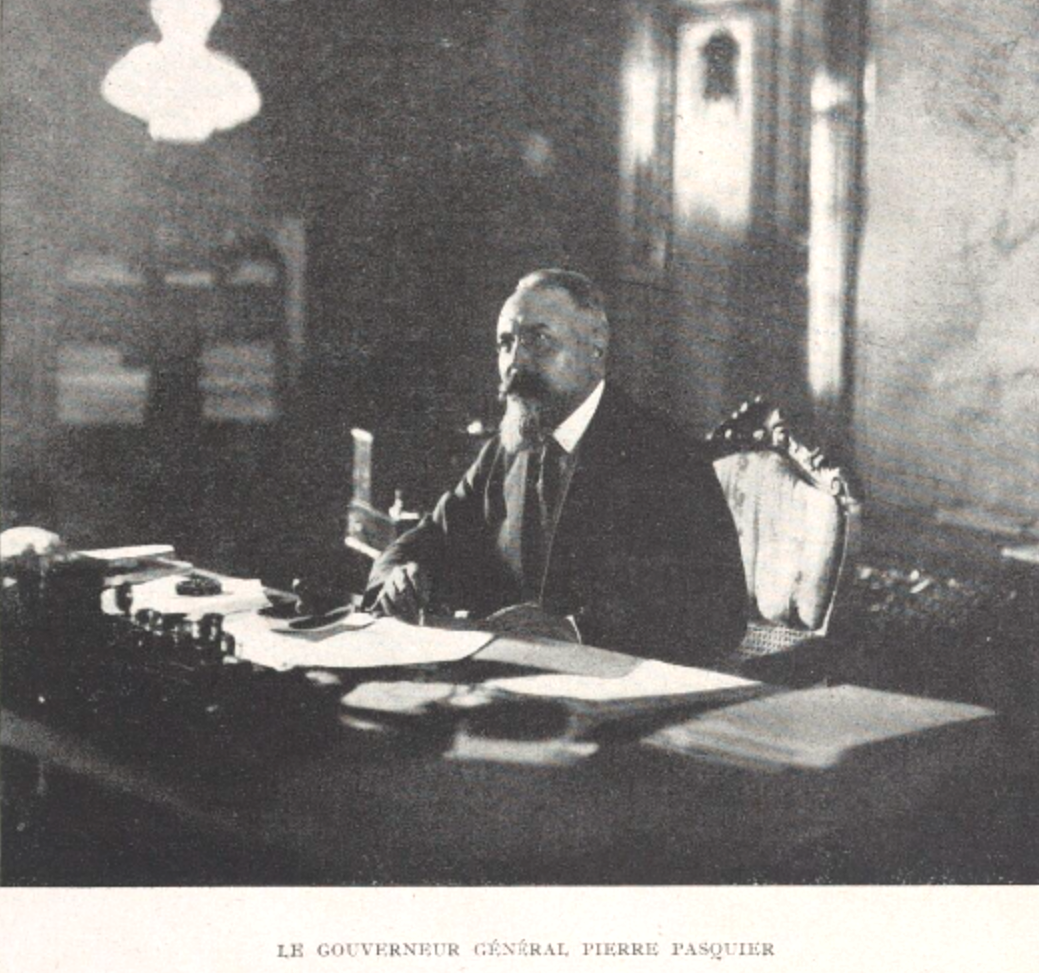
Official portrait in Eugène Teston & Maurice Percheron, L’Indochine moderne: encyclopédie administrative touristique, artistique et économique, Paris, Edition de France, 1931 – 2, 1028 p.
Official portrait in Eugène Teston & Maurice Percheron, L’Indochine moderne: encyclopédie administrative touristique, artistique et économique, Paris, Edition de France, 1931 – 2, 1028 p.
In contrast with ‘old-school’ colonial administrators such as Maurice Long or Francois Baudoin, Pasquier, along with Jules Bosc (Resident-Superieur of Laos from 1918), René Robin (‘General Secretary of Indochina Union’ in 1921 – 1925), Paul Blanchard de la Brosse (Resident of Cochinchina, Director of Public Instruction from 1924), was very much aware of the fact French Indochina had contributed to up to 60 pc of the colonies’ economic support to the French Great War effort. [see Patrice Morlat, “Projets coloniaux et mise en pratique : la politique des « fils » de Sarraut en Indochine dans les années vingt”, Cahiers d’histoire (Revue d’histoire critique) 85, 2001: 13 – 28 (online)].
Pierre Pasquier saw the potential of enhancing the cultural resources of Indochina in a profit-driven perspective. In Hanoi, he pushed for the economic and commercial of the colony, instigating the Grande Foire de Hanoi [Hanoi Grand Fair] in 1916 and the development of the Musée économique, with an antenna in Phnom Penh. In Oct. 1921, he established by Administrative Order the Ecole des Hautes Etudes du Gouvernement annamite (EHEGA), a project aborted in 1925. In 1923, he created the Khai-Dinh Museum in Hue, in cooperation with the association Les Amis du Vieux Hué. In 1931, he was in Phnom Penh on the occasion of the release of the first volume (800 p.) of the Tripitaka edition in Pali and Khmer, presented to King Monivong during a ceremony on 22 October at the just-completed new Buddhist Institute [anti-imperialist journalist Andrée Viollis attended the event and recounted it in her famous Indochine S.O.S., 1935 (repr. 2024, p. 44].
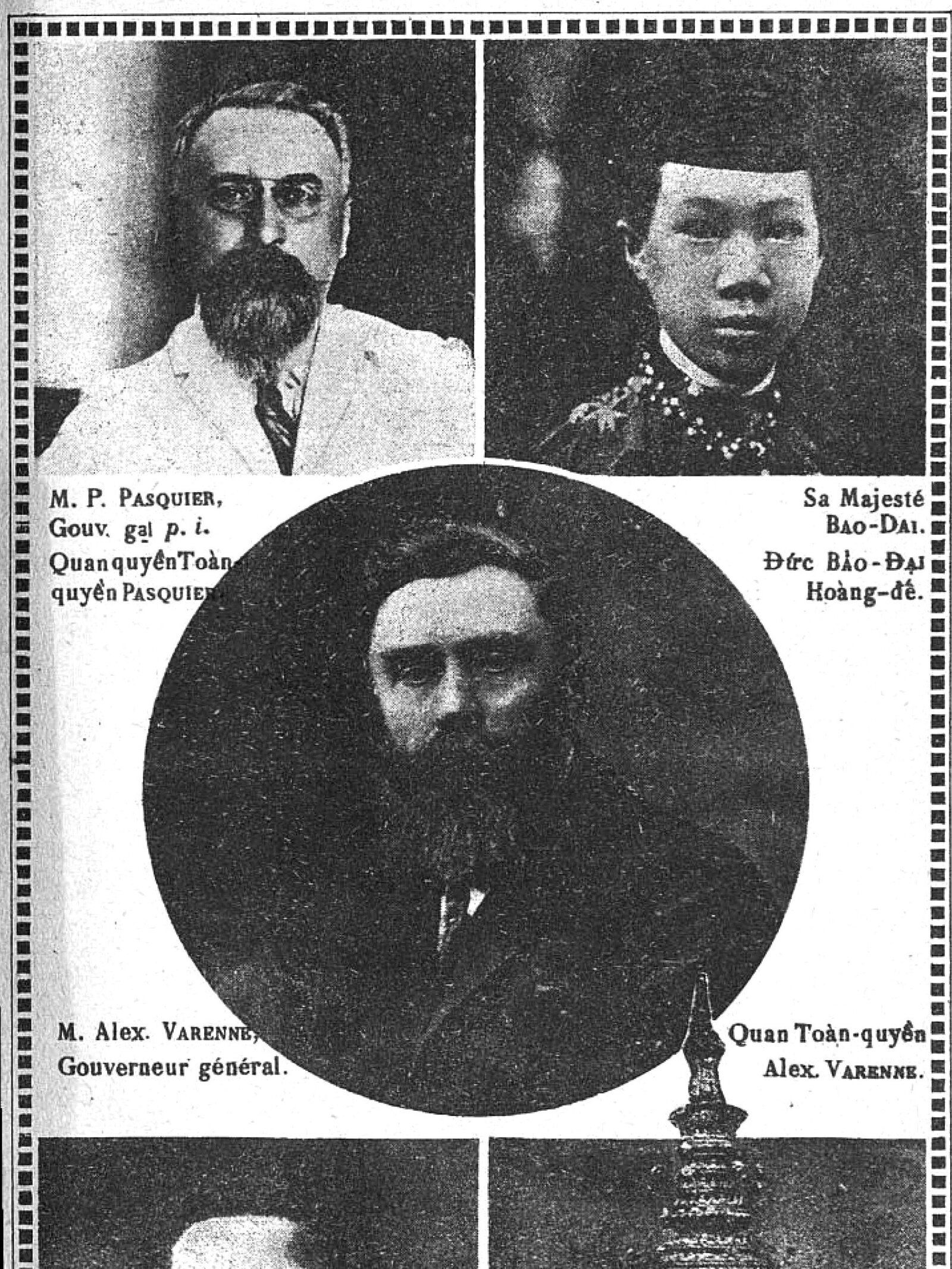
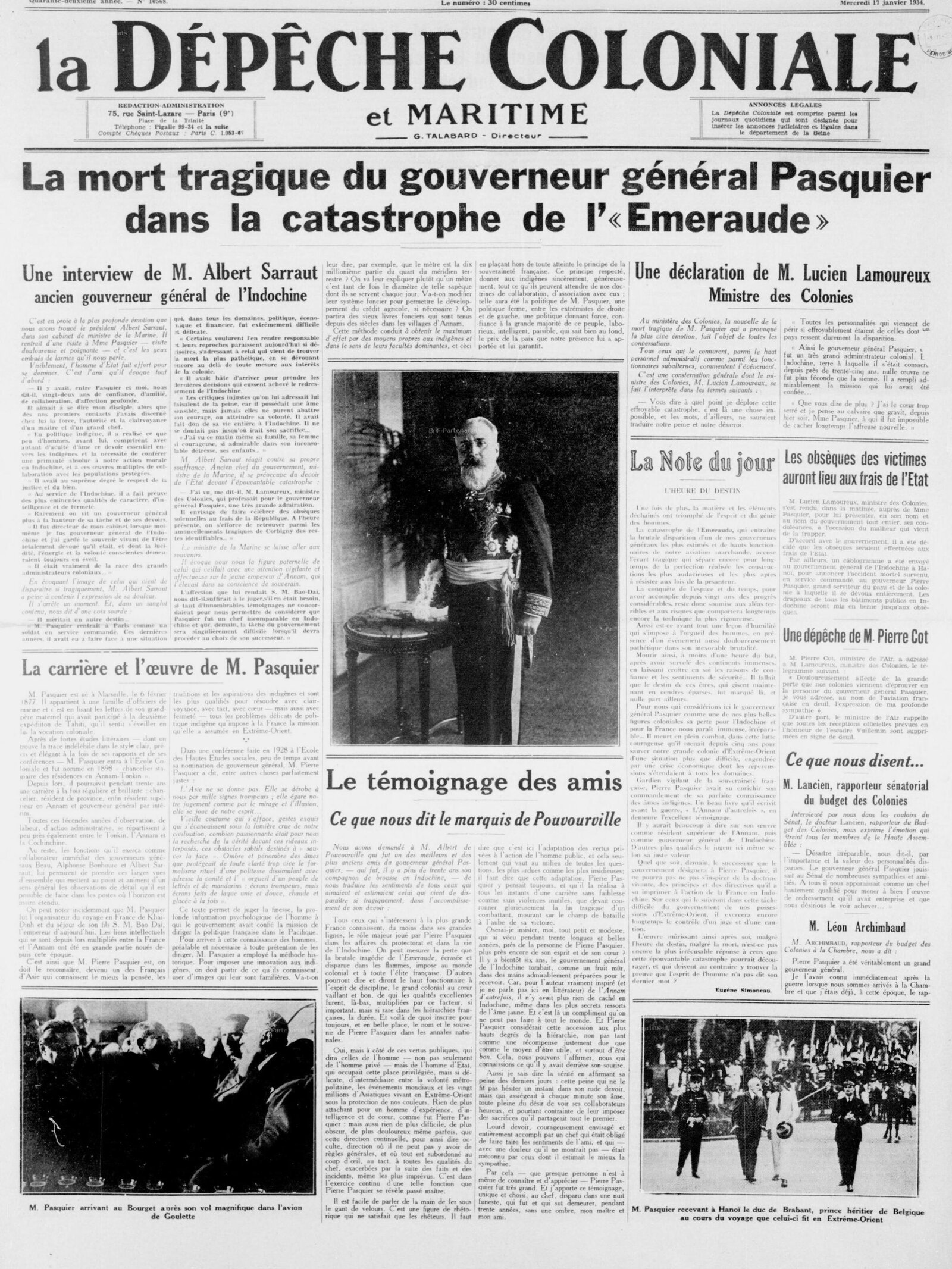
1) Pierre Pasquier’s portrait along with Emperor Bao Dai, King Sisowath of Cambodia, King Sisavang-Vong of Luang Prabang, and Governor-General Alexandre Varenne in Đông-Dương ngày xua va ngày nay [Indochina Then and Now], Henri Cucherousset & Vu Cong Nghi, FR/VN edition, Hanoi, Đông-Dương kinh-tế báo (L’Économique indochinois), 1926. 2) Cover page of La Dépêche coloniale et maritime about Pierre Pasquier’s death, 17 Jan. 1934 [via RetroNews/gallica.bnf.fr].
1) Pierre Pasquier’s portrait along with Emperor Bao Dai, King Sisowath of Cambodia, King Sisavang-Vong of Luang Prabang, and Governor-General Alexandre Varenne in Đông-Dương ngày xua va ngày nay [Indochina Then and Now], Henri Cucherousset & Vu Cong Nghi, FR/VN edition, Hanoi, Đông-Dương kinh-tế báo (L’Économique indochinois), 1926. 2) Cover page of La Dépêche coloniale et maritime about Pierre Pasquier’s death, 17 Jan. 1934 [via RetroNews/gallica.bnf.fr].
1) Pierre Pasquier’s portrait along with Emperor Bao Dai, King Sisowath of Cambodia, King Sisavang-Vong of Luang Prabang, and Governor-General Alexandre Varenne in Đông-Dương ngày xua va ngày nay [Indochina Then and Now], Henri Cucherousset & Vu Cong Nghi, FR/VN edition, Hanoi, Đông-Dương kinh-tế báo (L’Économique indochinois), 1926. 2) Cover page of La Dépêche coloniale et maritime about Pierre Pasquier’s death, 17 Jan. 1934 [via RetroNews/gallica.bnf.fr].
The appointment of Alexandre Varenne (3 Oct. 1870, Clermont-Ferrand – 16 Feb. 1947, Paris) as Governor-General in 1925 didn’t impact Pasquier’s course. The socialist politician and journalist, ‘bête noire’ of the hardcore colonials — before Indochina, the French administration had contemplated the prospect of sending him to Moscow as Ambassador to USSR — lasted until 1928 and Pasquier substituted to him from 4 Oct. 1926 to 16 May 1927. At the same time, he was furthering his own vision. He was instrumental in the development of commercialization of Ancient Khmer artworksunder EFEO supervision.
At the Paris Colonial Exhibition in 1931, Pasquier met in person with French ethnologist Paul Rivet (7 May 1876 – 21 March 1958), the founder of Musée de l’Homme in 1937. At his invitation, Rivet “traveled to Indochina later for the first time that same year to preside over the first meeting of the “Préhistoriens de l’Extrême Orient.” He used the opportunity to conduct a four-month-long ethnographic mission and came back completely seduced by the country he had discovered and the fieldwork he had done. In 1932 Pasquier signed a decree creating the Hanoi ethnographic Museum, which was placed under the authority of the EFEO. Meanwhile Rivet devoted his course the next year at the Institute to the Moi and Muong peoples; he also set to work creating a gallery devoted to the ethnography of Indochina at the MET.” (Metropolitan Museum of Art, New York) [Alice L. Conklin, “The New “Ethnology” and “La Situation Coloniale” in Interwar France”, French Politics, Culture & Society 20 – 2, Summer 2002: 29 – 46].
On the other hand, Governor-General Pasquier recommended repeated crackdowns on Caodaist followers in Vietnam, deeming the new monotheistic-syncretic — with precepts from Confucianism, Buddhism and Taoism, and a hierarchical structure inspired by the Catholic Church — religion founded in 1926 in the Southern city of Tây Ninh [with its ‘Holy See’ there], “a dangerous chimera.” [The complete name of Caodaism in Vietnamese is Đại Đạo Tam Kỳ Phổ Độ , litt. ‘The Great Faith in the Third Universal Redemption’.]
An airplane enthusiast, Pasquier encouraged French aviators Marcel Goulette (7 Dec. 1893 — 25 May 1932) and Marcel Lalouette (16 Dec. 1897 — 30 May 1931), who both died in plane crashes, to undertake the France-Saigon Raid in Nov.-Dec. 1930 on a Farman F 197, boarding the aircraft with them. Three years later, he perished in the crash of the Dewoitine D 332 “Émeraude” flight back from Damas to France, along with Maurice Noguès, Vice-Director of Air France (the airline established in 1933), Emmanuel Chaumié, Director of French Civil Aeronautics Service and Colette Chaumié, the latter’s wife.
Publications
L’Annam d’autrefois: Essai sur la Constitution de l’Annam avant l’intervention francaise, Paris, Challamel, 1907.
Le gouverneur général A. Sarraut et le personnel indochinois. Hanoï, La revue indochinoise, 1918, 16 p.
Dong is an ancient Chinese term for a mountain valley community, especially in the southern and soutwestern regions abutting to 'historic' mainland China.
In Korea, dong동 has come to refer to a neighborhood or an administrative sub-district.