

Eileen Power

Eileen Edna Le Poer Power (9 Jan. 1889, Parkdale, Dunham Massey, England — 8 Aug. 1940, London) was a British medievalist and economic historian who became in 1920 the first woman awarded the Albert Kahn Traveling Scholarship, a grant related to the project Archives of the Planet, launched in 1908 by French banker and philanthropist Albert Kahnn (1860−1940), which allowed her to travel through India, China and Japan.
After graduating from Oxford and Sorbonne Universities, Eileen Power became director of studies in history at Girton College, Cambridge University (1913−1920), Lecturer and Reader in political science and economic history back at the London School of Economics and Political Science (LSE) between 1921 and 1931, and from 1931 to her passing Chair of Economic History. In addition to a novel approach to world economics in Middle Age times, to her Eastern travels (which she described in a 1921 report), she ventured into the neglected field of women’s history. She was also an accomplished classical dancer.
A supporter of the National Union of Women’s Suffrage Societies, she lived in Bloomsbury, where a group of artists and philosophers were active in the famed Bloomsbury Group. While founding in 1927 The Economic History Review, a peer-reviewed history journal still published one century later, she launched and co-edited with Edward Denison Ross (1871−1940) The Broadway Travellers (1926−2015), a monumental collection of international travel writing. In 1933, as Aldolf Hitler seized power in Germany, she set up the Academic Freedom Committee, aimed at helping scholars and researchers to flee Nazi Germany.
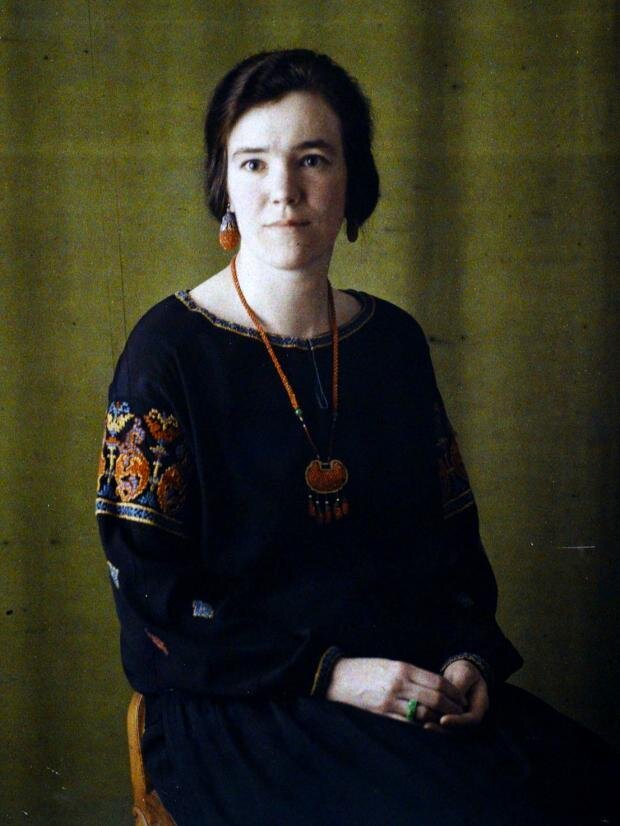
Eileen Power, portrait by Auguste Léon during her collaboration with the Albert Kahn Museum, c. 1922. [Albert Kahn Museum]
Eileen Power, portrait by Auguste Léon during her collaboration with the Albert Kahn Museum, c. 1922. Auguste Léon (1857−1942) was a French photographer who worked for Archive of the Planet project since 1909. In addition to overseas attributions, he was in charge of portraying contributors and guests of banker and philanthropist Albert Kahn.
In 1937, Eileen Power married historian Michael Postan (1899−1981), one of her former students who became professor of history at Cambridge. She had previously been engaged to Reginald Johnston (1874−1938), Scottish diplomat and colonial official who was the tutor/advisor of Puyi (1906−67), the last Emperor of China, whose book Twilight in the Forbidden City (1934) was the base for Bernardo Bertolucci’s feature movie The Last Emperor (1987).
Eileen Power was amongst the 20 women celebrated in the March 2017 event London’s Women Historians at the Institute of Historical Research, University of London. For an epigraph to her first major book, she had selected a sentence by English poet and essayist Charles Lamb (1775−1834): “I counsel thee, shut not thy heart nor thy library.”
Select Publications
- Medieval People, London, Methuen & Co., 1924, 1926, 1927; repr. 1975.
- The Wool Trade in Medieval History, Oxford University Press, 1941, 160 p.
About Eileen Power
- Maxine Berg, A Woman in History: Eileen Power, 1889 – 1940, Cambridge University Press, 1996, 307 p.
- A Biography by Stephen Roberts on Great British Life, 12 Feb. 2025.
Main photo: Collection Girton College.