

Kim Khanh Pham

Pham Kim Khanh, also known as Phạm Kim Khánh, Kim Khanh, Sunanda Pham Kim Khanh (10 Jan. 1921, Ben Tre [Bến Tre], Vin Long Province, Mekong Delta, Vietnam — 27 Feb. 2011, Seattle, WA, USA) was a photographer and photo-reporter active in Cambodia in the years 1950s and 1960s, and later on a Buddhist scholar and translator of texts on Theravada Buddhism.
Born in alearned family of the Delta — his father, Pham Kim Chi, was a local governor -, he studied at Saigon Lycée Chasseloup-Laubat and Providence School, Hue, mastering French, English and Pali terminology, and growing up with both Catholic and Buddhist influences. From 1948 until at least 1957, he joined the Service de cinématographie du Haut-Commissariat au Cambodge, becoming a staff photographer with the French Army Information Service (SCA-SPI), covering the transfer of the military command to the government of independent Cambodia and other hard news topics.
Kim Khanh’s mastery of the art of photography is expressed in his black-and-white photographs reflecting people of Cambodia, their daily life and their interaction with nature in a serene, highly empathic way. His ethical and philosophical quest was enhanced by his firsthand experience of the visit to the town of Bà Rịa by Venerable Narada Maha Thera from Sri Lanka to preach the Dharma.
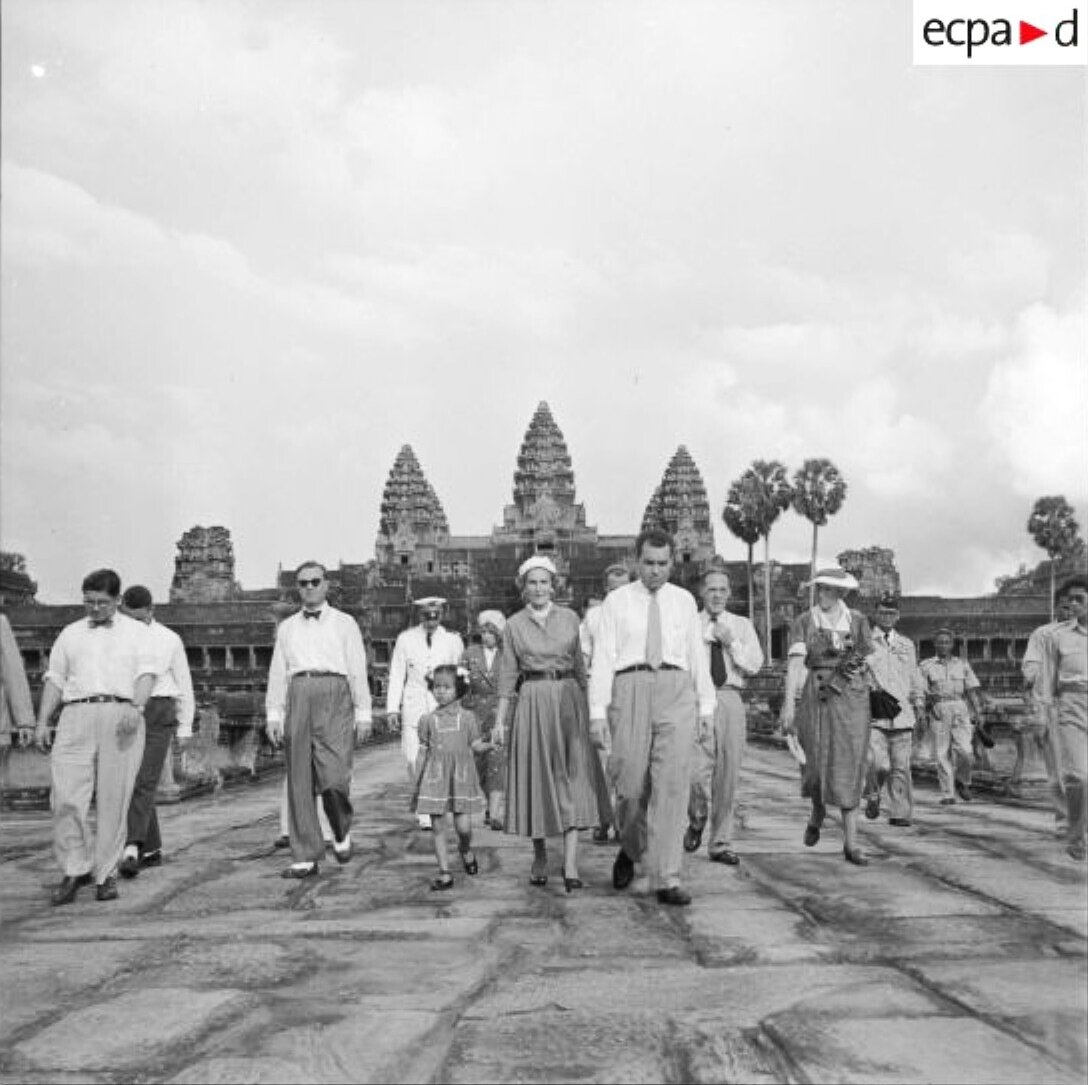
As a photoreporter, Kim Khanh covered major events such as the visit of US Vice-President Richard Nixon to Cambodia in 1953 (1) and significant religious events, for instance the arrival of Buddhist relics from Sri Lanka to Pocheuntong Airport, Phnom Penh in October 1952 (2) [source: ECPAD Collection].
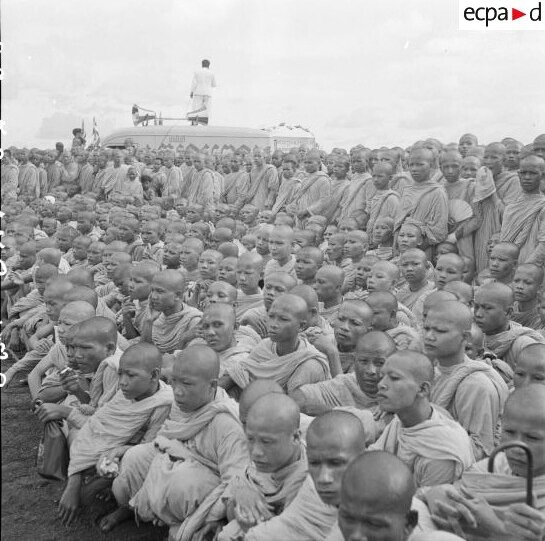
As a photoreporter, Kim Khanh covered major events such as the visit of US Vice-President Richard Nixon to Cambodia in 1953 (1) and significant religious events, for instance the arrival of Buddhist relics from Sri Lanka to Pocheuntong Airport, Phnom Penh in October 1952 (2) [source: ECPAD Collection].
As a photoreporter, Kim Khanh covered major events such as the visit of US Vice-President Richard Nixon to Cambodia in 1953 (1) and significant religious events, for instance the arrival of Buddhist relics from Sri Lanka to Pocheuntong Airport, Phnom Penh in October 1952 (2) [source: ECPAD Collection].
After studying several months at a Theravada pagoda in Saigon, he was given the Dharma name Sunanda (Good Karma) by Venerable Narada. From 1961, he started to translate into Vietnamese texts originally written in English by the Venerable, culminating with the bilingual edition of The Buddha and His Teachings [Đức Phật và Phật Pháp, Saigon, numerous editions since 1970). Pham Kim Khanh served until 1975 as General Secretary of the Vietnam Theravada Buddhist Association [Tổng Hội Phật Giáo Nguyên Thủy Việt Nam, established in 1957 at the instigation of Khmer monks and later known in Vietnam as ‘Southern Buddhism’ Congregation]. In total, from 1961 to 2002, he edited and translated some 31 books about Buddhist philosophy and Dharma teaching [information from ‘Cư sĩ Sunanda Phạm Kim Khánh (1921−2011)’, Thu Vien Hoa Sen blog, March 2011].
If we have no detail about Kim Khanh’s photographic work in Viet Nam, he seems to have covered the liberation of Phnom Penh from the Khmer Rouge by Vietnamese volunteers and Cambodian opponents to Pol Pot since he was credited as still photographer on the 80-min film directed by Michel Régnier, La vie commence en janvier [Life Begins in January] (1980), a documentary on the liberation of the Cambodian capital city in January 1979. He seems to have settled in Seattle at the end of the 1980s, as he was mentioned as the head of the Seattle Narada Center in 1994, inviting Zen masters to lead Vipasana sessions, and published several essays in the Co Lam Pagoda’s magazine, Duong Sang. He led Vietnamese Buddhists living in Seattle in a 1996 visit to India, during which he took photos to illustrate his account of the trip, Pilgrimage to the Land of Buddha [Hành Hương Xứ Phật, 1997; see a complete bibliography in Vietnamese.]
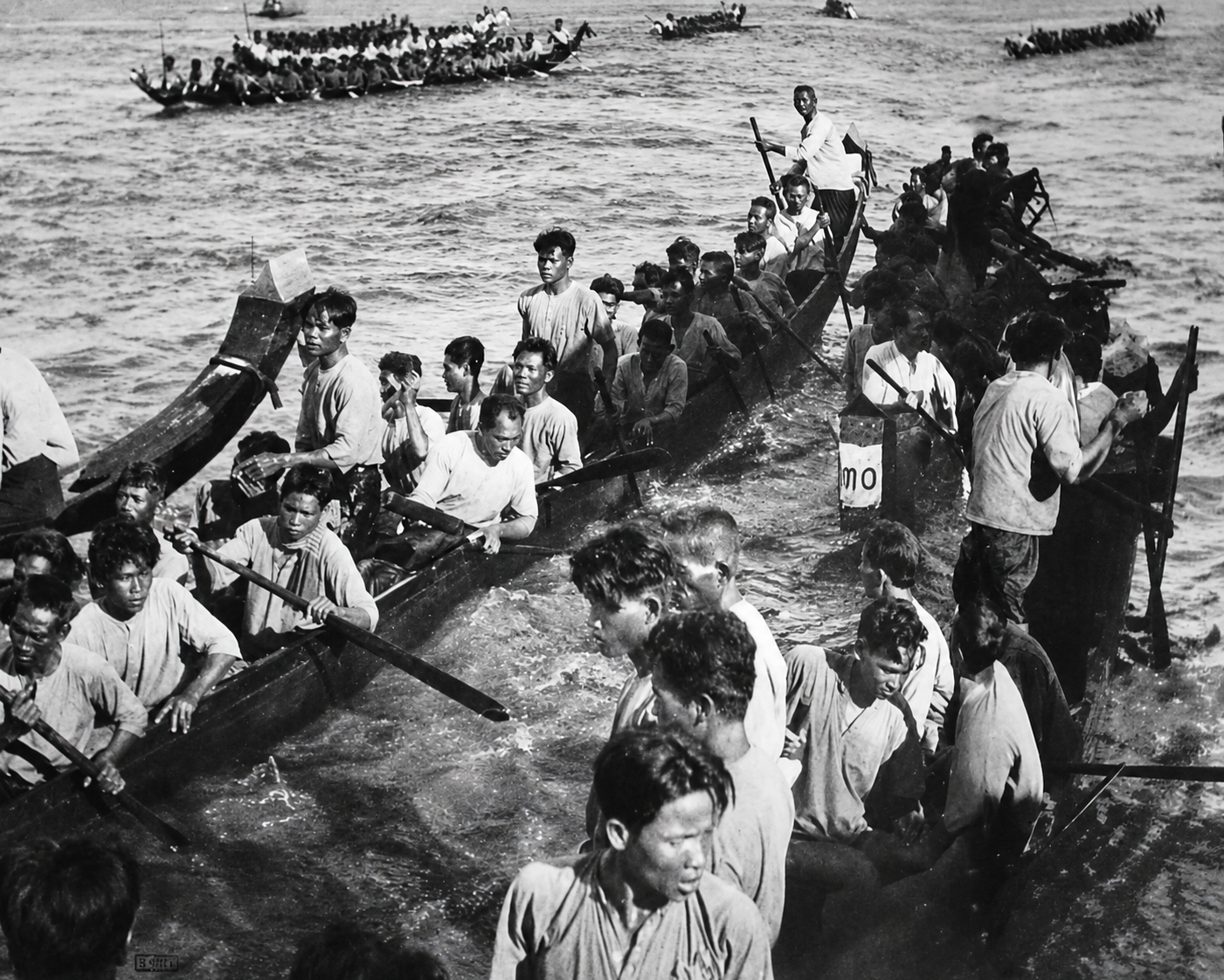
Boat racing, Water Festival in Phnom Penh, 1953, by Kim Khanh [from Indochine profonde, J.P. Dannaud ed., 1954].
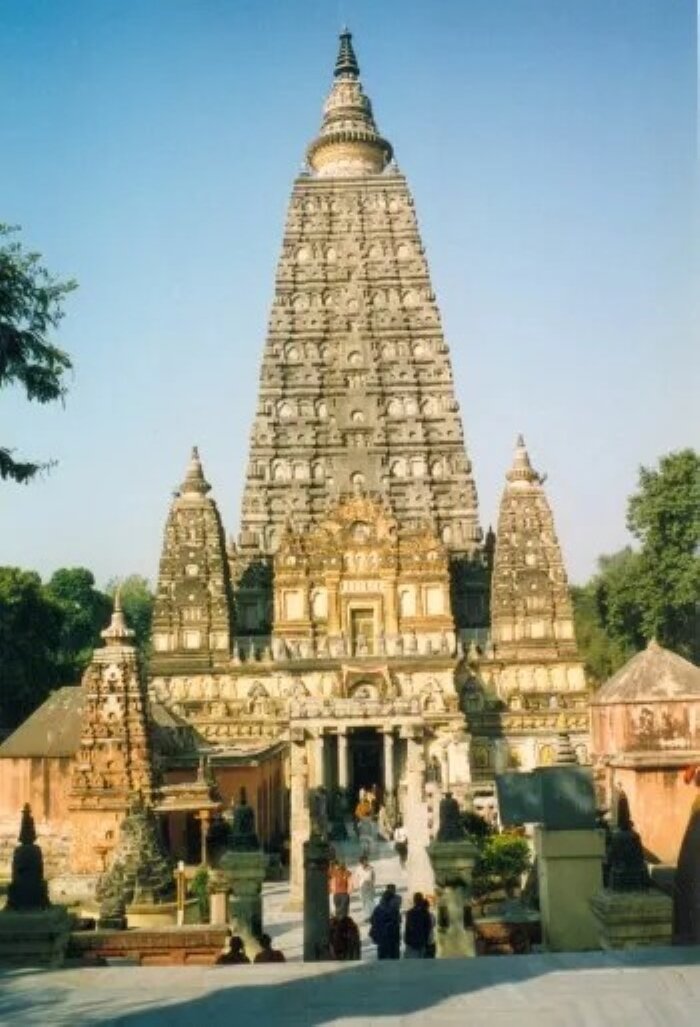
The Life of a Buddhist Photographer: 1) Boat racing at Bön Om Touk (Water Festival), Phnom Penh, 1953, by Kim Khanh. 2) The Mahabodhi Temple, Bodh Gaya, Bihar, where Lord Buddha attained enlightnement, photographed by Pham Kim Khanh during his 1996 pilgrimage, in his Pilgrimage to the Land of Buddha [Hành Hương Xứ Phật, Seattle, 1997, book available online].
The Life of a Buddhist Photographer: 1) Boat racing at Bön Om Touk (Water Festival), Phnom Penh, 1953, by Kim Khanh. 2) The Mahabodhi Temple, Bodh Gaya, Bihar, where Lord Buddha attained enlightnement, photographed by Pham Kim Khanh during his 1996 pilgrimage, in his Pilgrimage to the Land of Buddha [Hành Hương Xứ Phật, Seattle, 1997, book available online].
Alongside renowned French photographers such as Raymond Cauchetier, Raoul Coutard, Daniel Camus or Pierre Ferrari, Kim Khanh contributed to two major photo-albums on Cambodia:
- Indochine Profonde, J.P. Dannaud ed., Lausanne/Saigon, La Guilde du Livre/Société Asiatique d’Éditions, 1954;
- Cambodge, J.P. Dannaud ed., Lausanne/Saigon, La Guilde du Livre/Société Asiatique d’Éditions, 1959.
His last published photographs were published in his book Hành Hương Xứ Phật [Pilgrimage to the Land of Buddha], Seattle, Trung tâm Nārada [Narada Center], 1997 [read online].