

L'École française d'Extrême-Orient ou l'institution des marges (1898-1956) [EFEO or An Institution of the Fringes]
by Pierre Singaravélou
An independent and remarkably well-documented study on the EFEO, its achievments and shortcomings since 1898 until 1956.

- Author
- Pierre Singaravélou
- Publisher
- 1) Paris, L'Harmattan, 1998. 2) Paris, Biblis (CNRS éditions), Feb. 2019.
- Published
- 1999
- Pages
- 380
- Language
- French
- ISBN
- 9782271122551
- Formats
- on-demand ebook, ADB Physical Library, paperback
Initially a research assignment for his MA dissertation starting in 1997, the author plunged in the still unchartered world of École française d’Extrême-Orient (EFEO) Archives, from its establishment in Paris and Hanoi in 1900 until the year 1956. His exploration was encouraged by then EFEO director Denys Lombard (1938 – 1998). He recounted the experience in a 2021 interview:
“Ce fut ma plus belle expérience de recherché. Je passais mes journées dans les archives à compiler des sources, avenue du Président-Wilson, au rez-de-chaussée de l’École.” Au King’s College, il a ouvert un nouveau chantier de recherches, l’histoire du panasiatisme. Il prépare aussi une nouvelle série documentaire. Son sujet ? La Chine et le monde, de la guerre des Taiping au milieu du XIXe siècle jusqu’à nos jours, “pour montrer que, depuis un siècle et demi, la Chine s’approprie des influences du monde entier, les digère et les transforme, de la religion chrétienne au capitalisme financier.” [Virginie Bloch-Lainé, “Pierre Singaravélou : génération mondialisation”, L’Histoire, n 480, Feb. 2021]. [“It was my most rewarding research experience. I spent my days in the archives, compiling sources, on President Wilson Avenue, on the ground floor of the school.” At King’s College, he opened a new research project: the history of Pan-Asianism. He is also preparing a new documentary series. Its subject? China and the world, from the Taiping Wars in the mid-19th century to the present day, “to show that, for a century and a half, China has appropriated influences from all over the world, digested them, and transformed them, from Christianity to financial capitalism.”]
In his Introduction, the author discussed the arguments put forward by Edward Said in his referential essay Orientalism (1978):
Appliquant à la lettre la théorie du discours de Michel Foucaulf, Said étudie l’orientalisme comme une pratique discursive et analyse les objectifs politiques qu’elle sous-tend. Les orientalistes ont selon lui construit un objet «Orient» pour servir les visées impérialistes des pays colonisateurs. Cependant Saïd oublie un aspect primordial: la récupération du discours orientaliste par les élites autochtones pour légitimer leur autorité. Le savoir orientaliste est de fait un enjeu de pouvoir pour les colonisateurs et pour les colonisés. [p 19] [Applying Michel Foucault’s theory of discourse to the letter, Said studies Orientalism as a discursive practice and analyzes the political objectives that underline it. According to him, Orientalists constructed an object, “the Orient,” to serve the imperialist aims of colonizing countries. However, Said overlooks a crucial aspect: the appropriation of Orientalist discourse by indigenous elites to legitimize their authority. Orientalist knowledge is, in fact, a tool of power for both colonizers and colonized. [p. 19]
This is an interesting point, not entirely developed in the book, particularly in the case of Cambodia where archaeology literally set up the foundations of the national identity while it remained an activity under French monopoly. The author did tackle the question of the ‘local’ collaborators to French archaeologists and architects — or the paucity of ‘recognized’ collaborators as such. But since the scope of the study didn’t reach the decades 1960 and 1970, it didn’t mention the contribution of Cambodian architects such as Dy Proeung or Phuoeng Sophean, and the committment to the training and fostering of local talent manifested by EFEO researchers Jean Boulbet, Bruno Dagens, Claude Jacques or Guy and Jacqueline Nafilyan. Nevertheless, the “Essai de biographie collective” [Attempt to a Collective Biography] of EFEO members and collaborators published in Annex constitutes a rare recension of “local’ contributors to EFEO mission, in particular for the work in Angkor.
Here is certainly the first ‘fringe’ element in an apparently dignified scholarly institution — EFEO as an “interface between colonial administration and colonized intellectuals,” with the telling example of the future ideologists of the Vietnamese independence movement being exposed to intellectual growth thanks to ‘the School’ (of the Far East).
Mixed-Race Ideal and Practice
As a proponent of “global history”, the author expanded his sociological exploration of the EFEO actors in Southeast Asia and elsewehere to the sphere of personal life, illustrated with interracial marital union, a theme that has been amply studied since the first publication of this book in 1999 [the author referred, amongst other sources, to Kim Lefèvre, “Eve Jaune et colon blanc” in Saïgon 1925 – 1945, de la “belle colonie” à l’éclosion révolutionnaire ou la fin des dieux blancs, Philippe Franchini ed., Paris, Autrement, Mémoires, n° 17, 1992]. That’s one important aspect of the ‘fringe’ evoked in the title :
Nombre d’orientalistes de l’Ecole ont succombé aux charmes des femmes asiatiques: sur notre échantillon de 35 membres, 8 vivent avec une autochtone: Auguste Bonifacy avec Luong Thi Hien qui lui a donné une fille, Anne-Marie; Jean-Yves Claeys remarié avec Trân Thi Quy avec qui il a eu deux garçons et deux filles; George Coedès, marié avec Neang Yap, jeune femme d’origine cambodgienne avec qui il a eu six enfants; Charles Damais, marié avec une Indonésienne, Raden-Rorc, a eu trois enfants; Alfred Lavallée, marié avec La Thi Thung dite «Simone» ; Paul Lévy a épousé une laotienne, Banian qui lui a donné quatre enfants; Henri MarchaI qui, après le décès de son épouse Marie Gerny, vit avec Nang Nêv, couturière, et enfin Rolf Stein, marié avec Dao Thi Tu. Les unions mixtes sont — en général — plus répandues en Indochine qu’en Afrique du Nord ou dans les colonies anglaises, et en Indochine même, les orientalistes de terrain semblent se caractériser par une forte proportion d’unions mixtes par rapport à la moyenne. L’épouse autochtone jouerait un rôle d’initiatrice à la culture locale. Le métissage biologique parachève le métissage culturel des orientalistes. Eugène Pujamiscle explique autrement le goût des orientalistes pour les femmes du cru, les “Petites épouses”: «Assister aux fêtes indigènes, écouter le soir, les vieillards ou les bonzes vous raconter d’anciennes légendes, faire des kilomètres à travers la forêt pour aller examiner une stèle ou une statue, ce sont là des fantaisies que l’on peut tolérer à la rigueur chez un célibataire, mais auxquelles un homme marié doit renoncer comme à l’habitude d’aller faire sa manille au café… Eh! ce né sont pas nos petites épouses qui songeraient à nous imposer de pareils sacrifices.” Selon Pujarniscle, seules les congaï sont capables de supporter et de comprendre leurs compagnons. Ces derniers sont qualifiés d’ «encongayés», de «décivilisés» par les détracteurs du métissage.
George Groslier, membre de l’EFEO, qui explique et justifie ces unions mixtes dans ses romans, est accusé de trahison par la bonne société coloniale, en marge de laquelle vit aussi Henri Marchal; entouré de son épouse cambodgienne et de ses nombreux petits métis, MarchaI habite une modeste paillote dans la brousse. Pareil exemple d’intégration totale et définitive de l’orientaliste dans la société autochtone est rare. Les autres couples mixtes vivent à l’occidentale en Indochine, puis l’épouse d’origine asiatique accompagne son mari en métropole. Quant aux épouses d’origine vietnamienne, elles subissent de leur côté la réprobation de leur communauté. Elles sont menacées par la rancoeur de certains nationalistes, en particulier en temps de crise politique. Ainsi en 1941, Jean Yves Claeys écrit à Suzanne Karpelès : “On a prévenu ma femme qu’il y aurait danger pour elle à revenir là-bas, avec ou sans moi”.
Le couple formé par un orientaliste et une autochtone gagnerait à être étudié sur un échantillon plus significatif, compte tenu des perspectives ouvertes récemment par des chercheurs, tel Kim Lefèvre, qui ont réévalué l’importance des couples mixtes dans l’histoire sociale de l’Indochine française: “La colonisation française de l’Indochine comportait, outré ses aspects politiques et économiques, des aspects relationnels dont peu d’historiens font mention dans leurs analyses. Il s’agit des rapports amoureux entre femmes autochtones et colons français. Le sujet a pourtant inspiré une abondante littérature romanesque, témoignage d’une partie immergée de la réalité coloniale qu’on peut considérer comme la trame de chair, de passion et de calculs sur laquelle se sont tissés les grands motifs historiques de l’empire.” Les métis issus de ces couples mixtes subissent un ostracisme aussi bien de la part des colons que de la communauté indigène. [p 142 – 3]
[Many Orientalists from the School succumbed to the charms of Asian women: in our sample of 35 members, 8 live with a native woman: Auguste Bonifacy with Luong Thi Hien who gave him a daughter, Anne-Marie; Jean-Yves Claeys remarried to Trân Thi Quy with whom he had two sons and two daughters; George Coedès, married to Neang Yap, a young woman of Cambodian origin with whom he had six children; Charles Damais, married to an Indonesian woman, Raden-Rorc, had three children; Alfred Lavallée, married to La Thi Thung known as “Simone”; Paul Lévy married a Laotian woman, Banian who gave him four children; Henri Marchal who, after the death of his wife Marie Gerny, lives with Nang Nêv, a seamstress, and finally Rolf Stein, married to Dao Thi Tu. Mixed marriages are – in general – more widespread in Indochina than in North Africa or the British colonies, and in Indochina itself, field orientalists seem to be characterized by a high proportion of mixed marriages compared to the average. The native wife would play the role of initiator into the local culture. Biological mixing completes the cultural mixing of the orientalists. Eugène Pujamiscle explains the orientalists’ taste for local women, the (Little Wives), in another way: “Attending native festivals, listening in the evening to old men or monks tell you ancient legends, walking for miles through the forest to examine a stele or a statue, these are fancies that one can tolerate at a pinch in a bachelor, but which a married man must renounce, just as he must renounce the habit of going to play cards at the café… Eh!” “It’s not our little wives who would dream of imposing such sacrifices on us.” According to Pujarniscle, only the Congaï are capable of tolerating and understanding their partners. The latter are labeled “encongayés” (Congaï-ized) and “decivilized” by the detractors of mixed-race relationships.
George Groslier, a member of the EFEO who explained and justified these mixed unions in his novels, was accused of treason by colonial high society, on the fringes of which Henri Marchal also lived. Surrounded by his Cambodian wife and his numerous mixed-race children, Marchal lived in a modest thatched hut in the bush. Such an example of the total and definitive integration of the Orientalist into the local society is rare. Other mixed-race couples live a Western lifestyle in Indochina, then the Asian wife accompanies her husband to mainland France. As for the Vietnamese wives, they faced the disapproval of their community. They were threatened by the resentment among some nationalists, particularly during times of political crisis. For example, in 1941, Jean Yves Claeys wrote to Suzanne Karpelès: “My wife has been warned that it would be dangerous for her to return there, with or without me.”
The couple formed by an orientalist and a native woman would benefit from being studied on a more significant sample, given the perspectives recently opened up by researchers, such as Kim Lefèvre, who have reassessed the importance of mixed couples in the social history of French Indochina: “The French colonization of Indochina included, in addition to its political and economic aspects, relational aspects that few historians mention in their analyses. These are the romantic relationships between native women and French colonists.” The subject, however, has inspired a wealth of fiction, bearing witness to a submerged part of colonial reality that can be considered the fabric of flesh, passion, and calculation upon which the great historical themes of the empire were woven. The mixed-race children born of these mixed couples suffered ostracism from both the colonists and the indigenous community. [p 142 – 3]
Criminal fringe : The Malraux case
In the colonial context, EFEO de facto subsituted to non-existent Cambodian legitimate authority on the temple ruins and their sites. French writer — and future French Minister of Culture — André Malraux’s infamous depredation of Banteay Srei temple-monastery revealed that other ‘fringe’, to the extent that in the years 2020s American prosecutors and attorneys for the Cambodian government looked for the legalese in the court ruling against him to establish a de jure precedent against Ancient Khmer art looters and traffickers, Douglas Latchford being the most notorious of them.
In a dedicated section the author dissected Malraux’s “ambivalent relationship with EFEO as he hated the institution yet studied every single line of the archaeological reports then available. The predator of cultural assets also despised museums:
Malraux-Vannec [le héros de La Voie Royale] est animé par un sentiment d’attraction-répulsion à l’égard de l’EFEO qui tourne à l’obsession pathologique quand Vannec est sur le point d’arriver à Hanoï et d’y rencontrer enfin les membres de l’EFEO : “A l’aide de quoi lutterait-il? Quand s’accentuait le bruit des machines, il essayait de se délivrer des deux mots: L’Institut français, l’Institut français, l’Institut français, comme d’une scie. Je connais ces gens là, avait dit Perken, vous n’êtes pas des leurs. Evidence. (…) Ces gens possédaient les deux tiers de ses armes…” Pour faire pièce à son exclusion de l’orientalisme des universitaires, Malraux-Vannec, l’aventurier se construit un complexe de supériorité.
Cependant il est ébranlé par son entrevue avec le directeur de l’Ecole: la hantise de la colonie relaie celle de l’EFEO: “Le mot ‘colonie’ le hantait avec la sonorité plaintive qu’il a dans les romances des Iles”. […] Le musée est critiqué par le héros de La Voie Royale dans la
conversation qu’il a avec le directeur de l’EFEO : “Les musées sont pour moi des lieux où les oeuvres du passé, devenues mythes, dorment — vivent d’une vie historique — en attendant que les artistes les rappellent à une existence réelle. Et si elles me touchent directement, c’est parce que l’artiste a ce pouvoir de résurrection… En profondeur, toute civilisation est impénétrable pour une autre. Mais les objets restent, et nous sommes aveugles devant eux jusqu’à ce que nos mythes s’accordent à eux…” [p. 242, 244].
[Malraux-Vannec [surname of The Royal Way’s main character] is driven by a feeling of attraction-repulsion towards the EFEO that borders on pathological obsession when Vannec is about to arrive in Hanoi and finally meet the members of the EFEO: “With what would he fight? When the noise of the machines intensified, he tried to free himself from the two words: The French Institute, the French Institute, the French Institute, as from a saw. I know these people, Perken had said, you’re not one of them. Obviously. (…) These people possessed two-thirds of his weapons…” To offset his exclusion from academic Orientalism, Malraux-Vannec, the adventurer, constructs a superiority complex. However, he is shaken by his interview with the director of the School: the fear of the colony echoes that of the EFEO: “The word ‘colony’ haunted him with the plaintive sound it acquires in the ballads of the Islands.” […] The museum is criticized by the hero of The Royal Way in the conversation he has with the director of the EFEO: “Museums are, for me, places where the works of the past, having become myths, sleep — live a historical life — waiting for artists to bring them back to a real existence. And if they touch me directly, it is because the artist has this power of resurrection… In depth, every civilization is impenetrable to another. But objects remain, and we are blind to them until our myths align with them...” [pp. 242, 244].
The book didn’t deal in detail with the equally ambivalent dealing of EFEO with Malraux — while Henri Parmentier [but not his spouse, Jeanne Leuba] was utterly beguiled into supporting the young interloper and wife Clara, George Groslier wasn’t in the least impressed with his pretentious erudition, and promptly stopped Malraux’s attempt to whisker away his sculpted spoils preyed out of the beautiful walls of Banteay Srei in December 1924.
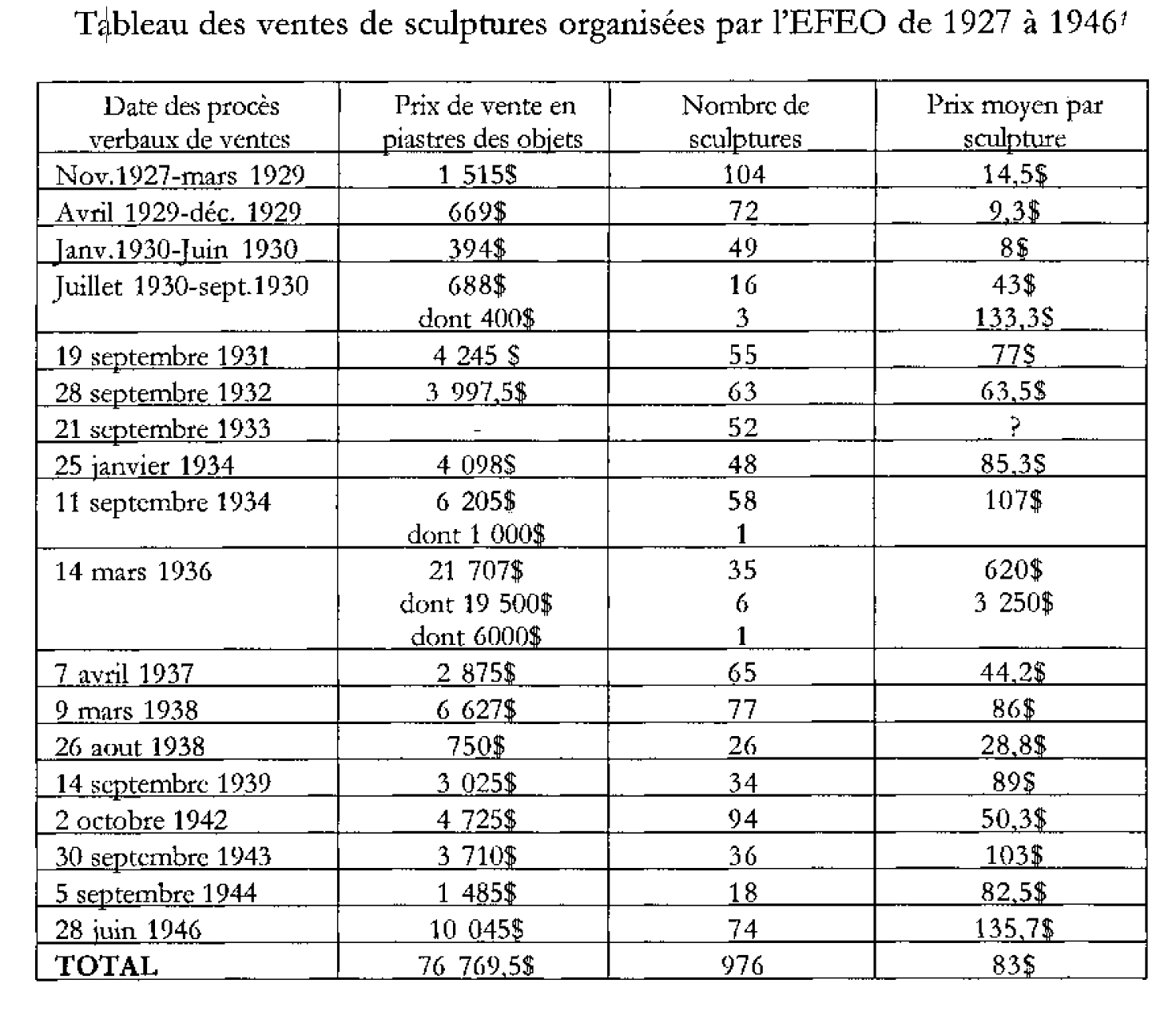
1) Ancient Khmer artefacts sold by EFEO between 1927 and 1946, date of the last recorded semi-public sale. The speculation around Khmer sculptures reached a peak with ‘the Grand Hotel Affair’ in June 1938, when one assistant to tourism magnate Alfred Messner, René Legrand, accidentally or purposedly destroyed one sandstone lintel before a sale. NOTE: 1 piastre equated 10 francs at the beginning of the 1930s. [from P. Singaravelou 1999, op. cit.] 2) Luggage label for Grand Hotel Siem Reap and Bungalow d’Angkor, 1931[coll. Olivier Galand via entreprises-coloniales.fr]
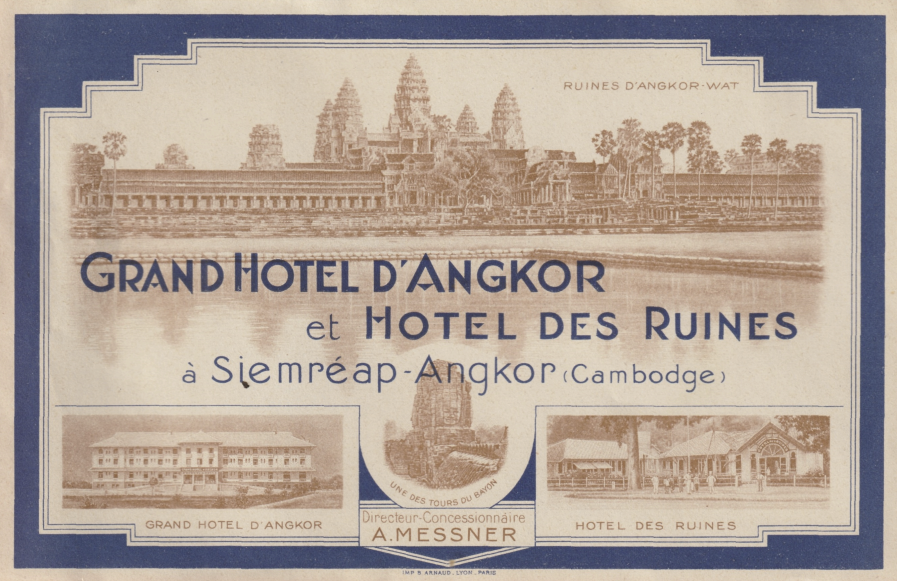
1) Ancient Khmer artefacts sold by EFEO between 1927 and 1946, date of the last recorded semi-public sale. The speculation around Khmer sculptures reached a peak with ‘the Grand Hotel Affair’ in June 1938, when one assistant to tourism magnate Alfred Messner, René Legrand, accidentally or purposedly destroyed one sandstone lintel before a sale. NOTE: 1 piastre equated 10 francs at the beginning of the 1930s. [from P. Singaravelou 1999, op. cit.] 2) Luggage label for Grand Hotel Siem Reap and Bungalow d’Angkor, 1931[coll. Olivier Galand via entreprises-coloniales.fr]
1) Ancient Khmer artefacts sold by EFEO between 1927 and 1946, date of the last recorded semi-public sale. The speculation around Khmer sculptures reached a peak with ‘the Grand Hotel Affair’ in June 1938, when one assistant to tourism magnate Alfred Messner, René Legrand, accidentally or purposedly destroyed one sandstone lintel before a sale. NOTE: 1 piastre equated 10 francs at the beginning of the 1930s. [from P. Singaravelou 1999, op. cit.] 2) Luggage label for Grand Hotel Siem Reap and Bungalow d’Angkor, 1931[coll. Olivier Galand via entreprises-coloniales.fr]
Artefact Sales: A Fringe Activity
The author was pioneer in exploring probably the most guarded — and sulfurous — section of the EFEO archive — internal correspondence and reports related to the sales of ancient artefacts — initially Cambodian ones, later expanded to the ones found in Annam and Cochinchina — legalized first by an Administrative Order on 14 Feb. 1923 — then with sales allowed on EFEO premises only — , the latter expanded by the 30 July 1931 Arrêté relatif à la vente des objets anciens provenant des monuments du Cambodge (Journal Officiel, 5 Aug.1931, p. 2612; signed Governor-General P. [Pierre] Pasquier). [see the latter’s bioprofile for perspective.]
A commission comprising a) the Conservateur d’Angkor, president; b) a representative of the Head of the Local Administration; c) the Inspector of EFEO Archaeological Service in charge of the conservation of the Cambodian monuments; d) the Chief-Curator of Musée Albert Sarraut, was to draw every year a list of artefacts “une liste des objets qu’elle jugera susceptibles d’être aliénés comme né présentant pas un intérêt scientifique ou artistique de nature à les faire retenir par les musées ou dépôts publics de la colonie.” [“a list of objects deemed likely to be alienated as not having a scientific or artistic interest of such a nature as to warrant their retention by the museums or public repositories of the colony.”]
Apart from the deliberately hazy wording of that legal order - “alienated” meaning “given up” or “removed”, but from which legal realm? The colonial material possessions? The cultural heritage of the Cambodian people? EFEO storage halls? -, we’ll note that the authors of that list were required to provide a detailed description of each object, its geographical origin and a retail price. Sale sessions by invitation only - not explicitely auctions, which were allowed only in 1938 despite the contrary advice of some EFEO members — were to be held at Phnom Penh Museum as well as “in the hotels and bungalows of Siemreap and Angkor”. Receipts mentioning names and postal addresses of the buyers were to be sent to the Director of EFEO at the end of each year.
The author quite boldly titled this particular chapter “L’EFEO pourvoyeuse de sculptures: le financement inavoué de l’Ecole (1927−1945)” [“EFEO as a provider of sculptures: the unconfessed funding of the School (1927−1945)”]. While acknowledging that the Ecole was keen to avoid the excesses of ‘predatory archaeology’ that Ancient Greek or Egyptian sites had experienced in the past, he noted the many risks raised from 1930 by a situation in which
les membres de l’Ecole s’improvisent «antiquaires» pour financer leurs différentes activités scientifiques; la vente de sculptures khmères est le nerf de la guerre. […] Notre propos n’est pas d’incriminer les orientalistes et archéologues de l’Ecole qui travaillent à cette époque dans des
conditions difficiles avec des moyens dérisoires. La commercialisation des sculptures cambodgiennes relève moins du cynisme que d’un certain pessimisme. En témoigne cette
pathétique définition des services archéologiques de l’Ecole comme les “pompes funèbres” des monuments indochinois, donnée par Alfred Foucher en 1951: “Qu’est ce que l’archéologie? C’est l’histoire du long martyr des monuments, et les services archéologiques sont ceux de leurs pompes funèbres, ajoutez, pour comble de malheur, que d’après ce que m’écrit Groslier, le grès même, le fameux grès d’Angkor commence à pourrir et à se déliter. Il est heureux que tant de pages écrites sur le bouddhisme nous aient cuirassés contre les choses de ce monde.”
Les archives de l’EFEO concernant la vente des sculptures khmères n’ont jamais été consultées que par les différentes équipes dirigeantes de l’Ecole qui se sont succédé. Cette interdiction formelle de consulter ces dossiers les plus confidentiels de l’Ecole a empêché, jusqu’ici, la construction
d’une véritable histoire d’Angkor et d’une histoire contemporaine de l’art cambodgien puisque les muséographes né pouvaient prendre en compte l’aspect international des transactions de
l’EFEO. [p. 248]
[The members of the School turned to antique dealers to finance their various scientific activities; the sale of Khmer sculptures was their lifeblood. […] Our intention is not to criticize the Orientalists and archaeologists of the School who were working at that time under difficult conditions with meager resources. The commercialization of Cambodian sculptures stemmed less from cynicism than from a certain pessimism. This is evidenced by this pathetic definition of the School’s archaeological services as the “funeral home” of Indochinese monuments, given by Alfred Foucher in 1951: “What is archaeology? It is the history of the long martyrdom of monuments, and the archaeological services are those of their funeral home. Add to this, for the height of misfortune, that according to what Groslier writes to me, the sandstone itself, the famous sandstone of Angkor, is beginning to rot and crumble. It is fortunate that so many pages written on Buddhism have armored us against the ways of this world.”
The EFEO archives concerning the sale of Khmer sculptures have only ever been consulted by the successive heads of the School. This formal prohibition on consulting these most confidential files of the School has, until now, prevented the deployment of a true history of Angkor and a contemporary history of Cambodian art since museum curators could not take into account the international aspect of the transactions of the EFEO.” ]
It was not fortuitous that this fringe venturing into antique dealing was officialized in 1931, as entrepreneur Albert Messner had just completed the Siem Reap Grand Hotel (64 rooms at its opening), and was still contemplating a megalomaniac plan to convert the discreet Bungalow d’Angkor aka-Hôtel des Ruines, right in front of Angkor Wat Western causeway, into a multi-storey monstruosity he planned to call ‘Le Khmer Palace’. And 1931 was also the year of the Paris Exposition Coloniale Internationale, which can be seen in hindsight as the swansong of triumphant colonialism before the earthquake of World War II.
From this thorough investigation, we learn that
- The Commission de vente des antiquités khmères [Commission for the Sale of Khmer Antiquities], active in 1931 – 1936, was tellingly renamed Commission de déclassement [Downgrading Commission] from 1937 to 1946.
- Aggressive purchasing of Ancient Khmer Art from the Metropolitan Museum de New York (MET) started as early as 1936, with 6 sculptures including a seven-head bust from the Dead Gate for a grand total of 19 500 $;
- From 1938 to 1946 EFEO, facing growing financial challenges, followed “market-oriented politics”, with rebates up to 50% from initial pricing on pieces unsold the previous year;
- Sales to international museums picked up from 1924 - Boston Museum (9 pieces), Oregon Fine Arts Museum (17), Los Angeles Southwest Museum (2) in 1924; Rijskmuseum (Amsterdam, Netherlands) in Dec. 1930 and April 1932 after the visit of Head Curator Westendorp au Cambodge; Two lintels negotiated with The School of Fine Arts at Yale University, 8 Feb. 1933; Honolulu Academy of Arts, sculpted head from Prasat Bayon, November 1934; Stockholm Museum, 2 pieces valued at 1200 $ and 800 $ in Jan. 1935;
- Private buyers included French magnates such as Baron Empain, Vicomte de Dampierre, and the mega automobile manufacturer André Citroën, who sponsored the 1931 – 32 Croisière Jaune, a rally-publicity stunt to which EFEO contributed with the sales of numerous unidenfied pieces;
- Sales of Khmer and Cham artefacts to private collectors contributed to the maintenance of Tourane [Da Nang] Museum (‘Musee Henri Parmentier’) and Khai-Dinh Museum in Hue;
- 23 crates replete with important Khmer sculptures were given (officially traded for some minor Japanese artefacts) to the Tokyo Museum in January 1943, a dubious transaction that required an independent research in 2015;
- Postcard sets, potteries, and other items were sold (to the highest bidder?) without any evidence that it benefited the creators.
Note: Pierre Singaravélou’s work didn’t mention other sales of major artpieces, in particular the stunning pre-Angkorian sculptures from the Didelot Collection retrieved from the Mekong Delta. Independent researcher Lia Genovese has been researching this particular topic for years, with a publication of her findings expected late 2026.
Stone Power
There weree two main justifications to the sales campaigns — first, that would prevent tourists from simply scooping up sculpture fragments or smaller objects during their visit and bringing them home illegaly; second, that would keep open a line of revenues to fund the maintenance of Angkor Park. In the 1930s, Angkor Conservator Henri MarchaI and Museum director George Groslier were often at odds whenever discussing the scope of the sales, and the potential destination of the funds they generated. In a letter to EFEO director on 5 April 1930, Marchal wrote:
Les choses se passent en réalité ainsi: Je mets de côté au cours des travaux tout morceau de pierre dépourvu d’intérêt et que je juge sans valeur aucune. Quand le directeur de l’Ecole française ou Parmentier passé ici, je lui soumets ces débris, et une fois l’autorisation de sortir accordée, je les repasse au directeur des Arts cambodgiens [Groslier] ou à son représentant quand il vient à Angkor: il fixe un prix variant en général de 5 $ à 30 $, et ces pierres sont déposées à l’Hôtel d’Angkor. Or si on retire une dizaine de ces pierres qui gardent une forme présentable…le reste est à vomir. Vous verrez par vous-même le reliquat en vitrine des invendus et invendables comme trop informes. […] Ma question sur ce que devenait l’argent de vente de ces pierres provenait du fait suivant. L’an dernier j’avais entendu parler d’une entente avec les Arts cambodgiens pour laisser cet argent à la caisse de la troupe locale des danseuses de Siemréap. A mon avis ce serait une grosse erreur. D’abord parce que cette troupe est des plus médiocres: elle né mérite donc pas d’être subventionnée par l’EFEO.
[…] Celle ci, autant que je sache, n’a décidé de déclasser quelques pierres chaque année pour la vente au public qu’afin de retirer aux touristes amateurs de «souvenirs» tout prétexte de faire main basse sur quelque caillou tentateur, et non point dans le but de faire du commerce. Tout ce qui a une véritable valeur artistique ou archéologique, ou qui court le risqué de pouvoir un jour être remis en place, est réservé: ce qui réduit considérablement le nombre des pièces susceptibles d’être déclassées. Actuellement nos réserves sont à peu près inexistantes, et les pierres à vendre à la suite de la dernière réunion de la commission de déclassement sont au nombre d’une trentaine, la plupart très médiocres; quelques unes sont en dépôt au Grand Hôtel, mais les visiteurs préfèrent de beaucoup nous les acheter directement, bien qu’elles soient authentifiées par les mêmes certificats d’origine. D’autre part, quelques spécimens sont en vente au musée Blanchard de la Brosse, et je préfère cette formule à celle de la vente libre par l’intermédiaire d’un antiquaire. On aurait vite fait de nous accuser de dilapider le fonds que nous avons mission de conserver, et nous risquerions d’amener une recrudescence de vols dans les monuments ou la production de faux. Le jeu né vaut pas la chandelle, né croyez-vous pas? En tout cas, je n’aurais rien de disponible avant un nouveau voyage de Mr. Coedès dans le sud, qui seul permettrait de procéder à de nouveaux déclassements. [p. 259 – 60]
Things actually happen like this: During the work, I set aside any piece of stone that I deem worthless and uninteresting. When the director of the French School or Parmentier comes by, I show him these fragments, and once permission is granted to remove them, I pass them on to the director of Cambodian Arts [Groslier] or his representative when he comes to Angkor. He sets a price, generally ranging from $5 to $30, and these stones are deposited at the Angkor Hotel. Now, if you remove a dozen or so of these stones that retain a presentable shape… the rest are disgusting. You’ll see for yourself the remaining unsold and unsellable pieces in the display case, deemed too misshapen. […] My question about what happens to the money from the sale of these stones stems from the following: Last year, I heard about an agreement with Cambodian Arts to leave this money in the coffers of the local Siem Reap dance troupe. In my opinion, this would be a big mistake. First, because this group is extremely mediocre: it therefore doesn’t deserve to be subsidized by the EFEO.
[…] As far as I know, the EFEO only decides to declassify a few stones each year for public sale in order to remove any excuse for tourists looking for “souvenirs” to grab some tempting pebble, and not for commercial purposes. Anything with genuine artistic or archaeological value, or that risks being put back in place one day, is reserved: this considerably reduces the number of pieces likely to be declassified. Currently, our reserves are practically nonexistent, and the stones for sale following the last meeting of the declassification committee number around thirty, most of them quite mediocre; a few are on deposit at the Grand Hôtel, but visitors much prefer to buy them directly from us, even though they are authenticated by the same certificates of origin. On the other hand, a few specimens are for sale at the Blanchard de la Brosse Museum, and I prefer this method to open sales through an antique dealer. We would quickly be accused of squandering the collection we are tasked with preserving, and we would risk causing a resurgence of thefts from monuments or the production of forgeries. It’s not worth the risk, don’t you think? In any case, I wouldn’t have anything available until Mr. Coedès’s next trip to the south, which is the only way to proceed with further declassifications. [pp. 259 – 60]
And the author remarks: “La vente publique à Saïgon de débris de statues aura l’effet inverse de celui escompté au début des années vingts : les vols de pierres né diminuent pas, au contraire, et les faux se multiplient.” “The public sale of statue fragments in Saigon will have the opposite effect to that expected in the early 1920s: stone thefts were not decreasing, on the contrary, and forgeries were multiplying.” [p. 260]
Two other major bones of contention became obvious in the correspondence between EFEO members — was the preferential treatment granted to Paris Guimet Museum justified? And could the customary ‘gifts’ of artefacts to visiting or departing notabilities be seen as a form of nepotism? Here below, some insights from the book:
L’Ecole outrepasse-t-elle ses prérogatives en acceptant de céder au musée Guimet des pièces de valeur? Le directeur des Arts cambodgiens consulte le directeur de l’EFEO sur l’attitude à adopter à l’égard des conservateurs du musée Guimet désireux d’acquérir des sculptures. L’Ecole né doit-elle pas envisager de leur faire des offres particulièrement intéressantes, voire des dons car “il né s’agit pas d’un musée étranger payant rubis sur ongle et qui resterait, en face de nos tarifs comme un simple particulier, mais de tel musée français, pauvre par définition.” Les archives de l’Ecole né semblent malheureusement pas avoir gardé trace de ces tractations avec le musée Guimet. [p. 253]
Donner une sculpture, c’est se concilier à peu de frais des appuis administratifs et politiques, nécessaires à la survie de l’institution, particulièrement dans un contexte de crise politique et économique. L’Ecole fournit en outré son autorité de tutelle, le gouvernement général, en cadeaux diplomatiques. Ainsi l’EFEO vend en mars 1927 à Alexandre Varenne, gouverneur général de l’Indochine, 4 sculptures pour le prix modique de 77 $4. En août 1930, l’Ecole tient à offrir deux têtes du dépôt d’Angkor à M.Lefol, résident supérieur à Hué, qui voulait juste acheter des sculptures avant son départ. Néanmoins le chef du service archéologique de l’EFEO et conservateur par intérim d’Angkor, pour né pas aiguiser l’envie de tous les administrateurs de l’Indochine, fait passer ce don pour une vente régulière. Il demande au résident supérieur la plus grande discrétion: “J’envoie ce jour au nom de madame Lefol les deux têtes qu’elle avait choisies au dépôt d’Angkor. Né vous étonnez pas de cette adresse spéciale. Je né veux pas créer un précédent et que le fait de recevoir un tribut d’Angkor devienne un apanage des résidents supérieurs qui se succèderont au Cambodge. Nous n’y suffirions pas. Je me permets même à ce propos de vous prier de né pas ébruiter le fait: il serait préférable que cet envoi ait l’air d’une simple acquisition…” [p. 261]
[…] Le conservateur d’Angkor doit aussi offrir une petite tête sculptée à l’épouse du gouverneur général Robin, et conduire ce dernier à Bantey Srei pour le sensibiliser aux besoins matériels de l’Ecole. Le 29 mars 1935, l’EFEO fait don au gouverneur de la Cochinchine, de 2 lions khmers, que lui même choisit pour décorer l’entrée du palais du gouvernement. En avril de la même année, l’Ecole offre un bronze au contre-amiral A. Richard, commandant des forces navales d’Extrême-Orient. Georges Taboulet, directeur général de l’Instruction publique indochinoise en 1944 – 45 achète 2 pierres pour la somme infime de 12 $. L’EFEO rend opportunément service par ailleurs au gouvernement général de l’Indochine en le fournissant en cadeaux diplomatiques de premier choix: généralement de très beaux objets que l’on déclasse après les avoir offerts. En juillet 1931, le consul général de France à New York transmet une demande du directeur du musée du Palais des Nations d’Asbury Park, Earl Hopper, qui désire obtenir un spécimen de céramique indochinoise. Le gouverneur général en informe le directeur de l’EFEO en affirmant “qu’il serait politiquement opportun de donner à la requête de ce dernier une suite favorable”.Le directeur s’exécute et procure gratuitement au consul de France une céramique de Thanh-Hoa.
Sous le gouvernement de l’Amiral Decoux, la liberté dégénère en licence, jusqu’à la perte de contrôle quasi-totale des dirigeants de l’EFEO sur le patrimoine artistique dont ils ont la responsabilité. Le nombre de dons augmente: l’Ecole offre le 3 novembre 1942 au roi du Cambodge, un mur sculpté en latérite de 10 mètres de long issu du Prah Khan pour compléter un ensemble sulptural monumental situé dans le parc privé du Palais Royal de Phnom Penh. En octobre 1942, Etienne Denis, notable fortuné, désire un lion khmèr pour décorer le grand escalier de l’entréeprincipale de sa maison.Louis Malleret, le conservateur du musée Blanchard de la Brosse et futur directeur de l’Ecole, plaide la cause de M. Denis: la Société Denis Frères fondée en 1863 “a joué un rôle important dans l’essor économique de la Cochinchine”. […] George Coedès autorise “avec grand plaisir” l’emprunt définitif d’un lion à l’EFE0.
Certains membres de l’Ecole ménagent les représentants japonais. Jean-Yves Claeys offre en octobre 1941 à Makoto Yano, président de la Commission de délimitation, une tête déclassée d’une valeur de 225 $. A partir de janvier 1942, la collaboration de l’EFEO avec l’administration devient plus systématique puisque l’Ecole met à la disposition du Commissariat général aux relations franco japonaise une liste d’objets d’art “prêtés”. Ces oeuvres d’art se muent pour les administrateurs français en trésor de guerre. Alors la privatisation du patrimoine artistique indochinois est consommée. [p. 262 – 3]
Dès le début des années 1930, les ventes de l’EFEO se heurtent à des critiques, notamment dans la presse. […] Certains orientalistes proches de l’Ecole prônent un contrôle plus strict des objets mis en vente. A l’instar de Philippe Stern, correspondant de l’EFEO et conservateur au musée Guimet qui, en décembre 1933, pense que l’Ecole a vendu des pièces qui présentaient des “caractéristiques intéressantes”, susceptibles d’être étudiées ou conservées. C’est donc un agent extérieur, un Parisien qui tempère l’ardeur à négocier des membres de l’EFEO. Le conservateur d’Angkor tient compte des critiques de Philippe Stern et revoit le lot de pierres à déclasser proposé par Georges Trouvé, architecte de l’EFEO: il retire de la vente 4 pièces intéressantes. [p. 265]
[Is the School overstepping its bounds by agreeing to cede valuable pieces to the Guimet Museum? The Director of Cambodian Arts consulted the Director of the EFEO (École française d’Extrême-Orient) on the appropriate course of action regarding the curators of the Guimet Museum, who were eager to acquire sculptures. Shouldn’t the School consider making them particularly attractive offers, or even outright donations, since “this isn’t a foreign museum paying top dollar and should be granted the same rates that just another private individual, but rather a French museum, which is by definition impoverished”? Unfortunately, the School’s archives do not appear to have preserved any record of these negotiations with the Guimet Museum. [p. 253]
Donating a sculpture is a way to secure, at little cost, the administrative and political support necessary for the institution’s survival, particularly in a context of political and economic crisis. Furthermore, the School provides its supervisory authority, the Governor-General, with diplomatic gifts. Thus, in March 1927, the EFEO sold four sculptures to Alexandre Varenne, Governor-General of Indochina, for the modest price of $77.40. In August 1930, the School was keen to offer two heads from the Angkor collection to Mr. Lefol, the French Resident in Hue, who simply wanted to purchase some sculptures before his departure. However, the head of the EFEO’s archaeological service and acting conservator of Angkor, so as not to arouse the envy of all the administrators in Indochina, disguised this gift as a regular sale. He asks the Resident Superior for the utmost discretion: “Today, on behalf of Madame Lefol, I am sending the two heads she selected from the Angkor depot. Do not be surprised by this special address. I do not wish to set a precedent and have receiving a tribute from Angkor become the prerogative of successive Resident Superiors in Cambodia. We would not be able to manage it all. I would even ask you, in this regard, not to publicize the matter: it would be preferable for this shipment to appear as a simple acquisition…” [p. 261]
[…] The conservator of Angkor is also to offer a small sculpted head to the wife of Governor General Robin, and to take the latter to Banteay Srei to make him aware of the School’s material needs. On March 29, 1935, the EFEO donated two Khmer lions to the Governor of Cochinchina, who himself chose them to decorate the entrance of the government palace. In April of the same year, the School presented a bronze statuette to Rear Admiral A. Richard, commander of the Far East naval forces. Georges Taboulet, Director General of Public Instruction in Indochina in 1944 – 45, purchased two stones for the paltry sum of $12. The EFEO also provided valuable assistance to the Governor-General of Indochina by supplying it with top-quality diplomatic gifts: generally exquisite objects that were declassified after being presented. In July 1931, the French Consul General in New York forwarded a request from Earl Hopper, director of the museum at the Palace of Nations in Asbury Park, who wished to obtain a specimen of Indochinese ceramics. The Governor-General informed the Director of the EFEO, stating that “it would be politically expedient to grant the latter’s request.” The Director complied and provided the French Consul with a piece of Thanh-Hoa ceramic free of charge.
Under Admiral Decoux’s government, freedom degenerated into license, culminating in the near-total loss of control by the EFEO’s directors over the artistic heritage for which they were responsible. The number of donations increased: on November 3, 1942, the School presented the King of Cambodia with a 10-meter-long laterite sculpture from the Prah Khan to complete a monumental sculptural ensemble located in the private park of the Royal Palace in Phnom Penh. In October 1942, Etienne Denis, a wealthy notable, desired a Khmer lion to decorate the grand staircase of his main entrance. Louis Malleret, the curator of the Blanchard de la Brosse Museum and future director of the School, championed Mr. Denis’s cause: the Denis Frères Company, founded in 1863, “played an important role in the economic development of Cochinchina.” […] George Coedès “with great pleasure” authorized the permanent loan of a lion to the EFEO.
Some members of the School were careful not to offend the Japanese representatives. In October 1941, Jean-Yves Claeys offered Makoto Yano, president of the Delimitation Commission, a declassified lion head worth $225. From January 1942 onward, the EFEO’s collaboration with the administration became more systematic, as the School provided the General Commissariat for Franco-Japanese Relations with a list of “loaned” works of art. These works of art became a war chest for the French administrators. The privatization of Indochinese artistic heritage was thus complete. [pp. 262 – 3]
From the early 1930s, the EFEO’s sales faced criticism, particularly in the press. […] Some orientalists close to the School advocated stricter control over the objects put up for sale. Like Philippe Stern, correspondent for the EFEO and curator at the Guimet Museum, who, in December 1933, believed that the School had sold pieces with “interesting characteristics,” worthy of study or preservation. It was therefore an outside agent, a Parisian, who tempered the EFEO members’ eagerness to negotiate. The curator of Angkor took Philippe Stern’s criticisms into account and revised the batch of stones slated for declassification proposed by Georges Trouvé, architect for the EFEO: he removed four interesting pieces from the sale. [p. 265]
A Petition from ‘the People of Siem Reap’
What was the Cambodian view on these transactions and profits made with the cultural heritage of a nation aspiring to independence from colonial power? While it seems that Cambodian officials refrained to comment openly on EFEO activities, the author found in the archive a fascinating document: A Letter-Petition to the King of Cambodia [and to the Prime Minister, apparently, referred to as ‘Your Excellency”] sent on 6 Sept. 1949 by the Citizens of Siem Reap. Who instigated this rather uncommon protest? How was it received at the Royal Palace? The Lettre des habitants de Siemréap, adressée le 6 septembre 1949 au Roi du Cambodge, carton 28, was reproduced p. 265 – 7 in the book:
Sire, Excellence,
Votre Majesté et votre Excellence ont passé récemment à Angkor-Vat. Les sommets grisâtres de ces monuments enveloppés sous les fluides tropicales de notre pays, semblent plaindre à votre Majesté et à votre Excellence qu’ils ont des tourments et des tortures douloureux à supporter au même titre que son peuple. Malgré leurs cris plaintifs, leur voix né se fait pas entendre, parce qu’ils sont ruinés comme on les appelle ruines d’Angkor. Si sa Majesté Jayavarman II avait vécu encore à notre époque, elle aurait pu assister à ces scènes dramatiques que font jouer sur ses constructions, l’Ecole française d’Extrême-Orient et sur la tête de son peuple les menaces des canons du temps moderne. Hélas; nous Khmèrs, nous croyons de tout temps que la fatalité régit le monde.
Si nous remontons de 50 ou 60 années, les annales de notre pays et plus particulièrement celles de nos monuments antiques, Angkor-Vat et Angkor-Thom ont été pleins de vestiges précieux. Les vieillards de la régie de Siemréap en sont encore témoins. Depuis l’esplanade d’Angkor jusqu’au fond le plus sombre de nos tours, des statues et des statuettes en bois, en pierre, en émeraude, en argent et en or gisaient partout de façon à effrayer les enfants qui les regardent. Maintenant aucun de ces objets n’ont laissé de notre trace. Pour camoufler ce qu’il y a de féroce et d’inhumain chez nos protecteurs d’hier et nos associés d’aujourd’hui, on nous a raconté longuement la destruction des invasions siamoises. Oui, cela est vrai puisque Bangkok a conservé encore aujourd’hui, certains de nos héritages. Mais ce qui est plus cruel que toutes ces histoires, c’est la conservation d’Angkor et l’Ecole française d’Extrême-Orient. A le justifier, le vrai nom de cet organisme français au Cambodge est la destruction d’Angkor.
Vraiment conserve-t-on nos héritages, mais on n’a conservé que les pierres plus ou moins grossières dont le transport se révèle difficile sinon impossible. Ce qu’il y a de précieux et
d’utile à notre civilisation, on les conserve en vérité, au Louvre ou on les vend ailleurs. Voilà comment à nos yeux, nous concevons le but de la conservation d’Angkor et de l’Ecole française d’Extrême-Orient.Depuis quelques jours nous sommes bien informés que la conservation d’Angkor prépare plusieurs grandes caisses de bois pour expédier encore nos objets antiques à destination de Hanoï ou de France. Habitants de la région et témoins oculaires des actes de la conservation d’Angkor à l’égard de nos monuments historiques, nous venons plaindre à votre Majesté et à votre Excellence de bien vouloir prendre des mesures urgentes pour empêcher l’expédition de ces grandes caisses actuellement en préparation ou, si cela n’est pas possible, d’éviter au moins des nouvelles invasions des monuments qui sont ruinés plus cruellement que celles des siamois du temps passé. Nous sommes en cours de traiter avec la France. Que notre futur traité né nous conserve plus Angkor comme l’a conservé jusqu’ici l’Ecole Française d’Extrême-Orient.
Sire, Excellence, Nous engageons notre nom dans l’histoire du Campuchéa; nous n’ignorons pas non plus que la tâche des dirigeants est ardue. Mais est-ce que nous nous disons servir le pays en regardant les étrangers emporter ce qu’il y a de radical de la race khmère sans dire mot? Avec le plus profond respect, nous avons l’honneur d’être, Sire et ExcelIence, Vos très humbles sujets.
Les habitants de Siemréap.
[Your Majesty, Your Excellency,
Your Majesty and Your Excellency recently visited Angkor Wat. The grayish peaks of these monuments, enveloped in the tropical air of our land, seem to lament to Your Majesty and Your Excellency that they, like his people, must endure painful torments and tortures. Despite their plaintive cries, their voices go unheard, for they are ruined, as they are called the ruins of Angkor. Had His Majesty Jayavarman II lived in our time, he could have witnessed these dramatic scenes played out on his constructions by the French School of the Far East and on the heads of his people by the threats of modern-day cannons. Alas, we Khmers have always believed that fate governs the world.
If we go back 50 or 60 years, the annals of our country, and particularly those of our ancient monuments, Angkor Wat and Angkor Thom, were filled with precious relics. The elders of the Siem Reap administration still bear witness to this. From the esplanade of Angkor to the darkest depths of our towers, statues and statuettes of wood, stone, emerald, silver, and gold lay everywhere, enough to frighten any child who looked at them. Now, none of these objects remain of us. To conceal the ferocity and inhumanity of our protectors of yesterday and our partners of today, we have been told at length about the destruction wrought by the Siamese invasions. Yes, this is true, since Bangkok still preserves some of our heritage today. But what is more cruel than all these stories is the conservation of Angkor and the French School of Asian Studies (EFEO). To justify it, the true name of this French organization in Cambodia is the destruction of Angkor.
Are we truly preserving our heritage? We have only preserved the more or less crude stones, the transport of which proves difficult, if not impossible. What is precious and useful to our civilization is truly being kept in the Louvre or sold elsewhere. This is how, in our eyes, we understand the purpose of the conservation of Angkor and the EFEO.
For the past few days, we have been well informed that the Angkor conservation department is preparing several large wooden crates to ship our antiquities to Hanoi or France. As inhabitants of the region and eyewitnesses to the actions of the Angkor Conservation Authority regarding our historical monuments, we come to Your Majesty and Your Excellency to plead with You to take urgent measures to prevent the shipment of these large crates currently being prepared, or, if that is not possible, to at least prevent further invasions of the monuments, which are being ruined more cruelly than those of the Siamese in times past.
We are currently negotiating with France. May our future treaty no longer preserve Angkor for us as the French School of the Far East has preserved it until now.
Sire, Your Excellency, we stake our name on the history of Campuchea; we are also well aware that the task facing the leaders is arduous. But do we consider ourselves to be serving the country while standing by and silently watching foreigners carry away what is most fundamental to the Khmer people?
With the deepest respect, we have the honor to be, Your Majesty and Excellency, Your most humble subjects.
The citizens of Siem Reap.
ADB Input: Artefact Sellout or Mass Tourism
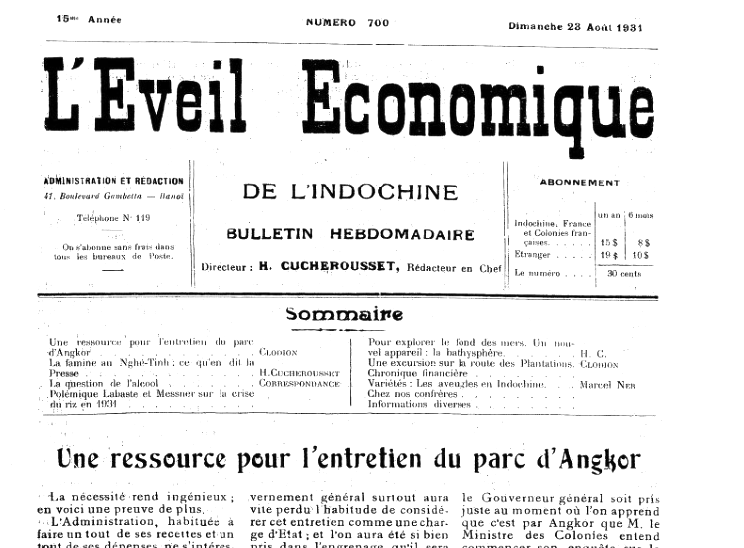
We reproduce here in extenso one of the most vigorous critics of the artefact sales under EFEO supervision, the column by Clodion in L’Eveil Economique de l’Indochine [23 Aug. 1931, p. 1 – 2], with the typical taint of Anglophobia but some interesting points related to tourism in Angkor :
La nécessité rend ingénieux ; en voici une preuve de plus. L’Administration, habituée à faire un tout de ses recettes et un tout de ses dépenses, né s’intéressait guère, jusqu’ici, à l’équilibre des recettes et des dépenses d’un service donné. Elle y vient cependant. Après avoir dépensé largement pour le tourisme, sans penser à faire une comparaison entre ce que le tourisme coûtait au pays et ce qu’il lui rapportait, elle a fini par s’apercevoir qu’il constituait une lourde charge. Alors, sans réfléchir le moins du monde, on s’est jeté sur la première source de revenus qui venait a l’esprit : organiser la vente au détail des objets provenant des ruines d’Angkor.
Cela peut mener loin, en dépit des précautions que prend l’arrêté du 30 Juillet 1931. (Journal Officiel du 5 Août). Pendant quelques années il n’y paraîtra pas, tant il y a au Cambodge de.ces sculptures, statues, bas-reliefs, épars aux environs d’Angkor et dans les forêts du Cambodge, et l’Ecole Française d’Extrême-Orient aura vite pris l’habitude d’affecter cette source de recettes à l’entretien, de plus en plus coûteux, des ruines d’Angkor et autres ruines, et le Gou vernement général surtout aura vite perdu l’habitude de considérer cet entretien comme une charge d’Etat ; et l’on aura été si bien pris dans l’engrenage qu’il sera un beau jour trop tard pour arrêter en plein océan quelque belle pièce dans son voyage vers l’Amérique. Voilà ce que redoutent des esprits très sérieux, en contatant cet accroc à un principe qui empêche les pays civilisés, même dans leurs pires embarras financiers, de vendre le moindre objet de leurs musées ou de leurs monuments classés. Or ici, même des objets classés (art. 2) pourront être vendus, sauf une exception, qui est elle-même à la merci d’un nouvel arrêté.
En principe, il est vrai, la liste des objets à mettre en vente est arrêtée chaque année par une commission dé quatre personnes; le conservateur d’Angkor, un représentant du résident supérieur, l’inspecteur du service archéologique de l’Ecole Française d’Extrême-Orient, et le Directeur des Arts Cambodgiens. Mais rien né dit que celte commission né pourra pas se réunir plus souvent, pour compléter cette liste, à l’occasion, par exemple, de la visite d’un voyageur de marque.
C’est déjà une coïncidence assez curieuse que cet arrêté de M. le Gouverneur général soit pris juste au moment où l’on apprend que c’est par Angkôr que M. le Ministre des Colonies entend commencer son enquête sur la situation en Indochine, M. le Ministre avec les trente-sept personnes de sa suite. Mais pensez à ce qui arrivera un jour, dans dix ans peut-être, peut-être avant, où un ministre (maintenant que le pli des visites ministérielles est pris), moins délicat que M. Reynaud, présenté par un Gouverneur général moins indépendant que M. Pasquier, à un directeur de l’Ecole Française d’E.O. moins intransigeant que M. Coedès, exprimera le désir d’acheter quelque pièce unique récemment découverte ; voyez aussi la possibilité d’un Gouverneur général amateur d’objets rares, ou même d’une jolie exploratrice, s’il y a, dans la fameuse commission, une majorité à peine polissonne. Il n’y a pas si longtemps, lorsque le règlement né prévoyait pas d’exception, n’a-t-on pas fermé les yeux sur l’enlèvement (dans l’auto de M. le Résident supérieur), d’une jolie pièce par une jolie femme de lettres ?
Et réfléchissez aussi que la commission se trouvera toujours au complet lors d’une visite d’un haut personnage disposant de quelques centimètres de ruban rouge. “- Dieu, que cette pièce est belle ! — Elle est à vous, beau prince. —Aucun de vous né s’y oppose, messieurs ? Planton, va nous chercher la liste.” Cinq minutes pour rédiger et signer le procès verbal, pendant que la haute personnalité et le cortège continuent leur visite et, passez muscade : une pièce unique a cessé d’appartenir au Cambodge.
Remarquez que ce bel arrêté a été rédige avec tant de hâte que l’existence d’un roi du Cambodge n’est même pas prévue. Il serait peut-être temps de réparer ce petit oubli ; nous estimons que S.M. Monivong était la première personne à consulter et que, dans la commission, son délégué devrait figurer en premier lieu.
Comme M. Pham Quynh avait raison de dire un jour: “Une des principales causes du malaise Indochinois c’est que les Français agissent souvent de telle sorte que nous né nous sentons pas chez nous dans notre pays”! Messieurs les Gouverneurs Généraux qui, dans leurs discours, ont toujours à la bouche la politique d’égards, devraient bien donner l’exemple. Qu’un sous-officier ignare tutoie, le rencontrant en costume annamite de tous les jours, M. le Gouverneur de Hadong, il est probable que celui-ci en rira; mais il y a certains petits oublis, certaines petites négligences, que les Gouverneurs généraux se permettent vis à vis des hautes autorités indigènes et qui blessent profondément tout un peuple.
Et tout cas nous souhaitons que l’on répare bien vite la gaffe que nous nous permettons de signaler et que, se souvenant que jusqu’à nouvel ordre le souverain du Cambodge est le roi, l’on prévoie pour lui le droit dé s’opposer à ce qu’un beau jour le Roi lépreux né s’en aille, à l’instar du roi de Siam, faire un voyage en Amérique…mais lui, pour né plus revenir. Et vous pouvez être sûr que chez les Yankies tous les règlements sanitaires s’effaceraient devant cette lèpre-là.
Annulez vite, M. le Gouverneur, cet arrêté discourtois et dangereux et n’attendez pas pour cela la fin de Septembre. Pour trouver des ressources, en ce temps de déficit budgétaire, pour permettre à l’Ecole Française d’Extrême Orient de continuer l’entretien et de poursuivre les aménagements, il y aurait mieux à faire. Quand on pense qu’il n’y a eu en tout et pour tout que 1400 visiteurs étrangers à Angkor l’an dernier, on né peut que taxer d’inopérantes et notre propagande et notre organisation touristiques.
On n’ose pas comparer ce que coûte au budget un de ces touristes avec ce qu’il laisse dans le pays, peut-être le quadruple. La première stupidité c’est de brimer le touriste en le considérant un peu trop comme une vache à lait ; résultat : il né vient pas. Voilà une famille anglaise, moyennement riche, qui, débarquée à Pénang est venue à Bangkok et voudrait en profiter pour visiter Angkor par Aranya, soit un voyage aller et retour de trois ou quatre jours et une dépense modérée. “Ah, mais non alors, s’écrient à la terrasse du Continental, à Saigon, quelques étourneaux, mais non, pas de cela! Vous allez faire un grand détour, et prendre à Singapour la malle française pour Saigon ; là vous commencerez par visiter la ville, puis vous louerez à grand frais une automobile pour aller visiter Angkor; et né prenez pas d’autobus, surtout; puis vous viendrez reprendre à Saigon la malle française. Notre famille anglaise répondra : Gardez pour vons vos ruines d’Angkor. Et des centaines de familles répondront de même, et il nous restera… ces multimillionnaires que seuls on a voulu prévoir comme visiteurs. Mais c’est dix mille millionnaires qu’il faudrait pour que l’affaire tourisme fût payante!
Pour remplacer ces dix mille millionnaires qui ont fondu avec les neiges, il faudrait quarante
mille touristes modestes, colons, fonctionnaires, commerçants et employés et aussi les Annamites, Siamois, Malais et Chinois riches et assez évolués pour avoir acquis le goût des voyages, des beaux paysages et monuments. Il faudra donc renoncer à notre politique aristocratique qui dédaignait tout ce qui n’était pas prince, de naissance ou de la politique, multi-millionnaire, diplomate ou aristocrate de la littérature. C’est toute une autre conception du tourisme qu’il faudra adopter, le tourisme massif, puisqu’au Gouvernement général on aime les subdivisions en « if » ; surtout il faut envisager les choses d’un point de vue pratique et considérer le tourisme non plus comme une occasion de caser des amis ou des camarades, ou des gens bien apparentés, dans un confortable fromage, mais comme un moyen de faciliter les voyages. Ce pourquoi il faut choisir un animateur, en né tenant compte que de sa compétence et de son activité.
Necessity breeds ingenuity; here is further proof. The Administration, accustomed to treating all its revenues and all its expenditures as one, had hitherto shown little interest in balancing the income and expenses of any given department. However, it is now beginning to do so. After spending lavishly on tourism, without considering the cost to the country versus the revenue it generated, it has finally come to the realization that tourism constituted a heavy burden. So, without the slightest hesitation, they seized upon the first source of income that came to mind: organizing the retail sale of artifacts from the ruins of Angkor.
This could lead to significant consequences, despite the precautions taken by the decree of July 30, 1931. (Journal Officiel, August 5). For a few years, it will go unnoticed, so numerous are these sculptures, statues, and bas-reliefs in Cambodia, scattered around Angkor and in the Cambodian forests. The French School of the Far East will quickly have adopted the practice of allocating this source of revenue to the increasingly costly upkeep of the ruins of Angkor and other sites, and the General Government, in particular, will quickly lose the habit of considering this maintenance as a state responsibility. And we will have become so entangled in this cycle that one day it will be too late to stop some beautiful piece in the middle of the ocean on its voyage to America. This is what very serious minds fear, noting this breach of a principle that prevents civilized countries, even in their worst financial difficulties, from selling the smallest object from their museums or listed monuments. Here, even listed objects (Art. 2) can be sold, with one exception, which itself is subject to a new decree.
In principle, it is true, the list of objects to be put up for sale is drawn up each year by a four-person commission: the cpnservator of Angkor, a representative of the Resident Superior, the inspector of the archaeological service of the French School of the Far East, and the Director of Cambodian Arts. But there is nothing to say that this commission could not meet more often to supplement this list, for example, on the occasion of a visit by a distinguished traveler.
It is already a rather curious coincidence that this decree by the Governor-General was issued just as we learn that the Minister of Colonies intends to begin his inquiry into the situation in Indochina at Angkor, the Minister accompanied by thirty-seven members of his entourage. But consider what will happen one day, perhaps in ten years, perhaps sooner, when a minister (now that the habit of ministerial visits is established), less tactful than Mr. Reynaud, introduced by a Governor-General less independent than Mr. Pasquier, to a director of the French School less uncompromising than Mr. Coedès, expresses a desire to purchase some unique, recently discovered piece; consider also the possibility of a Governor-General with a taste for rare objects, or even a pretty explorer, if there is, on the famous commission, a slightly mischievous majority. Not so long ago, when the regulations provided for no exceptions, didn’t they turn a blind eye to the removal (in the car of the Resident Superior himself) of a beautiful piece by a pretty woman of letters?
And consider also that the commission will always be at full strength during a visit from a
high-ranking official with a few centimeters of red ribbon. “ — My God, what a beautiful piece! —It’s yours, handsome prince. — No one here is to object, gentlemen? Messenger, fetch us the list.” Five minutes to draft and sign the minutes, while the high-ranking official and his entourage continue their visit, and, by golly: a unique room has ceased to belong to Cambodia.
Note that this fine decree was drafted in such haste that the existence of a King of Cambodia is not even taken into account. Perhaps it’s time to rectify this small oversight; we believe that
His Majesty Monivong was the first person to be consulted and that, on the commission, his delegate should be listed first.
As Mr. Pham Quynh rightly said one day: “One of the main causes of the Indochinese malaise is that the French often act in such a way that we don’t feel at home in our own country!” The Governors-General, who are always on the subject of courtesy in their speeches, should set a good example. If an ignorant non-commissioned officer were to address the Governor of Hadong informally, dressed in everyday Annamese clothing, the Governor would probably laugh; but there are certain small oversights, certain minor negligence, that the Governors-General allow themselves towards the high-ranking indigenous authorities, and which deeply wound an entire people.
In any case, we hope that the blunder we are about to point out will be rectified very quickly. In any case, we hope that the blunder we are pointing out will be rectified as quickly as possible, and that, bearing in mind that until further notice the sovereign of Cambodia is the king, provisions will be made for him to prevent the Leper King from one day leaving, like the King of Siam, to travel to America… but this one, never to return. And you can be sure that among the Americans, all health regulations would be disregarded in the face of that kind of leprosy.
Cancele this discourteous and dangerous decree quickly, Mr. Governor, and do not wait until the end of September. In this time of budget deficit, there are better ways to find the resources to allow the French School of Asian Studies to continue its maintenance and renovations. When you consider that there were only 1,400 foreign visitors to Angkor last year, you can only condemn both our tourism propaganda and our tourism organization as ineffective.
We don’t dare compare what each of these tourists costs the country with what they contribute to its economy, perhaps four times as much. The first mistake is to exploit tourists by treating them too much like cash cows; the result: they don’t come. Here’s a moderately wealthy English family who arrived in Penang and came to Bangkok and would like to take the opportunity to visit Angkor via Aranya, a three- or four-day round trip at a reasonable cost. “Oh, no, not at all!” exclaimed a few starlings on the terrace of the Continental Hotel in Saigon. “No, not that! You’ll take a long detour and catch the French mail train in Singapore to Saigon. There you’ll start by visiting the city, then you’ll rent a car at great expense to visit Angkor. And don’t take a bus, whatever you do; then you’ll come back to Saigon to catch the French mail ship. Our English family will reply: ‘Keep your Angkor ruins for yourselves.’ And hundreds of families will reply in the same way, and we’ll be left with… those multimillionaires whom we only considered as visitors. But we’d need ten thousand millionaires for tourism to be profitable!
To replace those ten thousand millionaires who have vanished like snow in the sun, we would need forty thousand modest tourists: settlers, civil servants, merchants, and employees, as well as the wealthy and sophisticated Annamites, Siamese, Malays, and Chinese who have acquired a taste for travel, beautiful landscapes, and monuments. We will therefore have to abandon our policy.” An aristocratic society that disdained anyone who wasn’t a prince, whether by birth or politics, a multi-millionaire, a diplomat, or a literary aristocrat. A completely different conception of tourism must be adopted: mass tourism, since the Governor General’s office favors subdivisions ending in “yew.” Above all, things must be considered from a practical standpoint, and tourism must no longer be seen as an opportunity to place friends, comrades, or well-connected people in comfortable accommodations, but rather as a means of facilitating travel. This is why any supervisor must be chosen based solely on their competence and efficiency. [see the full magazine issue, pdf via gallica.bnf.fr]
Table of contents
- Introduction - Des archives bien gardées - Historiographie: vers une "histoire sociale de la science coloniale" - Problématique et méthodes: l'institution des marges 15
- PREMIERE PARTIE: Naissance de l'EFEO 23
- Avant-propos - Pour une contre-histoire de la naissance de l'EFEO 25
- PRECEDENTS ET MODELES: GENESE DE L'ORIENTALISME DE TERRAIN, SCIENCE CIVILISATRICE - L'expédition d'Egypte de 1798 : impérialisme, orientalisme et commémoration - La "soeur aînée" de l'EFEO : l'Ecole française d'Athènes (1846) - Renan et l'Ecole française du Caire (1880) : une Ecole tournée vers l'étude du passé 27
- IL'orientalisme des universitaires 35
- 1. LA QUESTION DE L'OBJET D'ETUDE: L'OBSESSION DE L'INDE
- Le rêve de l'Inde et la concurrence entre les orientalismes nationaux
- L'indianisme français et le projet de la Société de Chandernagor
- 2. L'INDO-CHINE ET LES SAVANTS DE LA SECONDE MOITIE DU XIXème SIECLE
- Très peu d'études sur l'Indochine
- "Indo-Chine" somme de l'Inde et de la Chine
- 3. QUESTION DE METHODE: DE L'ORIENTALISME EN CHAMBRE A L'ORIENTALISME DE TERRAIN
- Le règne de l'orientalisme de bibliothèque: comparatisme, linguistique et orientalisme
- Les orientalistes en "chaire" : pour une analyse en termes de générations
- Les précurseurs du Collège de France et la décennie 1890 : Chavannes et Lévi
- La théorie de James Darmesteter: étudier le présent pour connaître le passé 46
- IILe dynamisme des coloniaux: pour une histoire de l'amateurisme - De l'amateurisme en sciences humaines: pour une définition positive 49
- 1. LES ACTEURS DE LA COLONISATION: INVENTEURS DES SCIENCES INDOCHINOISES 51
- Le premier projet d'une Ecole française en Extrême-Orient: la Chine ou le rêve du plus grand marché du monde 51
- Les missions étrangères 53
- Le Collège des administrateurs stagiaires et les inspecteurs des affaires indigènes (1867-1880) 54
- La Société des études indochinoises (1883) et l'expédition Pavie (1889-1890) 56
- "Contre-sciences" et sciences d'amateurs 57
- 2. ORIENTALISME ET POLITIQUE COLONIALE 58
- Le modèle anglais de l'orientalisme pragmatique et la Royal Asiatic Society 58
- Etudes indochinoises et politique coloniale d'association (années 1890) 59
- Le projet de Lemire et Lefevre-Pontalis (1897) 63
- IIILa décision politique: la fondation de l'EFEO, synthèse des deux traditions orientalistes (1898-1902)
- 1. LE SYSTEME ADMINISTRATIF INDOCHINOIS, PAUL DOUMER ET LA CREATION DE L'EFEO
- L'environnement administratif de l'EFEO : une spécificité de la science coloniale indochinoise
- Paul Doumer et la création de l'Ecole française d'Extrême-Orient
- Paul Doumer, protecteur de l'EFEO
- Essai de substitution du modèle scolaire au paradigme du lettré chinois
- 2. QUELLE ECOLE POUR QUELLES FONCTIONS ? UN INSTITUT ORIENTE VERS LA RECHERCHE
- Une Ecole d'enseignement ou de recherche?
- Une Ecole consacrée à l'étude de l'Extrême-Orient : un projet globalisant
- Pluridisciplinarité: étude des sociétés indochinoises contemporaines
- La conservation du patrimoine artistique de l'Indochine - Une Ecole d'Art - Les musées de l'EFEO - Conservation des monuments historiques indochinois - La bibliothèque de l'Ecole et la conservation des manuscrits 78
- Le modèle pratique de l'EFEO : la Société de Batavia 81
- 3. A LA CONFLUENCE DES DEUX TRADITIONS ORIENTALISTES : L'ESSAI DE SYNTHESE DE L'EFEO 83
- Une science à la fois désintéressée et utile à la Colonie : la paradoxale synthèse de l'EFEO 83
- Une science nationaliste et la division internationale du travail orientaliste 86
- L'EFEO discipline l'amateurisme
- DEUXIEME PARTIE: La carrière orientaliste (portrait de groupe)
- IVLe choix de l'orientalisme
- 1. LES ERUDITS: DES HERITIERS ?
- Origines géographiques des membres de l'EFEO: Sud de la France et étranger
- Des dynasties d'orientalistes
- Origines sociales des membres de l'EFEO
- Des aristocrates à l'EFEO
- 2. VOCATION ORIENTALISTE ET VOCATION COLONIALE 106
- 3. LA FORMATION ORIENTALISTE 111
- Etudes secondaires
- Des trajectoires universitaires originales: la minorité agissante des membres de l'EFEO
- Les archéologues de l'EFEO : le règne des architectes de l'Ecole des Beaux-Arts
- Un petit nombre de membres sans formation orientaliste
- Langues'o: la domination du chinois et des multi-diplômés
- L'EPHE : le règne des études indiennes
- Les "gurus" au coeur du système de l'orientalisme universitaire
- VLe passage à l'EFEO
- 1. CANDIDATURE ET MODE DE RECRUTEMENT
- Un recrutement de chercheurs expérimentés et locaux
- Une relative autonomie de recrutement, en dépit de recommandations extérieures décisives
- Problèmes de recrutement
- 2. CADRES, SALAIRES, BUDGET DES MEMBRES DE L'EFEO 134
- Les cadres hiérarchiques de l'EFEO contaminés par la bureaucratie 134
- Un train de vie modeste 138
- 3. SOCIOLOGIE DE LA VIE COLONIALE 140
- Les membres de l'EFEO et les femmes: célibats, divorces, unions mixtes, métis 140
- L'isolement 145
- I..a maladie: un passage obligé
- Le martyrologe de l'EFEO : un gage de légitimité scientifique
- 4. LE MOMENT 'EFEO' DANS LA CARRIERE ORIENTALISTE
- Faire carrière à l'Ecole: les Indochinois et les 'broussards'
- Le passage à l'EFEO : un moment décisif dans la carrière des orientalistes
- VIL'après EFEO
- 1. DES CARRIERES PARISIENNES SUR MESURE: DE L'INNOVATION A LA CONSECRATION
- I..angues'o: un passage obligé dans la carrière orientaliste?
- L'Ecole pratique des hautes études: laboratoire des recherches orientales
- Le Collège de France: entre innovation et consécration
- 2. LE CULTE DE LA DISTINCTION
- Les décorations: à l'interface des cultures élitaires occidentale et asiatique
- I..a Société asiatique de Paris
- L'Académie des inscriptions et belles lettres
- 3. L'EFEO : UNE FABRIQUE D'INTELLECTUELS VIETNAMIENS? 177
- Un exemple représentatif: biographie d'un lettré de l'Ecole 177
- Pham Quynh : chef de file du nationalisme conservateur et 1er ministre de Bao Dai 178
- Ngûyen Van Hûyen et Tran Van Tô: un anthropologue, ministre de l'Education nationale et un bouddhisant, ministre de l'action sociale de Hô Chi Minh 180
- TROISIEME PARTIE: L'EFEO dans la tourmente coloniale
- VIIL'EFEO entre administration coloniale et colonisés
- 1. L'EFEO ET L'ADMINISTRATION COLONIALE:
- UNE AUTONOMISATION IMPOSSIBLE ?
- L'EFEO contre les administrations locales (1898-1902)
- L'affaire Phân Chu Trinh - Le BEFEO et les mouvements nationalistes asiatiques - Le manifeste de Phân Chu Trinh: un nationaliste 'collaborateur de l'EFEO' (1906-1908) - Le Gouvernement général censure l'EFEO (1908-1909)
- Vichy en Indochine: l'EFEO instrumentalisée
- L'orientalisme comme légitimation du conservatisme colonial
- 2. RAPPORTS AVEC LES INDIGENES
- VIIIAu coeur des polémiques coloniales: la résistance des orientalistes amateurs (1909-1930) 215
- 1. JEAN AJALBERT CONTRE 'L'ECOLE FACETIEUSE D'EXTREME-ORIENT' (1909-1911)
- Des précédents: critiques de la ((science pure))de l'EFEO
- Un constat: l'EFEO n'enseigne pas les langues de l'Indochine
- Dénonciation du système 'parasitaire' de l'EFEO : fonctionnarisme, carrièrisme et parisianisme
- 162
Tags: artefact sales, looting, heritage conservation, heritage law, conservation, EFEO, 1920s, 1930s, National Museum of Cambodia, French Protectorate, French researchers, 1950s, 1940s
About the Author
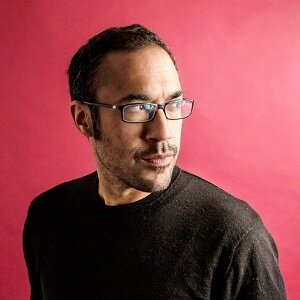
Pierre Singaravélou
Pierre Singaravélou (b. 18 Jan 1977, Bordeaux, France) is a French historian, a British Academy Global Professor of History at King’s College, London, a Professor of Modern History at Paris 1 Panthéon-Sorbonne University, and the director of the Center for Asian History (Sorbonne). He specializes in the modern history of European colonial empires, social sciences in colonial context, decolonization, museum history and globalization, counterfactual history, and alternate histories of the future.
With a French mother and a father of Indian origin born in 1945 in Pondichéry [Puducherry, South India] who studied in France and moved his family to the French West Indies in order to complete his PhD thesis on the Indian immigration in the Caribean Islands, he spent his first years in a ‘creole’ social context. Influenced by historian Christophe Charle at Sorbonne University, he submitted his doctoral thesis on “colonial sciences under the French Third Republic.”
Director of the publishing house Publications de la Sorbonne (Sorbonne University Press) from 2015 to 2019, he joined King’s College to pursue his work on globalization. He is the co-editor of Monde(s), a French journal of global history, and the founding editor of the book series “histoire-monde”.
For his independent history of Ecole Francaise d’Extreme Orient, he was the first non-member of EFEO to be given full access to the School’s archive by EFEO Director Denys Lombard in 1996 – 1998. In the same field, he studied the figure and work of pioneer “Khmerologist” Étienne Aymonier. Expanding his research on French colonial empire to its counterparts, and to the emergence of local elites in spite of colonial rule, Singaravélou devoted a book to the social experiment in the Chinese city of Tianjin in 1900 – 2, Tianjin Cosmopolis (2017), showing how the nine foreign concessions established there became, under the modernising influence of Chinese elites, a unique place for interaction between natives and foreigners.
Singaravélou was one of the coordinators [with Nicolas Delalande, Florian Mazel, Yann Potin] of Histoire mondiale de la France (ed. Patrick Boucheron, Seuil, Paris 2017), an exercise in global history which was emulated through Europe with Italian (Storia mondiale dell’Italia), Sicilian (Storia mondiale della Sicilia), Dutch (Wereldgeschiedenis van Nederland), Flamish (Wereldgeschiedenis van Vlaanderen), Spanish(Historia mundial de España), Catalonian (Història mundial de Catalunya) and German (Deutschland. Globalgeschichte einer Nation) versions.
The following year, in 2018, he curated the first exhibition of cartographic works in a museum of art and archaeology, “The World seen from Asia” at Guimet Museum, presenting an opposite stance to the Eurocentric perspective. In 2020 – 1, he developed the research program “The Worlds of Orsay” at Orsay Museum, Paris, placing the museum’s collections (painting, furniture, sculpture, photography…) in a worldwide context. And while holding the Chair of Louvre Museum in 2022, he studied “the lost museums of the Louvre in the 19th century: ethnographic museum, marine museum, Spanish museum, Algerian museum, Mexican museum, Chinese museum…”
Publications
- Pauvreté et développement dans les pays tropicaux, Bordeaux, Centre d’Etudes de Géographie tropicale, 1981, 585 p.
- L’École française d’Extrême-Orient ou L’institution des marges (1898−1956): Essai d’histoire sociale et politique de la science coloniale, L’Harmattan, Paris, 1999 — CNRS Éditions, 2019.
- “De la découverte du Champa à la direction de l’École coloniale : itinéraire d’Étienne Aymonier d’après ses mémoires inédits”, in Jean-Louis Bacque-Grammont, Angel Pino & Samaha Khoury eds., D’un Orient l’autre. Actes des troisièmes journées de l’Orient, Bordeaux, 2 – 4 octobre 2002, Cahiers de la Société asiatique IV, Paris-Louvain, Peeters, 2005, pp. 237 – 248.
- L’Empire des géographes. Géographie, exploration et colonisation 19e-20e s., Belin, Paris, 2008.
- “Etienne Aymonier”, in François Pouillon ed., Dictionnaire des orientalistes de langue française, Paris, IISMM-Karthala, 2008, 1007 p. ISBN 978 – 2845868021.
- “L’empire des économistes. L’enseignement de l’économie coloniale sous la IIIe République,” in Bonin Hubert, Catherine Hodeir, Jean-François Klein (eds), L’esprit économique impérial (1830−1970). Groupes de pression & réseaux du patronat colonial en France & dans l’empire, Paris, Société française d’histoire d’outré-mer, p 135 – 148, 2008.
- Au sommet de l’Empire: Les Élites européennes dans les colonies du 16e au 20e siècle, Peter Lang (co-ed), 2009.
- L’Empire des sports: Une histoire de la mondialisation culturelle. Belin, Paris, 2010 (with Julien Sorez).
- Territoires impériaux: Une histoire spatiale du fait colonial, Publications de la Sorbonne, 2011 (with Hélène Blais and Florence Deprest).
- Professer l’Empire: Les « Sciences coloniales » en France sous la IIIe République, Publications de la Sorbonne, 2011.
- Atlas des Empires coloniaux 19e-20e siècles, Autrement, Paris, 2012 (with Jean-François Klein and Marie-Albane de Suremain).
- Les Empires coloniaux, XIXe-XXe siècles, Éditions du Seuil, Paris, 2013.
- Grand Atlas des empires coloniaux, Autrement (illustrated edition), Paris, 2015, 288 p. ISBN13 978 2746742406.
- Pour une histoire des possibles: Analyses contrefactuelles et futurs non advenus, Éditions du Seuil, Paris, 2016 (with Quentin Deluermoz) ENG: A Past of Possibilities: A History of What Could Have Been (with Quentin Deluermoz), Yale University Press, 2021.
- Tianjin Cosmopolis: Une autre histoire de la mondialisation, Éditions du Seuil, Paris, 2017.
- Histoire mondiale de la France (coordination, dir. Patrick Boucheron), Éditions du Seuil, Paris 2017. ENG: France in the World: A New Global History, Other Press, 2019 (co-ed, dir. Patrick Boucheron)
- Histoire du Monde au XIXe siècle, Fayard, Paris 2017 (co-ed with Sylvain Venayre).
- Le Monde vu d’Asie: Une histoire cartographique, Éditions du Seuil, Paris, 2018 (with Fabrice Argounès). ENG: Mapping the World: Perspectives from Asian Cartography (with Fabrice Argounès), Singapore National Library, 2021.
- Les Mondes d’Orsay, Paris, Éditions du Seuil/ Musée d’Orsay, 2021, 192 p. EAN 9782021490275.
- Décolonisations. Éditions du Seuil-Arte éditions, Paris, 2020 (with Karim Miské and Marc Ball). ENG: Decolonization (with Karim Miské and Marc Ball), Other Press, 2022.
- Dictionnaire historique de la comparaison, Éditions de la Sorbonne, 2020 (co-ed).
- Le Magasin du Monde: La mondialisation par les objets du XVIIIe siècle à nos jours, Fayard, 2020 (with Sylvain Venayre).
- Les Mondes d’Orsay, Éditions du Seuil-Musée d’Orsay, Paris, 2021.
- L’Epicerie du Monde: La mondialisation par les produits alimentaires du XVIIIe siècle à nos jours, Fayard, 2022 (with Sylvain Venayre).
Exhibitions
- The World Seen From Asia, Guimet National Museum of Asian Arts, Paris, 2018.
- Another History of the World, Museum of European and Mediterranean Civilisations, Marseille, France, 2019 – 2022.
- The Worlds of Orsay, Orsay Museum, Paris, 2020 – 2021,
- Mapping the World: Perspectives from Asian cartography, Singapore National Library, Singapore, 2021 – 2.
Filmography
Decolonizations, TV documentary series (3 X 52 minutes), written with K. Miské and M. Ball, Arte, January 2020. [voice-over by Reda Kateb, ‘39th International URTI Grand Prix for Author’s Documentary’ (UNESCO), Nov 2020.]
Photo by Claire Delfino