
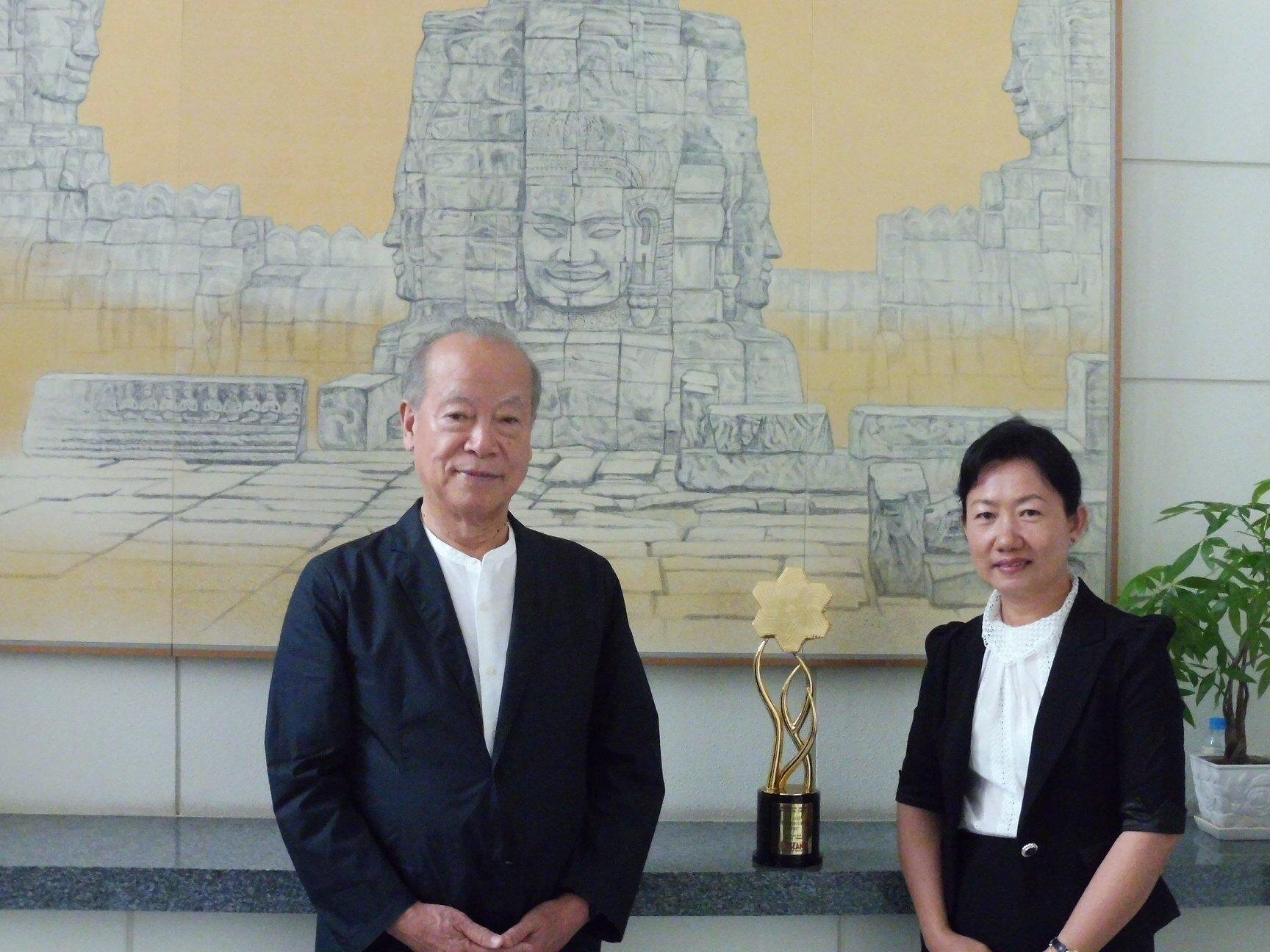
Takeshi Nakagawa

Portrait of Takeshi   Nakagawa

Emeritus professor of Architecture (School of Creative Science and Engineering) at Waseda University (Tokyo), Takeshi Nakagawa 中川 武 (b. 1944, Toyama Prefecture, Japan) is a researcher in comparative archaeological history and the Director of the Japanese Government Team for Safeguarding Angkor (JSA/JASA) since 1994.

He took part in several training programs in architectural preservation in Cambodia, in particular at Angkor Thom (being the mastermind behind the 2005 Bayon Master Plan’), and at Sambor Prei Kuk as part of the SPK Project Laboratory.

In an interview with Ky Chamna for Camness in August 2024, Prof. Nakawaga, 80, noted that the Bayon was first and foremost” his favorite Khmer temple (along with Prasat Phnom Krom and Pre Rup): The Baphuon and Angkor Wat are temples that symbolise orthodox historical development in Khmer architectural history. Thus, the series of monuments leading up to Angkor Wat are characterised by their harmony with the nature environment, which has been continuously shaped throughout Khmer history and cultural development, and this is what these architectures express. In contrast, the Bayon temple complex created in the late 12th century and early 13th century, has completely different characteristics and can be said to be Khmer heretical architecture. It is a symbolic group-sculptural swell, represented as a three-dimensional mandala, a challenge to the gazes of the giant sacred faces and pantheon-like deities, and an unprecedented creativity born from the manifestation of a new civic strength in Khmer traditional culture […] The Bayon is not a particularly large temple as such, but it has the power to expand and extend the viewer’s consciousness to the surrounding area and every corner of the world. The beauty of the Angkorian monument lies in the way its architecture, location, and surrounding area are designed to be in harmony with each other.”

 
With Dr. So Sokuntheary (photo KhmerNas)

Publications:

  1. Kenchiku yōshiki no rekishi to hyōgen: Ima, Nihon kenchiku o gekiteki ni, Shokokusha, Tokyo, 1987, 222 p.
  2. The Japanese House : In Space, Memory, and Language, tr. by Geraldine Harcourt, I‑House Press, 2005, 267 p.
  3. Report on the conservation and restoration work of the Northern Library inside the outermost enclosure of Angkor Wat, Angkor Thom, Kingdom of Cambodia, T. Academy, Tokyo, 2010

Main photo: ThmeyThmey 2024.

Related Glossary

Glossary Terms

  • Mandala

    sk मण्डल mandala "circle", "center"

    Maṇḍala is a Sanskrit term primarily referring to what is circular thus whole, complete. 

    1/ In the Arthaśāstra and other legal texts, the mandala is circle of twelve neighbouring kings, some friendly and others unfriendly, in relation to a king desirous of conquest. The term could also be used for the territory under the possession of a feudatory.

    2/In Shaivism, maṇḍala, cakra, and yantra are often translated as a “mystical diagram” figuring the space for rituals and the apparition of deities. Mandala can also be a disc, the lunar disc.

    3/ In ancient Indian epics, it is the deployment of an army in a circular shape. The term also refers to a part of the Rig-Veda, a combination of dance sequences in the Natyashastra [Treaty on Dance], and in some texts (Kulakaulinimata, for instance) to "round" meaning "breasts".

    4/ The Buddhist mandala is a circular picture, sometimes a symbol of the universe, a place of enlightnment or the symbolization of a meritous deed, to be contemplated in meditation or prayer.

    5/ The term has been used by some modern historians of Southeast Asia to describe pre-State polities or areas of influences, "circles of allegiance".

View all glossary terms →