On-demand book: contact
email hidden; JavaScript is required
This major essay on Buddhism in the period Cambodia was pushed into modernity by colonial design encompasses many paths for further research.
[From the introduction:]
Merely chanting Pali is empty if one does not understand its meaning. This is so because [taking part in] rituals… consists of clear belief and a wisdom involving right views, for which the measure is true knowing and true and correct understanding.
–Chuon Nath, Gihivinaya Sankheb
The 1920s in Cambodia saw an exuberant burst of new printed writings by Khmer Buddhist modernists on the subject of how to behave, as good Khmer Buddhists and moral persons, and simultaneously, how to purify themselves in the context of everyday life in a modernizing world. This book examines the intertwined ethical and historical questions of what Khmer writers articulated as the Buddhist values most important and relevant to their times, how these interpretations were produced, and how they represent Southeast Asian ethical and religious responses to the modern circulation of local and translocal events, people, ideas, and anxieties. In sum, the book attempts to understand how ethical ideas are produced in a particular historical moment, in this case the “moment” of Southeast Asian colonial modernity.
The three passages above, written in the early 1920s in Phnom Penh by Ukñā Suttantaprījā Ind and Brah Sāsanasobhana Chuon Nath, suggest the ethical preoccupations of this self-described Buddhist “modernist” movement with purification, authenticity, and rationalism. Being a Buddhist and a moral person in the modern world required a new and different kind of knowing from that required in the past. This knowledge was based on correct understanding of scripture; it was demonstrated through moral conduct in religious ritual and everyday life.
The ideas that modernists were articulating in Cambodia were resonant with forms and expressions of religious and literary modernism emerging elsewhere in Southeast Asia during this same period. Strikingly, the Khmer and Thai modernist concerns are similar to those voiced by Southeast Asian Islamic modernists.
Viewed regionally, Buddhist and Islamic modernist expressions in Southeast Asia were in part shaped by factors joined to imperialism. These included the relatively late arrival of print in the region, the gradual demarcation of national boundaries; participation in a global market economy, and engagement with discourses of Western science, rationalism, and secularism. But imperialism alone does not explain religious modernism and the accompanying educational modernization projects, which were also a product of the interactions between colonial subjects and other non-Western and pan-Asian alliances. Cambodian and Siamese modernism was influenced by a pan-Theravādin dialogue that reached to Sri Lanka. Similarly, Islamic modernists in Malaya and the Dutch East Indies were in conversation with their counterparts in the Middle East, just as Confucian and Buddhist Vietnamese reformers were part of an East Asian discourse in Japan and China as well as religious developments in mainland Southeast Asia.
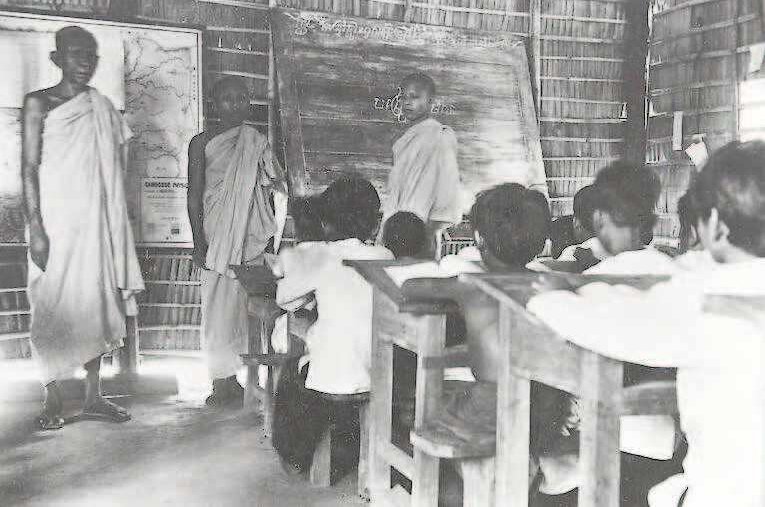
A Cambodian pagoda school c. 1937 (source: នគរខ្មែរ ៖ ជួបប្រទះគ្នាផ្លាសម័យអាណានិគម (ច្បាប់ជាភាសាខ្មែរ) [Cambodia: Colonial Encounters (Khmer version)]. Siksacakr, 12 – 13 (2010−2011): 10.
A Cambodian pagoda school c. 1937 (source: នគរខ្មែរ ៖ ជួបប្រទះគ្នាផ្លាសម័យអាណានិគម (ច្បាប់ជាភាសាខ្មែរ) [Cambodia: Colonial Encounters (Khmer version)]. Siksacakr, 12 – 13 (2010−2011): 10.
In this book, Anne Hansen argues for the importance of Theravada Buddhist ethics for imagining and articulating what it means to be modern in early twentieth-century Cambodia. The 1920s in Cambodia saw an exuberant burst of new printed writings by self-described Khmer Buddhist modernists on the subject of how to behave (as good Buddhists and moral persons) and how to purify oneself in everyday life in the modern world. Hansen explores their new interpretations of traditional doctrines and values, and how they represent Southeast Asian ethical and religious responses to the modern circulation of local and translocal events, people, ideas, and anxieties.
The imagery of moral persons in the “Story of Bhikkhu Sukh” returns us to the illumination of Dhamma-vinay in Lvī-Em’s sermon “Sāsanahetukathā” that began my analysis of Buddhist modernist writings. An authentic Buddhist is one with pure moral behavior, which also shapes the nature of the sāsana and the religious community as a whole, good moral conduct involves disciplining the body, words (including the articulation of the Buddha’s teachings through text and translation), and the heart and mind through a deep understanding of the Dhamma-vinaya. These ideas formed the framework of the Buddhist modernism that was in place by 1930 and quickly rose to prominence during the following decade, putting forward a new expression of Buddhist modernity and tradition in Cambodia and supplanting an older orthodoxy connected with manuscript culture.
A curriculum compiled in 1951 for teaching children at the Dhamma-vinaya school at Vatt Unnālom – where Chuon Nath and Huot Tath had preached their contentious Vinaya sermons thirty-five years earlier – demonstrates how modernist ideas had become absorbed:
The aim of the Dhamma that is found on the pages of the Brah Suttantapitaka and the Brah Albidhammapitaka is that one should adopt it as rules of conduct for teaching and guiding one’s heart and mind toward purification. The aim of the Vinaya is that one takes the rules of conduct found on every page of the Brah Vinayapitaka as rules of conduct for training and disciplining one’s body and speech to have an appropriate manner, to have order and discipline, to have modest and seemly conduct.
…Buddhism is illustrious, prospers and endures for a long time because the whole community of Buddhists comes together to diligently listen to Dhamma, study Dhamma, support and uphold Dhamma, examine Dhamma, and act in accordance with Dhamma out of respect for it by agreeing to carefully apply it. But when the community of Buddhists does not come together to listen to the Dhamma, to study Dhamma, to support and uphold Dhamma, to examine Dhamma, and to act in accordance with Dhamma, that is when Buddhism will fall into decline, become corrupted, useless, and degenerate.
This brief, clear distillation of modernist values hardly seems to evoke the complexity of the forces and interactions through which it arose: purification and reform movements, millenarianism, arduous travels to Siam, controversies over loofah-gourd rolls in robes, orthography battles, clandestine Vinaya study cells, epiphanies caused by grammatical parsing, modern pedagogies, and the introduction of print. Added to these factors, the interactions between a changing cosmopolitan body of ideas, symbols, and notions of authority (the Pali canon) and local interpreters, acting within a colonial context in which Buddhist texts and knowledge were highly politically charged, helped to give rise to the modern Dhamma movement that intertwined modernity with notions of moral purification. During the 1920s and 1930s, modern Dhamma teachings were increasingly incorporated into classes and curricula at the Sālā Pali and pagoda schools and disseminated through the publications of the Royal Library, through funeral volumes and biographies of monks, through Dhamma tours to the provinces undertaken by modernist monks beginning in the early 1930s, by the text “fetes” organized by SuzanneKarpelès, and through the Buddhist Institute’s new traveling “bookmobile.”
The 1951 Vatt Unnālom curriculum provided Chuon Nath’s answers to common questions about Buddhism. His explication for the meaning of Buddhism incorporated interconnected notions of Khmerness, purification, moral conduct, a historicity situated in a this-worldly temporality, and antiquity. According to the curriculum, “Buddhism” (which in Khmer is expressed as a compound word), was composed of two words, Buddh and sāsana. Taken together, the phrase referred to the “teachings and discipline, the words of counsel or advice of the Lord Buddha, he who was enlightened and came to know the Truth.” The first word in the compound was Buddh, which, Chuon Nath explained,
refers to the name of an extraordinary human being who attained enlightenment through insight into the Dhamma. This is the same Buddha whom we respect and revere today, the Lord who is the Foremost Teacher, who came from the Sakya family, who was born as a ksatra in the Middle Country, known today as India. If you think about the number of years between our time to his, it is a span of 2,573 years since the lifetime of this extraordinary person.
The curriculum went on to recount not the cosmic lifetimes of the Bodhisatta of the jātaka or Prince Siddhat’s duel with Mārā in the Pathamasambodhi, but the historical life and circumstances of Prince Gotama, who renounced his luxurious life in the palace, took up the life of a wandering ascetic, and went on to discern the true origin of suffering, or dukkha.
The second word, sāsana, the curriculum continued, referred to teachings, discipline, and advice. In a comparative sense, sāsana had certain characteristics:
Its teachings and discipline are directed at people in the entire world to exhort them to make their behavior right and good and to refrain from wrong actions with body, speech, heart and mind. Sāsana exhorts its followers to lift themselves up from inferiority to self improvement, from ignorance to wisdom, from discontentedness to contentedness, from living in blindness to living in virtue, from living in virtue to becoming Noble, and for those who have not yet achieved compliance with [these teachings], it exhorts them to follow the [teachings] carefully in order to attain these [fruits].
In these passages, sāsana, and by extension Khmer Buddhism, is infused with values of purification and moral conduct, rationalism, and a historicist sense of civilizational progress and development. The writings suggest the comparability between Khmer Buddhism and other religions, in terms of the universality of its ethical principles and its historical emergence as a world religion.
Writing still another decade later, in 1961, HuotTath represented the antiquity of Khmer Buddhism in empirical terms that could be historically proven through the study of Buddhist scriptural texts and inscriptions. The origins of Khmer Buddhism, he wrote in his 1961 history Brahbuddh-sāsana nau Prates Kambujā Sankhep (An abbreviated account of Buddhism in Kampuchea), could be traced nearly to the origins of the Buddhist religion itself. According to Buddhist commentaries such as the Samantapāsādika-atthakathā-vinaya-pitaka (a commentary on the Vinaya), Huot Tath wrote, right after the Third Buddhist Council in India, “a great thera named Mahāmoggaliputtissa arranged to send the theras Sonatthera and Uttaratthera… on a mission to disseminate Buddhism to Suvannabhūmi, during the realm of the great king named Dhammāsok.” Suvannabhūmi appears to have included all or part of the region now called Southeast Asia, Huot Tath continued. Although every country in Southeast Asia now claimed to have been the location of Suvannabhūmi, looking closely at scriptural and epigraphical evidence led one to conclude that the establishment of Buddhism among the Khmer coincided with the time frame of this early mission.
Having established the antiquity of Khmer Buddhism, Huot Tath summarized its further development:
From that period on, Buddhism in Kampuchea became established and never at any point suffered annihilation or disappearance, but merely [periods of] decline alternating with [periods of] growth and prosperity. This was caused by the fact that in certain periods, Buddhism was strongly supported by its adherents, while in other periods, it was only weakly maintained. Throughout its long history, the kings, elites, and populace of Kampuchea have not always followed just one type of Buddhism. At some points, they were Theravādins, at other points Mahāyānists, and at still others, Brahmans. As a result, Buddhism has been subject to continual adaptation, depending on the power and influence of its adherents, which in turn has depended on the particular period of history. Indeed, it is striking how Buddhism in Kampuchea has endured up until the present time. But because its essence was maintained, even when its material means of support was sometimes diminished, it never dwindled away.
At the present time, Buddhism in Kampuchea is in a period of strong growth, progress, and prosperity. Why is this? Because Kampuchea has established itself as an independent country, observing neutrality in political matters, with abundant rights and liberties; because Kampuchea is fortunate in possessing a king … at its head who is a protector of Buddhism, and who leads our nation’s people to freedom from fear and danger.… As the country develops, so does Buddhism – because Buddhism and country are inextricably interconnected; if the country suffers, so does Buddhism; if the country experiences peace and prosperity, so does Buddhism.
This strong identification between Khmerness, Buddhism, and modernity clearly represented in these writings from the 1950s and 1960s, I have suggested, began to emerge in the second decade of the century with the establishment of new Buddhist institutions, new textual and pedagogical practices, and the rise of a modern interpretation of Buddhism.
My chronological narrative of the growth of Khmer Buddhist modernism ends in 1930 with the creation of the Buddhist Institute because it seems to me to mark another shifting point. After 1930, the forces were in place to ensure that modernism would cease to function as a modernism in the sense of an opposing critique, ethos, or movement but increasingly as the dominant religious discourse. The complex nature of the processes and interactions shaping Khmer Buddhist modernism up through 1930 and the creation of the Buddhist Institute are evident through my preceding discussion. Even though there is still more to learn about the particular individuals and ideas involved, it is already apparent that it was more than simply an outgrowth of the colonial presence. Nor was Buddhist modernism a strictly national or nationalist project, although it did provide an intellectual space for the expression of a heightened awareness of Khmer culture, history, language, and literature, as well as for discontents about social organization under colonialism to be voiced.
As in Malaya and the Netherlands East Indies, the nature of religious modernism shifted as other ideologies became more prominent. In Cambodia and elsewhere, religious modernism as a critical discourse was fused to anticolonial nationalism, and among some factions of society, supplanted by secular ideologies. Among Southeast Asian Muslims, the sharp divide between modernists and traditionalists began to fade during the 1920s, when a new generation educated in Dutch-sponsored secular schools came of age; the tensions between Islam and secularism became a more pressing concern to many Muslims than those between traditionalist and modernist camps. In colonial Cambodia, the dynamics between traditionalists and modernists played out somewhat differently. While Buddhism continued to play a central role in imagining nationalism and the modern nation, the religious establishment, led by the modernists who had assumed positions of authority in the Sangha, increasingly suppressed traditionalism.
Although the political and nationalist implications of religious modernism in the Islamic and Theravāda Buddhist worlds of Southeast Asia display some striking parallels, what is also striking – and almost wholly unstudied by scholars of Southeast Asia – are the similar ethical values constructed by colonial Southeast Asian Muslims and Buddhists concerning how to be modern. Debates between modernists and traditionalists in both Islamic and Buddhist contexts centered on how to behave, ritually and ethically, as moral persons in a rapidly modernizing environment. Modernist movements connected with the two religious traditions stressed an ethic of purification and a complex of related values that aided the articulation of new forms of knowledge and new ideas about how to live that were oriented toward modernity. Gayo modernist poetry from highland Sumatra, for example, proselytized about “prayers that are ineffective” because of lack of earnest concentration:
If the heart is roaming,
even though worship has begun.
The mouth is reciting, the heart is figuring all sorts of matters, up and down.
In the middle of worship, thoughts are flying
like a kite no longer held down.
So the heart is long gone:
“there are the hills, the knoll is in view,
there is the field’s edge, with every little row…”
Comparable ethical ideas in Khmer modernist thought about how to conduct oneself during religious ritual are obvious from the discussion in this chapter. Not only was the crucial importance of rational understanding similarly stressed, but the particular ethical value of attentiveness underscored in this excerpt of Gayo poetry is similar to the ethical priority placed on the cultivation of satisampajañña in Ind’s work. In both contexts, modernist conceptions of authentic ritual performance demanded rational knowing and correct performance but also the ethical quality of keeping one’s mind focused and attentive – rather than flying off “like a kite” or tumbling out of a sugar-palm tree. Closer study of the comparisons and interactions between Southeast Asian Islamic and Buddhist modernist ethics could lead us to recognize regional resonances in the ways that Southeast Asians constructed their distinctive conceptions of modernity.
Setting itself in opposition to traditionalism, Buddhist modernism in Cambodia incorporated currents of thought that had originated with KingAng Duong’s efforts to renovate Khmer religion in the 1850s along with notions of purification and conduct inherited from other religious reforms in Siam and Cambodia, from local millenarian movements, and from the discursive and pedagogical collusions between colonial French and Khmer officials and scholars. But although modernists had absorbed older Khmer intellectual assumptions about the moral construction of reality, the nineteenth-century literary preoccupations with merit, power, and the cosmic biography of the Buddha were deemphasized in their writings. In contrast to the older representations of moral development, modern renderings of purification reflected a temporal and spatial shift, locating meaningful Buddhist values in the here and now of the colonial world.
Thinkers such as Chuon Nath, Huot Tath, Um-Sūr, Lvī-Em, and Ind contributed to the articulation of a transformed Buddhism in Cambodia whose values reflected Khmer conceptions of modern ways of being. The result was an array of new translations and compendiums of the Buddhist Dhamma-vinay that circulated widely among a population that had become receptive to new forms and articulations of how to behave. They reflected a “demythologized” view of reality characteristic of modern perception elsewhere – but not a “disenchanted” one in the sense of being secular. Associating the purity and health of the sāsana and its disciples within the everyday behavior of ordinary Khmer living “right now” in “these present times,” they had begun to construct an understanding of themselves as belonging to an authentic Buddhist moral community defined by their scriptural knowledge, moral development, and purity of conduct. In Buddhist modernism in the 1920s in colonial Cambodia, modernity is perhaps best inscribed not in European terms such as “nation” or the sensation that “all that is solid melts into air,” but by the ethics of moral purification and in the image of an orphan, clinging to the frame of the right vehicle, whose driver can speak to him in his own language.
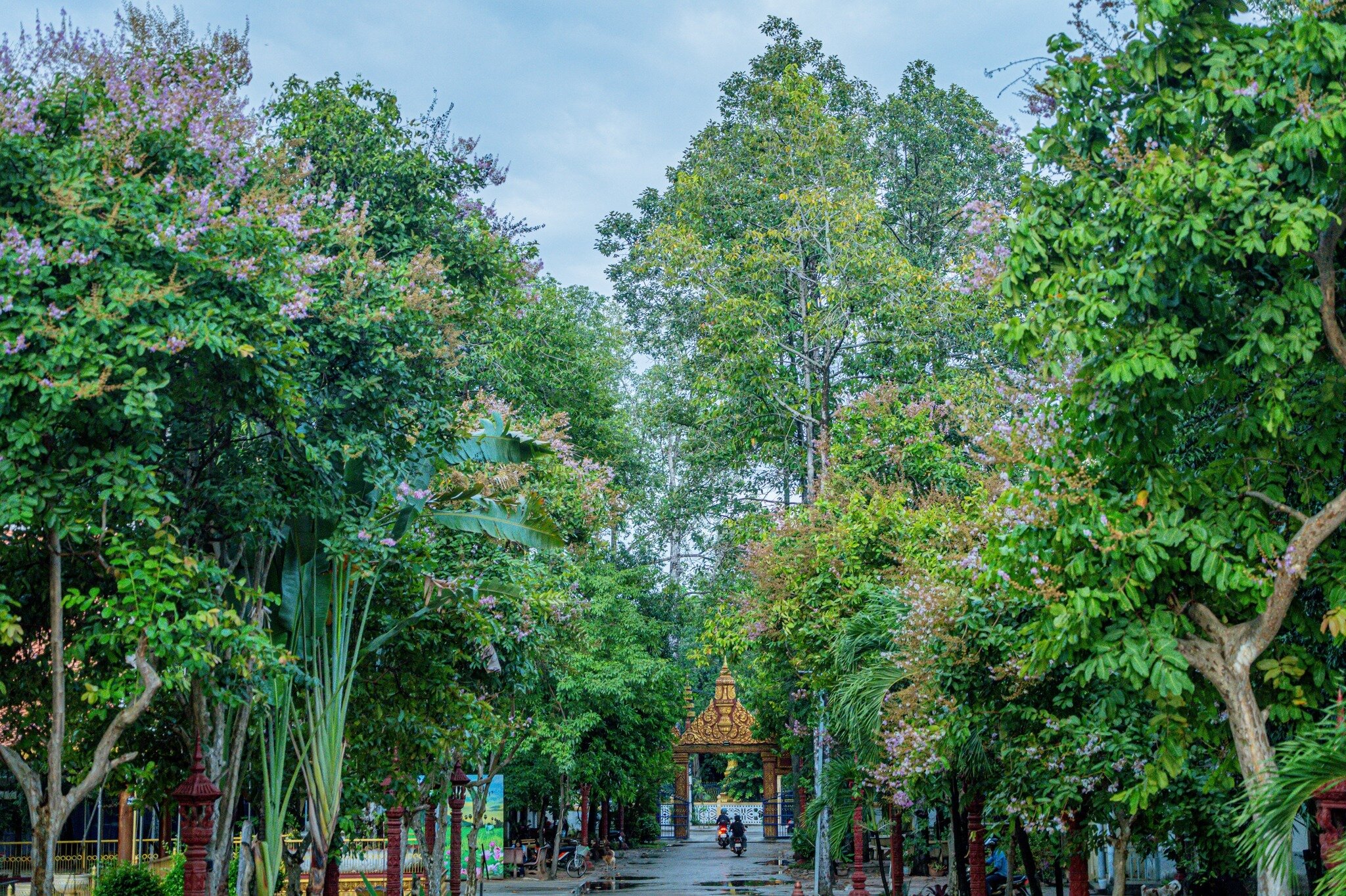
Wat Damnak វត្តដំណាក់ premises were the Royal Residence in Siem Reap from 1904 to 1927, during the reign of King Sisowath. When King Monivong decided to build a new residence on the other bank of the Siem Reap River, a larger pagoda was erected in 1935 under the supervision of Venerable Prin Timសម្តេចព្រះតេជគុណព្រឹនទីម [Samdech Preah Teuk Pun Prœn Tim], and the site became a major teaching monastery, complete with a youth hostel (photo from Wat Damnak social media feed).
Wat Damnak វត្តដំណាក់ premises were the Royal Residence in Siem Reap from 1904 to 1927, during the reign of King Sisowath. When King Monivong decided to build a new residence on the other bank of the Siem Reap River, a larger pagoda was erected in 1935 under the supervision of Venerable Prin Timសម្តេចព្រះតេជគុណព្រឹនទីម [Samdech Preah Teuk Pun Prœn Tim], and the site became a major teaching monastery, complete with a youth hostel (photo from Wat Damnak social media feed).
Oknha Suttantaprija Ind and “Buddhist modernism”
The author devotes numerous pages to the Pali scholar and Battambang writer Suttantaprija Ind. From her remarks:
The period between 1860 and 1930 also roughly coincides with the lifetimes of two of the Buddhist intellectuals who figure prominently in this historical narrative: Brah Maha Vimaladhamm Thon (1862−1927) and Ukña Suttantaprījā Ind (1859−1925). Both were highly respected Pali scholars in the Mahanikay order in Cambodia who were educated in the established monastic traditions of the late nineteenth century. They were exposed to reformist and modernist discourses through travels to Bangkok and studies with Siamese-educated teachers. Although trained in older schools of thought, they ended their scholastic careers by contributing to the construction of Khmer modernism. Both Thon and Ind were closely aligned with the highly politicized “modern Dhamma” group in the Buddhist Mahānikāy order. [p 10]
Ukñā Sutrantaprījā Ind wrote, “What is Dhamma in these times?” He went on to consider the moral values most necessary for living eluv neh, “right now” contrasting the “old” with the “new,” and examining the gatilok tmi dael koet mān loen, “modern morality that has arisen.” It is necessary “in these present times,” he wrote, for “persons who are trying to be good and pure” to be able to clearly recognize “what is worldly [behavior] and what is Dhammic [behavior].” This framing of moral conduct in terms of time, delineating eluv neh “right now,” from “cās” or purān, “past or ancient times,” or mun, “all previous time before right now,” in combination with his division between the worldly (or secular) and the Dhammic (or religious) is expressive of the kind of self-consciousness of temporality that Harvey has associated with modernism. Yet at the same time that Ind emphasizes the present-ness and even the newness of this time period through references to what is tmi, “new” or “modern,” his transhistorical claims about Buddhist moral values are also made evident. [p 11]
“Nowadays,” Ukñā Suttantaprījā Ind observed in the Gatilok, his primer on moral conduct, “people are not the same as they [once] were.” Although they intend to behave in accordance with the Dhamma, more often they end up being “swayed by the ways of the world instead.” Thus, it was necessary to give scrutiny to the question of moral conduct: “how should we behave if we want to make ourselves pure?” […] Writings produced by the modern Dhamma group and Ukñā Suttantaprījā Ind from the second decade of the century to the early 1930s reveal the contours of the modern Buddhism emerging in Cambodia. The new focus on the purified individual, the sāsana, and the religious community that appears in these writings is linked to nineteenth-century constructions of exemplary moral figures traversing through a hierarchical moral cosmos. But as I have suggested, in modern understanding, these conceptions were visibly altered — demythologized, less bodhisatta-centric, and more concerned with lay social ethics. They feature the development of new temporally and geographically localized imagery of the individual moral agent, the sāsana, and the collective body or community of Buddhists. They also begin to evoke notions of a distinctive Khmer society, culture, and “national religion” that became more pronounced in Khmer thought and literary production after this period. […] I turn first to a discussion of the relationship between textual purification and self-purification in the two most prominent forms of modernist writing from this period: sankhep (abridgments) and samrāy (vernacular translations), literary forms that modernists reshaped to fit their new ideologies and translation methods. Second, to suggest the ways in which Khmer writers localized their interpretations of Theravādin values, I turn to a reading of purification and moral agency in Ukñā Suttantaprījā Ind’s primer Gatilok. Ind coined still another new literary style in the Gatilok. He referred to his work as a “tamrā” or “manual” for its combination of abridgements and vernacular translations of Pali canonical verses, which he interwove with Buddhist stories, translations of French fables, and Khmer oral folktales. In a marked departure from his own previous literary compositions and from the styles that dominated the nineteenth century, Ind composed this new work almost entirely in prose. [p 148 – 50]
The depiction of the morally constructed universe and individual progression through its cosmic spatial and temporal framework in these well-known texts was joined by a third theme related to moral development: the intertwining of merit and power. To examine the importance of this theme during the late nineteenth century, I will return briefly to the Vessantar-jātak and then move to a reading of portions of a vernacular poem on the enlightenment of the Buddha, composed at the close of the century by Ukñā Suttantaprījā Ind. Its assertion of the moral construction of world and person at the end of the century coincides with the decline of the political structures in society that reduplicated similar hierarchical notions of power, merit, and social organization. By considering the issue of power, I begin reading the texts as sources for Cambodian political history, a reading that also allows their ethical themes to be interpreted in a more nuanced manner. [p 32]
Another vernacular version of the Pathamasambodhi is an epic poem titled the Rueng Pathamasambodhi (History [or story] of the Pathamasambodhi), probably written in the 1880s or 1890s by Ukñā Suttantaprījā Ind. The text offers a distinctive Khmer verse elaboration of scenes from the life of the Buddha. As a text composed primarily for entertainment, it functioned somewhat differently from Leclère’s version of the Pathamasambodhi, which was read to lay audiences assembled in monasteries. Like some of Ind’s other poems, the Rueng Pathamasambodhi was composed as a literary work but seems to have circulated in oral as well as manuscript (and later printed) forms. In trying to reconstruct elements of Ind’s biography in Battambang Province, where he passed much of his life and where many of his descendants remain, I met one of Ind’s grand-nephews who could still recite portions of Ind’s work from memory. An elderly man when I first met him in 2000, he remembered going to the monastery with other youths in his village to memorize Ind’s poetry for recitation. Working from a manuscript version of the poem stored in the monastery library, the young men would copy a portion of the poem on a wooden slate made from painted kapok wood, writing with a form of locally produced chalk. Once they had memorized that portion of the poem, they would repaint the slate and copy out a new section to learn. [p 35]
A professor of History at University of Wisconsin-Madison (USA), Anne Ruth Hansen has extensively researched ethical ideas and modern religion representations in South East Asia, with an accent on Theravadin Buddhism.
Her MD thesis at Harvard Divinity School in 1988 was titled: “Crossing the River: Secularization of Khmer Childbirth Rituals.”
She is the author of several published studies, as well as the following books: At the Edge of the Forest : Essays on Cambodia, History, and Narrative in Honor of David Chandler(Cornell University SEAP Press, 2008), and How to Behave: Buddhism and Modernity in Colonial Cambodia, 1860 – 1930(University of Hawaii Press, 2007).
greek "askēsis" originally "physical practice, athletic training".
A sage who practices austerity.
In various Indian philosophies from Shaktism to Ayurveda, the concept of Tapas (तपस्),"penance", "ascetism", "austerity", "practice of self denial" is essential.
In Khmer religious philosophy, អនង្គណ angkana is the state of being without defilement, a person without defilement, pure. ព្រះពុទ្ធអរហន្ត The Buddha Arahant is the great blessing of having all defilements removed.
sk जातक jātaka “science of astrology" pl "birth story" | kh ជាតក cheatk 'jataka'
Initially the study of horoscope, the term Jātaka evolved into the Buddhist notion of "birth story", in particular stories related to the former births of the Buddha, and later to the birth of who is destined to be a Buddha in the future.
Written around the 3d century CE, the Jataka was a vast compendium of folk tales and mythic literature, primarily associated with the Theravada Buddhist tradition written in Pali. Telling the stories related to the birth of the Buddha became one of the nine types of teaching (sūtra) as defined in the Dharma-saṃgraha.
In Cambodian Buddhist tradition, it includes stories (រឿងរ៉ាវ rungreav) of edifying past experiences, such as 'the ten stories', as told by the Buddha Sakyamuni ('All-Knowing').
kh: ឧកញ៉ា angk: uk-na | in ancient vn texts: Ốc nha (屋牙)
Khmer honorific meaning 'nobleman' or 'lord'. Initially envoys of the Angkor kings, then title in used during the Oudong monarchy from the 18th century, substituting Ponhea (ពញា - equivalent to Phraya (พญา) in Thai). The title "Oknha" was transformed into Thai as Okya (ออกญา) by the Ayutthaya Kingdom. The word Oknha occurs in ancient Vietnamese records.
Since 1993, title bestowed by the King (later by the Cambodian government) on civilians (non-royalty) distinguished for their goods deeds. Recently, 'oknha' has become a Khmer version of 'tycoon', as since 2017 wealthy people donating a minimum of 500,000 USD to the State can obtain the title.
Vinaya refers to numerous monastic rules and ethical precepts for the Sangha communities, and by extension to a category of Buddhist text discussing the application of these precepts.
In Theravada Buddhism, the Vinaya Piṭaka(lit.Basket of Discipline) is one of the three divisions of the Pali canon, Tripitaka, along with the Sutta Piṭaka and the Abhidhamma Piṭaka, dealing with the monastic codes of conduct for monks (bhikṣu) and nuns (bhikṣuṇī) of the Sangha (community of faithful). It covers rules of individual discipline (prātimokṣa), guidelines for communal harmony, and recommendations for handling transgressions.
Upāli (kh ឧបាលី), a barber by trade and one of the ten chief disciples of the Buddha, was the first in charge of reciting and reviewing the vinaya.