António da Madalena or Magdalena (??-1589, aboard the Sao Tomé) gave an account of his journey to Angkor to Diogo do Couto, the main chronicler and “guarda-mor” (curator) of the Archives of Portuguese exploration-colonization in Asia.
Curiously, Diogo do Couto did not include Madalena’s testimony in the sixth volume of the sum initiated by writer João de Barros, the Décadas da Ásia. After do Couto’s death, his personal papers were kept by his brother-in-law, priest Deodato da Trindade, his wife Luisa de Melo’s brother. It was only in 1947 that historian Charles R. Boxer found do Couto’s transcription of Madalena’s relation to his journey in Cambodia.
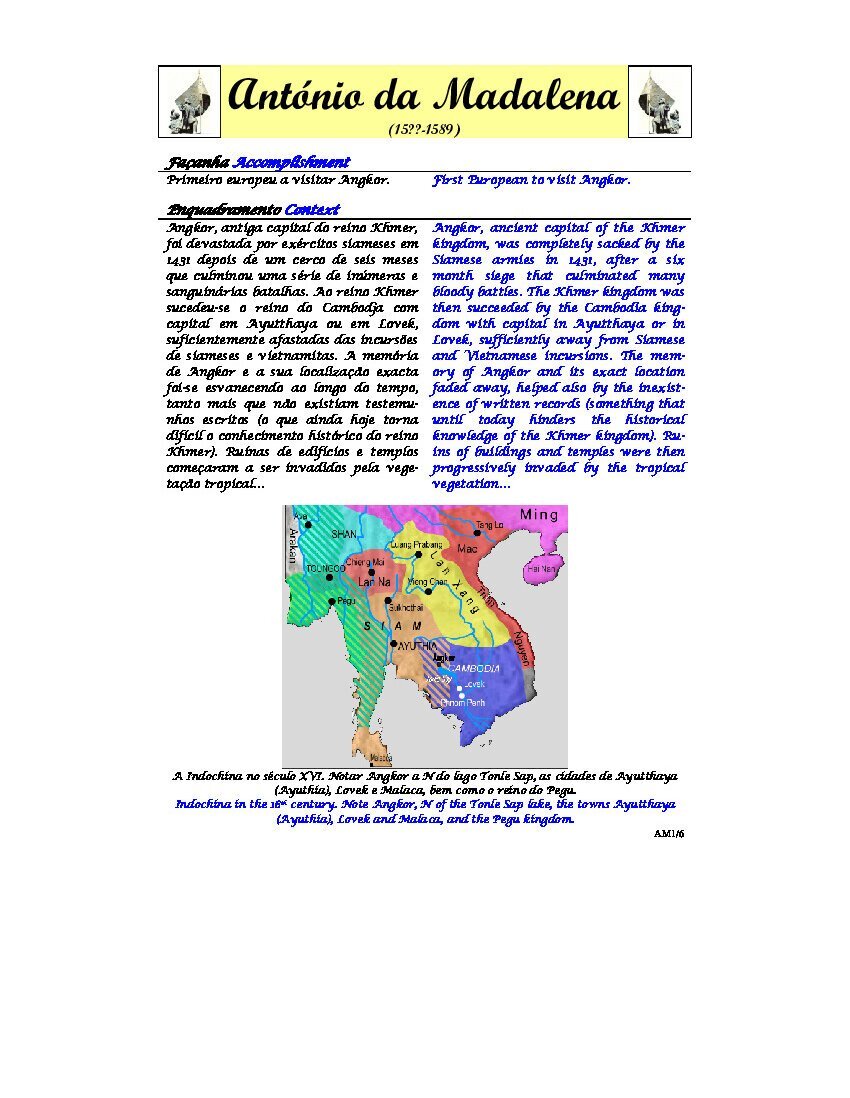
We know little about Capuchin Fraile [Brother] Antonio da Madalena’s activities in Southeast Asia apart from quite confuse notations by chronicler Jacinto de Deos dissected by Bernard-Philippe Groslier (Angkor et le Cambodge au XVIeme siecle, p 49), according to which he was amongst the missionaries from Malacca allowed to “preach freely” by “the King of Cambodia” — King Barom Reachea I (c. 1520- c. 1576, r. from 1556 or 1566)- or his son King Satha (c. 1553 ‑c. 1593 or c. 1543 — c. 1584, r. from 1567 or 1576), also called Apram Langara or Prauncar Langara, sired with Queen Kessa, one of the three queens of Barom Reachea I. In any case, the description of Angkor he left to Diogo do Couto remains “not only the oldest but also the most complete, the most exact and the most precious,” to quote B.P. Groslier.
A lay brother, da Madalena had arrived in Malacca with Fr. Diogo da Conceicão on 5 October 1584, and joined the latter at the monastery he had founded near Ayutthaya in 1585 or 1586. One anecdot reported by Jacinto de Deos, the only personal detail about Fraile Antonio, depicts the friar in the streets of Ayutthaya, to which he had certainly come from Cambodia,
Once he went with his shoulder bag seeking alms in the streets, as is customary and according to the rules of our order, when a mandarin — that is, the governor of the town-passed by on horseback. The mandarin sent a servant in haste to obtain bread and fruit, then, taking them in his own hand and going down on his knees, he filled the bowl of Brother Antonio; he shed many tears when saying his prayers, pressingly and humbly asking him to commend him to God. This gesture, coming from a gentile, caused much confusion among the Christians…
“Edifying little story, commented B.P. Groslier, perhaps too much so, for it hardly corresponds with what we imagine to be the attitude of an Ayutthayan mandarin in the reign of Preah Nareth concerning a Catholic missionary.” [Angkor and Cambodia in the 16th centuries, tr. Michael Smithies, p 23 – 4). Or had the potentate been moved to see a foreigner humbly begging like Buddhist Theravada monks still do in the morning?
The Franciscan friar perished when his ship sunk during a storm near the coast of Natal (South Africa) as he was heading back home from Cochin [now Kochi, India] after many years spent in India, Malacca, Ayuthaya (Kingdom of Siam) and Cambodia.