

Complexe Olympique de Phnom Penh [in L'Architecture d'Aujourd'hui]
by Molyvann Vann
The first exhaustive presentation of Phnom Penh National Sports Complex, issued right after this Jewel of Cambodian Golden Age opened in 1964.

- Author
- Molyvann Vann
- Publication
- L'Architecture d'aujourd'hui, n. 116, Sept.-Nov. 1964: 28-32.
- Published
- September 1964
- Pages
- 4
- Languages
- French, English (ADB Translation)
pdf 5.1 MB
From L’Architecture d’aujourdhui 116, Sept-Oct. 1964: 28 – 32.
From L’Architecture d’aujourdhui 116, Sept-Oct. 1964: 28 – 32.
From L’Architecture d’aujourdhui 116, Sept-Oct. 1964: 28 – 32.
From L’Architecture d’aujourdhui 116, Sept-Oct. 1964: 28 – 32.
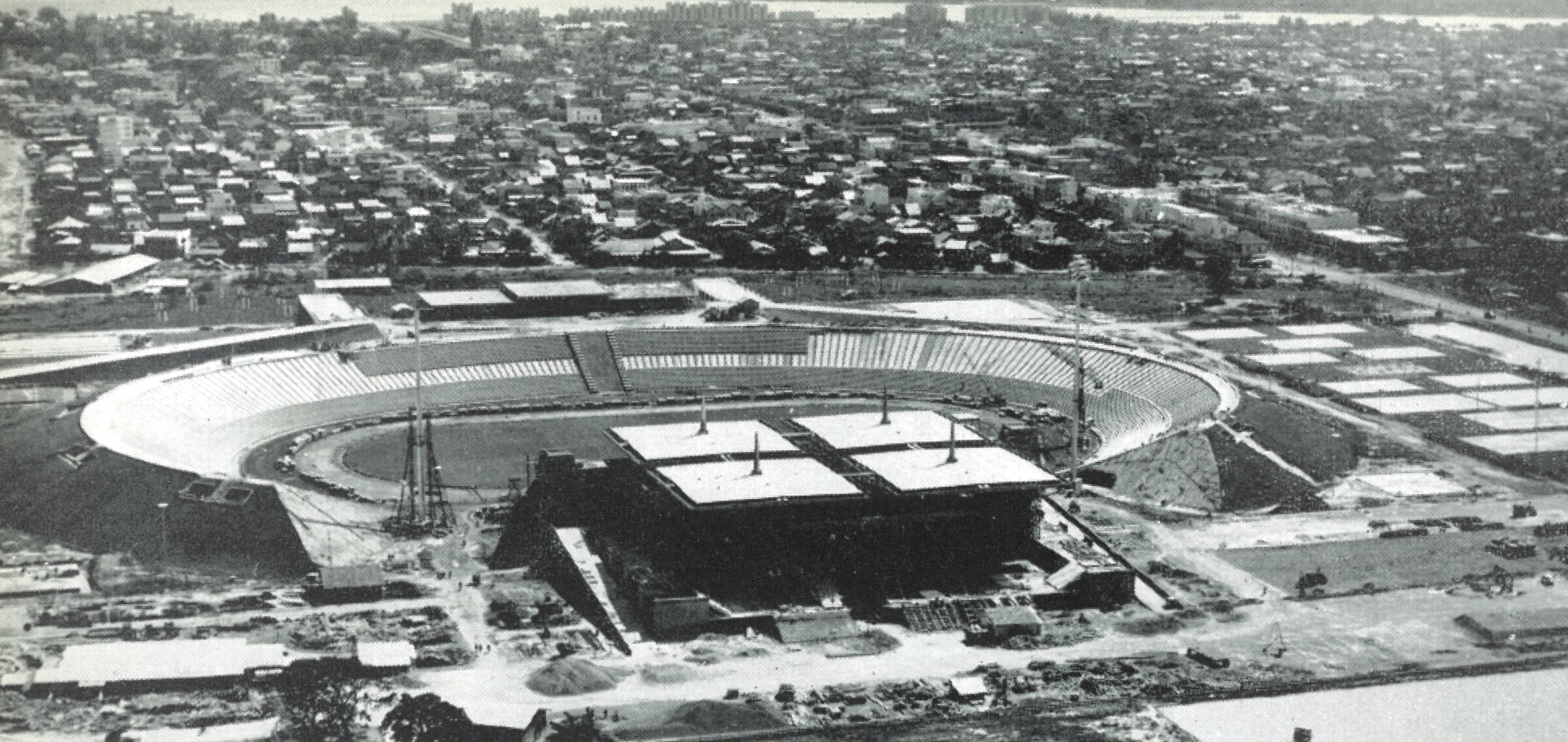
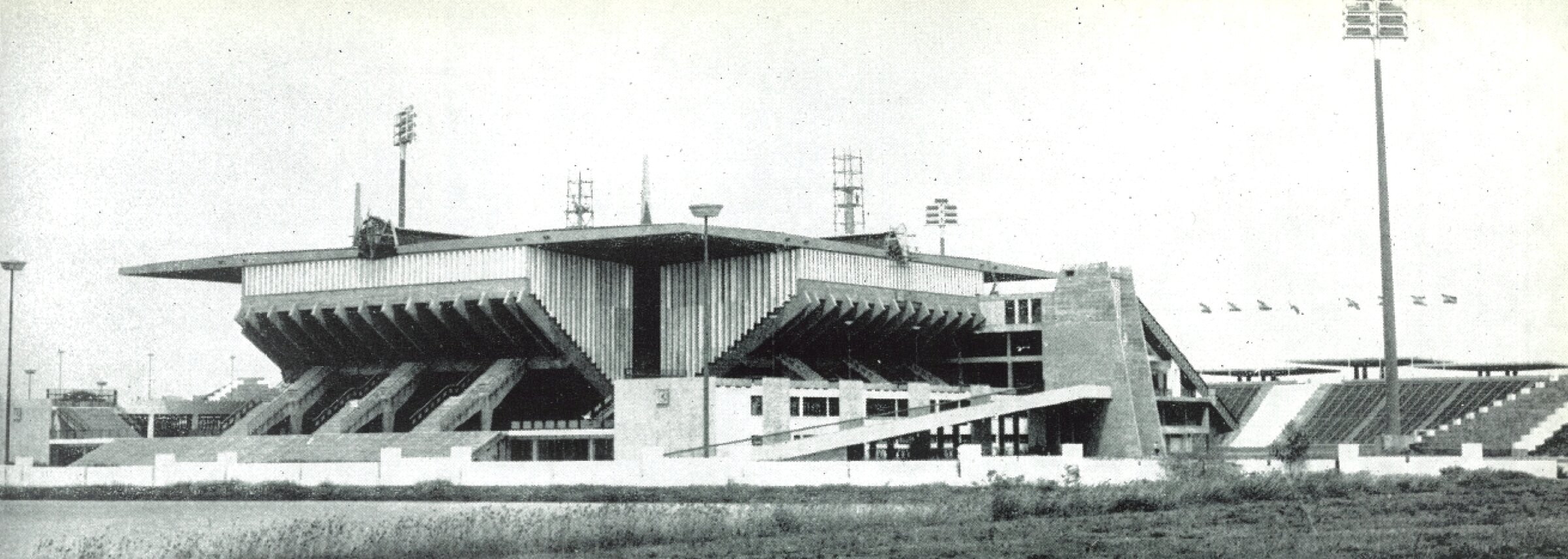
1) Aerial view of Stadium and Sports Center before completion. 2) The Sports Center.
Symbol of Cambodia’s optimistic blooming after its peaceful accession to independence on 9 November 1953, the Phnom Penh Olympic Complex (or National Sports Complex), known as National Olympic Stadium ពហុកីឡាដ្ឋានជាតិអូឡាំពិក in recent times and completed in 1964 after only one year and a half of intense work (including two rainy seasons with climatic conditions making the open air operations really challenging), remains a rare feast in architectural creativity, structural ingeniosity, and cultural connection to a national past that was still in the making.
Sixty-two years later (as of 2026), this publication in a French referential magazine remains essential to retrace the whole project with concise and informed texts as well as section and floorplans by chief architect Vann Molyvann and some (uncredited) photographs taken right after completion — the worksite itself had been extensively documented by Micheline Dullin and anonymous Cambodian photographers.
The texts here translated into English by Angkor Database can be found in original French in the attached pdf or in this text-only version [Subheaders by ADB].
The Olympic Complex in its Context, by Vann Molyvann
For the past ten years, Cambodia has pursued an investment policy aimed at developing its infrastructure. The actions of the Head of State, Prince Norodom Sihanouk [ADB: who was himself an ardent promoter of sporting activities at the time] , have been decisive in the implementation of this infrastructure and modernization plan and are accelerating its realization.
Under his energetic leadership, the country’s infrastructure has already been profoundly transformed: a port has been created in a previously undeveloped region [ADB: Sihanoukville (Kompong Som)] , modern roads have replaced dirt tracks, new routes have penetrated the forest and enabled the development of previously untapped land; railways, airfields, dams, factories, schools and universities, hospitals, and model villages are springing up everywhere.
Alongside these investments, which promote trade and industry, health, education, and well-being, the major challenge of renovating and expanding urban centers — in short, urban planning — cannot be overlooked. Throughout the city, and especially in Phnom Penh, green spaces and large housing complexes have been developed on the sites of unsanitary neighborhoods where some residents lived in thatched huts.
It was within the framework of these urban development projects that the construction of a vast sports complex in Phnom Penh was undertaken for the Third Southeast Asian Games [ADB: after some diplomatic imbroglio, the games were never hosted in Phnom Penh, substituted with the GANEFO games held here in 1967]. Exceptionally, this complex was built right in the city center, where it provides a 40-hectare reserve, a permanent space for walking and recreation, on the site of a former drainage channel that had previously been a foul-smelling receptacle for wastewater from the commercial districts.
There is no need to elaborate on the description and characteristics of this complex. Three particular points, however, deserve special mention:
- The overall design was not based solely on the “grand composition” but also on adapting to climatic conditions, finding a functional layout at minimal cost, and employing a contemporary architectural approach that nonetheless took into account the artistic traditions of the Angkor period.
- The rapid execution of all the work (design, studies, construction, and equipping) required only eighteen months, thus meeting the strict deadlines.
- Teamwork was paramount in the realization of this project. Indeed, this work is essentially the result of the efforts of a team of experts, primarily composed of renowned urban planning and structural consultants: G.[Gerald] Hanning and V. [Vladimir] Bodiansky; and Parisian architects, Messrs. Duchemin and Morin, whose collaboration with the engineering firms in developing the construction plans proved particularly effective. Engineers from design offices, such as Mr. Kandaourof, who handled the calculations and studies of the site equipment; project engineers and architects like Mean Kimly and Um Samuth, who led specialized teams; and the construction company (Société Française d’Entreprise de Dragages et de Travaux Publics), whose representative, Mr. Martin, managed the organization and direction of the sites with remarkable competence.
This entire team was truly enthusiastic about the challenge of completing a project of this scale in such a short time; it was an act of faith to which each member gave their very best.
From L’Architecture d’aujourdhui 116, Sept-Oct. 1964: 28 – 32.
From L’Architecture d’aujourdhui 116, Sept-Oct. 1964: 28 – 32.
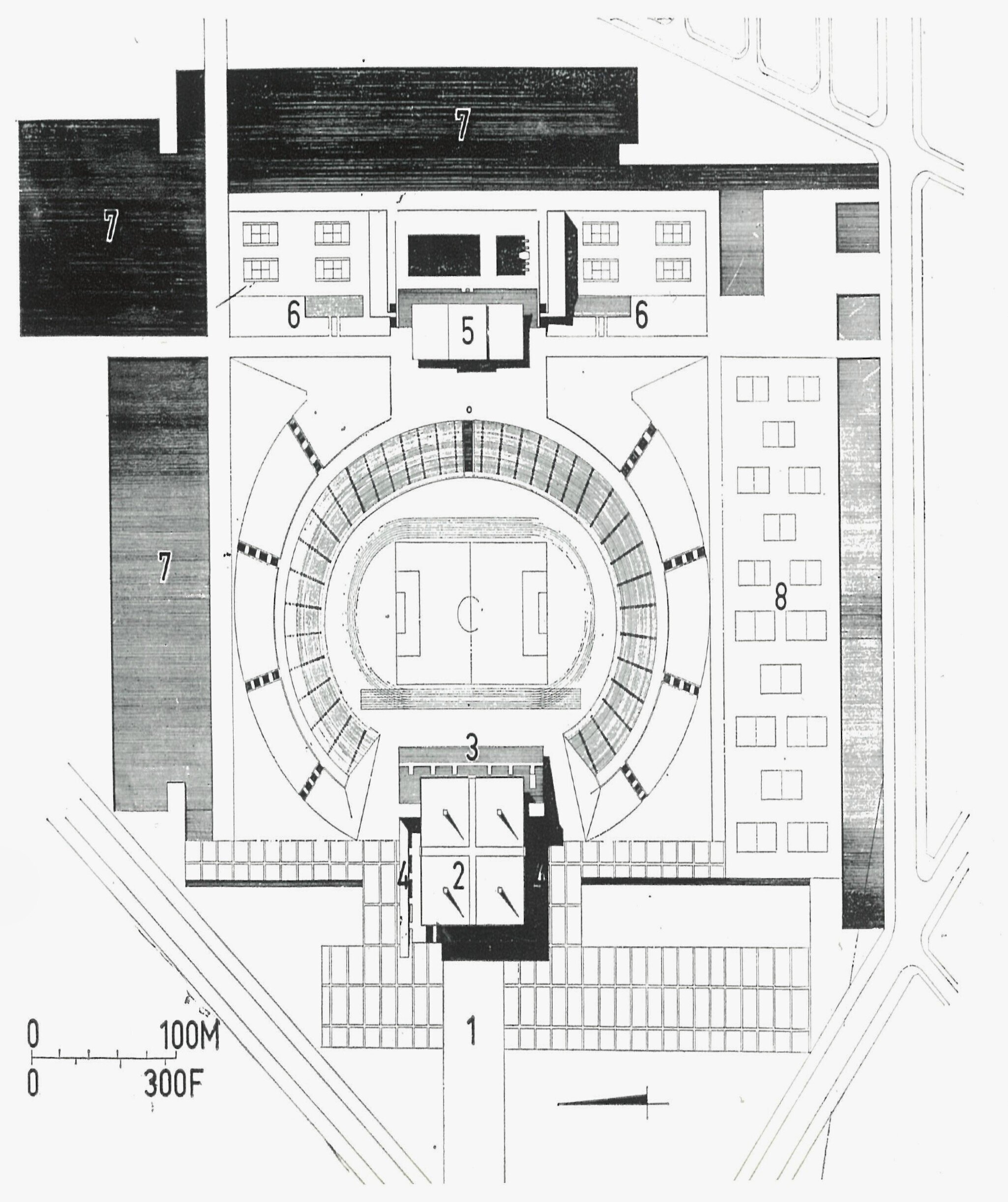
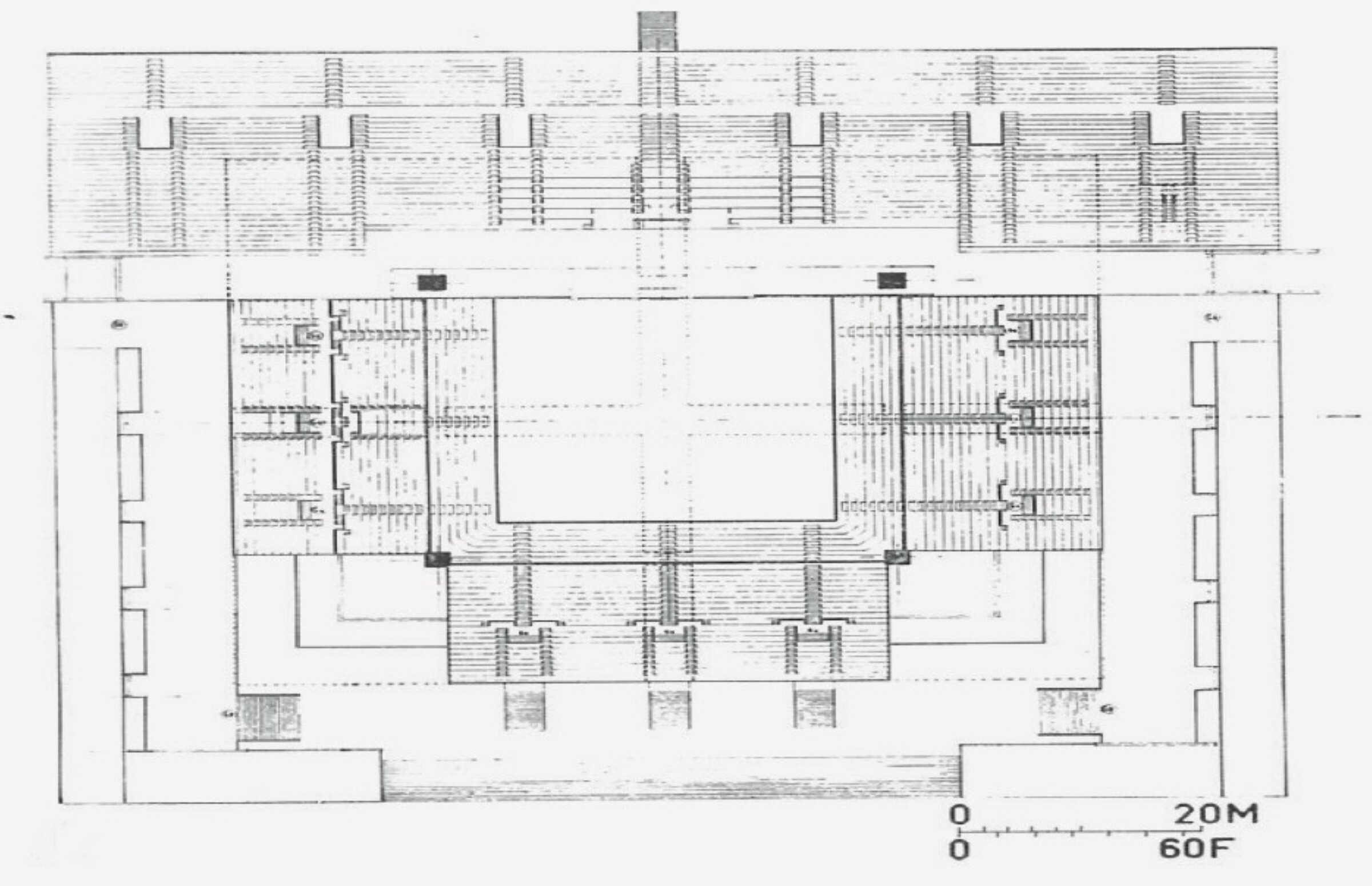
1) General Floorplan of the Olympic complex: 1- Access to main level, Sports Center. 2- Sports Center. 3- VIP Grandstand, Stadium. 4‑Access ramp to Grandstand foyer. 5- Shaded stands (pool). 6- Tennis courts, bleachers. 7. Rainwater collection pit. 8. Sports fields (soccer, basketball, etc.). 2) Sports Center, floorplan at stand level. B. Coupe d’ensemble sur le Palais des Sports.

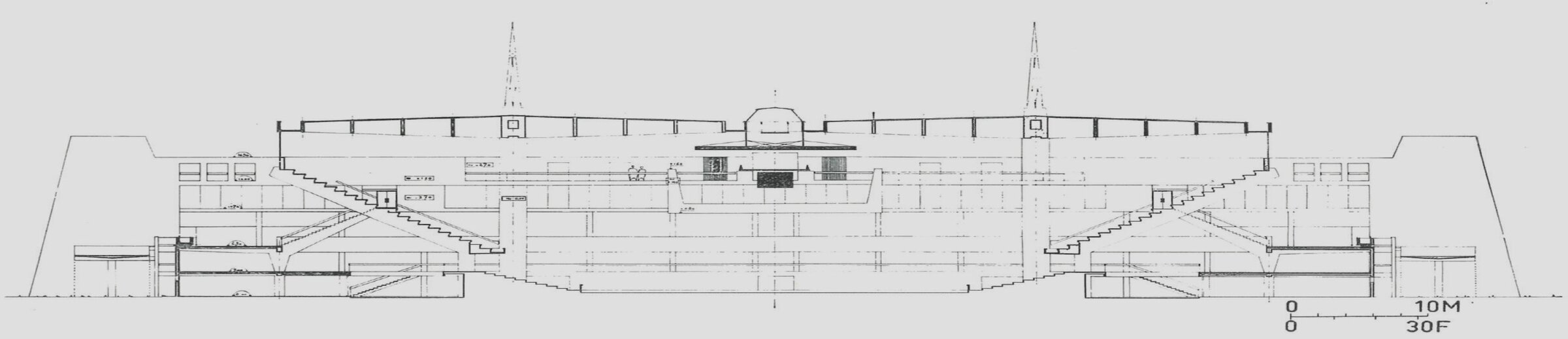
1 and 2) Cross-sections of the Sports Center.
1 and 2) Cross-sections of the Sports Center.
1 and 2) Cross-sections of the Sports Center.
Descriptive
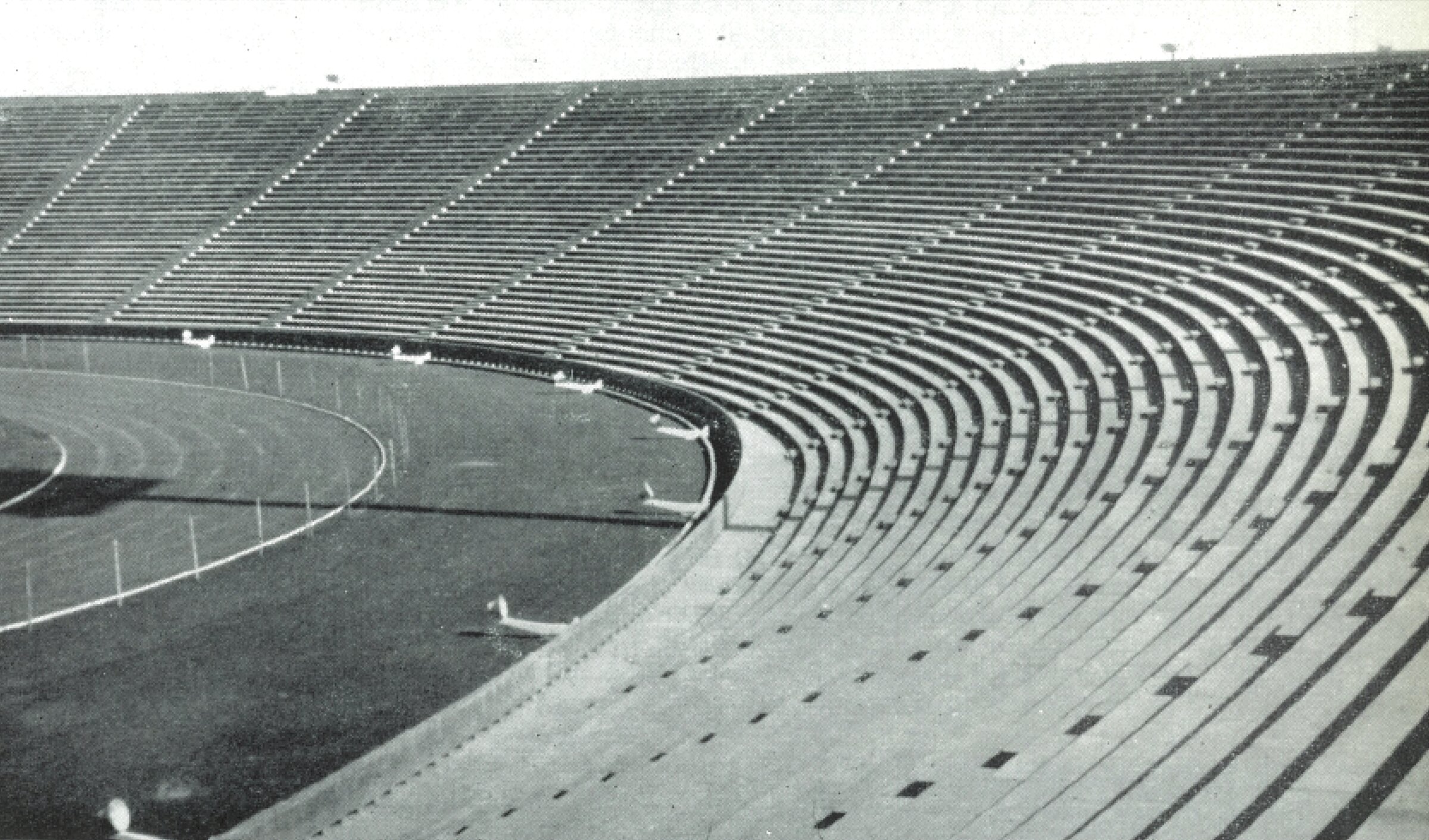
The Olympic Stadium takes the form of an elliptical crown [1] open to the east, bordered at the edge of the Sports Palace by sloping planes designed as monumental steps. The 600,000 cubic meters of earth required for the stadium bowl’s embankment and the site preparation were sourced locally from the creation of moats intended to collect overflow water during the rainy season and to give the architecture a distinctive character. The bowl’s apex is occupied by a wide circulation area distributing access to the 50,000 seats in the stands and 10,000 standing places, via eight staircases built into the exterior grassed embankment.
Overall, the design reveals three sectors, each dedicated to the following uses: indoor sports, outdoor sports, and water sports. It includes the Sports Palace, the Olympic Stadium, the Olympic Swimming Pool, and the facilities for aquatic competitions along the Mekong River.
The Sports Palace, built at the entrance to the complex, remains, by its design and size, the dominant architectural element of this sports complex. It primarily houses an 8,000-seat indoor arena, with spectators arranged around the playing area on three tiers of stands to the east, north, and south; the fourth side is occupied by a portico supporting the Olympic Stadium’s main stand.
The structure of the tiers of stands consists of a series of “giraffe” beams resting at their base on columns and in the middle on a longitudinal beam that distributes the total load of the stands onto the struts supporting the access staircases. The roof of this hall and part of the stadium’s main stand consists of four giant concrete umbrellas, each 34 meters square, supported 20 meters high by pillars with a 2‑meter cross-section.
The Greek cross-shaped void between these four umbrellas allowed for the installation of ventilation and daylighting skylights, as well as a technical gallery constructed of metal elements, clad in aluminum, and whose façade ends are closed by decorative tympana or crests of anodized aluminum. Rainwater is channeled inside the pillars and flows into basins distributed around the hall. The hall is enclosed by a curtain wall composed of alternating V‑shaped elements, which provide excellent cross ventilation, effective sun protection, homogeneous light diffusion, and waterproofing of the facades.
The Sports Palace ground floor, in addition to the lobby, houses the technical facilities and athletes’ areas, which connect directly to the Olympic Stadium.
The two levels reserved for the public (administration, press, restaurant, association offices, etc.) are accessible from the main entrance via a wide flight of steps and two ramps located on either side of the Palais des Sports. The upper level, accessible by elevators, houses the reception areas. The Olympic podium, located opposite the Palais des Sports and connecting to the swimming pool, is directly linked to the stadium by a grand staircase.
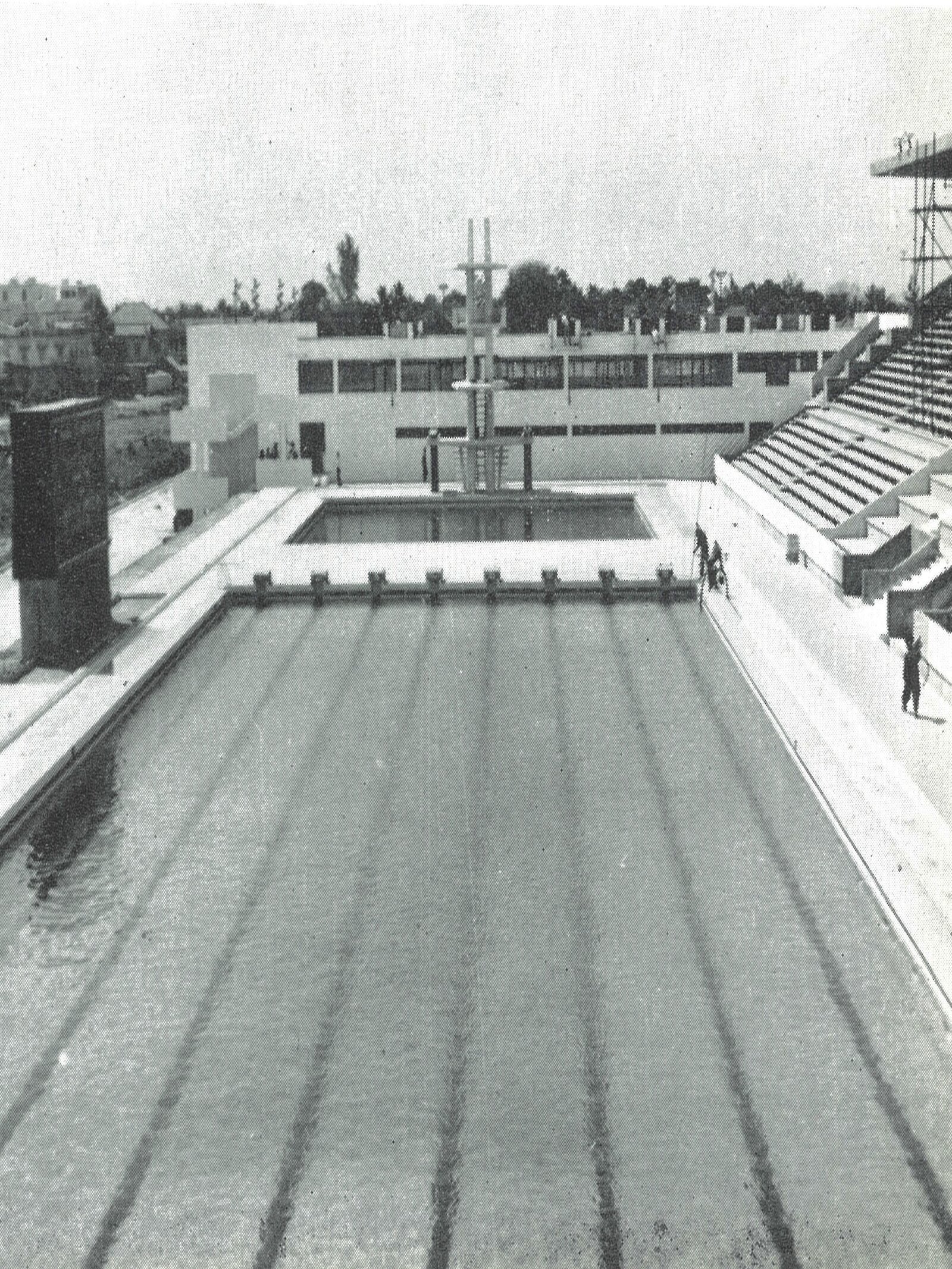
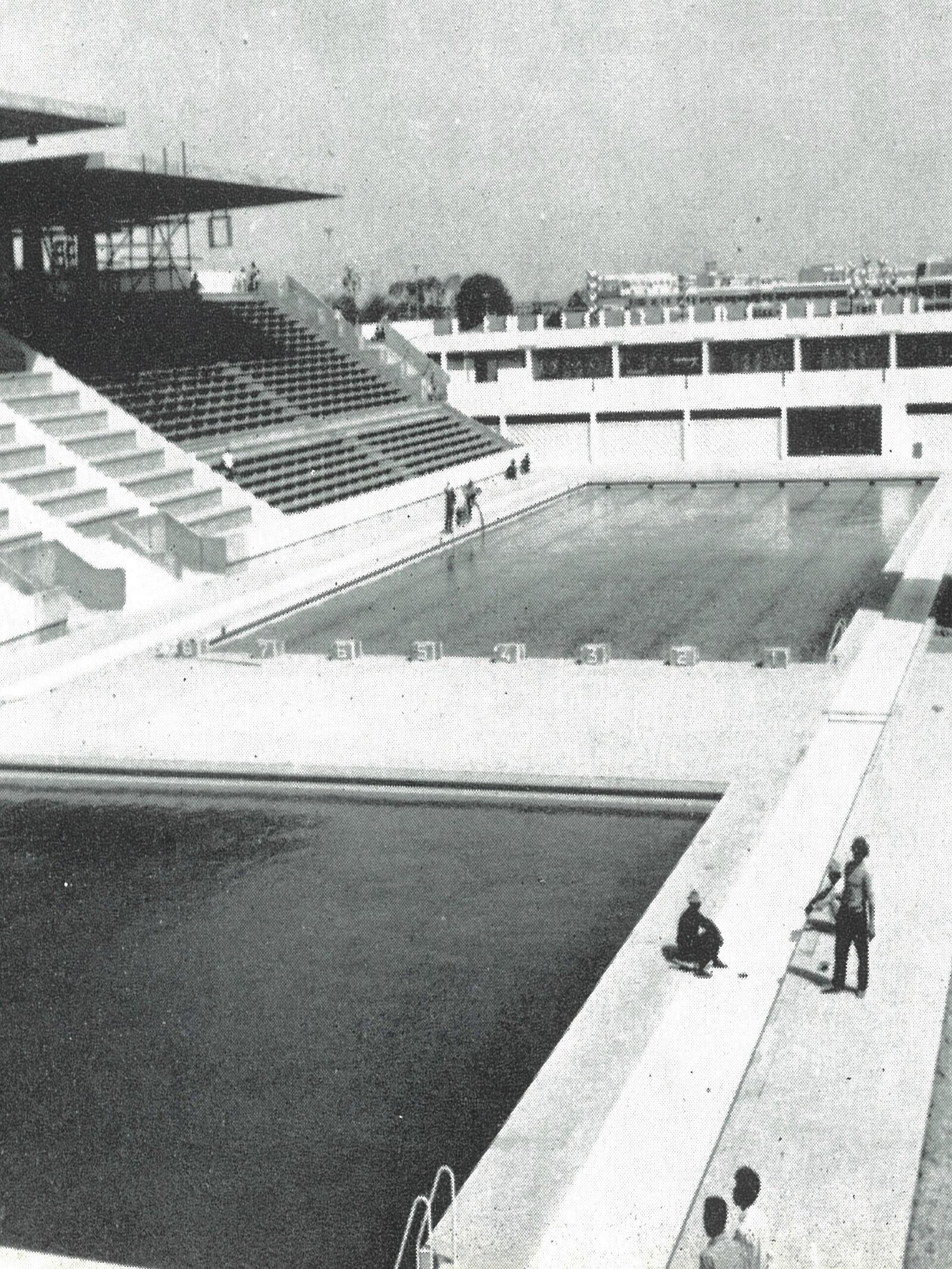
The Olympic swimming pool, with seating for 4,000 spectators, includes a pool equipped with a diving board and a regulation 50 x 20 m pool with 8 lanes.
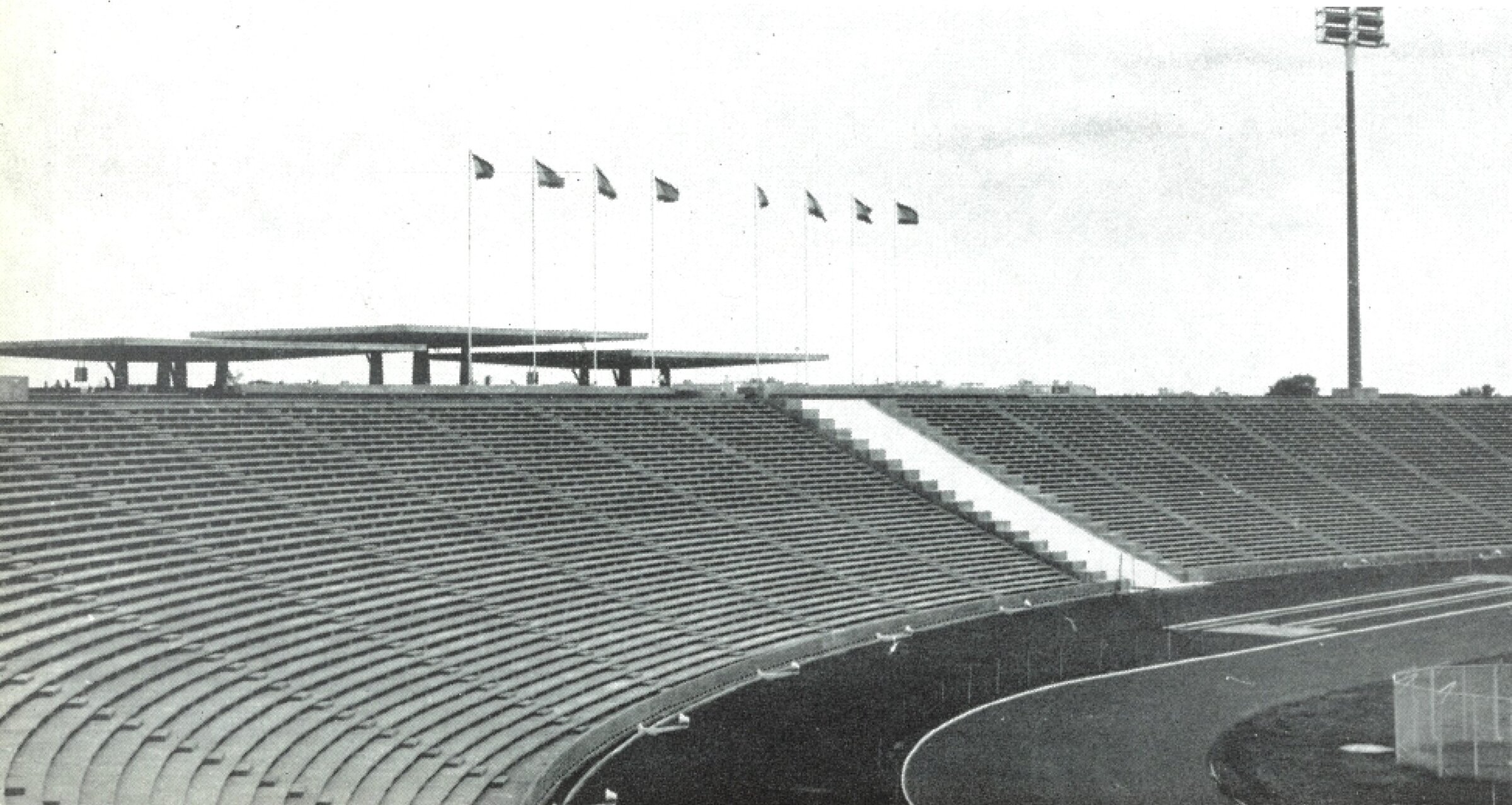
The roof covering part of the stands consists of three reinforced concrete canopies, each 27 meters square and resting on a central element made up of four 3.5‑meter-high columns. The central canopy, slightly taller, overlaps the lateral canopies by 2 meters. This structure, located at the rear of the Olympic podium, also serves as access to the stands.
The buildings surrounding the pools house, in addition to technical facilities, a restaurant and bar, as well as facilities for athletes and the public using the pool and tennis courts.
The Olympic complex is complemented to the south of the Stadium by a series of training fields, ensuring continuous use of the Sports Palace.
The water sports complex on the banks of the Bassac River, offering a sweeping view of the Mekong, includes, in addition to boat garages and floating docks, a clubhouse, a restaurant, administrative offices, and various facilities for athletes, judges, and the press.
Finally, a 200-unit apartment building was erected within the same timeframe on the banks of the Bassac River; it will house the 2,000 athletes of the Third South Asian Olympic Games before being converted into luxury apartments.
Although some of the work was carried out during the two monsoon seasons, the project was completed in 18 months.
Gerald Hanning’s Urbanistic Perspective
The central plains of Cambodia are an amphibious land subject to the peaceful yet immense annual floods of the Tulesap and Mekong rivers.
Human settlement there is necessarily founded on a demiurgic act of dividing land and water, through the earthworks whose tireless labor of Khmer farmers shaped the Cambodian landscapes and whose masterful execution constituted the ancient monumental settlement of the Angkor region.
This system of dikes and canals, of “mountains” (phnom) and moats, so characteristic of Khmer settlements, was naturally applied to the conception of the new Olympic complex, built in 1963 and 1964 in the Cambodian capital. This work, contemporary in its program and techniques, integrates itself into the landscape and climate through its design, its traditional disciplines, its form, and its implementation. It is an example of the adaptation of architecture and technology to the specific conditions of the country and to the essence of its culture.
For Cambodian artists, this can be seen as the origin of an awareness of their capacities as modern creators and builders, and for the experts of the United Nations Technical Assistance, as an experience generally applicable to developing countries, where progress must proceed not simply through the importation of Western technology, but, as here, through the synthesis of modern forms and techniques with the resources of an original culture.
[1] The stadium bowl was called ‘couronne’ [crown] in French.
1) View on the ‘umbrella’ structures above VIP grandstands. 2) Stadium bowl, detail of the stand bend.
1) View on the ‘umbrella’ structures above VIP grandstands. 2) Stadium bowl, detail of the stand bend.
1) View on the ‘umbrella’ structures above VIP grandstands. 2) Stadium bowl, detail of the stand bend.
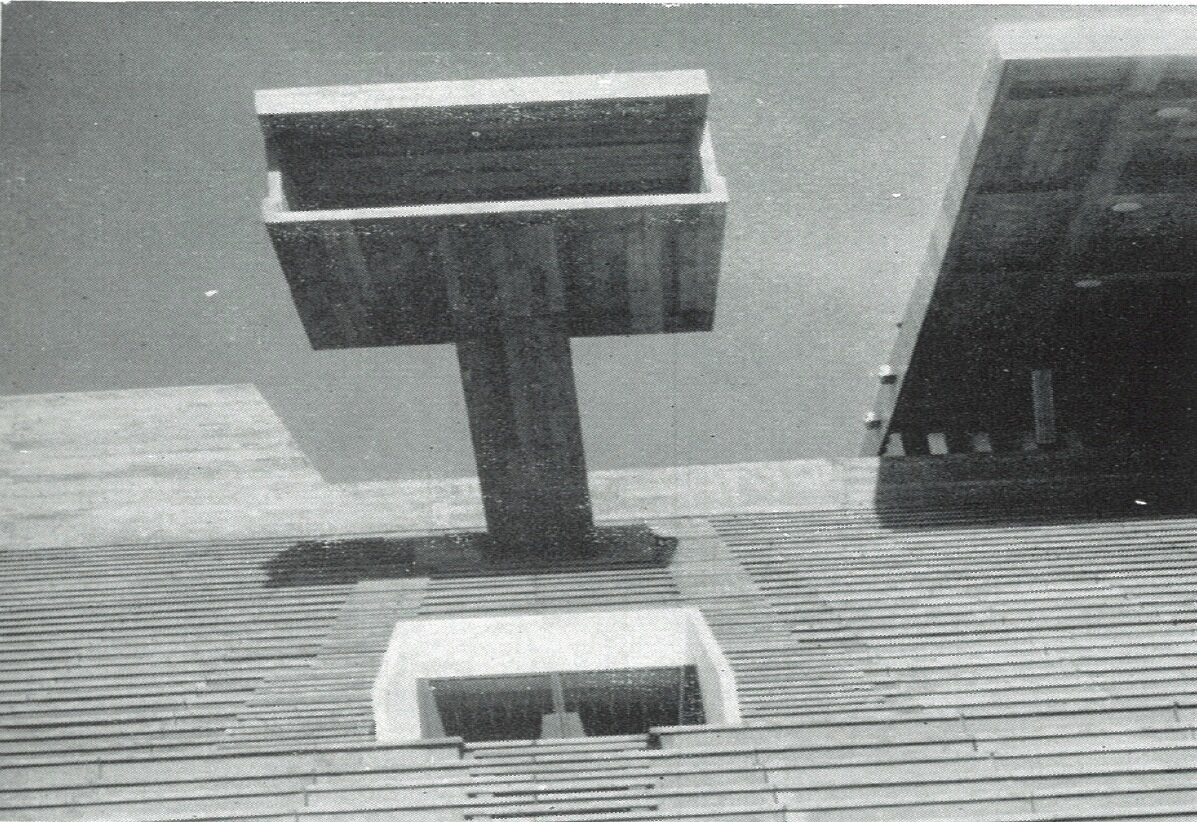
1) The Press lookout (‘tribune de presse’). 2) Le Palais des Sports. 2) Interior view of the Sports Center, lit and ventilated from above by skylights set in the Greek cross-shaped void between the four umbrellas, and laterally by the curtain wall composed of alternating V‑shaped elements.
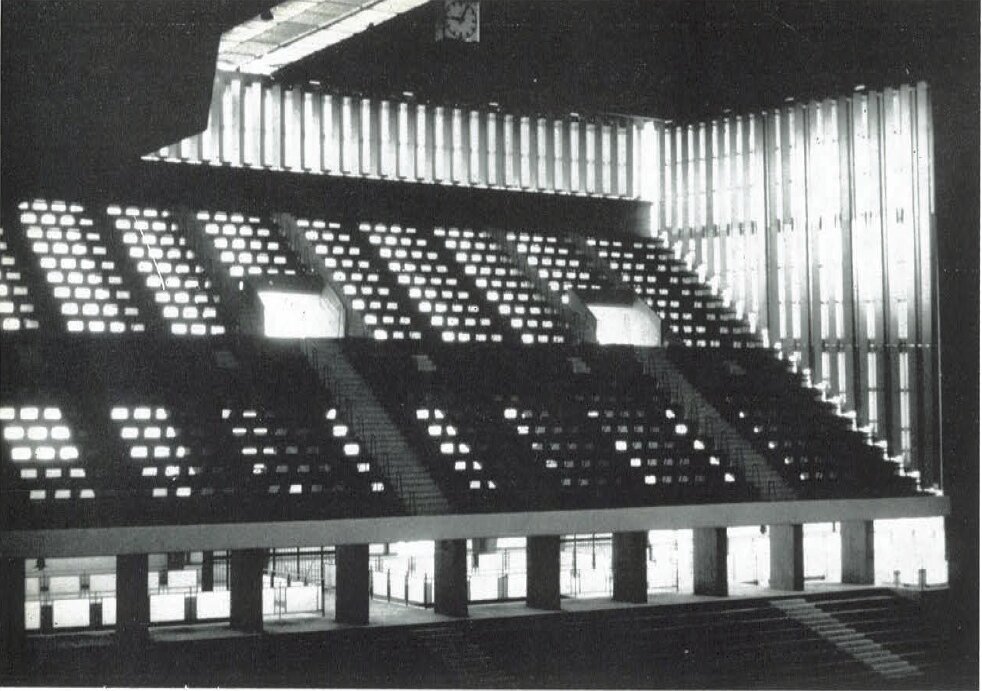
1) The Press lookout (‘tribune de presse’). 2) Le Palais des Sports. 2) Interior view of the Sports Center, lit and ventilated from above by skylights set in the Greek cross-shaped void between the four umbrellas, and laterally by the curtain wall composed of alternating V‑shaped elements.
1) The Press lookout (‘tribune de presse’). 2) Le Palais des Sports. 2) Interior view of the Sports Center, lit and ventilated from above by skylights set in the Greek cross-shaped void between the four umbrellas, and laterally by the curtain wall composed of alternating V‑shaped elements.
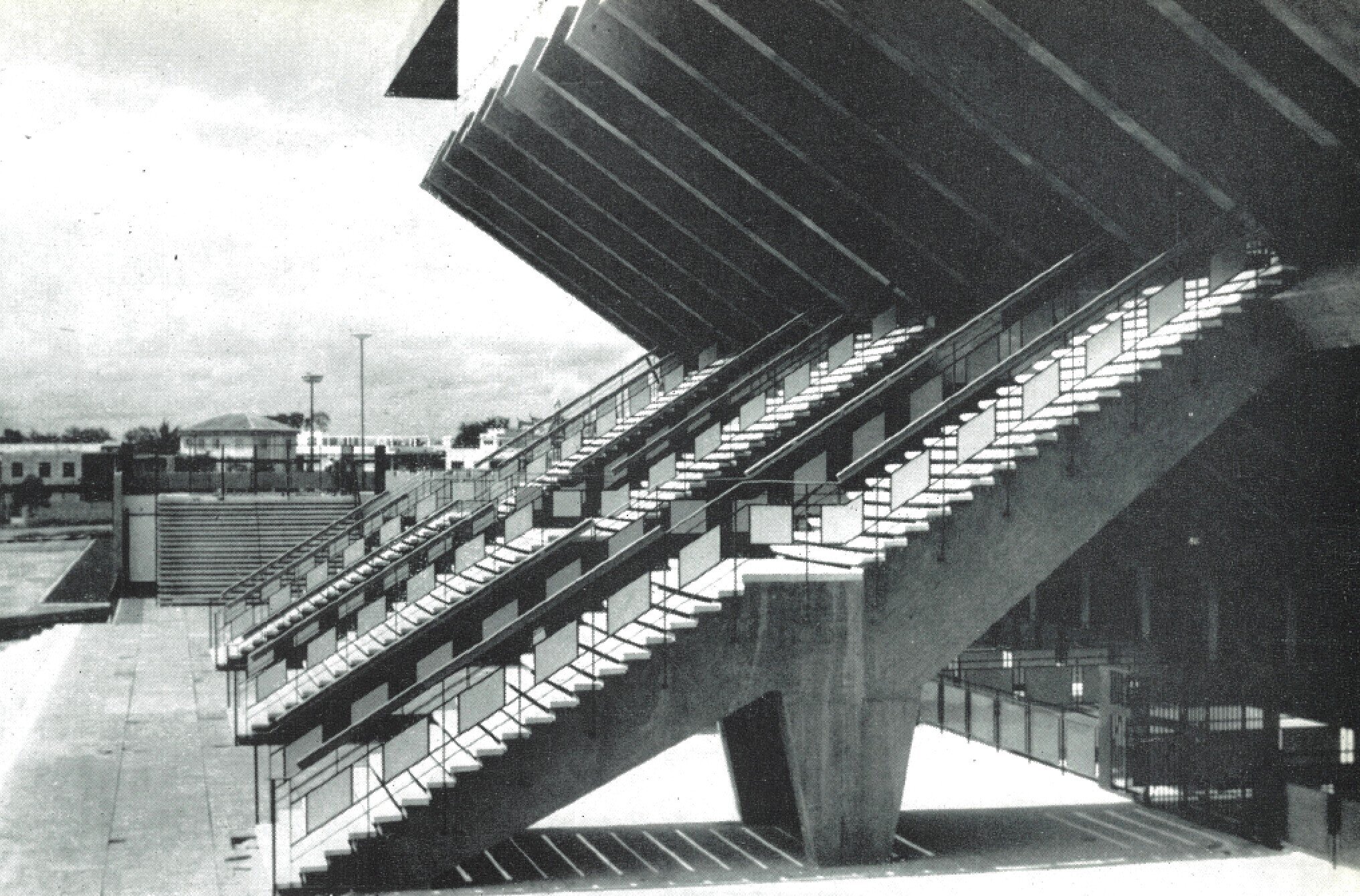
3) Access to grandstands, monumental stairways.
3) Access to grandstands, monumental stairways.
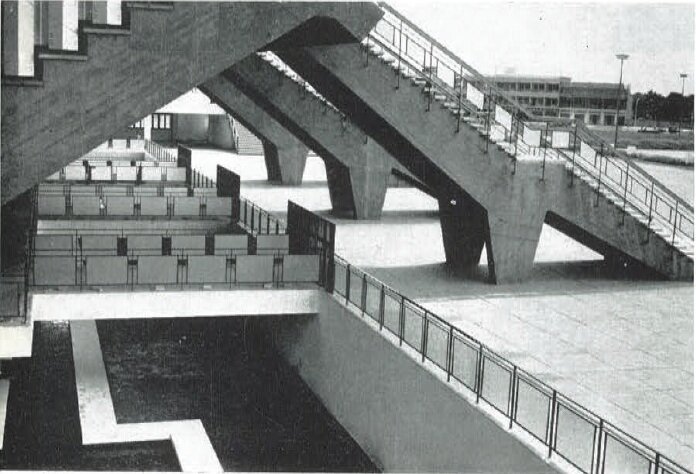
4) Detail of main stairways, structurally linked to the grandstand above the moats channeling rainwater collection durant the monsoon season. 5) Detail of the gargoyle conducting rainwater from each other pillar into one of the four basins.
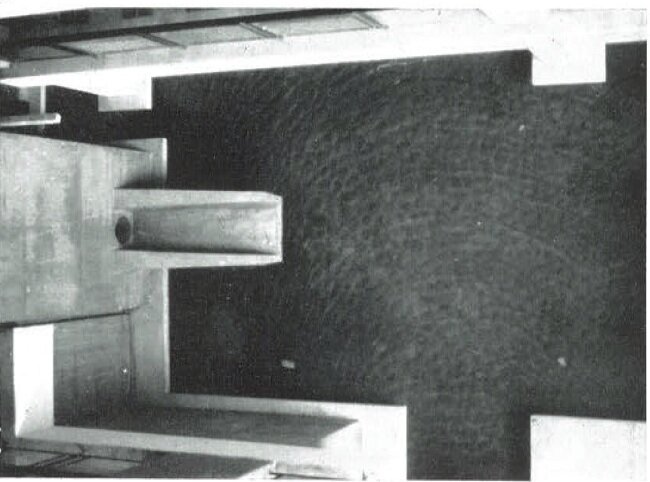
4) Detail of main stairways, structurally linked to the grandstand above the moats channeling rainwater collection durant the monsoon season. 5) Detail of the gargoyle conducting rainwater from each other pillar into one of the four basins.
4) Detail of main stairways, structurally linked to the grandstand above the moats channeling rainwater collection durant the monsoon season. 5) Detail of the gargoyle conducting rainwater from each other pillar into one of the four basins.
From L’Architecture d’aujourdhui 116, Sept-Oct. 1964: 28 – 32.
From L’Architecture d’aujourdhui 116, Sept-Oct. 1964: 28 – 32.
The Olympic Pool, 1964 [From L’Architecture d’aujourdhui 116, Sept-Oct. 1964: 28 – 32.]
Project Team
- VANN MOLYVANN, ARCHITECTE, SECRÉTAIRE D’ÉTAT AUX TRAVAUX PUBLICS [Architect, State Secretary of Public Woks] and
- V. BODIANSKY, EXPERT DE l’ASSISTANCE TECHNIQUE DES NATIONS UNIES [Expert with the UN Department of Technical Support], with the assistance of:
- MEAN KIMLY, INGÉNIEUR T. P. DIRECTEUR DE L’URBANISME ET DE l’HABITAT [Public Works Engineer, Director of Urbanism and Housing]
- UM SAMOUTH, CHEF DU SERVICE DE L’ARCHITECTURE [Chief of Architectural Department]
- G. HANNING, URBANISTE, EXPERT DE L’ASSISTANCE TECHNIQUE DES NATIONS UNIES [Urban Planner, Expert with the UN Dept. of Technical Support]
- DUCHEMIN ET MORIN, ARCHITECTES [Architects]
- KANDAOUROFF, BUREAU D’ÉTUDES TECHNIQUES [Office of Technical Design]
Tags: sports, Sangkum Reastr Neyum, 1960s, architecture, urbanism, National Sports Complex, Phnom Penh, urban planning
About the Author
Molyvann Vann
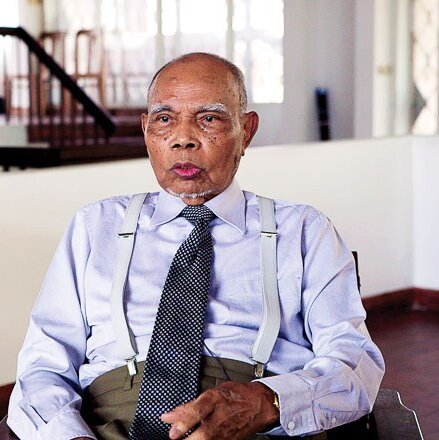
Vann Molyvann វណ្ណ ម៉ូលីវណ្ណ (23 November 1926, Ream – 28 September 2017, Siem Reap), a a leading Cambodian architect who largely contributed to the New Khmer Architecture movement, served as first Director of APSARA Authority, as well as Minister of Culture and of Education during King Norodom Sihanouk’s reign.
The designer of landmark monuments and building sucg as Phnom Penh Olympic Stadium, Chaktomuk Conference Hall, the Royal University, the Institute of Foreign Languages or Independence Monument, Vann Molyvann also reflected on urbanism and urban development.
Developing an interest in Angkor and Angkorean civilization since his youth, he studied architecture in Paris, coming back to Cambodia in order to develop post-colonial architecture, educational programs and renewed efforts in the preservation of Angkor that led to its inscription to UNESCO World Heritage list.
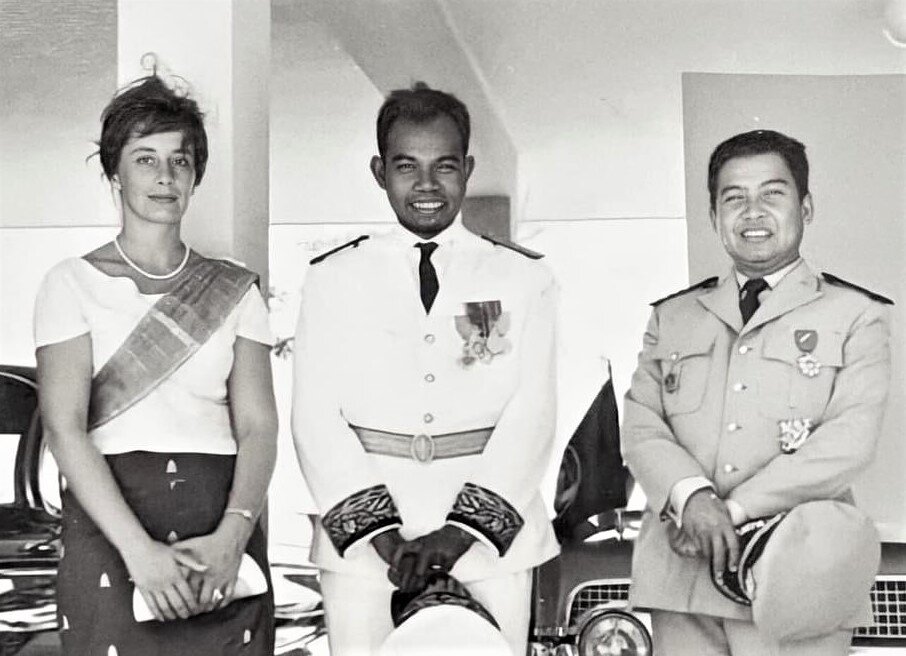
With second wife Trudy Amberg-Vann and HM King Sihanouk (collection Royal Cambodian Monarchy)
With second wife Trudy Amberg-Vann and HM King Sihanouk (collection Royal Cambodian Monarchy)
Since 2009, The Vann Molyvann Project has been working in raising awareness of the scope of Vann Molyvann’s legacy.