

Bernard Fall

Dr. Bernard B. (Berthold) Fall (19 Nov. 1926, Vienna, Austria – 21 Feb. 1967, near Hue, Thừa Thiên Province, Vietnam) was a soldier, war correspondent, political scientist, and historian who reported on and studied the ‘Indochina Wars’ in 1950s and 1960s. “A soldier and a scholar,” he advocated for the end of the US military escalation in Vietnam and praised King Norodom Sihanouk’s effort towards a peaceful, negotiated way out of colonialism.
The son of Jewish refugees in France, Fall joined the underground Resistance at age 16 — he had lost both his parents, his father tortured and killed by the Gestapo, his deported mother unaccounted for — and continued to fight Nazism in the French Army throughout World War II. Fluent in French, German and English (self-taught), he worked as a military translator for the US Counsel at the trial of Nazi magnate Alfred Krupp during the Nuremberg War Crime Tribunal in 1947 – 1948.
In 1951, he went to Syracuse University, NY, USA, on a Fullbright Scholarship, receiving his PhD in 1955 — his dissertation was tittled Political Development of Viet-Nam, VJ-day to the Geneva Cease-Fire. There, he met Dorothy Winer, a visual arts student he fell in love with, the two getting married on 20 February 1954, a few weeks between the final collapse of French military intervention in Vietnam at Dien Bien Phu, which he covered first-hand. His physical bravery and intellectual independence was then established, and he became over the years a respected expert in the bloody conflict that would only end with the fall of Saigon [now Ho Chi Minh Ville] on 30 April 1975.
While teaching international relations at Howard University, Washington DC, he went back to Southeast Asia five more times — in 1957, 1961 – 2, 1965, 1966, and 1967. From December 1961 to late August 1962, he lived with Dorothy and their two daughters in Phnom Penh thanks to a research grant from the Rockefeller Foundation and a teaching assignment at the Cambodian Royal Institute of Administration allowed him to complete the manuscript of Street Without Joy. From Cambodia, Fall traveled to Vietnam and interviewed Ho Chi Minh, presenting the Vietnamese leader with a copy of his new book. Dorothy Fall recalled their stay, and their friendship with Prince Sihanouk and Princess Monique (Monineath), in her 2006 book.
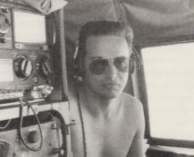
1) Bernard Fall on an airborne mission in Vietnam, 1953. 2) Presenting his nemesis, Madame Nhu, and her daughter, with a copy of his book, The Two-Vietnams, at Howard University, Oct. 1963. 3) The last family photo with daughters Elisabeth, Nicole, and Patricia in the arms of Dorothy, Hong Kong, Christmas Eve 1966 [photos from Dorothy Fall, Bernard Fall: Memories of a Soldier-Scholar, 2006].
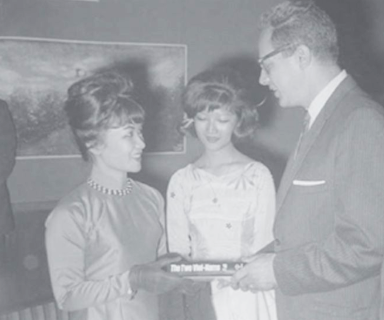
1) Bernard Fall on an airborne mission in Vietnam, 1953. 2) Presenting his nemesis, Madame Nhu, and her daughter, with a copy of his book, The Two-Vietnams, at Howard University, Oct. 1963. 3) The last family photo with daughters Elisabeth, Nicole, and Patricia in the arms of Dorothy, Hong Kong, Christmas Eve 1966 [photos from Dorothy Fall, Bernard Fall: Memories of a Soldier-Scholar, 2006].
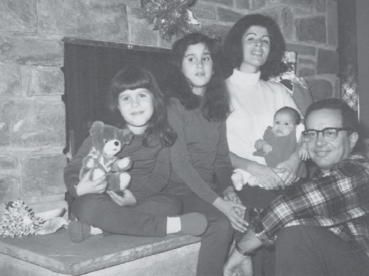
1) Bernard Fall on an airborne mission in Vietnam, 1953. 2) Presenting his nemesis, Madame Nhu, and her daughter, with a copy of his book, The Two-Vietnams, at Howard University, Oct. 1963. 3) The last family photo with daughters Elisabeth, Nicole, and Patricia in the arms of Dorothy, Hong Kong, Christmas Eve 1966 [photos from Dorothy Fall, Bernard Fall: Memories of a Soldier-Scholar, 2006].
1) Bernard Fall on an airborne mission in Vietnam, 1953. 2) Presenting his nemesis, Madame Nhu, and her daughter, with a copy of his book, The Two-Vietnams, at Howard University, Oct. 1963. 3) The last family photo with daughters Elisabeth, Nicole, and Patricia in the arms of Dorothy, Hong Kong, Christmas Eve 1966 [photos from Dorothy Fall, Bernard Fall: Memories of a Soldier-Scholar, 2006].
Increasingly worried that the American administration was repeating France’s mistakes in Vietnam, and appalled by the exactions of South Vietnamese leader Ngo Dinh Diem and his brother Ngo Dinh Nhu — whose influent wife and soon widow, Madame Nhu, had a nefarious influence on US political elites -, Bernard Fall came to the conclusion that the USA were losing the war as early as 1964. His predictions were lucidly documented and argumented but only triggered the hostility of the “military-industrial complex”, and during the last three years of his life he was closely monitored by the Federal Bureau of Investigation (FBI). That suspicion shockingly contrasted with the esteem in which his opinion was held by international leaders — including Prince Sihanouk, who always expressed his utter respect for him -, diplomats, academics and even military officials, including hawkish ones like George Bush’s Secretary of Defense Colin Powell.
Suffering from retroperitoneal fibrosis, a rare and then incurable disease, Fall was first hospitalized the eve of President John F. Kennedy’s assassination in Dallas on 22 Nov. 1963. From that time, he developed a sense of seasoned soldier’s fatalism which be attempted to balance with his love for his family. Leaving Hong Kong for Vietnam on Christmas’ Eve 1966, he wrote a farewell note to Dorothy that was to be given to her with his personal effects only after his death. On 21 February 1967, while accompanying a company of the 1st Battalion 9th Marines on Operation Chinook II near Hue, he stepped on a ‘Bouncing Betty’ landmine. He was killed along with Gunnery Sergeant Byron G. Highland, a US Marine Corps combat photographer. Two days later, the US Department of Defense ruled that Bernard Fall could not be buried in Arlington National Cemetery. Instead, he was interred at Rock Creek Cemetery, also in Washington, DC.
Publications
[numerous articles in various publications such as The New York Times Magazine, The Saturday Evening Post and The New Republic, as well as academic journals, are not listed here. See Bernard Fall’s website for a complete bibliography.]
- The Viet-Minh Régime, New York: Institute of Pacific Relations & Cornell University, 1954.
- Le Viet Minh 1945 – 1960, Paris: Armand Colin. 1960.
- Street without Joy: Indochina at War, 1946 – 54. Harrisburg, Pa.: Stackpole. 1961. | FR Rue Sans Joie: Indochine 1946 – 1962, tr. by Serge Ouvaroff, preface by Herve Gaymard, Paris, Les Belles Lettres, 2019, 464 p., ISBN 978 – 2251450360.
- The Two Vietnams: A Political and Military Analysis, New York, Frederick A. Praeger, 1963; repr. 1985, Westview Press, 507 p., ISBN 978 – 0813300924.
- Hell in a Very Small Place: The Siege of Dien Bien Phu. Philadelphia, Lippincott, 1966.
- Viet-Nam Witness 1953 – 66, New York, Praeger, 1966, 353 p.
- Last Reflections on a War. Garden City, New York: Doubleday & Co, 1967.
- Ho Chi Minh on Revolution; Selected Writings 1920 – 66. New York, Praeger, 1967.
- Anatomy of a Crisis: The Laotian Crisis of 1960 – 1961, Garden City, New York: Doubleday. 1969.
Research and Memories on Bernard Fall
- Dorothy Fall, Bernard Fall : Memories of a Soldier-Scholar, Washington, D.C.: Potomac Books, 2006, 285 p. ISBN 1574889575. (Kindle Edition).
- Frances FitzGerald, “The Reporter Who Warned Us Not to Invade Vietnam 10 Years Before the Gulf of Tonkin”, The Nation, 6 April 2015.
- Nathaniel L. Moir, “Bernard Fall and Vietnamese Revolutionary Warfare in Indochina”. Small Wars & Insurgencies 28 (6), 2017: 909 – 946.
- Hervé Gaymard, Un homme en guerres: Voyage avec Bernard Fall [A Man at Wars: Travel with Bernard Fall], Paris, Edition des Equateurs, 2019, 256 p.
- Michael A. Innes, Streets Without Joy: A Political History of Sanctuary and War. London: C. Hurst & Co., 2020, 336 p. ISBN 978 – 1787383173.
- Nathaniel L. Moir, Number One Realist: Bernard Fall and Vietnamese Revolutionary Warfare, Oxford University Press, 2022.
- Bernard Fall: Visionary Soldier-Scholar [exhaustive website by his youngest daughter, Patricia Fall, and grandson Bernard Fall-Conroy. FallMediaGroup LLC.
Main photo: Bernard Fall when he served as translator at Nuremberg War Crime Tribunal, 1948.