

Dorothy Fall

Dorothy Fall born Winer (b. 7 April 1930, Rochester, NY, USA) is an American artist, graphic designer and writer who published in 2006 a book of memories on famous war correspondent and political scientist Bernard Fall (1926−1967), her husband since 20 February 1954 and the father of their three daughters, Nicole, Elisabeth and Patricia.
The youngest of four children from Isadore Winer and Esther Rudman-Winer, a couple of Eastern European Jewish refugees, she majored in graphic design at Syracuse University, where she met an exchange student from France in 1951, Bernard Fall, recounting the moment in Bernard Fall: Memories of a Soldier-Scholar:
We wanted to expose students to other cultures, and therefore decided to have a series of lectures by foreign students. After sociology professor Byron Fox addressed our group on world poverty, my cochair Joan Altstedter and I asked him to recommend foreign students who could speak to us. He suggested a French student who was a Fulbright scholar studying at Syracuse’s Maxwell School of Citizenship. Joan phoned to invite him to talk at our next session. She reported to me, “He doesn’t sound French, and he doesn’t even have a French name: Bernard Fall. He wants us to meet with him at the Cosmo for coffee on Tuesday evening at eight.”
To publicize this talk by a Frenchman, I produced three-dimensional posters and put them up around the campus. They featured an entirely stereotyped Frenchman. He sported a twirling mustache, wore a black beret, and I had a real cigarette hanging out of his mouth through a hole in the board. At the end of the cigarette, to simulate smoke, I glued a flowing ribbon of nylon, which I cut from an old stocking. I let my creative urges run wild. “Are We It? A Frenchman’s View of the U.S., March 5, 1952,” the posters proclaimed. I also produced fliers which included a small drawing of the Arc de Triomphe and the handwritten phrase “Ah! Paree!” I had of course never been to Paris.
On Tuesday, [my friend] Joan and I met our Frenchman, who proved to be an attractive, six foot tall, clean-cut young man with a crew cut, who was wearing an American Army bomber jacket, blue jeans, and loafers. “Who is that idiot who did those stupid posters?” he asked. I admitted to being the idiot, but Bernard only laughed. He didn’t even sound French. He spoke colloquial English with a midwestern twang and a barely perceptible accent. He told us that was because he’d taken a course in remedial English given to American GIs in Germany. [p 47]
While Bernard Fall was increasingly involved in the coverage of the French debacle in Indochina, culminating with the Battle of Dien Bien Phu (13 March and 7 May 1954), she furthered her art studies, at the American University and in Paris at the Académie de la Grande Chaumière (1961) and Académie Julian (1965). She worked as Deputy Art Director of AMERIKA Magazine, the publication of the United States Information Agency, Washington, from 1956 to 1980, and she held her first ever solo exhibition in 1962 in Phnom Penh (at Maison de France), when she spent 10 months in the Cambodian capital city with Bernard and their two eldest daughters. They befriended Prince Norodom Sihanouk and Princess Monique ‑Monineath, as well as the Cambodian leader’s then-close advisor Charles Meyer and his wife of Chinese origin, Sika.
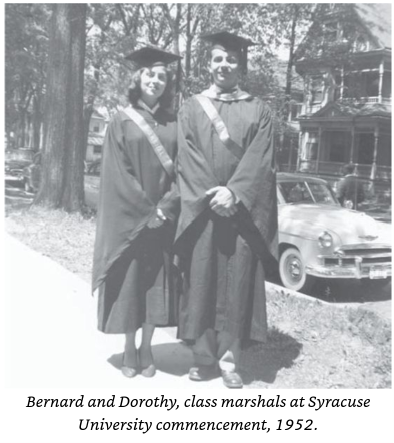
Bernard Fall and Dorothy Winer, Syracuse University, 1952.
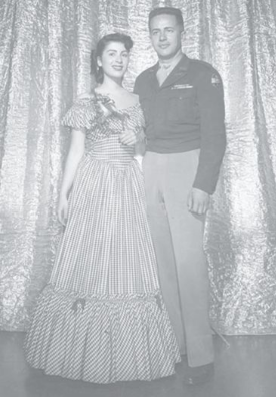
Bernard Fall and Dorothy Winer, Syracuse University, NY, USA, 1952.
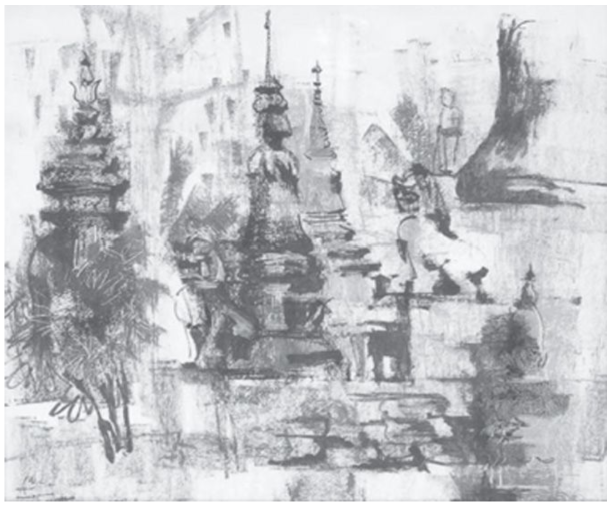
1, 2) Syracuse U sweethearts: Bernard Fall and Dorothy Winer in 1952. 3) Wat Phnom, painting by Dorothy Fall, 1962. 4) Prince Sihanouk bought one of Dorothy’s paintings at her Maison de France exhibition, Phnom Penh, August 1962. [all photos from Dorothy Fall, Bernard Fall: Memories of a Soldier-Scholar, 2006].
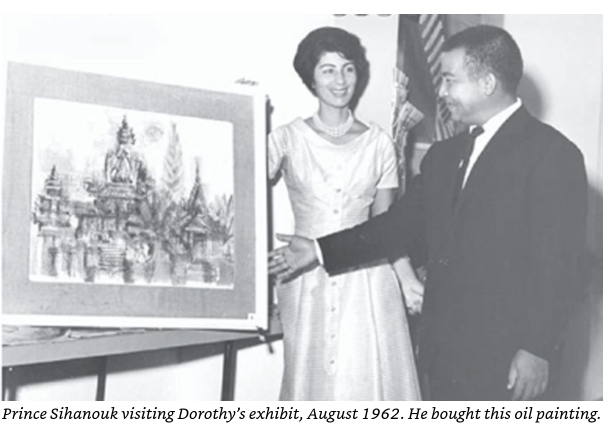
Prince Sihanouk at Dorothy Fall’s Phnom Penh exhibition, August 1962.
1, 2) Syracuse U sweethearts: Bernard Fall and Dorothy Winer in 1952. 3) Wat Phnom, painting by Dorothy Fall, 1962. 4) Prince Sihanouk bought one of Dorothy’s paintings at her Maison de France exhibition, Phnom Penh, August 1962. [all photos from Dorothy Fall, Bernard Fall: Memories of a Soldier-Scholar, 2006].
Later, the couple traveled to Australia, Oceania, North Africa, while keeping bases in America and France. Late 1966, as Bernard Fall had been diagnosed with a rare, incurable disease, she moved to Hong Kong with their children in order to be closer to her husband, as he was still going back to “an incredibly stupid and brutal war” in Vietnam, as he wrote to her in his final written message shortly before his death near Hue, when he stepped on a landmine while walking along a US Marine patrol on the ‘Street Without Joy’ (Colonial Road 1) on 20 February 1967.
After Bernard’s death, Dorothy Fall helped in publishing posthumous editions of his work, facing the hostility of the warmongers who could not forgive his visionary denunciation of the American failure in Vietnam. She kept exhibiting her artworks, launching her communications firm, Fall Design Communications, in 1980 and heading art galleries Gallery 10 and Pyramid Atlantic in Washington, D.C. With her daughters, she visited Vietnam and Cambodia again in the early 1990s, still marveling at “spectacular Angkor” yet saddened by the scars the conflict and civil war had left.
Right after Bernard Fall’s death, Dorothy had written in her preface to the collection Last Reflections on A War, 1967:
This was Bernard’s sixth trip to his beloved Viet-Nam. He was first introduced to the area in 1953 when he decided to write his doctoral dissertation on the Viet-Minh, Ho Chi Minh’s guerrillas who were then fighting the French. He was always proud to admit that he had gone on his own funds— the meager savings he had accumulated during his student days. From his letters to me evolved Street Without Joy. The French censor had chided him for these letters. “Why don’t you stick to love letters to your fiancée instead of these detailed reports and maps on French operations,” he had said. To obtain his information on the structure and degree of infiltration of the Viet-Minh, Bernard went deep into the provinces of Viet-Nam interviewing officials, tax collectors and village chiefs. The resulting analysis showed that the situation was much different from what the French command thought it was. The enemy held far more terrain than was known or acknowledged.
[…] In late 1963, just three weeks after the November 1 coup in which President Diem was overthrown and he and his brother, Ngo Dinh Nhu, killed, Bernard landed in the hospital with a near fatal case of uremic poisoning. He had been in this state for a week; most people die after four or five days. His strong constitution and superb physical stamina would not permit it. […] President Kennedy was assassinated the day after Bernard entered the hospital and during my daily vigil I often envisioned Madame Nhu, whose own world had toppled, sitting before two dolls — one of President Kennedy and the other of Bernard Fall — eking out vengeance by sticking pins into them. [p 9 – 11]
At the turn of the century, Dorothy Fall took a step she had postponed for nearly three decades. As she explained herself on the blog Women Across Generations,
At the age of 70 I realized that it was now or never if I was to write the planned memoir about my late husband Bernard Fall. Out came the cartons filled with interviews, diaries and correspondence put away for this moment 20 years earlier. I do not consider myself a writer but an author with a story to tell. It took many years and more research as I wrote steadily. I cried as I sent the manuscript off to my editor. I could not believe that I finally wrote my book.
Solo Exhibitions by Dorothy Fall
- 1962 Maison de France, Phnom Penh, Cambodia
- 1968 Galerie Internationale, New York, NY
- 1969 Mickelson Gallery, Washington, DC
- 1970 Utica College, Utica, NY
- 1973 Mickelson Gallery, Washington, DC
- 1975 Mickelson Gallery, Washington, DC
- 1979 Mickelson Gallery, Washington, DC
- 1984 Mickelson Gallery, Washington, DC
- 1989 Plum Gallery, Kensington, MD | “O” Street Studio, Washington, DC
- 1990 AVA Gallery, Lebanon, NH | Covington & Burling, Washington, DC
- 1992 “O” Street Studio, Washington, DC
- 1993 American Horticultural Society, Alexandria, VA
- 1996 Gallery 10, Washington, DC
- 2000 Gallery 10, Washington DC | Cosmos Club, Washington, DC
- 2014 BlackRock Center for the Arts, Germantown, MD
- 2015 Cosmos Club, “Forest Spirits”, Washington, DC
- 2016 410 GoodBuddy, “Transitions”, Washington, DC
- Related Books