First-hand account of the life and works of celebrated war correspondent Bernard Fall, as well as an endearing testimony on Cambodia's daily life in 1961-1962.
Author
Dorothy Fall
Publisher
Washington DC, Potomac Editions. Foreword by David Halberstam. Kindle Edition.
Published
2006
Pages
285
Language
English
ISBN
978-1-57488-957-4
Formats
e-book, Kindle
The author, Dorothy Fall, an American visual artist and Bernard Fall’s wife, waited some 30 years to share this unique testimony on an exceptional war correspondent and scholar, their 10 months spent in Phnom Penh in 1961 – 1962, the way Prince Norodom Sihanouk negotiated the high and sometimes treacherous way of nonalignement when Southeast Asia was engulfed in flames, and, after much suffering and tears, the ultimate demise of US aggression on Southeast Asia which ended with the fall of Saigon in 1975.
Dorothy Fall conjured numerous memories in this poignant book, including the note her husband Bernard wrote to her before leaving for his last assignment when he was forseeing his death:
“X‑mas eve, 1966 — Darling, You will see this only if anything has happened. I want you to know that I loved you and the children terribly much and was proud of you. If I assumed the risks I did in this incredibly stupid and brutal war, I did so because somebody had to be a witness to what was happening. I hope that those poor blind men who direct America’s policies will awaken to the real facts before it is too late. In that case, whatever happened to me will not have happened in vain. I know that you will be thinking of me as I will think of you — no matter where I will be. Love, Bernard”
There were decades of silence after that, when Dorothy devoted her energy to their three daughters return in 1997 with two of her daughters, found Angkor
even more spectacular than I remembered. But Cambodia was heartbreaking, its people ravaged. Phnom Penh was a more modern city now but with too many ghosts. Elisabeth said that she felt death close at hand, that the dust had not settled. We were happy to leave.
It was only in 2000 that, thanks to a 1995 Bill Clinton’s directive to the FBI, she was able to access the files related to the US spies ‘snooping’ over her late husband. But Bernard Fall’s historic stature was already well-establish. As noted Vietnam war correspondent and writer David Halberstam (10 April 1934 – 23 April 2007) wrote in his Foreword,
When I first met Bernard, I belonged to a small group of correspondents who were constantly under attack because of their pessimism. It was the early sixties, and we were young. I was twenty-eight, which was about average, and my pal Neil Sheehan was even younger, twenty-five. We were good at what we did, and we sensed instinctively that it did not work, but we depended on Bernard for the reason why it did not work. At the time we were considered by two administrations to be “enemies of the people.” Five of us, all of us in that unofficial way taught by Bernard, went on to win the Pulitzer Prize. Not many professors can claim that five of their students did so well in such a short time. But then Bernard was teaching not just at Howard University — he was teaching the largest graduate class in the nation. The whole country was learning from him, if a bit too slowly. [p. xv-xvi]
Cambodia 1961 – 1962 as seen by Dorothy Fall
[Chap 12, p 161 – 177. Highlights by ADB.]
Bernard met us at the Pochentong airport in Phnom Penh on December 12, 1961. This would be our home until the following August, while Bernard worked on his Rockefeller Foundation project. Cambodia in those days was a never-never land with a rich mix of cultures and an aura of tranquility. It was a mysterious country with a legacy of the ancient Khmer civilization that had produced one of the wonders of the world, the temple city of Angkor. I marveled at the exoticism of the city. Palm trees lined the boulevards of Phnom Penh, and flowers and green grass decorated the central islands of its broad avenues. As a bonus, the French colonizers had left behind their culinary genius in many fine restaurants.
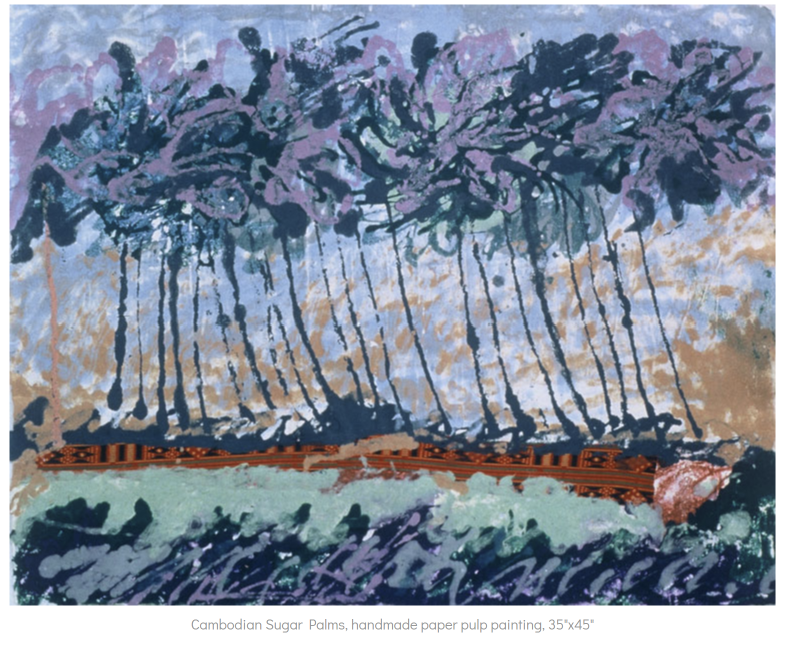
The city offered large, beautiful playgrounds for children. A quiet walk led up to the Wat Phnom, the highest point in the city, with its dome-shaped Buddhist shrines, or stupas. Surrounded by a lush park, it provided a place for contemplation and a taste of total serenity. Exploring beyond the city, we encountered dirt roads and people living in thatch-roofed huts on stilts. It was normal to see an elephant walking with its caretaker or leading a funeral procession down the road. Monkeys would jump down from trees in hopes of being fed, but they were vicious and one was wise to avoid them. There were vibrant emerald-green rice fields and tranquil villages. The sugar palms, their fronds whirling atop the long, curved trunks of the trees, were a visual delight and would inspire images for my art.
Buddhism is a peaceful religion, and you felt that in the people, in the air, as you moved along the city streets. The sweet smell of the purple frangipani covering garden walls and the flaming, six feet tall poinsettia in the gardens were balm to my soul. December’s coolness was a surprise. The months would change along with the heat and the monsoon rains; the latter would not last long but would inundate the streets as high as the car doors. The Cambodians did not seem impoverished. There was no begging. We found an abundance of fresh food. This was a land of bountiful exports of rice, sugar cane, fish, and spices. It was an under-populated country with only part of the arable land under cultivation. They were a fun-loving people, happy with each other. No one could imagine the horror that would begin there only thirteen years later.
The country revolved around Prince Norodom Sihanouk, the former king, who had abdicated the throne to his father in 1955, demoting himself so that he could take a political role in his country. As head of state, he walked a fine line between the East and West. He clung to neutrality to protect his country from joining Vietnam and Laos in the expanding war, a choice that outraged many in Washington. Americans at the embassy in Phnom Penh scorned him and mimicked his high-pitched voice and French repartee. They denounced him as a fool or a crypto-Communist. But his policy of neutralism was working. I respected that and could excuse his eccentricities and even enjoy them.
Sihanouk was a master showman, a dynamic personality who constantly worked the diplomatic community. Foreign ambassadors were persuaded to join him in digging trenches or trying their hands as bricklayers in his Manual Labor campaign. This set an example which was meant to encourage workers to return to the rural areas they had left in search of an easier life in the city. The prince played the saxophone and wrote plays in which he starred with his beautiful wife Monique. He put on volleyball games that were command performances for the diplomatic and military communities. All would come, all would play, and the prince’s team would always win. Afterwards he entertained the participants at the Royal Palace.
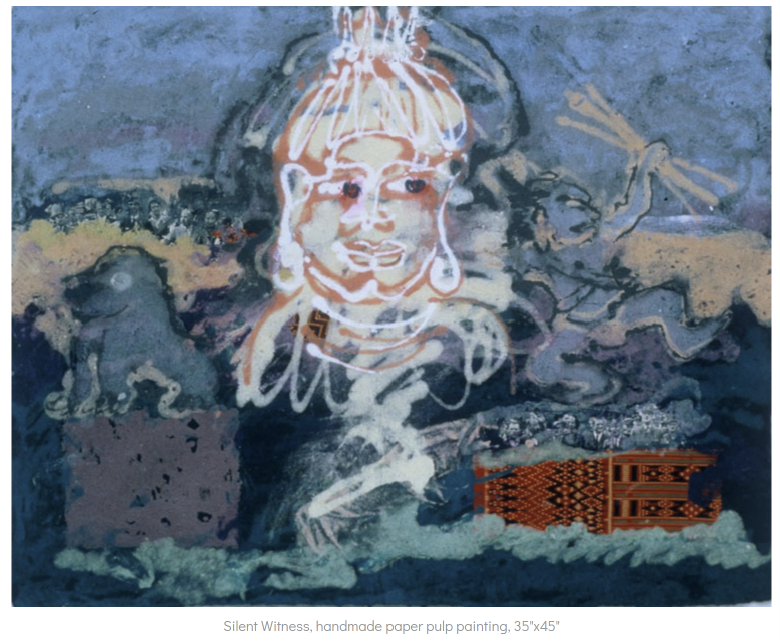
Shortly after his arrival, Bernard had an audience with Prince Sihanouk that lasted an hour and a half. He told me that he was “extremely impressed with the enormous amount of sense Sihanouk made — more than any other politician in Southeast Asia.” They hit it off so well that Bernard was invited by the prince to accompany him on trips, and I gladly went along, to see more of this fascinating country. Sihanouk worked hard to take care of his people. They were like his children. The Cambodians loved him and throngs came running whenever he appeared, to touch him and to receive the money handed out by his aides. On one of his trips, a helicopter hovered overhead dropping brightly-colored bolts of cotton cloth, patterned with a symbolic Khmer temple in a jungle setting with palm trees. People eagerly caught them as they fell. I too scooped one up and years later collaged sections of the cloth into my paper-pulp paintings.
Because Bernard was teaching a course at the Cambodian Royal School of Administration, we were entitled to an apartment in the Bâtiment des Experts, which housed primarily UN advisors and journalists. It provided a basic but enjoyable existence. The long, narrow cement building was built on stilt-like pylons to keep it above the monsoon flooding. Our living room ran the width of the building, and at either end were immense balcony sized openings. These exposed us to the rains and monsoon winds and formed a sort of wind tunnel that could only partially be diminished by closing the ill-fitting louvered shutters. We essentially lived in open air. There was no hot water, but it was easy enough to heat some to wash my hair. The kitchen was also exposed to the outside and offered easy access to our resident rat, which we would sometimes glimpse scampering to its hiding place in the cupboard. Even with air conditioners for the enclosed bedrooms, we slept under mosquito netting. Many evenings, a bat would enter one end of the living room, fly through, and disappear. Later, I would find it perched upside down, on a ledge outside the girls’ bedroom. It looked so innocent that I soon forgot about the old wives’ tale that a bat’s wings could get tangled in your hair.
From our third-floor haven, a lovely garden spread out below. It was a central courtyard surrounded by American-occupied buildings with their own generator. When the electricity would go off all over town, as it frequently did, often just before a dinner party, we would prevail upon our American friends for ice and related needs. We ate dinner by candle light, and our cook had no problem creating her delicacies in the tiny charcoal stove. With daughters aged one and four, I soon hired two servants, an affordable luxury in Cambodia that gave me time for my art. We found two Vietnamese women, Thi Hai, the cook and housekeeper, and Thi Ba, the nanny. Thi Hai was a good cook and followed my instructions with regard to boiling water, cooking meat well done, and washing vegetables to be eaten raw in permanganate.
We didn’t get sick, except for an unrelated kidney infection that Bernard developed near the end of our stay. We were unconnected to any organizations, did not have a lot of money, and lived on the local economy. We had access to no American commissary where we could buy products from the United States. This was not a hardship but an adventure, as we dined on local fish, the freshest vegetables, and exotic fruits, including exquisite mangoes in season. Bread, a legacy from the French, was fresh and crunchy even with the baked-in bugs that lived in the flour. I asked an Army wife to purchase some cereal for me from the commissary, for our girls, but she said that was against the rules, so I sent to Hong Kong for corn flakes, which arrived somewhat stale. There was no problem getting around town, as there were always cyclo drivers waiting outside the building. Cyclos were one-passenger vehicles, built on a bicycle frame, with the passenger sitting up front and the driver behind pedaling. We eventually bought a Citroën Deux Chevaux from a young Canadian couple who were leaving the country. Fresh from operating a little Fiat in Paris, I had no trouble coping with this car, peculiar as it was, and we needed it for trips outside the city.
Charles Meyer, a Frenchman, was Sihanouk’s foreign policy advisor. A gentle man with a dark mustache and serious demeanor, he offered access to the inner workings of Sihanouk’s government, and he and Bernard quickly became friends. They shared a love of Indochina and savored long political discussions. Some at the U.S. Embassy whispered that Charles had been sent by the French to keep an eye on the prince, a charge that infuriated him. His Chinese wife Sika and her sister Lika greeted me warmly and introduced me to the city. They showed me the ropes — the things that I, as a foreigner, needed to understand to navigate the native culture. For example, before I attended a special evening event, Sika took me to her Chinese hairdresser. When we received our bills, Sika explained that as a foreigner I would pay more. Thus, as an American “long nose,” I learned about Cambodia’s double standard.
At Pich Nil [1], Prince Sihanouk’s hideaway in the Cambodian mountains. Left to right: the prince, Dorothy, Bernard, unidentified woman, Sika Meyer, and writer Donald Lancaster. Photo courtesy of Charles Meyer. Charles Meyer arranged some graphic design assignments for me. In addition to illustrations for a book on Cambodia, I found myself designing campaign posters for Prince Sihanouk. He was running for reelection, and the posters illustrated the progress he had brought to Cambodia. I was delighted to see my posters hanging all over Phnom Penh and thus, as American artist incognito, to be playing a role in the Cambodian election. The Prince won the election as easily as he won the volleyball games. Phnom Penh was a city of intrigue, a meeting place for people from all parts of the world with often conflicting interests. Our arrival caused alarm within the American Embassy. What was the abrasive, controversial Bernard Fall, a French agent, doing in Phnom Penh? In this small post, there was a panic about this outspoken Frenchman who questioned U.S. support of South Vietnam at a time when the U.S. was pouring billions of dollars into its anti-Communist crusade there. What did he want? One of our friends at the embassy told us that, at a specially called meeting, the embassy’s public affairs officer warned: “He may not be on our side.”
That was true enough — Bernard was not on anyone’s side. People were told to keep him at a distance. An old poem was updated to, “We do not like you, Dr. Fall, for reasons that we can’t recall.” Nervous American officials assumed that Bernard was working for the French or for Sihanouk. He certainly did not share the embassy view that Sihanouk was a temperamental, narcissistic, troublesome despot. For a while we were shunned. But some people from the American Embassy befriended us. Tom Hirschfeld, second man in the political section, and his wife, Hana, sought us out. They were of European background and enjoyed sharing ideas and ignoring official edicts. Years later, Tom told me, “Bernard was the only one writing about the Vietnamese as if they were human and had national aspirations of their own. This was a view that, during the days of the Cold War, was unacceptable. There was a Gallic flavor to Bernard’s stuff. He was acutely aware of the French experience and he gave it, like any Frenchman, a lot of weight. The effect of that with American officials was, ‘So what. If the French can’t do it, why does that mean that we can’t?’”
Avoided by most U.S. foreign service people, Bernard befriended the military, with whom he always had rapport, although some of them were guarded in their contact with him. Most were advisors to the Cambodian army, serving in MAAG, the Military Assistance Advisory Group. Soon after I arrived, Lt. Col. Ray Gertie and his wife, Rita, invited us to their house for Christmas dinner. Bernard had met Ray in Washington when the officer attended one of his lectures before leaving for his assignment to Cambodia. Although official policy was to avoid Fall, Gertie felt that what he did in his own home was his own affair. It was a friendship that lasted many years.
On several occasions, Prince Sihanouk invited us to dinner at the Royal Palace. The invitation sometimes arrived late in the afternoon for a command appearance that evening. Before we bought our car, we went by cyclo. Two drivers would greet us at the bottom of the landing. Bernard got into one cyclo and I into the other, carefully sitting back into the chair so as not to wrinkle our best clothes. Arriving at the Palace, we were an incongruous sight descending from these jerrybuilt vehicles in our finery, while others emerged from chauffeured limousines.
The first dinner we attended at the Royal Palace was honoring a visit by David Rockefeller, which was fitting since Bernard was there on a Rockefeller Foundation grant. Another dinner honored former Secretary of State Dean Acheson, who was presenting Cambodia’s case in the Temple Preah Vihar dispute before the World Court in the Hague. The temple, situated on the border between Cambodia and Thailand, had been occupied by Thailand in 1953. The case was later settled in Cambodia’s favor. It was a sumptuous feast consisting of fine French wines and an elaborate selection of French dishes. There were many toasts, and dinner was followed by a performance of the Royal Cambodian dancers. They wore splendid, gold-encrusted costumes and elaborate headdresses. Beautiful, delicate women performed as celestial creatures, half-woman, half-bird. One dance portrayed goddesses and an evil deity wielding an ax. His defeat portrayed evil defeated by purity and innocence. Finally we left as we had come, by cyclo.
To connect with his people and to show foreign diplomats his country, the prince made inspection trips throughout Cambodia, inviting members of the diplomatic corps and journalists to accompany him. Thus, we were able to see remote parts of the country that were best reached by private plane. In those Cold War days, Communist and non-Communist countries did not often associate with one another, but on these trips diplomats from both camps were side by side, including the envoys from North Vietnam and Red China. We traveled in World War II vintage DC-3s (Bernard and I always flew in separate planes, out of concern for our children), and always breathed easier upon landing. The first places we visited were Kompong Cham, Battambang, and Stung Treng near the Laotian border. The diplomats were shown newly constructed hospitals, schools, and playgrounds, and local crafts. Sihanouk greeted the throngs who came to touch him while his aides distributed money.
Ethnic minorities lived in these remote regions and Sihanouk sought to convince them that they were Cambodians. One day we made a day trip to Ratanakiri province, bordering Vietnam. The traveling party included twelve ambassadors, other diplomats, journalists, and Sihanouk’s own entourage. We departed at 7:30 a.m. and flew to Lomphat, a lovely spot where we cooled off in a lake. From there, we flew through a terrifying thunderstorm to Labansiek, where Jeeps took us to the village. The roads had been newly hacked out of the forest for the prince’s visit. Clouds of clay dust, churned up by the car wheels, began to settle on our clothes and faces as we perspired in the tropical sun. The ambassadors’ light-colored suits turned terra cotta red. The Czech ambassador turned to a colleague and said, “Don’t look now, but the American ambassador, he is all red.” Of course, by “red” he also meant Communist. As we traveled by Jeep from the market to the military plantation, to the hospital, to schools, and to other destinations, we were a bedraggled, dusty crowd, except for Sihanouk, who rode in a closed limousine. Our schedule called for our return to Phnom Penh after lunch at four thirty, but at two we still had two more villages to visit. It was at six, after an apéritif at a waterfall and too late for some of the captive ambassadors to get back for their own embassy receptions in distant Phnom Penh, that we sat down to a sumptuous lunch of French food and fine wines. We departed for Phnom Penh at nine.
It was an idyllic life. Bernard taught his courses at the Royal School of Administration, in addition to the challenge of writing articles, keeping up his vast correspondence, and meeting with people seeking his views. As 1962 began, publisher Frederick Praeger was waiting for the manuscript for The Two Viet-Nams, which Bernard was finishing, along with a profile of the North Vietnamese General Giap for an English translation of the general’s book People’s War, People’s Army. Praeger, originally from Vienna, regarded Bernard as a compatriot. He wrote to Bernard: “When I consider our heritage and Viennese background, I cannot help finding the world funny with you staying in the jungles of Cambodia and me grinding out books on Communism, on East Asia, on guerrilla warfare, etc., at a steadily increasing pace. When you come back we must drink a special toast to Taborstrasse.” (Taborstrasse is the main street of the Jewish section of Vienna. Bernard lived on Taborstrasse as a child. Perhaps Praeger lived there too.)
Bernard’s first article for the New Republic — the first of many — was written that winter in Phnom Penh and published in the spring. Instead of publishing it under his name, it was signed “Z.” This harked back to George Kennan’s historic “X” article, published in Foreign Affairs in 1947, which proposed a policy of “containment” toward the Soviet Union. Kennan was a diplomat and writer whom Bernard greatly admired, but I think the main reason Bernard published the article anonymously had to do with security. Not his own — he never worried about himself — but concerns that the article would further antagonize the dictator in South Vietnam at a time when his family was unprotected in nearby Phnom Penh. Of course, among those who followed the Vietnam issue closely, there wasn’t much doubt about who “Z” was.
The New Republic article was bluntly titled “The War in Vietnam: We Have Not Been Told the Whole Truth.” It was a hardhitting statement on the deteriorating situation in South Vietnam, the false information being put out by our government, the influential pro-Diem lobby in the United States, and how many journalists unquestioningly supported the official line. Bernard warned that the situation in South Vietnam had become, early in 1962, “what North Vietnam had become in the tragic spring of 1954: a lacework of fortified villages and army posts completely surrounded by a population that is either deliberately hostile, or at least terrorized by an efficient network of Communist guerillas into cooperating with them…” He quoted an American Army colonel saying “this is a brutal, grubby, dirty method of fighting,” after spending twelve fruitless days chasing after an elusive Vietcong unit, and he noted that it was a war “whose killing rate has been increasing steadily. At first there was a steady trickle of about 30 – 50 dead a month in 1957 – 58. Late in 1959, the figure had increased to 10 a day, and in the spring of 1960 a figure of 25 a day was openly admitted in the press.” (Unlike U.S. officials, who spoke only of American casualties, Bernard was always concerned with Vietnamese deaths as well.) He added that major magazines like Time “fell for the ‘Bastion-of-the-Free-World line,” and that “those few journalists or scholars who sought to buck the trend soon found themselves the target of an equally well organized whisper and letter-writing campaign on the part of [the] Ngo Dinh Diem régime’s lobby, the American Friends of Vietnam, whose first honorary president was General Donovan of OSS fame.” The article challenged what the Kennedy administration and most of the media were telling the American public, but it did not have nearly the but it did not have nearly the impact as one Bernard wrote later in 1962 when he became the first Western journalist in years to interview Ho Chi Minh — and proceeded to write about him in that most mainstream, apple-pie of American magazines, the Saturday Evening Post.
Nicole attended a French school; a bus picked her up and returned her. Our apartment had no telephone to disturb us; communication was by messenger. With few household duties, I had time to paint. I would go out into the street, a pad of paper under my arm and sketching materials in hand, up to the Wat Phnom or down to the river to draw the ferry or the melon boats or the village on the other side of the muddy water. As soon as I sat down to draw, a crowd of young people would suddenly gather round to see the spectacle of a Caucasian lady and her art. Sometimes I had a painting partner, George Ann Gillespie, the elegant wife of a MAAG colonel. She was showing her art at the United States Information Service library, where I hoped to exhibit once I had enough works. It was a simple, thatched-roofed building on the embassy grounds. Once George Ann and I went out to a village in the countryside, where we painted portraits of the children. On occasion, I took Nicole along on painting trips and she, too, sketched the countryside.
Now and then our daily routine was broken by some festival or ceremony. An important one, attended by the royal family and all members of the government, as well as the diplomatic corps, was the “Ploughing of the Sacred Furrow.” It was held in a large park festooned with colored banners, and marked the beginning of the agricultural year. Many people dressed in traditional Khmer costume. The ceremony began with a member of the royal family walking with a plough behind a beautifully decorated ox and followed by a princess sowing grain. Then two oxen were led to a row of silver platters, each containing a different item: rice, corn, beans (signifying an abundance of food), grass, water (signifying sufficient rain), and sugar cane. Whatever the oxen chose to nibble predicted what crops would prosper that season.
Another ceremony, the Fête de Genie [sic for ‘fête des génies’, Spirit Festival in French], was a Chinese ritual outlawed in other countries. Men dressed in glistening red and gold paraded by, carried on wooden contraptions. One man was piercing his tongue with his sword. He licked gold papers that were then distributed to outstretched hands in the crowd: the blood of this genie was supposed to drive away evil. Another man had long bamboo stakes coming out of his cheeks, piercing one side clearly through and out the other, forming an X. One woman passed by in a trance. Others waved knives. All were dressed in red, to signify blood. The ceremony filled me with terror.
Bernard remained persona non grata in South Vietnam. From Saigon, Malcolm Browne of the Associated Press wrote to Bernard that Street Without Joywas banned in South Vietnam. The Diem Régime was unhappy that a number of correspondents had visited Phnom Penh to seek Bernard’s views. His friend François Sully of Newsweek had come in January and later quoted Bernard in an article. By then, the Times of Vietnam regularly attacked any journalist critical of the Diem régime. In August 1962, our old friend Gene Gregory, editor of the Times of Vietnam, denounced a Newsweek article by Sully and called Bernard a “phony military analyst, better known as a café strategist who spent a few months in Vietnam in 1953.” Sully had quoted Bernard as saying the common soldier in South Vietnam “doesn’t have an ideology worth fighting for” and that “there would be no victory in South Vietnam until political deficiencies were corrected.”
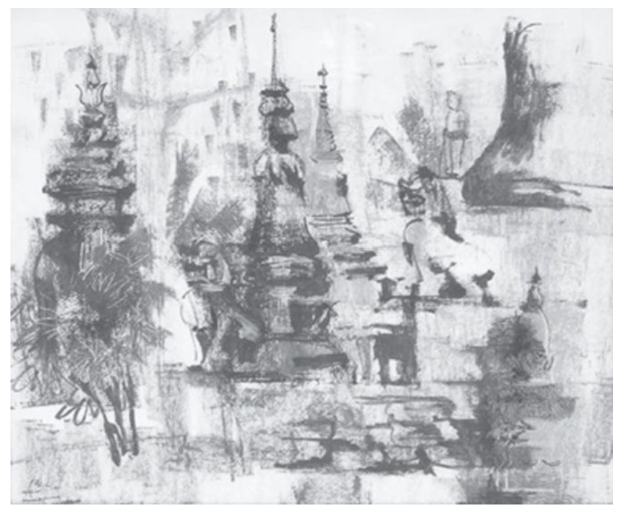
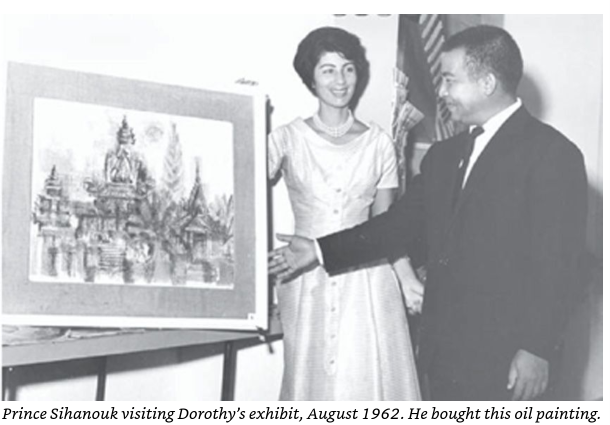
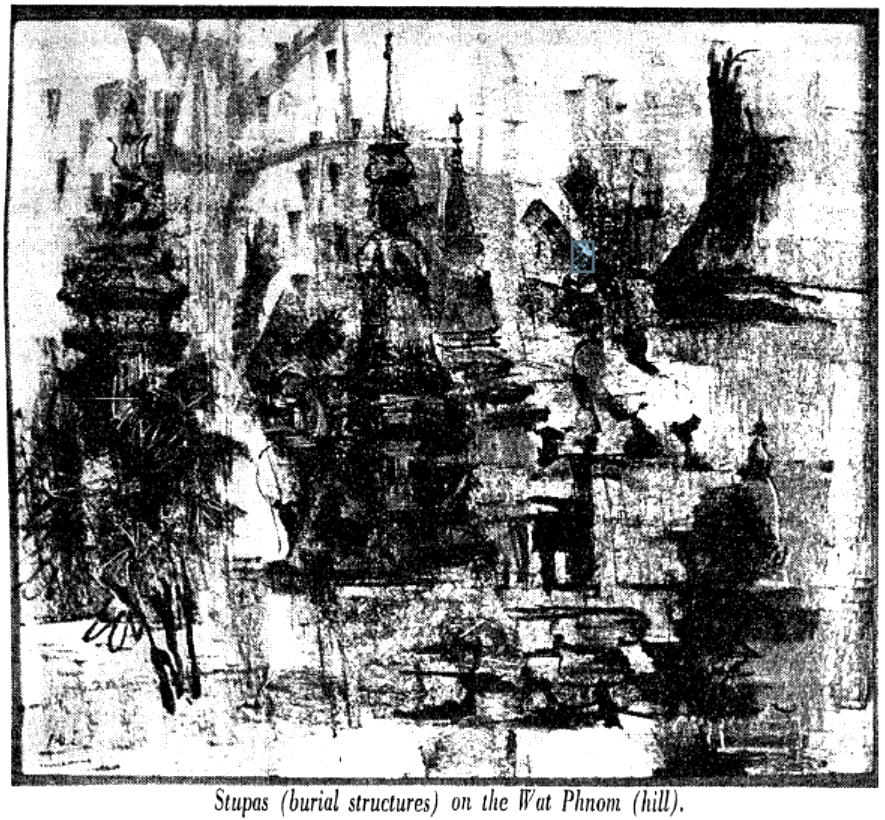
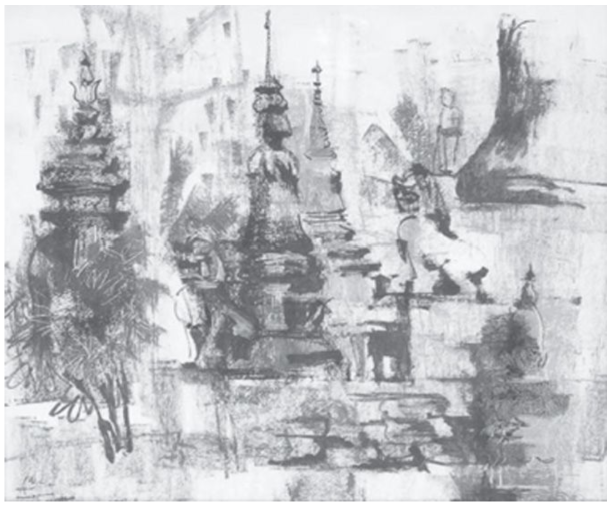
1) Stupas at Wat Phnom. 2) One of the 2 paintings by Dorothy Fall purchased by Prince Sihanouk for his personal collection at the Royal Palace during her Impressions du Cambodge exhibition, Aug. 1962 [photos from the book].
1) Stupas at Wat Phnom. 2) One of the 2 paintings by Dorothy Fall purchased by Prince Sihanouk for his personal collection at the Royal Palace during her Impressions du Cambodge exhibition, Aug. 1962 [photos from the book].
1) Stupas at Wat Phnom. 2) One of the 2 paintings by Dorothy Fall purchased by Prince Sihanouk for his personal collection at the Royal Palace during her Impressions du Cambodge exhibition, Aug. 1962 [photos from the book].
Our August departure was approaching and I hoped to have an exhibit at the USIS library. Tom Hirschfeld arranged for me to meet with the head of the U.S. Information Service, Darrell Price, but no invitation was issued and finally Bernard said, “If the Americans don’t want to show your work, why don’t I ask the French?” He pointed out that the French had a grand cultural center, the Maison de France, which would be a much better place to exhibit than the isolated, rather shabby USIS library. The French were happy to sponsor my exhibit. Perhaps with Charles Meyer’s intervention, the Cambodian Ministry of Information became the cosponsor. A week later, Tom called to say that USIS would, after all, give me a show, but it was too late to change my plans. I don’t know if USIS didn’t want to sponsor my show, or was just slow, but either way they lost some good publicity.
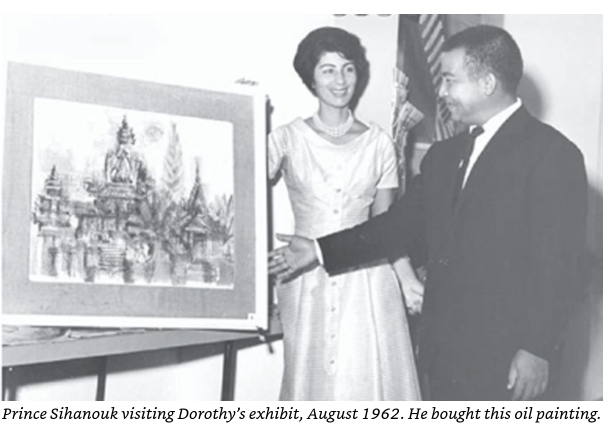
Large posters appeared all over town that announced, in French and Khmer, my show “Impressions du Cambodge.” The Maison de France was filled with my impressions of the country. I felt that our time in Cambodia had inspired a breakthrough in my work. The country was such a visual feast for a painter. I had gone into the villages, drawing the smiling, curious children, the huts on stilts, the water buffaloes cooling off in a muddy pond. I had portraits on display. I showed the river and the melon boats, the green-skinned, plump fruit piled high under the circular roofs, the fields in colors from yellow chartreuse to thalo to dark green to blue, and the ducks and chickens and pigs in their sties. There were women planting rice, moving in unison in the brightly colored paddy, in their dark clothes. was delighted with the exhibition. Ambassadors, diplomats, and friends attended. Sihanouk did not attend but requested a private showing a few days later. He spent an hour studying my impressions of his country and bought six works. A little later, he gave a farewell luncheon for us, thanked Bernard for his “intensive research on the contemporary political situation in Southeast Asia,” and urged us to return soon. Finally, on August 21, 1962, we started home. Our Cambodian interlude had taken place during a time that can never return, with a people who will never be the same. The mass slaughter inflicted by the Pol Pot régime in the late 1970s was unimaginable then. Of course, neither could we imagine that we Americans would be fighting in Vietnam for another dozen years.
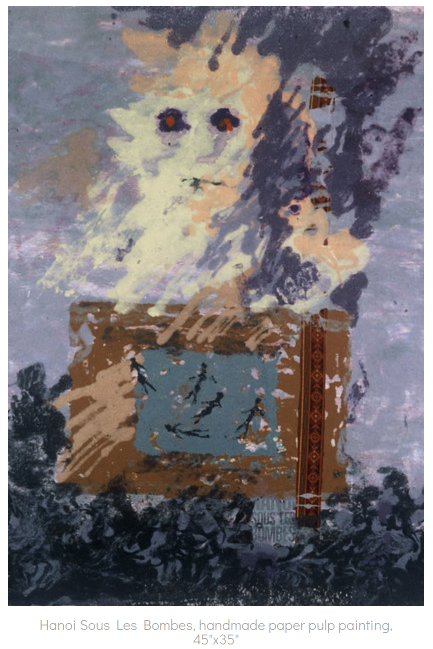
Dorothy Fall’s artworks inspired by Southeast Asia [undated color reproductions posted on the artist’s website].
Dorothy Fall’s artworks inspired by Southeast Asia [undated color reproductions posted on the artist’s website].
Dorothy Fall’s artworks inspired by Southeast Asia [undated color reproductions posted on the artist’s website].
Dorothy Fall’s artworks inspired by Southeast Asia [undated color reproductions posted on the artist’s website].
While we were in Cambodia, in addition to his work on the Rockefeller report, Bernard had published his initial New Republic article on Vietnam as well as another piece there on the situation in Laos, which he felt that U.S. meddling had pushed from neutralism into chaos. But the most important journalistic outcome of our stay in Cambodia — one of the most important articles he ever wrote — was published in the Saturday Evening Post on November 24, 1962, and told of his visit to North Vietnam and his exclusive interview with its leader, Ho Chi Minh.
No Western journalist had been to North Vietnam since the departure of the French eight years earlier. Bernard urgently wanted to go there, to interview its Communist leaders and to see how the country had changed, under their rule, since his 1953 trip. Early in 1962 he had written to the Foreign Ministry in Hanoi, requesting permission to visit. Five months later, in early July, a telegram arrived. It said simply: “PERMISSION GRANTED WIRE DATE ARRIVAL HANOI.” Bernard was thrilled. To get to Hanoi, he flew to Vientiane, Laos, and boarded an old Boeing Stratoliner of World War II vintage. His visit lasted from July 10 to July 24 and its highlight was an interview with Ho Chi Minh. That journalistic coup enabled Bernard, upon his return, to sell his article to the prestigious Saturday Evening Post. Unsurprisingly, he opened his interview with Ho: “‘It took us eight years of bitter fighting to defeat you French in Indochina,’ said the slightly built, grandfatherly man with the wispy goatee. ‘Now the South Vietnamese régime of Ngo Dinh Diem is well armed and helped by ten thousand Americans. The Americans are much stronger than the French, though they know us less well. It may perhaps take ten years to do it, but our heroic compatriots in the South will defeat them in the end.’” A little later in the article, Bernard again quoted the seventy-two-year-old Vietnamese leader, whom he described as “looking very spry”: “‘I think the Americans greatly underestimate the determination of the Vietnamese people. The Vietnamese people always have shown great determination when they were faced with a foreign invader.’” Bernard is perhaps best remembered as a historian and analyst, but the Post article showed what a fine reporter he could be, as he captured the beauty and energy of this new nation he was visiting as well as its politics. He wrote this about his arrival by air:
I thought for a while that the land looked much as it had when I had known it in the days of French rule. In the Red River Delta I could see dark green patches where tree-lined villages nestle between the rice fields of lush light green. But something had changed even here. Some fields are no longer small, handkerchief-like squares but are f ar larger than before, with no dikes to interrupt their expanse. They belong to the new collective farms. Communism has already left its mark on the landscape. And as we came in for a landing I noticed the brutal reds of new tile roofs and the glaring whites of factory walls where there once had been nothing but farmland or French forts.
Having described his meeting with Ho and others in “official Hanoi,” he added, “There is another Hanoi, full of the bustle of any Asian city, with children swarming around, street merchants peddling duck eggs, and lines forming in front of movie houses. I saw one food queue too — people lined up to buy the Vietnamese equivalent of Popsicles.” He also related that when he was dining, almost alone, in the huge dining room of what had once been the elegant Metropole Hotel, “the public-address system — perhaps in my honor — switched from a propaganda speech to a scratched record of Glenn Miller’s ‘In the Mood.’” Bernard was astonished, because that was one of the songs he most fondly remembered from his time with the American GIs in 1944 – 45. His article also examined the nation’s economy: “In contrast to China, the industrialization of North Vietnam is relatively easy, for it is a nation a little smaller than Missouri with a population of 17 million. A few modern machine-tool plants, for example, can change it from a machine-importing to a machine-exporting country.” He concluded, “The country is functioning, and developing at a very rapid rate.”
Bernard also described his talks with Premier Pham Van Dong, who spoke scornfully of South Vietnam’s President Diem: “Monsieur Diem’s position is quite difficult. He is unpopular, and the more unpopular he is the more American aid he will require to stay in power. And the more American aid he receives, the more he will look like a puppet of the Americans and the less likely he is to win popular support.” Bernard said that sounded like a vicious circle, then: “The premier’s eyes showed a humorous gleam as he said that it was more than ‘vicious.’ ‘It is really more like a descending spiral.’” Bernard closed the article with a call for a negotiated peace to avoid a potentially disastrous war:
I believe we could press more effectively for some kind of truce settlement on terms that would definitely not be ‘surrender.’ We could demand the immediate end of guerrilla fighting in the South and a far more effective international inspection system to police the truce. We may not achieve such a settlement, but I feel very strongly that we have no reason to fear it. And we must clearly realize that the alternative means the bloodshed and misery of a long and probably inconclusive guerrilla war — a war which Ho Chi Minh is well prepared to fight.
On a lighter note, Bernard described how he had given Ho a copy of his newly published Street Without Joy and mentioned that it contained a drawing of Ho by his wife. “Where? Where?” Ho demanded. “Let me see it.” He studied the drawing and announced that he liked it. Then he took a bouquet of flowers from a nearby vase and handed them to Bernard. “Tell her for me that the drawing is very good and give her the bouquet and kiss her on both cheeks for me.” Bernard did just that on his return to Phnom Penh, making me one of the few American women to have been kissed by Ho Chi Minh, even by proxy.
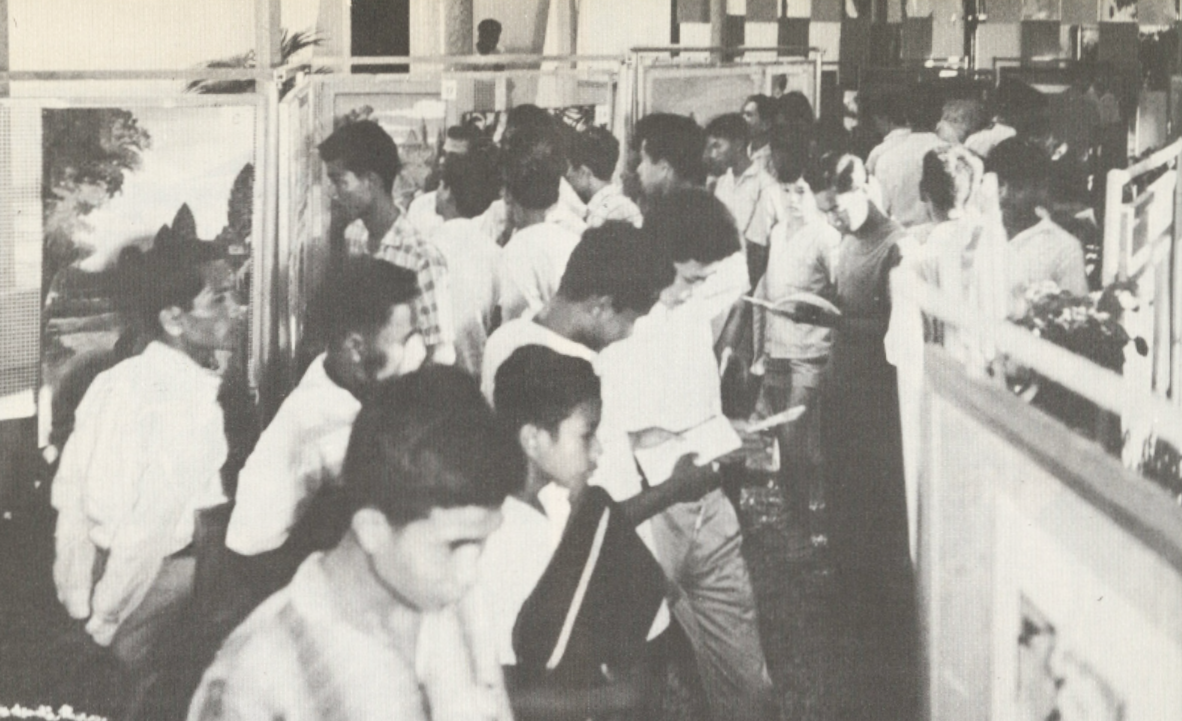
Arts and Politics - While the US Information Service wouldn’t get anywhere near Bernard Fall and his artist wife due to their anti-war stance, they wisely encouraged Cambodian artists — including visual art stars such as Nhek Dim, Ieng Say, Sin Var, to compete in a contest for calendar illustrations, with a public exhibition held with much success at the American Library in Phnom Penh on 28 Nov. 1960. Photo fromFree World X‑6, 1960, p. 18, courtesy of SAR‑ស Museum of Modern Art, Siem Reap. [Published in Manila by ‘Free World Press’ from 1952 to the mid-1960s, Free World was the mouth piece of the anti-communist US propaganda in Asia during the Cold War.]
Arts and Politics - While the US Information Service wouldn’t get anywhere near Bernard Fall and his artist wife due to their anti-war stance, they wisely encouraged Cambodian artists — including visual art stars such as Nhek Dim, Ieng Say, Sin Var, to compete in a contest for calendar illustrations, with a public exhibition held with much success at the American Library in Phnom Penh on 28 Nov. 1960. Photo fromFree World X‑6, 1960, p. 18, courtesy of SAR‑ស Museum of Modern Art, Siem Reap. [Published in Manila by ‘Free World Press’ from 1952 to the mid-1960s, Free World was the mouth piece of the anti-communist US propaganda in Asia during the Cold War.]
[1] Phnom Pech Nil ពេជ្រនិល, ‘The Pitch-Black Diamond Hill”, slopes down to National Road 7, called “American Road” in the 1960s as this major motorway linking Phnom Penh to Sihanoukville port was improved thanks to USAID funds. Jacky Kennedy and Prince Norodom Sihanouk inaugurated it officially in November 1967, during the US First Lady’s (and JFK’s widow) trip to Cambodia. The dangerous stretch of the road at Pech Nil foothill, overlooking the lowlands down to the ocean, was for decades a mandatory stop for drivers who prayed and gave offerings at Yeay Mao’s shrine, a sacred place for Cambodian lovers as reflected in this highly popular song [here sung by Vanneth Pichenda]. The new four-lane highway built during the Covid-19 pandemic with Chinese funds bypasses the hilly, scenic viewpoint.
An Epitaph for Phnom Penh by Dorothy Fall, 1970
[Note: “An Epitaph for Phnom Penh: A Gallant Prince” was initially published in The Washington Post, Times Herald, 13 Dec 13. 1970 [thanks to John Burgess for finding and sharing the original publication with Angkor Database]. It was Dorothy Fall’s initial reaction to General Lon Nol’s anti-royalist coup d’état in March 1970, and the proclamation of the Khmer Republic in September that year.
Although the author was inspired by the memories of better years in the Sangkum Reastr Neyum era [see above], she had the premonition that the 1970 events were the harbinger of dark years to come. The heartfelt article also provided additional background for the book she would finally publish 30 years later.]
By Dorothy Fall — Mrs. Fall is the widow of Bernard B. Fall, the writer, historian and professor of international relations at Howard University, who was killed by a Vietcong mine while on patrol with U.S. Marines near Hue in February, 1967.
With Cambodia at war, my heart is heavy. I feel the terrible loss of a fascinating era that can never return, not to mention the tragic involvement of a people uninterested in this war. I am lucky to have seen this country· in its tranquil beauty and to have partaken of its fairy tale existence at a time when one could still feel light-hearted.
In late 1961, my husband was awarded a Rockefeller Foundation grant for research in Southeast Asia and we decided on Phnom Penh as a base from which we could travel and where I could paint with no other obligations except the care of my two little girls, 4‑year-old Nicole and year-old Elisabeth.
I arrived in the Cambodian capital before the last dirt roads were paved and the paillotes (thatch huts on stilts) torn down to make way for modern buildings. There were wide boulevards — some tree-lined, others with flowers and grass islands down the center — and the largest playgrounds I have ever seen. There were even marvelous Parisian-type restaurants along the boulevards.
The city, by contrast with the country, was densely populated with 500,000 inhabitants of many nationalities and religions. There were as many Vietnamese and Chinese as Cambodians, complemented by Indians, Europeans, Americans, Burmese, Chams. The streets were bustling with people in all kinds of dress. Women in sarongs, full trousers, long, transparent Vietnamese tunics or saris rubbed elbows with monks in saffron robes. The traffic was a hodgepodge of automobiles, bicycles, scooters, cyclos and even an occasional regal elephant accompanied by his caretaker. The central streets converged on the main market, an enormous building full of foodstuffs and other items.
The focal points of the city were the palace grounds, with its complex of elegant triangular roofs facing the Tonie Sap River, and the Wat Phnom. The wat or temple is built on a hill (phnom) with a flower clock on orie side. A Mme. Penh was responsible for its being built, hence the name of the city. Also on the phnom are stupas, conical structures that guard the ashes of the departed, and temple lions. Like the other 25 temples of the city, its Buddhist air of tranquility was balm for the soul. One would hardly believe that there was a war anywhere in the world, much less in a neighboring country.
Drab Costumes
The Cambodian people people were not as delicate or as colorful as I had expected. The women are bigger and heavier than the Vietnamese, often with kinky black hair. They wear faded sarongs of dark colors or black trousers and jackets, often with a similar faded cloth around their heads.
Near Phnom Penh is one of several Cham-Malay villages. These people came from the ancient country of Champa, were joined by the invading Malays and now are Moslems. The men who have made the trip to Mecca often wear a fez. As in other parts of Southeast Asia, there are a number of mountain tribes, generally nomadic. The men wear loin clothes or tunics and turbans and the women generally wear a brief skirt and sometimes a sleeveless bodice.
Because Bernard was to teach a course at the Royal School of Administration, we were entitled to an apartment in the Batiment des Experts, which mainly housed U.N. advisers and some journalists. The living room, which ran the width of the building and had huge balcony-type openings at both ends, formed a sort of wind tunnel. In monsoon season, the soup would literally fly off the spoon. The kitchen arid bathroom had louvered openings so that while taking a shower, one was exposed to the street below. There was no hot water, and the Vietnamese cook, Ti Hai (the name for the first servant; Ti Ba was her subordinate), did her cooking on charcoal.
We rented a refrigerator and an air conditioner for the bedroom, both of which went dead during one of the city’s periodic power failures. This usually happened before a dinner party so that there was no ice and the ice cream melted. It was two months before we bought a car — a second-hand Citroen often referred to as a mobile garbage can with a sewing machine motor, but it could take the roughest terrain. Until then, travel was by cyclo-pousse, a bicycle arrangement in which the passenger sits in front of the driver facing oncoming traffic. The driver is usually erratic, enjoying the sport of dodging other vehicles and passing trucks as closely as possible. The price was never the same; it cost the cook two riels to go to market while I paid six. Americans paid top fare. There was always a cyclo driver waiting outside the apartment building and rumor had it that many belonged to the police.
A Gallant Prince
My husband had met Prince Norodom Sihanouk years before and we were accepted as friends. He is a charming man with the Old World gallantry that has almost disappeared. Often when dignitaries were visiting Cambodia, we were invited to the palace for dinner. This was always a lavish affair, although sometimes the invitation was issued as late as 3:30 of the same afternoon. After the usual exchange of gifts between the prince and the visitor, we went in to dinner. This was a sumptuous feast usually of French cuisine and ended in a delicacy that one could not find in the stores of Phnom Penh.
The dinner was almost always followed by a performance of the Royal Ballet. The Cambodian dance is similar to that of the Thais but much slower. It looks simple and languid, but having taken lessons, double jointed that I am, I found it terribly difficult and painful to do. The dancers are sewn into their costumes even for rehearsal; there are no buttons or zippers. The costumes are of silk with intricate gold and silver designs interwoven. The heavy gold headdresses and jewelry — ankle and wrist bracelets, rings, necklaces — are old palace treasures. Often masks are worn to represent the villain or a god or even animals.
Diplomatic life in Phnom Penh was fascinating at that time. All countries were represented — the East, the West, North Vietnam and South, Red China and Taiwan — and one had a sense of perpetual intrigue. Everything revolved around Sihanouk. His doctors had told him to reduce, so he decided to play volleyball. Everyone· played volleyball. There was the team of diplomats, the American military advisers and the Cambodian team, on which Sihanouk played and which usually won.
Cambodia had had many of the same men in ministerial posts for years, except that they rotated. The Minister of Information became Minister of Agriculture. The Finance Minister became Prime Minister. A Prime Minister became commander in chief of the royal armed forces. Gen. Lon Nol was always one of the prince’s closest advisers.
Prince Sihanouk was also president of the political structure, the Sangkum Reastr Niyum or Popular Socialist Community. An interesting aspect of the Sangkum was the National Congress, an open-air session in the Congress Square near the palace where Sihanouk presided over debates, some by government officials, about the country’s problems. He also listened to complaints and personal problems of people from the villages. Sometimes these involved family squabbles about property, a woman’s problems with her husband or an appeal to reopen the “tea houses.” Sihanouk acted as mediator.
A Food Cornucopia
In going to Phnom Penh, I had envisioned problems in obtaining proper nourishment for my children. To my delight, I discovered that Cambodia has an abundance of fresh food. The market was filled with vegetables, some familiar, some exotic; the freshest fish, the most succulent langoustine; carcasses of beef — a form of buffalo — tough but tasty; pork; meager chickens and ducks; mounds of grain and rice, and native cooked food. Of course, one has to bargain. As an American, and a timid one, I was at first ashamed to dicker. So often when I would settle on what must have been too high a price, the vendor would throw in extra lemons or flowers. It was all in the game.
One could also find the best imported French cheeses and butter and canned goods from other countries, including Communist China. All this was topped by the best French bread I have tasted anywhere in the world, sold at any street corner. The little rice bugs baked into it could easily be removed.
To illustrate her 1970 piece in The Washington Post, Dorothy Fall suggested one of the paintings she had proudly exhibited in Phnom Penh in August 1962, with Prince Sihanouk in attendance.
To illustrate her 1970 piece in The Washington Post, Dorothy Fall suggested one of the paintings she had proudly exhibited in Phnom Penh in August 1962, with Prince Sihanouk in attendance.
Local currency was no problem. I would go to a Chinese grocer, give him a personal check for $200 drawn on our Washington bank and he would give me Cambodian riels at the rate of 65 to $1. The official rate was 35 to $1, but I knew of no one who got that little.
From our apartment, I could watch the women of the army dependents’ village across the road bathing in the open. They would douse themselves with dipperfuls of water from a huge vat and emerge in a clean sarong, the other having been somehow secretly discarded before my eyes.
The palace elephants grazed in the field next to our building. There was a street near the palace where monkeys played in the trees; one could coax them down with a banana, but they could be vicious.
The daily routine was often broken by some festival or ceremony. My favorite was the “Ploughing of the Sacred Furrow,” marking the beginning of the agricultural year. It began with a member of the royal family walking with a plough behind a beautifully decorated ox and followed by a princess sowing grain. Then two oxen were led to a row of silver platters, each containing a different item: rice, beans, water (meaning drought), sugar cane. Whatever they nibbled indicated what crops would grow well that season. They appeared to have a bit of help in making their choices.
An Artist’s Gallery
For an artist, Cambodia provided a wealth of inspiration. Often I would go to the edge of the river to draw the ferry or the melon boats or the village on the other side. As I alighted from the cyclo with a large drawing pad under my arm, people would suddenly start running over until there were 50 or 100 of them peering over my shoulder or even standing in front of me, making comments in Khmer or Vietnamese. Once, near a village, some little girls were fascinated by the fact that I perspired and that I had hair on my face and arms, which they would never have.
The climax of our stay for me was an exhibit of my paintings and drawings which the prince visited and purchased six of the works. I wonder where they are now…
In our last days in Phnom Penh, I tried to make some quick sketches from which I could later paint. A drawing of water buffalo swimming in a pond which I had done three weeks earlier had been sold; I wanted to do another. But when I arrived at the spot, the pond no longer existed. It had been filled in and the road was paved.
The village opposite my apartment was being torn down, no doubt to make room for modern buildings. The following year, a stadium was built, and then a university and more apartment buildings. All this, I suppose, was for the good of the country. But I prefer to remember this as a never-never land with all of its idiosyncrasies and charms rather than a country marching on the road to progress, and now perhaps to destruction.
About Dean Acheson and Preah Vihear
The author recalled an important dinner hosted by Prince Sihanouk with Dean Gooderham Acheson (11 April 1893 – 12 Oct. 1971), the 51st U.S. Secretary of State, who had set the tone of the foreign policy of the Harry S. Truman administration from 1949 to 1953 and had contributed to the design of the Marshall Plan and the North Atlantic Treaty Organization (NATO).
Viciously attacked by Senator Joseph McCarthy over Truman’s policy toward the People’s Republic of China, Acheson became a special advisor to President John F. Kennedy in 1962 — part of the group dubbed ‘The Wise Men’, and later counseled President Lyndon B. Johnson to negotiate for peace with North Vietnam in 1968. He was an attorney with private practice [Washington firm of Covington & Burling] when the Cambodian government sought his help in the Preah Vihear controversy.
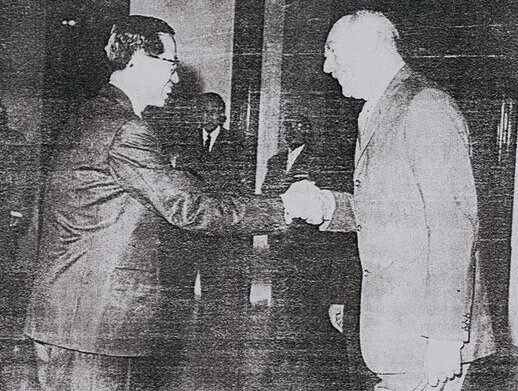
Cambodian Foreign Minister Son Sann សឺន សាន (5 October 1911 – 19 December 2000), left, greeting Dean Acheson in Phnom Penh in 1961 [photo National Archive of Cambodia (NCA) via US Embassy in Phnom Penh].
Cambodian Foreign Minister Son Sann សឺន សាន (5 October 1911 – 19 December 2000), left, greeting Dean Acheson in Phnom Penh in 1961 [photo National Archive of Cambodia (NCA) via US Embassy in Phnom Penh].
In an interview with Charles Stuart Kennedy on 26 January 1999,Richard C. Howland, who served on rotation in Phnom Penh from 1961 – 1963, shared his experience with the Preah Vihear temple dispute and Dean Acheson’s work as a lawyer in the case:
It was baffling to me why the prince could not develop better relations with the Thai, which could have solved a lot of their problems. In fact, diplomatic relations were broken about six months after I got there. During this period the Thai Prime Minister was Sarit Thanarat, a military dictator. He endlessly taunted and insulted Sihanouk. Later when he died, in 1963 I think, Sihanouk declared a week of national rejoicing in Cambodia; everyone wore little pink ribbons which were Buddhist symbols of joy. The insults were mostly related to the dispute between the two countries over the temple called Preah Vihear, built in the 11th century on the edge of the bluffs of the Dangrek Range, the border between northern Cambodia and Thailand. During the early 1960s this was a major factor, who had owned and who would get the temple. The World Court in The Hague was to rule on it.
By 1960 Norodom Sihanouk decided that Cambodia needed to hire a really high-powered lawyer to plead its case there. So the Cambodian Government engaged Dean Acheson, the former U.S. Secretary of State who had returned to private law practice in 1953.
The Cambodian move was a shrewd one in several respects. Basically Sihanouk thought it hindered U.S. support for the Thai position. Well, we would not have gotten involved, of course, but he probably thought we would.
Second, the chief jurist on the court was a Polish judge. It was widely presumed that he would support the Cambodian case because of the Soviet desire to court Sihanouk. The Thai were complaining about this likelihood. Acheson’s role as Cambodia’s representative lent a cachet of impartiality to this potential outcome – it was presumed he wouldn’t lend himself to a spurious judgment, especially from a Soviet bloc jurist.
Thailand was, as usual, taunting Cambodia on this issue and Sihanouk broke relations with the Thai in November 1961. The next year, Acheson was going to argue the Cambodian case before the ICJ in The Hague and naturally he wanted to see the temple. But Thailand continued to occupy the temple and would not let Acheson get access to it via Thai territory.
Acheson had already met Sihanouk years earlier, I suppose at the UN. Naturally he came out to Cambodia to call on Sihanouk and discuss the case with the Cambodian Foreign Minister of the moment. Afterwards he wanted to see the temple. It was potentially too ’high-profile’ to use the Defense Attaché aircraft from Saigon to fly him up to the Dangrek range to ’eyeball’ the temple. That would have been reported by the Thai at the site and caused big complications in Bangkok.
So Charlie Mann, the USAID director, arranged for a USAID contract flight in a civilian aircraft, which routinely ferried USAID personnel to various aid projects in Southeast Asia. The Ambassador had decided that Peter Poole, another Foreign Service Officer, should be the control officer, so he went along.
The flight plan called for a survey of northern Cambodia, with a stop at Siem Reap. This was a routine sort of flight. The aircraft flew to the northeast and then cruised westward along the border, first with Laos, then with Thailand. After circling Preah Vihear a few times at a respectful attitude, well inside Cambodia, the plane continued along the border to the west, then turned south and landed at the Siem Reap airport.preah-vihear-03 – 600x450
Acheson told Peter he had never toured Angkor Wat and wanted to see it. They were able to arrange for the Auberge des Ruines, the French guesthouse at the Angkor Park, to send a car and driver to take Acheson to see Angkor Wat, a few miles away.
Now, the former Secretary of State was of course wearing his office shoes, so on the way Peter suggested they stop at the Siem Reap market to buy some Bata sneakers. He pointed out that the temples were full of bat-droppings and the causeway was muddy. They actually found a pair of sneakers that fit Acheson.
Then they went off to see Angkor Wat.
Peter Poole showed Acheson many of the bas-reliefs and explained them to him. Angkor you know is a funerary temple, oriented to the West to get the last rays of the setting sun. Acheson was fascinated and they drove around the archaeological park until late afternoon. Finally the pilot said they had to get back to the Phnom Penh airport before dark, otherwise he might lose his contract with USAID. So they flew back to Phnom Penh.
“The Thai were furious, but we leaned on them and they respected the decision” 114427 – 004-12D39290That evening there was a reception for Acheson (seen left) and I got to talk to him. He was quite charming but had little regard for Asia. He said to several of us clustered around him: “you know these ex-colonies are never going to amount to anything. You young officers should try to get to Europe as quickly as possible. Don’t bother with this area. NATO (North Atlantic Treaty Organization) is the whole thing. You have to associate your career with NATO now, at your early stage. Leave all of this area behind. These ancient civilizations are fascinating, but they’ll never amount to anything again.”
Well, by this time most of those to whom he spoke, including myself, had fallen in love with Southeast Asia. We were rather appalled by his words. We felt that in Southeast Asia, for example a junior officer could deal with ministers, even the head of state as I had. That was not possible in Europe where Third Secretaries spoke only to other Third Secretaries.
But as it happened Acheson developed a good court case and the ICJ ruled in favor of Cambodia. The Court argued that although the French maps were inaccurate, the Thai had accepted them as a matter of policy for almost forty years, only seizing Preah Vihear under the umbrella of the Japanese takeover of the whole region. The logic was impeccable. No one challenged it, and there was national jubilation in Cambodia at the outcome.
Ambassador Trimble and senior Embassy officers attended a great dinner at the Palace. The ThaiimagesZ5VG7A0C were furious, but we leaned on them and they respected the decision. Marshall Sarit Thanarat [former Thailand Prime Minister], despite his virulent hatred for Sihanouk, ordered the Thai troops withdrawn from the temple precinct.
They took down the barbed wire fences between Preah Vihear and what was now Cambodian soil. New fences were built along the dry streambed, which now marked the border with Cambodia. Cambodian troops were deployed in and around the temple.
A few weeks later, Prince Sihanouk and the top government officials, plus the leaders of the Buddhist sangha, made a pilgrimage to Preah Vihear, climbing the steep cliffs to get there. It was a wonderful inspiring victory for Cambodia and the Khmer people.
So that was the outcome of the temple dispute, with Dean Acheson and the ICJ. The Cambodians had a big one-day splash, and that was all. Four years later, in 1966, the Thai moved back into the temple enclosure briefly and border incidents continued in the Dangrek range for many years. After 1970 the Khmer Rouge occupied the whole northern area of Cambodia and I presume they controlled the temple. As I write, almost 50 years later, the Thai and Cambodians still come occasionally to the brink of war over the temple on the brink of the Dangrek range.
About two months later, Dick Melville, a USAID officer who traveled quite a lot, went to the town just south of the temple, Cheom Khsan, on USAID business. While there he wangled a vehicle and drove to the base of the cliff on a road that had been improved for the Prince’s visit several months earlier. He climbed the cliff and walked about the temple.
He found that the handful of Khmer soldiers still there had not been resupplied for weeks. The whole country had just forgotten about them. Some had left the temple and wandered away, others went down to Cheom Khsan to buy food. They had also gotten food from the Thai soldiers who guarded the other side of the barbed-wire fence along the streambed, which now marked the border. The soldiers told Melville that the Thai were kind, but also made fun of them. That’s a perfect description of the Thai.
So that was the outcome of the temple dispute, with Dean Acheson and the ICJ. The Cambodians had a big one-day splash, and that was all. Four years later, in 1966, the Thai moved back into the temple enclosure briefly and border incidents continued in the Dangrek range for many years. After 1970 the Khmer Rouge occupied the whole northern area of Cambodia and I presume they controlled the temple. As I write, almost 50 years later, the Thai and Cambodians still come occasionally to the brink of war over the temple on the brink of the Dangrek range. [“How a Former Secretary of State Won an Ancient Temple for Cambodia”, Association for Diplomatic Studies and Training (ADST), April 2016.]
In his contribution to the blog American Diplomacy [Feb. 2021], “Cold War Conflicts over a Khmer Temple”, John Burgess gave the — temporary — coda to the tragic saga of Preah Vihear in modern times:
On June 15, 1962, the court announced its decision: Cambodia had prevailed by a vote of nine to three. Many issues figured in the lengthy decision that the chief judge read aloud in the court, but the crucial one was that for close to half a century Thailand had not formally objected to a 1907 map that was based on the work of a joint Thai-French border commission. It clearly showed the temple on the Cambodian side of the border. That silence, the majority ruled, amounted to acceptance.
Wild celebration erupted in Cambodia. Acheson and the two French lawyers were awarded the decoration of Prince of the Royal Order of Cambodia. In Thailand the response was disbelief, street protests, threats to ignore the ruling — and renewed anger about Acheson. Surely on his calls in European capitals for President Kennedy, it was said, he had rigged the outcome. The decision was unfair, a humiliation.
To protest, the Thais withdrew representatives from the Southeast Asia Treaty Organization and ordered the Polish ambassador expelled (the chief judge was a Pole) and Polish ships banned from Thai waters. They threatened to drop out of international talks about a Cold War crisis in Laos.
Bernard Fall at Angkor, October 1953
In his essential essay on the ‘First and Second Indochina Wars’, Street Without Joy[p 291 – 4], Bernard Fall himself recalled his impressions on a visit to Siem Reap and Angkor in October 1953. This excerpt illustrates the profound empathy he felt for the Cambodian people, and his premonition of the ending of French colonial power:
Sometimes, there occurs an almost irrelevant incident which, in the light of later developments, seems to have been a sign of the gods, a dreamlike warning which, if heeded, could have changed fate or so it seems.
One such incident occurred to me in October 1953 in Cambodia, at Siem-Réap, not far away from the fabulous temples of Angkor-Wat. I had been in the field with the 5th Cambodian Autonomous Infantry Company and was now in need of trans-portation back to Phnom-Penh, the capital of Cambodia. Siem-Réap, a quiet and pleasant little place with two hotels catering to the tourist trade and a few French archeologists working around the ruins of Angkor, might as well have been a small garrison town in southern France, such as Avignon or Nimes.
A few French officers were still around, mainly as advisers to the newly-independent Cambodian Army. Their chores were light; there were no Communists in the area and the handful of obsolescent “Renault” trucks and World War II-type weapons needed a minimum of maintenance and care. An assignment to Siem Reap was as good a sinecure as could be found in Indochina in October 1953 and the officers made the most of it.
When I went to the Transportation Office that afternoon at 1530, the Cambodian orderly told me apologetically that “le Lieutenant est allé au mess jouer au tennis avec le Capitaine and that they might well stay there for the rest of the afternoon. Since a convoy which I expected to catch was supposed to leave at dawn, I decided to stroll over to the mess in order to get my travel documents signed there.
The Siem Reap officers’ men was a pleasant and well-kept place; with its wide Cambodian-type verandahs, its parasol-shaded tables and the well-manicured lawns and beautifully red-sanded tennis court, it was an exact replica of all the other colonial officers meues from Port Said to Singapore, Saigon or even Manila, wher ever the white man had set his foot in the course of building his ephemeral empires.
I found the two officers at the tennis court, in gleaming white French square-bottomed shorts (no one in Europe would be caught dead in the ungainly Bermuda pants called “shorts” in the United States), matching Lacoste tennis shirts and knee-long socks. Their skins had lost the unhealthy pallor of the jungle and taken on the handsome bronze of the vacationer engaging in outdoor sports; their wives, seated at a neighboring table, were beautifully groomed and woes deceptively simple (but, oh, so expemive!) cotton sum mer dresses clearly showing the hand of a Paris designer. Both officers played in the easy style of men who knew cach ach other’s game and were bent less on winning than on getting the fun and exercise of it. Three Cambodian servants, clad in impeccable white slacks and shirts, stood respectfully in the shadow of the verandah, awaiting the call of one of the officers women for a new cool drink
Since the ere in the midst of a set and lind little else to do, 1 sat down at a neighboring table after a courteous bow to the ladies and watched the game, gladly enjoying the atmosphere of genteel civility and forgetting for a moment ing for a moment the war. At the next table, the two women kept up the rapid-fire chatter which French women are prone to use when men are present. The two men also kept up a conversation of sorts, interrupted regularly by the “plop plop” of the tennis ball.
Then emerged from the verandah a soldier in French uniform. His small stature, brown skin and Western-type features showed him to be a Cambodian. He wore the blue field cap with the golden anchor of the Troupes Colonialer-the French “Marines” and the three golden chevrons of a master-sergeant. On his chest above the left breast pocket of his suntan regulation shirt were three rows of multi-colored ribbons: croix de guerre with four citations, cam-paign ribbons with the clasps of France’s every colonial campaign since the Moroccan pacification of 1926; the Italian campaign of 1943 and the drive to the Rhine of 1945. In his left hand, he carried several papers crossed diagonally with a tri-colored ribbon; travel orders, like mine, which also awaited the signature of one of the officers.
He remained in the shadow of the verandah’s awnings until the officers had interrupted their game and had joined the two women with their drinks, then strode over in a measured military step, came stiffly to attention in a military salute, and handed the orders for himself and his squad to the captain. The captain looked up in surprise, still with a half-emile on his face from the remark he had made previously. His eyes narrowed suddenly as he understood that he was being interrupted. Obviously, he was annoyed but not really furious.
“Sergeant, you see that I’m busy. Please wait until I have time to deal with your travel orders. Don’t worry. You will have them in time for the convoy.” — The sergeant stood stiffly at attention, some of his almost white hair glistening in the sun where it peeked from under the cap, his wizened face betraying no emotion whatever. — “A vot ordres, mon Capitaine.” A sharp salute, a snappy about face. The incident was closed, the officers Seer had had had had their their drink and now resumed their game.
The sergeant resumed his watch near where the Cambodian mesaboys were following the game, but this time he had squatted down on his haunches, a favorite Cambodian position of repose which would leave most Europeans with partial paralysis for several hours afterwards. Almost without moving his head, he attentively followed the tennis game, his travel orders still tightly clutched in his left hand.
The sun began to settle behind the trees of the garden and a slight cooling breeze rose from the nearby Lake Tonlé-Sap, Cambodia’s inland sea. It was 1700 [5 PM].
All of a sudden, there rose behind the trees, from the nearby French camp, the beautiful bell-clear sounds of a bugle playing “lower the flag” the signal which, in the French Army, marks the end of the working day as the colors are struck.
Nothing changed at the tennis court; the two officers continued to play their set, the women continued their chatter, and the mess-boys their silent vigil.
Only the old sergeant had moved. He was now standing stiffly at attention, his right hand raised to the cap in the flat-palmed salute of the French Army, facing in the direction from which the bugle tones came; saluting, as per regulations, France’s tricolor hidden behind the trees. The rays of the setting sun shone upon the immobile brown figure, catching the gold of the anchor and of the chevrons and of one of the tiny metal stars of his ribbons.
Something very warm welled up in me. I felt like running over to the little Cambodian who had fought all his life for my country, and apologizing to him for my countrymen here who didn’t care about him, and for my countrymen in France who didn’t even care about their countrymen fighting in Indochina.
And in one single blinding flash, I knew that we were going to lose the war.
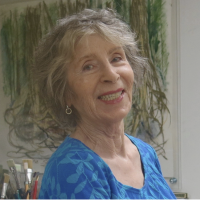
Dorothy Fall born Winer (b. 7 April 1930, Rochester, NY, USA) is an American artist, graphic designer and writer who published in 2006 a book of memories on famous war correspondent and political scientist Bernard Fall (1926−1967), her husband since 20 February 1954 and the father of their three daughters, Nicole, Elisabeth and Patricia.
The youngest of four children from Isadore Winer and Esther Rudman-Winer, a couple of Eastern European Jewish refugees, she majored in graphic design at Syracuse University, where she met an exchange student from France in 1951, Bernard Fall, recounting the moment in Bernard Fall: Memories of a Soldier-Scholar:
We wanted to expose students to other cultures, and therefore decided to have a series of lectures by foreign students. After sociology professor Byron Fox addressed our group on world poverty, my cochair Joan Altstedter and I asked him to recommend foreign students who could speak to us. He suggested a French student who was a Fulbright scholar studying at Syracuse’s Maxwell School of Citizenship. Joan phoned to invite him to talk at our next session. She reported to me, “He doesn’t sound French, and he doesn’t even have a French name: Bernard Fall. He wants us to meet with him at the Cosmo for coffee on Tuesday evening at eight.”
To publicize this talk by a Frenchman, I produced three-dimensional posters and put them up around the campus. They featured an entirely stereotyped Frenchman. He sported a twirling mustache, wore a black beret, and I had a real cigarette hanging out of his mouth through a hole in the board. At the end of the cigarette, to simulate smoke, I glued a flowing ribbon of nylon, which I cut from an old stocking. I let my creative urges run wild. “Are We It? A Frenchman’s View of the U.S., March 5, 1952,” the posters proclaimed. I also produced fliers which included a small drawing of the Arc de Triomphe and the handwritten phrase “Ah! Paree!” I had of course never been to Paris.
On Tuesday, [my friend] Joan and I met our Frenchman, who proved to be an attractive, six foot tall, clean-cut young man with a crew cut, who was wearing an American Army bomber jacket, blue jeans, and loafers. “Who is that idiot who did those stupid posters?” he asked. I admitted to being the idiot, but Bernard only laughed. He didn’t even sound French. He spoke colloquial English with a midwestern twang and a barely perceptible accent. He told us that was because he’d taken a course in remedial English given to American GIs in Germany. [p 47]
While Bernard Fall was increasingly involved in the coverage of the French debacle in Indochina, culminating with the Battle of Dien Bien Phu (13 March and 7 May 1954), she furthered her art studies, at the American University and in Paris at the Académie de la Grande Chaumière (1961) and Académie Julian (1965). She worked as Deputy Art Director of AMERIKA Magazine, the publication of the United States Information Agency, Washington, from 1956 to 1980, and she held her first ever solo exhibition in 1962 in Phnom Penh (at Maison de France), when she spent 10 months in the Cambodian capital city with Bernard and their two eldest daughters. They befriended Prince Norodom Sihanouk and Princess Monique ‑Monineath, as well as the Cambodian leader’s then-close advisor Charles Meyer and his wife of Chinese origin, Sika.
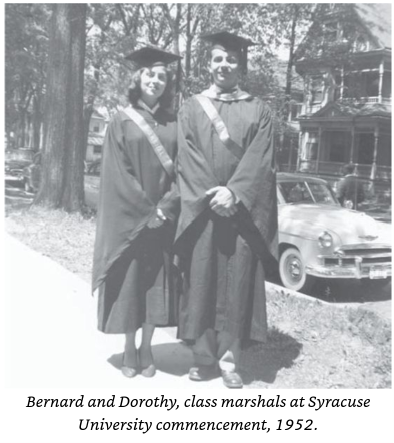
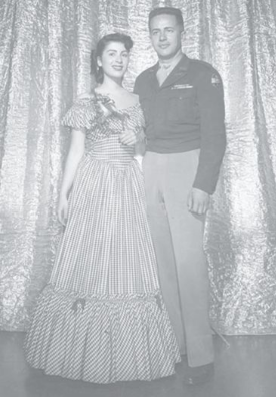
Bernard Fall and Dorothy Winer, Syracuse University, 1952.
Bernard Fall and Dorothy Winer, Syracuse University, NY, USA, 1952.
1, 2) Syracuse U sweethearts: Bernard Fall and Dorothy Winer in 1952. 3) Wat Phnom, painting by Dorothy Fall, 1962. 4) Prince Sihanouk bought one of Dorothy’s paintings at her Maison de France exhibition, Phnom Penh, August 1962. [all photos from Dorothy Fall, Bernard Fall: Memories of a Soldier-Scholar, 2006].
Prince Sihanouk at Dorothy Fall’s Phnom Penh exhibition, August 1962.
1, 2) Syracuse U sweethearts: Bernard Fall and Dorothy Winer in 1952. 3) Wat Phnom, painting by Dorothy Fall, 1962. 4) Prince Sihanouk bought one of Dorothy’s paintings at her Maison de France exhibition, Phnom Penh, August 1962. [all photos from Dorothy Fall, Bernard Fall: Memories of a Soldier-Scholar, 2006].
Later, the couple traveled to Australia, Oceania, North Africa, while keeping bases in America and France. Late 1966, as Bernard Fall had been diagnosed with a rare, incurable disease, she moved to Hong Kong with their children in order to be closer to her husband, as he was still going back to “an incredibly stupid and brutal war” in Vietnam, as he wrote to her in his final written message shortly before his death near Hue, when he stepped on a landmine while walking along a US Marine patrol on the ‘Street Without Joy’ (Colonial Road 1) on 20 February 1967.
After Bernard’s death, Dorothy Fall helped in publishing posthumous editions of his work, facing the hostility of the warmongers who could not forgive his visionary denunciation of the American failure in Vietnam. She kept exhibiting her artworks, launching her communications firm, Fall Design Communications, in 1980 and heading art galleries Gallery 10 and Pyramid Atlantic in Washington, D.C. With her daughters, she visited Vietnam and Cambodia again in the early 1990s, still marveling at “spectacular Angkor” yet saddened by the scars the conflict and civil war had left.
Right after Bernard Fall’s death, Dorothy had written in her preface to the collection Last Reflections on A War, 1967:
This was Bernard’s sixth trip to his beloved Viet-Nam. He was first introduced to the area in 1953 when he decided to write his doctoral dissertation on the Viet-Minh, Ho Chi Minh’s guerrillas who were then fighting the French. He was always proud to admit that he had gone on his own funds— the meager savings he had accumulated during his student days. From his letters to me evolved Street Without Joy. The French censor had chided him for these letters. “Why don’t you stick to love letters to your fiancée instead of these detailed reports and maps on French operations,” he had said. To obtain his information on the structure and degree of infiltration of the Viet-Minh, Bernard went deep into the provinces of Viet-Nam interviewing officials, tax collectors and village chiefs. The resulting analysis showed that the situation was much different from what the French command thought it was. The enemy held far more terrain than was known or acknowledged.
[…] In late 1963, just three weeks after the November 1 coup in which President Diem was overthrown and he and his brother, Ngo Dinh Nhu, killed, Bernard landed in the hospital with a near fatal case of uremic poisoning. He had been in this state for a week; most people die after four or five days. His strong constitution and superb physical stamina would not permit it. […] President Kennedy was assassinated the day after Bernard entered the hospital and during my daily vigil I often envisioned Madame Nhu, whose own world had toppled, sitting before two dolls — one of President Kennedy and the other of Bernard Fall — eking out vengeance by sticking pins into them. [p 9 – 11]
At the turn of the century, Dorothy Fall took a step she had postponed for nearly three decades. As she explained herself on the blog Women Across Generations,
At the age of 70 I realized that it was now or never if I was to write the planned memoir about my late husband Bernard Fall. Out came the cartons filled with interviews, diaries and correspondence put away for this moment 20 years earlier. I do not consider myself a writer but an author with a story to tell. It took many years and more research as I wrote steadily. I cried as I sent the manuscript off to my editor. I could not believe that I finally wrote my book.
Solo Exhibitions by Dorothy Fall
1962 Maison de France, Phnom Penh, Cambodia
1968 Galerie Internationale, New York, NY
1969 Mickelson Gallery, Washington, DC
1970 Utica College, Utica, NY
1973 Mickelson Gallery, Washington, DC
1975 Mickelson Gallery, Washington, DC
1979 Mickelson Gallery, Washington, DC
1984 Mickelson Gallery, Washington, DC
1989 Plum Gallery, Kensington, MD | “O” Street Studio, Washington, DC
1990 AVA Gallery, Lebanon, NH | Covington & Burling, Washington, DC
1992 “O” Street Studio, Washington, DC
1993 American Horticultural Society, Alexandria, VA
1996 Gallery 10, Washington, DC
2000 Gallery 10, Washington DC | Cosmos Club, Washington, DC
2014 BlackRock Center for the Arts, Germantown, MD
2015 Cosmos Club, “Forest Spirits”, Washington, DC
2016 410 GoodBuddy, “Transitions”, Washington, DC
Dong is an ancient Chinese term for a mountain valley community, especially in the southern and soutwestern regions abutting to 'historic' mainland China.
In Korea, dong동 has come to refer to a neighborhood or an administrative sub-district.