

Richard Halliburton

Richard “Dick” Halliburton (9 Jan. 1900, Brownsville, Tennessee, U.S.– presumed dead in the Pacific Ocean after 24 March 1939) was an American travel writer and adventurer who, after running a successful publishing career, disappeared at sea while attempting to sail a Chinese junk, the Sea Dragon, across the Pacific Ocean from Hong Kong to the Golden Gate International Exposition in San Francisco, California.
In his lifetime, this diminutive and slender man dubbed “The Innocent Abroad”
climbed Mount Olympus in Greece, the Matterhorn in the Swiss Alps and Fujiyama in Japan. He swam the length of the Panama Canal and plunged into the Hellespont in Turkey. He was arrested in Gibraltar, slept on top of the Great Pyramid in Egypt, and was the first to photograph both Mount Everest and the Taj Mahal from the air. Halliburton rode a donkey he named Hannibal over the Pyrenees and, in homage to Hannibal, rode an elephant across the Alps. He spent time with convicts on Devil’s Island and a month on the island of Tobago pretending he was Daniel Defoe’s Robinson Crusoe. Halliburton joined the Foreign Legion, dove 70 feet into a Mayan well of death at Chichen Itza and flew all the way from here to Timbuktu, right across the middle of the Sahara Desert in an airplane he christened The Flying Carpet. [“80-years-ago-tennessees-boy-adventurer-met-his-untimely-death”, Tennessee State Museum website]
2) Halliburton posing near two giant olive oil jars in Knossos, Greece [from RH’s Second Book of Marvels — The Orient].
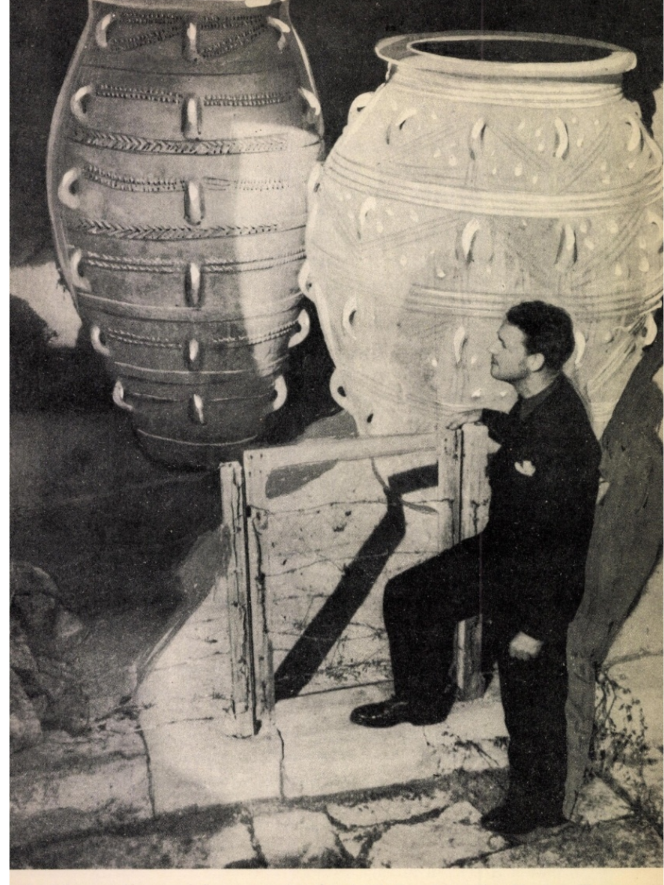
2) Halliburton posing near two giant olive oil jars in Knossos, Greece [from RH’s Second Book of Marvels — The Orient].
2) Halliburton posing near two giant olive oil jars in Knossos, Greece [from RH’s Second Book of Marvels — The Orient].
The son of all-American parents — his mother, Nelle Nance-Halliburton was born on 9 March 1869 in Paris…Tennessee — Richard completed high school in Memphis before joining Princeton University, where he was the chief editor of The Princetonian Pictorial Magazine and attended courses in public speaking (he was to be known later as a “Raconteur”, a born story-teller who gave numerous conferences after each and everyone of his trips ). In September 1919, he unexpectedly vanished from the company of his parents in New Orleans and boarded a ship to England, touring France and Monte-Carlo until his return in mid-January 1920. But his later journeys were gladly funded by his businessman father, and despite Richard’s admiration for elder travel writer Harry Franck he never had to ‘bum his way around the world as a vagabond.’
In 1925, two years after graduation, he published his first book, The Royal Road to Romance, about his first Iintercontinental travel from the Alhambra in Spain to Mt. Fuji through Monte Carlo, the Nile, Punjab, Kashmir, Ladakh, the Khyber Pass, Angkor, Bangkok and Bali. That was followed with The Glorious Adventure (1927), a recounting of his own reading of Homer’s Odyssey — more than 100 years before the spectacular popular success of Christopher Nolan’s eponymous movie (2026) — and the visit the young author had paid to the grave of English poet Rupert Brooke on the Greek island of Skyros, then New Worlds To Conquer (1929), a summary of his latest feats.
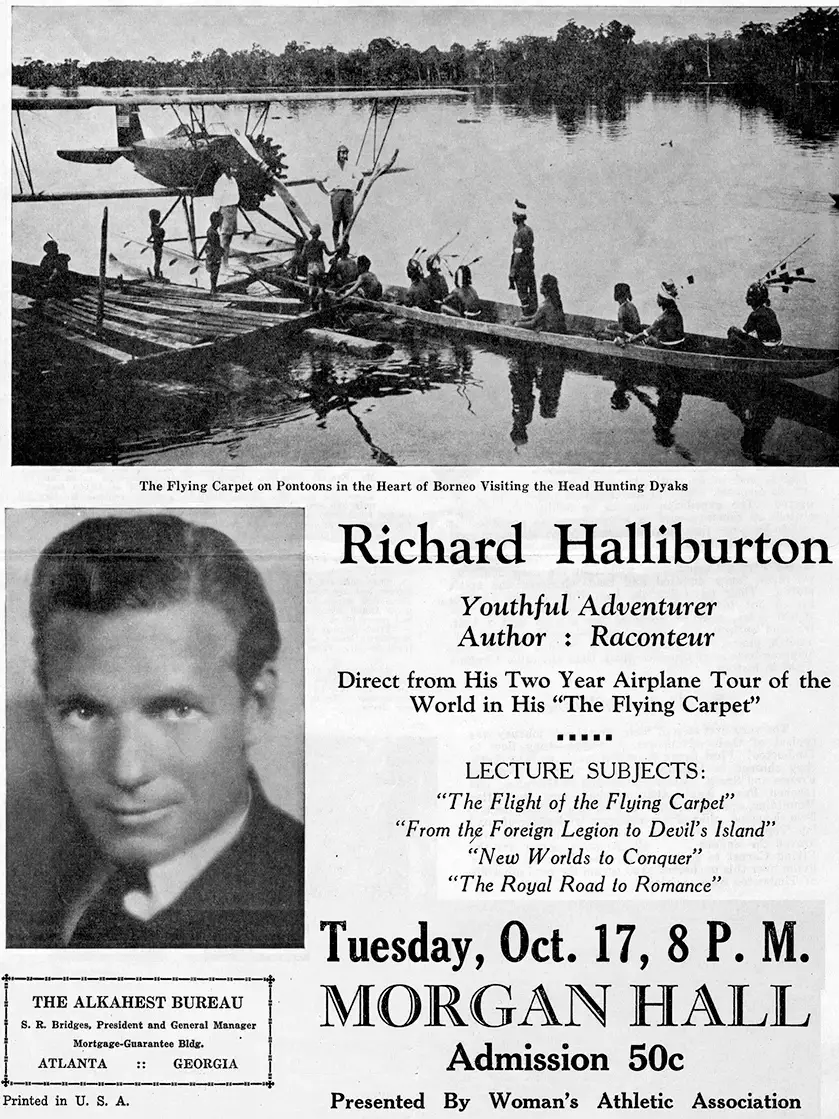
When he boarded his Flying Carpet (a Searman C3B airplane) at the French Foreign Legion airstrip in Colomb-Béchar (Algeria) in April 1931, along with experienced pilot Moye Stephens, he was probably the world’s most famous travel adventure writer, with three books on the bestseller list, translated into nine languages, and the movie rights for the first one already bought by Fox Films in Hollywood. Flying over the Sahara to legendary Timbuktu, last leg of this air trip across three continents, was his way of emulating and exceeding Charles Lindbergh’s transatlantic flight, and even the Antoine Saint-Exupéry’s tragic exploit.
At the same time, Halliburton — who has been labelled “the gay Indiana Jones” in the years 2000s, was able to “navigate a very visible career as a “ladies’ man” while also living a fairly openly gay lifestyle that included some long-term relationships” [to quote his biographer C. Scott William, The The Forgotten Adventures of Richard Halliburton: A High Flying Life from Tennessee to Timbuktu, Charleston, The History Press, 2014, p. 138]. We are still trying to find out whether his path crossed the wandering of another American Southerner enamored with traveling and same-sex adventures, Harry Hervey.
In 1934, US newspapers syndicated with the Bell group started to publish Halliburton’s weekly feature stories — in total, some 50 short (about 1,000 words) pieces of history popularization dealing with topics as diverse as Dr. Samuel Mudd (plotter of President Abraham Lincoln’s assassination), the Seri Indian tribe of Southern California, the Battle of Santiago de Cuba a month later; Henri Christophe and the Citadelle Laferrière in Haiti; Christopher Columbus, Lord Byron, and “The Girl from Martinique Who Wrecked Napoleon” [Joséphine de Beauharnais]…That required an extra round of traveling, this time from Cuba to Ethiopia to Russia and the Arabic Peninsula, with the resulting new set of books — Seven League Boots and the two Books of Marvels.
Less persistent than the marathonian lecturer and American traveler supreme Burton Holmes (1892−1952), less physically robust than his exploits would allow — he had spent a year in a Kellogg sanatorium in his childhood -, Richard Halliburton was again looking for a career rebound and fame boost when he boarded the SS President Coolidge bound for Hong Kong on 23 Sept. 1938 — the same cruise liner that had carried Charlie Chaplin and Paulette Goddard on their way to Angkor two years earlier. The plan was to sail back a 23-meter Chinese junk, the Sea Dragon [ch 海龍], across the Pacific Ocean to San Francisco, a spectacular demonstration of ‘East Meets West’ culminating at the Golden Gate International Exposition (GGIE). The junk would be moored at Tresasure Island and take visitors on excusions around the bay for a limited fee.
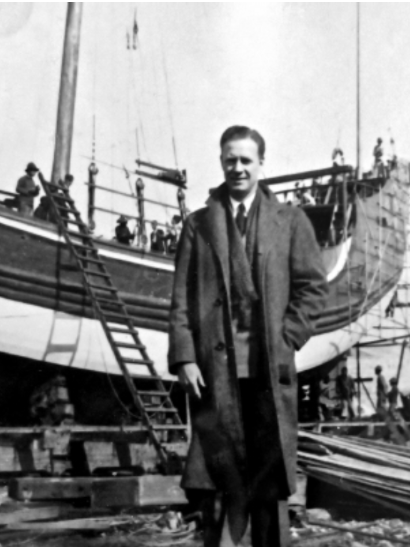
1) Richard Halliburton posing in front of the Sea Dragon on 29 Dec. 1938. [photo taken by Dr. and Mrs. J.M. Lapp, Hong Kong — Rhodes College Archives and Special Collections, Memphis, Tennessee.] 2) Front page of the Commercial Appeal reporting Richard Halliburton’s probable death, 11 June 1939. [both photos reproduced in C. Scott William, The The Forgotten Adventures of Richard Halliburton: A High Flying Life from Tennessee to Timbuktu, op. cit.].
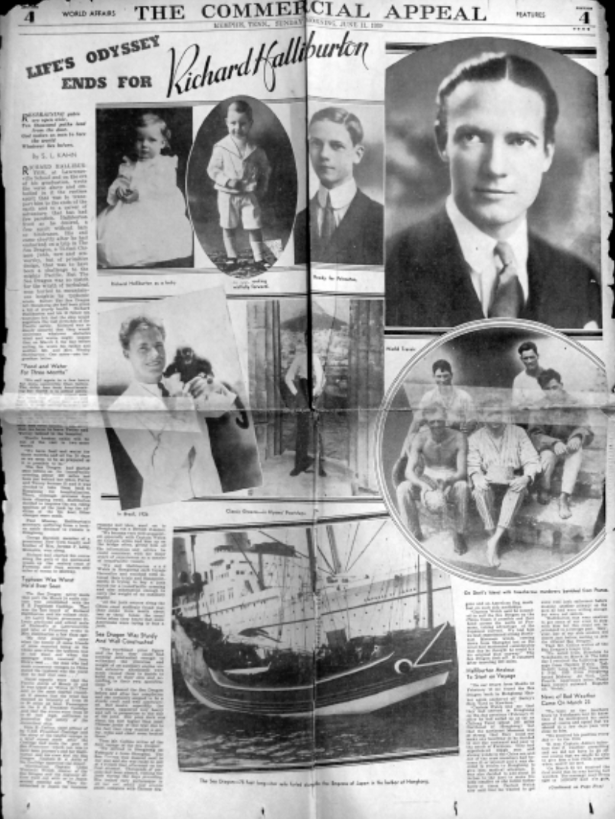
1) Richard Halliburton posing in front of the Sea Dragon on 29 Dec. 1938. [photo taken by Dr. and Mrs. J.M. Lapp, Hong Kong — Rhodes College Archives and Special Collections, Memphis, Tennessee.] 2) Front page of the Commercial Appeal reporting Richard Halliburton’s probable death, 11 June 1939. [both photos reproduced in C. Scott William, The The Forgotten Adventures of Richard Halliburton: A High Flying Life from Tennessee to Timbuktu, op. cit.].
1) Richard Halliburton posing in front of the Sea Dragon on 29 Dec. 1938. [photo taken by Dr. and Mrs. J.M. Lapp, Hong Kong — Rhodes College Archives and Special Collections, Memphis, Tennessee.] 2) Front page of the Commercial Appeal reporting Richard Halliburton’s probable death, 11 June 1939. [both photos reproduced in C. Scott William, The The Forgotten Adventures of Richard Halliburton: A High Flying Life from Tennessee to Timbuktu, op. cit.].
The three-month journey, sponsored by subscribers, had two trial starts, in January and February 1939, and each time experienced mariners found the vessel way too heavy. After some repair, the junk sailed again out of Hong Kong on 4 March 1939. The last contact with the boat was made on 24 March. A search party off Hawaii was set up on 10 April. Even if rumors about his fate continued to arise over the years — just as it happened with woman explorer and pilot Amelia Mary Earhart (24 July 1897 — disap. 2 July 1937), who was declared dead that same year on 5 Jan. 1939 -, Richard Halliburton quickly became the faded memory of a short-lived fame, “of a meteor that blazed across the heavens…and was gone”, to use the same image as his own father, Wesley Halliburton [James Cortese, Richard Halliburton’s Royal Road, Memphis, TN: White Rose Press, 1989, p. 8].
Publications
- The Royal Road to Romance, Indianapolis, The Bobbs-Merrill Company, 1925.
- The Glorious Adventure, Indianapolis, The Bobbs-Merrill Company, 1927.
- New Worlds to Conquer, Indianapolis, The Bobbs-Merrill Company, 1929.
- The Flying Carpet, Indianapolis/New York, The Bobbs-Merrill Company, 1932.
- Seven League Boots, Indianapolis /New York, The Bobbs-Merrill Company, 1935.
- Richard Halliburton’s Book of Marvels: the Occident, Indianapolis /New York, The Bobbs-Merrill Company, 1937. [originally titled Marvels of the West].
- Richard Halliburton’s Second Book of Marvels: the Orient, Indianapolis /New York, The Bobbs-Merrill Company, 1938.
- Richard Halliburton: His Story of His Life’s Adventure, as Told in Letters to His Mother and Father, Indianapolis/New York, The Bobbs-Merrill Company, 1940.
- Richard Halliburton’s Complete Book of Marvels, Indianapolis/New York, The Bobbs-Merrill Company, 1941.
The Royal Adventures of Richard Halliburton. Indianapolis/New York, The Bobbs-Merrill Company, 1947 [repr. in 1 volume of The Royal Road to Romance, The Glorious Adventure, and New Worlds to Conquer.]
Contributions
- [Introduction by Richard Halliburton, “World Traveler, Author and Epicure”] One Hundred Years of Delightful Indigestion – Memphis Priceless and Treasured Receipts, Memphis, James Lee Memorial Academy of Arts, 1935.
- India Speaks, photo-play and film with Richard Halliburton, produced and directed by Walter Futter, written by Norman Houston, 1933 [A sequel to the popular film Africa Speaks!].
About Richard Halliburton
- “Richard Halliburton”, website by C. Scott William.
- Mark F. Bernstein, “What Would Halliburton Do? The life of a Princeton adventurer”, Princeton Alumni Weekly, 8 March 2019.
- The Barrett Library at Rhodes College, USA, holds ‘Richard Halliburton’s Archives’ [not available online as of June 2026].