

Richard Halliburton's Second Book of Marvel: The Orient - A Tale from the Jungle
by Richard Halliburton

- Author
- Richard Halliburton
- Publisher
- Indianapolis/New York, The Bobbs-Merrill Company, 1938. Chapter 28, p. 269-82 (out of 316). | Digital version Papamoa Press, 2018.
- Published
- 1938
- Pages
- 14
- Language
- English
- Formats
- e-book, Kindle
America’s favorite explorer during the Roaring Twenties, the wide-eyed and closeted gay man who wanted to follow the path of Ulysses at a tender age, Richard Halliburton was the ultimate ‘Innocent Abroad’ as he was often called and as Time magazine’s caustic obituary was titled, stating :
When, at 22 of age, Richard Halliburton lawlessly hid in the shrubbery, watched the Taj Mahal and his chance by moonlight, and swam in the lily-padded pool, he was neither putting on a show nor concocting copy: he was simply a college boy on the loose, a little bit crazy with romantic enthusiasm. When, three years later, he wrote “Monday I was free to climb over the darned walls and spend a night alone in the Parthenon,” a lot of water had gone under the bridge. His Royal Road to Romance [1925] was a raving bestseller, and Richard’s whole trip was a professional set piece: a stunt following-out of the wanderings of Ulysses.
These episodes and the change of spirit that took place between them may be understood from Halliburton’s letters home, of which this volume is a selection. The stunts, it is obvious, became more & more staged, more & more weary, as time went on. Yet the naïveté which made it possible for him to invent them was also nearly great enough to exonerate him of their ridiculousness, their frantic commercialism. His last stunt — a voyage across the Pacific in a Chinese junk, which ended somewhere at sea — was of a piece with all the rest.
Halliburton was something more than a bad writer, a rather hard-to-take public figure. He was an appealing, confused individual, a U. S. phenomenon, a U. S. symbol. The nice son of a nice U. S. environment, he never entirely either out grew or betrayed it. He was essentially, if mildly, an artist and a rebel, he achieved neither art nor rebellion. He was an innocent sort of Byron-of-his-time. (“Innocent Abroad”, Time, 8 June 1940, p. 71)
In the Introduction to his Second Book Of Marvels ‑The Orient [unsurprisingly, the first one was titled ‘The Occident’], Halliburton noted:
I often said to myself: “I wish my father, or somebody, would take me to all these wonderful places. What good are they if you can’t see them? If I ever grow up and have a son, we are going traveling together. I’ll show him Gibraltar and Jerusalem, the Andes and the Alps, because I’ll want my boy not only to study geography — I’d like for him to live it, too.” Well, I’m grown up now. But as yet I haven’t any son or any daughter to go traveling with me. And so, in their places, may I take you?
And so, in this last published book (1938) before the ‘Raconteur’ [story teller] perished at sea, the reader-child is taken by the hand and led through ‘the Orient’, which starts at Rome’s Coliseum and ends on the snowy peak of Mount Fuji. With Angkor featured in a spot of choice, between India’s Taj Mahal and the Great Wall of China, this is a pleasant visit to the “largest and finest temple ever built by man…a magnificent city that would be…spread for miles across the land, and towering in the sky.”
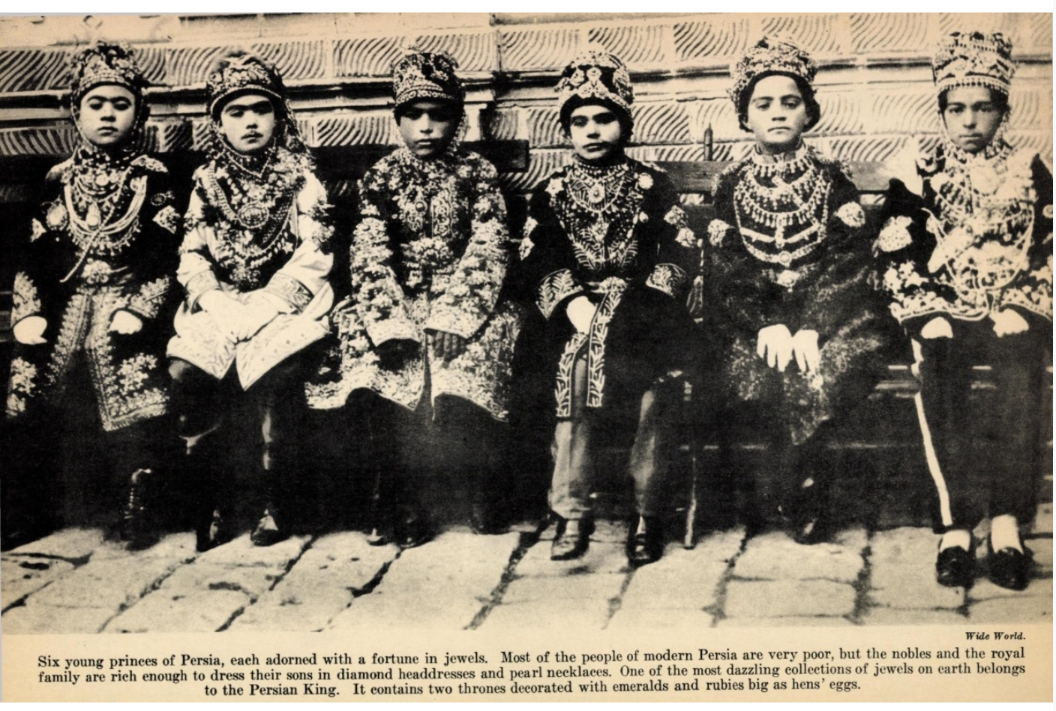
1) “Young Princes of Persia” — ultimate magic of the Orient for American travelers of the time [photo Wide World]. 2) Great Wall of China. [photo Galloway].
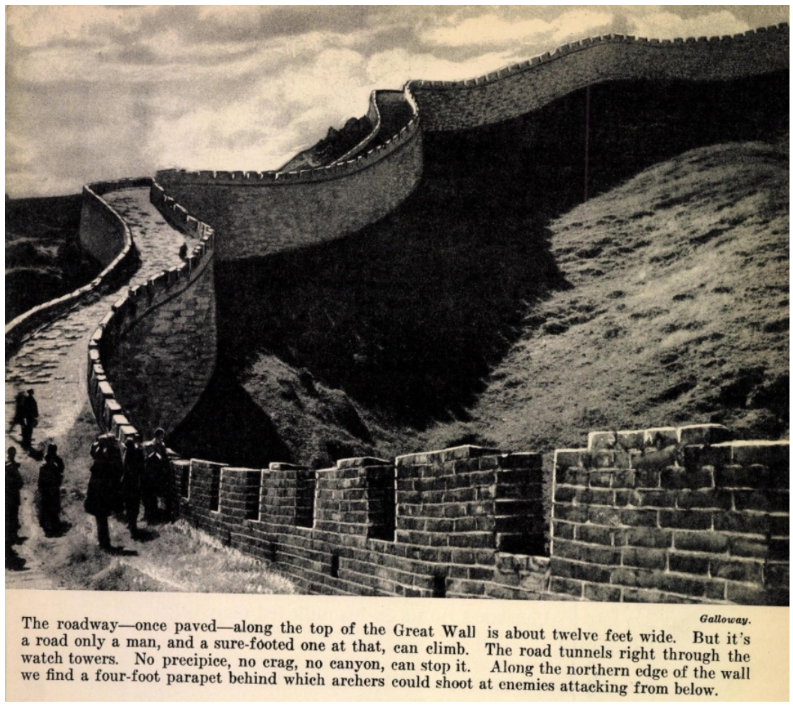
1) “Young Princes of Persia” — ultimate magic of the Orient for American travelers of the time [photo Wide World]. 2) Great Wall of China. [photo Galloway].
1) “Young Princes of Persia” — ultimate magic of the Orient for American travelers of the time [photo Wide World]. 2) Great Wall of China. [photo Galloway].
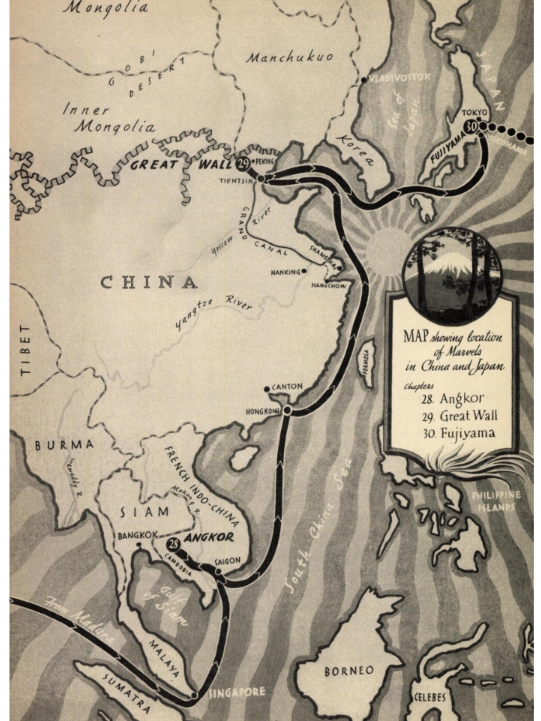
1) Map showing Angkor respectively to China and Japan, repr. at the start of Chapter 28. 2) “ANG-kor WOT”, “BOOda”: List of recommended [American] pronunciation at the end of the book. 3) The author with two Japanese kids shortly after climbing Mount Fuji in winter [author’s collection].
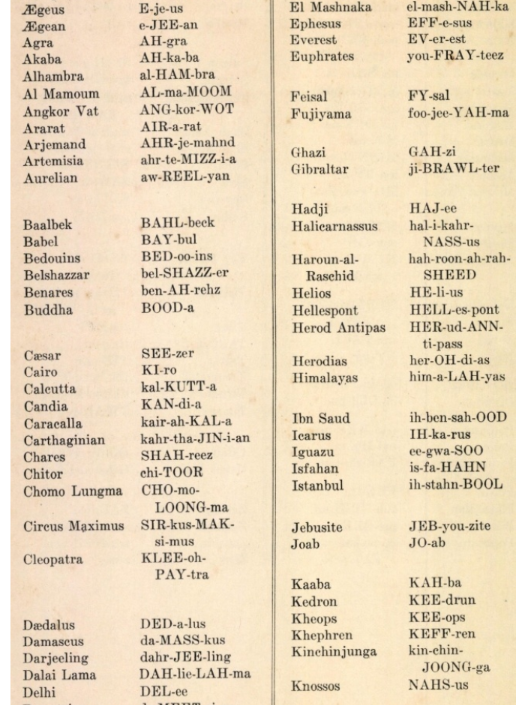
1) Map showing Angkor respectively to China and Japan, repr. at the start of Chapter 28. 2) “ANG-kor WOT”, “BOOda”: List of recommended [American] pronunciation at the end of the book. 3) The author with two Japanese kids shortly after climbing Mount Fuji in winter [author’s collection].
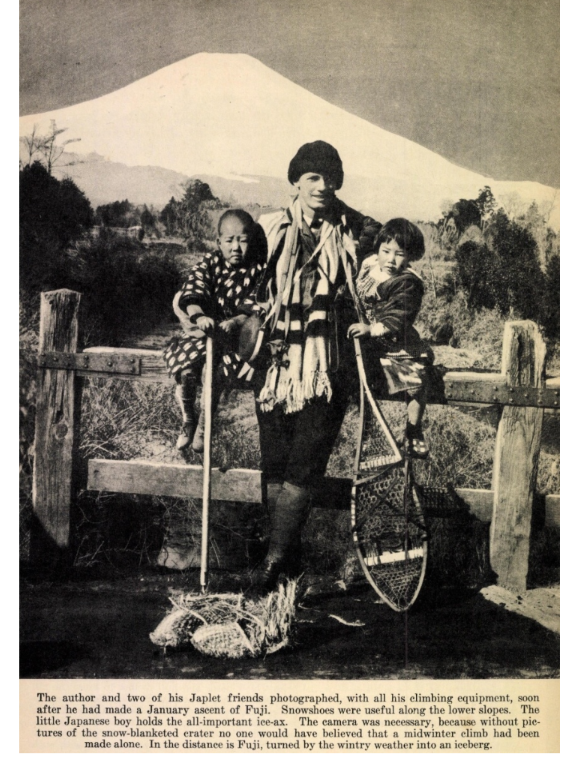
1) Map showing Angkor respectively to China and Japan, repr. at the start of Chapter 28. 2) “ANG-kor WOT”, “BOOda”: List of recommended [American] pronunciation at the end of the book. 3) The author with two Japanese kids shortly after climbing Mount Fuji in winter [author’s collection].
1) Map showing Angkor respectively to China and Japan, repr. at the start of Chapter 28. 2) “ANG-kor WOT”, “BOOda”: List of recommended [American] pronunciation at the end of the book. 3) The author with two Japanese kids shortly after climbing Mount Fuji in winter [author’s collection].
CHAPTER XXVIII — A TALE FROM THE JUNGLE
Suppose — just to help me tell this story — that the city of Washington were five times as big as it is now, with five times as many people. And suppose the great public buildings — the Capitol, the Library of Congress, the Supreme Court, the Lincoln Memorial, were likewise five times as big as they are today. Suppose, instead of a dozen or a score of such huge buildings, there were a hundred. Suppose one of them — a great national temple — was the largest and finest temple ever built by man…Think what a magnificent city that would be…spread for miles across the land, and towering in the sky.
Now please keep on imagining.… Instead of having smooth white stone walls and smooth white columns, the walls of this imaginary Washington are flooded, down to the last inch, with the most delicate and wonderful carving — and above all the walls rise towers and spires of carved stone lace. This city — if you’re still keeping up with me — swarms with 2,000,000 people. It has wealth, and luxury, and power, and fame.
And then, suddenly, at the height of its power, a terrible disaster falls upon it. A plague kills off every man, woman and child — all 2,000,000 inhabitants — within a month. Or perhaps a civil war arises and the people kill each other. Anyway, they all suddenly disappear. Every stone of this mighty city is left uninjured, but not one human being is left to live there. It becomes a vast stone corpse, intact but dead. With no one to defend the corpse, the forest marches in upon it. Trees sprout from the stone towers, roots twine themselves around the carved stone columns, vines block the doors, the streets become fields of grass. The city is swallowed up in a flood of foliage, and completely lost from the memory of man — for 500 years.
And then a naturalist, in quest of rare butterflies, comes to this country, and is hacking his way through the forest. He comes to an open glade, and looks ahead across the treetops. He rubs his eyes…it must be an attack of fever…for there before him, springing right out of the jungle, are five great towers of stone lace. With a pounding pulse he rushes forward toward those towers and, in a moment more, comes face to face with the greatest and most gorgeous temple his eyes have ever beheld. Most wonderful of all is its perfect preservation. Unlike the ruins of Greece, and Rome, this temple has almost every stone in place. Even the forest that has blanketed wall and pinnacle has been unable to dislodge the massive blocks.
With increasing wonderment the naturalist creeps up the carved stone steps. Snakes lie in his path. Panthers slip noiselessly from their carved stone dens. Bats and owls fly about his head. Whole colonies of monkeys chatter at him as he moves along the carved corridors. But he pushes on and finally reaches the supreme central tower. From this high point he looks back down upon the miles and miles of waving forest-tops. In this sea of trees he spots a hundred other great and beautiful buildings lifting their heads above the branches.
And the naturalist knows that he has made one of the greatest discoveries in history — that he has stumbled upon the ruins of a lost city, the city that was once the proud capital of an empire, a city as big in area as Paris, and with far finer buildings. And not one human being lives in this city. And only he, of all the millions of people on earth, knows that it exists. The naturalist hurries home to tell the world what he has found. But back in France, his friends, hearing him insist that he has discovered a lost city more wonderful than Paris, just tap their heads and suppose the heat has weakened his brain. Indeed, in a very short time some kind of jungle fever does bring about his death. But, to the end, he keeps raving about the miraculous city and temple.
Now — if you have imagined all that, I’ll tell you the next chapter in the story.… You say it’s nice of me to try to amuse you with my tall tales of adventure and romance…didn’t the naturalist also find a white princess chained in the temple, and guarded by gorillas?…but you would like it better if I told you something more useful — something, for example, about our next Marvel — what is it going to be — and where.… But I am telling you about our next Marvel. The city I’ve asked you to try to picture in your mind’s eye did actually exist. And it still exists. It was a great capital, like the city of Washington, only five times as big.
It did and still does have a hundred gigantic buildings — temples, palaces, libraries, monuments. And they are all adorned with the most gorgeous carving, just as I said, and have beautiful towers 250 feet high. The great central temple is the biggest building in all Asia. Yet no coral cameo was ever so delicately fashioned as is each block of this mammoth monument. And just as I said, the city, about the year 1350, actually had 2,000,000 people, and they all suddenly disappeared as if by magic.
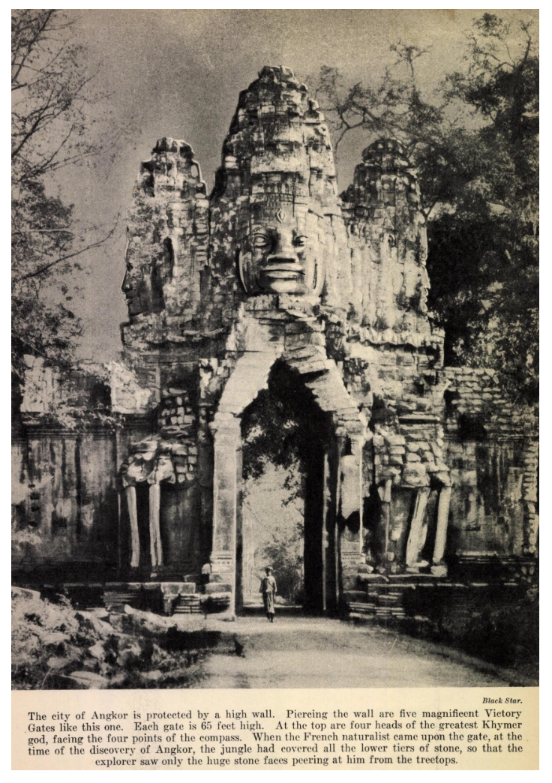
1) Angkor Thom Gate (‘each one is 65 ft high’) [photo Black Star]. 2) Angkor Wat, “biggest religious building in Asia” [photo by Lionel Green]. 3) Devatas on Angkor Wat reliefs [uncredited photo, possibly by the author]. 4) Angkor Thom Gate with “sacred snake baluster” [photo Galloway].
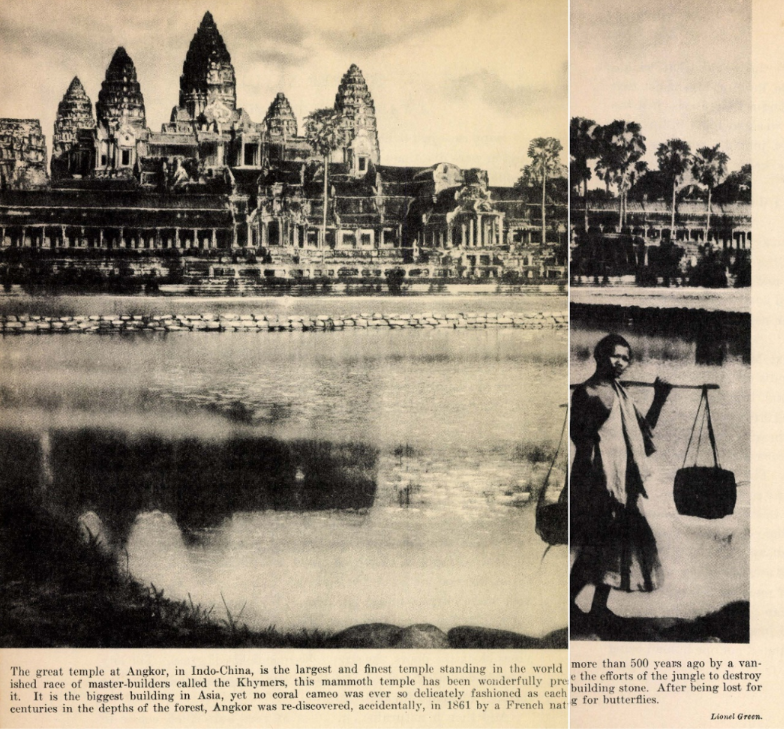
1) Angkor Thom Gate (‘each one is 65 ft high’) [photo Black Star]. 2) Angkor Wat, “biggest religious building in Asia” [photo by Lionel Green]. 3) Devatas on Angkor Wat reliefs [uncredited photo, possibly by the author]. 4) Angkor Thom Gate with “sacred snake baluster” [photo Galloway].
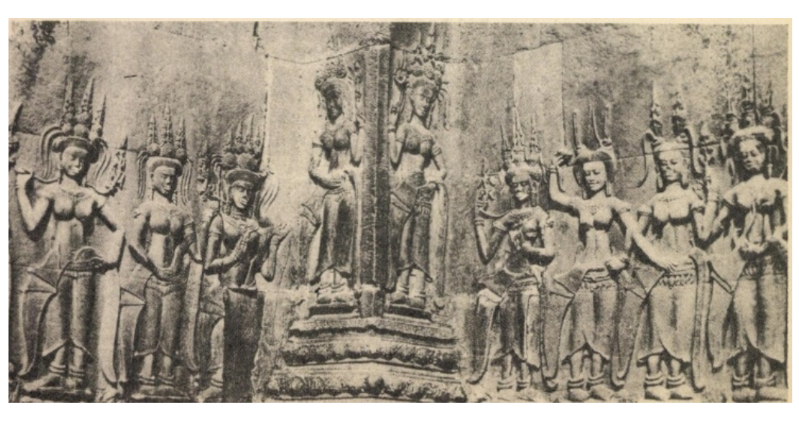
1) Angkor Thom Gate (‘each one is 65 ft high’) [photo Black Star]. 2) Angkor Wat, “biggest religious building in Asia” [photo by Lionel Green]. 3) Devatas on Angkor Wat reliefs [uncredited photo, possibly by the author]. 4) Angkor Thom Gate with “sacred snake baluster” [photo Galloway].
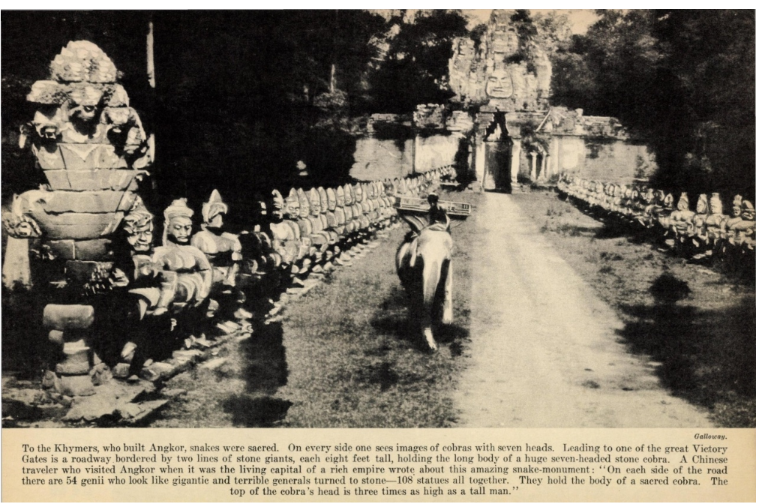
1) Angkor Thom Gate (‘each one is 65 ft high’) [photo Black Star]. 2) Angkor Wat, “biggest religious building in Asia” [photo by Lionel Green]. 3) Devatas on Angkor Wat reliefs [uncredited photo, possibly by the author]. 4) Angkor Thom Gate with “sacred snake baluster” [photo Galloway].
1) Angkor Thom Gate (‘each one is 65 ft high’) [photo Black Star]. 2) Angkor Wat, “biggest religious building in Asia” [photo by Lionel Green]. 3) Devatas on Angkor Wat reliefs [uncredited photo, possibly by the author]. 4) Angkor Thom Gate with “sacred snake baluster” [photo Galloway].
The forest, as I explained, crept in and swallowed the place, and it was completely lost to the memory of man for 500 years. Then in 1861 (the year the American Civil War began), the French naturalist was wandering in the jungle, and bumped right into this marvelous ruin. As I said, he found not one human being living in it.
His name was Henri Mouhot. The city’s name is Angkor. Angkor, before it got lost, was the largest city in the Orient, and the finest city in the world.
Look here — I’ll show you where it is on the map, and how we are going to reach it: You remember we left Madura and went past the island of Ceylon, off the southern end of India. (See map page 186.) Aboard a ship we crossed the Bay of Bengal to Singapore at the tip of the Malay Peninsula. (See map page 270.) From Singapore we continued by sea north to Saigon, the port of Cambodia, which is part of French Indo-China. Saigon is near the mouth of a huge tropical river called the Mekong. Now, in a river boat, we are traveling 300 miles up the Mekong and into one of its largest branches. Soon the river will broaden out to make a lake. Near the banks of this lake, sunk deep in the forest, lies this Marvel we have come to see.
Early in the morning we leave our boat and go ashore. A narrow road, pressed on either side by the dense, dark jungle, leads us inland. Jungle, jungle, for several miles smothers the earth. And then, all of a sudden, we come to a glade, and look over the trees — and see what Henri Mouhot saw…five magical towers rising out of the forest — the towers of the Great Temple! Like Mouhot, we hurry forward. We come to the Temple grounds, and look up at the stone miracle before our eyes. With wonderment we stare at the enormous mass of the thing — it blots out the whole horizon. And then we stare with just as much wonderment at the richness of detail — at the acres of delicate stone carving, at the hundreds of carved windows, at the miles of carved galleries, at the towers thrusting upward to meet the sky — all powerful and beautiful and desolate beyond belief. But no use trying to describe it.
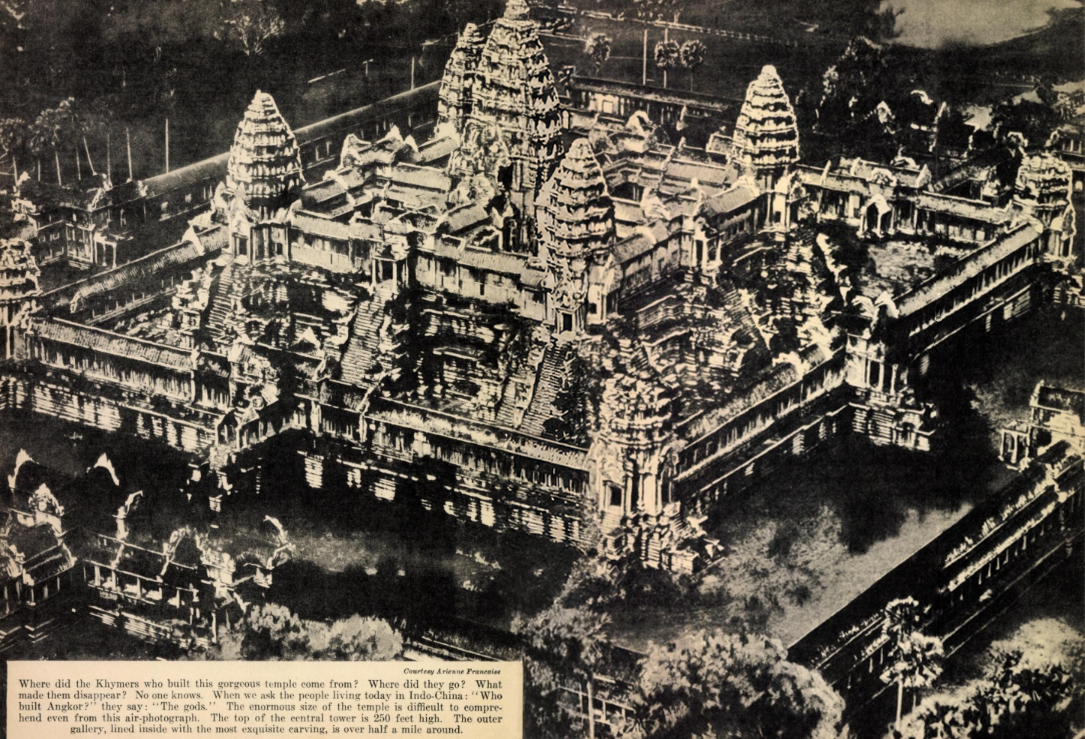
Angkor Wat, aerial c. 1931 [photo Air France].
Angkor Wat, aerial c. 1931 [photo Air France, cred. “Arienne Francaise” [sic] in the book.]
It can’t be described. We just stand there at the edge of the glade in silence and amazement. Then somebody finally asks our native Cambodian guide: “Who built this mighty temple?” And we quite believe him when he says: “The gods.”
With a feeling of awe we move on toward the carved stone mountain. To reach the entrance we walk along a raised stone causeway, 1200 feet long and 40 wide. This causeway leads over what was once a sacred lake. The balustrade is made of the long stone bodies of huge seven-headed stone cobras. We notice that the pavement is rutted by the passage of ancient chariot-wheels — chariots that once bore the king and his nobles to worship at this god-built shrine.
We climb the steep steps that lead through the entrance door into the lowest gallery. (Look at the picture on pages 276 and 277.) Inside we find ourselves in the midst of the most marvelous stone tapestry. The Egyptians might have raised this vast pile of stones in place, but only these ancient Cambodians — called Khymers by historians — could ever have carved them with such lavish beauty. Every inch of this giant building is covered with decorations. Kings and cobras, smiling deities, chains of dancers, riot over wall and tower. They rioted likewise at Madura. But there they were hideous, made of plaster, painted pink, and gave us a headache. The Angkor carvings are all stone — such stone beauty as the world has never seen before, and may never see again.
Only one thing at the Angkor temple reminds us of Madura—the bats. These same evil-smelling little beasts swarm by the million in the silent halls of this empty building. Whenever we walk along the galleries, the bats, as at Madura, squeak and tumble about our heads. For some 500 years these glorious stone rooms and terraces were the homes of monkeys, panthers, and bats. The monkeys and panthers have been driven out by the French archeologists. But the bats cling to their temple, and squeak with rage at everyone who comes to visit it.
When I was here once before, I happened to glance, one day just at twilight, toward the peak of the central tower, and I saw what looked like a great plume of smoke pouring out of the tower-top. I thought: The Temple is on fire! And then I saw that the smoke was bats — millions and millions of bats, pouring out of the tower, and in a black cloud spiraling into the sky.
This Temple is called Angkor Vat. The city surrounding it is called Angkor Thom. We must see the city, too. The French government has cleaned all the weeds and trees from the walls and towers of the Temple. (Henri Mouhot would hardly recognize the place if he came back today.) But the other hundred wonderful buildings, strewn about the city, are still in the grip of the jungle.
We spend eight hours wandering from one of these magnificent structures to another. We walk ten miles, and late afternoon comes, and we have not seen half of Angkor Thom. Half? — we have not seen a tenth. We would need a week to see it all. The number and size of Angkor’s ruins are staggering — more temples, more palaces, more libraries, baths, walls, gateways, monuments…all gorgeously carved, all but a few drowned in the jungle.
Let’s rest here on this big stone — I’m tired. But first, look well at the stone! The cobras are thick around these ruins — let’s not sit on one! You’ve asked me what happened to the Khymers, what made them disappear. You’ve asked me why this heavenly city, with its huge population, its armies, its palaces, its temples, its might and glory, should suddenly be deserted and turned over to the forest.
History itself would like to know the answers. Some people say a plague came and killed all the inhabitants. Some say an enemy conquered the city, and dragged every one of the 2,000,000 citizens away into slavery. Still others say — and I think this is the true answer — that the Khymers’ own armies of slaves, who had been driven like beasts to work in the quarries and on the walls, found a leader. And the leader led them in a murderous rebellion against their overlords. For many years, thousands upon thousands of slaves had died of torment and despair in order that these glorious temples might rise; in order that stones might be piled on stones to quench the kings’ mad thirst for beauty.
Then came the day of reckoning. The slaves turned on their cruel masters, and slaughtered them in every horrible fashion they could think of. The nobles, fleeing for their lives, hid in the jungles, only to be tracked down and slain like beasts. Every house that would burn was set on fire. Every child of a noble family was killed. The slaves, in an orgy of hate and vengeance, butchered everybody who was not a slave. And then the rebels, with no one left to feed them and clothe them, began to wander away from the corpse-strewn city, until soon not even a slave remained. And scarcely were they out of sight when that hungry fiend, the jungle, rushed upon the helpless and deserted capital and suffocated all but a few of its greatest monuments. It remained deserted and lost in the forest, for five long centuries. Perhaps it might be lost still, had Henri Mouhot not come along on that famous day.
Slowly and wonderingly we crawl on, like ants, about these lonely ruins. The sun sets behind the western treetops, and twilight creeps through the jungle. Every bird has become hushed; not even a cricket breaks the silence that sinks upon this mighty graveyard. In a few moments more, it’s almost night. We begin to see ghosts of murdered Khymers in the shadows. We draw closer together for protection against the terrors of the darkness.
I suggest we stay here in the jungle till morning…it might be nice to sleep in a ruined temple along with a few ghosts and cobras.
You reply that I can stay here, if I wish, but you are going out of this dark jungle, and away from these snaky ruins, and back to the river-boat, as fast as your legs will carry you!
I say! Wait a minute! In the name of all the Khymer gods, don’t leave me behind!
NOTE ABOUT THE PHOTOGRAPHS: All photos reproduced above came from the Halliburton’s Second Book of Marvels original edition (1938). Remark the author’s and publisher’s choice of using shots provided by American photo agencies or taken by American photographers. In that regard, we note for Angkor
- photos from Black Star and Galloway Agencies. The great German photographer Walter Bosshard, who had worked in Angkor in the early 1930s, emigrated to the USA and joined Black Star. As for the agency founded in 1920 by Ewing Galloway, it hed collected an important fund of photos of Asia across the years;
- one magnificent photo credited to Lionel Green, a noted architecture and commerce photographer who had photographed Angkor as a personal research in the early 1930s.
- an aerial of Angkor Wat was credited ‘Courtesy Arienne Francaise’ [sic], mispelling of Courtesy Compagnie Aérienne Française. That photograph, reproduced in several French books and publications, was indeed one of the first ever credited to Air France, the French commercial airline founded on 7 Oct. 1933 after the merger of Air Orient, Air Union, and Aéropostale.
Angkor by Halliburton, 1920s
Like for contemporary Harry Hervey of King Cobra fame, Halliburton had met instant success with his first published book, The Royal Road to Romance (1925). Like their elder Robert ‘Bob’ Casey, his editor was the Bobbs-Merrill Company, based in Indianapolis. Like Harry L. Foster, he called himself a ‘beachcomber’ and a ‘vagabond’ yet he journeyed quite comfortably. And unlike Helen Churchill Candee, whose Angkor The Magnificent (1924) left a durable impression on American generations, Halliburton’s Royal Road — note that André Malraux’s The Royal Way came out five years later in 1930 — was mostly the dizzying travelogue of a dashing young adventurer supposed to be a “ladies’ man” but longing for different emotions.
Tellingly, the ‘royal road’ from the Alhambra to Mount Fuji, the romantic galloping around the world in 399 pages concluded with these lines, literally the return of the prodigal son:
A red-cap, carrying my two-pound knapsack escorted me into the most expensive compartment the special extra-fare Florida Limited de luxe could possibly provide. In his glittering blaze of glory I returned to my paternal hearth on the first day of March, six hundred days after my departure from New York, fully and finally aware that be it ever so luxurious, after all, there is no place like home. [The Royal Road to Romance, p 399].
The Royal Road to Romance, p 291 – 307.
I climbed aboard a French coastal steamer — once more a vagrant, once more a romanticist in pursuit of new sky-lines. Malay horrors were forgotten, Bangkok’s hospitality put away. New and wonderful territory lay before me. I was on the threshold of a spectacle that alone made all I had endured worth while; I was soon to become one of those god-favored mortals who had been granted the privilege, granted so few, of looking upon Angkor.
For two days and nights the little ex-yacht that plies between Bangkok and Saigon carried me as a
deck passenger (a misnomer, as a French merchant invited me to share his first-class cabin) along the coast of Indo-China. Saigon is the place all visitors to Angkor embark. A Mekong Biver steamer takes them three hundred and fifty miles inland, almost back to the Siamese border, and that is the way I would have gone had I not learned from an old resident in Bangkok that by disembarking at Kampot on the southern coast of Cambodia and going overland to Pnom Penh on the Mekong I could cut the length of the journey to Angkor almost in half.
Disembarking at the little port, I spent a night on the beach, and next day covered one hundred and forty miles in a motor-bus over magnificent rock roads, through continual alternations of dense jungles and neat villages. This put me in Pnom Penh just in time to meet a steamer from Saigon sailing up the river to Angkor.
Again, in an effort to counterbalance the motor-bus extravagance, I was a “decker,” much to the dis-approval of an English mother and her grown daughter, the only other white passengers aboard.
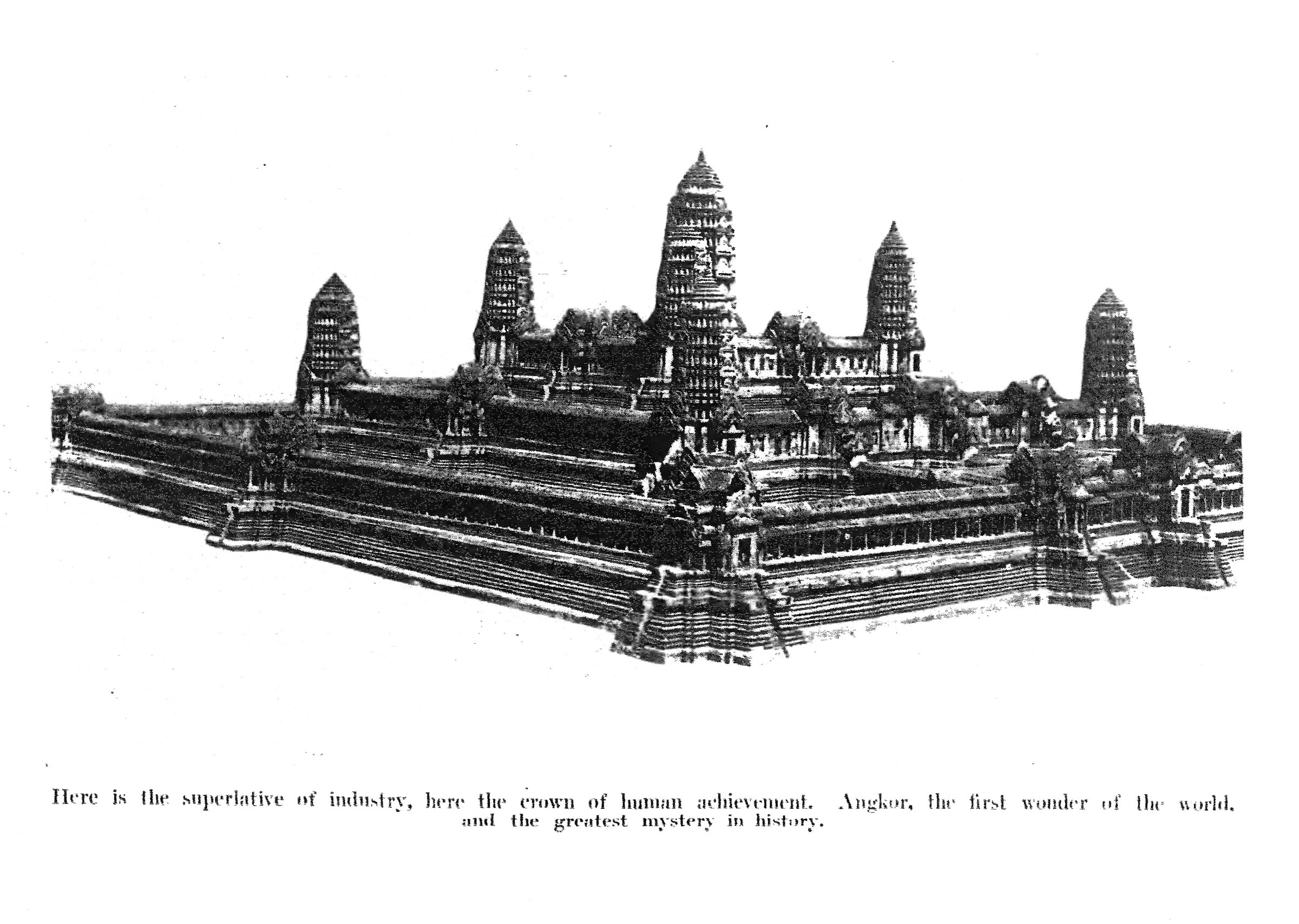
“Here is the superlative of industry, here the crown of human achievement* Angkor, the first wonder of the world, and the greatest mystery in history…” [R. Halliburton, The Royal Road to Romance, p. 302]
“Here is the superlative of industry, here the crown of human achievement* Angkor, the first wonder of the world, and the greatest mystery in history…” [R. Halliburton, The Royal Road to Romance, p. 302]
At sunset we entered the Great Lake at the far end of which Angkor lay. The lake is navigable only in the wet season, when it fills to a depth sufficient to float big steamers. During the six dry months it shrinks to nothing, becoming a sea of mud with scarcely enough clearance for a sampan dugout in which for four days and nights the resolute tourist must plow his way up the lake bed. Now in early October the water had reached its highest point and all one could see on every side were the tips of inun-dated forest-trees, through and over which our ship wound its way. Since early morning the wind had been violent, and here in the open water it howled about us with fresh fury. At three A. M., with the rain pouring in torrents the two English ladies and I were awakened and told “C’est Angkor, ici.”
“Where?” the three of us asked in weak voices as we looked out into the raging night, and instead of seeing Angkor saw that we were in the middle of a tossing lake with five or six miles of tree-tops to navigate in a ten-foot sampan. “Oh, out there,” the captain replied, waving his hand into the impenetrable void. The ladies were almost in tears. They had come all the way from Singapore to visit Angkor, and here at its front door were met with a sampan in which they must run the gauntlet of waves and deluged forests, or go the three hundred and fifty miles back to Saigon, empty-handed.
To bolster up my own faltering spirits I encouraged them to take this last leap into the dark and guaranteed to see them ashore safely, though what was back of the guarantee I should like to have known myself. With our hearts in our mouths, the three of us clambered down the ladder and into the fragile plunging dugout. Crack! The lightning blazed over our heads. Crash! The storm hurled us against the steamer’s hull. Boom! Hiss! The waves, in a flood of cold water, almost swept us out of the tiny boat. The daughter screamed between gasps for breath; the mother clung to her, speechless with fright. A fresh swirl of rain, and our ship had disappeared into the wilderness.
We had a boatman, but whether he was black, white or green we could not see. No word came from him. In dead and desperate silence he plied the single stern oar, pushed the tree-tops aside, fought our way yard by yard through the dense masses of floating water-plant, unable to find Iiis hand before his face. Whether we were going north or south we did not know; whether this was Charon taking us across a tempestuous Styx into Hades — we did not know that either. It certainly was dark enough. For nearly two hours, that seemed as many days, this exhausting struggle through the ink and rain and forest-tops lasted. Before the end we had become somewhat accustomed to the onslaught of waves and weather, and concluding that, despite everything, we were going to live, decided to get acquainted. How easy and natural getting acquainted is in times of danger such as this, when the peril and the cold and wet and wretchedness are being shared by all alike. My companions no longer despised the deck-passenger; I was no longer contemptuous of their contempt. After the first murderous drenching they were extraordinarily composed during these two hours when the weakest elements in their natures would naturally have manifested themselves. They were brave and British through and through, and set me an example for fortitude, rather than I them.
How our boatman ever found his way to the proper point on land is a mystery. With thanksgiving for our deliverance from the sampan we splashed ashore, to be met by an archaic Ford unescapable even in these jungle wilds— with its light showing dimly through the rain.
“How far is the bungalow?” I asked the native French-speaking chauffeur, expecting to be told only a few steps. “Twenty-five kilometers” — fifteen miles. And the tourist bureau in Saigon advertised that their river steamers deposited one at “the very gates of Angkor”!
If possible, this part of the journey was worse than the boat-ride, for the road ran alongside a river which, swollen and rushing from torrential rains, had overflowed its banks. Long stretches at a time our path was completely covered with water, and in consequence we could not tell which was road and which river. The chauffeur crept cautiously forward, foot by foot, greatly handicapped by the antiquated lights which went out whenever the engine went dead — which it did every few yards.
As we crawled in sight of the bungalow about eight, half-dead from exhaustion and strain and cold, I saw a curious gray cloud with blossoming towers disappearing into the mist — no, by heaven it was not a cloud. It was stone—it was what I had come to see, “the wonder of wonders, the most colossal and perfect monument ever built, the prodigious temple of Angkor.”
Read the full excerpt here.
Table of contents
- ITHE TRAVELS OF DEMETRIUS [Demetrius' Greece] 3
- IIHALICARNASSUS [Demetrius' Greece] 12
- IIITHE COLOSSUS [Demetrius' Greece] 16
- IVTHE PHAROS [Demetrius' Greece] 24
- VTHE FIRST WONDER OF THE WORLD [Egypt] 30
- VITHE PYRAMIDS TODAY [Egypt] 41
- VIITHE LABYRINTH [Crete] 52
- VIIITHE SLAVE CITY [Timbuktu] 63
- IXTHE SMOKE THAT SOUNDS [Mosi-oa-Tunga - Zambezi River] 73
- XALLAH'S CHILDREN [Mecca & Jeddah] 83
- XITHE ENCHANTED TEMPLE [Petra, Jordan] 97
- XIITHE DEAD SEA [Dead Sea] 107
- XIIITHE ROCK OF ABRAHAM [Jerusalem] 118
- XIVTREASURE HUNTERS [Jerusalem 2] 127
- XVBAALBEK [Baalbek] 137
- XVIZENOBIA [Queen Zenobia in Palmyra] 146
- XVIITHE PRINCE AND THE FLYING CARPET [Bagdad] 159
- XVIIIBABYLON [Samara] 169
- XIXHOME OF THE NIGHTINGALES [Isfahan] 177
- XXWONDERLAND [Udaipur, Rajasthan] 187
- XXIMY HINDU PRINCESS [Udaipur, Rajasthan 2] 194
- XXIIA LOVE STORY [Taj Mahal, Agra] 207
- XXIIITHE GLORY OF ASIA [Taj Mahal, Agra 2] 216
- XXIVTHE TOP OF THE WORLD [Himalayas] 227
- XXVLAND OF MYSTERY [Tibet] 242
- XXVIPALACE OF THE LIVING GODS [Tibet 2] 249
- XXVIITHIRTY MILLION IDOLS [Madura, India] 258
- XXVIIIA TALE FROM THE JUNGLE [Angkor] 270
- XXIXTHE GREAT STONE SERPENT [Great Wall of China] 283
- XXXTHE MAGIC MOUNTAIN [Mt Fuji, Japan] 293
- PROPER NAMES PRONOUNCED 315
Tags: American travelers, 1930s, American literature, Zhou Daguan, Henri Mouhot, American writers
About the Author
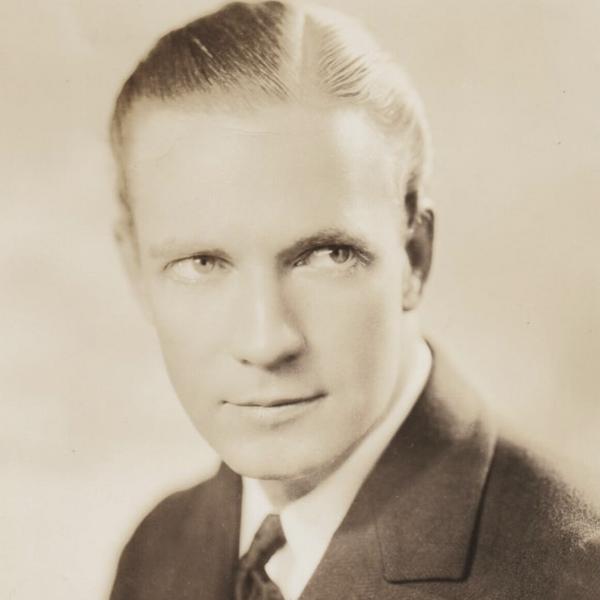
Richard Halliburton
Richard “Dick” Halliburton (9 Jan. 1900, Brownsville, Tennessee, U.S.– presumed dead in the Pacific Ocean after 24 March 1939) was an American travel writer and adventurer who, after running a successful publishing career, disappeared at sea while attempting to sail a Chinese junk, the Sea Dragon, across the Pacific Ocean from Hong Kong to the Golden Gate International Exposition in San Francisco, California.
In his lifetime, this diminutive and slender man dubbed “The Innocent Abroad”
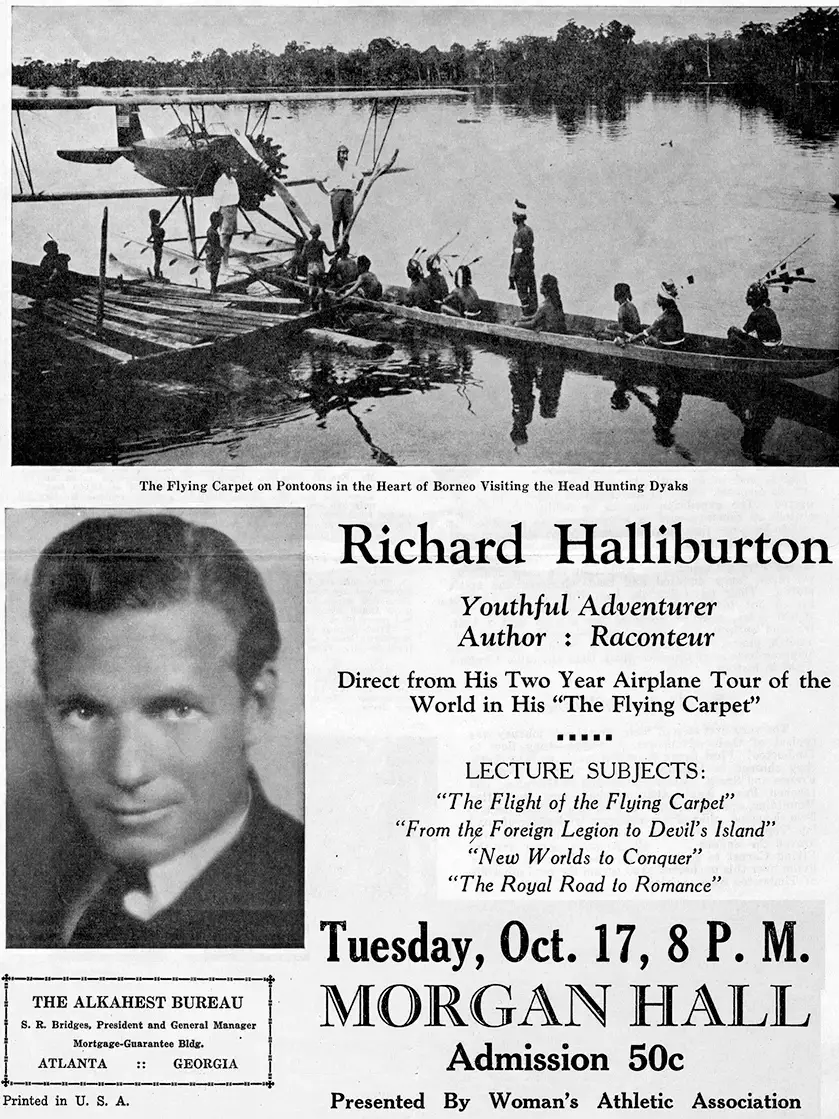
climbed Mount Olympus in Greece, the Matterhorn in the Swiss Alps and Fujiyama in Japan. He swam the length of the Panama Canal and plunged into the Hellespont in Turkey. He was arrested in Gibraltar, slept on top of the Great Pyramid in Egypt, and was the first to photograph both Mount Everest and the Taj Mahal from the air. Halliburton rode a donkey he named Hannibal over the Pyrenees and, in homage to Hannibal, rode an elephant across the Alps. He spent time with convicts on Devil’s Island and a month on the island of Tobago pretending he was Daniel Defoe’s Robinson Crusoe. Halliburton joined the Foreign Legion, dove 70 feet into a Mayan well of death at Chichen Itza and flew all the way from here to Timbuktu, right across the middle of the Sahara Desert in an airplane he christened The Flying Carpet. [“80-years-ago-tennessees-boy-adventurer-met-his-untimely-death”, Tennessee State Museum website]
2) Halliburton posing near two giant olive oil jars in Knossos, Greece [from RH’s Second Book of Marvels — The Orient].
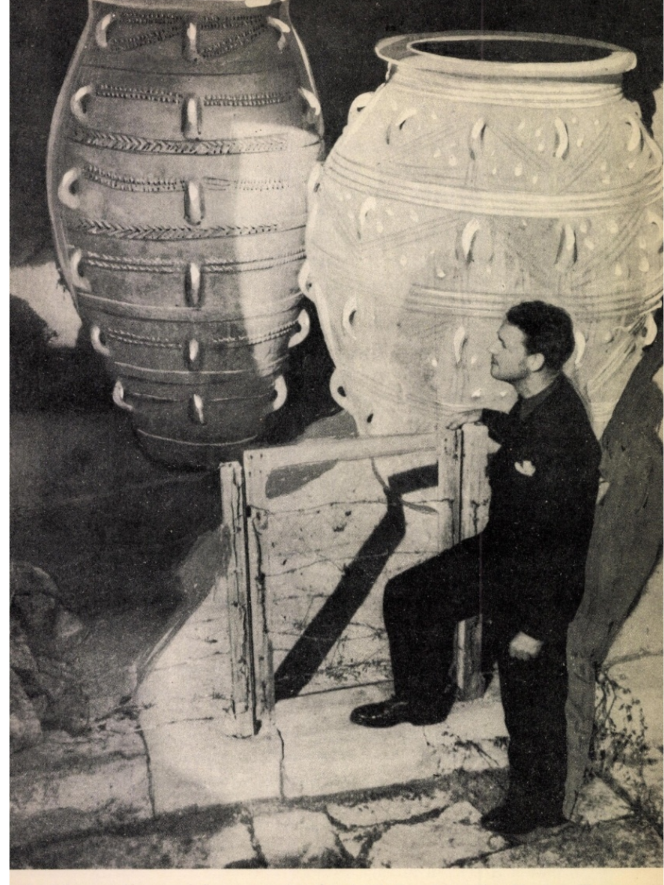
2) Halliburton posing near two giant olive oil jars in Knossos, Greece [from RH’s Second Book of Marvels — The Orient].
2) Halliburton posing near two giant olive oil jars in Knossos, Greece [from RH’s Second Book of Marvels — The Orient].
The son of all-American parents — his mother, Nelle Nance-Halliburton was born on 9 March 1869 in Paris…Tennessee — Richard completed high school in Memphis before joining Princeton University, where he was the chief editor of The Princetonian Pictorial Magazine and attended courses in public speaking (he was to be known later as a “Raconteur”, a born story-teller who gave numerous conferences after each and everyone of his trips ). In September 1919, he unexpectedly vanished from the company of his parents in New Orleans and boarded a ship to England, touring France and Monte-Carlo until his return in mid-January 1920. But his later journeys were gladly funded by his businessman father, and despite Richard’s admiration for elder travel writer Harry Franck he never had to ‘bum his way around the world as a vagabond.’
In 1925, two years after graduation, he published his first book, The Royal Road to Romance, about his first Iintercontinental travel from the Alhambra in Spain to Mt. Fuji through Monte Carlo, the Nile, Punjab, Kashmir, Ladakh, the Khyber Pass, Angkor, Bangkok and Bali. That was followed with The Glorious Adventure (1927), a recounting of his own reading of Homer’s Odyssey — more than 100 years before the spectacular popular success of Christopher Nolan’s eponymous movie (2026) — and the visit the young author had paid to the grave of English poet Rupert Brooke on the Greek island of Skyros, then New Worlds To Conquer (1929), a summary of his latest feats.
When he boarded his Flying Carpet (a Searman C3B airplane) at the French Foreign Legion airstrip in Colomb-Béchar (Algeria) in April 1931, along with experienced pilot Moye Stephens, he was probably the world’s most famous travel adventure writer, with three books on the bestseller list, translated into nine languages, and the movie rights for the first one already bought by Fox Films in Hollywood. Flying over the Sahara to legendary Timbuktu, last leg of this air trip across three continents, was his way of emulating and exceeding Charles Lindbergh’s transatlantic flight, and even the Antoine Saint-Exupéry’s tragic exploit.
At the same time, Halliburton — who has been labelled “the gay Indiana Jones” in the years 2000s, was able to “navigate a very visible career as a “ladies’ man” while also living a fairly openly gay lifestyle that included some long-term relationships” [to quote his biographer C. Scott William, The The Forgotten Adventures of Richard Halliburton: A High Flying Life from Tennessee to Timbuktu, Charleston, The History Press, 2014, p. 138]. We are still trying to find out whether his path crossed the wandering of another American Southerner enamored with traveling and same-sex adventures, Harry Hervey.
In 1934, US newspapers syndicated with the Bell group started to publish Halliburton’s weekly feature stories — in total, some 50 short (about 1,000 words) pieces of history popularization dealing with topics as diverse as Dr. Samuel Mudd (plotter of President Abraham Lincoln’s assassination), the Seri Indian tribe of Southern California, the Battle of Santiago de Cuba a month later; Henri Christophe and the Citadelle Laferrière in Haiti; Christopher Columbus, Lord Byron, and “The Girl from Martinique Who Wrecked Napoleon” [Joséphine de Beauharnais]…That required an extra round of traveling, this time from Cuba to Ethiopia to Russia and the Arabic Peninsula, with the resulting new set of books — Seven League Boots and the two Books of Marvels.
Less persistent than the marathonian lecturer and American traveler supreme Burton Holmes (1892−1952), less physically robust than his exploits would allow — he had spent a year in a Kellogg sanatorium in his childhood -, Richard Halliburton was again looking for a career rebound and fame boost when he boarded the SS President Coolidge bound for Hong Kong on 23 Sept. 1938 — the same cruise liner that had carried Charlie Chaplin and Paulette Goddard on their way to Angkor two years earlier. The plan was to sail back a 23-meter Chinese junk, the Sea Dragon [ch 海龍], across the Pacific Ocean to San Francisco, a spectacular demonstration of ‘East Meets West’ culminating at the Golden Gate International Exposition (GGIE). The junk would be moored at Tresasure Island and take visitors on excusions around the bay for a limited fee.
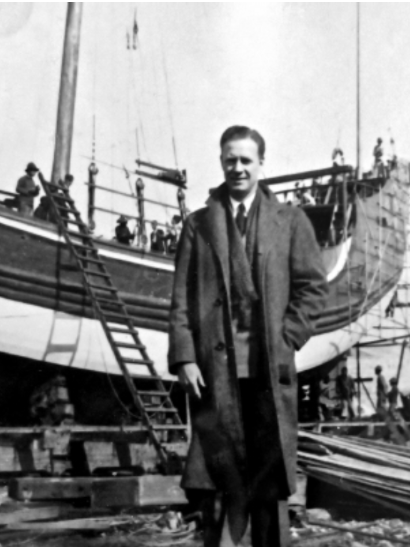
1) Richard Halliburton posing in front of the Sea Dragon on 29 Dec. 1938. [photo taken by Dr. and Mrs. J.M. Lapp, Hong Kong — Rhodes College Archives and Special Collections, Memphis, Tennessee.] 2) Front page of the Commercial Appeal reporting Richard Halliburton’s probable death, 11 June 1939. [both photos reproduced in C. Scott William, The The Forgotten Adventures of Richard Halliburton: A High Flying Life from Tennessee to Timbuktu, op. cit.].
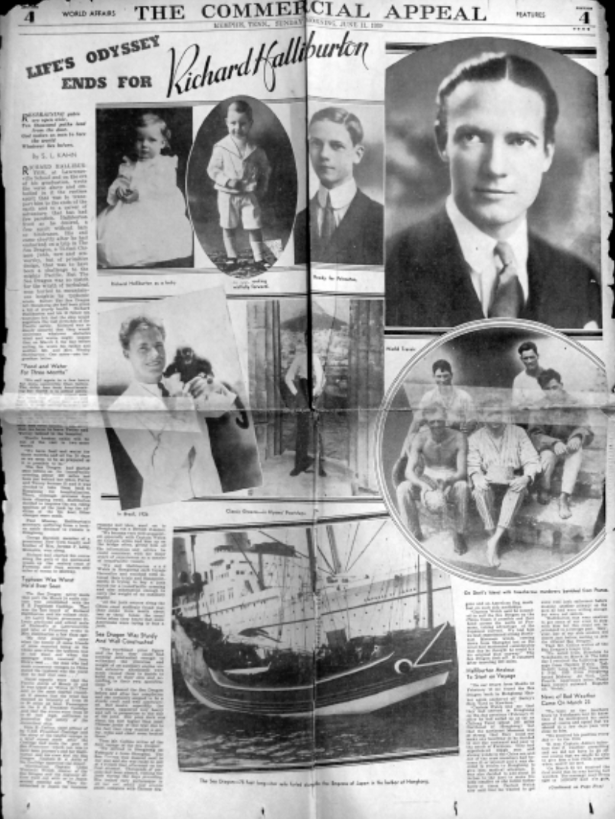
1) Richard Halliburton posing in front of the Sea Dragon on 29 Dec. 1938. [photo taken by Dr. and Mrs. J.M. Lapp, Hong Kong — Rhodes College Archives and Special Collections, Memphis, Tennessee.] 2) Front page of the Commercial Appeal reporting Richard Halliburton’s probable death, 11 June 1939. [both photos reproduced in C. Scott William, The The Forgotten Adventures of Richard Halliburton: A High Flying Life from Tennessee to Timbuktu, op. cit.].
1) Richard Halliburton posing in front of the Sea Dragon on 29 Dec. 1938. [photo taken by Dr. and Mrs. J.M. Lapp, Hong Kong — Rhodes College Archives and Special Collections, Memphis, Tennessee.] 2) Front page of the Commercial Appeal reporting Richard Halliburton’s probable death, 11 June 1939. [both photos reproduced in C. Scott William, The The Forgotten Adventures of Richard Halliburton: A High Flying Life from Tennessee to Timbuktu, op. cit.].
The three-month journey, sponsored by subscribers, had two trial starts, in January and February 1939, and each time experienced mariners found the vessel way too heavy. After some repair, the junk sailed again out of Hong Kong on 4 March 1939. The last contact with the boat was made on 24 March. A search party off Hawaii was set up on 10 April. Even if rumors about his fate continued to arise over the years — just as it happened with woman explorer and pilot Amelia Mary Earhart (24 July 1897 — disap. 2 July 1937), who was declared dead that same year on 5 Jan. 1939 -, Richard Halliburton quickly became the faded memory of a short-lived fame, “of a meteor that blazed across the heavens…and was gone”, to use the same image as his own father, Wesley Halliburton [James Cortese, Richard Halliburton’s Royal Road, Memphis, TN: White Rose Press, 1989, p. 8].
Publications
- The Royal Road to Romance, Indianapolis, The Bobbs-Merrill Company, 1925.
- The Glorious Adventure, Indianapolis, The Bobbs-Merrill Company, 1927.
- New Worlds to Conquer, Indianapolis, The Bobbs-Merrill Company, 1929.
- The Flying Carpet, Indianapolis/New York, The Bobbs-Merrill Company, 1932.
- Seven League Boots, Indianapolis /New York, The Bobbs-Merrill Company, 1935.
- Richard Halliburton’s Book of Marvels: the Occident, Indianapolis /New York, The Bobbs-Merrill Company, 1937. [originally titled Marvels of the West].
- Richard Halliburton’s Second Book of Marvels: the Orient, Indianapolis /New York, The Bobbs-Merrill Company, 1938.
- Richard Halliburton: His Story of His Life’s Adventure, as Told in Letters to His Mother and Father, Indianapolis/New York, The Bobbs-Merrill Company, 1940.
- Richard Halliburton’s Complete Book of Marvels, Indianapolis/New York, The Bobbs-Merrill Company, 1941.
The Royal Adventures of Richard Halliburton. Indianapolis/New York, The Bobbs-Merrill Company, 1947 [repr. in 1 volume of The Royal Road to Romance, The Glorious Adventure, and New Worlds to Conquer.]
Contributions
- [Introduction by Richard Halliburton, “World Traveler, Author and Epicure”] One Hundred Years of Delightful Indigestion – Memphis Priceless and Treasured Receipts, Memphis, James Lee Memorial Academy of Arts, 1935.
- India Speaks, photo-play and film with Richard Halliburton, produced and directed by Walter Futter, written by Norman Houston, 1933 [A sequel to the popular film Africa Speaks!].
About Richard Halliburton
- “Richard Halliburton”, website by C. Scott William.
- Mark F. Bernstein, “What Would Halliburton Do? The life of a Princeton adventurer”, Princeton Alumni Weekly, 8 March 2019.
- The Barrett Library at Rhodes College, USA, holds ‘Richard Halliburton’s Archives’ [not available online as of June 2026].