

The Royal Road to Romance
by Richard Halliburton

- Author
- Richard Halliburton
- Publisher
- Indianapolis, The Bobbs-Merrill Company.
- Published
- 1938
- Pages
- 399
- Language
- English
- Format
- on-demand ebook
Like for contemporary Harry Hervey of King Cobra fame, Richard Halliburton had met instant success with his first published book, The Royal Road to Romance (1925). Like their elder Robert ‘Bob’ Casey, his editor was the Bobbs-Merrill Company, based in Indianapolis. Like Harry L. Foster, he called himself a ‘beachcomber’ and a ‘vagabond’ yet he journeyed quite comfortably. And unlike Helen Churchill Candee, whose Angkor The Magnificent (1924) left a durable impression on American generations, Halliburton’s Royal Road — note that André Malraux’s The Royal Way came out five years later in 1930 — was mostly the dizzying travelogue of a dashing young adventurer supposed to be a “ladies’ man” but longing for different emotions.
Tellingly, the ‘royal road’ from the Alhambra to Mount Fuji, the romantic galloping around the world in 399 pages — starting with the ascension of the Matterhorn, the 4,478 meters (14,692 feet) “peak of the meadows” on the border between Switzerland and Italy, with the town of Zermatt nearby — concluded with these lines, literally the return of the prodigal son:
A red-cap, carrying my two-pound knapsack escorted me into the most expensive compartment the special extra-fare Florida Limited de luxe could possibly provide. In his glittering blaze of glory I returned to my paternal hearth on the first day of March, six hundred days after my departure from New York, fully and finally aware that be it ever so luxurious, after all, there is no place like home. [The Royal Road to Romance, p 399].
An instant bestseller, Royal Road to Romance remains a pleasant read nowadays if only for the way the book reflects the “Innocent American” abroad, a much nicer, wide-eyed and ingenuous predecessor to the “Ugly American” conjured by writers Eugene Burdick and William Lederer in 1958. The six merry and good-humored graduates from Princeton University with whom Halliburton embarked on his first major journey abroad, supported by wealthy parents, found their first ‘siren’ on a train to Seville and played the mandoline to her, yet the coquettish Spanish girl was a five-year child who found them hilariously outlandish. To Halliburton’s discharge, it must be noted that he traveled cheaply [pursuing the ideal of the ‘beachcomber’] and supported himself by selling accounts of his adventures to US magazines.
On his way to Japan through Manchuria, the young Princetonian managed to cross the Soviet border and reach Vladivostock for a few cold, dark day right before New Year (1924, we suppose). He had not much to report in guise of Bolshevik atrocities except the celebration at the city railway station during which the commander of the place
reached his sensational climax, and stretching his arms out to the fifty-piece brass band stationed in the balcony at the stroke of midnight shouted, Internationale. There was a crash of music and the strains of this stirring song leaped to the rafters. The people were overwhelmed with emotion by the dramatic effect of the perfectly timed trumpets. Some cheered, some wept, the rest of the two thousand stood on their chairs and waving iminutive red flags joined in the music;
Arise, ye members of starvation!
Arise, ye wretched of the earth!
For justice thunders condemnation,
A better world’s in birth.
No more tradition’s chains shall bind us,
Arise, ye slaves, no more in thrall!
The earth shall rise on new foundations,
We have been naught, we shall be all!
I left the building in a daze, as emphatically anti-Bolshevik in sentiment as ever, but deeply impressed by the faith of the party’s constituents in the righteousness and justice of their cause. [p. 366].
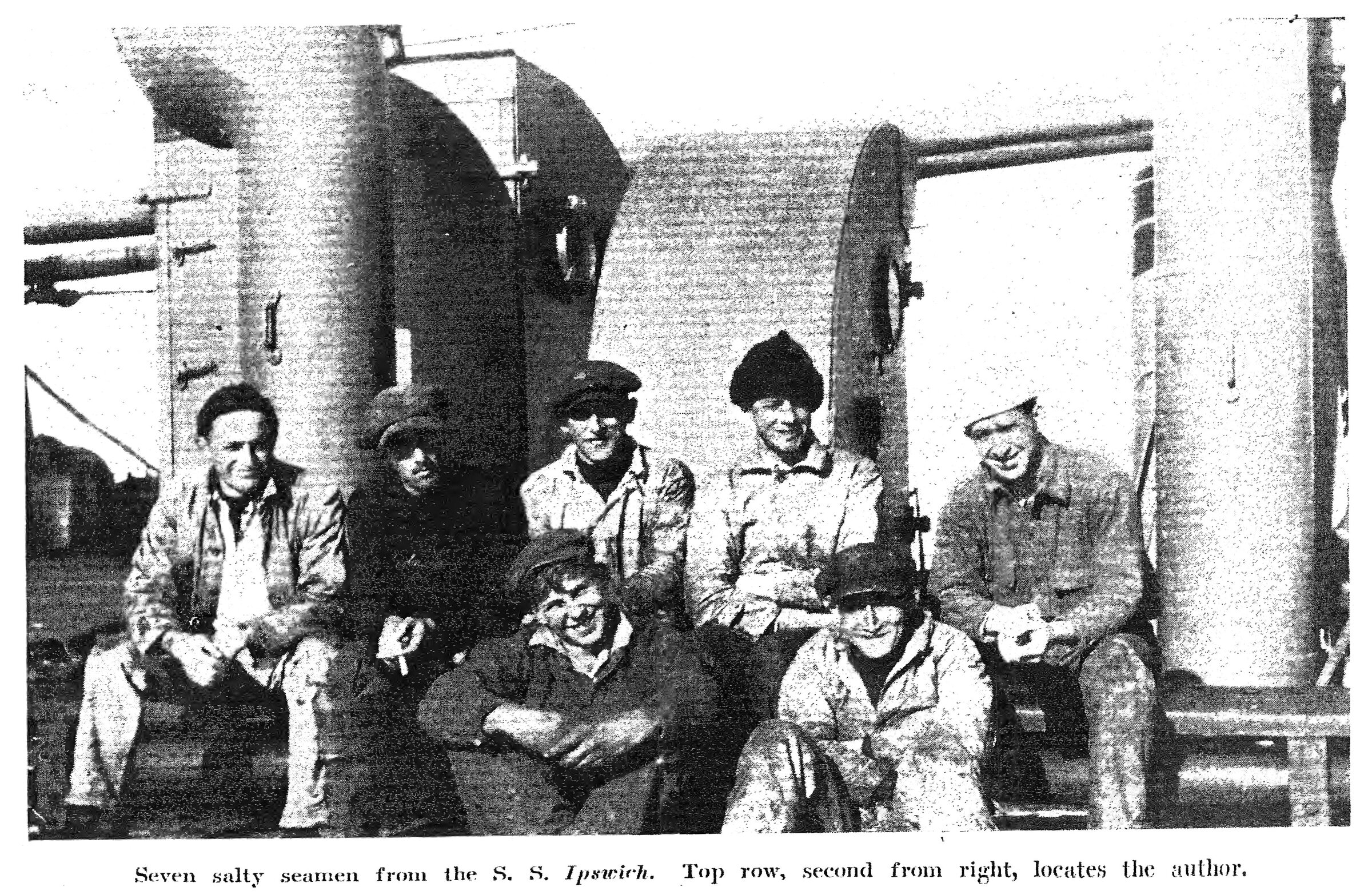
1) Princeton graduates at sea (Halliburton on top row, second from the right). 2) In the frozen harbor of Vladivostok, apparently ice-fishing. [both photos from the book original edition.]
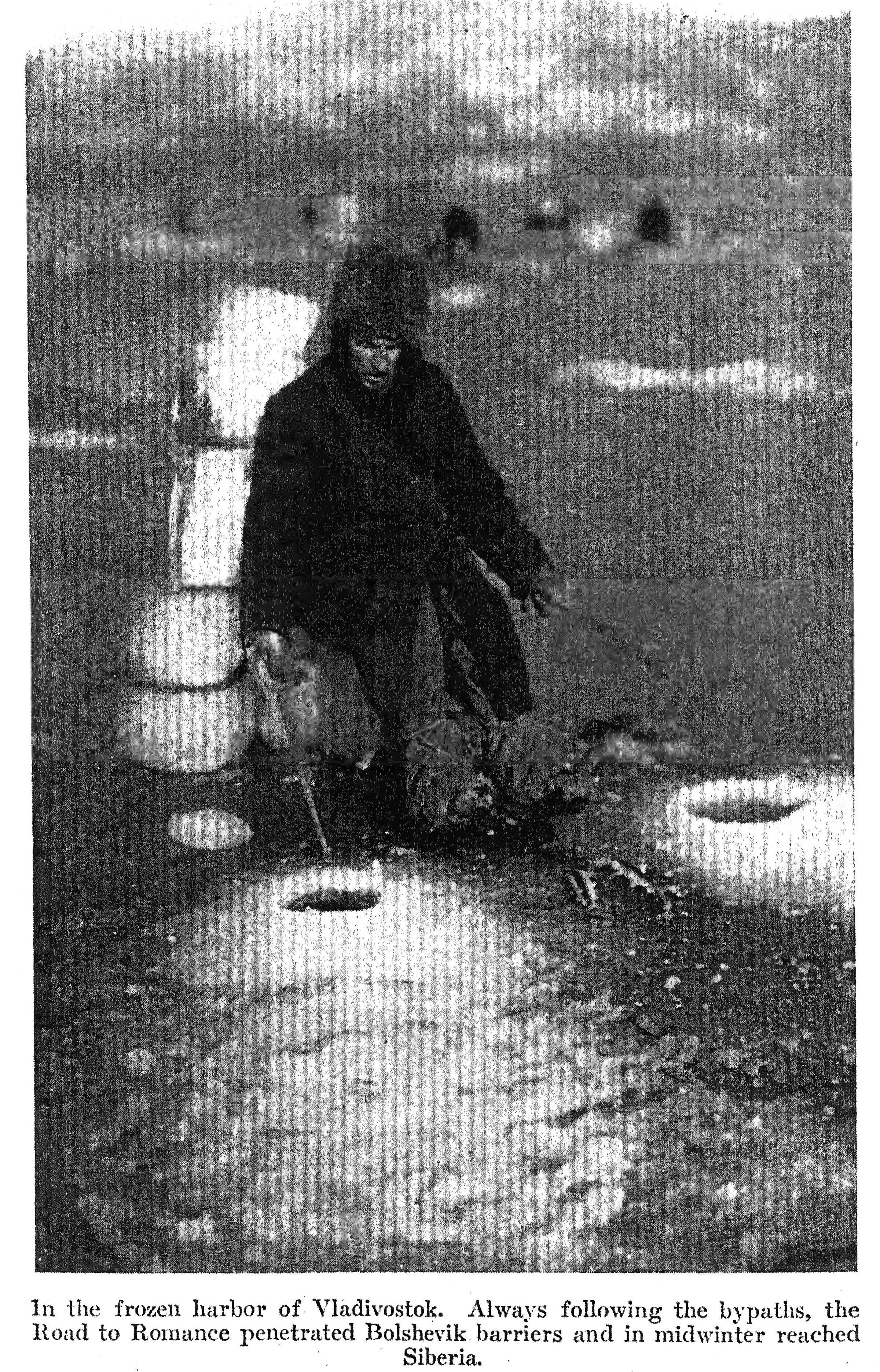
1) Princeton graduates at sea (Halliburton on top row, second from the right). 2) In the frozen harbor of Vladivostok, apparently ice-fishing. [both photos from the book original edition.]
1) Princeton graduates at sea (Halliburton on top row, second from the right). 2) In the frozen harbor of Vladivostok, apparently ice-fishing. [both photos from the book original edition.]
Some 15 years later, the famous American adventurer would include Angkor amongst his “marvels of the Orient” in Richard Halliburton’s Second Book of Marvel: The Orient, with an entire chapter, n. 28, dedicated to the Khmer [‘Khemyr’, as he insisted to spell it] temples, A Tale from the Jungle. But the description in Royal Road was remarkably precise [in particular the detailed account of Angkor Wat sculpted galleries]. By serendipity or design, in both books Angkor was assigned the 28th chapter.
The Royal Road to Romance, p 291 – 307.
I climbed aboard a French coastal steamer — once more a vagrant, once more a romanticist in pursuit of new sky-lines. Malay horrors were forgotten, Bangkok’s hospitality put away. New and wonderful territory lay before me. I was on the threshold of a spectacle that alone made all I had endured worth while; I was soon to become one of those god-favored mortals who had been granted the privilege, granted so few, of looking upon Angkor.
For two days and nights the little ex-yacht that plies between Bangkok and Saigon carried me as a
deck passenger (a misnomer, as a French merchant invited me to share his first-class cabin) along the coast of Indo-China. Saigon is the place all visitors to Angkor embark. A Mekong Biver steamer takes them three hundred and fifty miles inland, almost back to the Siamese border, and that is the way I would have gone had I not learned from an old resident in Bangkok that by disembarking at Kampot on the southern coast of Cambodia and going overland to Pnom Penh on the Mekong I could cut the length of the journey to Angkor almost in half.
Disembarking at the little port, I spent a night on the beach, and next day covered one hundred and forty miles in a motor-bus over magnificent rock roads, through continual alternations of dense jungles and neat villages. This put me in Pnom Penh just in time to meet a steamer from Saigon sailing up the river to Angkor.
Again, in an effort to counterbalance the motor-bus extravagance, I was a “decker,” much to the dis-approval of an English mother and her grown daughter, the only other white passengers aboard.
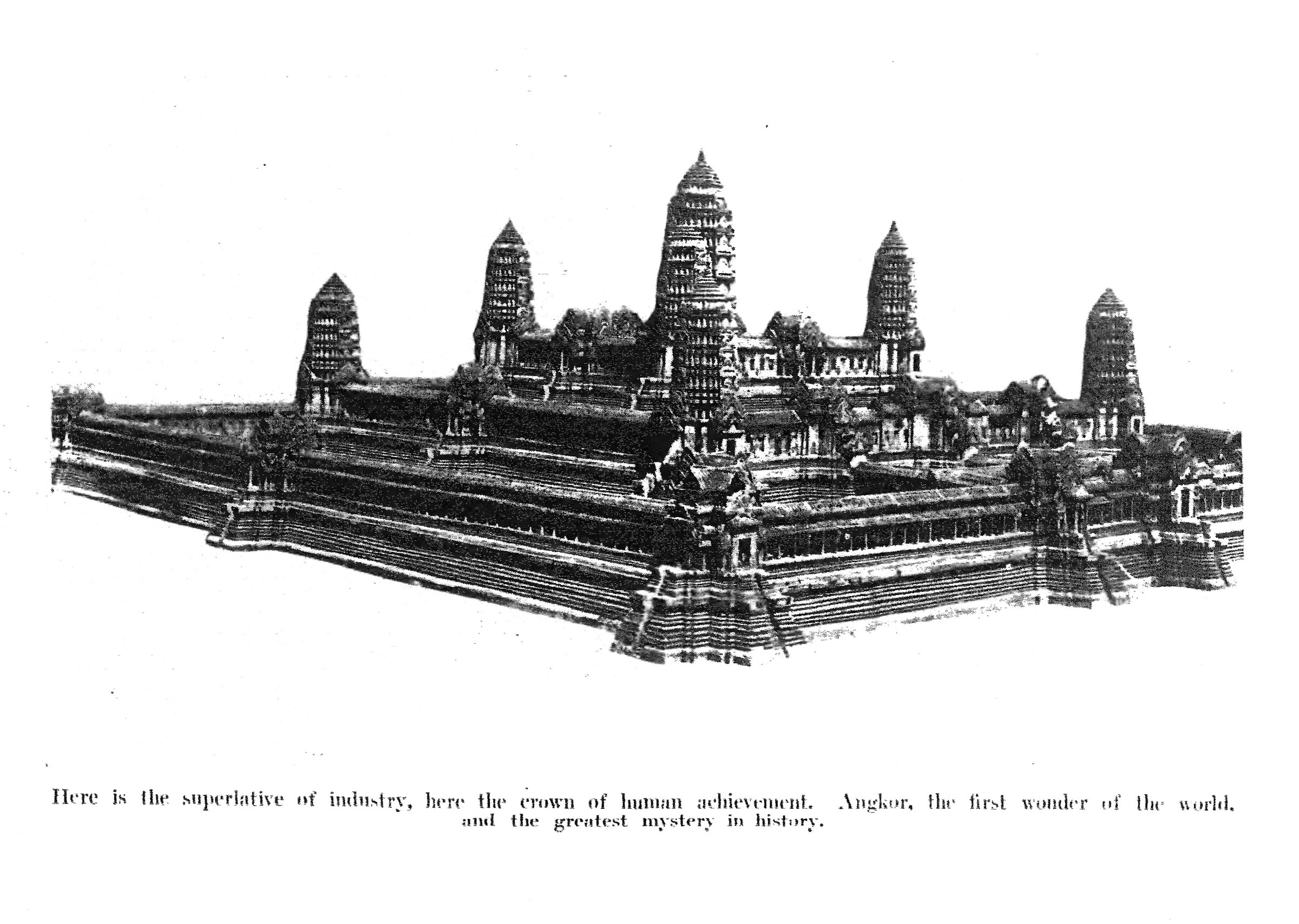
“Here is the superlative of industry, here the crown of human achievement* Angkor, the first wonder of the world, and the greatest mystery in history…” [R. Halliburton, The Royal Road to Romance, p. 302]
“Here is the superlative of industry, here the crown of human achievement* Angkor, the first wonder of the world, and the greatest mystery in history…” [R. Halliburton, The Royal Road to Romance, p. 302]
At sunset we entered the Great Lake at the far end of which Angkor lay. The lake is navigable only in the wet season, when it fills to a depth sufficient to float big steamers. During the six dry months it shrinks to nothing, becoming a sea of mud with scarcely enough clearance for a sampan dugout in which for four days and nights the resolute tourist must plow his way up the lake bed. Now in early October the water had reached its highest point and all one could see on every side were the tips of inun-dated forest-trees, through and over which our ship wound its way. Since early morning the wind had been violent, and here in the open water it howled about us with fresh fury. At three A. M., with the rain pouring in torrents the two English ladies and I were awakened and told “C’est Angkor, ici.”
“Where?” the three of us asked in weak voices as we looked out into the raging night, and instead of seeing Angkor saw that we were in the middle of a tossing lake with five or six miles of tree-tops to navigate in a ten-foot sampan. “Oh, out there,” the captain replied, waving his hand into the impenetrable void. The ladies were almost in tears. They had come all the way from Singapore to visit Angkor, and here at its front door were met with a sampan in which they must run the gauntlet of waves and deluged forests, or go the three hundred and fifty miles back to Saigon, empty-handed.
To bolster up my own faltering spirits I encouraged them to take this last leap into the dark and guaranteed to see them ashore safely, though what was back of the guarantee I should like to have known myself. With our hearts in our mouths, the three of us clambered down the ladder and into the fragile plunging dugout. Crack! The lightning blazed over our heads. Crash! The storm hurled us against the steamer’s hull. Boom! Hiss! The waves, in a flood of cold water, almost swept us out of the tiny boat. The daughter screamed between gasps for breath; the mother clung to her, speechless with fright. A fresh swirl of rain, and our ship had disappeared into the wilderness.
We had a boatman, but whether he was black, white or green we could not see. No word came from him. In dead and desperate silence he plied the single stern oar, pushed the tree-tops aside, fought our way yard by yard through the dense masses of floating water-plant, unable to find Iiis hand before his face. Whether we were going north or south we did not know; whether this was Charon taking us across a tempestuous Styx into Hades — we did not know that either. It certainly was dark enough. For nearly two hours, that seemed as many days, this exhausting struggle through the ink and rain and forest-tops lasted. Before the end we had become somewhat accustomed to the onslaught of waves and weather, and concluding that, despite everything, we were going to live, decided to get acquainted. How easy and natural getting acquainted is in times of danger such as this, when the peril and the cold and wet and wretchedness are being shared by all alike. My companions no longer despised the deck-passenger; I was no longer contemptuous of their contempt. After the first murderous drenching they were extraordinarily composed during these two hours when the weakest elements in their natures would naturally have manifested themselves. They were brave and British through and through, and set me an example for fortitude, rather than I them.
How our boatman ever found his way to the proper point on land is a mystery. With thanksgiving for our deliverance from the sampan we splashed ashore, to be met by an archaic Ford unescapable even in these jungle wilds— with its light showing dimly through the rain.
“How far is the bungalow?” I asked the native French-speaking chauffeur, expecting to be told only a few steps. “Twenty-five kilometers” — fifteen miles. And the tourist bureau in Saigon advertised that their river steamers deposited one at “the very gates of Angkor”!
If possible, this part of the journey was worse than the boat-ride, for the road ran alongside a river which, swollen and rushing from torrential rains, had overflowed its banks. Long stretches at a time our path was completely covered with water, and in consequence we could not tell which was road and which river. The chauffeur crept cautiously forward, foot by foot, greatly handicapped by the antiquated lights which went out whenever the engine went dead — which it did every few yards.
As we crawled in sight of the bungalow about eight, half-dead from exhaustion and strain and cold, I saw a curious gray cloud with blossoming towers disappearing into the mist — no, by heaven it was not a cloud. It was stone—it was what I had come to see, “the wonder of wonders, the most colossal and perfect monument ever built, the prodigious temple of Angkor.”
CHAPTER XXVIII: THE MAGIC STONES OF ANGKOR
IN CAIRO I met an Englishman who had seen Angkor. He spoke of it in awesome tones as if it had been a superhuman experience. Again and again in India I heard the name linked with superlative adjectives relating to its monstrous size and exquisite detail, yet always encompassed in rumor and obscurity. No one there had seen it-everyone said it was a miracle. Angkor the murmur of its name grew as I moved eastward. Angkor — tales of its reputed glories were rumbling in my ears at Bangkok. ANGKOR — the wind and the jungle and the vast gray cloud of stone roared at me now as I hurried from the bungalow toward the mile-distant mystery: “Here is the superlative of industry, here the crown of human achievement. Here, here, is Angkor, the first wonder of the world, and the greatest mystery in history.”
Jungle, jungle, for mile after mile on every side it smothered the earth, dense, black, consuming-and from out of it, unheralded and unbelievable, rose the gigantic, the magical temple with its tier on tier of gray tapestried stone, acres of carving, hundreds of delicately-wrought windows, miles of galleries, great lace towers — all powerful and beautiful and desolate beyond imagination.
The spectacle was so amazing, stumbled on here in the forest, I would have scarcely credited my eyesight had I not been prepared by the fleeting distant glimpse of it snatched over the tree-tops early that morning. To have blundered upon the Pyramids or St. Peter’s suffocating in the jungle depths of this wild corner of Asia and utterly deserted but for bats and lizards would not have astonished me more — indeed not nearly so much, for Angkor, built by gods for a fabulous vanished empire, in the might of its dimensions, in artistry, in purity, in magnificence, and above all in preservation, Angkor surpasses anything Greece or Rome or Egypt has ever seen.
Whence came this superhuman monument and the even more extraordinary dead city that surrounds it, both lost for seven hundred years in the impenetrability of an Indo-China wilderness and but recently uncovered to the amazement and admiration of the orld? No one knows exactly. Whither departed the Titans that piled these stones together and deluged them with incredibly lavish carvings? No one knows that either. All trace of their beginning, all records of their destruction, have been utterly lost in these merciless jungles.
For lack of a better name, history calls the mysterious race that once dwelt here the Khymers. Conjecture founds their empire in the fourth century and obliterates it in the twelfth. Except for miles and acres of bas-relief pictures of battles and mythology and common life carved on the stones of the six hundred ruined public buildings found in the space once covered by the Khymer capital, we should not know one single thing about this race, whose ability as artists and architects has rarely been approached.
It seems impossible that this masterpiece could have escaped for so long the attention it is now beginning to enjoy. However, when one sees the flood of vegetation it is buried under, and realizes in what an isolated part of the world it is hidden, one can understand why it remained unknown and unsung while archeological monuments of a far lesser magnitude were being explored, and in picture and story made familiar to the whole world.
As far back as 1857 a Frenchman, urged on by the fabulous legends of an angel-built temple then within the southeast borders of Siam, fought his way through leagues of jungle to the spot, and on his return to civilization told such unbelievable stories of the size and magnificence of the ruins he had seen, obviously erected by a lost race of superbeings, that people laughed at him and thought his deprivations had weakened his brain.
No one laughs to-day at the first superlatives of praise that came from Angkor. To quote one recent archeological writer, it is : “The most amazing archeological site in the world. It stands, and is perhaps destined to stand, the noblest monument raised by man.”
All during the latter half of the nineteenth century Angkor the inaccessible was left as it had been left since 1300, at the mercy of the elements and inhabited by wild beasts. In 1907, France, by a “treaty” with Siam, seized a large slice of the latter’s eastern forest wilderness that includes the site of the ancient Khymer capital, with its fifteen square miles of magnificent ruins — ruins of palaces, libraries, gates, walls, and Angkor Vat, the mighty temple.
Owing to the fact that it was the latest and most ponderously built, it stands to-day in all its original glory, while the other Khymer structures have fallen prey to the gourmand jungle and the assaults of time.
The Siamese, who are believed to have driven the Khymers from Angkor Vat, insist it was built by divinities, because human beings could not have been powerful enough or inspired enough to do it. You may not be inclined to believe this legend from seeing pictures or reading descriptions of Angkor; you may not believe that it took four generations of (instant industry to complete, or that kings commandeered and kept occupied five hundred thousand slaves from their sixteen provinces; but when you at last look upon Angkor in reality, you believe anything.
The temple is in the form of a pyramid, with five hollow squares each fitting into and above the other. Each corner of the last two terraces is adorned with an elaborate tower completely covered with carvings of seven-headed cobras, medallions, deities, chains of dancers; and reaching higher and higher with each tier until the great supreme tower of lace soars two hundred feet and looks with majestic defiance over the miles of waving, waiting jungle-tops that stretch unbroken on to China.
Alone for my companions of the night before were still prostrate from our encounter with sampan and Ford — I approached the entrance, along a twelve-hundred-foot stone viaduct, forty feet wide, that led across what was once a lake. Raised well above the bed, balustraded with seven-headed nagas and deeply rutted by the passage of ancient chariot-wheels, this great bridge is a fitting approach to so great a building.
I moved toward the stone mountain with a feeling half of awe and half of wonder, that I, a product of the materialistic, modern age, a vagabond, a pagan, should be granted a sight of this handiwork of the gods. In solitude I climbed the worn steps that led up to the second gallery, and found myself in the midst of the most magical array of stone tapestry on earth. It is this proximity that lends the greatest enchantment to the gigantic temple. From afar Angkor with its ascending rows of colonnaded galleries, its hundreds of elaborately barred windows, its labyrinth of roofs, stejis, cupolas, towers, looks more like a mirage than a reality. Only close at hand can one fully appreciate the inconceivable intricacy and beauty of its details and ornaments. The Egyptians might have raised this vast pile of stones in place, but only the Khymers could ever have executed the carvings.
Every inch of the wonderfully-wrought structure is covered with finely-chiseled decorations. The display of each window, the facing of each door, is a masterpiece with an individual design unapproachable for delicacy and grace. Kings and cobras, smiling deities and dancing figures, riot over wail and tower. There is no mechanical ornamentation, but dash and reality to everything. The fancy of the decorator has been given free play, yet more perfect blending of detail could not be conceived. However, I cannot do justice to the stones of Angkor — only a Ruskin or a Chateaubriand could, and either would fill many volumes in the task.
Of the many Angkor wonders, the most wonderful is the bas-relief that stretches unbroken for a half-mile around the second terrace. Protected from the weather by a gallery, it has withstood the ravages of time, and is as vivid and fresh to-day as it was seven hundred years ago. One could spend weeks before this great stone picture and not see it all, since there are fully fifty thousand figures chiseled upon it in such inextricable confusion one’s head begins to swim from examining them.
One wall, three hundred and fifty feet long, portrays the battle-scene between a Khymer king and his enemies. There are hundreds of fighters in armor with shield and sword, on foot, on horseback, hundreds more in chariots and on elephants, yet not one figure is passive. It is a battle. Each army sweeps against the other, and the clash in the center is terrific. Men are piled on one another, struggling in groups, in pairs, with clenched teeth, in agony, in fury, in despair, in triumph; arrows and spears fly thick and fast; the officers urge on their followers; the trumpeters sound the charge; the horses and elephants rear and tremble with excitement; the dead and dying are piled on the ground to be trampled by succeeding waves. At the rear deep ranks of reenforcements, cheering and hurrying, are marched forward into the slaughter. There is action, action, and carnage and the roar of battle. One’s eyes stare at this realism; heart beats faster in sympathy with this mortal combat. Yet all this is in stone — cold, silent, colorless stone. Someday the artistic world will recognize the Khymers as the greatest artists that ever lived — though perhaps they never lived. Perhaps they were angels, as the Siamese insist, descended from Heaven to carve this superhuman work.
Their conception of Heaven and Hell takes up another hundred yards. They were none too prolific in their ideas about the rewards of a virtuous life, Heaven being depicted as a pleasant grove of trees filled with peacocks, where the men sat around eating and the women (off in one corner) played with their children. But ah, Hell — that was different. The pictured purgatory was a museum of all the physical tortures the devil himself could think of. No vagueness about the punishments of evil. Great, horned demons drive in their victims, all reduced to skin and bones, and, by rings in their noses, drag them through endless diabolical torments in comparison with which drawing and quartering would be springtime frolic.
A flight of steps worn almost to a slide leads from terrace to terrace, and into the galleries, through which one could walk all day and never retrace one’s steps. They were once the scene of great activity; they are silent now except for the endless screech and whir of a million bats that swarm in the black recesses of this desolate building.
As I walked from tier to tier, from stone picture to stone picture, these repulsive creatures, disturbed by the hollow sound of footsteps, tumbled in swarms about the evil-smelling vaults, execrating me and my intrusion. For seven hundred years, Angkor Vat, has been the private property of the lizards and the monkeys. Who was I to disturb their peace?
For an hour I had seen no human being. All about me was the most gorgeous architecture ever reared, and yet it was a corpse— a corpse that had maintained its complete physical being though unutterably dead. This depressing silence, this ghostly emptiness, this grim ruthless jungle that was waiting at the gates to spring again upon these god-hewn stones and devour them, all made me shiver and want to cry out against the doom that clanked beside me no matter where I turned.
What was that yellow streak — I started— that flitted like an enormous butterfly across a patch of distant sunlight? I hurried to investigate and found a Buddhist priest in his daffodil gown, wandering, even as I, along the endless corridors. He was one of an order that used this prodigious corpse for its monastery. Angkor was built as a temple to Brahma, but local followers of Buddha, like mice in a deserted dwelling, have taken several corners of the pile, and established shrines by setting up battered statues of Buddha and a few miserable candles.
These imperturbable statues, so calm and mysterious, sitting and smiling in the gloom, are startling when one comes upon them unexpectedly. In one courtyard there is a Buddha morgue, where several hundred images have been stored pell-mell. They are discarded and decayed, and yet one of the few gaunt priests that are always prowling about the temple almost obliterated me when I picked up a piece of a broken Buddha from the pile, and used it as a stepladder to reach the roof where I wanted to take photographs.
These ecclesiastics, but for their bright yellow robes, would be lost in the vastness of Angkor. Nevertheless, let the trespasser beware. There is a persistent rumor current among the natives that fabulous treasures are buried in the sealed crypts beneath the central tower, and these obstructed passages are guarded with special zeal by the priests. But if there is any great wealth buried here it is little used by its guardians, for more bedraggled disciples of Buddha I have never seen.
Angkor Vat, after all, is only the greatest and best preserved of a vast array of magnificent sandstone structures once enclosed in the city of Angkor Thom, which in the days of its glory had several million people and was the luxurious capital of a mighty empire. The number and dimensions of the city’s ruins are staggering — and, oh, how melancholy, how indescribably desolate! How was it possible for such a race as the Khymers to disappear so absolutely? Did it happen in a day? Was this heavenly city, with its vast population, its armies, its palaces, its might and glory, surprised by its enemies and destroyed over night by the sword? What diabolical wrath was spent upon it! No sooner had the roar of tumbling battlements die’d away than that insatiable fiend, the jungle, rushed upon the prostrate magnificence and suffocated all but a few of the most indomitable giants.
Of the remaining buildings the Temple of Bayan is in a class of interest by itself. Mutilated, overthrown, the lodgment for a forest of trees and vines, it is still the most original and fantastic temple in the world. Formerly it contained fifty-one towers, each faced near the top of all four sides, with a great carved countenance of Brahma eight feet high. Although many of the faces are lost, a number remain, and the sight of them, looking calmly out to the four quarters of heaven as passive as Sphinxes, is weird and wonderful. The cracks and yawns in the joints of the stones upon which they are carved give each of them a different and contorted expression, some wry, some smiling, some evil. Lianas have crept across the eye of one; lichens and moss have blinded another. They peered at me from the treetops; they pursued me with their scrutiny like a bad conscience, no matter where I tried to escape.
Stamped with the wisdom of a thousand years, they seemed to read my puny soul and mock the awe of them that rested there. Slowly and wonderingly I climbed about these fabulous ruins. The sun set beyond the western jungle-tops, and before I realized that day had gone twilight enveloped me. Every bird became hushed; the faintest breeze seemed to hold its breath. Not even a cricket broke the pall of silence that sank upon this mighty corpse. From the shadows, death and oblivion crept forth to seize the city from the retreating sunshine; ghosts drifted beside me as I moved and dreamed through the gathering darkness. Loneliness — loneliness — in all this stupendous graveyard of man and monument, I stood— the only living human being.
________
After Angkor, Ulysses’ sirens were back in this youthful travelogue but again in the most innocuous, innocent way — Bali was “the siren isle”, bewitching the Westerner with its serene beauty, and if the narrator spent some time with a young Balinese girl, Taja, it was to attend a traditional funeral procession and then climb up the slopes of Mont Batur (which he named by its Dutch name, Batoer) to gravely take in the majestice views over the ocean. Then, after gambling at Macao, his boat is attacked by some sixty ‘sea brigands’ led ‘by a girl pirate’ who shots the captain dead but is herself disabled by a bullet. Apart from this exciting incident — and discovering earlier in Paris that a shy French girl they presumed to be a Bible student was in fact an exotic dancer at the Folies-Bergères -, the traveler remained remarkably lonely during his peregrinations, staying at YMCA hostels when he wasn’t sleeping on a beach or housed by local, dignified families. And that was the magic of US marketing in its pioneer days — just by adding ‘romance’ to the title, Halliburton came back to the Land of the Brave as a “heartbreaker” and a “ladies’ man” [a qualifier Ernest Hemingway applied to him derogatively]. Even if, as he pointed out in the first pages of Royal Road, his companion book during the journey was Oscar Wilde’s Portrait of Dorian Gray.
Table of contents
- IThe Royal Road to Romance 1
- IIHumiliating The Matterhorn 7
- IIILargo 23
- IVMademoiselle Piety 27
- VCastles in France 34
- VIHannibal Invades Andorra 42
- VIISpanish Dancing 57
- VIIINew Tales from the Alhambra 66
- IXThe Sirens of Seville 75
- XThe Jails of Gibraltar 80
- XIThe Count of Monte Carlo 99
- XIICamped on Kheops 111
- XIIIThe Nile Merman 120
- XIVThe Garlic-Eaters 131
- XVTiger Tales 151
- XVIThe Garden of Immortality 168
- XVIIAdventure in the Punjab 179
- XVIIIInto the Vale of Kashmir 188
- XIXOutlandish Ladakh 197
- XXThe Strange Story of Leh 211
- XXIBack to Earth 226
- XXIIThrough the Khyber Pass 238
- XXIIIPrincess Padmini 243
- XXIVRenaissance 255
- XXVByroads to Bangkok 263
- XXVIGreat Snakes! 277
- XXVIIInterlude 289
- XXVIIIThe Magic Stones or Angkor 296
- XXIXDolce-Far-Niente 308
- XXXThe Stowaway 327
- XXXIPirates! 333
- XXXIIThe Bride of Heaven 345
- XXXIIIVeni Vidi Bolsheviki 352
- XXXIVWelcome to Japan 367
- XXXVThe Challenge of Fujiyama 373
- XXXVITo the Peak! 382
- XXXVIIThe Last Battle 391
Tags: American writers, American explorers, American literature, 1920s, reliefs, Russia, China, USSR
About the Author
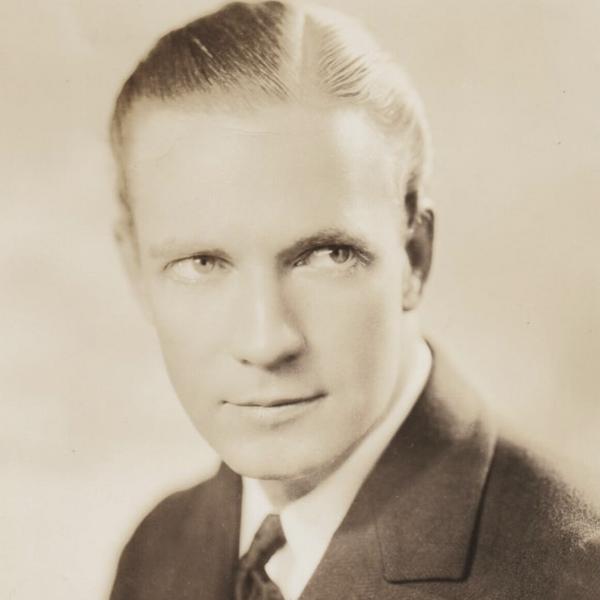
Richard Halliburton
Richard “Dick” Halliburton (9 Jan. 1900, Brownsville, Tennessee, U.S.– presumed dead in the Pacific Ocean after 24 March 1939) was an American travel writer and adventurer who, after running a successful publishing career, disappeared at sea while attempting to sail a Chinese junk, the Sea Dragon, across the Pacific Ocean from Hong Kong to the Golden Gate International Exposition in San Francisco, California.
In his lifetime, this diminutive and slender man dubbed “The Innocent Abroad”
climbed Mount Olympus in Greece, the Matterhorn in the Swiss Alps and Fujiyama in Japan. He swam the length of the Panama Canal and plunged into the Hellespont in Turkey. He was arrested in Gibraltar, slept on top of the Great Pyramid in Egypt, and was the first to photograph both Mount Everest and the Taj Mahal from the air. Halliburton rode a donkey he named Hannibal over the Pyrenees and, in homage to Hannibal, rode an elephant across the Alps. He spent time with convicts on Devil’s Island and a month on the island of Tobago pretending he was Daniel Defoe’s Robinson Crusoe. Halliburton joined the Foreign Legion, dove 70 feet into a Mayan well of death at Chichen Itza and flew all the way from here to Timbuktu, right across the middle of the Sahara Desert in an airplane he christened The Flying Carpet. [“80-years-ago-tennessees-boy-adventurer-met-his-untimely-death”, Tennessee State Museum website]
2) Halliburton posing near two giant olive oil jars in Knossos, Greece [from RH’s Second Book of Marvels — The Orient].
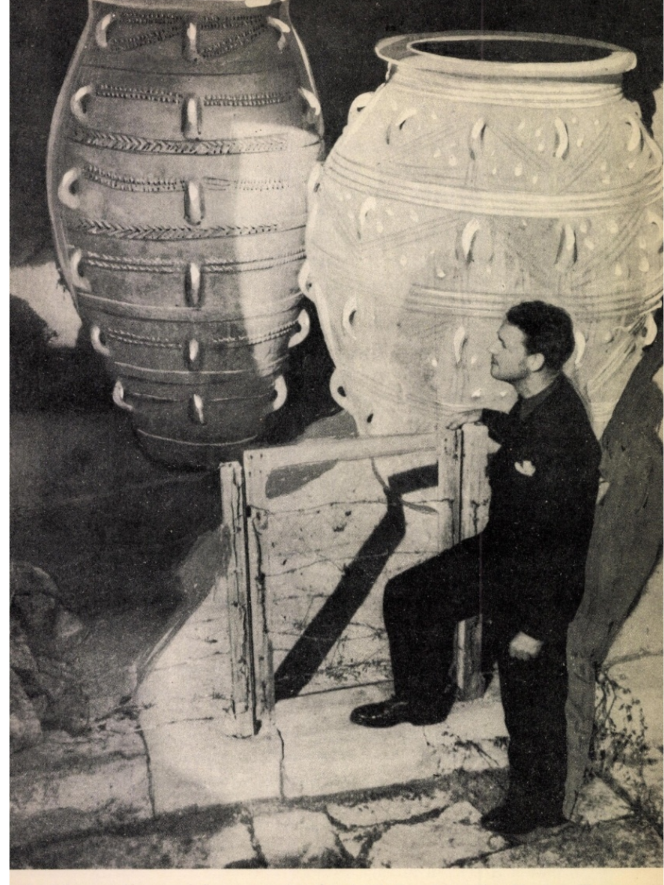
2) Halliburton posing near two giant olive oil jars in Knossos, Greece [from RH’s Second Book of Marvels — The Orient].
2) Halliburton posing near two giant olive oil jars in Knossos, Greece [from RH’s Second Book of Marvels — The Orient].
The son of all-American parents — his mother, Nelle Nance-Halliburton was born on 9 March 1869 in Paris…Tennessee — Richard completed high school in Memphis before joining Princeton University, where he was the chief editor of The Princetonian Pictorial Magazine and attended courses in public speaking (he was to be known later as a “Raconteur”, a born story-teller who gave numerous conferences after each and everyone of his trips ). In September 1919, he unexpectedly vanished from the company of his parents in New Orleans and boarded a ship to England, touring France and Monte-Carlo until his return in mid-January 1920. But his later journeys were gladly funded by his businessman father, and despite Richard’s admiration for elder travel writer Harry Franck he never had to ‘bum his way around the world as a vagabond.’
In 1925, two years after graduation, he published his first book, The Royal Road to Romance, about his first Iintercontinental travel from the Alhambra in Spain to Mt. Fuji through Monte Carlo, the Nile, Punjab, Kashmir, Ladakh, the Khyber Pass, Angkor, Bangkok and Bali. That was followed with The Glorious Adventure (1927), a recounting of his own reading of Homer’s Odyssey — more than 100 years before the spectacular popular success of Christopher Nolan’s eponymous movie (2026) — and the visit the young author had paid to the grave of English poet Rupert Brooke on the Greek island of Skyros, then New Worlds To Conquer (1929), a summary of his latest feats.
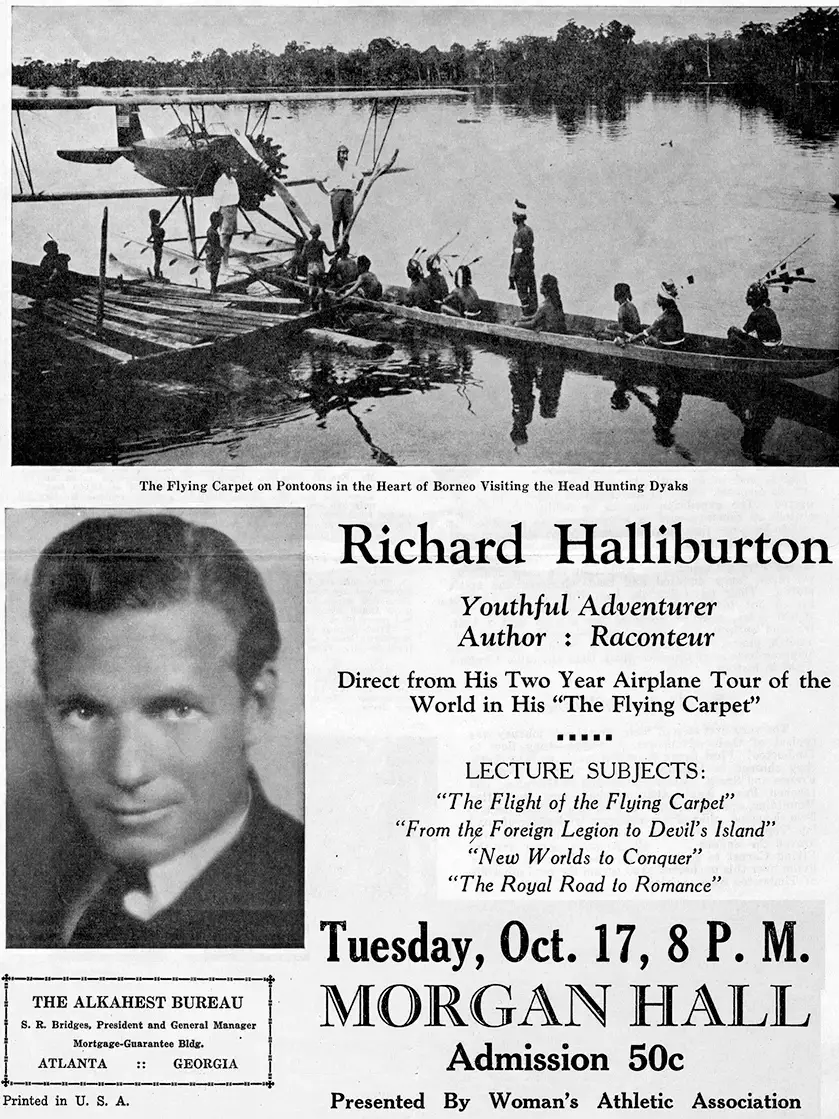
When he boarded his Flying Carpet (a Searman C3B airplane) at the French Foreign Legion airstrip in Colomb-Béchar (Algeria) in April 1931, along with experienced pilot Moye Stephens, he was probably the world’s most famous travel adventure writer, with three books on the bestseller list, translated into nine languages, and the movie rights for the first one already bought by Fox Films in Hollywood. Flying over the Sahara to legendary Timbuktu, last leg of this air trip across three continents, was his way of emulating and exceeding Charles Lindbergh’s transatlantic flight, and even the Antoine Saint-Exupéry’s tragic exploit.
At the same time, Halliburton — who has been labelled “the gay Indiana Jones” in the years 2000s, was able to “navigate a very visible career as a “ladies’ man” while also living a fairly openly gay lifestyle that included some long-term relationships” [to quote his biographer C. Scott William, The The Forgotten Adventures of Richard Halliburton: A High Flying Life from Tennessee to Timbuktu, Charleston, The History Press, 2014, p. 138]. We are still trying to find out whether his path crossed the wandering of another American Southerner enamored with traveling and same-sex adventures, Harry Hervey.
In 1934, US newspapers syndicated with the Bell group started to publish Halliburton’s weekly feature stories — in total, some 50 short (about 1,000 words) pieces of history popularization dealing with topics as diverse as Dr. Samuel Mudd (plotter of President Abraham Lincoln’s assassination), the Seri Indian tribe of Southern California, the Battle of Santiago de Cuba a month later; Henri Christophe and the Citadelle Laferrière in Haiti; Christopher Columbus, Lord Byron, and “The Girl from Martinique Who Wrecked Napoleon” [Joséphine de Beauharnais]…That required an extra round of traveling, this time from Cuba to Ethiopia to Russia and the Arabic Peninsula, with the resulting new set of books — Seven League Boots and the two Books of Marvels.
Less persistent than the marathonian lecturer and American traveler supreme Burton Holmes (1892−1952), less physically robust than his exploits would allow — he had spent a year in a Kellogg sanatorium in his childhood -, Richard Halliburton was again looking for a career rebound and fame boost when he boarded the SS President Coolidge bound for Hong Kong on 23 Sept. 1938 — the same cruise liner that had carried Charlie Chaplin and Paulette Goddard on their way to Angkor two years earlier. The plan was to sail back a 23-meter Chinese junk, the Sea Dragon [ch 海龍], across the Pacific Ocean to San Francisco, a spectacular demonstration of ‘East Meets West’ culminating at the Golden Gate International Exposition (GGIE). The junk would be moored at Tresasure Island and take visitors on excusions around the bay for a limited fee.
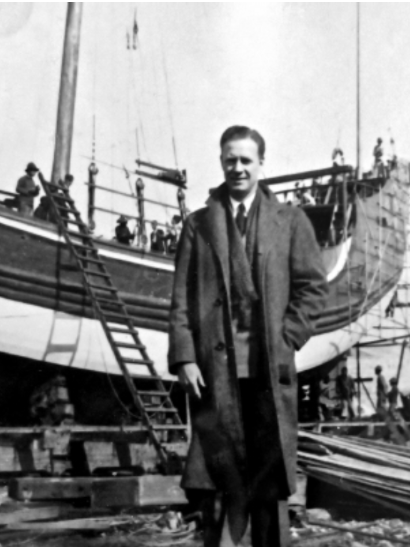
1) Richard Halliburton posing in front of the Sea Dragon on 29 Dec. 1938. [photo taken by Dr. and Mrs. J.M. Lapp, Hong Kong — Rhodes College Archives and Special Collections, Memphis, Tennessee.] 2) Front page of the Commercial Appeal reporting Richard Halliburton’s probable death, 11 June 1939. [both photos reproduced in C. Scott William, The The Forgotten Adventures of Richard Halliburton: A High Flying Life from Tennessee to Timbuktu, op. cit.].
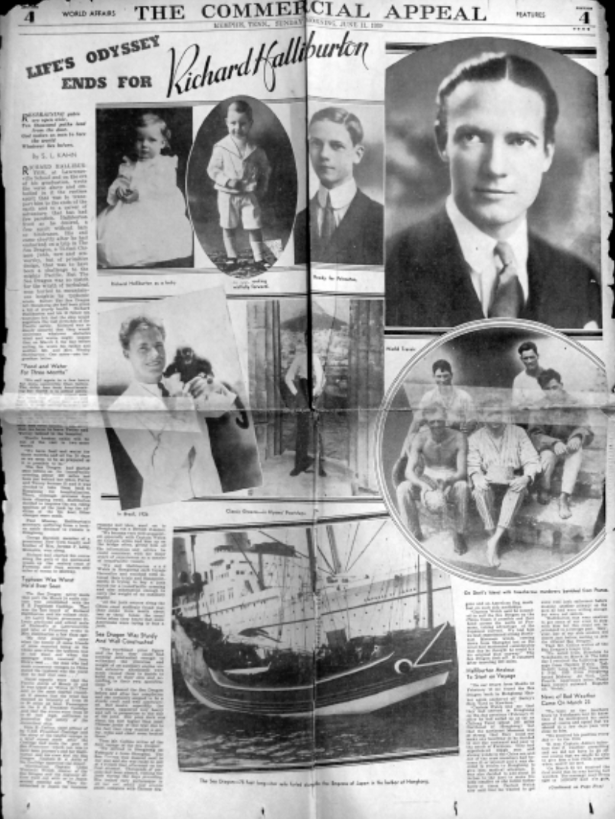
1) Richard Halliburton posing in front of the Sea Dragon on 29 Dec. 1938. [photo taken by Dr. and Mrs. J.M. Lapp, Hong Kong — Rhodes College Archives and Special Collections, Memphis, Tennessee.] 2) Front page of the Commercial Appeal reporting Richard Halliburton’s probable death, 11 June 1939. [both photos reproduced in C. Scott William, The The Forgotten Adventures of Richard Halliburton: A High Flying Life from Tennessee to Timbuktu, op. cit.].
1) Richard Halliburton posing in front of the Sea Dragon on 29 Dec. 1938. [photo taken by Dr. and Mrs. J.M. Lapp, Hong Kong — Rhodes College Archives and Special Collections, Memphis, Tennessee.] 2) Front page of the Commercial Appeal reporting Richard Halliburton’s probable death, 11 June 1939. [both photos reproduced in C. Scott William, The The Forgotten Adventures of Richard Halliburton: A High Flying Life from Tennessee to Timbuktu, op. cit.].
The three-month journey, sponsored by subscribers, had two trial starts, in January and February 1939, and each time experienced mariners found the vessel way too heavy. After some repair, the junk sailed again out of Hong Kong on 4 March 1939. The last contact with the boat was made on 24 March. A search party off Hawaii was set up on 10 April. Even if rumors about his fate continued to arise over the years — just as it happened with woman explorer and pilot Amelia Mary Earhart (24 July 1897 — disap. 2 July 1937), who was declared dead that same year on 5 Jan. 1939 -, Richard Halliburton quickly became the faded memory of a short-lived fame, “of a meteor that blazed across the heavens…and was gone”, to use the same image as his own father, Wesley Halliburton [James Cortese, Richard Halliburton’s Royal Road, Memphis, TN: White Rose Press, 1989, p. 8].
Publications
- The Royal Road to Romance, Indianapolis, The Bobbs-Merrill Company, 1925.
- The Glorious Adventure, Indianapolis, The Bobbs-Merrill Company, 1927.
- New Worlds to Conquer, Indianapolis, The Bobbs-Merrill Company, 1929.
- The Flying Carpet, Indianapolis/New York, The Bobbs-Merrill Company, 1932.
- Seven League Boots, Indianapolis /New York, The Bobbs-Merrill Company, 1935.
- Richard Halliburton’s Book of Marvels: the Occident, Indianapolis /New York, The Bobbs-Merrill Company, 1937. [originally titled Marvels of the West].
- Richard Halliburton’s Second Book of Marvels: the Orient, Indianapolis /New York, The Bobbs-Merrill Company, 1938.
- Richard Halliburton: His Story of His Life’s Adventure, as Told in Letters to His Mother and Father, Indianapolis/New York, The Bobbs-Merrill Company, 1940.
- Richard Halliburton’s Complete Book of Marvels, Indianapolis/New York, The Bobbs-Merrill Company, 1941.
The Royal Adventures of Richard Halliburton. Indianapolis/New York, The Bobbs-Merrill Company, 1947 [repr. in 1 volume of The Royal Road to Romance, The Glorious Adventure, and New Worlds to Conquer.]
Contributions
- [Introduction by Richard Halliburton, “World Traveler, Author and Epicure”] One Hundred Years of Delightful Indigestion – Memphis Priceless and Treasured Receipts, Memphis, James Lee Memorial Academy of Arts, 1935.
- India Speaks, photo-play and film with Richard Halliburton, produced and directed by Walter Futter, written by Norman Houston, 1933 [A sequel to the popular film Africa Speaks!].
About Richard Halliburton
- “Richard Halliburton”, website by C. Scott William.
- Mark F. Bernstein, “What Would Halliburton Do? The life of a Princeton adventurer”, Princeton Alumni Weekly, 8 March 2019.
- The Barrett Library at Rhodes College, USA, holds ‘Richard Halliburton’s Archives’ [not available online as of June 2026].