Ly Team Teng លីធាមតេង 李添丁 [also Li Dham Ten] (15 May 1930, Kompong Siem District — 1978, captive of the Khmer Rouge) was a Sino-Khmer researcher and author who wrote many essays and novels that became Cambodian literature classics, and authored the first Khmer translation of Zhou Daguan’s 13th century account Zhenla and Its People, a work he considered as “sacred”, since it is the only written relation of Angkor during the Khmer relation.
As a young reaseacher at Phnom Penh Buddhist Institute, he was remarked by ethnologist Éveline Porée-Maspéro, who appointed him at the Commission for the Study of the Cambodian Mores and Customs. Later, Ly Theam Teng founded the Khmer Writers Association, with its bi-monthly publication Ecrivains Khmers (“Khmer Writers”), and contributed to the first Cambodian journal of literary studies, Kambuja suriyā - a monthly publication of the Buddhist Institute.
With a solid knowledge of Chinese, Vietnamese and French literature, Ly Theam Teng was active on the international scene, attending the 1958 Afro-Asian Writers’ Conference in Tashkent (then USSR) as part of the non-aligned movement encouraged by Prince Sihanouk. In 1962, he was invited to China by the China Writers Association, which gave him the opportunity of meeting with Chinese writers such as Yang Shuo, and of perusing older editions of Zhou Daguan’s travelogue.
Before the Khmer Rouge takeover in 1975, had published a biography of Khmer poet Krom Ngoy (1966), collected oral traditions in the Siem Reap area, and achieved the first comprehensive history of Cambodian literature, Outline of Khmer Literature Development (1972). He published his work on Zhou Daguan in 1972, later reprinted in various editions and now available in digital format at Angkor Database.
Married to Ly Thirak (maiden name Eam Kim Houy 穗金惠), with whom he had five children, Ly Team Teng was arrested by the Khmer Rouge in 1975 and died of exhaustion in 1978. After the war, his widow and one of their sons helped researcher and translator Uk Solang to find his preparatory notes for his translation of Zhou Daguan, as he was studying the Khmer phonetic origin of certain terms used by the Chinese chronicler.
Ly Team Teng’s contribution has been highlighted by Cambodian scholars such as Khing Hoc Dy. Since 2021, a Center for Khmer Studies (CKS) research unit is working on his legacy.
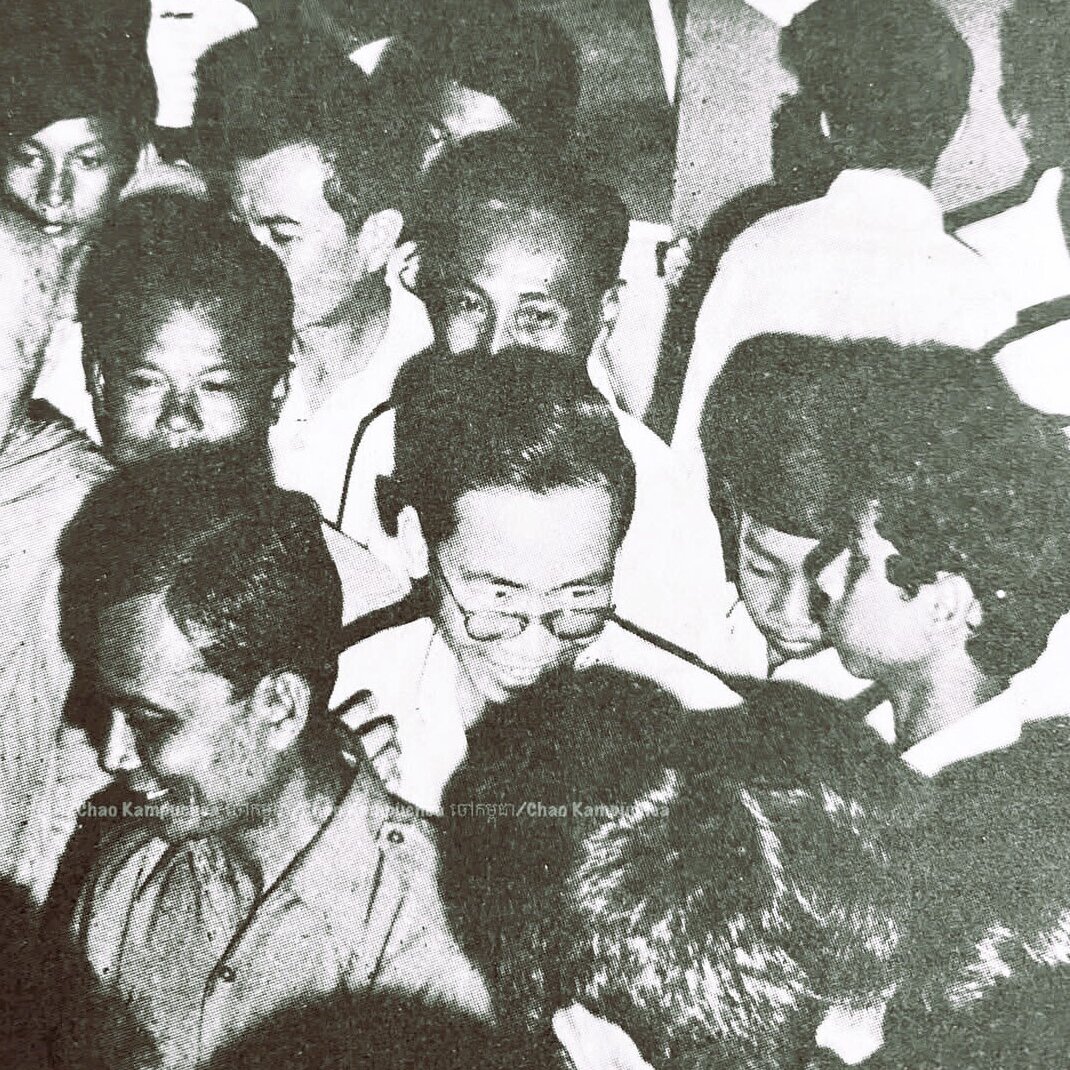
Ly Team Teng (center, wearing glasses) in the 1960s. [photo via Chao Kambuja]
Ly Team Teng (center, wearing glasses) in the 1960s. [photo via Chao Kambuja]
Kāmboja, a kingdom often mentioned in the Mahābhārata and in the Ramayana, with supposed location in the northwestern part of India, in modern Kabul area, renowned for its warriors and fine horses. Later on, a country visited by Asokas missionaries.
In ancient Indian astrology, a Kādi (subdivision) belonging to Nairṛtī (south-western division referring to a country possibly identified with the Cambodia of Cochin China according to the Bṛhatsaṃhitā (chapter 14), an encyclopedic Sanskrit work written by Varāhamihira.
One of the two Mahājanapadas of the Uttarāpatha (Northern District) of ancient India, as recorded in the Pāli Buddhist texts, presumably not far from Gandhāra, with Nandipura as the only city of the Kambojas mentioned in the inscriptions. "Home of horses," a term related to horses and elephants.
In Ayurvedic medicine, a plant defined with Coccinia grandis. White mimosa.
Kambujadesa, the land of कम्बु Kambu: according to 10th-century traditions, the union between hermit Kambu Swayambhuva and the celestial nymph Mera founded the Cambodian solar royal dynasty (Kambu-Mera), beginning with Chenla ruler Srutavarman and his son Sreshthavarman.
[Kambhoji or Kambodhi, a raga or raganimode in Carnatic music, derived from 28th mela Hari Kambhoji, widely known and developed since the 7th century, often dedicated to Lord Ganesha. Defined as "majestic, auspicious in the devotional register" by Dr. Charulatha Mani and by famed Bollywood music composer A.R. Rahman. Etymology unknown, Kāmbhojī काम्भोजी being one name for Guñjā गुञ्जा, Abrus Precatorius, "red bean" plant. Carnatic music scholars do not exclude the possibility that the name might derive from Cambodia-Kampuchea.]