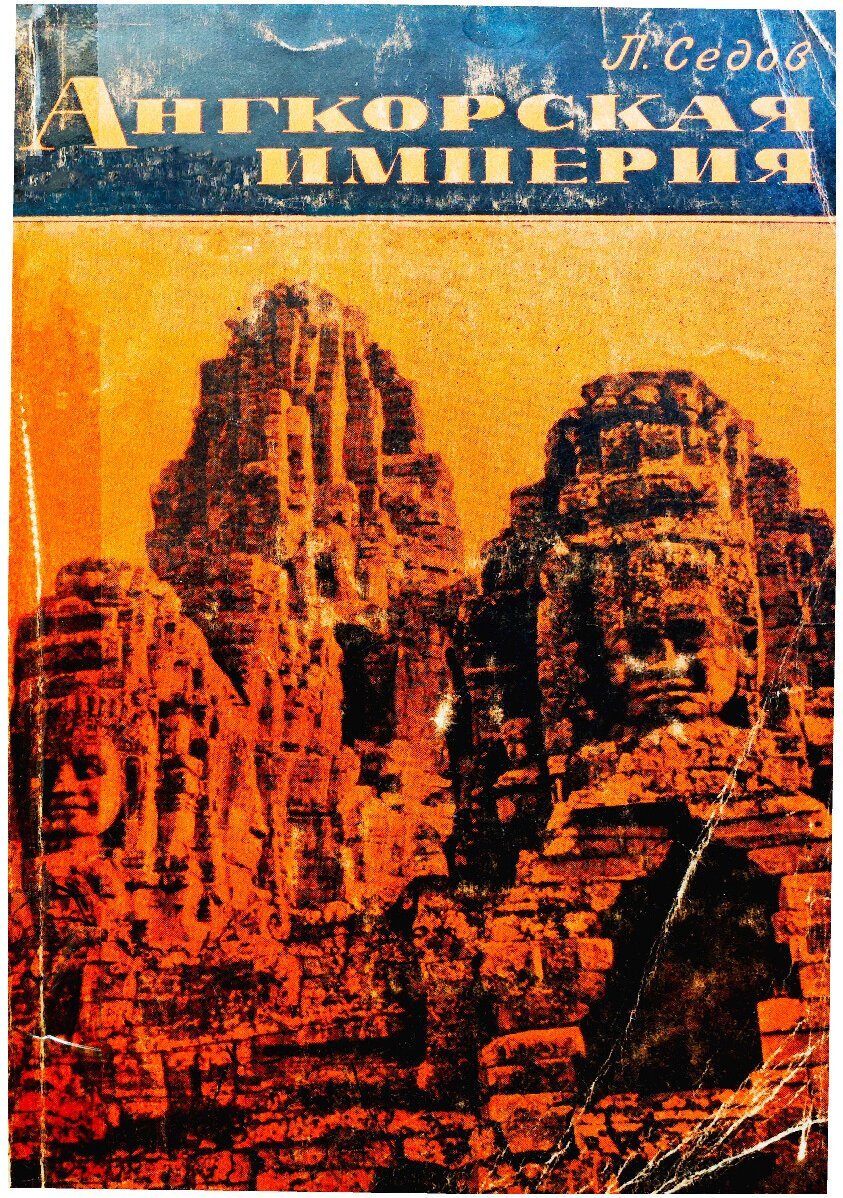
Ангкорская империя (Социально-экономический и государственный строй Камбоджи в IX-XIV вв) | The Angkorian Empire (Social, Economic and State Formation in Cambodia in the 9th-14th centuries)
by L. A. Sedov
The first and only major study on Ancient Angkor in Russian, often quoted but hard to find in its full version.
Author
L. A. Sedov
Publisher
Moscow, Академия наук СССР - Институт народов Азии [Academy of Sciences of the USSR, Institute of the Peoples of Asia], Издательство «Наука» [Na'uka Publishing House]
Published
1967
Book Edition
digitized version obtained Nov. 2025 [with thanks to Mikhail Fiveyskiy].
At the peak of the Cold War, the author, a researcher with the Institut of the Peoples of Asia (Институт народов Азии, Moscow, founded in 1930 and predecessor of the Institute of Oriental Studies [Институт востоковедения] within the Academy of Sciences), produced a study on Khmer civilization showing his knowledge of Western and Indian sources from beyond the Iron Curtain.
The foreword was formulaic in Soviet-propangada style: Данное исследование представляет собой пионерскую попытку применения марксистского метода к изучению и анализу источников ангкорского периода. [This study is a pioneering attempt to apply the Marxist method to the examination and analysis of sources from the Angkorian period]. But what Western Khmerologists have found interesting was something else — and Sedov’s work has in effect been often quoted in French or English publications -: it was the first comprehensive attempt to present a sociological, structural vision of the Angkorian period in the history of Cambodia, and to consider the specifics of the Angkorian material culture.
L. A. Sedov had read and assmilated most of the French sources on the subject — from A. Leclère and E. Aymonier to the abundant production by EFEO researchers, in particular the 13th-century imprescendible testimony of Zhou Daguan in Paul Pelliot’s version — then the only one available — George Coedès -, the American author L. P. Briggs and his groundbreaking The Ancient Khmer Empire (1951), and Indian scientific publications, to begin with the often quoted B. R. Chatterji’s Indian Cultural Influences in Cambodia (1908). Note that, apart from the compulsory references to Marx, Engels and Lenin’s writings, and S.A. Maretina’s works [see below] all quoted sources belong to the Western or Indian schools of Orientalism.
Far from limiting himself to marxist clichés about “religion, opium for the people”, the author attempts to understand how religious beliefs both determined power structures and were instrumentalized in power struggles. He easily reckons that Angkor Wat was “самое крупное религиозное сооружение, когда-либо созданное руки человека” [the largest religious structure ever built by human hands] [p 41], noting that the caste system never reached the extreme rigidity that occurred in India. The early Angkorian sovereigns had all the traits of “восточной деспотии” [“Oriental despotism”, the classical Marxist notion of Asian system of governance], he writes, yet he’s looking for a more pertinent grid of interpretation based on ethnography, for instance in considering how traditional ‘clans’ mutated into ‘estates’, not following the European feudalist pattern.
Interestingly, the mention of Sofia Maretina’s study on the people of Assam (1964) points to the direction of further research on pre-Indianized Southeast Asian power structures as later developed by Claude Jacques, Georges Condaminas or Michael Vickery. Also, several years before S. Sahai’s Les Institutions politiques et l’organisation administrative du Cambodge ancien, VIe-XIIIe, siècles(1970), the author explores the possible interpretations of ‘khlon’, this term so recurrent in ancient Khmer inscriptions — curiously, Sahai didn’t mention Angkorskaia Imperiia in his bibliography…
Sensing that so many points were still in need of clarification, the author finally opts for rallying to the conventional reading of ‘Devaraja’ as ‘God-King’, before other researchers like Jacques or Vickery would push in the direction of devaraja as the “tutelar god-ancestor of the king”:
Идеологической опорой централизованной ангкорской державы был культ девараджи — «бога-царя». Царская власть рассматривалась как земное воплощение бога Шивы (на отдельных этапах Вишну и Будды). Официальная государственная религия была религией аристократической, чуждой и враждебной массам. Грандиозных масштабов храмовое строительство влекло за собой колоссальные непроизводительные растраты материальных ресурсов и человеческой энергии. Государственный аппарат ангкорской монархии строился так, чтобы наилучшим образом обслуживать потребности эксплуататор,скоrо общества. Верхушка этого аппарата ‚совпадала ‚с верхушкой ·правящего класса. Характерной чертой этой верхуш-ки было то, что ее представители в большинстве случаев были связаны с царем родственными узами.
[The ideological pillar of the centralized Angkorian state was the cult of the devaraja — the “god-king.” Royal power was viewed as the earthly incarnation of the god Shiva (or, at certain stages, Vishnu and Buddha). The official state religion was aristocratic, alien and hostile to the masses. Temple construction on a grand scale entailed colossal waste of material resources and human energy. The state apparatus of the Angkorian monarchy was structured to best serve the needs of an exploitative society. The top brass of this apparatus coincided with the ruling class. A characteristic feature of this elite was that its members were, in most cases, related to the king by family ties. [p 247]
However, the too simplistic prism of “exploitative” elites “hostile to the masses” doesn’t suffice to explain the architectural feat at Angkor, as ‘forced’ or ‘slave’ labor wouldn’t account for all the technical prowesses of Khmer monumental architecture. Before exploring the building techniques (down to a detailed description of the lever system to haul stone blocks), the author resituates Angkor in its physical context:
Действительное объединение всех камбоджийских земель было осущес!влено пр.и преемниках Джаявармана 11 Индравармане 1 (877−889) и Яшовармане 1 (889−900). Этому способствовал на редкость удачный выбор района, в котором Джаяварман 11 разместил свою столицу. Расположенный вдали от возможных агрессоров, вблизи озера Тонле-Сап, богатого рыбой, недалеко от песчаниковых карьеров горы Пном Кулен, близко к перевалам, открывающим доступ к плато Карат и долине Менама, этот район представлял исключительно благоприятные условия для быстрого экономического развития.
[The true unification of all Cambodian lands was accomplished by Jayavarman II’s successors, Indravarman I (877−889) and Yashovarman I (889−900). This was facilitated by the exceptionally fortunate choice of the region in which Jayavarman II located his capital. Situated far from potential aggressors, near the fish-rich Tonle Sap Lake, not far from the sandstone quarries of Phnom Kulen, and close to the passes providing access to the Korat Plateau and the Menam Valley, this region offered exceptionally favorable conditions for rapid economic development.] [p 57]
And more specifically:
По Гролье, кирпичная башня- высотой 12 м, имеющая в основании 5 м, сооружалась не более чем за 1 месяц. На строительство Ангкор Вата, где объем камнной кладки оценивается в 220 000 куб. м, Ж. Гролье отводит максимум 50 лет. Для храма Бантеай Тьхмар, в который заложено 30 849 куб м песчниковых блоков и 51 973 куб м латерита, Ж. Гролье полаrаeт необходимым труд 4 тыс. рабочих в течение восьми с половиной лет при десятичасовом рабочем дне только на начальном этапе строительства, включающем изготовление блоков в карьерах Пхном Кулена, доставку их на строительную площадку нарасстояние 18 км, укладку и подгонку. При этом Ж. Гролье исходил из того, что камни доставлялись вручную, носильщиками, хотя на самом деле, по-видимому, широко использовались слоны и водный транспорт. Поэтому указанную выше цифру можно считать завышенной.
[According to Groslier, a 12-meter-tall brick tower with a 5‑meter base was erected in no more than one month. For the construction of Angkor Wat, where the volume of stonework is estimated at 220,000 cubic meters, Groslier allocates a maximum of 50 years. For the Banteay Chhmar temple, which contains 30,849 cubic meters of sandstone blocks and 51,973 cubic meters of laterite, Groslier estimates the labor of 4,000 workers over eight and a half years, working ten hours a day, for the initial stage of construction alone, which included the production of blocks in Phnom Kulen quarries, their transportation to the construction site 18 km away, their installation, and fitting. Moreover, J. Groslier assumed that the stones were transported by hand, by porters, although in reality, elephants and water transport were apparently widely used. Therefore, the above figure can be considered an overestimate.] [p 224 – 5]
As for the slave status in ancient Angkor, the author refers to a rather confidential 1959 study by Yvonne Bongert, “Note sur l’esclavage еп droit khmer ancien” [in Etudes d’histoire du droit prive offertes à Pierre Petot, 631 p]. Yvonne Bongert (1921−2012) was a noted professor in the history of law, the firt first female professor at Lille Faculty of Law (1957−1965), Emeritus Professor at Paris Faculty of Law from 1989 to her death.
The closing lines are an interesting take on the historiography of Cambodia, and the people’s perception of their ancient history. What the author suggests in two paragraphs is that 1) Colonization pursued the preservation of “archaic traditions” not with the prospect of helping people to understand their past but to maintain them in a “medieval” condition; 2) It is only after the 1953 independence that the Khmer collective could be fully reconciled with its Angkorian past:
The social system that existed in Angkor did not collapse with the fall of the Angkorian state. It continued to exist in Cambodia through the 15th-18th centuries, having undergone only partial changes. Thus, in particular, as a result of the change of religion, temple land ownership was undermined and religious institutions significantly lost their original features. Many social traits were borrowed by Siam and underwent further development there. The French colonizers were also interested in preserving archaic traditions; thus, several vestiges of the Middle Ages in the country’s political and economic life were preserved until its full independence.
The Angkor period was a period of flourishing of the Khmer economy, statehood, and culture. For several centuries, Cambodia was the most powerful state in Southeast Asia, exerting an all-round influence on neighboring countries. Modern Khmers honor and preserve the traditions of Angkor. Cambodia’s interest in its history was particularly strong after it threw off the yoke of colonial rule. It is no coincidence that the flag of independent Cambodia depicts the symbol of Khmer national pride — the Angkor Wat temple, built in the 12th century. [p 249]
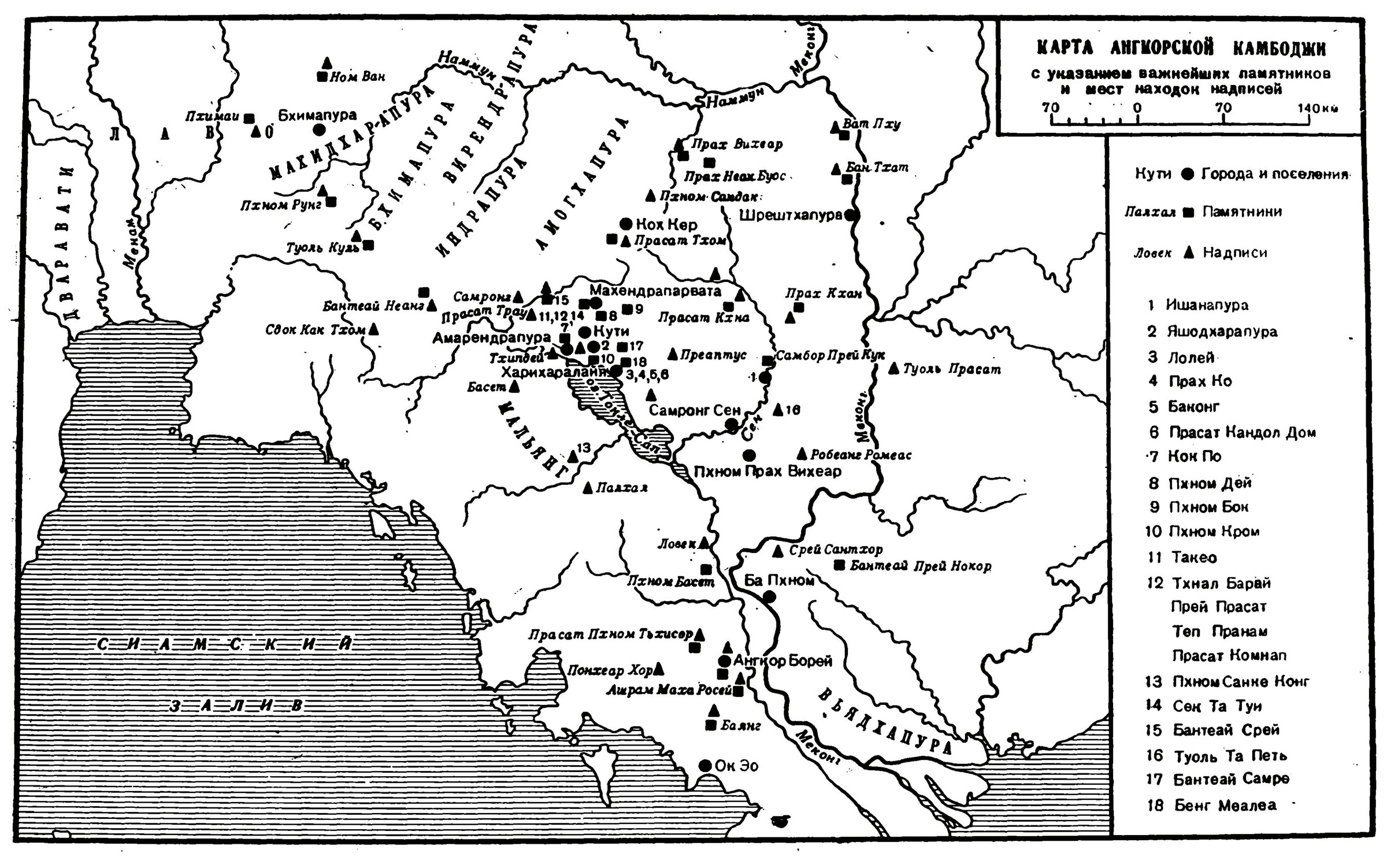
A Geography of the Angkor kingdom
showing the most important monuments and locations where inscriptions were found (in Russian) [Sedov 1967, p 251]
Map of Angkorian Cambodiashowing the most important monuments and locations where inscriptions were found (in Russian). [Sedov 1967, p 251]
While he never actually visited Cambodia (to our knowledge, at least), L. A. Sedov had remarkably mastered the historical lay of the Khmer land, correctly locating Prasat Banteay Chhmar បន្ទាយឆ្មារ or the lesser known Banteay Neang បន្ទាយនាង, both in Banteay Meanchey Province. His map [see above] was lauded by Cambodian researcher Long Seam, who had known Sedov during his studies in Moscow and wrote in his 2007 study on Khmer toponymy
En s’appuyant sur les descriptions des emplacements d’un grand nombre de toponymes importants trouvés dans les inscriptions en langue sanskrite, Sedov a pu établir d’une façon plus précise [que Georges Maspero, ADB], la carte de l’empire du Kambujadesa (du IXe au XIVe siècle) en indiquant les grandes divisions territoriales du pays pendant la période angkorienne (Sedov 1967). [Based on descriptions of the locations of a large number of important place names found in Sanskrit inscriptions, Sedov was able to establish a more precise map [than Georges Maspero, ADB] of the Kambujadesa empire (9th to 14th centuries) , indicating the major territorial divisions of the country during the Angkorian period (Sedov 1967).]
And Long Seam to add, more specifically about toponymy:
Le seul travail consacré à l’étude des toponymes du Cambodge actuel est une monographie de Saveros Pou-Lewitz (Lewitz 1967). Elle y a employé le plus souvent les matériaux des inscriptions du Cambodge pour expliquer la signification des toponymes trouvés dans la langue khmère moderne. La méthode diachronique et comparative employée par cet auteur a permis de suivre l’évolution phonétique et sémantique d’un petit nombre de toponymes du Cambodge seulement. D’une façon plus générale, cette étude nous permet de comprendre qu’un grand nombre de toponymes anciens formés de mots vieux khmers se rapportant au monde aquatique, botanique et animal n’ont pas subi de grands changements de structure. Ils sont reconnus et compris par les locuteurs du khmer moderne. Actuellement encore les Khmers forment leurs toponymes selon les mêmes schémas mentaux. [The only work devoted to the study of place names in present-day Cambodia is a monograph by Saveros Pou-Lewitz (Lewitz 1967). In it, she most often used material from Cambodian inscriptions to explain the meaning of place names found in modern Khmer. The diachronic and comparative method employed by this author made it possible to trace the phonetic and semantic evolution of only a small number of Cambodian place names. More generally, this study allows us to understand that a large number of ancient place names formed from Old Khmer words relating to the aquatic, botanical, and animal worlds have not undergone significant structural changes. They are recognized and understood by speakers of modern Khmer. Even today, Khmer people form their place names according to the same mental patterns.] [“Les toponymes en khmer ancien”, Aséanie 19, 2007: 15 – 74.]
Table of Contents
Введение [Introduction] / 3
Глава1. Очерк политической истории Анrкорской Камбоджи [Chapter I: An Outline of the Political History of Angkorian Cambodia] /13
Камбоджийское общество до IX в. [Cambodian Society before the 9th Century] / 1З
Становление Ангкорского государства [The Formation of the Angkor Empire] / 21
Период расцвета Ангкорского государства [The Rise of the Angkor Empire] / 29
Кризис ангкорской монархии и ее гибель [The Crisis and Fall of the Angkor Monarchy] / 41
Причины упадка Ангкорского государства [Causes of Decline of the Angkor Empire] / 50
Глава II. Государственный строй Ангкора [Chapter II: The State Structure of Angkor] / 54
Царская власть [Royal Power] / 58
Культ девараджи — идеологическая основа ангкорской деспотии [The Devaraja Cult : The Ideological Basis of Angkorian Despotism] / 75
Высшее духовенство [The Higher Clergy] / 82
Государственный аппарат [The State Apparatus] / 103
Суд и право [Courts and Law] / 115
Армия [The Army] / 125
Глава III. Некоторые проблемы социального строя Ангкора [Chapter III: Some Issues of the Social Structure of Angkor] /131
Сословное деление ангкорского общества [Class Division in the Angkorian Society] / 132
Земельная собственность и ее отчуждение [Land Ownership and Its Alienation] / 143
Государственные налоги и повинности [State Taxes and Duties] / 149
Храмовая собствепность как форма собственности знатных родов [Temple Property as a Form of Ownership of Elite Families] / 152
Иммунитеты [Immunities] /166
Хозяйство «личного» храма [The Economy of a “Personal” Temple] /169
«Центральные» храмы [“Central” Temples] / 183
Хозяйство «центрального храма [The Economy of a “Central Temple”] / 193
Различие между храмами и ашрамами. Уставы ашрам [Difference Between Temples and Ashrams. Ashram Statutes] / 203
Глава IV. Материальная культура Ангкора [Chapter IV: The Material Culture of Angkor] / 210
Leonid Alexandrovich Sedov Леонид Александрович Седов (4 Dec 1934, Moscow- 15 Feb 2018, Moscow) was a Soviet and Russian sociologist and orientalist.
After studying translation at Moscow Maurice Thorez Foreign Languages Institute (институт иностранных языков имени Мориса Тореза) and at the USSR Institute of Oriental Studies (Института востоковедения АН СССР), Sedov published in 1967 the reference study Ангкорская империя, Социально-экономический и государственный строй Камбоджи в IX-XIV вв (The Angkorian Empire: Social, Economic and State Formation in Cambodia in the 9th-14th centuries, 1967, Moscow, Na’uka, Akademii︠a︡ Nauk SSSR, Institut Narodov Azii, 258 p.). This essay, inspired by Marxist methodology and developing remarkable historic insights, has been quoted by scholars worldwide.
Specializing in the study of Eastern states formation, Sedov contributed many articles to the Encyclopaedia of USSR (Советская энциклопедия) and published several studies, including Типы ранних классовых государств на Юго-Востоке Азия (Types of early-class states in Southeast Asia, with M. Kozlova and V. Tiurin, 1968) and ‘La société angkorienne et le probleme du mode de production asiatique’(CERM, Paris, 1969).
Later on, L.A. Sedov specialized in sociological and political studies on post-Soviet Russia, especially as a leading associate of the Yurii Levada (after Prof. Yurii Alexandrovich Levada Юрий Александрович Левада) Analytical Center. In his 2018 tribute to Sedov, Prof. Alexandr Grofman wrote
Леня Седов был одним из наиболее видных и ярких представителей левадинской школы социологов. В социологию он пришел из востоковедения, опубликовав, в частности, в этой области книгу «Ангкорская империя». Первоначально он работал в секторе, руководимом Левадой в Институте конкрет ных социальных исследований Академии наук, затем, после разгрома сектора, в течение ряда лет он был редактором в издательстве «Советская энциклопедия» и, наконец, многие годы он работал в левадинском ВЦИОМе и Левада центре в качестве научного сотрудника, аналитика текущих социально-политических процессов и событий. [..]Он был безусловно профессионалом высокого класса, который испытывал отвращение к идеологическим штампам и предрассудкам советской системы. [Lenya Sedov was one of the most prominent and brightest founders of the Levada school of sociologists. He went into sociology from Oriental studies, after publishing in particular the book“Angkor Empire”. Initially, he worked in the Levada-led branchof the Institute of Applied Sciences at the Academy of Sciences; then, after this structure was disbanded, he was for a number of years editor-in-chief of the publishing house “Soviet Encyclopedia” and, finally, worked as researcher, social and political analyst at Levada Center.[…] He was certainly a high-level professional, who had an aversion to ideological cliches and prejudices of the Soviet system. [Alexandr Grofman, “Несколько слов о Леониде Александровиче Седове” [“A Few Words about Leonid Alexandrovich Sedov”], Телескоп no. 5 (131), 2018]
Publications
‘K voprosu ob ekonomicheskom stroe ankorskoi Kambodzhi IX-XII w.’ [On the question of the economic order of Angkorian Cambodia in the ninth to twelfth centuries], in: Narody Azii i Afriki n. 6., 1963
‘K voprosu ο varnakh ν angkorskoi Kambodzhe’ [On the question of vamas in Angkorian Cambodia] in: Kasty υ Indii. Moscow: Nauka, 1965.
‘Kamni Ankora’ [Steles of Angkor], in: Asia i Afrika Segodnia, n. 5, 1966
‘La societe angkorienne et le probleme du mode de production asiatique’, in: La Pensie 138: 71 – 84, 1968 (reprinted in Garaudy, R. (ed.) Sur le mode de production asiatique, Paris: Editions Sociales, (1969: 327 – 343).
Ό vysshem dukhovenstve angkorskoi Kambodzhi’ [On the higher clergy in Angkorian Cambodia], in: Epigrafika Vostoka 19, 1969
‘Angkor: Society and State’, in The Early State, ed. Henri J. M Claessen and Peter Skalník, Mouton Publishers, The Hague, The Netherlands, 1978 [pp 111 – 30]. ISBN 90 2797904 9
Sk आश्रम āśrama, "spiritual hermitage" or "monastery" |kh អាស្រម ashram "monastery"
ashram: a kind of monastery or retreat to which men retire when they consider that their active life is over, in order to prepare for their future existence. In ancient Angkor, the asrama, or vidyasrama, or varnnasrama, were educational colleges with teachers were called adhyapaka, and heads of association often called kulapati (cf. varnnasrama).