Not to be confused with eponym novella The Downfall of the Gods by mystery writer K.J. Parker (2016), this perceptive novel emerged from the author’s imagination after he visited Angkor some time before the passing of King Norodom I, since he noted in his foreword
I was at Phnom Penh, the capital of modern Kambodia, the which is a Protectorate of France, ruled by a French Resident, in the name of its aged king [1]. I had just quitted Angkor, after many days passed among its temples, and the spell of its magic was still upon me. Yonder, up the dismal river which flowsfrom the Great Lake, behind the thick curtain of almost deserted forest, I had dwelt in a solitude, hardly broken, amid things ancient and wonderful. Here, in a place one half of which is a modern French town, I was jarred by the incongruity which results from grafting on to the gnarled trunk of Asia, the rank products of latter-day Europe.
I sought loneliness and peace. I wanted to think, to meditate upon all that I had seen at Angkor, and upon all that I had learned of its tragic history. I wanted to get once more into tune with the Asia of olden days, away from the noise inseparable from its invasion by the West…[…] My gropings and searchings among the scattered wreckage of a once mighty civilisation, my sojourn amid the deserted temples of a once great people’s worship, had set me dreaming of the Past; forced my imagination to fearful probings of the Future ; for these things told, in silent, grim mockery, of the changing, unchanging fate of gods and empires. [p I‑II, XV,XVI]
The plot starts with Chun, a young boy, sobbing and shaking on the the Angkor Wat’s moat of Angkor at night. The reason of his torment: his mother “was wonton, and him a bastard.” A descendant of the Brahmanic elite of Angkor now seen as an outcast. A girl appears from the shadows:
She was very small and slender and beautifully formed, as though the Gods who fashioned her had taken joy in the exquisite perfection of their handiwork ; and the slim symmetry of her figure was delicately revealed by the soft silk cloth which, draped across her breasts, and leaving the right shoulder nude, fell from waist to ankles. Her arms, bare, shapely, something over thin — little virginal arms — showed against that vesture like foam upon a wave. Chun was struck breathless by the extreme whiteness of her— the whiteness and the divine frailty. [p 23]
He kneels before this goddess-like apparition, but she laughs at hin:
“A Deva! I !” she gasped. “An Incarnation of the Shining Ones !” There was bitter derision in her tones ; and then, of a sudden, she was grave, and to her eyes and face that strange look of age returned. “And yet … “” she said presently as-though she were speaking, not to Chun, but to herself. ” And yet … who knows ? Which of us can guess what we are, or whence we come, or why ? I am that which I am ; but even to me — to me, perhaps beyond the common lot — at times far-off voices have whispered. They make themselves heard in the stillness, in the hush of the night. They murmur of … I know not what — shadowy memories of lives long passed. Or are they only dreams — dear, impossible dreams ? [p 26] [After scorning the Brahmanist rules, she announces:] “If you would know what manner of goddess I am, think of me as the Spirit of Destruction.” [p 33]
They swim together in the moat, naked, she initiates him to infinite pleasure and we understand that this girl is more than the “eternal goddess-woman” which has haunted English literati in the decades preceding this novel publication, to begin with the Ayesha of Sir Henry Rider Haggard (22 June 1856 – 14 May 1925), She-who-must-be-obeyed (1886): facing the Brahman elders “softened by security”, she’s the vital energy of this land, the one chosen for rekindling “the Spirit of the Snake” [the author never writes naga, always snake, but it is obviously the Naga principle that ruled the land before India came over, the multi-headed cobra protecting the access to all temples and cities, the mysterious Serpent-Lady consorting with the king every night in a golden tower of the Angkor Thom described by Zhou Daguan [2], Neak Neang (Naga Princess) at the origin of the Khmer civilization, the legendary initiator of the matrilineal succession that would define Khmer dynasties for centuries. It is a cultural clash, but also a textbook case of class war :
Always, the Brahmans —the twice-born demigods — had achieved their successes at the expense of the folk they ruled. They had been the brain — the guiding, inspiring, subduing influence. The thews and sinews had been supplied by the low-caste peoples who served and worshipped them, to whose lot had fallen ever the heat and the burden of the day, the unending travail, the labour unto death. For in the universal belief in their divinity, abode the power of the Brahmans — a power that enslaved the souls of low-caste men. These latter, descendants of the conquered peoples, raised awed eyes from the dust in adoration of the priest-princes, at whose bidding they toiled, and who ordered for them their lives. They existed only in the shadow cast upon the earth by these demigods who, to them, were a divine mystery made manifest to human sight. By serving, obeying, and honouring them, thus, and thus only, might they do distant and vicarious reverence to the Shining Ones and so, acquiring merit, might win at last, in some yet far-off incarnation, to more honourable estate. […]
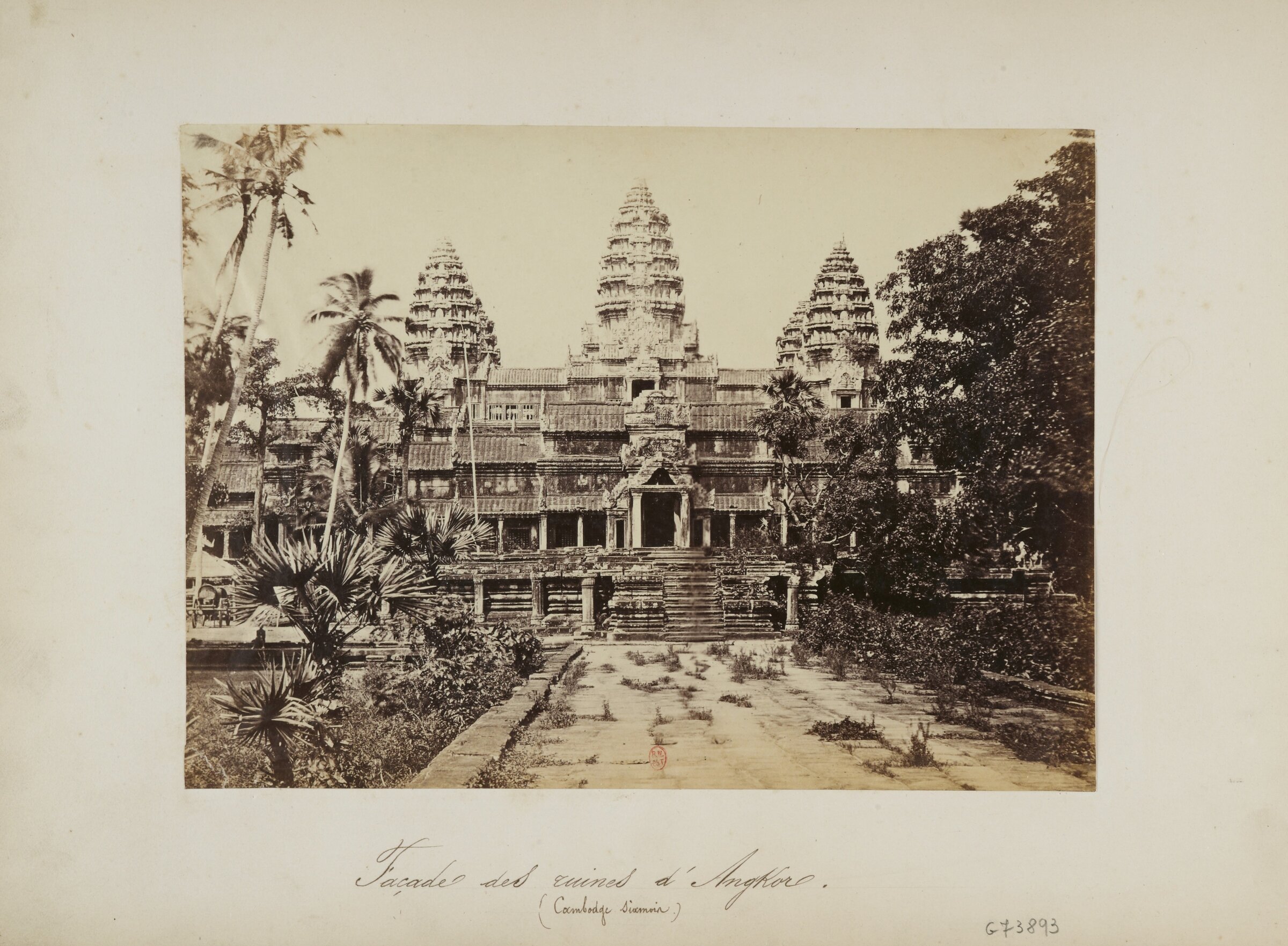
“Menacing and insatiable”: a peculiar take on Angkor Wat, here photographed by Emile Gsell ca 1872. Note that Gsell located the temple in “Siamese Cambodia”, while, earlier, Scottish photographer John Thomson always labeled his photos as “Cambodia” [source: Emile Gsell, Souvenir de Cochinchine, 35-plate album, nd, unknown printing location, via bnf-gallica.fr].
“Menacing and insatiable”: a peculiar take on Angkor Wat, here photographed by Emile Gsell ca 1872. Note that Gsell located the temple in “Siamese Cambodia”, while, earlier, Scottish photographer John Thomson always labeled his photos as “Cambodia” [source: Emile Gsell, Souvenir de Cochinchine, 35-plate album, nd, unknown printing location, via bnf-gallica.fr].
Drunken with power, indifferent to the needs or the sufferings of their people, goaded onward by a tremendous and augmenting ambition, and urged, moreover, to still greater efforts by their awful fear of the Gods, the Brahmans, through the centuries, had piled monolith on monolith, carving and fashioning them wonderfully, and still had found their fierce lust for architectural achievement unappeased; till, in the fulness of time, the vast scheme of Angkor Wat had burst, in all the splendour of its inspiration, upon the imaginations of these dreamers in stone. Now, during three hundred years, men had laboured ceaselessly in bitter travail, under the pitiless sun-glare, to give that idea form; but the end of their toiling was not yet.
The Wat, cruel and inexorable as Fate, had bounded and dominated the lives of thousands. To the men of Angkor — the casteless ones dedicated to its service — it had a monstrous personality of its own. It was eternal. It had always been there, claiming the strength and vigour of their manhood, grinding them slowly and mercilessly back into the dust whence they had emerged. Men, whose fathers and grandfathers had grown grey in its slavery, had been born beneath the shadow that it cast ; had attained to maturity and had decayed with age, still spending themselves in labour upon it; and had been carried to the burning-ghat under a shadow imperceptibly lengthened. It brooded over their imaginations,menacing and insatiable. It paralysed their thought. They were blind to the beauty of the marvel at which they wrought. They knew only the measure of the toil and pain which were the heavy price of it. They looked at it with eyes sad and hopeless, spoke of it furtively in fearful whispers. [p 4 – 8]
With the help of old wise man Slat [clearly from Khmer ឆ្លាត chlat, ‘smart’] and Chun as a devoted herald-worshipper-lover, ‘she’ — since she’s never namely referred to in the novel — and the Naga spirit will ultimately triumph in a tumultuous, grandiose procession at Angkor Thom, near the Bayon:
The eyes of the entire multitude were fixed upon the little, graceful figure, lightly poised upon the shapely feet, and with a carriage so confident and proud. Above the shadowy masses of her hair — visible through the veil of gauze, whereof the folds concealed all save the faintest outline of her face — rose a head-dress fashioned of gold and silver scales, representing seven snake-masks, with the expanded hoods behind them fanning out into a single, spreading cowl, beautiful, but sinister. From the mouths of these reptiles, little forked tongues of red gold protruded, and their eyes were emeralds, which flashed with a green light in the sunshine of the afternoon.
Her body was clothed in a closely-fitting garment of silver and gold scales, which revealed and accentuated every curve and line of her figure, and shot forth rays, scintillating with every movement. Her slender arms, bare to the shoulder, were loaded with bangles and bracelets, in which great jewels shone with a dazzling refulgence. From her anklets, and from the rings she wore on the toes of her little, white feet, gems glittered and sparkled like supernatural glow-worms.
In her hands she fondled a live cobra, that writhed, coiling itself about her arms and neck, and gliding in and out of her clasp, seemed to pour its sinuous length over her, like an animated stream, liquid, yet solid. For a little the people stood at gaze, while the conchs, drums, and cymbals broke forth anew into a salvo of wild and hysterical music ; and then, with a sound like a universal intake of the breath, the multitude sank earthward, in an attitude of adoration. [p 321 – 2]
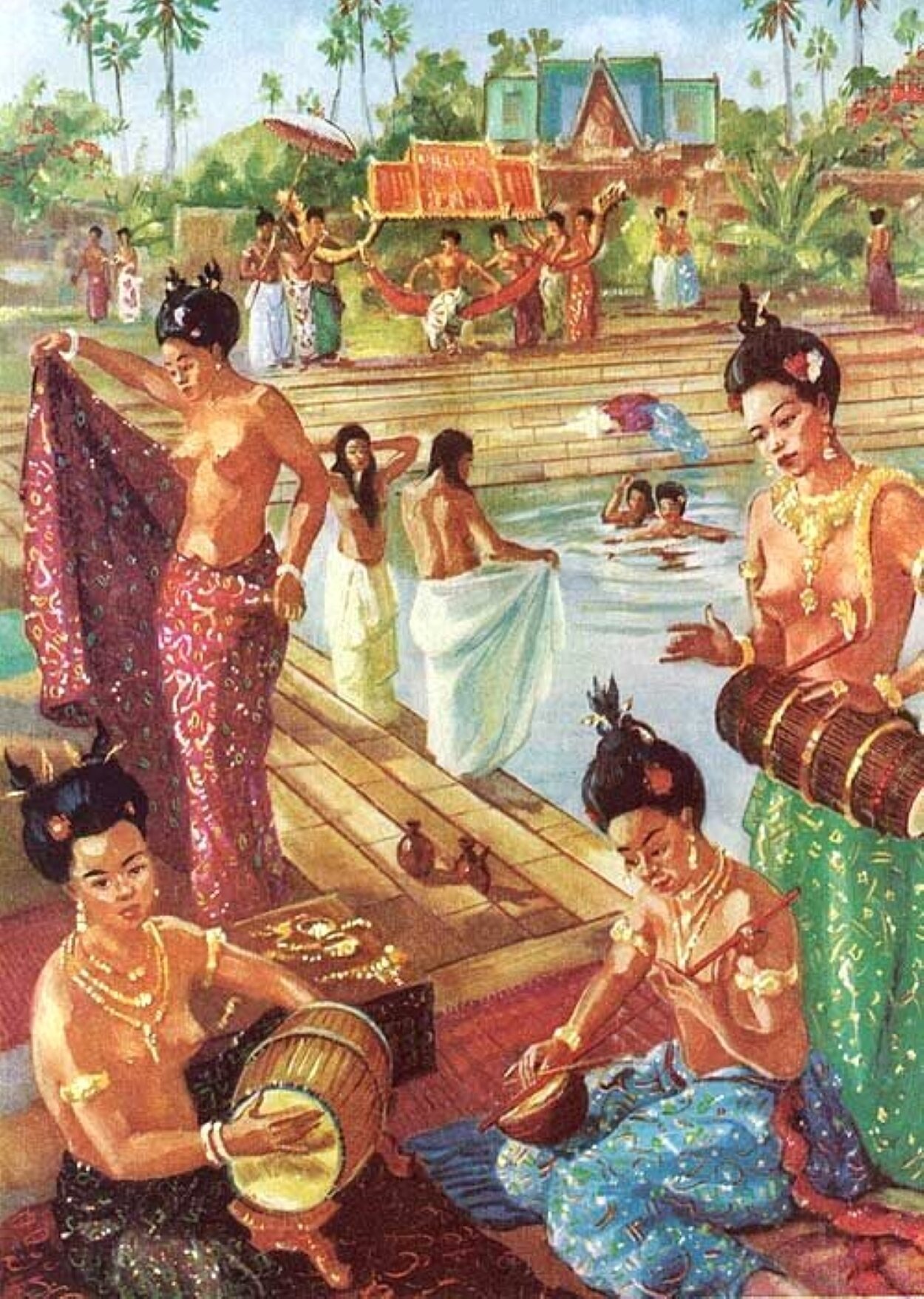
Women of Ancient Angkor as imagined by artist Maurice Fievet in his stunningly vivid series published in the National Geographic (1960).
Women of Ancient Angkor as imagined by artist Maurice Fievet in his stunningly vivid series published in the National Geographic (1960).
“Tell upon my people my decree!”, she regally commands Chun, and
Immediately to the rear of this group, the great, square minarets of the Ba Yon made an impressive background of cold, grey stone, holding aloft, carved on each gigantic facet, effigies of the head of Brahma [3], impassive in their tireless expectation.
“O my brothers !” cried Chun, in a loud voice that carried far and wide. “My brothers, and children of the most sacred Snake !” He turned once more, to salaam [ADB: the veiled woman-gooddess, the ‘minarets’ and ‘salaam’ for salute are obvious echoe of the author’s long lasting involvement with Islamized Malay states] reverently toward her. ” Listen well to the words I speak, obedient to her dread command. “The barbarous Thai are upon us—even at our doors. Our armies, as a punishment for our transgressions, have suffered defeat on many stricken fields. The reinforcements sent have not availed to stay the on-coming of these brutish invaders. Already the camps of the enemy are pitched upon the shores of Tonle-Sap. The need of our nation is sore — the danger dire. Therefore, mindful of her people in this hour of their extreme necessity, the most glorious, most merciful, and most omnipotent Snake hath vouchsafed to assume once more the fetters of human flesh, and to make herself visible to the eyes of all men, ” And thus, through me her unworthy mouthpiece, doth she make known to you her will. She will save you from the invading Thai !” [p 325 – 6]
But then he announces that She has shared with Slat and him the design of a new, even more intricate temple to erect, and hearing that piece of news the ‘quarrymen’, the entire the entire populace to which “the very thought of the exacting, senseless toil of temple-building — of the unending battle with gigantic monoliths, of the eternal straining, of the frequent crushings and maimings — had become a thing abhorrent, erupt in violent protest, hurling stones to the Snake worshippers. In the confusion, the veil protecting ‘her’ shifts on her adorable face and the crowd discovers she’s no other than “Gunda, the dancing-girl of the temple!”. The trio flees the enraged crowd through the Bayon dedalus, trying to take refuge in the jungle. But Gunda is wounded and, even as she stands defiantly, she’s “torn to pieces by the women of the temple.”
The fact that the near-goddess has been a temple dancing-girl, a Khmer devadasi, is essential to the plot: in a note, he referred to Sir Charles Frazer’s essat, Adonis, Attis, and Osiris : Studies in Oriental Religion (Macmillan and Co., 1907), and remarked: “The belief in which religious prostitution had its origin was that the land was rendered fruitful through the fertilisation of women by the gods. These latter were represented by the priests of the temple, or in some instances by strangers; but the favours of the temple women were always denied to the laymen living in the vicinity of their abodes.” [p 340].
Deprived of this ‘incarnation of Womanhood’, in a humble hut in the forest, Chun, Slat and a few faithful followers assess the situation. When someone mentions the rumor that “the Thai have brought a new god they call Gautama the Buddha”, Slat growls:
“I have had enough of gods and worship! “They rise and pass and are forgotten, like the mists of morning. Only the temples which men rear in their honour, seeking therewith to make articulate the dumb agony of their own souls — they — they only — endure. I have had enough of gods.” “I too” said Chun. [p 337 – 8]
The End.
[1] In his notes, the author mentioned he was in Angkor in December 1908.
[2] H. Clifford was one of the earliest English authors to quote from Zhou Daguan. Interestingly, at the time of writing he only referred to of Jean-Pierre Abel-Rémusat’s translation in his first 1819 publication, expanded ten years later in Mélanges d’études asiatiques (1829). Contrary to contemporary French Orientalists, he apparently wasn’t aware of the much more comprehensive translation by Paul Pelliot, published in Paris in 1902.
[3] It was only one decade later that the notion of Brahma represented on the four-faced towers of Angkor Thom were refuted by researchers, who started to see there the face of Jayavarman VII or, more accurately, of the Boddhisvata Lokeshvara.
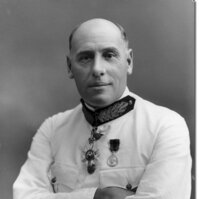
Sir Hugh Charles Clifford (5 March 1866, Roehamption, London – 18 Dec 1941, Roehamption) was a British colonial administrator and a writer who devoted a novel, The Downfall of the Gods, to Angkor and the ancient Khmer civilization.
The son of a distinguished British Army general, he opted to join the civil service in the Straits Settlements (Singapore), and within the administration of the British Protectorate of the Federated Malay States. He spent twenty years in Pahang (ancient Malay kingdom, now a State of Malaysia, east coast of the Malay Peninsula), studying traditional cultures and languages. In 1903, he left Malaya to take the post of Colonial Secretary of Trinidad and Tobago, and was later appointed Governor of British Ceylon (1907−1912), Governor of the Gold Coast, 1912 – 1919, Nigeria, 1919 – 1925, and Ceylon, 1925 – 1927. In 1937, he returned to Malaya as Governor of the Straits Settlements and British High Commissioner, but due to the ailing health of his second wife, Elizabeth Lydia Rosabelle Bonham, he retired from civil service in 1929.
Several schools in Malaysia are named Clifford School in his honour.
Publications
In Court and Kampung. Singapore, Graham Brash, 1899. ISBN 9971−4−9199−0. [First published as: East coast etchings. Singapore, Straits Times Press, 1896.]
A Dictionary of the Malay Language [withFrank Swettenham, published in stages between 1894 and 1902, abandoned after letter G].
various essays and short stories located in Malaya including Studies in Brown Humanity, Bushwacking, A Free-Lance of To-day, In Days that Are Dead, Malayan Monochromes, The Gold Coast Regiment in the East African Campaign, Heroes of Exile (Being Certain Rescued Fragments of Submerged Romance), 1900s.
Further India, being the story of exploration from the earliest times in Burma, Malaya, Siam and Indo-China, New York, Frederick A. Stokes, 1904.
The Downfall of the Gods. London, John Murray, 1911.
A prince of Malaya. New York, Harper & Brothers, 1926. [repub. as Saleh : a prince of Malaya. Singapore, Oxford University Press, 1989.]
Stories by Sir Hugh Clifford. Kuala Lumpur, Oxford University Press, 1966. [repub. as At the court of Pelesu and other Malayan stories. Kuala Lumpur, Oxford University Press, 1993.]
In a corner of Asia; being tales and impressions of men and things in the Malay Peninsula. Freeport, New York, Books for Libraries Press, 1970.
Journal of a mission to Pahang : January 15 to April 11, 1887. Honolulu, University of Hawaii, Southeast Asian Studies Program, 1978.
“An expedition to Kelantan and Trengganu: 1895” JMBRAS, 1992 [repub. of “Report of an expedition into Trengganu and Kelantan in 1895”. Kuala Lumpur, JMBRAS (Journal of the Malayan Branch of the Royal Asiatic Society), v. 34 pt. 1, 1961.
sk अवलोकितेश्वर Avalokiteśvara (" lord who looks down and watches [the world]") | लोकेश्वरः Lokeśvara ("Lord of the World") | also पद्मापाणी Padmapāni ("Holder of the Lotus")
ch 觀音 Guanyin /Kuan Yin (female deity) | tlநாதா Nātha | vn Quan Am (female deity) | tb སྤྱན་རས་གཟིགས Chenrezig ("eye looks with continuity", male and female) | bh Avalokitesvara
Lokeśvara ("Lord of the World") and Chenrezig (in Tibetan) is a tenth-level bodhisattva associated with great compassion (mahakaruṇā), and often with Amitabha Buddha in Mahayana Buddhism. Avalokiteśvara has numerous manifestations and is depicted in various forms and styles. In some texts, he is even considered to be the source of all Hindu deities (such as Vishnu, Shiva, Saraswati, Brahma, etc).
In modern Cambodia, the four faces of Avalokitesvara (or Avaloksvara, Loksvara) are usually represented at the top of a pagoda or a stupa, as protector of all the planets. When Brahmanism was popular, these faces were considered as the faces of Brahma. In ancient Khmer art, he is represented with two, four, six or eight arms in freestanding sculptures, and ten arms in temple bas-reliefs such those at Banteay Chhmar. The massive stone faces of Bayon are believed to represent Lokeshvara.
Khmer worship of Lokeshvara reached a peak during the reign of Jayavarman VII. Due to his healing powers, the he was given a predominant position in the scenes carved on the chapels of the hospitals built by this king. Lokeshvara was also omnipresent at Neak Poan Temple, whose waters could cleanse the sins and diseases of the pilgrims. Jayavarman VII dedicated the temple of Preah Khan Temple to the memory of his father, deified in the likeness of Lokeshvara.
A sculpture from Prei Monti (Roluos), late 12th-early 13th century, at the National Museum of Cambodia (piece Ga.2424), represents three adorned divinities: Buddha shelled by the Naga in the middle, Lokesvara to the right of the Buddha, and Prajnaparamita to the left. Lokesvara's attributes are the lotus bud, rosary, vase with water of immortality (amrta) and book. Those of Prajnaparamita include the book and the lotus bud.
While Avalokiteśvara was depicted as male in India, and male or female in Tibetan tradition, the deity is often depicted as a female figure in East Asian Buddhism, known as Guanyin /Kuan Yin in Chinese, Kannon in Japanese, Gwaneum in Korean and Quan Am in Vietnamese. In Sri Lanka, Natha literally means ‘no form’ or ‘no shape’, thus associating Avalokiteśvara with Maitreya, the next Buddha
Avalokiteśvara is also known for his popular mantra, oṃ maṇi padme hūṃ, which is the most popular mantra in Tibetan Buddhism.
sk देवदासी devadāsi, 'maid-servant to gods' | kh ទេវទាសី tevatesei, 'god's maid', 'slave woman'.
Devadāsī referred in Ancient India to a lady involved in the worshipping of gods and goddesses. Specifically, a dancing girl attached to a temple; a female temple-servant. Equivalent to vilāsinī, gaṇikā, mahārī.
In modern India, the term was used to refer to 'courtezans', women dedicating themselves to sacred prostitution. Particularly in Southern India, devadasi were respected members of the community until the British colonial administration made the status unlawful.
In colonial India, devadasi were often confused with the nautchny or nautch girls, performersof a court dance of Hindustani origin which appeared in the last decades of the Mughal Empire. 'Nautch' was a British corruption of the Bengali word নাচ Nāca, "dance".