The Ocean of Churn: How The Indian Ocean Shaped Human History
by Sanjeev Sanyal
An unconventional, stimulating take on Indian Ocean and cultural exchanges between the Indian subcontinent and Southeast Asia.
Author
Sanjeev Sanyal
Publisher
Random House Publishers India, Penguin Books.
Published
2014
Book Edition
Kindle Edition
Pages
289
Language
English
ISBN
978-9-386-05761-7
Formats
e-book, Kindle
On-demand book: contact
email hidden; JavaScript is required
This well-written, forward-looking book is dedicated ‘To the Dark One, Goddess of Time, She who ultimately devours the greatest of empires and the mightiest of kings’: a quite proper invokation to Kali as we are way into the Kali Yuga, the fourth cyclic age preceded (and followed) Satya Yuga, Treta Yuga and Dvapara Yuga. Since Kali Yuga “started just over 5,000 years ago in 3102 BCE, when Krishna left our planet Earth, and will last another 427,000 years” [according to Popular Vedic Science], our descendants can expect a lot of trouble ahead.
Although the author favors a “popular history” approach, and his views have often been criticized in India for aligning in excess on the political agenda of the ruling Hindu elites, this work is informed by various trips he took to Southeast Asia, and departs from the ‘Greater [or ‘Further’] India’ outlook that dominated Indian history research for many years. As he remarked in his postface,
Almost all of the existing books on the Indian Ocean fall into one of two categories. The first category, which still accounts for the bulk, comprises of histories of the region written from a Western perspective. One would get the impression from these narratives that the history of the Indian Ocean came into being only after the Portuguese arrived on the scene and that it effectively stopped with the withdrawal of the colonial powers. Ancient Indian mariners, Arab merchants and Indonesian maritime empires are simply left out or are presented perfunctorily in an opening chapter as background material. The little that is mentioned is presented in terms of the supply of spices to medieval Europe, as if the Indian Ocean people existed only as part of a supply chain and did not have an independent way of life. The second category comprises of books written by indigenous scholars who have begun to explore the past of their respective countries. This group has published an increasing number of books and papers in recent years as new material has emerged from archaeology and elsewhere. Their writings have introduced a local perspective to the narrative and restored some balance. However, one major shortcoming of their approach has been a narrow focus on a particular country or region rather than on the broader picture of the Indian Ocean. This is misleading in its own way as it does not fully acknowledge the interconnectedness of the region’s history. [p. 265].
Indian Princes, Naga Daughters and Matrilinearity
And so, from the start, the study invites us to stop thinking of ‘the Indianization of Southeast Asia’ and to consider the ‘Asianization of India’, if we’re allowed the neologism. The departure point is Pallava king Nandivarman II Pallavamalla (718−796, r. 731 – 796), who according to the tradition was found in Kambujadesa [or the ancient Kadaram Kingdom, located near Kedah, modern Malaysia] at a young age and brought back to South India (Tamil Nadu) in order to succeed the heirless Paramesvaravarman II. Nandi, who belonged to the Kadava [1] founding family, was one of the four sons of Hiranya Varman, a descendant of Prince Bhima — the younger brother of the great Pallava king Simha-Vishnu — and a ‘Naga princess’. Even if his successor Dantivarman was the son of Reva, the daughter of the Rashtrakuta emperor Dantidurga he had marriedaround 751 CE, the symbolic union of the Naga realm and the Tamil princes is certainly arresting, and leads the author to the following remarks:
This remarkable story is also about the Indian Ocean — the churn of people, goods and ideas along its shores that have defined human history from the very beginning. The influence of Indian civilization on South East Asia is obvious to anyone who has travelled around the region and it is increasingly well documented. The impact that South East Asia had on cultural and historical events in India is less appreciated. The evidence, however, suggests that the influence flowed both ways. There are many examples, including the famed university of Nalanda in Bihar, that attracted students from around the Indian Ocean rim as well as from China and Central Asia. Few people realize that the university was partly funded by the Sri Vijaya kings of Sumatra. [p. 9]
And the consequences of the irruption of Naga princesses from Southeast Asia are compounded by the persistence of matriarchal traditions in the whole area:
Matrilineal systems are not just a cultural oddity but had a real impact on the political history of the Indian Ocean. Royal legitimacy, for instance, was derived from the female lineage in many places. The effective founder of the Angkor empire in Cambodia, Jayavarman II, was from Java, Indonesia, and most likely acquired the throne through marriage. In AD 877, the throne passed to Indravarman I who was Jayavarman’s queen’s nephew. The offices of Brahmin priests in ancient Cambodia, similarly, passed from uncle to nephew down the maternal line. Given the importance of the female line, it is not surprising that royal inscriptions in this part of the world put a special emphasis on matrilineal genealogies. It is quite interesting to compare how some societies opted for a matrilineal system and others did not. Along the south-western coast of India, for example, the custom probably evolved as a result of long-distance maritime trade which meant that the male population was constantly churning while the women were more rooted. This is why the Muslim community of the Kerala coast is still called Mappila or ‘son-in-law’ in memory of the Arab traders who came here from pre-Islamic times. Interestingly, the eastern coast of India did not develop similar customs despite being just as actively engaged in maritime trade with the matrilineal societies of South East Asia. This difference is perhaps just another example of how history does not evolve along predetermined paths and the same set of circumstances can lead to different outcomes. [p 20]
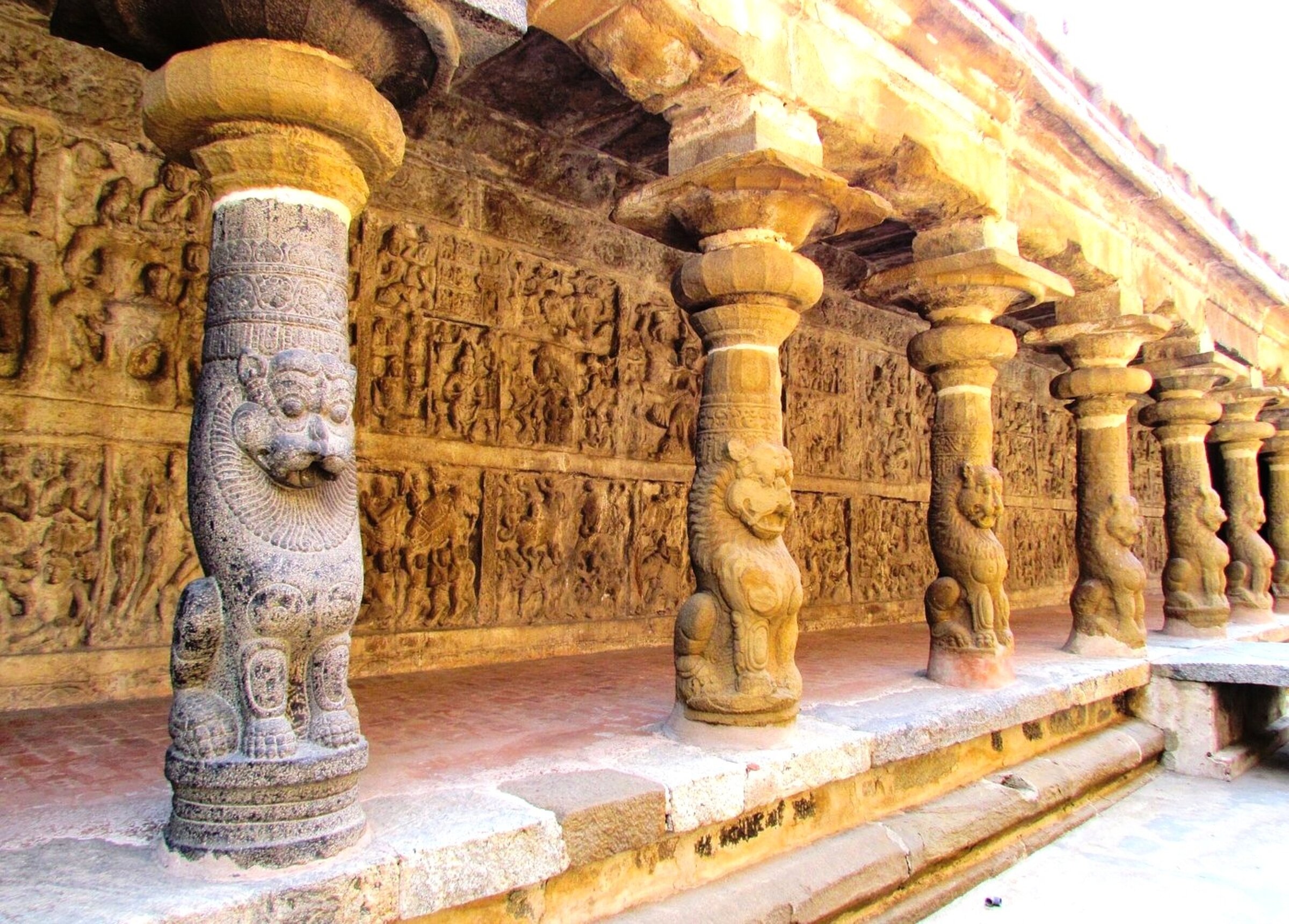
The quest for ‘reverse links’ brought the author to the Vishnu-dedicated Vaikunta Perumal Temple erected by Nandivarman II in the ancient Pallava capital city of Kanchipuram (mod. State of Tamil Nadu):
I spent a couple of hours alone ‘reading’ the story narrated by the panels. What struck me were the unmistakably oriental facial features of many of the depicted individuals. For instance, there is a prominent figure of a Chinese traveller. The temple priests were convinced that it showed the famous Chinese pilgrim Xuan Zang (also spelled Hiuen Tsang). It is quite possible that they are right since we know from Xuan Zang’s diaries that he had visited Kanchipuram a few decades before the temple was built but, given the volume of international trade and exchange that passed through Pallava ports, it could well be another Chinese visitor. However, what I found even more interesting about these panels were the obvious parallels with Khmer art. Anyone who has also visited Angkor and other sites in Cambodia would not fail to notice the similarities. The close link between the Pallavas and the Cambodians is well known; even the Khmer script is derived directly from the Pallavas. There is also plenty of evidence of Pallava links with other parts of South East Asia. For instance, an inscription by Nandi Varman II has been found near the Thai-Malaysian border. This was once part of the Hindu – Buddhist kingdom of Kadaram in what is now Kedah, Malaysia. Usually historians assume that these connections were limited to trade and culture, but is it possible that Nandi Varman II was from South East Asia? It turns out that there is some reason to believe that not just Nandi Varman II but the Pallava dynasty itself may have had its roots in the region! Scholars have long debated the origins of the Pallavas — some claiming local roots while others have speculated on north Indian or Parthian ancestry. […] Whether Cambodian or Malay, [there is evidence] that the Pallavas had been repeatedly marrying into the Naga royal clan. Nandi Varman’s ancestor Bhima, in other words, had not sailed off to an unfamiliar land but to a country with which the Pallavas already had close family ties. [p. 8]
According to the author, an Odisha festival also links the Indian subcontinent with Southeast Asia:
The maritime links to Kartik Purnima [ADB: a major Hindu, Sikh and Jain festival celebrated on the full moon of the Hindu month of Kartik (Nov/Dec)] are remembered in many other ways. A fair is held every year in Cuttack called Bali Yatra which literally means ‘The Journey to Bali’. It is also a tradition to perform songs and plays based on the old folk tale about Tapoi. The story goes that there was a wealthy merchant, a widower, who had seven sons and a daughter. The daughter, the youngest, was named Tapoi and her father and brothers doted on her. One year, the merchant decided to take all his sons on a long voyage to a distant land. He left Tapoi behind in the care of his seven daughters-in-law with clear instructions that they look after the young girl. Unfortunately, Tapoi’s sisters-in-law secretly hated her and mistreated her. She was made to cook, clean the cowshed and do all the washing. They even withheld food from her. After several months of tolerating all the physical and mental abuse, Tapoi eventually ran away into the forest. There she prayed to goddess Mangala, a form of Durga, who blessed her. A few days later, her father and brothers returned unexpectedly. They soon realized what had happened and brought Tapoi back from the forest. The evil sisters-in-law were punished. The folk tale not only hints at the tradition of long oceanic voyages but also expresses some of the inner anxieties of those who made these voyages — when will we get back home, what will happen to those left behind? [p 90]
1) Bas-reliefs at Vaikunta Perumal Temple, Kanchipuram, Tamil Nadu [photo by Bala Tripura S.] 2) Angkor Wat, South Gallery, West Wing: musicians in the Suryavarman procession. [photo by Arsenio Nicolas, 2009]
1) Bas-reliefs at Vaikunta Perumal Temple, Kanchipuram, Tamil Nadu [photo by Bala Tripura S.] 2) Angkor Wat, South Gallery, West Wing: musicians in the Suryavarman procession. [photo by Arsenio Nicolas, 2009]
Genetics, Linguistics
Typically for a modern Indian author, genetics is ranking high on the list of evidence in this demonstration — after all, 2009 Nobel Prize-winning [with Thomas A. Steitz and Ada Yonath] molecular biologist Venki Ramakrishnan, author of the essential Why We Die: The New Science of Aging and the Quest for Immortality (2024), was born in 1952 in Chidambaram, Tamil Nadu:
A recent study by a consortium of geneticists argues that this group of hunter – gatherers, usually associated with Y‑chromosome haplogroup O‑M175, became the ancestors of most people who today live in East and South East Asia including the Chinese, Japanese, Vietnamese, Thai, Tibetan, Burmese, Malay, Filipino and most Indonesians. The Polynesians scattered across the Pacific are also derived from this group, as are a number of tribes who live in eastern India. At this stage, however, we are still dealing with small bands of closely related people. We will later see how subgroups descended from this migration would colonize the eastern Indian Ocean rim and even make their way to Madagascar. [p. 32]
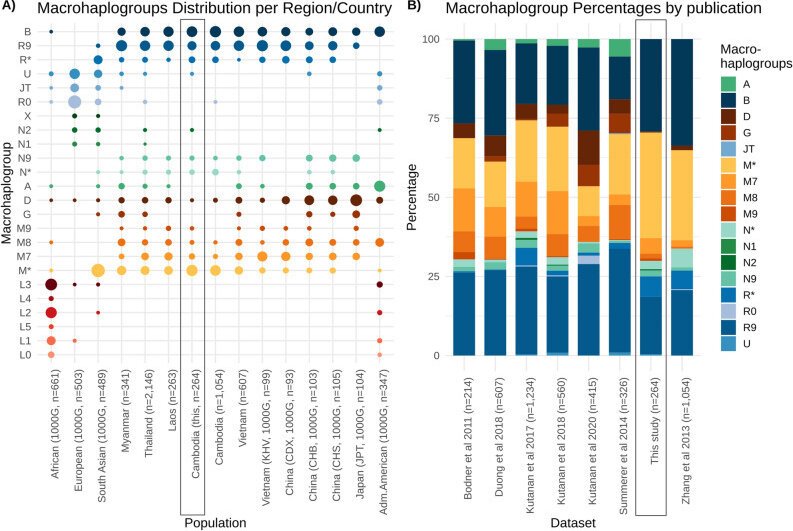
[ADB: a more recent study (2021 ) gave the following results for Cambodia, although it didn’t compare with Indian and Maritime Southeast Asia genomes:]
Haplogroup distribution in different populations/data sets. (A) Frequency plot of macrohaplogroups in different populations, including 1000 Genome Project data. The super populations are given for African ancestry, European ancestry, South Asian ancestry and admixed American ancestry. East Asia is reported individually as Vietnam (KHV = Kinh in Ho Chi Minh City, Vietnam), China (CDX = Chinese Dai in Xishuangbanna, CHB = Han Chinese in Beijing, CHS = Southern Han Chinese) and Japan (JPT = Japanese in Tokyo). (B) Haplogroup distribution by publication, Bodner et al. (Laos), Duong et al. (mostly Vietnam), Kutanan et al. (mostly Thailand), Summerer et al. (Myanmar), Zhang et al. (Cambodia). “This study” indicates the present work’s data set. Macrohaplogroups represent M (yellow), N (green) and R (blue) groups. [source: Anita Kloss-Brandstätter, Monika Summerer, David Horst, Basil Horst, Gertraud Streiter, Julia Raschenberger, Florian Kronenberg, Torpong Sanguansermsri, Jürgen Horst & Hansi Weissensteiner, “An in-depth analysis of the mitochondrial phylogenetic landscape of Cambodia”, Nature.com-Scientific Reports, 24 May 2021.
Haplogroup distribution in different populations/data sets. (A) Frequency plot of macrohaplogroups in different populations, including 1000 Genome Project data. The super populations are given for African ancestry, European ancestry, South Asian ancestry and admixed American ancestry. East Asia is reported individually as Vietnam (KHV = Kinh in Ho Chi Minh City, Vietnam), China (CDX = Chinese Dai in Xishuangbanna, CHB = Han Chinese in Beijing, CHS = Southern Han Chinese) and Japan (JPT = Japanese in Tokyo). (B) Haplogroup distribution by publication, Bodner et al. (Laos), Duong et al. (mostly Vietnam), Kutanan et al. (mostly Thailand), Summerer et al. (Myanmar), Zhang et al. (Cambodia). “This study” indicates the present work’s data set. Macrohaplogroups represent M (yellow), N (green) and R (blue) groups. [source: Anita Kloss-Brandstätter, Monika Summerer, David Horst, Basil Horst, Gertraud Streiter, Julia Raschenberger, Florian Kronenberg, Torpong Sanguansermsri, Jürgen Horst & Hansi Weissensteiner, “An in-depth analysis of the mitochondrial phylogenetic landscape of Cambodia”, Nature.com-Scientific Reports, 24 May 2021.
And this brings to a linguistical mapping of Southeast Asia, with the Sanskrit apportations looming large in the background:
The Indians were not the only people on the move in the region — the coastlines of South East Asia witnessed major changes as Sundaland was inundated by the post-Ice Age floods. Recent genetic studies confirm that the region’s current population landscape is heavily influenced by human migrations following the floods. These South East Asian migrations involved two major ethnic groups — the Austronesians and the Austroasiatic. Someone with a dark sense of humour must have given them such similar names in order to purposely confuse future generations of researchers. To make it less confusing, let’s call them AN and AA respectively. The AN included the ancestors of the Malays, Indonesians, Filipinos, Bruneians, Timorese and significant minorities in neighbouring countries. It also includes Taiwanese aborigines and the Polynesians spread across the Pacific. As one can see, they had a strong maritime culture. It was once thought that this group originated in Taiwan but it now appears that they lived along the eastern coast of Sundaland and were forced by the floods to search for new homes. The outrigger canoe was an important part of their maritime culture. It is a simple design but clearly very effective as it allowed the AN to colonize most of the islands in South East Asia during the Neolithic period. Some of these islands may have had existing Melanesian populations who seem to have been squeezed into a smaller area in and around New Guinea and Fiji. A few centuries later, the eastern Polynesian branch of ANs would set out to colonize a swathe of islands across the Pacific—from New Zealand to Hawaii and Easter Island. Similarly, the western branch would sail across the Indian Ocean and settle in Madagascar. Thus the AN came to colonize a large swathe of the planet from Madagascar to Hawaii!
The speakers of AA languages were the other important ethnic group of South East Asia. They include the Vietnamese, Khmer (i.e. Cambodian) and the Mon in Myanmar and Thailand. Unlike their Malay and Polynesian cousins, however, this group seems to have preferred to migrate over the land rather than over sea. At some point, small groups of AAs drifted into north-east India. The descendants of these migrations are the Munda-speaking tribes, such as the Santhals, who are scattered all over eastern and central India. A somewhat later wave survives today as the Khasis of the state of Meghalaya. Thus it came to be that India’s population mix includes people who speak languages related to Vietnamese and Khmer!
The folk tales and legends of South East Asia recall the Great Flood. For instance, the Laotian founding myth of Khun Borom tells us that the gods once became angry with the sinful and arrogant behaviour of humans and caused a flood that washed away all mortals. After the deluge they sent a buffalo that died and from its nostril grew a creeper that bore giant gourds. When the ‘khun’ (i.e. lords of heaven) cut open the gourds, a new generation of humans emerged from them with different gourds giving birth to different ethnic groups. The Laotian story is quite different from that of Noah or Manu, but it too remembers an earlier way of life that was destroyed by a huge flood and of how civilization had to be re-established. Similarly, the oral traditions of Australian aborigines also speak of swathes of coastline that were flooded. Till just a decade ago, it was common for scholars to dismiss indigenous oral histories as mere fantasy but latest research shows that they often contain folk memories of real events. The Daughters of Chitrangada Matrilineal customs appear to have been an important feature of the AA-speaking groups migrating across South East Asia and into India’s north-east. The Khasis of Meghalaya, for instance, remain matrilineal to this day. Traces of matrilineal customs seem to have been imbibed even by neighbouring communities that may never have been matrilineal. For instance, in Assamese Hindu weddings, the ‘sindoor’ (red vermilion) is applied to the forehead of the bride by the mother-in-law at the ‘jurun’ ceremony that precedes the wedding. The act of applying sindoor is a key part of Hindu marriage rituals and is usually the prerogative of the husband. The performance of this rite by the groom’s mother symbolizes the women of the family accepting a new member — a very matrilineal view of a wedding. So why were the AAs matrilineal? The answer to this riddle is found in the study of the genetics of the AA groups. It appears that the Indian branch is the result of almost exclusively male migrations. At the risk of oversimplifying, one could say that groups like the Santhals and Khasis are the result of male migrants from South East Asia marrying local women. This fits in with the hypothesis offered in the previous chapter of matrilineal customs emerging in South East Asia due to a Neolithic male population that was relatively more mobile than the female population. We do not know exactly what drove these migrations but this movement was not quite one of conquest since the incoming males seem to have accepted the property rights of the local women. [p. 64 – 66]
Kaundinya and Soma
The founding couple of Cambodia, called in Khmer tradition Preah Thong and Neang Neak, has always fascinated Indian historians. The author’s take on this story deserves to be quoted at length.
The period following the collapse of the Mauryan empire [ADB: Founded around 322 BCE, this vast empire disappeared in 185 BCE. The name might be related to Sanskrit मयुर mayura for ‘peacock’.] is somehow glossed over in history books as if the size of an empire is the only thing that matters. This is unfortunate as the period saw a boom in economic activity and mercantile trade. Merchant ships set sail from Satvahana and Kalinga ports, as well as those of the small kingdoms in the far south, to trade as far as Egypt in the west and Vietnam in the East. As already discussed, Odiya – Bengali seafarers had been visiting and settling in Sri Lanka from the sixth century BC. At some point they also began to trade with South East Asia. However, in the initial phase, they did not have the confidence to sail directly across the Bay of Bengal. Instead, they hugged the coast till the Isthmus of Kra. This is the thin strip of land, now part of Thailand, from which the Malay peninsula hangs. Goods were then taken overland to the Gulf of Thailand from where they were loaded again on ships for ports in Cambodia and southern Vietnam. This explains why India’s eastern coast established links with faraway Vietnam before the Indonesian islands of Java and Bali that may appear closer on a map. Óc Eo, in Vietnam’s Mekong delta, seems to have become a major hub. From there, merchandise would be traded up the coast to China. It is in the Mekong delta that we witness the establishment of the first Indianized kingdom of South East Asia around the first century BC. The Chinese called it the kingdom of Funan.
There is an interesting legend about how this kingdom was founded. It is said that an Indian merchant ship was sailing through the region when it was attacked by pirates led by Soma, daughter of the chieftain of the local Naga clan. The Indians fought back and fended off the attackers led by a handsome young Brahmin called Kaundinya. Unfortunately, the ship had been damaged and had to be beached for repairs. The merchants must have been worried about a second attack but luck turned in their favour. It appears Princess Soma had been impressed by Kaundinya’s bravery and had fallen in love! She proposed marriage and the offer was accepted. This union is said to have founded a lineage that ruled Funan for many generations. We have no way of knowing if this legend is based on true events but slightly different versions of the story are repeated in inscriptions by both the Chams of Vietnam and the Khmers of Cambodia — the royal families of both claim descent from Soma and Kaundinya. It is also repeated in contemporary Chinese records. Notice how Kaundinya acquired his throne through marriage to a warrior princess. Moreover, it was the princess who made the proposal. Given that royal legitimacy had been acquired through the female line, we find that matrilineal genealogies would be given a great deal of importance over the fifteen hundred years that these Indianized kingdoms flourished in this part of the world.
This founding myth also explains why the serpent (naga) became such an important royal symbol in Khmer iconography. More than a thousand years later, the mystical union between the king and a ‘serpent’ princess remained an important part of the court ceremonials at Angkor. So, who was Kaundinya? We know nothing about him except that he was a Brahmin from India but his name provides a clue. While Kaundinya is not a common first name, it is the name of a gotra (i.e. male lineage) of Brahmins who still live along the Tamil – Andhra – Odisha coastline. Perhaps this is not a coincidence. By the end of the second century BC, Indian mariners appear to have learned enough about the monsoon winds and ocean currents to attempt a more southern route across the Indian Ocean to the islands of Indonesia. Odisha’s Lake Chilika was an important starting point for this voyage. It is a large brackish water lake with a small opening to the sea. The mariners of Kalinga, therefore, used the lake as a safe harbour. Even today, you are likely to find broken heaps of ancient pottery strewn along the lake’s shores. Note that the ships did not sail out directly for Indonesia. Instead they used the north-eastern monsoon winds that blow from mid-November to sail down the coast to Sri Lanka. This was already a well-known route and the merchants probably stopped along the way to trade as well. In Sri Lanka, the ships would have taken in fresh water and supplies before using ocean currents to cross the Indian Ocean to the northern tip of Sumatra (called Swarnadwipa, or Island of Gold in Sanskrit texts). From here, the ships could choose to sail down the Straits of Malacca towards Palembang and take the sea route to Borneo and Vietnam. Alternatively, they could head south hugging the western coast of Sumatra to Bali and Java (called Yavadwipa, or Island of Barley/Grain).
After finishing their purchases and sales, most ships would have used the countercurrent to return to Sri Lanka, and then Odisha. If the sailors started from Odisha in mid-November, it is estimated that they would reach the islands of Java/Bali by mid-January. They would now have two months to conduct their business before they started their return journey in mid-March. This would allow them to get back to Sri Lanka in time to catch the early South-West monsoon winds in May that would take them home. The merchants of Kalinga were not the only ones making the journey to Indonesia. There were merchants from the Tamil, Andhra and Bengal coasts too. There were even horse traders from India’s north-west who made their way to the port of Tamralipti in Bengal and then sailed to Java and Sumatra. However, in the initial phase, it is the Sadhaba merchants of Kalinga who seem to have had a dominant influence. This is why Indians were known as ‘keling’ by the Malays and Javanese from ancient times although the term has acquired a somewhat derogatory connotation in recent times. That era of maritime exploration and trade is still remembered in Odisha in folklore and festivals. The festival of Kartik Purnima takes place in mid-November when the winds shift and begin to blow from the north. This marks the time of year that ancient mariners would have set sail for Indonesia. Families, especially women and children, gather at the edge of a waterbody and place paper boats with oil lamps in the water. I witnessed the ritual on a beach near the temple town of Konark. Streams of people from nearby villages arrived before dawn to place their little boats in the water and watch them float away. A cool breeze blew from the north as promised and the full moon made the crashing waves glimmer. As per tradition, one must wait for the sun to rise. I watched my paper boat float away. This is how the families of the ancient mariners would have bid goodbye to their loved ones. [p. 88 – 9]
Jayavarman II
Having acquired power, Jayavarman II systematically subdued local rivals as well as fended off the raiders from both Java and Sri Vijaya. He next conducted the ancient Vedic ceremony that declared him as a Chakravarti Samrat or Universal Monarch. By doing this, he was signalling that the Khmers were no longer vassals of any external power. A new capital called Indrapura was founded, the first of several new cities that Jayavarman II would establish. At the same time, the territories around the great lake of Tonle Sap were added to the growing kingdom and systematically settled. This would later lead to an economy based on hydraulics and intensive rice cultivation. Jayavarman II died around AD 850. He was succeeded by his son who seems to have consolidated the fledgling empire till AD 877. The next king, Indravarman I, however, was Jayavarman II’s queen’s nephew. Inscriptions also tell us that Indravarman I’s wife traced her lineage back to the royal family of ancient Funan that had been established by Kaundinya and the Naga princess. As one can see, matrilineal descent was a very important component of royal legitimacy in Angkor. This is explicit in the inscriptions of the Angkor monarchs. For instance, when Indravarman built a grand Shiva temple at Bakong, he dedicated statues to Jayavarman II and his queen, his own parents and his maternal grandparents. It was under Indravarman I that the Khmers began to build the complex hydraulic network of canals and lakes that allowed a major expansion in rice cultivation.
By the time his son and successor Yashovarman I wore the crown, the Khmers ruled much of what is now Cambodia, Thailand and Laos. The empire now needed a grand capital and Yashovarman I laid out the first city in Angkor and named it after himself Yashodharapura. He also built a number of large Hindu temples. This includes the Preah Vihear temple, a UNESCO World Heritage Site, built on a mountaintop on the Thai-Cambodian border which is now the focus of a bitter dispute between the two countries. Despite the International Court of Justice in Hague ruling that it belonged to Cambodia, the conflict spiralled into an armed skirmish in 2011 and nearly escalated into a war.4 Angkor grew and prospered through most of the tenth century but there appears to have been instability and civil war at the beginning of the eleventh century. Yet again, power was captured by an outsider with a matrilineal claim to the throne. Suryavarman I was a prince of a vassal state but his mother came from the same maternal line as that of Jayavarman II’s queen and Indravarman I’s mother’s family.
Some Western historians have suggested that Suryavarman’s claim to the throne was tenuous. However, from a Khmer perspective, a matrilineal link to the royal Naga clan was an entirely legitimate claim to the crown. Suryavarman I ruled over the empire for almost half a century (AD 1002 – 1050). He re-established control over territories that had broken away during the civil war as well as established temporary peace along the eastern border with Champa. He also expanded the capital and built a large palace complex that included a tiered pyramid called the Phimaen Akas or Sky Palace. A Chinese visitor, who visited Angkor a few generations later, reports that the stepped pyramid was topped with a golden pinnacle that no longer exists. A modern-day visitor will almost certainly be told of the legend of how the ruling monarch was expected to spend the first watch of every night in the pyramid tower where he would sleep with a serpent princess in the form of a beautiful woman. While I am a little sceptical about the bit where snakes turn into women, it is a reminder of the importance of the Naga lineage in establishing the legitimacy of royal power. This is why the royal symbol of the Khmer kings was the seven-headed cobra which shows up frequently in their art. [p. 130]
Trade and Sanskrit
With an ocean in common, the Indian one, political and cultural entities from both sides of it were prone to exchange rather than hostility. And here is a quite unique history of mostly pacific — apart from the Chola kings unsuccessful pushes eastward — and deeply ‘civilized’ dialogue:
The most important Indian export was cotton textiles which would continue to be in much demand across the Indian Ocean rim till modern times. Excavations in South East Asia also show evidence of carnelian beads and a variety of metalware. By AD first century, we find that Indian merchants were also bringing along Mediterranean and West Asian products that they, in turn, had purchased from the Romans, Greeks and Arabs. Artefacts found in Sembiran in Bali clearly show that it was in close contact with Arikamedu, an Indo-Roman port, just outside Puducherry. Indian imports included Chinese silks, via ports in Vietnam, and camphor from Sumatra. The islands of Indonesia would have been a source of cloves, nutmeg and other spices. Many of the spices thought to be ‘Indian’ by medieval Europeans were actually from Indonesia except black pepper which grows along the south-western coast of India. Till the late eighteenth century, the world’s entire supply of cloves came from the tiny islands of Ternate and Tidore in the Maluku group. Trade links with South East Asia unsurprisingly led to cultural exchange. Within a few centuries we see the strong impact of Indic civilization on the region — the Buddhist and Hindu religions, the epics Mahabharata and Ramayana, the Sanskrit language, scripts, temple architecture and so on. Despite the later impact of Islam, European colonial rule and postcolonial modernity, the influence of ancient India remains alive in place and personal names, commonly used words, and in the arts and crafts. Buddhism is still the dominant religion across Myanmar to Vietnam, while Hinduism survives in pockets such as Bali.
There are some cultural artefacts that seem to have survived with little change from the very earliest phase of contact between the two regions. One cannot look at traditional masks from Bali, Sri Lanka and the Andhra – Odisha coast without being struck by the similarity. The same is true of Wayang Kulit, the Indonesian art of shadow puppetry, and its equivalent in Odisha and Andhra Pradesh. Imagine ancient mariners entertaining each other during the long nights of an ocean crossing by using their ship’s sail to enact shadow-puppet plays, cultural roots anchoring them as they made a perilous journey to distant lands. One should not be under the impression that influences always flowed unidirectionally from India to South East Asia. Far from it, Indian civilization was enriched in many ways by influences from the east. One commonplace example is the custom of chewing paan (betel leaves with areca nuts, usually with a bit of lime and other ingredients). While it is common across the Indian subcontinent, the areca nut, called ‘supari’ in Hindi, is originally from South East Asia and was chewed across the region and as far north as Taiwan. Paan is still widely consumed in India but, in recent years, has become less popular in the urban areas of South East Asia. Still, the leaf and nut continue to play an important cultural role and are used in many ceremonies. I have eaten them at a wedding in Bali and found old villagers chewing them in the Philippines. The Vietnamese too use it for many marriage-related ceremonies. It is quite possible that they were used by the warrior princess Soma when she sent the marriage proposal to Kaundinya. The supari that one chews today in most parts of India gives no more than a mild buzz. The Khasis of Meghalaya, however, have preserved a strain that can be surprisingly strong. Perhaps they brought it with them during their prehistoric migrations from Sundaland. Surprisingly, the strongest that I have eaten came from a wild variety that I accidentally discovered in Singapore of all places. Suffice to say, the tiny nut packed the punch of a bottle of rum!
Most of the early known history of the far south of the Indian peninsula, what are now the states of Kerala and Tamil Nadu, is about the rivalries between three clans — the Cholas, Cheras and Pandyas. The Cholas had their heartland in the Kaveri delta, the Pandyas were further south near Madurai and the Cheras along the Kerala coast. Their relative strength waxed and waned over time but it is amazing how the same three clans battled each other over fifteen centuries (c. 300 BC to AD 1200)! Early Tamil poetry of the Sangam compilations provides vivid, if somewhat idealized, views of the times — prosperous cities, bustling bazaars and ports busy with merchant ships from foreign lands. The city of Madurai, the capital of the Pandyas, is described as follows in ‘Maduraikkanchi’, composed in the first century BC: “The city walls are sky high and contain strong sally-ports and gateways old and strong, On whose doorposts is carved great Lakshmi’s form. Their strong built doors are blackened by the ghee poured as libation In the wide long streets that are broad as rivers, Crowds of folk of various professions and speech create a noise in the morning market-place while buying things.”
Excavations in Tamil Nadu in recent years have unearthed remains of significant urban centres from this period such as one found under the hamlet of Keezhadi, near Madurai, in 2015. The findings confirm that the cities mentioned in the Sangam literature are not imaginary even if the descriptions may have been embellished. Tamil nationalists of the twentieth century had attempted to use these texts to glorify some pristine Dravidian past but, ironically, Sangam literature is full of ‘northern’ influences. Far from being Dravidian purists, ancient Tamils credited the sage Agastya, a northerner, with formalizing Tamil grammar. The great Tamil kings similarly took great pride in building linkages with the epics. In other words, the very earliest Tamil texts suggest a people who were very proud of being part of a wider Indic civilization. As historian Nilakanta Sastri puts it, ‘But none can miss the significance of the fact that early Tamil literature, the earliest to which we have access, is already full of charged words, conceptions and institutions of Sanskritic and northern origin.’7 Far from being concerned with a pristine civilization, Sangam literature celebrates interactions with the rest of the world with descriptions of bustling ports and foreign trade. One of the texts also makes the first definite reference to a naval battle where Chera king Udiyanjeral defeated an unspecified local adversary and took a number of Greek merchants captive. The captives were later freed upon providing a large ransom. By the fourth century BC, some Tamil groups began to settle in northern Sri Lanka. There was already a significant population of settlers from Odisha – Bengal, and the local Vedda population had been sidelined, as mentioned earlier. Several small kingdoms gradually emerged, scattered across the island, but one of them, Anuradhapura, seems to have gained prominence due to the backing of Emperor Ashoka. According to the Mahavamsa, Ashoka sent his son Mahinda to convert the ruler of Anuradhapura, Devanampiya Tissa, to Buddhism, in the third century BC. [p. 89 – 92].
And:
The Sri Vijaya kingdom covered most of Sumatra and the Malay peninsula. It had two major urban hubs — Palembang on Sumatra and Kadaram on the peninsula. Java was another major political centre. Its kingdoms steadily extended their influence over islands such as Bali and Madura till it later grew into the great Majapahit empire that controlled a large swathe of what is now Indonesia. In Cambodia, the Khmers were welded into a kingdom that culminated in the Angkor empire. Further east, the kingdom of Champa stretched along the central and southern coast of Vietnam (some historians argue that it was more a confederacy than a centralized kingdom). These kingdoms traded with each other and with India and China. They also fought bitter wars, particularly the Khmers versus the Chams, and the Javans versus the Sri Vijaya. Given the close political and commercial links between the Pallavas and these kingdoms, it is not surprising that the dominant source of Indian influence in South East Asia shifted from Odiya to Tamil during this period. For instance, the South East Asians adopted the Pallava version of the Brahmi script. This is why the scripts used to write Khmer, Thai, Lao, Burmese and Javanese-Kawi are derived from the Pallava script. Till the early nineteenth century, the Brahmi-derived Baybayin script was even used to write Tagalog in the Philippines. As we saw from Fa Xian’s account, the trade routes between India and China were well established by the fifth century. By the Pallava period, there were large Indian merchant communities living in Chinese ports. Since the 1930s, archaeologists have discovered evidence of a number of Hindu shrines and at least two large temples in and around the port city of Quanzhou. These include stone carvings depicting mythological tales related to the gods Vishnu and Shiva that look identical to those found in southern India during the same period. In the nearby village of Chedian, locals still worship the image of a goddess who is clearly of Indian origin (the villagers see her as a form of the Chinese goddess Guanyin). [pp. 115 – 116].
Danger comes from the west
In shocking contrast with these harmonious early times — and virtually without any mention of the contentious interaction with China -, the threats to ‘Mother India’ [Bharata] started to pile up from the end of 15th century, invariably came from the West and were two-pronged: Western colonialism as prefigured by the Portuguese armies, Islamic expansion.
One of the intriguing aspects of the medieval world is the success with which the Arabs blocked information about the Indian Ocean from reaching the Europeans. Despite the accounts of occasional European travellers like Marco Polo, there was so much misinformation around that it became easy for blatant charlatans like John Mandeville to thrive. Mandeville was an Englishman who left his country in 1322 and returned after thirty-four years claiming that he had been to China, India, Java and other places in the East. He then wrote a book of fantastical tales about one-eyed giants, women with dogs’ heads and two-headed geese. He also embellished the widely held medieval European belief that there was a powerful Christian king called Prester John in India who would be a willing ally against the Muslims. The Europeans lapped up these stories and Mandeville’s book was closely studied by scholars, explorers and kings.
In the fifteenth century, some Europeans began to look for ways to break the Muslim stranglehold on trade with Asia. One option was to find a sea route to the Indies by sailing around Africa. The Portuguese took the lead and began to systematically sail down the west coast of Africa. In 1487, a captain called Bartholomew Diaz finally reached the southern tip of Africa. Most history books give the impression that the Portuguese then waited for a full decade before sending a fleet under Vasco da Gama to further explore the route. Given the importance attached by the Portuguese throne to this project, it is hardly likely that the voyage was casually postponed. Far from it, there is evidence to suggest that the Portuguese followed up Diaz’s discovery with a number of secret voyages to properly document the winds and currents. After all, the Portuguese were quite suspicious of a certain Christopher Columbus who seemed to be sniffing around for information. There was another reason why the Portuguese waited. King John II had dispatched two spies disguised as Moroccan merchants to make their way to the Indian Ocean through the Red Sea in order to gather information on what the Portuguese fleet should expect after they rounded Africa. The two spies — Pero da Covilha and Afonso de Paiva — made their way to Aden where they split. The former would criss-cross the Indian Ocean for two years collecting information on various ports and kingdoms. His Arabic must have been very convincing because he would face certain death if discovered. Paiva, meanwhile, made his way inland to Ethiopia in the hope of finding the mythical Christian king Prester John. He would have been disappointed by what he saw. The Ethiopians had been surrounded by the Arabs for centuries and had somehow survived in isolation by retreating into the highlands. [p. 162 – 163]
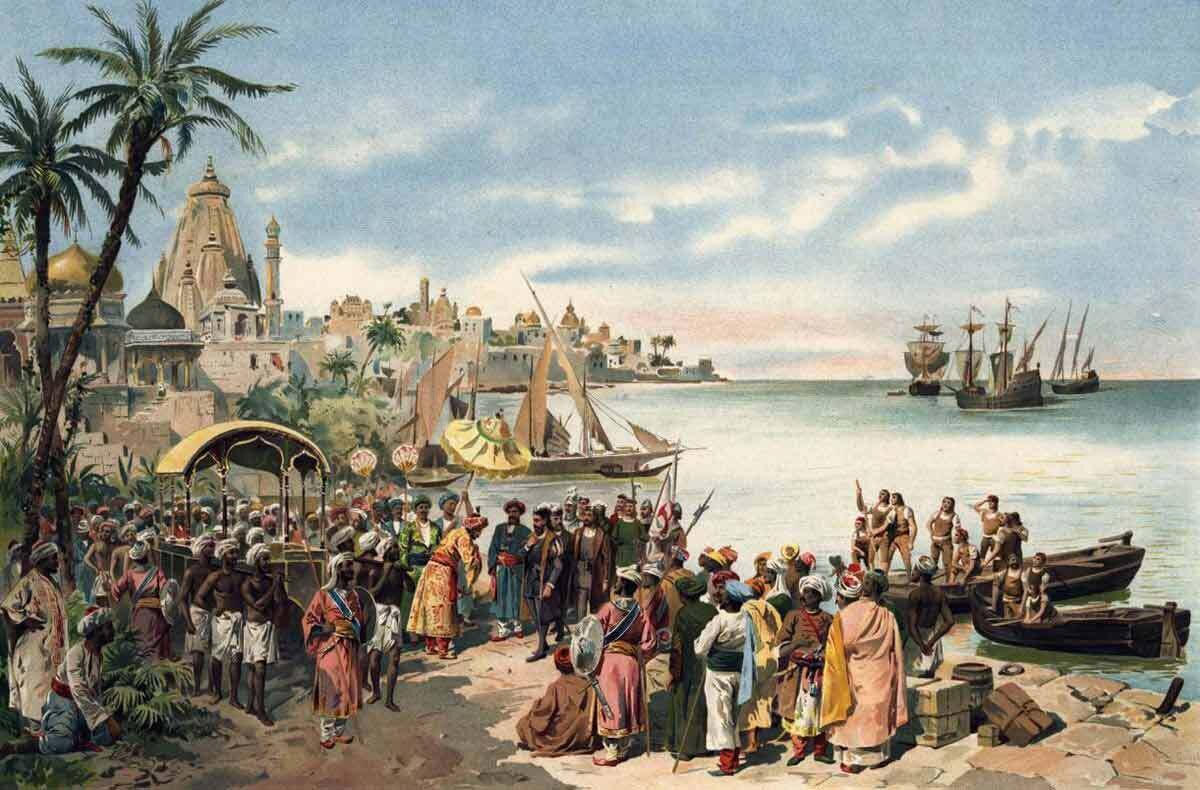
Vasco da Gama arriving on the shore of Calicut [source: National Library of Portugal].
Vasco da Gama arriving on the shore of Calicut [source: National Library of Portugal].
And:
The Arab merchants of Calicut [ADB: Kozhikode on the Malabar Coast, now part of the state of Kerala] were understandably unhappy to see their monopoly being broken. They even arranged to kidnap da Gama before he could return to his ship but the Samudrin intervened and had him freed. The prosperity of Calicut depended on free trade and he had to ensure that the principle was upheld even if he felt uneasy about the newcomers. The Portuguese fleet, however, did not wait for long. After purchasing pepper, they lifted their anchors and headed home. Da Gama wanted to get home as soon as possible to tell his king about his discoveries. He received a rapturous welcome and was showered with honours and 20,000 gold cruzados. However, the human cost of the expedition had been great — two-thirds of the crew had perished during the voyage, including Vasco da Gama’s brother. This did not deter King Manuel from declaring himself ‘Lord of Guinea, and of the Conquest, the Navigation and Commerce of Ethiopia, Arabia, Persia and India’.
Preparations now began for sending a much larger fleet to India. It would have thirteen ships armed with cannons and 1200 men under the overall command of Pedro Alvares Cabral. Despite the loss of some ships along the way, the fleet arrived in Calicut in September 1500 and demanded that the Samudrin expel all the Arabs and trade exclusively with Portugal. The Indians, understandably, were not keen on such an arrangement. While prolonged negotiations were continuing, a large Arab ship loaded with cargo and pilgrims decided to set sail for Aden. Cabral seized the ship and the Arabs retaliated by attacking a Portuguese contingent that was in the city. The Portuguese now seized ten more ships in the harbour and burned their crew alive in full view of the people ashore. Next they bombarded the city for two days and even forced the Samudrin to flee from his palace — a humiliation that the rulers of Calicut would never forget. Thus began the European domination of the Indian Ocean.
The fleet now headed south for Cochin (Kochi), a rival port that had lived in the shadow of Calicut since the time of Zheng He’s visit. As had happened in the case of Malindi, the Portuguese would exploit a local rivalry in order to establish themselves. Cabral hurriedly loaded his ship with pepper and other spices, made payments in gold coins, and headed home. In order to gauge the potential profits, note that pepper that made its way to Venice by the traditional Rea Sea route would cost sixty to a hundred times its price on the Kerala coast. With the discovery of the new route, it was clear that Venice was ruined. Using the profits from these successful voyages, the Portuguese now rapidly scaled up the number of fleets operating in the Indian Ocean. Within a couple of decades they had sacked or occupied many of the important ports in the western Indian Ocean region — Muscat, Mombasa, Socotra, Hormuz, Malacca and so on. Even by the standards of that time, they established a well-deserved reputation for extreme cruelty. For example, when Vasco da Gama returned on a second voyage to Calicut, he refused to negotiate and simply bombarded the city for three days. He also seized all the ships he found in the harbour and their crews — 800 men in all. They were paraded on ships’ decks and then killed by having their arms, noses and ears amputated. The body parts were piled into a boat and sent ashore. When the Samudrin sent a Brahmin to negotiate for peace, he was gruesomely mutilated and sent back. His two sons and a nephew, who had accompanied him, were hanged from the mast.
In other words, the maritime world of the Indian Ocean rim now experienced a shock similar to what had been experienced by the inland cities of Asia during the Turko-Mongol invasions. The Islamic world clearly needed to respond and it fell on the Turks to provide a comeback. The Ottoman Turks were the most powerful Muslim empire of that time and had taken Constantinople (i.e. Istanbul) in 1453, thereby ending the last vestige of the Byzantines. Although their military tactics were derived from the Central Asian steppes, they had recently developed naval capability in the Mediterranean. However, they were aware that their galleys were not capable of dealing with the much more demanding conditions in the Indian Ocean. The traditional vessels of the Arabs were also deemed unsuitable as the stitched ships could not take the shock wave from firing cannons. Thus, twelve large warships were custom-built on the Red Sea and fitted out with cannons. Interestingly, Venice provided the Turks with inputs from their spies in Portugal and even put a team of gunners at the Sultan’s disposal. Clearly, economic interests trumped all other differences. The Turkish fleet sailed down the Red Sea in early 1507 under the command of Amir Husayn and headed for the Indian coast. Together with reinforcements sent by Calicut, the Turks won a battle against a small and unprepared Portuguese fleet anchored at Chaul (near modern Mumbai). The Portuguese were enraged and a large fleet was assembled. The two sides met near the island of Diu, just off the coast of Gujarat in February 1509. In the battle that followed, the superiority of European ship and cannon designs was fully displayed. Within hours, Husayn’s defensive line had been shattered and the Turks were forced to flee.
An additional factor that helped the Portuguese was the fact that forces sent by the Sultan of Gujarat remained neutral rather than help their fellow Muslims. The Turkish admiral would complain bitterly about this treachery when he faced the Ottoman Sultan in Istanbul. Despite these victories, the Portuguese were still operating like nomadic pirates and did not have a permanent establishment in the Indian Ocean yet. After another unsuccessful raid on Calicut, it was decided that Goa would be a good place to build a base. Under the command of Afonso de Albuquerque, the Portuguese attacked and took Goa from the Sultan of Bijapur in 1510. Albuquerque would boast to King Manuel in a letter: Then I burned the city and put everyone to the sword and for four days your men shed blood continuously. No matter where we found them, we did not spare the life of a single Muslim; we filled the mosques with them and set them on fire.… Soon the Portuguese had built a network of fortifications around the Indian Ocean rim from where they controlled their maritime empire. Perhaps the best preserved of these forts can be seen today on the island of Diu. The ramparts offer fine views over the Arabian Sea and an excellent collection of early cannons still stand guard. The fort would fend off a second Turkish attempt against the Europeans in 1538. The only reminder of this second failed attempt is an enormous Turkish cannon that can be seen in Junagarh fort museum on the mainland. [p.166 – 9]
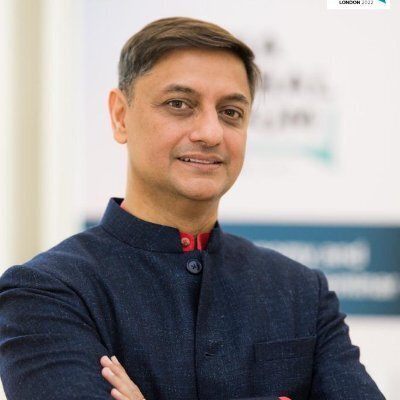
Sanjeev Sanyal (27 Aug 1970, Kolkata, West Bengal, India) is an Indian economist and popular historian, author of several books on the history of India and Asia which have received laudative and dismissive reviews.
A member of the Economic Advisory Council to the Prime Minister of India since February 2022, Sanyal majored in economics from Shri Ram College of Commerce, New Delhi, before receiving a BA in philosophy, politics and economics in 1992 at St John’s College, University of Oxford, Great Britain. In 2004, he created with environmental economist Pavan Sukhdev the Green Indian States Trust to promote sustainable development. He worked as chief economist for South and Southeast Asia at Deutsche Bank from 2008 to 2015.
A staunch liberal, Sanyal claims that Indian historiography has been distorted by “Colonial, Nehruvian Socialist, and Marxist” biases. His rewriting of Ancient India history promotes a return to India’s golden age, when the nation gave birth to “yoga, algebra, the concept of zero, chess, plastic surgery, metallurgy, Hinduism, Buddhism.” Historian Meera Visvanathan has blamed the lack of “primary source references” in Sanyal’s “reconstruction of India’s history”.
In 2021, Sanjeev Sanyal criticized the state-controlled cartography of India, writing that “the real problem was not so much the Survey of India itself but the restrictions on private participation. Thus, when a team led by Lalitesh Katragadda created Google Maps in India, they were technically illegal. The viral spread of Google Maps, therefore, would remain a legal grey area till the sector was finally liberalized last week. The cartography and geospatial sector has been of critical economic and geostrategic importance for centuries. The technological cluster has applications ranging from urban governance and defense to transportation and ecommerce. By opening it up to private innovation and investment, the government hopes that India will be able to create cutting-edge capabilities that can compete with the best in the world.” (author’s website).
Indian ruler who unified India through the Maurya Empire and ruled from c. 269 BCE to c. 232 BCE. During his reign Buddhism was adopted as the state religion. He sent Buddhist missionaries to Sri Lanka and Southeast Asia, in particular.
Ashoka hailed from Magadha, Maurya dynasty's home province, and came to be called Devanampriya Priyadarsi Raja, ‘the king who is the beloved of the gods and who glances graciously upon al, or simply Devanampriya, or king Priyadarsi, or Priyadarsana [‘one having an amiable appearance’]. Tradition says that the fuller form of Asoka’s name was Asokavardhana.
"Gautama the Buddha and the Maurya emperor Asoka are two of the greatest sons of India and the world, and their lives and achievements stand among India’s best contributions to human civilization", wrote Indian scholar D.C. Sircar.
His important Edicts were inscribed on stone in Prakrit, Greek and Aramaic languages.
Ashoka Chakra, "the wheel of Righteousness" (Dharma in Sanskrit, Dhamma in Pali), adorns India's national flag.
Sk ब्राह्मी brāhmī, "the shakti of Brahma"; "mother-goddess"; type of medicinal plant.
Brahmi is a writing system (abugida, using diacritical marks) appeared as exhaustive script in the 3rd century, possibly with Aramaic origins, and was used in the Ashoka inscriptions.
Brahmi is also the name of an ancient number system which developed in India as early as the second millenium BCE, and of an early Indian alphabet.
According to French sinologist Jean Baptiste Terrien de Lacouperie (1844-1894), noting the term "Brahmi" and "Kharosthi" in ancient Chinese encyclopedia, proposed that Brahmi refer to the left-to-right script of the Ashokan pillar inscriptions, and Kharosthi to the right-to-left script of some rock inscriptions in northwest India.
Brahmi was widespread in Southeast Asia, and Southern Brahmi script, from which appeared the Grantha alphabet (6th century) and the Vatteluttu alphabet (8th century), was at the origin of the Javanese script in Indonesia, the Khmer alphabet in Cambodia, and the Old Mon script in Burma.
sk दुर्गा Durga "invicible", "fortress-like", "beyond defeat" | sk दुर्गा महिषासुर मर्दिनी Durga Mahishasura Mardini "who defeats Mahishasura". | kh ព្រះម៉ែទុគា Preah Me Thuka, ព្រះនាងទុរគ្គា Preah Tureka, ចៅម៉ែទុគ៌ា Chao Methuka, ព្រះម៉ែទុគ៌ា Preah Maa Tukra, "Preah Maa Durga" ["Goddess Mother Durga"] | th เจ้าแม่ดูร์กา Cea mae Durka "Goddess Durga" | jv Loro Jonggrang "slender maiden"
Durga is a major Hindu goddess, worshipped as a principal avatar of mother goddess Mahadevi, associated with protection, strength, motherhood, destruction, and wars. She has different names, including Durgā, Bhadrakālī, Vijayā, Vaiṣṇavī, Kumudā, Caṇḍikā, Kṛṣṇā, Mādhavī, Kanyakā, Māyā, Nārāyaṇī, Īśānī, Śāradā and Ambikā.
In Shaktism (goddess-centric sect), she is Devi (the Goddess), primordial creator of the universe, and in the Bhagavata purana she is Vishnu's younger sister. In Indian representations - in particular at Aihole Temple - Mahishasura Mardini Durga has eight arms, carrying the weapons and attributes given to her by male deities: the trident (given by Shiva), the Chakra (Vishnu), the conch (Varuna), the Pasha an iron rod (Yama), the dart (Agni), the bow (Vayu), the quiver and arrows (Surya), the thuderbolt (Indra), the mace (Kubera), the rosary and a water pot (Brahma), the sword and shield (Kala), the battle axe (Vishwakarma), the lion (Himavan), a disc and a lotus, a bell, etc...She is standing in the Tribhanga pose (three bends), legs apart, left leg pressing down the buffalo demon.
Across Indonesian islands, Durga was the most common representation among ancient sculptures of female deities. Durga statues have been discovered at stone temples and archaeological sites in Vietnam, likely related to Champa or Cham dynasty era.
In Cambodian art, Durga, in particular in the Mahishasurmardini form, was revered since the oldest recorded times. An 1.65 meter-high statue was retrieved at what has been supposed to be the site of the main temple of King Ishanavarman of Chenla (r. c. 615–628 C.E.) in Ishanapura (Sambor Prei Kuk).
In modern Cambodia, the Indian community has started to give social resonance to the celebration of Durga Puja, the festival observed usually in September or October, from the sixth (Shashti) to the tenth day of the bright lunar fortnight in the Hindu lunar calendar month of Ashvin, concluding with Durga Visarjan (immersion of the idol).