

Martin Parr in Angkor, 2012
by Martin Parr
Never seen before photographs by acclaimed photographer Martin Parr (1952-2025) taken in Angkor in 2012.
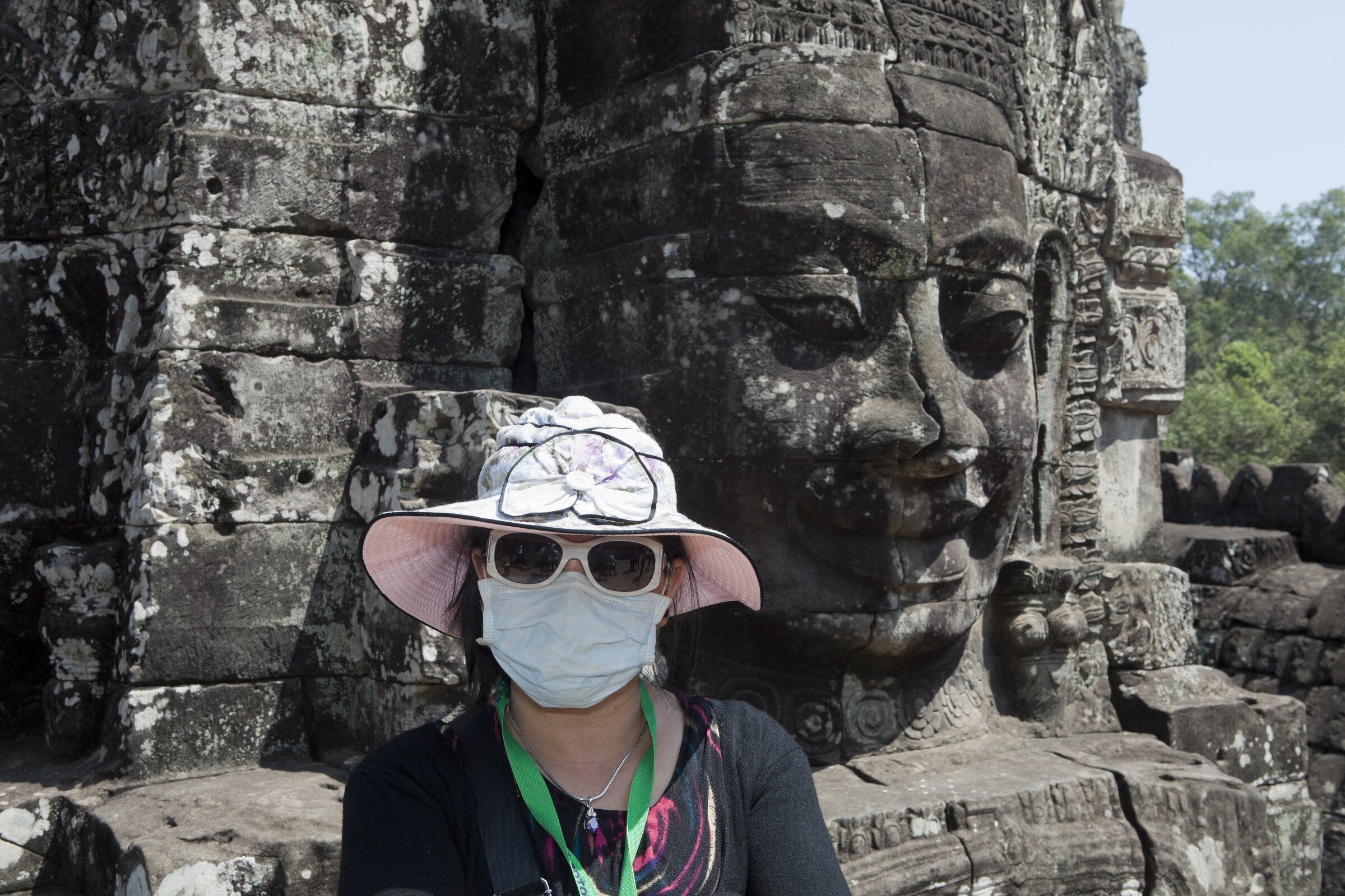
Martin Parr, Angkor, 2012 / 1
At Bayon Temple. ©Martin Parr/Magnum Photos (LON140141)/ licensed to Angkor Database.
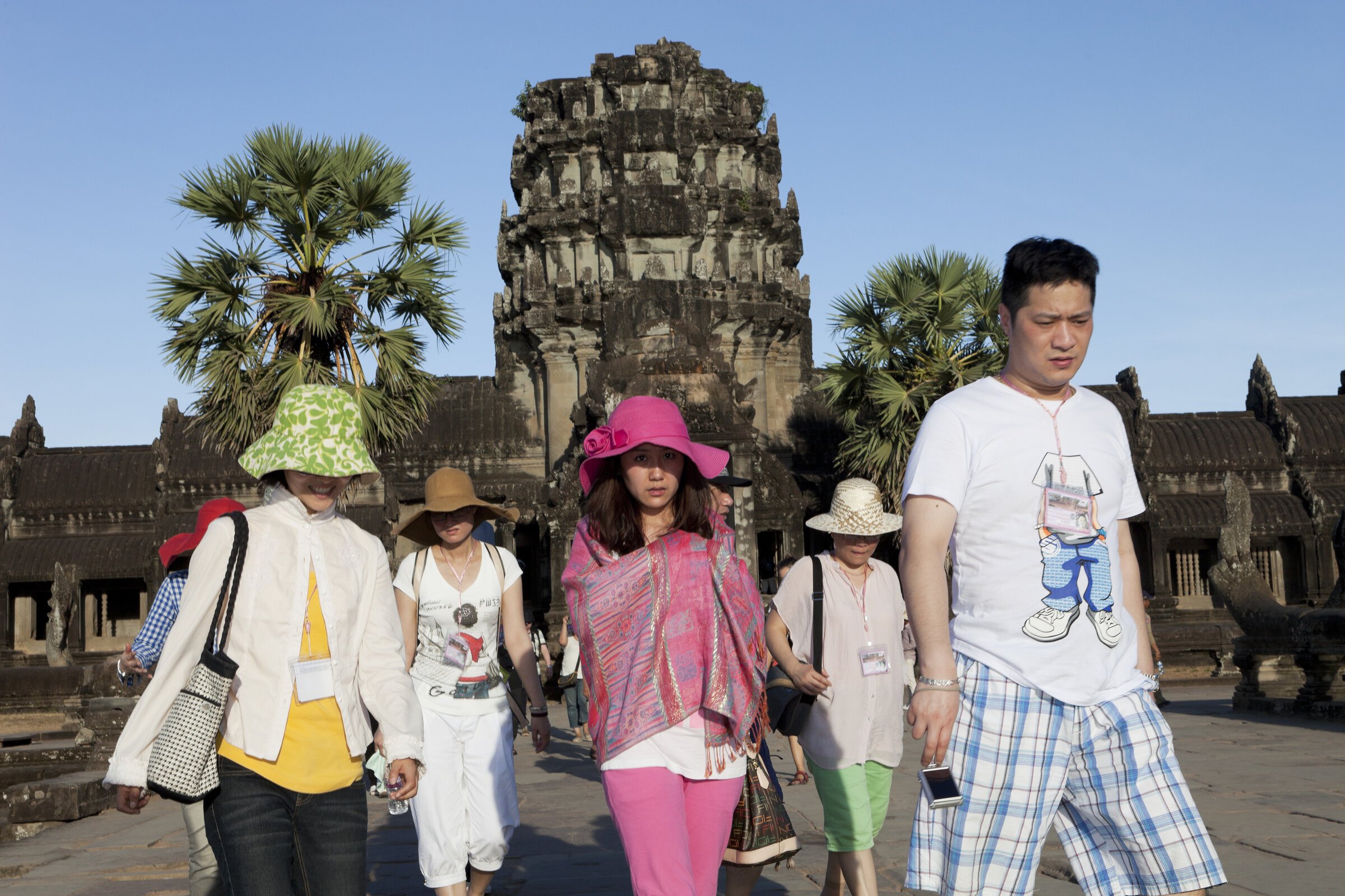
Martin Parr, Angkor, 2012/ 2
©Martin Parr/Magnum Photos (LON140110)/ licensed to Angkor Database.
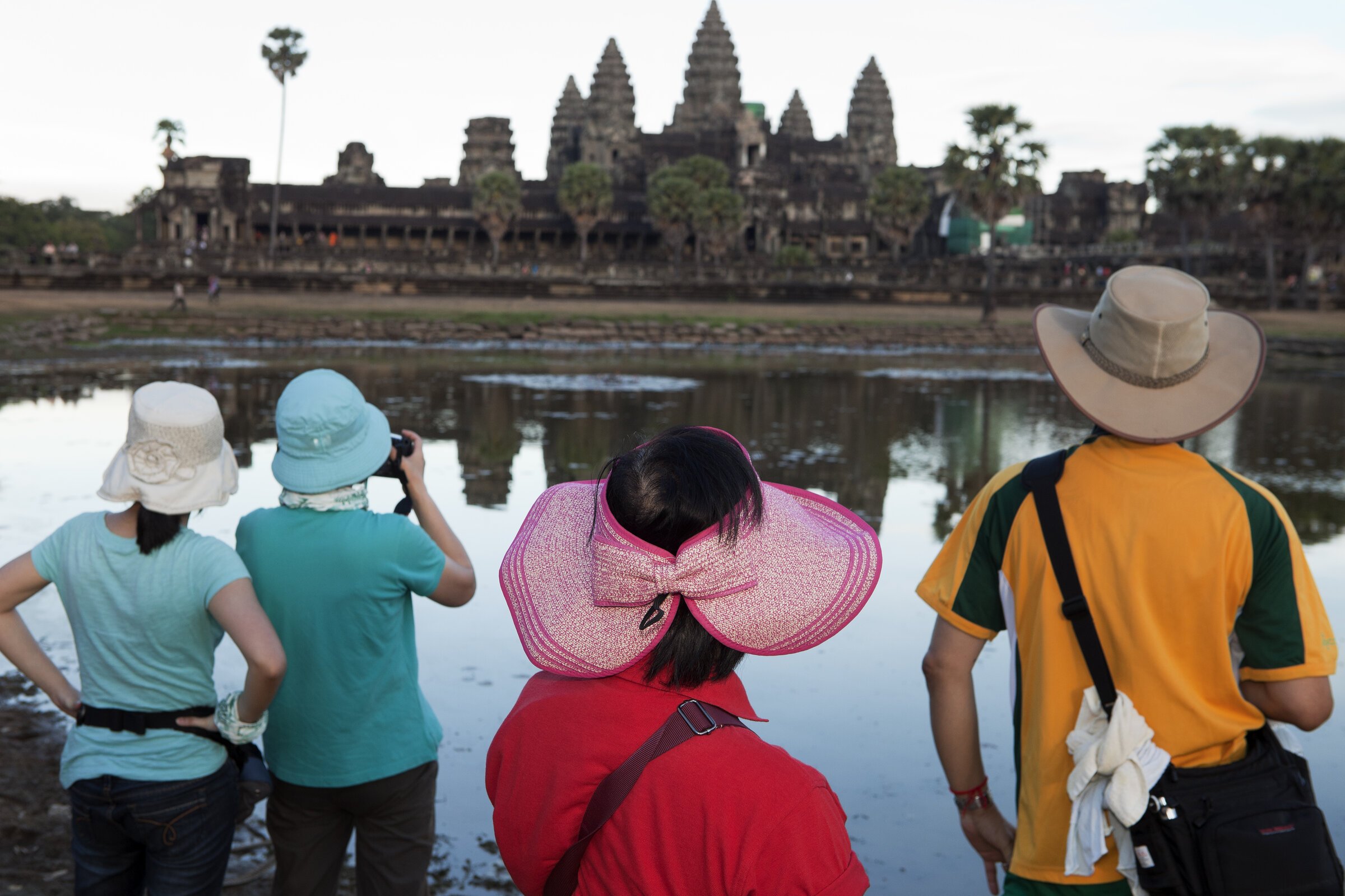
Martin Parr, Angkor, 2012/ 3
©Martin Parr/Magnum Photos (LON140111)/ licensed to Angkor Database.
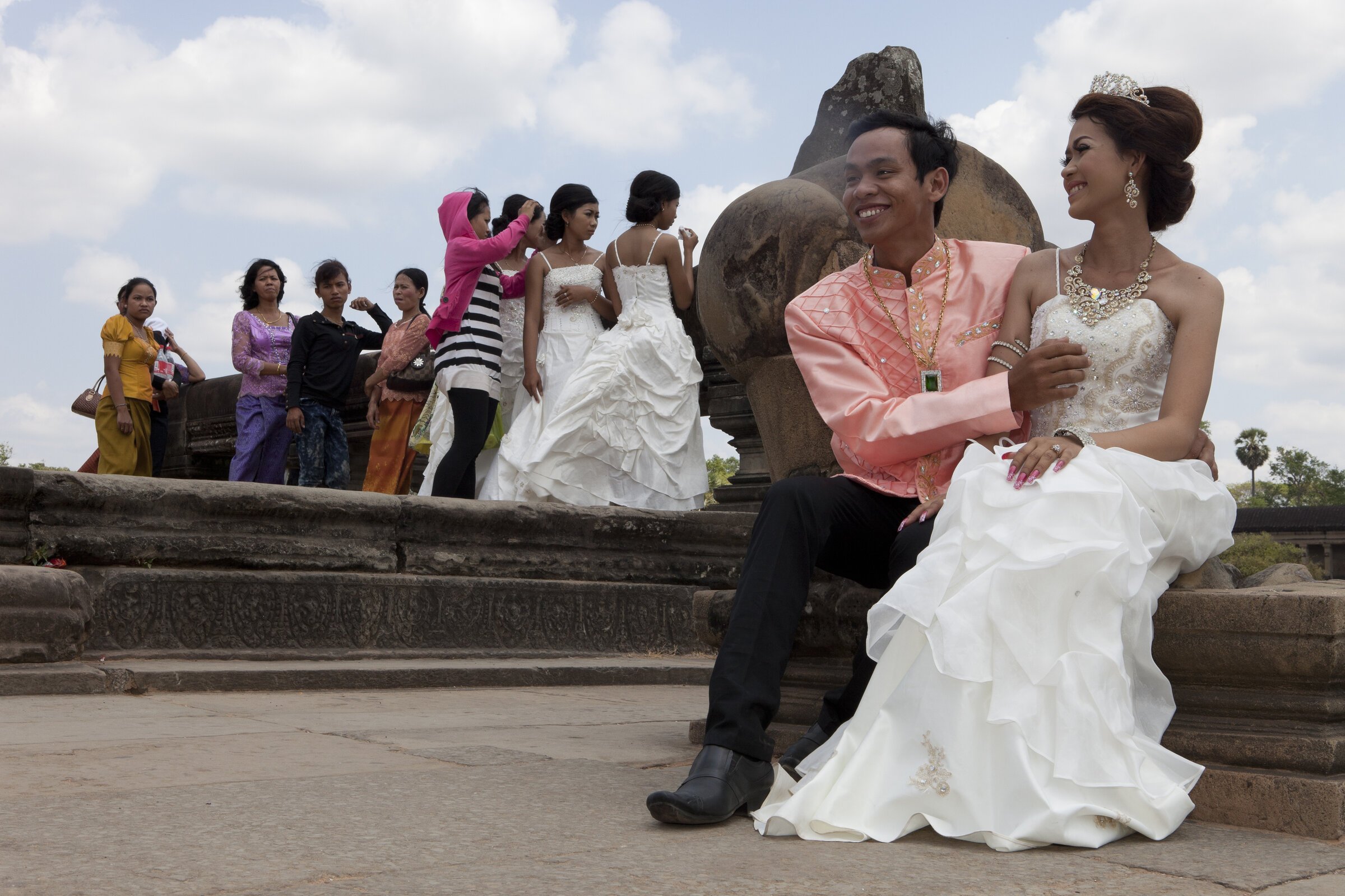
Martin Parr, Angkor, 2012/ 4
© Martin Parr/Magnum Photos (LON140146)/ licensed to Angkor Database.
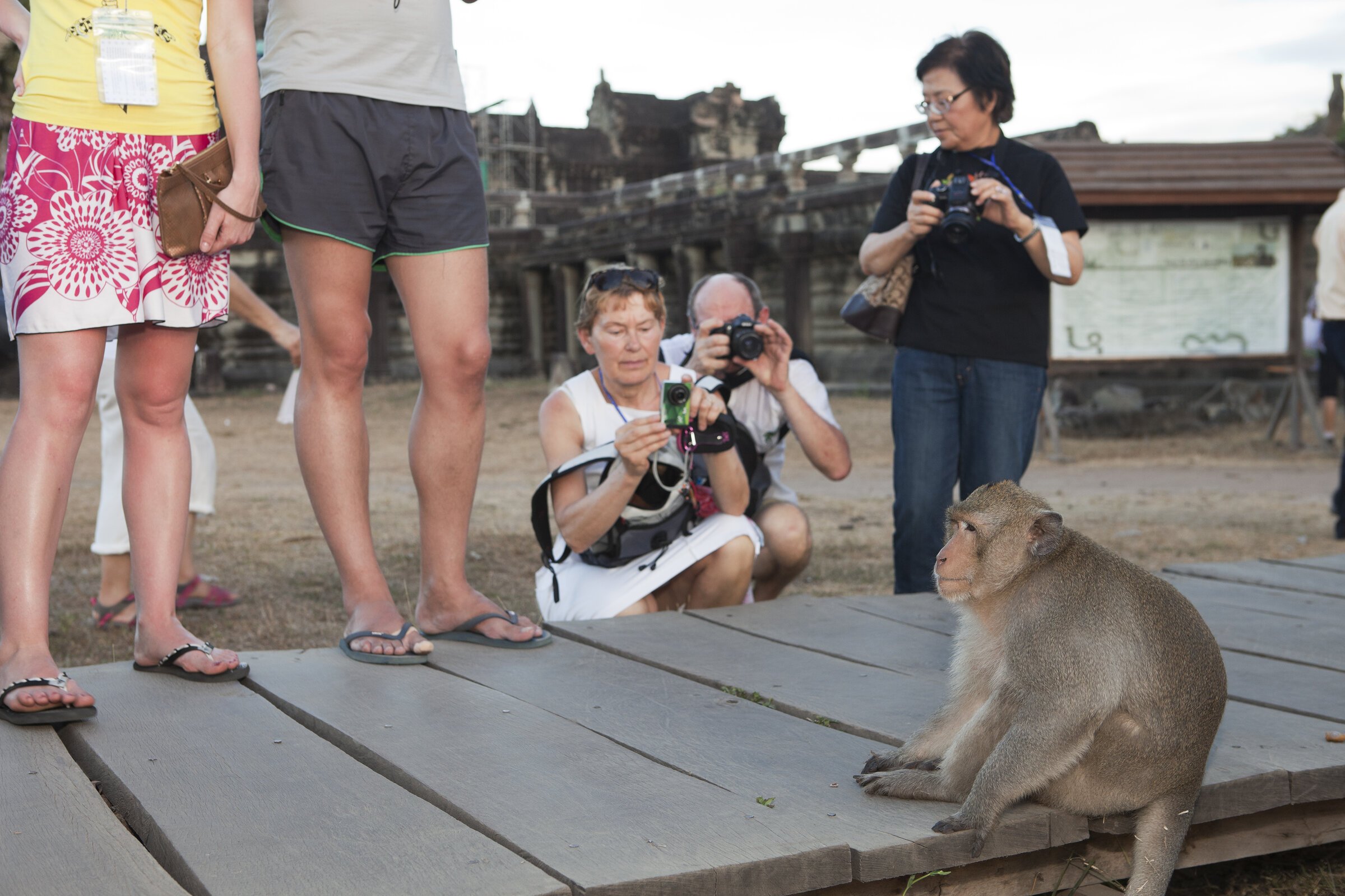
Martin Parr, Angkor, 2012/ 5
©Martin Parr/Magnum Photos (LON140115)/ licensed to Angkor Database.
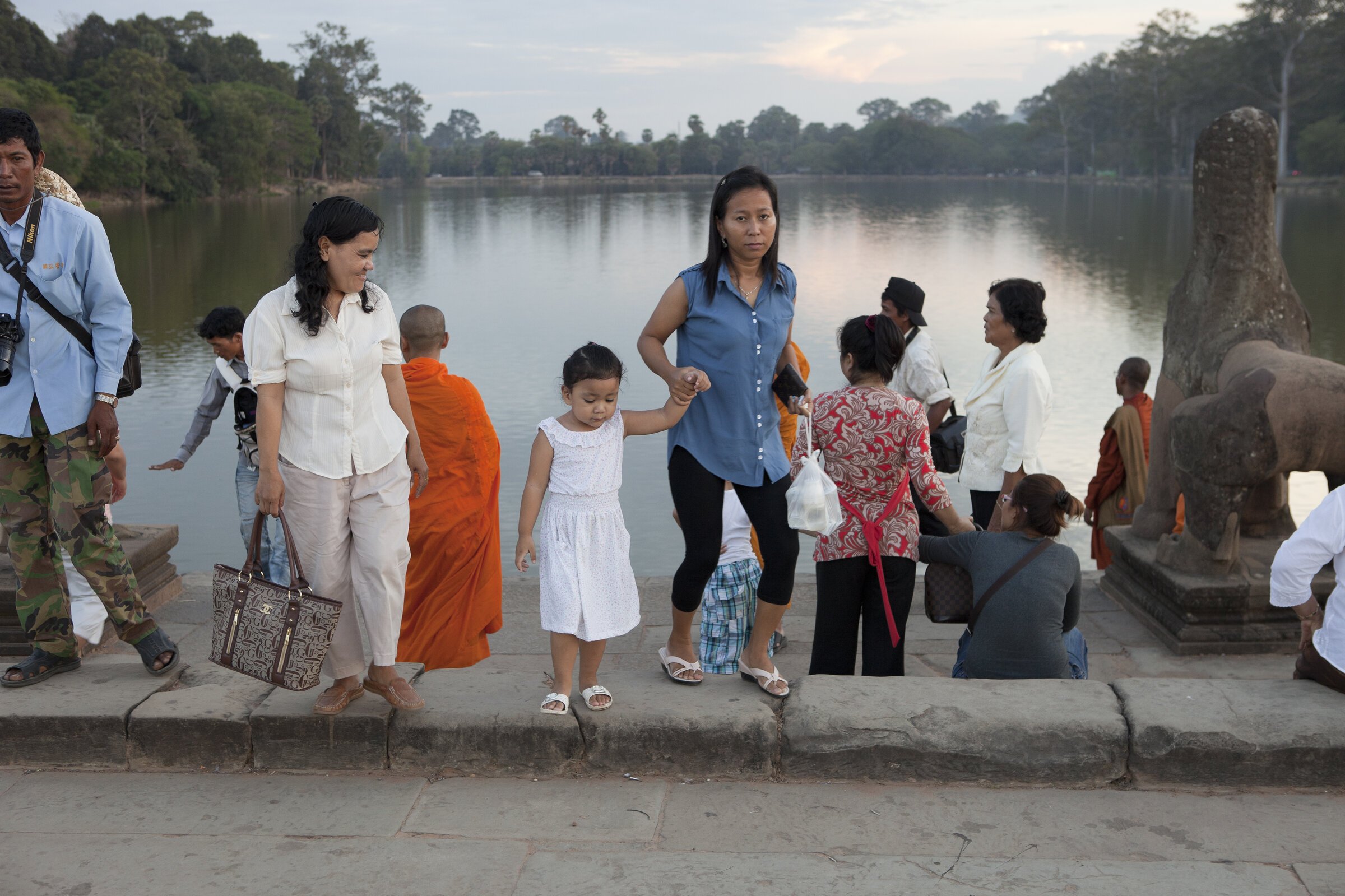
Martin Parr, Angkor, 2012/ 6
©Martin Parr/Magnum Photos (LON140117)/ licensed to Angkor Database.

- Author
- Martin Parr
- Source
- This publication was made possible by Magnum Photos Licensing Department, in coordination with the Martin Parr Foundation. All photos in the gallery - ©Martin Parr/Magnum Photos/licensed to Angkor Database.
- Published
- April 2026
As a chronicler of the anthropocene age and its excesses, including mass tourism, photographer Martin Parr (1952−2025) had to come and see Angkor. During his 2012 visit, he took some 30 photographs deposited at Magnum photo agency, which he had joined in 1994 and presided over from 2014 to 2017. After being kindly allowed to go through this Magnum collection — probably the one and only repository, to which we were directed when we asked the Martin Parr Foundation (established in 2017 in Bristol, England) to help us in tracking Angkor-related works -, here is a selection of 6 photographs. This is the first time Parr’s unique approach to our world is featured as applied to a site of such significance for the world’s cultural heritage and for the people of Cambodia.
As far as we know — and we had planned to inquire directly with the photographer himself before his sudden passing in December 2025 -, Martin Parr didn’t write much about experiencing the Angkorian site in 2012. Precisely right after that experience, however, he wrote on his blog:
Mass tourism is one of the subjects I have photographed consistently over the years. I have documented many of the most well known tourist sites in the world including Machu Picchu, Angkor Wat and Copacabana beach. Tourism is the biggest industry in the world and the tourist spend is always growing, despite the current downturn in global economies.
One thing that has really changed in recent years is how the tourist uses photography. When I started shooting this topic many years ago, people would take one photo of themselves in front of the site and move on. Now mobile phone cameras and digital photography mean that the entire visit is documented. From the moment the tourist enters the site, everyone has to be photographed in front of every feature of note. Now it is almost impossible for me to shoot a photo where someone is NOT taking a picture or posing for one. So I am under the impression that no-one is really paying attention to the splendours and beauties of the site, as the urge to photograph is so overwhelming. The photographic record of the visit has almost destroyed the very notion of actually looking. […]
Hang on, I hear you say, surely this is all too cynical. For if anyone has a shocking carbon footprint it is me. What am I doing at these sites? Doing exactly what I am now questioning ie taking photographs. Do I think tourism is good thing? Of course. It provides a much needed economic boost to countries that are struggling. It educates and enlightens the tourist. Perhaps it is the iconic sites that we all know before we get there that are in danger of becoming overwhelmed. Other equally impressive but less known sites tend to become overlooked.
My theory is that the act of photographing ourselves at tourist sites becomes so important because it makes us feel reassured that we are a part of the recognisable world. “Too Much Photography”, Martin Parr Blog, Apr. 2012.]
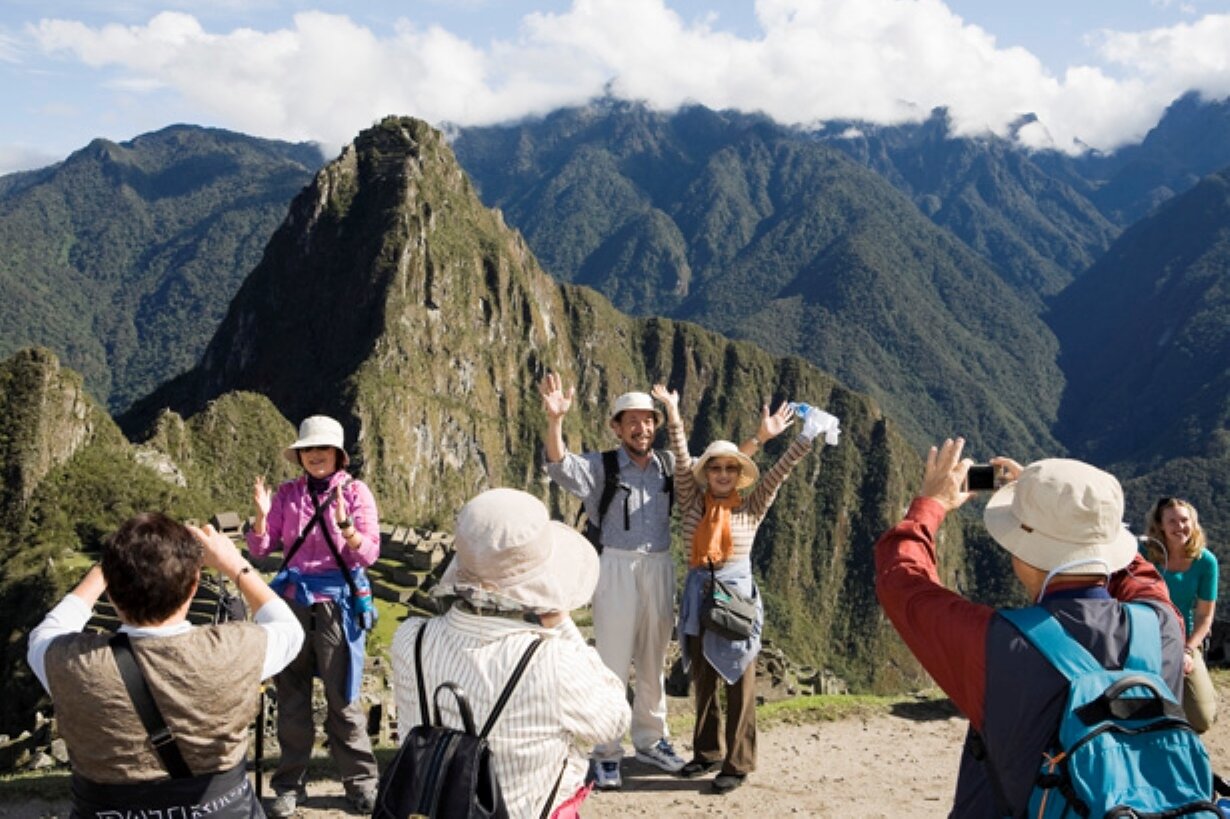
Machu Picchu (2010) and Angkor (2012) by Martin Parr, from Martin Parr’s Blog.
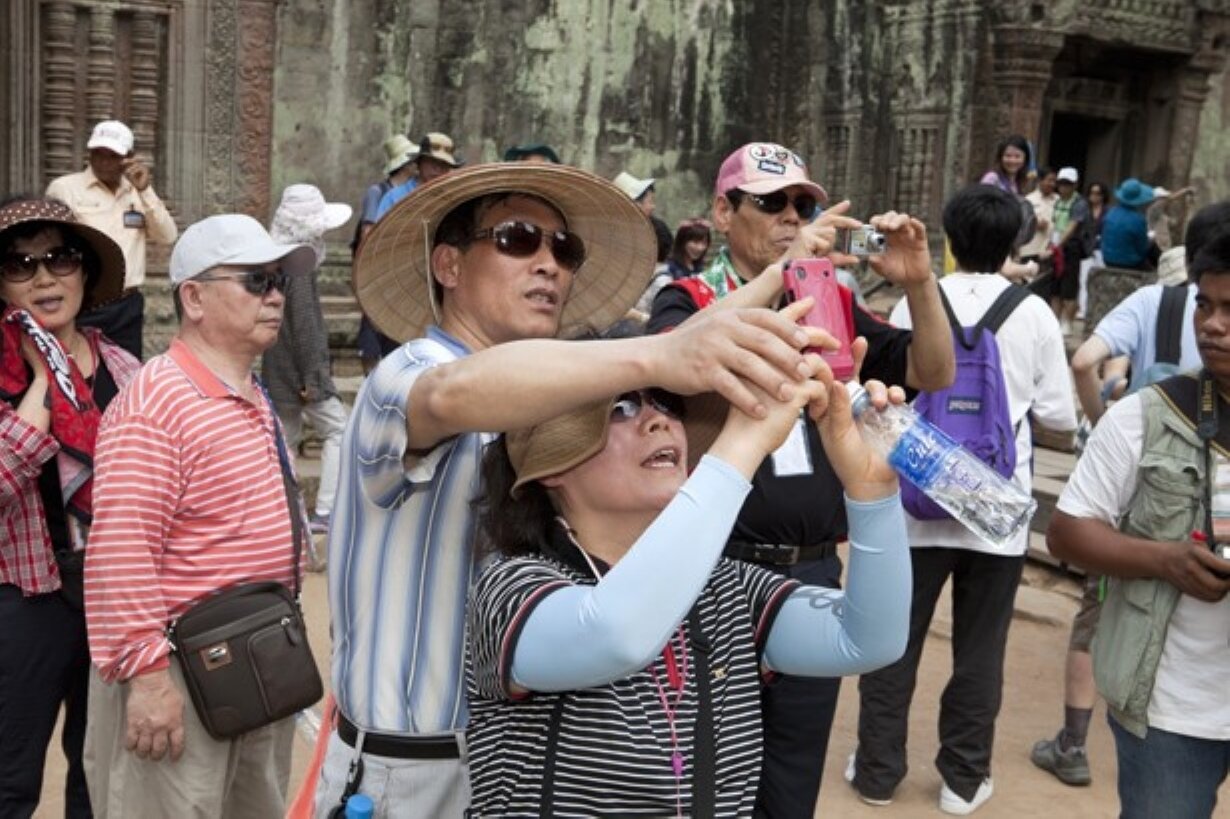
Machu Picchu (2010) and Angkor (2012) by Martin Parr, from Martin Parr’s Blog.
Machu Picchu (2010) and Angkor (2012) by Martin Parr, from Martin Parr’s Blog.
This sample of Martin Parr’s work in Angkor, however limited it is — and we do hope that some day there will be a book titled Martin Parr’s in Angkor, not a glossy coffee-table product but a humble, locally-made one, just like he did for Macchu Pichu (2010) or India (2013) -, certainly tells us more about the photographer than the myriads of photographs he took in more chartered territories, be it English or Irish ‘Old Country’, crowded beaches across the planet, or even the fashion industry microcosm. Something special happened in Angkor, and you can see on the unusually candid shots. Was it because tourists in Angkor, even during the brief peak of overtourism experienced in the decade preceding the 2020 Covid pandemic, weren’t mere tourists but somehow pilgrims to an imagined — or real, for true Buddhist believers — sacred spot? After all, even the French blasé novelist Pierre Loti depicted himself at the turn of the 20th century as ‘a pilgrim at Angkor’, and more than 120 years later his short book remains one of the most sought-after reference.
Beyond ‘Touristy’
The other singularity of Angkor amongst UNESCO world heritage sites is that it is a real living site, with actual people working and residing near the temples, and with Cambodians from all around the country — and from the diaspora — deeply feeling their connections to it. This aspect caught the eye of the photographer as shown in its photographs of newlyweds in front of Angkor Wat or Cambodian families by the serene expanse of water of Angkor Wat Southern moat from the Western causeway before the platforms were slightly remodeled in the 2020s. Suddenly, the old dilemma between tourism and authenticity became somehow irrelevant. In Angkor, Parr’s keen eye registered ‘locals’ who weren’t ‘performing’ for the visitors but were just here, awed yet comfortable with the majestic relics of their past. This is probably why we can find some softening in Parr’s typically sharp way of documenting tourism — yet he always pointed to the economic benefits of tourism for developing countries, and rejected the elitist vilification of ‘mass tourism’.
In Global Warning, the first substantial study on Martin Parr’s body of work published after his death and catalog of the eponymous, widely attended exhibition at Musée du Jeu de Paume in Paris, one contributor noted
“The paradox for tourists is that they want to go where there are no tourists. To put it another way: they turn the places they go into places they don’t want to go to. […] Many of Parr’s photos show tourists pursuing this dream; the absurdity of their situation may be amusing, but there is also something pathetic about their inevitable failure. Ultimately, those who enjoy the most successful or even the most authentic experience are post-tourists who, like Parr, adapt to — or even embrace- the artificiality of these situations. [Jean-Francois Staszak, “Martin Parr’s Small World and Globetrotters,” Global Warning, Phaidon Press, 2026, p. 50 – 2]
In Angkor, this prism falls out of the picture, so to speak. The photographer notices the tour guides with their little flags, the souvenir hawkers, the relentless shooting of smartphone photos, and in the end what remains on the visitors’ strained faces is mostly wonderment, a sense of harmony oozing from the usually hectic tourist scenes. Ultimately, the photographs give us an insight of how a talented, strongly committed to his vision creator was seeing the world, and possibly wished us to react positively to his outlook. These photos are not ‘kitsch’ — a label he gladly assumed for himself while remarking that it was ‘a really complex notion’ -, they don’t express the “quiet grief” and the feeling of “loss, evaporation of a world in which the social fabric had weight and materiality and some degree of tensile strength, and its wholesale replacement by a world in which that fabric is woven of nothing more than digits flickering unendingly in the dark”, to quote Adam Greenfield’s essay in Global Warning [op. cit., p. 207].
Similarily, the stunning image of Western tourists capturing with their cameras a lonely monkey on the main esplanade leading to Angkor Wat under the quite quizzical glance of an Asian lady visitor encapsules the whole story. Martin Parr has been criticized for the fact that “the animals in [his] images have been rendered invisible as they are manifested as consumer goods,” a result of a cultural pattern that would make most of us “terribly violent in our pacifism, caught in a globalized community that reassures us even while it leaves us implacably alone.” [p. 153, 156] The scene at Angkor in Parr’s lenses comes across as radically estranged from such theorizations. APSARA Authority, in charge of Angkor Archaeological Park, has attempted for years to keep monkey’s onsite population to a level that wouldn’t infringe on their natural habitat while preventing damages to the ancient buildings and physical harm to the visitors. The photo is in fact a case study of that issue — Westerners avidly trying to shoot that evidence of wildlife in a free environment, one tiny connection to the animal realm they can only get visiting a zoo, the Asian onlooker astonished by their nervousness in front of a rather common sight for her, and the monkey looking away, unaffected by that human fussing around. Cross-purposes at the gates of Angkor.
The Empathetic Satirist
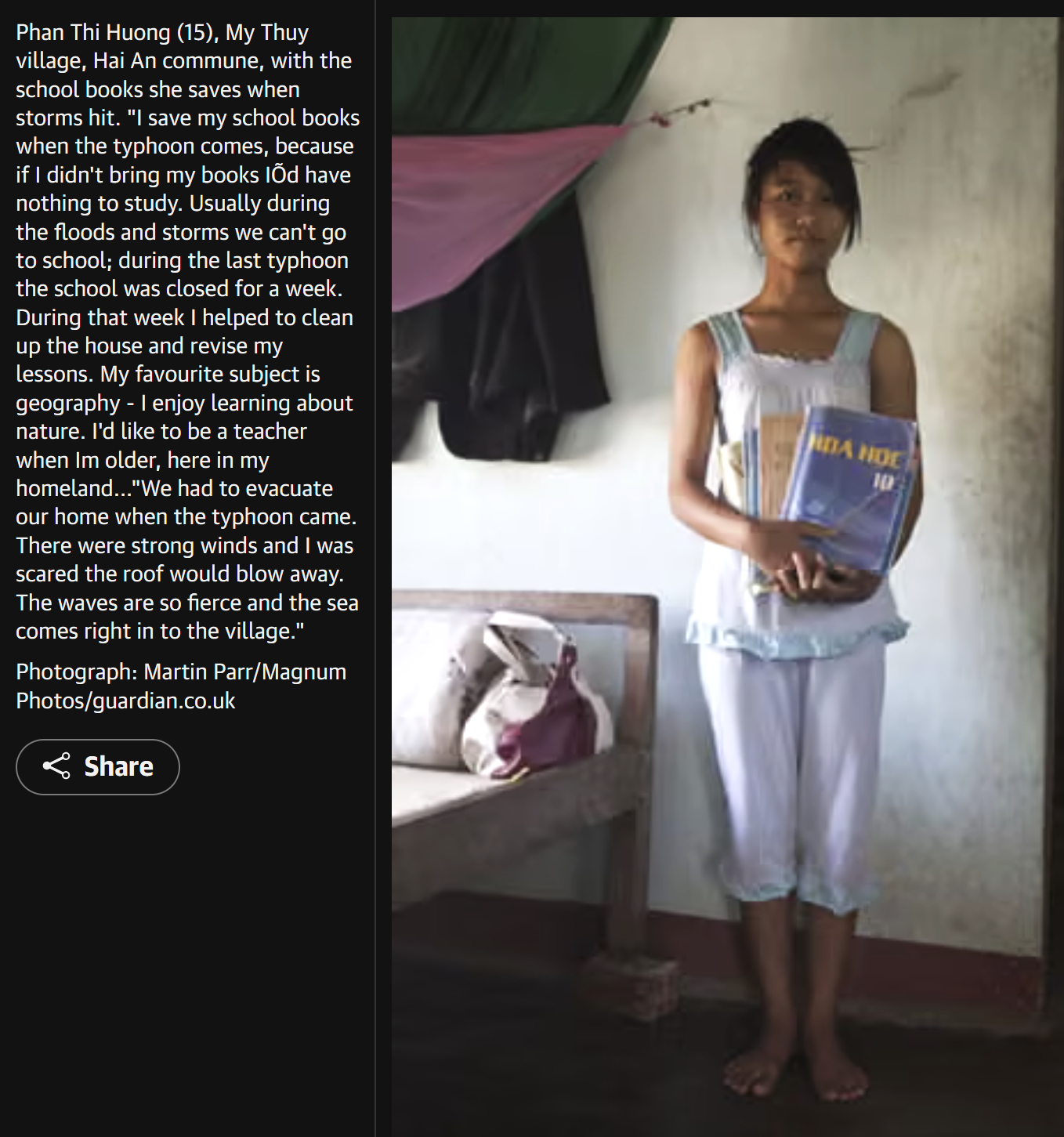
1) Part of Martin Parr’s work with Oxfam in Vietnam in The Guardian, Dec. 2009]. 2) Elegance at the gas pump ‑one of many Martin Parr’s photographs at Global Warning Exhibition, Paris, Musée du Jeu de Paume, Jan.-May 2026.
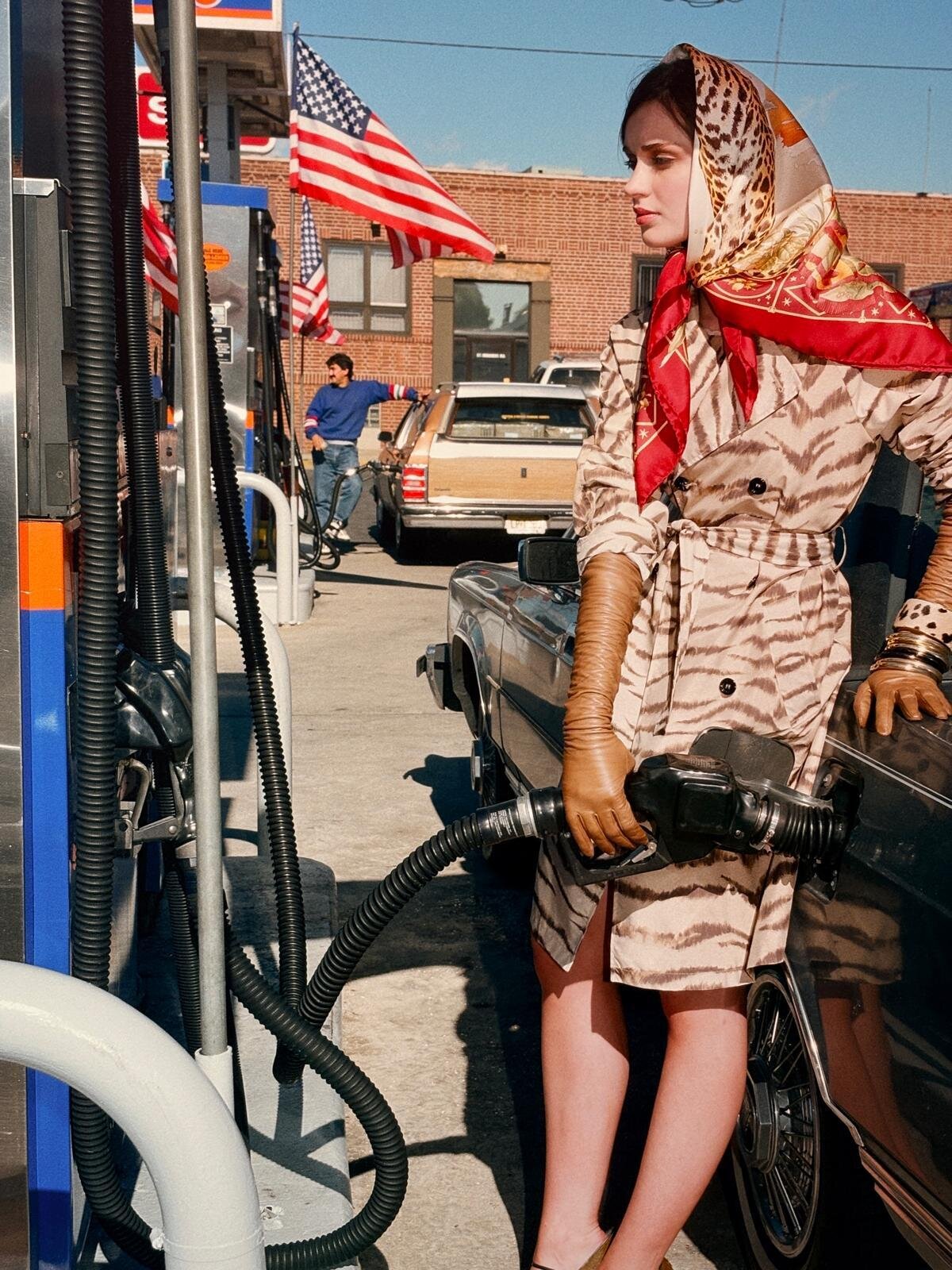
1) Part of Martin Parr’s work with Oxfam in Vietnam in The Guardian, Dec. 2009]. 2) Elegance at the gas pump ‑one of many Martin Parr’s photographs at Global Warning Exhibition, Paris, Musée du Jeu de Paume, Jan.-May 2026.
1) Part of Martin Parr’s work with Oxfam in Vietnam in The Guardian, Dec. 2009]. 2) Elegance at the gas pump ‑one of many Martin Parr’s photographs at Global Warning Exhibition, Paris, Musée du Jeu de Paume, Jan.-May 2026.
Three years before Angkor, in 2009, Martin Parr had been invited by the global organization Oxfam to go to the province of Quang Tri and photograph the local families confronted to the ever more drastic consequences of floods and typhoons due to climate change. “Many people are getting into serious debt as they borrow huge sums of money to replace crops, repair houses and send their children to school,” noted the editorial comment to the series published in The Guardian, 8 Dec. 2009. It was an eye opener, and one decade later, in 2021, he would remark — “I can see now how nearly all the images I have recently taken are related to climate change.”
Also in 2009, at the same time he was documenting the extreme vulnerability of humans facing natural disasters, he had started his project code-named Luxury, tracking the extreme vanity of hyper-consumerism. Writing on his blog, he raised an existential question:
I photograph wealth in the same spirit as has traditionally been associated with photographing poverty, an updated version of the ‘concerned photographer’ but disguised as entertainment. For surely, what is the main indirect cause of our increasing carbon emissions, but the increasing wealth of our planet?
These images of Angkor are the work of a photographer certainly inscribed in the time-honored English tradition of satirists, yet never removing himself entirely, emotionally speaking. For a satirist, lucidity devoid of empathy can easily turn into some out-of-touch bitterness. In front of the lasting relics of past human ingeniosity (genius), the acute observer has also to ponder, and to marvel without waxing lyricism.
Tags: photography, tourism, Angkor Archaeological Park, 2010s, heritage conservation, living cultural site
About the Photographer
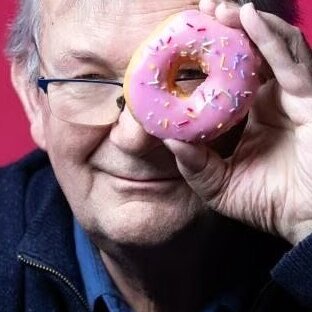
Martin Parr
Martin Parr (23 May 1952, Epsom (Surrey), England — 6 Dec. 2025, Bristol, England) was a worldwide famous photographer who explored global issues in his own style and with a good measure of English humour.
He grew interested in cameras though his grandfather, an amateur photographer. When his parents would take him, camera in tow, on weekend bird-watching trips, he found himself far more fascinated by the birders than the birds as subjects worth snapping, according to his referenced biography. After studying photography at Manchester Polytechnic (now Manchester Metropolitan University), he set up shop with like-minded colleagues in the Yorkshire mill town Hebden Bridge.
In 1980, Martin Parr married Susan ‘Sue’ Mitchell, a speech therapist, and, two years later, they relocated for her job to the Liverpool area. The move marked a professional transition for him as well as he switched to color and trained his lens on images that he believed would better “reflect current trends in society.” For many years, he photographed people of England, Ireland, Wales and became both a protagonist and a target in the British political debate. Profiling him in The Times of London (20 April 2008), Robert Sandall claimed he was “a tremendous polariser” viewed as “arrogant”, “either a pin-sharp satirical genius who tells uncomfortable truths with comedic flair” or “a heartlessly cynical smartarse” who was desacrating the values of photo-journalism - a critique openly expressed by famed photographer Henri Cartier-Bresson, one of the founders of Magnum, the elite photo-agency in which Parr was finally accepted in 1994 and even came to preside over from 2013 to 2017.
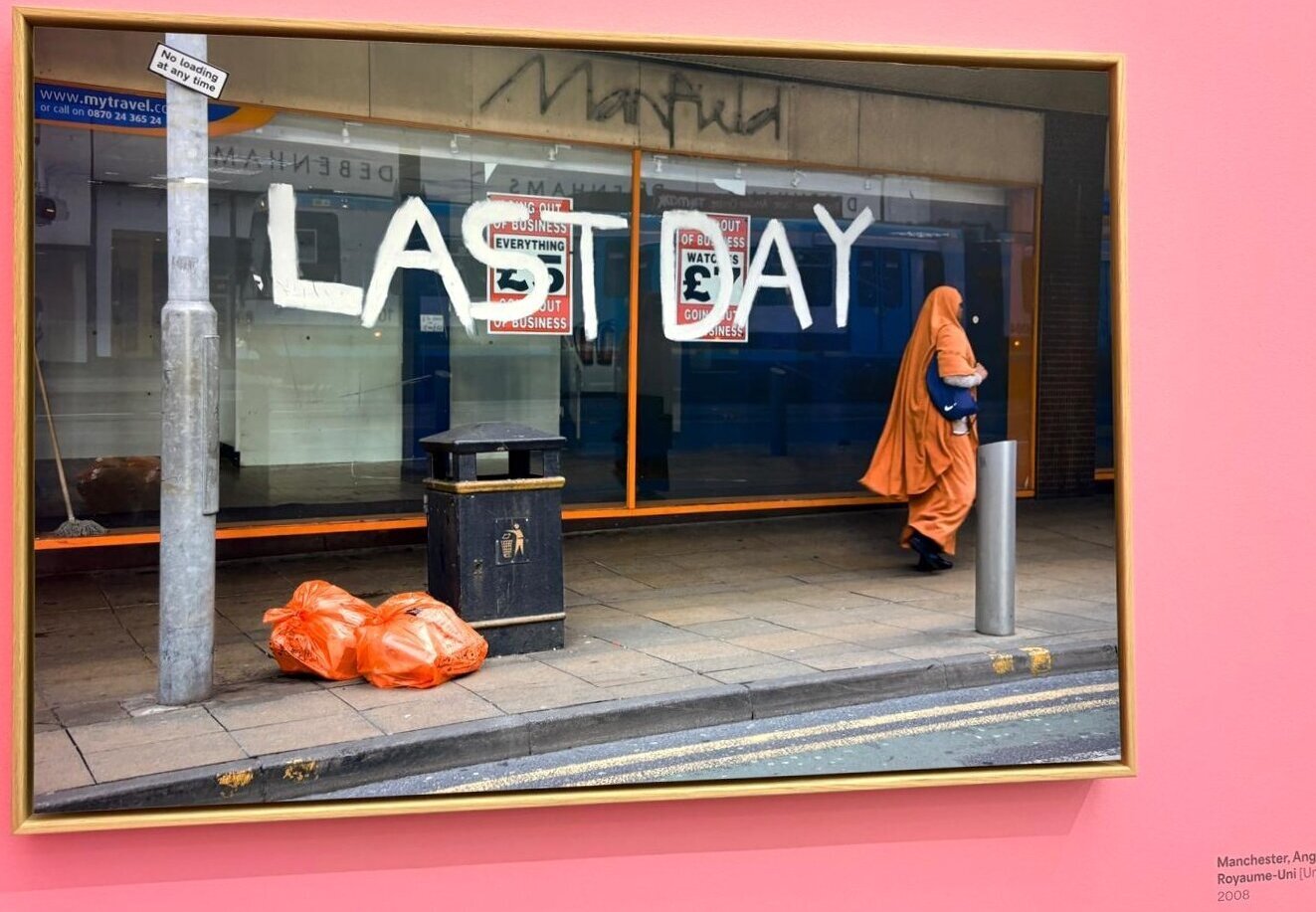
1) Manchester, street view, 2008, from Global Warning, 2026 Paris exibition [photo ADB]. 2) Martin Parr in his office, nd [Martin Parr’s website] 3) Scene at the US Republican Convention, in Martin Parr’s Conventional Photography, 2017 [MP’s website]. 4) Book cover of Martin Parr in India, 2010 [MP’s website].
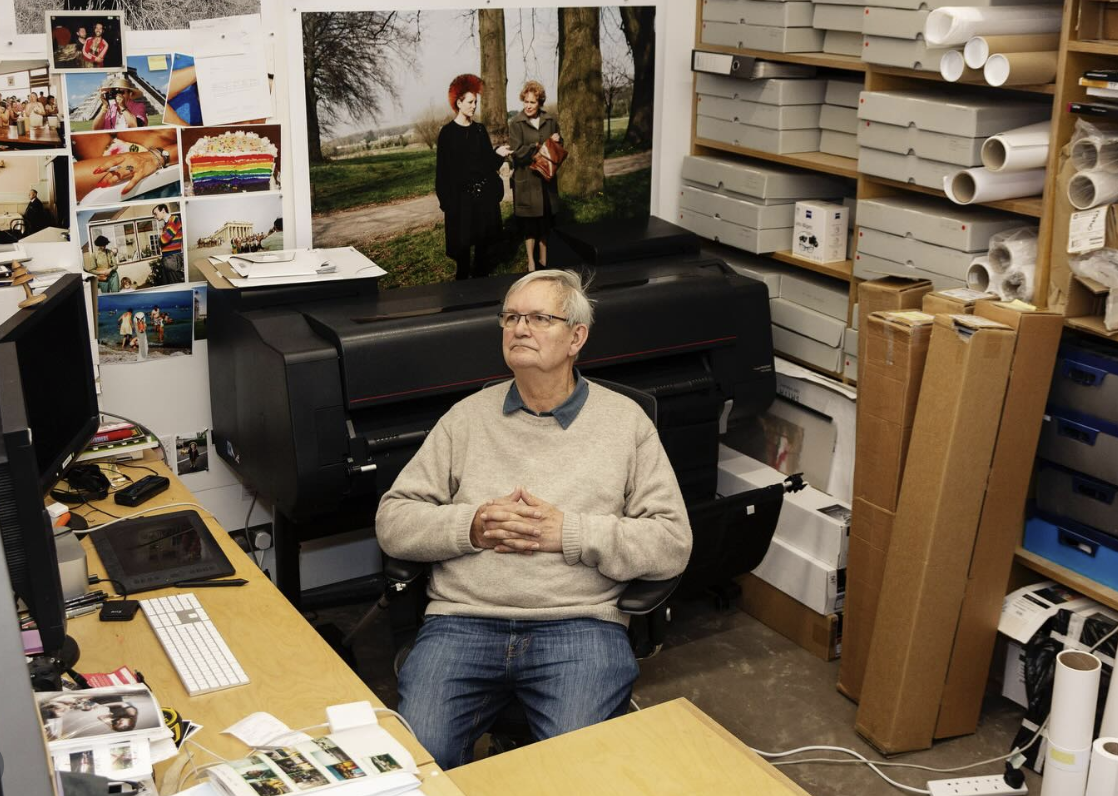
1) Manchester, street view, 2008, from Global Warning, 2026 Paris exibition [photo ADB]. 2) Martin Parr in his office, nd [Martin Parr’s website] 3) Scene at the US Republican Convention, in Martin Parr’s Conventional Photography, 2017 [MP’s website]. 4) Book cover of Martin Parr in India, 2010 [MP’s website].

1) Manchester, street view, 2008, from Global Warning, 2026 Paris exibition [photo ADB]. 2) Martin Parr in his office, nd [Martin Parr’s website] 3) Scene at the US Republican Convention, in Martin Parr’s Conventional Photography, 2017 [MP’s website]. 4) Book cover of Martin Parr in India, 2010 [MP’s website].
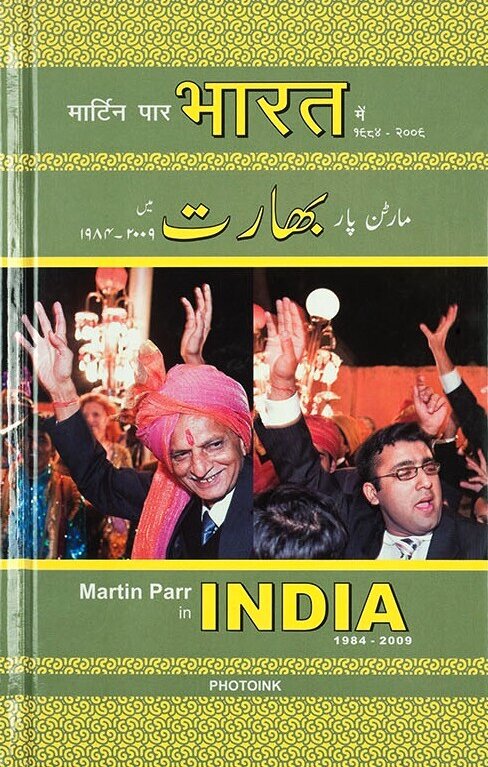
1) Manchester, street view, 2008, from Global Warning, 2026 Paris exibition [photo ADB]. 2) Martin Parr in his office, nd [Martin Parr’s website] 3) Scene at the US Republican Convention, in Martin Parr’s Conventional Photography, 2017 [MP’s website]. 4) Book cover of Martin Parr in India, 2010 [MP’s website].
1) Manchester, street view, 2008, from Global Warning, 2026 Paris exibition [photo ADB]. 2) Martin Parr in his office, nd [Martin Parr’s website] 3) Scene at the US Republican Convention, in Martin Parr’s Conventional Photography, 2017 [MP’s website]. 4) Book cover of Martin Parr in India, 2010 [MP’s website].
In March 2016, Parr curated Strange and Familiar, an exhibition at the London Barbican reflecting on how international photographers from 1930s onwards have photographed in the United Kingdom. That was the coda in his own process of distancing himself from endless controversies on the “social mission” of photography. His garishly colored images of crowded beaches, working-class supermarkets or pubs had irked many when he shot in England, but when he expanded his geographic reach (for instance with the series Playas on South American beaches, 2009) his international recognition made the scope of his vision more obvious. “Arles [the international photo festival held every year in Southern France] was the place that launched my career,”he told the New York Times during the 2015 edition of that festival, recalling that his series The Last Resort had been exhibited there in 1986; “Having come from a country that doesn’t much love photography, and being dropped into the middle of Arles — it was completely astonishing, the scale of it, the ambition of it, the professionalism of it.”
An explorer of hyper-consumerism who was himself an avid collector — of postcards, orwristwatches with the portrait of Iraki leader Saddam Hussein, or photos of Soviet dogs-cosmonauts -, a chronicler of the non-event who always knew where to be at the right time — photographying the opening of the first McDonald’s joint in Moscow in 1991 after the collapse of USSR, covering backstage the last Dior fashion show directed by the controversial designer John Galliano, who had just been sacked -, an observer of mass tourism who went to Machu Picchu and Angkor, Martin Parr came to know and picture the planet in and out, becoming increasingly concerned by global warming. Tellingly, he was working on the mega exhibition Global Warning when he passed away in December 2025, and the art show which opened a month later in Paris — complete with the most ambitious of the 140 books he authored, edited or contributed to — projected a vision he had built up for more than half his life.
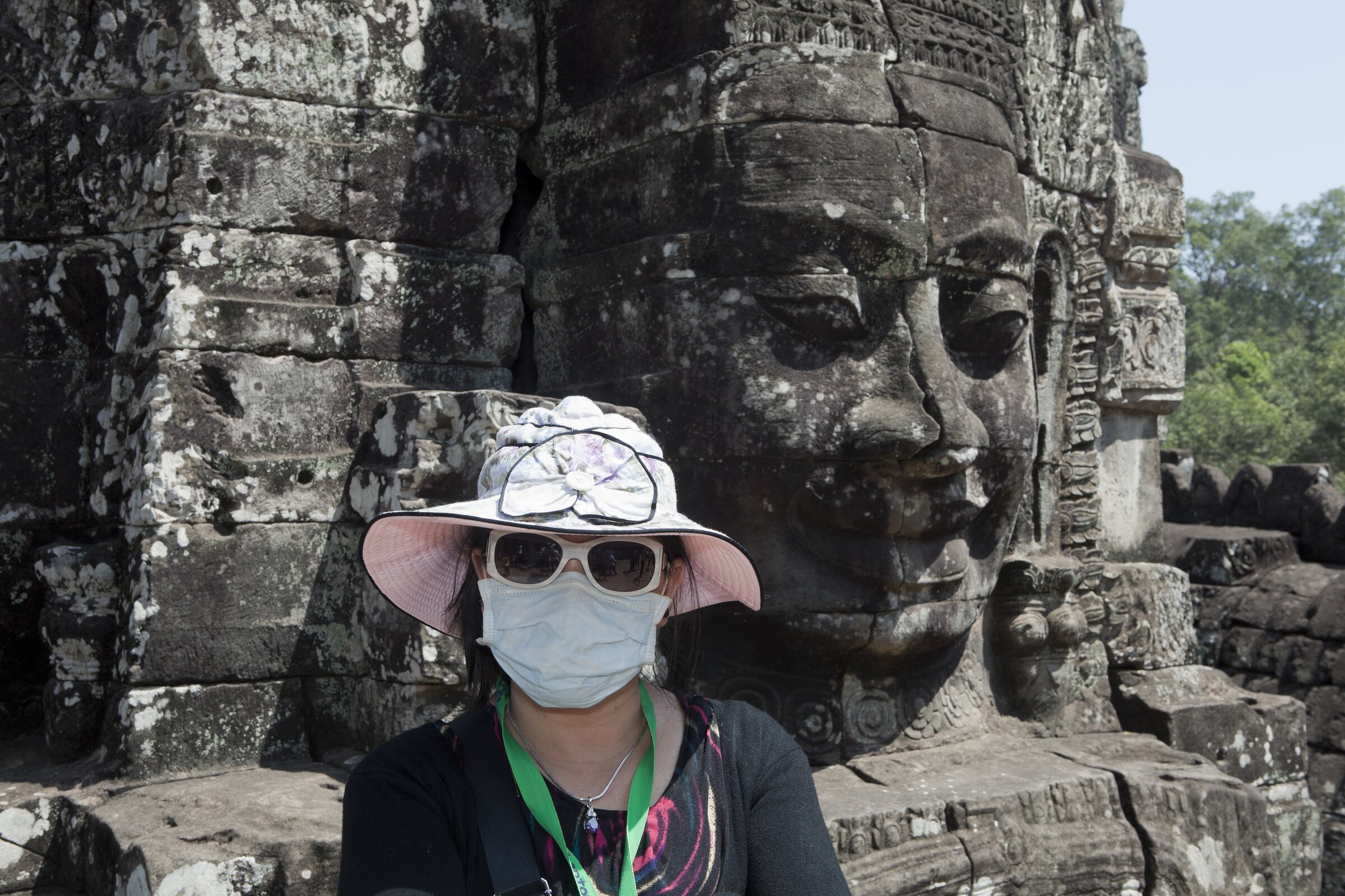
©Martin Parr/Magnum Photos (LON140141)/ licensed to Angkor Database.
At Bayon Temple, 2012©Martin Parr/Magnum Photos (LON140141)/ licensed to Angkor Database. Part of Martin Parr’s series of photos in Angkor, 2012, exclusively on Angkor Database.
More will be written on Martin Parr, the man who “photographed the quirks of our era with a blend of apparent neutrality and clinical precision” and assumed “the incongruity often arises from the contrast between the banality of his subjects and the methodical discipline of his photography”, to quote Quentin Baujac in his introduction to Global Warning [Phaidon Press, 2026, p. 16]. “I’m creating entertainment, which has a serious message if you want to read into it, but I don’t expect to change anyone’s mind,” he had allowed in a 2025 interview to Ana Bogdan’s podcast The Talks. And for those looking for easy labels to put on complex things, let’s recall his rather intriguing answer to Lolita Mang in Vogue France (26 March 2024)
Pour conclure, parlons du kitsch, un mot qui a souvent servi à qualifier votre travail. Comment le prenez-vous ? — Je suis très flatté ! Je n’ai aucun problème avec ce mot, que je trouve atrocement difficile à définir. [In closing, let’s talk about kitsch, a word that has often been used to describe your work. How do you feel about it? — I’m really flattered! I have no problem with this word, which I find awfully difficult to define.]
Martin Parr’s website (with blog)
Selected Publications
- Home Sweet Home, York, Impressions Gallery of Photography, 1974.
- Bad Weather, London, A. Zwemmer Ltd, 1982.
- [texts by Nicholas Backer] Signs of the Times, Cornerhouse, 1992, 72 p.
- [intr. by Roland Toper] Small World, Heaton Moor, Dewi Lewis, 1995; 3d ed. 2007.
- [with poems by Jonathan Stephenson, Fergus Allen, Kate Clanchy, Philip Gross, Sophie Hannah, Geoffrey Hoare, Roger McGough, Alice Oswald, Vicki Raymond] West Bay, Oxfordshire, The Rocket Press, 1997.
- [with Françoise Caraco, Daniel Stuur, Nitin Vadukul, Raymond Meier, Beda Achermann, Peter Ruch] Reduce to the max/smart, Biel, Micro Compact Car AG, 1997. [in German]
- Common Sense, Heaton Moor, Dewi Lewis Publishing, 1999.
- From Our House To Your House, Heaton Moor, Dewi Lewis Publishing, 2002. ISBN13: 9781899235346.
- Autoportrait, Dewi Lewis Ltd, 2002. ISBN13: 9781899235728.
- The Phone Book 1998 – 2002, London, The Rocket Press, 2002. Limited Edition (Pink Cover Variant) ISBN13: 9780946676538.
- Bliss: Perfect for Couples! Ideal for Families! A Martin Parr Postcard Collection, Chris Boot Pub., 2003. ISBN 13: 9780954281335.
- Saddam Hussein Watches, London, Chris Boot Ltd, London, 2004. [photographs of watches depicting Irak leader Saddam Hussein from the author’s collection].
- Road Trip: Martin Parr and Friends, Sony Ericsson, 2005.
- [with John McAslan, texts] A8 Glasgow, London, JMP Journal, London, 2005. ISBN13: 9780014742851.
- Small World 2007, Heaton Moor, Dewi Lewis Publishing, 2007.
- Martin Parr: Witness Number Three, New York, Joy of Giving Something Inc, 2007.
- Correspondencia, Chile, AFA Editions, 2008.
- Playas, Chris Boot Ltd., 2009.
- Assorted Cocktail, Mallorca, Casal Solleric de Palma, 2009.
- St Mary Redcliffe and Temple School, St Mary Redcliffe and Temple School & Arnolfini, 2010.
- Martin Parr por Martin Parr. Un dialogo con Quentin Bajac, Madrid, La Fabrica, 2010. [in Spanish]
- Macchu Picchu, Nazraeli Press, 2010. [1st limited ed. 100 copies].
- Martin Parr in INDIA, Delhi, PHOTOink, 2010.
- Life’s a Beach, Aperture, USA, 2013. ISBN 13: 9781597112130.
- [text by Fergus Henderson] Real Food, Phaidon Press, 2016, 208 p. ISBN 9780714871035.
- Rhubarb Triangle, The Hepworth Wakefield, 2016. ISBN13: 9780995654914.
- Conventional Photography, New York, Harper’s Books, 2017, 120 p. [limited ed. from coverage of US Party Conventions for CNN].
- WORLD (The Price of Love), Gucci, 2018. [about Gucci Cruise in Cannes, France].
- [with Robert Hollingham, texts] Space Dogs : The Story of the Celebrated Canine Cosmonauts, Laurence, King Publishing, 2019. ISBN 13: 9781786274113.
- [int. by Fintan O’Toole] From the Pope to the Flat White: Ireland 1979 – 2019, Damiani, 2020.
- Fashion Faux Parr, Phaidon Press, 2024.
- Sports and Spectatoship, London, The Rocket Press, 2024. [limited ed. 500 copies].
- [with Wendy Jones] Utterly Lazy and Inattentive: Martin Parr, My Words, My Photographs, Rizzoli UK, 2026.
- 2 for 1 — Memory Game, Paris, Pyramyd, 2026. [in French]
- The Last Resort: Forty Years On, Dewi Lewis Publishing, 2026. ISBN13: 9781916915213.
- [texts by Quentin Bajac, Jean-François Staszak, Roberta Sassatelli, Violette Pouillard, Adam Greenfield] Global Warning, Phaidon Press, 2026. ISBN13: 978 – 1837291540. [around the exhibition Global Warning, Musée du Jeu de la Paume, Paris, Jan.-May 2026].
Martin Parr’s Works in Collections
- Arts Council of Great Britain
- Union Bank of Finland, Helsinki
- Museum for Fotokunst, Odense, Denmark
- The Victoria and Albert Museum, London, United Kingdom
- George Eastman House, Rochester, USA
- Bibliothèque Nationale, Paris, France
- Museum of Modern Art, New York, USA
- Philadelphia Museum of Art, USA
- Museum of Modern Art, Tokyo
- Calderdale Council, Halifax, United Kingdom
- Getty Museum, Malibu, USA
- Walker Art Gallery, Liverpool, United Kingdom
- Kodak, France
- Museum Folkwang, Essen, Germany
- Seagrams Collection, New York, USA
- British Council, London, United Kingdom
- Irish Arts Council, Ireland
- Australian National Gallery, Australia
- Paris Audiovisual, France
- Sprengel Museum, Hannover, Germany
- Yokohama Museum of Art, Tokyo, Japan
- Metropolitan Museum of Photography, Tokyo, Japan
- San Francisco Museum of Modern Art, USA
- Stedelijk Museum, Amsterdam, The Netherlands
- Tate Modern, London, United Kingdom
- National Centre for Contemporary Arts, Moscow
- National Museum of Fine Arts, Buenos Aires
- Archive of Modern Conflict, London, United Kingdom0
- Gemeentemuseum, Helmond, The Netherlands
- Irish Museum of Modern Art, Ireland
- Santa Barbara Museum of Art, USA
- High Museum of Art, Atlanta, USA
- Minneapolis Institute of Arts, USA
- Guernsey Museums, The Channel Islands
- The Hepworth Wakefield, England
- The Guildhall, London, England
- Dudley Archives and Local History Services, England
- M+, Hong Kong
- Wolverhampton Art Gallery, England
- La Filature, Mulhouse, France
- Theatre de la Photographie et de l’Image, Nice, France
- Manchester Art Gallery, England
- National Portrait Gallery, London, England
- National Museum Wales, Cardiff, Wales
[Portrait photo: AFP]