John Kremers Whitmore (1940 — Nov. 2020) was an American scholar credited as the pioneer of Vietnamese studies in the US starting from the 1960s, as he explored Vietnamese pre-modern and modern history, mentored new generations of American researchers in Southeast Asian history and expanded his anthropological research to Vietnamese refugee communities borne from the American war on Southeast Asia.
An anthropologist (Yale University after Wesleyan U.) and historian (Cornell University under O.W. Wolters, with his 1968 PhD thesis ‘The Development of Lê Government in Fifteenth-Century Vietnam’), John K. Whitmore joined the Department of History (Southeast Asian Studies) at the University of Michigan in Ann Arbor, researching and publishing on topics from the eleventh to the twentieth centuries, including law, family, social organisation, education, bureaucracy, administration, ideology, map-making, Buddhism, trade, economy, seaports, Cham and Vietnamese refugees in the US… He also taught at Yale University, his alma mater.
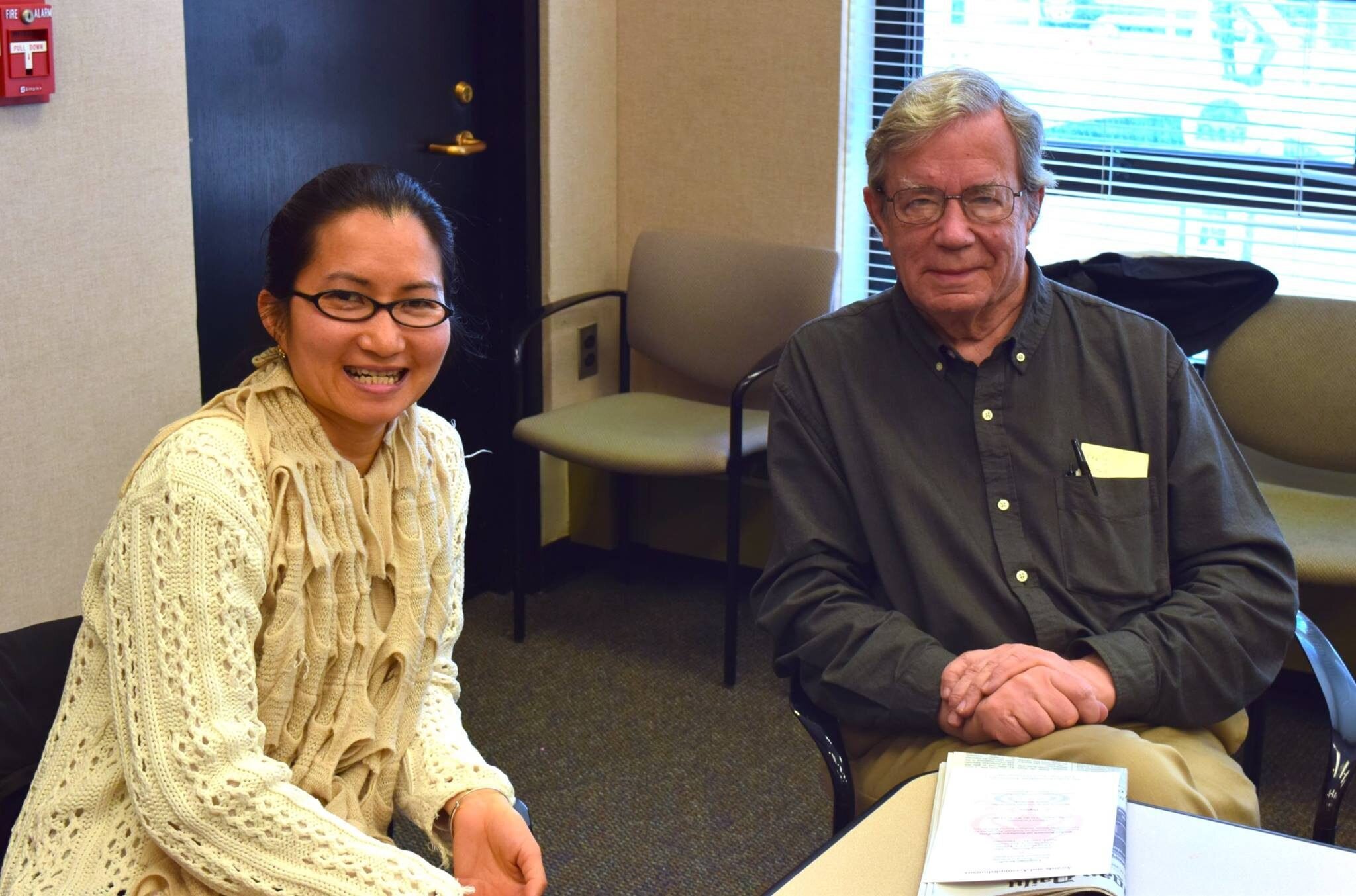
John K Whitmore with Thuy Anh Nguyen, a lecturer in Vietnamese Language, Yale University, 2014.
John K Whitmore with Thuy Anh Nguyen, a lecturer in Vietnamese Language, Yale University, 2014.
In a context electrified by the US military escalation and anti-war protests, John Whitmore remained committed to scientific research on primary sources in Chinese and Vietnamese languages, exploring the historic transformation of North Vietnam’s social fabric combining three principal groups — recent Chinese immigrants, older populations of mixed Chinese-indigenous origin, and upland communities speaking local Vietnamese dialects -, and the formation of a coherent Vietnamese identity on an elite level starting from the late fifteenth century. He was also interested in the impact of ancient Cham cultural traits on modern Vietnam.
Publications
Vietnamese Adaptations of Chinese Government Structure in the Fifteenth Century. New Haven: Yale University, Southeast Asia Studies, 1970.
“Vietnamese Historical Sources: For the Reign of Le Thanh-Tong (1460−1497),” The Journal of Asian Studies (JAS) 29:2 (1970), 373 – 394.
“A Note on the Location of Source Materials for Early Vietnamese History,” JAS 29:3 (1970), 657 – 662.
[with Kenneth R. Hall] Explorations in Early Southeast Asian History: The Origins of Southeast Asian Statecraft. Ann Arbor: University of Michigan Center for South and Southeast Asian Studies, 1976.
“Chiao-Chih and Neo-Confucianism: The Ming Attempt to Transform Vietnam,” Ming Studies 3, 1977: 51 – 92.
An Introduction to Indochinese History, Culture, Language, and Life: For Persons Involved with the Indochinese Refugee Education and Resettlement Project in the State of Michigan. Ann Arbor: Center for South and Southeast Asian Studies, University of Michigan, 1979.
“Social Organization and Confucian Thought in Vietnam.” Journal of Southeast Asian Studies (JAS) 15:2 (1984), 296 – 306.
““Elephants Can Actually Swim”: Contemporary Chinese Views of the Late Ly Dai Viet”, in D. G. M. a. A. Milner (Ed.), Southeast Asia in the 9th to 14th Centuries. Singapore, 1986. [Yale University pdf]
‘An outline of Vietnamese history before French conquest’, Vietnam Forum 8, Fall 1986: 1 – 9.
[with Nathan Caplan & Marcella Choy] Children of the Boat People: A Study of Educational Success. Ann Arbor: University of Michigan Press, 1991.
[with Nathan Caplan & Marcella Choy] “Indochinese Refugee Families and Academic Achievement,” Scientific American (SCIAM), 266:2 (1992), 36 – 45.
“The Tao-Đàn Group: Poetry, Cosmology, and the State in the Hồng-Đức Period (1470−1497),” Crossroads: An Interdisciplinary Journal of Southeast Asian Studies 7:2 (1992), 55 – 70.
“Cartography in Vietnam”, in J. B. Harley & D. Woodward (Eds.), The History of Cartography, Volume 2, Book 2: Cartography in the Traditional East and Southeast Asian Societies (Vol. The History of Cartography Series, pp. 478 – 508). Chicago: University of Chicago Press, 1994.
[edit. with Keith W. Taylor] Essays into Vietnamese Pasts. Ithaca: Cornell University Southeast Asia Program, 1995.
“The Two Great Campaigns of the Hong-Duc Era (1470 – 97) in Dai Viet,” South East Asia Research 12:1 (2004), 119 – 136.
“The Rise of the Coast: Trade, State and Culture in Early Ðại Việt,” Journal of Southeast Asian Studies (JSAS) 37:1 (2006), 103 – 122.
“The Last Great King of Classical Southeast Asia: ‘Chế Bồng Nga’ and Fourteenth-Century Champa,” in The Cham of Vietnam: History, Society and Art, edited by Trần Kỳ Phương and Bruce M. Lockhart. Singapore: NUS Press, 2011.
[ed. with James A. Anderson] China’s Encounters on the South and Southwest Reforging the Fiery Frontier Over Two Millennia. Leiden: Brill, 2014.
“Ngo (Chinese) Communities and Montane – Littoral Conflict in Dai Viet, Ca. 1400 – 1600,” Asia Major 27:2 (2014), 53 – 85.
“Building a Buddhist Monarchy in Đại Việt: Temples and Texts under Lý Nhân-tông (r.1072 – 1127)”, in Buddhist Dynamics in Premodern and Early Modern Southeast Asia, D. Christian Lammerts ed., ISEAS – Yusof Ishak Institute, 2015, ISBN 9789814519076.
[with James A. Anderson] “The Dong World: A Proposal for Analyzing the Highlands Between the Yangzi Valley and the Southeast Asian Lowlands,” Asian Highlands Perspectives 44 (2017), 8 – 71.
[with K.W. Taylor] Essays into Vietnamese Pasts, Ithaca, Cornell University Press, 2018, 288 p. ISBN 9781501718991.
“Kingship, Time, and Space: Historiography in Southeast Asia,” The Oxford History of Historical Writing vol 2: 400‑1400, New York: Oxford University Press, 2018.
“Fall of Vijaya in 1471: Decline or Competition? Campa in the Fifteenth century”, in Arlo Griffiths, Andrew Hardy&Geoff Wade, Champa: Territories and Networks of a Southeast Asian Kingdom, Paris, EFEO (Etudes thematiques 31), 2019, 448 p. ISBN 978 – 2855392691.
“Southeast Asia,” in A Companion to the Global Early Middle Ages, ed. by Erik Hermans. Leeds: Arc Humanities Press, 2020. 65 – 94.
Dong is an ancient Chinese term for a mountain valley community, especially in the southern and soutwestern regions abutting to 'historic' mainland China.
In Korea, dong동 has come to refer to a neighborhood or an administrative sub-district.