China’s Encounters on the South and Southwest: Reforging the Fiery Frontier Over Two Millennia

by John K. Whitmore & James A. Anderson

A collection of essays on the fluctuations of Chinese policy towards Southern and Southwestern neighbors from the 5th to the 20th century.

 
Format
e-book
Publisher
Leiden, Brill. Handbook of Oriental Studies (Handbuch der Orientalistik), Section 3: Southeast Asia, V. Lieberman and M.C. Ricklefs eds, Vol. 22).
Published
2015
Authors
John K. Whitmore & James A. Anderson
Pages
427
ISBN
978-90-04-28248-3
Language
English

This collection of essays on the fiery frontier” lands close to the Chinese dynastic core opened with a proposition by the two editors — the concept of Dong world, the border areas inhabited by mountain valley communities. In a demonstration of longue durée” perspective [long-term history] — the historiographical approach pioneered by the French Annales School (Marc Bloch, Fernand Braudel…) -, they asserted the slow change of border orientation from a north-south to the east-west orientation that has lasted until now:

We have come to define this entire highland region lying between China and Southeast Asia as the Dong world, originally consisting of the many dong (mountain valley communities) existing within it. Initially, the southern frontier ran roughly in a north-south direction, as Sinic civilization worked its way along the river systems and in from the coasts and their river mouths. These were more horizontal than vertical moves, as the hills were left to the dong (mountain valley community) chiefs. This process of frontier formation took over a millennium and a half, beginning in Qin times late in the third century BCE, before it began to form the east-west frontier as it exists today. Northern and north-central Vietnam (Jiaozhi/​Annan) lay within the southern reaches of the Chinese empires for most of this time, while Yunnan (Nanzhao, Dali) and the Dong world at large stood outside. Gradually, this north-south axis shifted into the east-west one of today. 

First, Đại Việt emerged in the Red River Plain during the tenth and eleventh centuries out of the fragmented Tang realm. Then the Mongols and the Ming brought the higher regions, particularly Yunnan, into China. Though the Ming took Đại Việt briefly back into China (for only two decades, 1407 – 27), by the middle of the fifteenth century the east-west frontier had come into being, forged by actions of political and cultural forces on both sides of and within it. The past half millennium has seen the varied agents, both within and without the borderlands, act to shape the nature of this fiery frontier.’ In the present day, the political leaders of the nation-states in this region, north and south, have re-empowered” local communities, while retaining ultimate authority through strong central government directives. [p vii-viii]
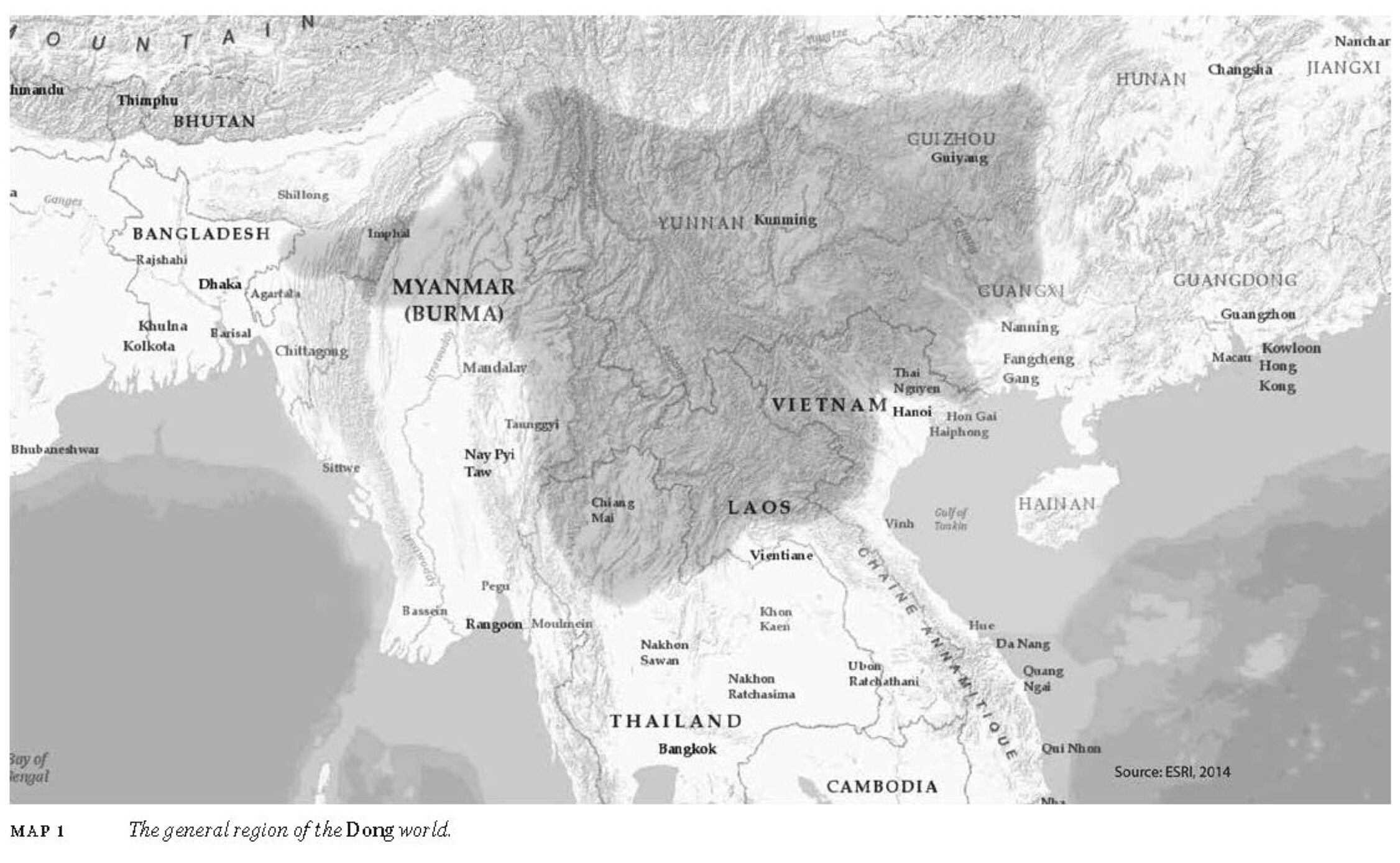
 

The general region of the Dong world according to the editors [Map 1 in J. Whitmore & J. Anderson eds., China’s Encounters on the South and Southwest: Reforging the Fiery Frontier Over Two Millennia, 2015. Source: ESRI, 2014].

The general region of the Dong world according to the editors [Map 1 in the book, source: ESRI, 2014].

Fifteen contributions cover different aspects of Chinese diplomacy, territoriality, and spatial conceptions through a lengthy period of time. 

Table of contents

  • Preface vii
  • List of Figures, Maps and Tables x
  • List of Contributors xi
  • Introduction: “The Fiery Frontier and the Dong World”, by James A. Anderson & John K. Whitmore 1
Part 1: Shifting the Southern Frontier
  • 1
    Where to Draw the Line? The Chinese Southern Frontier in the Fifth and Sixth Centuries, by Catherine Churchman 59
  • 2
    Constructing Local Narratives: Spirits, Dreams, and Prophecies in the Medieval Red River Delta, by Liam C. Kelley 78
  • 3
    Man and Mongols: the Dali and Đại Việt Kingdoms in the Face of the Northern Invasions 106, by James A. Anderson 106
  • 4
    Yunnan’s Muslim Heritage, by Michael C. Brose 135
  • 5
    Gunsmoke: The Ming Invasion of Đại Việt and the Role of Firearms in Forging the Southern Frontier, by Kenneth M. Swope 156
  • 6
    A State Agent at Odds with the State: Lin Xiyuan and the Ming Recovery of the Four Dong, by Kathlene Baldanza 169
Part 2: Shaping the Southern Frontier
  • 7
    Imperial Ideal Compromised: Northern and Southern Courts Across the New Frontier in the Early Yuan Era, by Sun Laichen 193
  • 8
    Northern Relations for Đại Việt: China Policy in the Age of Lê Thánh Tông (r. 1460–1497), by John K. Whitmore 232
  • 9
    Projecting Legitimacy in Ming Native Domains, by Joseph Dennis 259
  • 10
    Royal Refuge and Heterodoxy: The Vietnamese Mạc Clan in Great Qing’s Southern Frontier, 1677–1730, by Alexander Ong 273
  • 11
    The Rule of Ritual: Crimes and Justice in Qing-Vietnamese Relations during the Qianlong Period (1736–1796), by Jaymin Kim 288
  • 12
    Volatile Allies: Two Cases of Powerbrokers in the Nineteenth-Century Vietnamese-Chinese Borderland, by Bradley C. Davis 322
  • 13
    Depicting Life in the Twentieth-Century Sino-Tibetan Borderlands: Local Histories and Modernities in the Career and Photography of Zhuang Xueben (1909–1984), by Amy Holmes-Tagchungdarpa 339
  • 14
    From Land to Water: Fixing Fluid Frontiers and The Politics of Lines in the South China/Eastern Sea, by Kenneth MacLean 370
  • 15
    Asymmetric Structure and Culture in China’s Relations with Its Southern Neighbors, by Brantly Womack 395
  • Glossary 405
  • Index 419

Tags: China, border lands, Da Viet, Tibet, Yunnan, mountain people, hill people, diplomacy, territoriality

About the Authors

John K Whitmore with Thuy Anh Nguyen a lecturer in Vietnamese Language

John K. Whitmore

John Kremers Whitmore (1940 — Nov. 2020) was an American scholar credited as the pioneer of Vietnamese studies in the US starting from the 1960s, as he explored Vietnamese pre-modern and modern history, mentored new generations of American researchers in Southeast Asian history and expanded his anthropological research to Vietnamese refugee communities borne from the American war on Southeast Asia.

An anthropologist (Yale University after Wesleyan U.) and historian (Cornell University under O.W. Wolters, with his 1968 PhD thesis The Development of Lê Government in Fifteenth-Century Vietnam’), John K. Whitmore joined the Department of History (Southeast Asian Studies) at the University of Michigan in Ann Arbor, researching and publishing on topics from the eleventh to the twentieth centuries, including law, family, social organisation, education, bureaucracy, administration, ideology, map-making, Buddhism, trade, economy, seaports, Cham and Vietnamese refugees in the US… He also taught at Yale University, his alma mater


John K Whitmore with Thuy Anh Nguyen, a lecturer in Vietnamese Language, Yale University, 2014.

John K Whitmore with Thuy Anh Nguyen, a lecturer in Vietnamese Language, Yale University, 2014.

In a context electrified by the US military escalation and anti-war protests, John Whitmore remained committed to scientific research on primary sources in Chinese and Vietnamese languages, exploring the historic transformation of North Vietnam’s social fabric combining three principal groups — recent Chinese immigrants, older populations of mixed Chinese-indigenous origin, and upland communities speaking local Vietnamese dialects -, and the formation of a coherent Vietnamese identity on an elite level starting from the late fifteenth century. He was also interested in the impact of ancient Cham cultural traits on modern Vietnam. 

Publications

  1. Vietnamese Adaptations of Chinese Government Structure in the Fifteenth Century. New Haven: Yale University, Southeast Asia Studies, 1970.
  2. Vietnamese Historical Sources: For the Reign of Le Thanh-Tong (1460−1497),” The Journal of Asian Studies (JAS) 29:2 (1970), 373 – 394.
  3. A Note on the Location of Source Materials for Early Vietnamese History,” JAS 29:3 (1970), 657 – 662.
  4. [with Kenneth R. Hall] Explorations in Early Southeast Asian History: The Origins of Southeast Asian Statecraft. Ann Arbor: University of Michigan Center for South and Southeast Asian Studies, 1976.
  5. Chiao-Chih and Neo-Confucianism: The Ming Attempt to Transform Vietnam,” Ming Studies 3, 1977: 51 – 92.
  6. An Introduction to Indochinese History, Culture, Language, and Life: For Persons Involved with the Indochinese Refugee Education and Resettlement Project in the State of Michigan. Ann Arbor: Center for South and Southeast Asian Studies, University of Michigan, 1979.
  7. Social Organization and Confucian Thought in Vietnam.” Journal of Southeast Asian Studies (JAS) 15:2 (1984), 296 – 306.
  8. Vietnam, Hồ Quý Ly, and the Ming (1371−1421). New Haven: Council on Southeast Asia Studies (The Lac Viet Series, No. 2), 1985, 213 p. ISBN 978 – 0938692225.
  9. “Elephants Can Actually Swim”: Contemporary Chinese Views of the Late Ly Dai Viet”, in D. G. M. a. A. Milner (Ed.), Southeast Asia in the 9th to 14th Centuries. Singapore, 1986. [Yale University pdf]
  10. An outline of Vietnamese history before French conquest’, Vietnam Forum 8, Fall 1986: 1 – 9.
  11. [with Nathan Caplan & Marcella Choy] Children of the Boat People: A Study of Educational Success. Ann Arbor: University of Michigan Press, 1991.
  12. [with Nathan Caplan & Marcella Choy] Indochinese Refugee Families and Academic Achievement,” Scientific American (SCIAM), 266:2 (1992), 36 – 45.
  13. The Tao-Đàn Group: Poetry, Cosmology, and the State in the Hồng-Đức Period (1470−1497),” Crossroads: An Interdisciplinary Journal of Southeast Asian Studies 7:2 (1992), 55 – 70.
  14. Cartography in Vietnam”, in J. B. Harley & D. Woodward (Eds.), The History of Cartography, Volume 2, Book 2: Cartography in the Traditional East and Southeast Asian Societies (Vol. The History of Cartography Series, pp. 478 – 508). Chicago: University of Chicago Press, 1994.
  15. [edit. with Keith W. Taylor] Essays into Vietnamese Pasts. Ithaca: Cornell University Southeast Asia Program, 1995.
  16. Literati Culture and Integration in Dai Viet, c. 1430‑c. 1840,” Modern Asian Studies 31:3 (1997), 665 – 687.
  17. The Two Great Campaigns of the Hong-Duc Era (1470 – 97) in Dai Viet,” South East Asia Research 12:1 (2004), 119 – 136.
  18. The Rise of the Coast: Trade, State and Culture in Early Ðại Việt,” Journal of Southeast Asian Studies (JSAS) 37:1 (2006), 103 – 122.
  19. The Last Great King of Classical Southeast Asia: Chế Bồng Nga’ and Fourteenth-Century Champa,” in The Cham of Vietnam: History, Society and Art, edited by Trần Kỳ Phương and Bruce M. Lockhart. Singapore: NUS Press, 2011.
  20. [ed. with James A. Anderson] China’s Encounters on the South and Southwest Reforging the Fiery Frontier Over Two Millennia. Leiden: Brill, 2014.
  21. Ngo (Chinese) Communities and Montane – Littoral Conflict in Dai Viet, Ca. 1400 – 1600,” Asia Major 27:2 (2014), 53 – 85.
  22. Building a Buddhist Monarchy in Đại Việt: Temples and Texts under Lý Nhân-tông (r.1072 – 1127)”, in Buddhist Dynamics in Premodern and Early Modern Southeast Asia, D. Christian Lammerts ed., ISEAS – Yusof Ishak Institute, 2015, ISBN 9789814519076.
  23. [with James A. Anderson] The Dong World: A Proposal for Analyzing the Highlands Between the Yangzi Valley and the Southeast Asian Lowlands,” Asian Highlands Perspectives 44 (2017), 8 – 71.
  24. [with K.W. Taylor] Essays into Vietnamese Pasts, Ithaca, Cornell University Press, 2018, 288 p. ISBN 9781501718991.
  25. Kingship, Time, and Space: Historiography in Southeast Asia,” The Oxford History of Historical Writing vol 2: 400‑1400, New York: Oxford University Press, 2018.
  26. Fall of Vijaya in 1471: Decline or Competition? Campa in the Fifteenth century”, in Arlo Griffiths, Andrew Hardy & Geoff Wade, Champa: Territories and Networks of a Southeast Asian Kingdom, Paris, EFEO (Etudes thematiques 31), 2019, 448 p. ISBN 978 – 2855392691.
  27. Southeast Asia,” in A Companion to the Global Early Middle Ages, ed. by Erik Hermans. Leeds: Arc Humanities Press, 2020. 65 – 94. 
Anderson james a

James A. Anderson

James A. Anderson is an American historian in premodern China and Vietnam, and an Associate Professor in the History Department at the University of North Carolina at Greensboro, USA. 

With a B.A. in East Asian Languages and Civilizations, Harvard College, a M.A. and a Ph.D. in History obtained at University of Washington (Seattle, USA), James Anderson has taught courses in Civilizations of Asia from earliest times to the 18th century, Early Chinese Civilization, and selecte topics in East Asian History (“Silks and Spices”, History, institutions, and culture of India, China, and Japan”, Viet Nam War”…). 

His research has focused on the roles trade and religious patronage played in state formation among the upland communities between southwestern China and northern Southeast Asia during the 9th ‑13th centuries, hill people realities in relation to border spaces, and global studies in Zomia. This has led him to coauthor several studies in pre-modern Vietnam and Yunnan with John K. Whitmore

Selected Publications

Glossary Terms

  • Dong

    chsdong, "cave" | 峒 tong, "dong"

    Dong is an ancient Chinese term for a mountain valley community, especially in the southern and soutwestern regions abutting to 'historic' mainland China. 

    In Korea, dong has come to refer to a neighborhood or an administrative sub-district. 
View all glossary terms →