

French Indo-China
by Virginia Thompson
One of the smartest insights of the French colonial system in Southeast Asia by an Anglo-Saxon political scientist in the 1930s.

- Author
- Virginia Thompson
- Publisher
- London, Allen & Unwin; repr. New York, McMillan, 1942.
- Published
- 1937
- Book Edition
- via Internet Archive.
- Pages
- 517
- Language
- English
- Format
- on-demand ebook
One of the smartest insights of French colonial system in Southeast Asia by an Anglo-Saxon political scientist, this study initially published in 1937 quietly developed a somehow groundbreaking approach of colonialism in all its aspects, including its effects on the ‘colonials’ themselves. Macroeconomics were looming large in this remarkably well-researched and documented work, with many sources unknown or overlooked by French researchers active in that period.
Long before Michel Foucaut’s structuralist approach, the author explored the mechanics of sheer, often brutal imposition of colonialist values onto traditional — and often conservative in their own way — societal systems that kept going on their own terms, unnoticed or deprecated by the colonizer. Some of her remarks, for instance on the ubiquitous games of chance in Southeast Asian societies [“they mostly took care of any surplus one might have accumulated”, p. 76], still ring a bell nowadays. And in her remarks on the legacy of Brahmanic caste system combined with Chinese heavy-handedness, we can find the origination of later studies by ethnologists such as Georges Condominas.
Challenging the concept of an ideally unified ‘Indo-China’ under the umbrella of French ‘mission civilisatrice’, the author made sure to assess separately ‘Annam’ [Vietnam] and what she called ‘People of Indian Culture’, namely Cambodia and Laos. The part on Cambodia [p 321 – 363], although highly condensed, remains highly significant one century later. We share it some excerpts, along with other insightful remarks.
Cambodia: “Superficial Gallicization”
- Indo-China had, at this period [ADB: start of the French colonial expansion], nothing but geographical unity. Cochin-China was a colony run by a corrupt machine which refused to cooperatewith its neighbouring countries. Up to 1887, it had been administratively linked to Cambodia and placed under both a local governor and the Minister of the Colonies. Cambodia was nominally a ‘Protectorate’ whose superficial Gallicization covered an essentially unchanged Indian feudalism. Annam-Tonkin formed a second group, each with its Resident Superior, who were in turn dependent on the Minister of Foreign Affairs. This Protectorate was quite absorbed in keeping down on revolt, and had made no attempt as yet to penetrate the internal administration. In 1887, a first step towards unification was taken by the creation of a Governor-General and Council, still under the Colonial Minister. No federai budget existed to give force to its orders: finances were strictly controlled by the Métropole, as well as general policy. For a brief moment Paris had permitted the creation of an Indo-Chinese budget but soon repented of its generosity. As was ever the case, it took an increasing budgetary deficit to wrench a permanent grant from Paris. Paul Doumer, a former Budget Reporter, was the man selected to start this new policy and to create a real Indo-Chinese Union. [p. 76]
The Mekong dominates Cambodian economy. It absorbs all tributaries and is incessantly changing its banks, thereby displacing houses and even villages. Yet the Khmer humility before its whims is based on that great river’s essential benevolence, for every year it leaves a billion cubic metres of fertile alluvial soil. The Mekong is on its best behaviour in Cambodia and not impossibly torrential, as where it flows through Laos. The virgin forest is the second most important physical factor in the country. The heavily wooded mountains form an impenetrable citadel. If they afford Cambodia some geographical protection it is nevertheless true that the loss of seaports, which they now cut off, synchronized with the country’s decline. They cut off human as well as commercial relations, and have contributed to an ingrown localism.
Forests offer remarkable resources, which the French are trying to develop by protection and licensed exploitation in precious woods and fauna, yet much of them must be cut down before there is any economic progress in the country. The psychological effect of the forest on human beings is another spect of its importance. Even its silence is portentous: there is an intense life, an incessant; and tumultuous activity. Hordes of ants on every branch; trees being eaten alive by insects — erywhere a large or miniature battlefield. The climate is seasonless. Sunshine does not penetrate its lush foliage to indicate the time of day. Beside its vitality, human effort seems futile, its conquest foredoomed to failure. The forest is a formidable adversary which furthers defeatism, already too potent a factor in Khmer psychology. [p. 336 – 7]
Writing in a Colonial Context
- From 1908 to 1930 there appeared in the field of imaginative literature alone ten times as many books as from 1886 to 1908. About a third of the books on Indo-China are novels. Some of the earliest works written on the colony are still the best, because the writers were for the most part officers who lived in direct contact with the people. They brought zest and scholarship to their writing, which was, moreover, a self-imposed task apart from their official routine. The work of Luro, Schreiner, Philastre, Lagrée, Garnier, Pouvourville, Dumoutier, Cadière, Briffaut and Silvestre are outstanding for Annamite culture, as are the books of Aymonier, Mouhot, Groslier, A. Leclère, [Roland] Meyer, Cabaton, Coedès for Khmer civilization. Laos has been studied thoroughly by Pavie and his collaborators, and the art of Champa by Parmentier. Very little has been written on Indo-China’s primitive tribes. […] The author would also like to express appreciation of aid to Mesdames Gauthier and [ADB: Renée] Viollis, and to MM. Ajalbert, Bouvier, Demiéville, Dennery, Dufresne, Gauthier, Gourdon, Le Fol, Lévy, Maspéro [sic for George Maspero], [ADB: Roland] Meyer, Ng. V. Tuong, Père Sy, and Comte A. de Vogüe. [9 – 10]
- If these writers may be justly accused of lacking objectivity, the same criticism may be levelled, though not in the same way, at their more numerous French colleagues. Indo-China has not been French long enough to have produced a Kipling. Most of the works on the colony are the work of transients, not residents, for the very good reason that most colonials are money-makers and not artists. The feeling of impermanency, of regarding France as their home, of being suspended between two worlds, has militated against the production of a literature rooted in the colony: Indo-China has served writers far more as background for their own psychological experiences. This harmonizes with the cult of Metropolitan exoticism and its superficial romanticism, and it has created a rift between itself and the more realistic literature produced in the colony. There are, of course, exceptions, and some colonial writers, like Jean d’Esme, who know better, deliberately cater to Metropolitan tastes. [p 310]
- The Khmers are inordinately proud of their past, but do nothing to revive it or to even learn about it. They bask in an atmosphere of credulous naiveté and this eventuaily effects the Westerner in their midst. His reasoning slowly loses a common-sense basis. He begins to sleep with his head to the south [ADB: following the Vashtu Shastra principle], to pay attention to native omens and unconsciously to propitiate the spirits. Unlike learning Annamite customs, Cambodian life is contagious without effort. It is easier to slough off a superficial varnish of Western culture than to enter the complicated psychology of the Annamite mind. Roland Meyer’s story of Komlah is that of A European who found the Khmers so overwhelmingly congenial that he gave his life to studying them. He became so steeped in Khmer life that he was dominated by what he had intended to master. In analysing the cause of their charming decadence his personality and will-power were eaten away. In feeling so keenly their charm he absorbed the germs of their decadence. The unlimited devotion which the Khmer it capable of giving to those who know how to handle him is partially offset by the cloying docility of this perennially enslaved people. Despite their intelligence and obstinacy the Khmers are discouraging material with which to work, from the viewpoint of future development. [p 357]
Poulo Condore
- The English, at this time weak in comparison with the Dutch and Portuguese, were hunting trade in the Far East. A massacre of British merchants at Fai-fo in 1613 was not a propitious beginning, nor were they more successful in getting established in Tonkin. The rapacity of the Annamite mandarins, who either stole goods outright or set their own prices for what they took, forced than to close down their posts in 1697, three years before the more persevering Dutch. An attempt in 1702 to transfer their headquarters to Poulo Condore was likewise a failure. All the European nations recognized the trade possibilities with Annam, but the mandarins’ exactions, the people’s lack of purchasing power, the incessant local warfare, and the destructive mutual jealousy of all the European traders there contributed to making it an unprofitable and hazardous venture. India, China, and Java offered a far greater reward in proportion to the obstacles
encouittered. [p. 21 – 22]Not all the nationalist parties are revolutionary. The Tonkinese Party of Pham Quynh and the Constitutionalist Party of Bui Quang Chieu want reforms along democratic lines rather than a violent break with France. In 1925 a secret society called the Revolutionary Party of Young Annam (Tan-Viet-Cach-Manh-Bang) was founded in North Annam among the small bourgeoisie of nationalist sentiments. It never grew beyond the organizing stage before most of its members were absorbed into the communist party. The roots of this party went wayback to a group called Phuc Viet, the Restoration of Annam, formed in the Poulo Condore penitentiary among the prisoners from the 1908 outbreaks. It was an old-time revolutionary group in the Chinese manner, linked to the exiled Pham Boi Chau,but it went quiescently underground when the Chieu conspiracy was betrayed to the government. In the post-War period it was revived through an alliance between the Siamese and Chinese revolutionaries, but it was more moderate and methodically organized than of yore. In fact it was too mild to please the revolutionary element, who leaned more and more to Cantonese communism.
The party, which took the name of Vietnam-Cach-Manh-Bang in 1926, thus contained two increasingly divergent elements — the nationalists and communists. The failure of Pham Quynh at about this time to win governmental approval of his moderate reform programme sent many of the neutral members into the revolutionary camp, and made the Cantonese influence predominate. The period which followed was one of preparation and organization: it was the era of strikes and manifestations. The leaders’ mutual jealousy, as well as their failure to fuse the two opposing camps, proved fatal. When trouble broke out in Canton, in 1929, the Annamites felt generally that the Cantonese communists had deceived and exploited them. The leaders became discouraged, the party lost strength and influence, and finally died when the communists broke away at the end of 1929. The moderate elements hesitated to denounce their communist ex-colleagues lest they themselves became involved, but their erstwhile comrades did not hesitate to denounce them to the police, and with their arrest in 1930 the party came officially to an end. [p. 486 – 7]
Table of contents
- PREFACE 9
- IANNAMITE CIVILIZATION 19
- HISTORY OF ANNAM 19
- THE CENTRAL GOVERNMENT OF ANNAM 25
- THE LOCAL ADMINISTRATION 30
- ANNAMITE JUSTICE 35
- ANNAMITE PSYCHOLOGY 42
- ANNAMITE CULTURE 45
- ANNAMITE ART 49
- ANNAMITE MEDICINE 52
- ANNAMITE RELIGIONS 54
- IITHE FRENCH ADMINISTRATION OF INDO-CHINA 58
- COCHIN-CHINA 58
- TONKIN 62
- THE PROTECTORATE OF ANNAM-TONKIN 68
- THE INDO-CHINESE UNION 75
- INDO-CHINA’S FOREIGN POLICY 98
- IIITHE ECONOMY OF INDO-CHINA 109
- PRODUCTION: NATURAL RESOURCES 109
- AGRICULTURAL PRODUCTION 123
- THE HUMAN FACTOR IN PRODUCTION: LABOUR 143
- Corvées 162
- Labour in the Pacific Islands 163
- ASIATIC FOREIGNERS IN INDO-CHINA 165
- THE EXCHANGE OF PRODUCTION: COMMERCE 173
- THE ECONOMIC EQUIPMENT OF INDO-CHINA 182
- THE BUDGETS 182
- The Monopolies 184
- Local Budgets 191
- Currency Problems 194
- The Post-War Budget 196
- The Tariff 198
- PUBLIC WORKS 205
- Means of Communication 205 205
- Canals and Dykes 215
- Cities and Civil Structures 219
- CAPITAL AND CREDIT 220
- THE LAND RÉGIME 228
- IVTHE CONTACTS OF CIVILIZATIONS 236
- THE EVOLUTION OF ANNAMTTE INSTITUTIONS 236
- The Commune 236
- The Mandarinate 238
- THE EVOLUTION OF FRENCH IDEAS 243
- The Protectorate 243
- French Political and Civil Liberties 249
- French Justice in Indo-China 254
- THE COLLECTION OF DATA 265
- Explorations 265
- Orientalism 269
- THE PROPAGATION OF IDEAS 270
- Missions 270
- Social and Medical Services 277
- Education 284
- THE EXCHANGE OF IDEAS 307
- The Press 307
- Indo-Chinese literature 315
- VPEOPLES OF INDIAN CULTURE 321
- CAMBODIA 321
- Social Institutions 325
- Political Organization 327
- Khmer Culture 332
- Economy: Resources | Production | Labour | The Land Régime | Commerce 336
- The French Administration 342
- French Justice 348
- Intellectual Penetration: French Revival of Khmer Arts | The Mission in Cambodia 351
- The French Reaction to Cambodia 357
- The Native Reaction to the French Protectorate 358
- LAOS 363
- History and Administration 363
- Population 371
- Religion 372
- Language and Literature 373
- Music 373
- Laotian Arts 374
- The Economy of Laos | Labour 374
- The Contact of Ideas 376
- Education 377
- The Mission 378
- The Contact of Peoples 380
- The Primitive Tribes 381
- VIREACTION TO THE FRENCH COLONIZATION OF INDO-CHINA 391
- INDO-CHINA 391
- THE MÉTROPOLE’S REACTION | Public Opinion in France 391
- THE COLONIALS' REACTION: Reaction of French Colonials to Each Other | Colonials and the Administration | Freemasonry | The Métropole and Colonials | Reaction of Colonials to the Country | Reaction of Colonials to the Natives | The Effect upon Colonials of Indo-China and its Peoples | Eurasians 411
- NATIVE REACTION TO CONTACTS WITH FRENCH COLONIALS 448
- NATIVE REACTION TO THE MACHINE 456
- NATIVE REACTION TO FRENCH CULTURE 466 466
- NATIVE NATIONALISM 476
- BIBLIOGRAPHY 495
- INDEX 507
Tags: colonialism, French Protectorate, French writers, French explorers, American scholars, 1930s, Annam, judicial system, economics, literature, Poulo Condore, Poulo Condor
About the Author
Virginia Thompson
Virginia Mc Lean Thompson, also Virginia Adloff or Virginia Thompson Adloff (18 Oct 1903, Newtonville, MA — 9 Jan 1990, San Diego, CA, USA) was an American international relations analyst, political scientist, literary translator and travel writer who covered extensively Southeast Asia, publishing — alone or with her husband Richard Adloff — some 20 books dealing with French Polynesia, French colonialism in Equatorial Africa and Southeast Asia during colonial and post-colonial times.
While completing her studies at Vassar College, then a doctorate from Columbia University, she developed an interest in French language and culture. “Virginia Thompson, who is now a Ph.D., has written a book on French Indo-China, published by Macmillan. Probably you have all seen the enthusiastic reviews of French Riviera Villages, with text by Virginia, aquatints by Augusta Rathbone and photographs by Juliet Thompson, ’22. It was published this spring, and it is a beautiful book,” stated the Vassar Quarterly (XXIII, 6, 1 June 1938).
During World War II Virginia Thompson joinred the Office of War Information, specializing on Southeast Asia. The OWI was a Federal agency in charge of the dissemination of all official news in the United States and abroad and of propaganda abroad (except in Latin America, which was the province of the Office of Inter-American Affairs), terminated by an executive order of August 31, 1945.
After the war, Thompson and her husband contributed to scholarly journals, translated works from the French and wrote books focusing on areas then undergoing communist-inspired uprisings. Teaching political science at several institutions with diverse political orientations, including the conservative Hoover Institution at Stanford University and the liberal University of California, Berkeley, she became in 1973 the first American woman elected to France’s 250-member Academie des Sciences d’Outré-Mer.
Virginia Thompson and Richard Adloff’s personal papers are kept at the Hoover Institution Library and Archives.
Select Publications
- French Indo-China, London, Allen & Unwin, 1937; repr. New York, McMillan, 1942, 517 p.
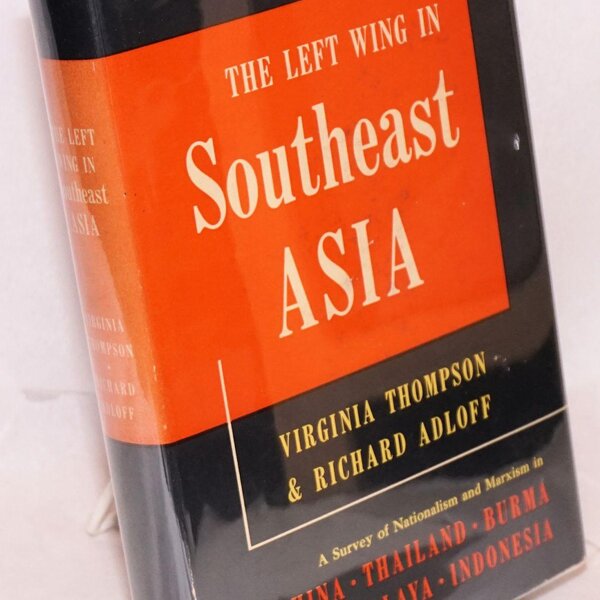
- The Left Wing in Southeast Asia, New York, William Sloane Associates, 1950.
- The Emerging States of French Equatorial Africa, 1960.
- [with Richard Adloff] Djibouti and the Horn Africa, Stanford University Press, 1968, 246 p.
- The French Pacific Islands: French Polynesia and New Caledonia, 1971.
- The Western Saharans: Background to Conflict, 1975.