


Publications
About Jean Moura's house and Khmer collection in Moissac, France
by Angkor Database
by Alfred Foucher
Brief notations on the personal collection of Khmer Art gathered by Jean Moura in his Moissac house before 1879.

Indianist and archaeologist active in Asia, Alfred Foucher was not directly a Khmerologist but his missions to Angkor as EFEO Director in 1902 – 1907, his closeness to several specialists of Khmer civilization such as Louis Finot and Suzanne Karpelès led him to take some interest in Khmer art and civilization, while his first mission for the Société Asiatique, in 1907, took him to Java.
His wife, Eugénie ‘Ena’ Bazin, a philologist and researcher herself, was very keen on Southeast Asian art, and together they visited Borobodur during the couple’s stint in Asia, from 1918 to 1926 (Foucher was then 53 years of age, Eugénie 29). In 1926, when traveling to Japan from Afghanistan, they spent almost two weeks (17−29 December) in Angkor.
This short study was based on Louis Finot and Etienne Lunet de Lajonquière’s visit to the personal residence of former France’s Representative to Cambodia Jean Moura after the latter’s death, at the request of the Commission archéologique de l’Indochine.
Note 1: Apart from reliefs and statues, Jean Moura kept in his Moissac residence important documents, sketches, maps, manuscripts, that were dispersed in an auction held in September 2017. Among the sold items, a photo-album titled ‘Album Supplémentaire’, with a selection of Cambodia-related engravings, photographs and drawings, including some photographs by Noémie Ary-Jouanne, the very first female photographer who captured Cambodian scenes and peoples in the 1870s [presently in Terry Bennett’s Collection, Ref: IND-GR-132 – 1b].
Note 2: Jean Moura’s former hôtel particulier in Moissac (Southwestern France), built circa 1770, was located 2 – 3, rue Saint-Jacques (later rue Jean Moura or rue des Arts).


1) “Image d’apothéose” [Idealized portrait]: Khmer head statue, unknown subject, unknown date and origin. 2) “Four-armed female deity, bronze color, H: 0,85 m, maybe a Lakshmi?” 3) a. [above] Female torso, H: 0,53 m. b. “Wooden ceiling fragment (one of the few recovered), probably used to hide the ill-repaired intrados of a vault; MM. Finot and De Lajonquière recognized the motive as similar to ceiling ornaments in Angkor Wat main portico.” [author’s caption and comment].

1) “Image d’apothéose” [Idealized portrait]: Khmer head statue, unknown subject, unknown date and origin. 2) “Four-armed female deity, bronze color, H: 0,85 m, maybe a Lakshmi?” 3) a. [above] Female torso, H: 0,53 m. b. “Wooden ceiling fragment (one of the few recovered), probably used to hide the ill-repaired intrados of a vault; MM. Finot and De Lajonquière recognized the motive as similar to ceiling ornaments in Angkor Wat main portico.” [author’s caption and comment].
1) “Image d’apothéose” [Idealized portrait]: Khmer head statue, unknown subject, unknown date and origin. 2) “Four-armed female deity, bronze color, H: 0,85 m, maybe a Lakshmi?” 3) a. [above] Female torso, H: 0,53 m. b. “Wooden ceiling fragment (one of the few recovered), probably used to hide the ill-repaired intrados of a vault; MM. Finot and De Lajonquière recognized the motive as similar to ceiling ornaments in Angkor Wat main portico.” [author’s caption and comment].
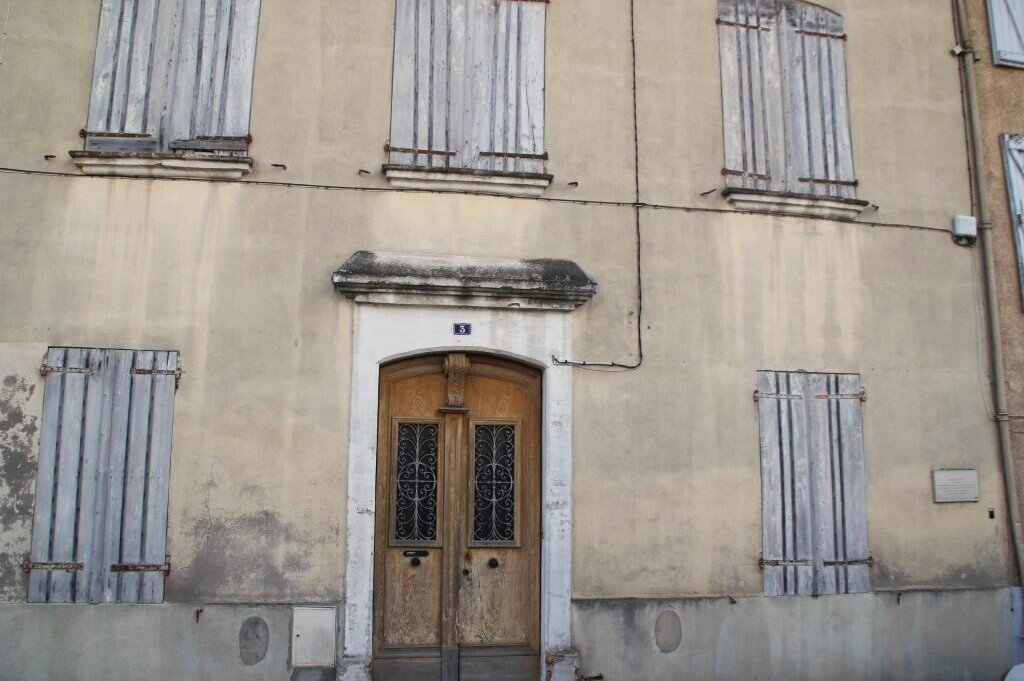
The Moissac house where Jean Moura stored Khmer artefacts and documents brought from Cambodia in the 1870s, 2 – 3 rue Saint-Jacques (later rue Jean Moura or rue des Arts), in 2017 [photo by Julie Philippe in “Des habitants de Moissac vivaient dans un décor inchangé depuis cent ans !”, La Dépeche du Midi, 15 Sept. 2017.]
The Moissac house where Jean Moura stored Khmer artefacts and documents brought from Cambodia in the 1870s, 2 – 3 rue Saint-Jacques (later rue Jean Moura or rue des Arts), in 2017 [photo by Julie Philippe in “Des habitants de Moissac vivaient dans un décor inchangé depuis cent ans !”, La Dépeche du Midi, 15 Sept. 2017.]
In Alfred Foucher’s and Eugénie Bazin-Foucher’s complete bibliography established in 2009, this publication is given reference number 54bis, as the second part of entry 54: “54: « Matériaux pour servir à l’étude de l’art khmèr » [sic], Bulletin de la Commission archéologique de l’Indochine 1912, p. 215 – 218 et pl. x‑xiv.[Analyse de diverses sculptures cambodgiennes : « I. Bronzes » appartenant à M. Chambert et à Auguste Barth, et « II. Deux têtes de statues en pierre » appartenant à Pierre Jarillon et au Dr Heckel.] 54bis – « Matériaux pour servir à l’étude de l’art khmèr » [sic], Bulletin de laCommission archéologique de l’Indochine 1913, p. 93 – 103 et pl. i‑viii. [Suite de l’article précédent. Analyse de diverses sculptures cambodgiennes : « III. La collection Moura » et « IV. Une statue du Buddha » découverte par Jean Commaille.]”
Tags: Khmer art, wooden ceilings, EFEO, French explorers, French archaeologists, archaeology, displaced artworks

Alfred Charles Auguste Foucher (21 Nov. 1865, Lorient — 30 Oct. 1952, Sceaux, France) was a French archaeologist, philologist, art and religion historian specialized in Buddhist iconography, a member of the French Société Asiatique and the Commission archéologique de l’Indochine, and the Deputy Director of EFEO in Hanoi from 1902 to 1904, then Director until 1907.
With famous Sanskritists Abel Bergaigne (1838−1888) and Sylvain Lévi (1863−1935) as mentors, he developed a lengthy career as an academic (professor at Ecole Pratique des Hautes études and Sorbonne University) and an indefatigable traveling archaeologist, working in Java, Afghanistan, Iran, India, Japan, lecturing at many universities worldwide, from Harvard to Lahore. He was a close friend of archaeologist Louis Finot, and of German and Dutch Indianists and archaeologists. After his 1884 dissertation ‘Les scenes figurées de la légende du Buddha’, he accumulated a remarkable knowledge on Buddhist iconography and art. His doctoral thesis in 1905 was titled L’art gréco-bouddhique du Gandhâra.
Albert Foucher visited several times the site of Angkor in the early 1900s, both for EFEO and for the Commission archéologique de l’Indochine, and was commissionned to study the collection of Khmer antiquities kept by Jean Moura at his Moissac house after his death in 1885. In Sept. 1904, Foucher delivered the eulogy of young archaeologist Charles Carpeaux after his premature death from illnesss. He went back to Angkor with his wife in December 1925, In a 1926 conference in Tokyo, titled “Une récente visite aux ruines d’Angkor et les antiquités bouddhiques du Cambodge”, he talked about his findings during that visit.
On 14 Feb. 1919, Alfred Foucher married in Colombo (Sri Lanka) Eugénie ‘Ena’ Bazin (7 Oct. 1889 – 30 Jan. 1952), whom he had met during her studies at Sorbonne University, where she majored in English with a dissertation on Rabindranath Tagore. Together, they traveled and published extensively during the following decades, in particular La vieille route de l’Inde de Bactres à Taxila, Paris, 1942 – 1947.
Fluent in Parsi and Hindi, Ena Bazin-Foucher was able to converse with Queen Soraya Tarzi of Afghanistan without the help of an interpreter. She assisted him through his mission for the Archaeological Survey of India. Later on, Alfred Foucher would be a resolute promoter of young female archaeologists and orientalists in this rather male-chauvinistic milieu.
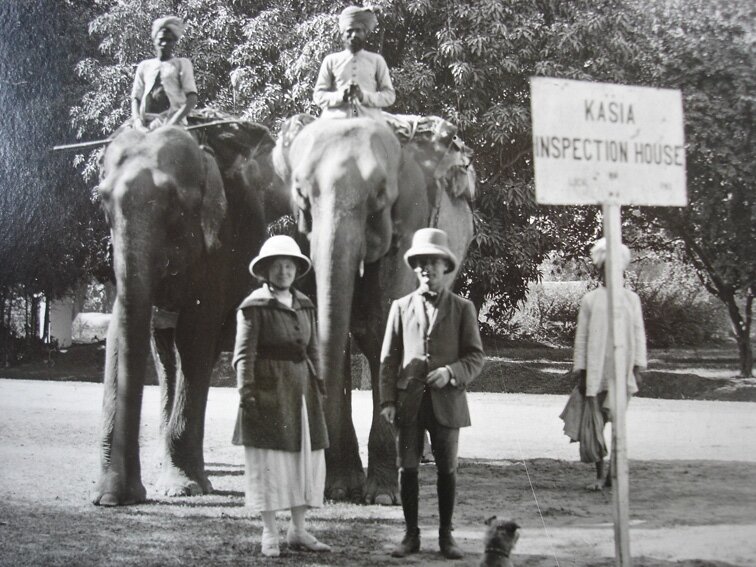
Ena Bazin-Foucher and Alfred Foucher in Kushinagar, India, 1920 (from Annick Fenet, “De la Sorbonne à l’Asie. Routes orientalistes d’Ena Bazin-Foucher (1889−1952)”, in Voyageuses et histoire(s) 2/2, Fall 2011).
Ena Bazin-Foucher and Alfred Foucher in Kushinagar, India, 1920 (from Annick Fenet, “De la Sorbonne à l’Asie. Routes orientalistes d’Ena Bazin-Foucher (1889−1952)”, in Voyageuses et histoire(s) 2/2, Fall 2011).
[based on Annick Fenet, “L’oeuvre écrite d’Alfred Foucher et d’Eugénie Bazin-Foucher: Bibliographies inédites et commentées”, in Bouddhismes d’Asie: Monuments et Littératures, Journée d’étude en hommage à Alfred Foucher (1865−1952) réunie le 14 décembre 2007 à I’Académie des Inscriptions et Belles-Lettres (palais de l’lnstitut de France), Pierre-Sylvain Filliozat et Jean Leclant eds., Paris, AIBL — Diffusion De Boccard, 2009).]