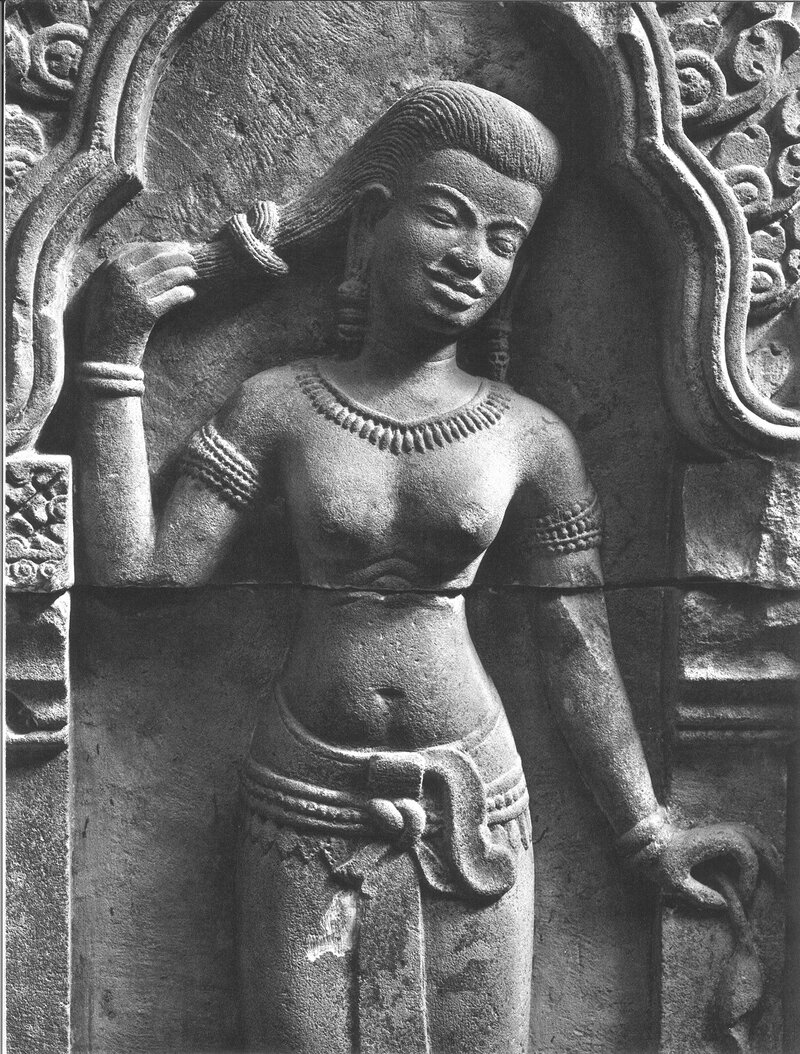
Photos
Khmer Art at Paris Guimet Museum, 1965
by Jeannine Auboyer
by Collective
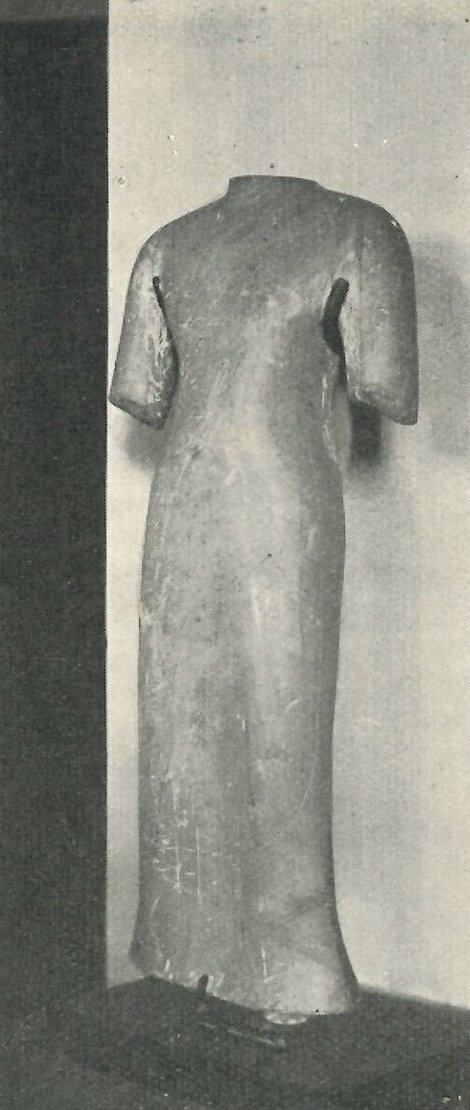
A. Standing Buddhist male statue, Pre-Angkorian style. Pl. III (1-1).
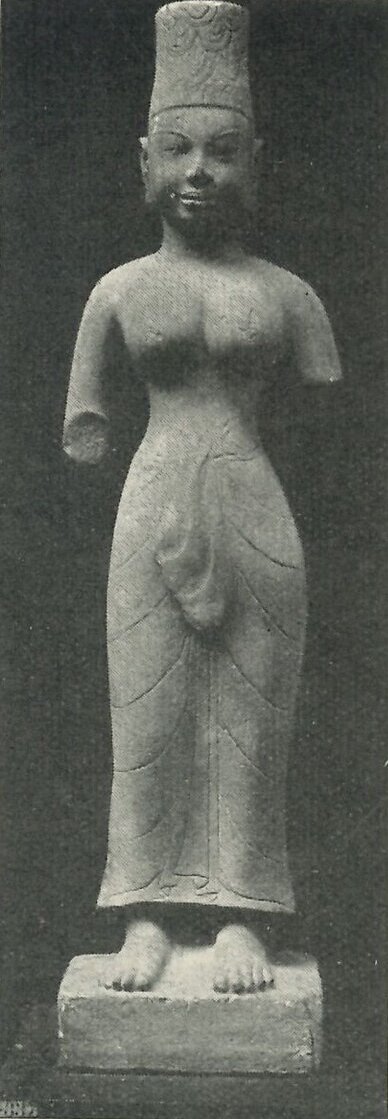
B. Standing female statue, Pre-Angkorian style. Pl. III (1-2).
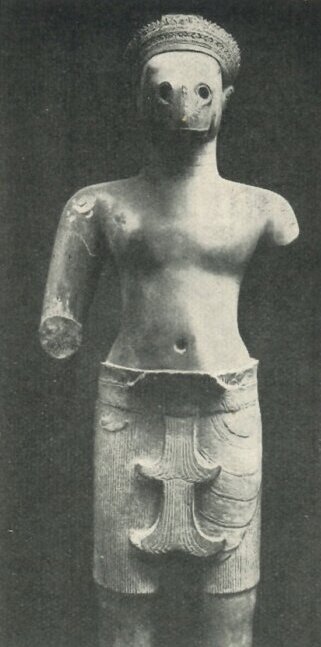
C. Standing male statue with horse's head: Yakşa, Kalki or Balāha (?), Roluos style. Pl. III (2-3).
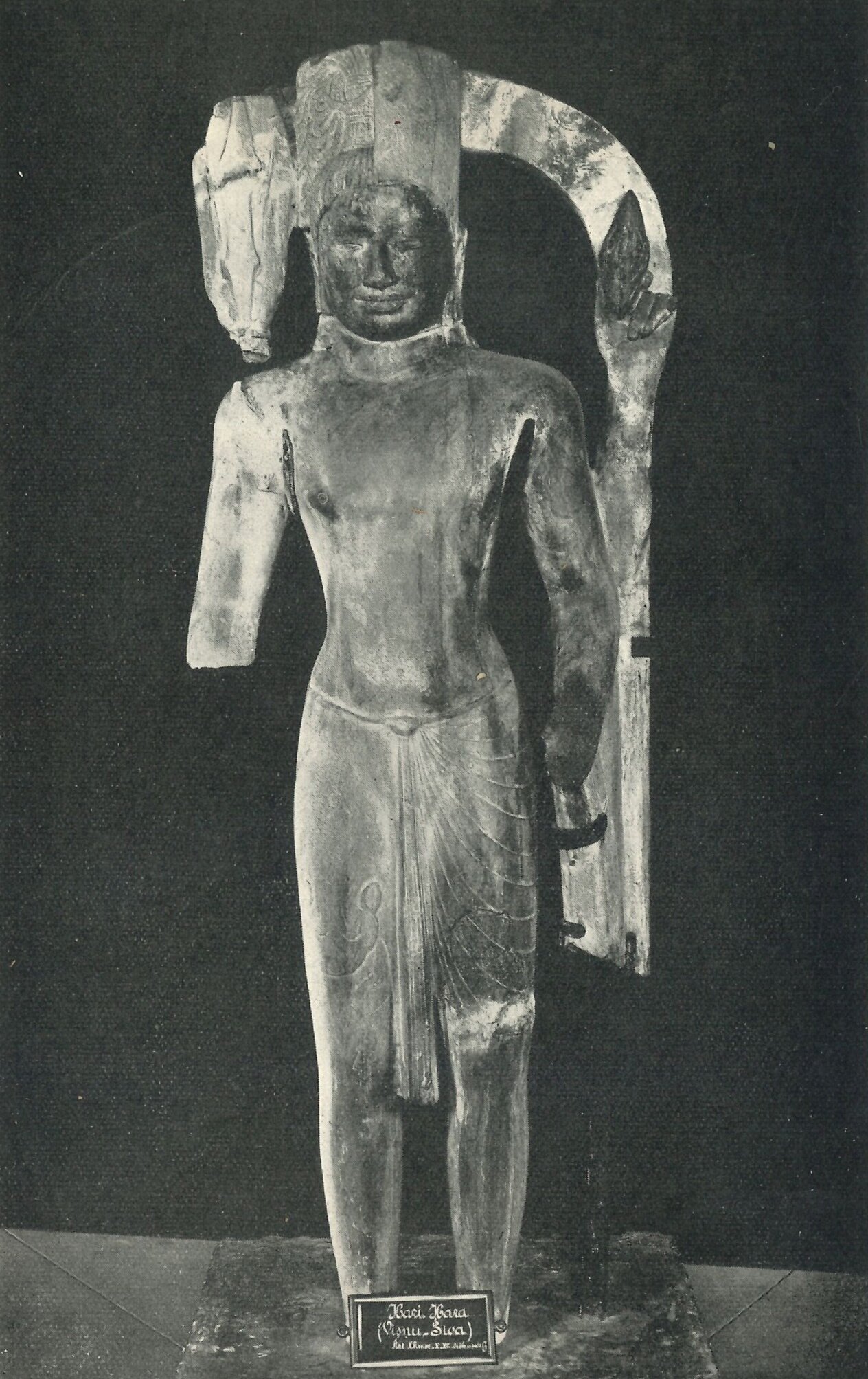
Statue of Hari-Hara with four arms, standing, Pre-Angkorian style. Pl. IV (1-6).
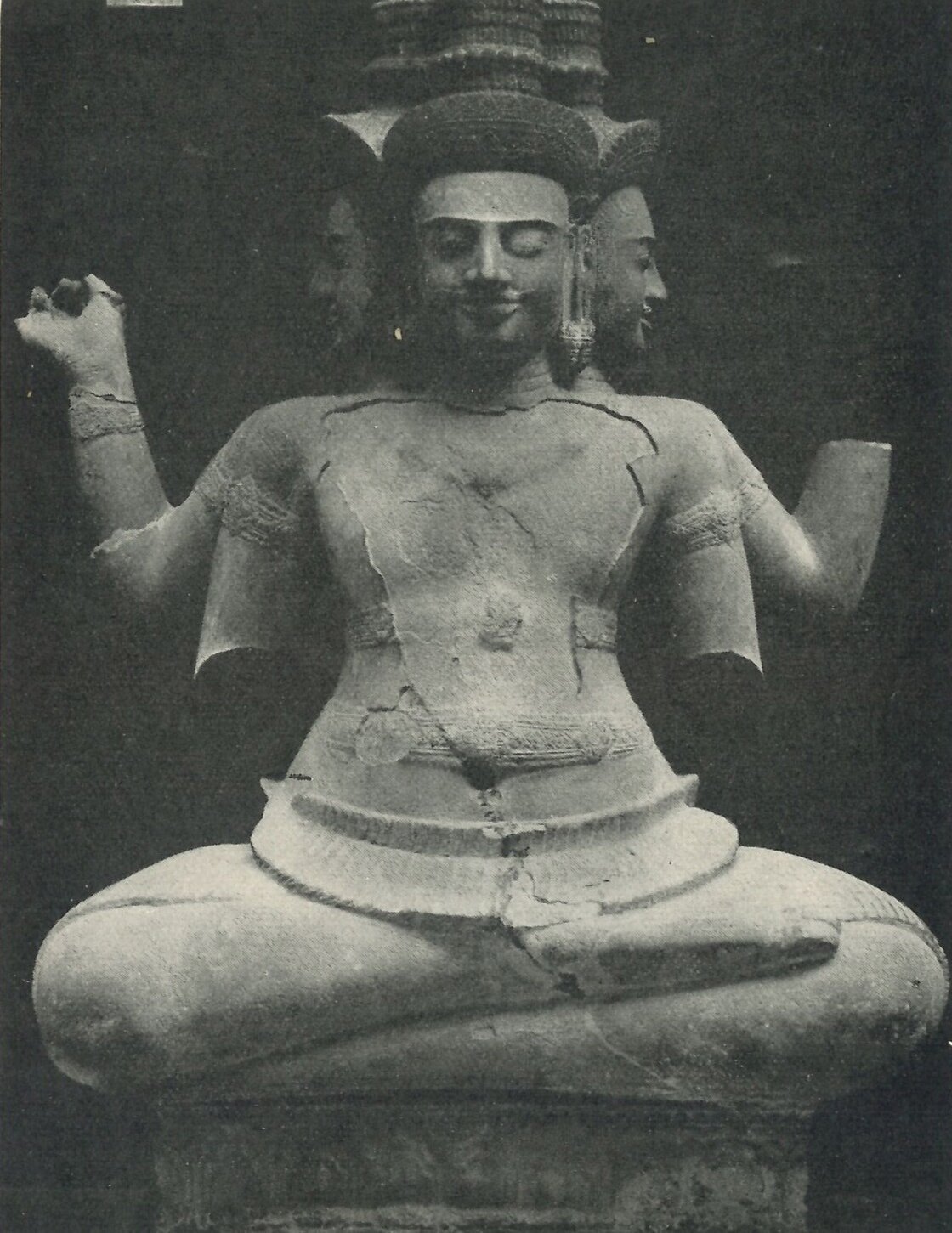
Statue of Brahmā with four arms, seated in virāsana, Koh Ker style. Pl. V (2-4).
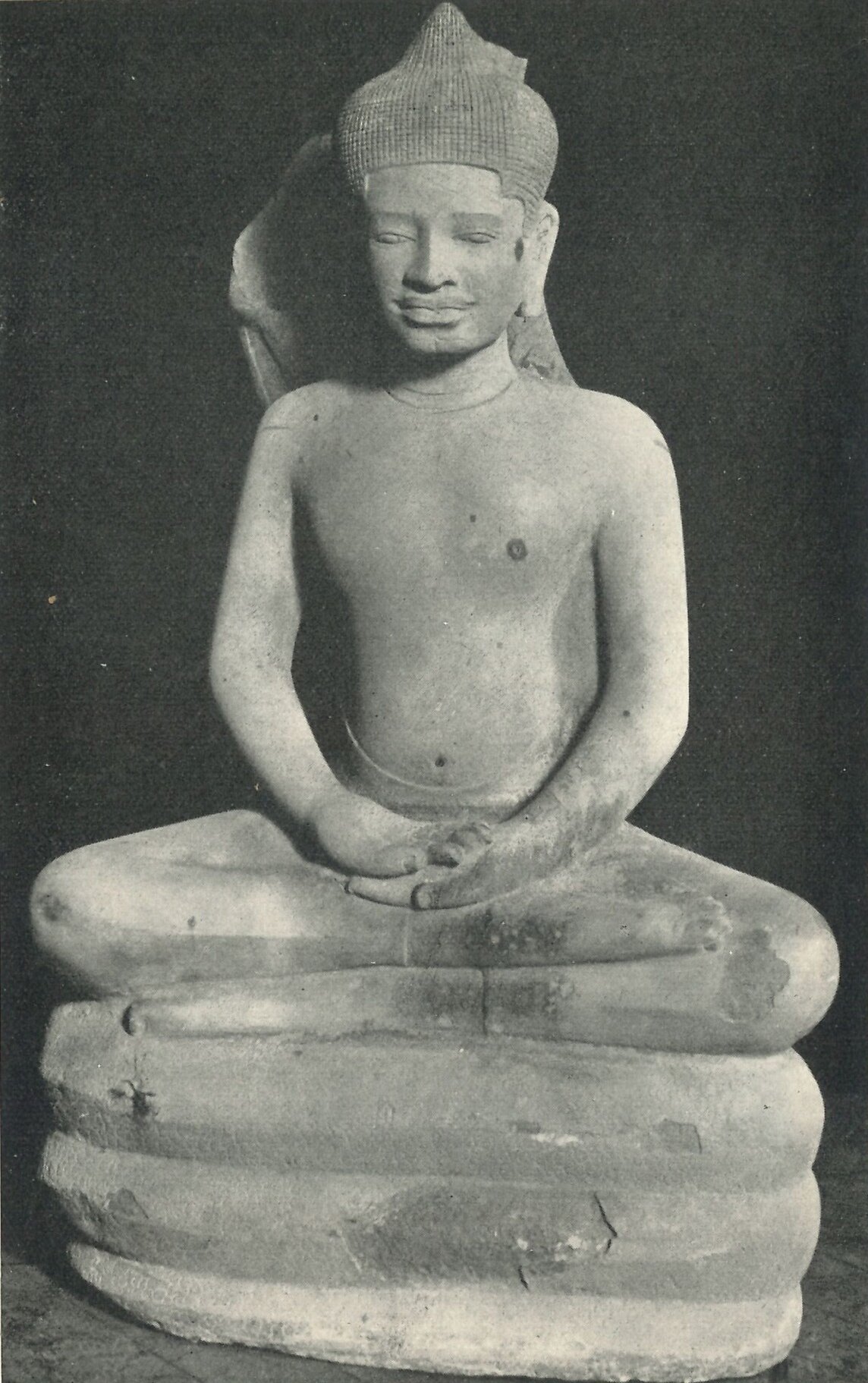
Statue of Buddha seated in dhyāna-mudrā and paryankāsana on the heptacephalus nāga, Bayon (Ankor, Siem Reap). Pl. VI (3-33).
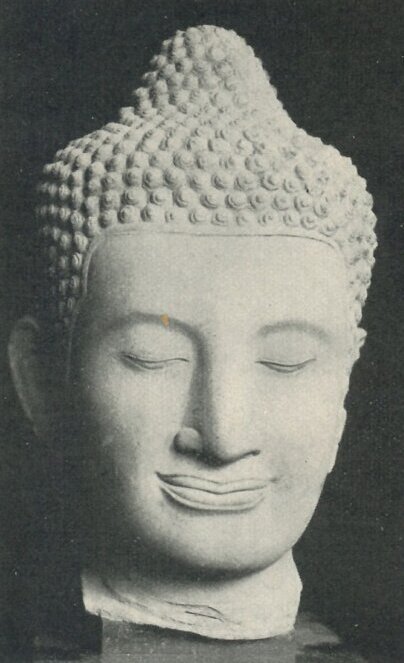
Head of Buddha, Bayon style. Pl. VII (4-13).
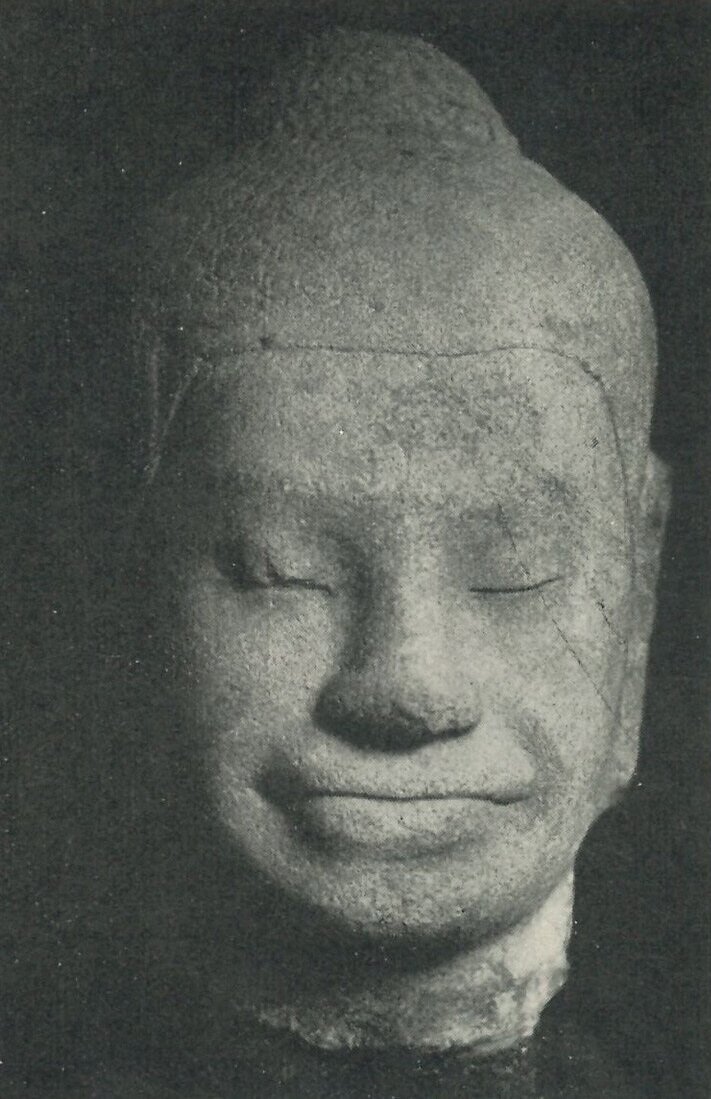
Head of Buddha, Bayon style. Pl. VII (4-18).
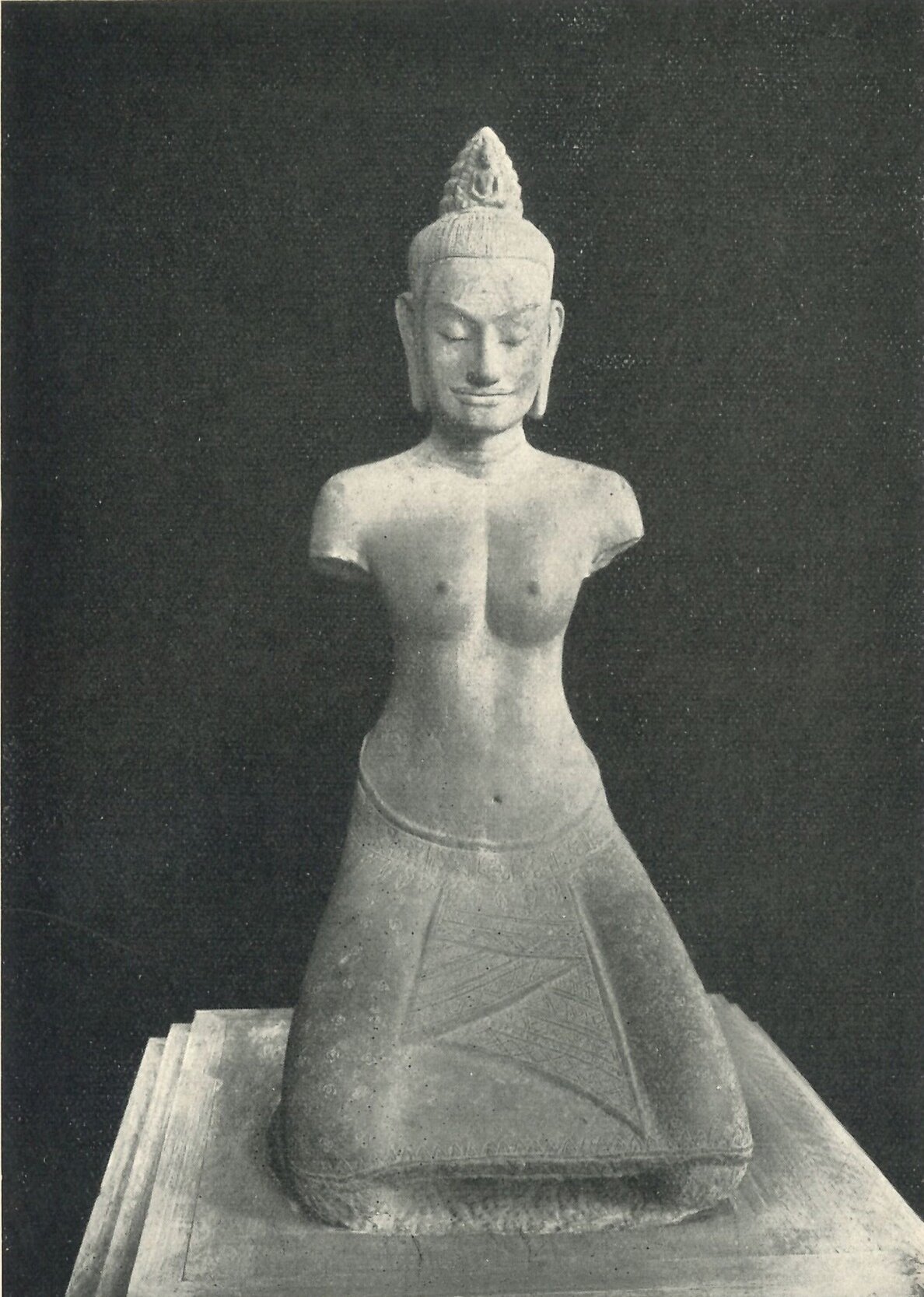
Kneeling female statue: Tārā or Prajñāparamitā (?), Bayon style. Pl. VIII (4-37).
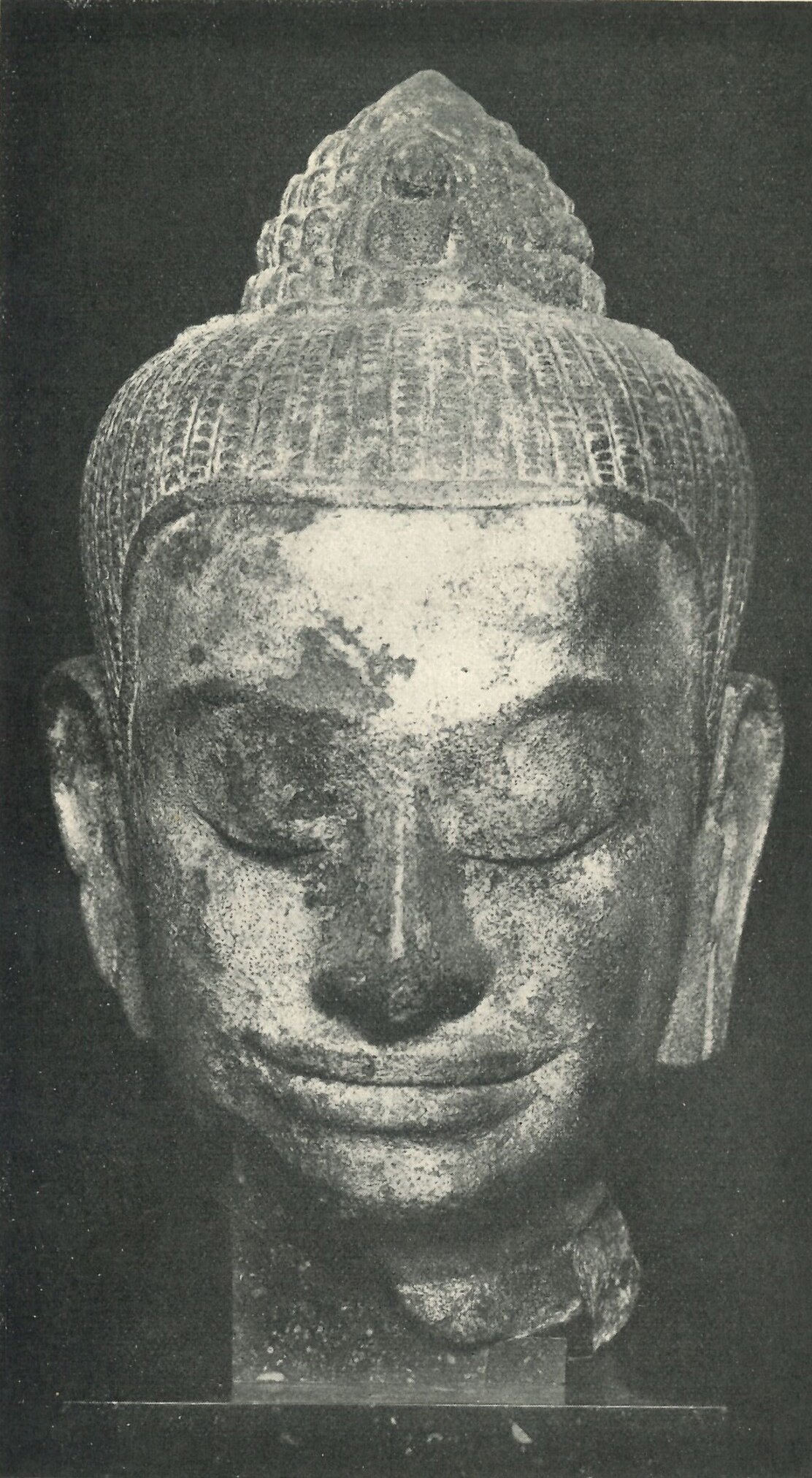
Head of Prajñāpāramitā (?), Bayon style. Pl. IX (4-40).
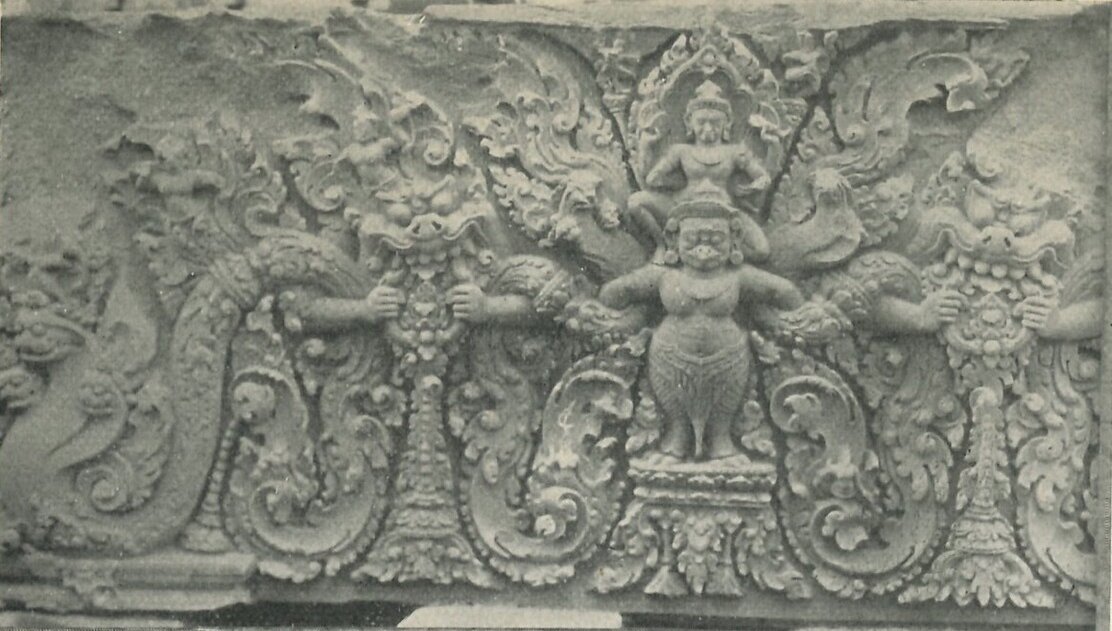
Lintel depicting Vişnu on Garuda, Roluos style. Pl. X (2-1).
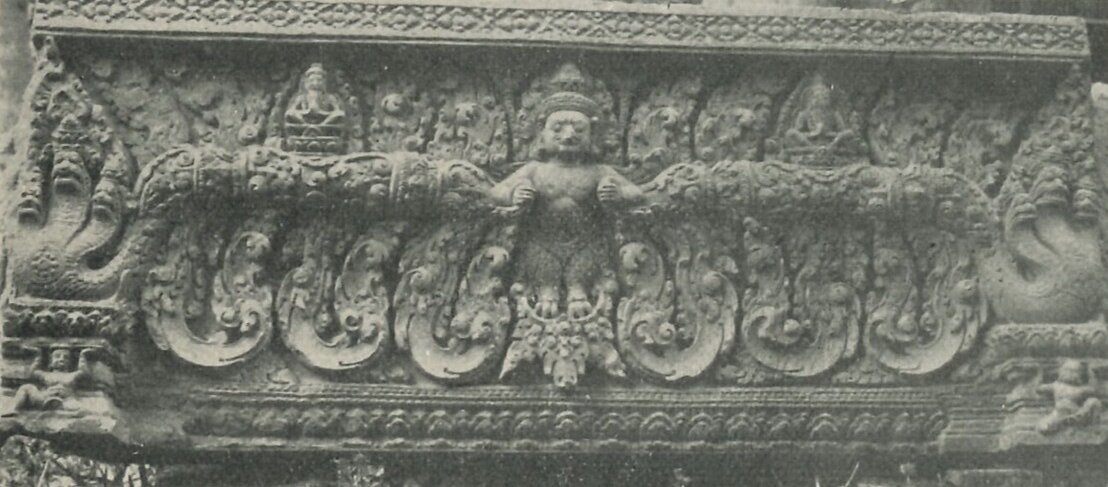
Lintel representing Garuda, Koh Ker style. Pl. X (2-11).
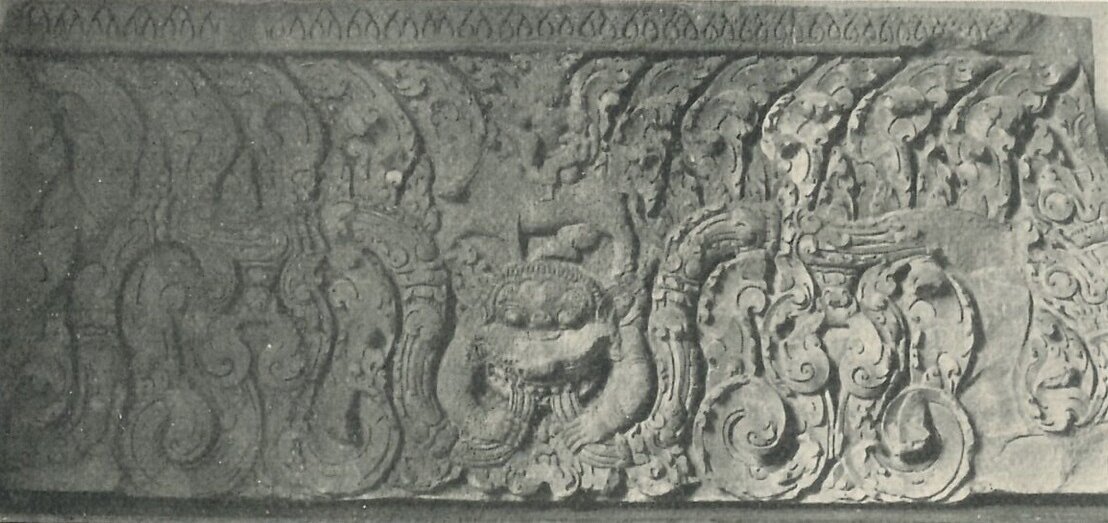
Lintel with Shiva and Pārvatī riding on the bull Nandin, Baphuon style. Pl. X (3-5).
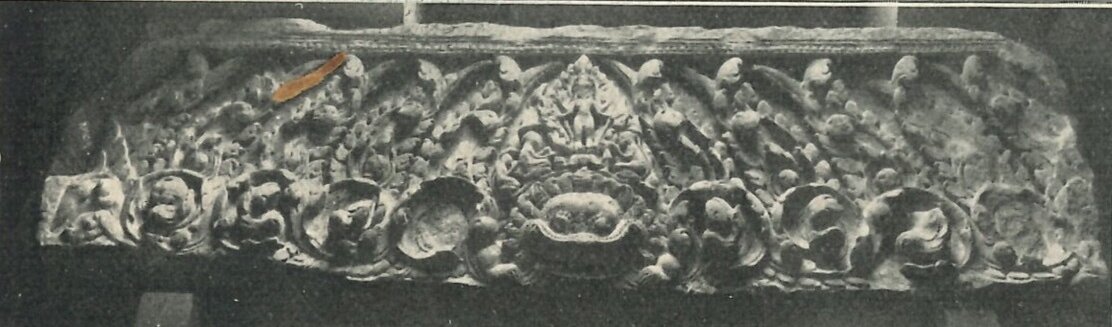
Lintel representing Vişnu, Bayon style. Pl. X (4-22).
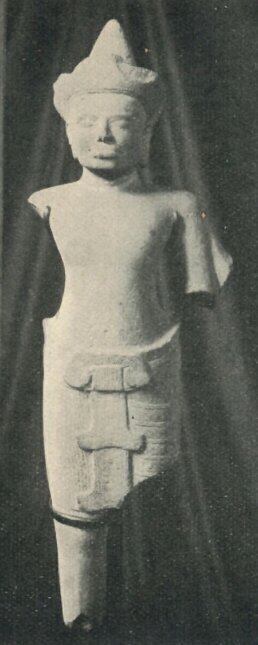
Standing four-armed male statue, Khmer art, Baphuon style (?). Pl. XI (3-20).
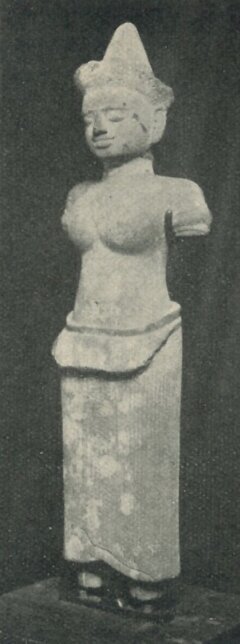
Standing female statue, Khmer art, Baphuon style (?). Pl. XI (3-21).
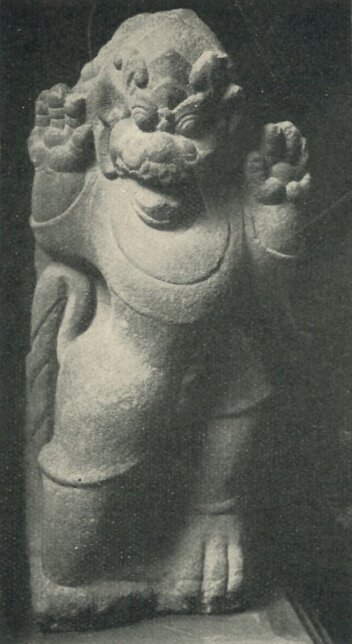
Accent piece decorated with a standing lion, Cham art, Trà-kiệu style. Pl. XI (6-3).
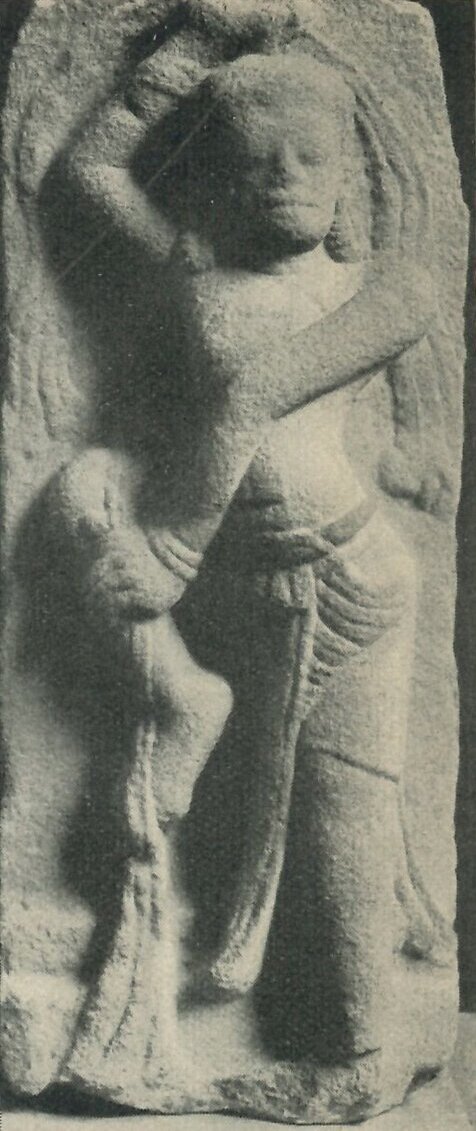
Metope decorated with a dancer, Cham art, Trà-kiệu style. Pl. XI (6-5).
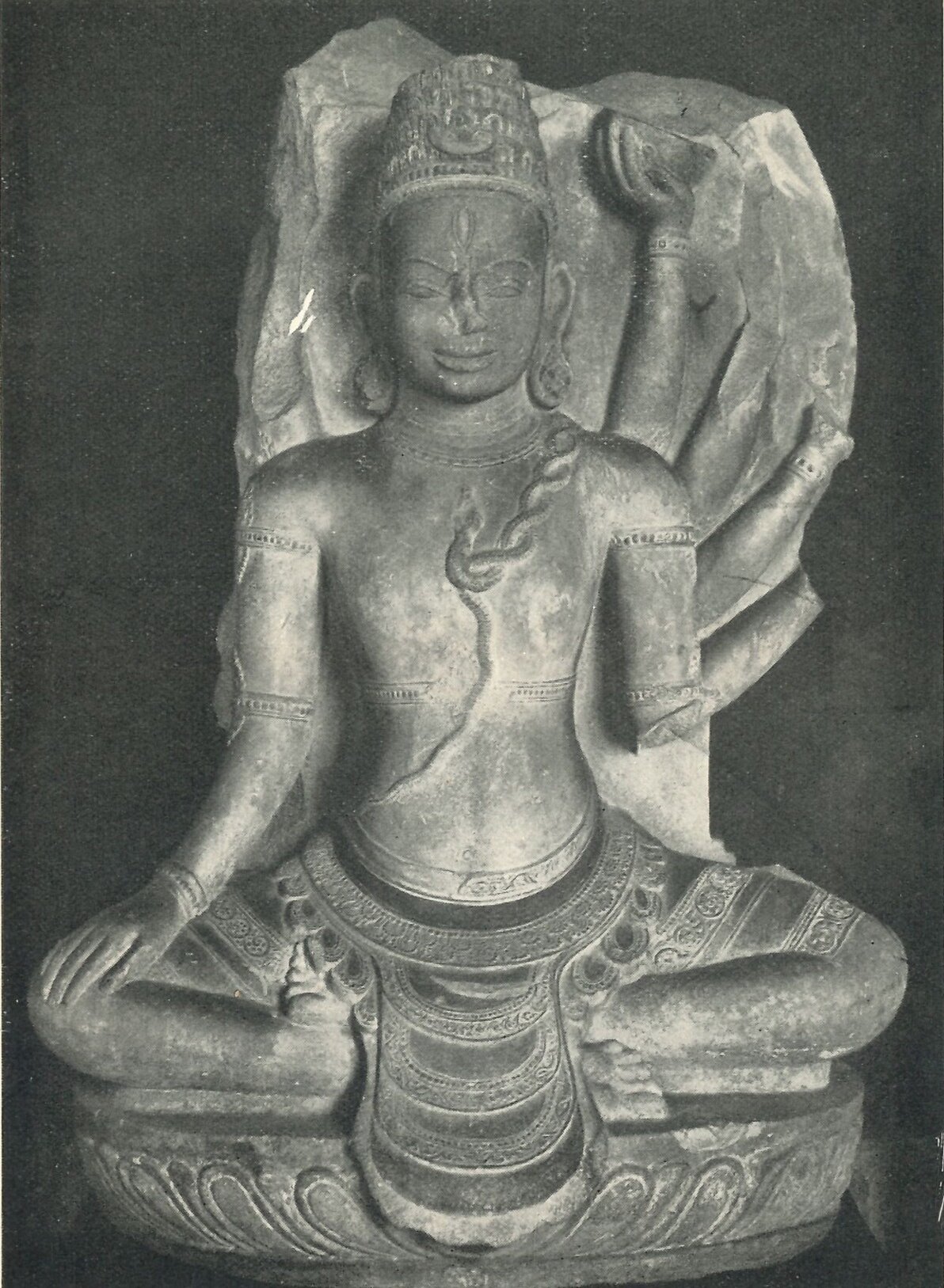
Statue of Shiva with ten arms, seated in vīrāsana, classic Cham style. Pl. XII (8-1).
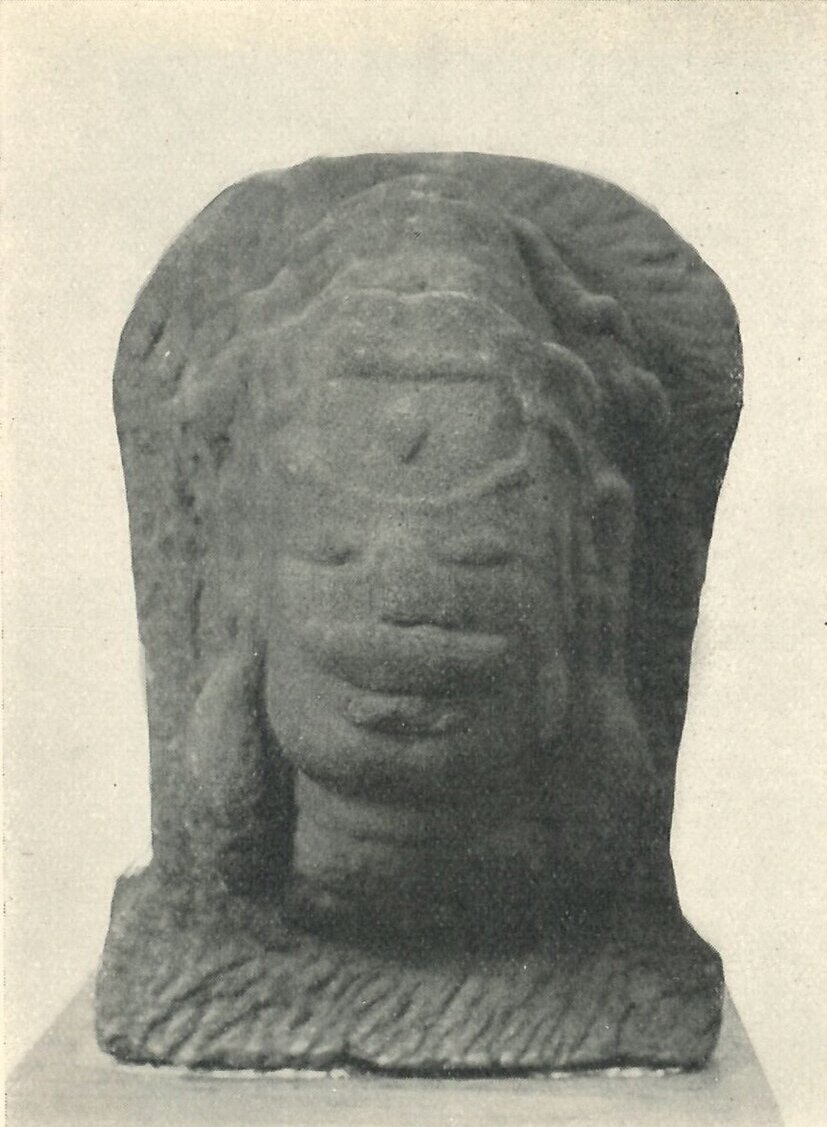
Metope decorated with a head of Shiva, Đồng-dương style. Pl. XIII (7-1).
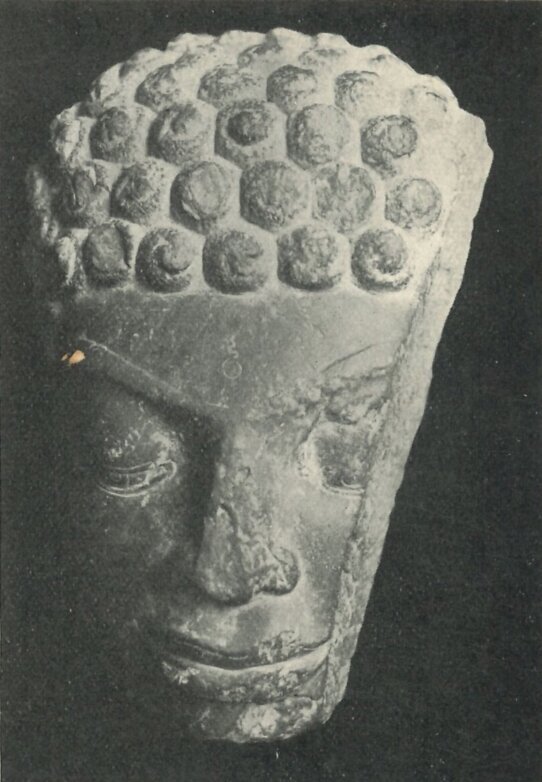
Head of Buddha, Dvāravatī style. Pl. XIII (11-1).
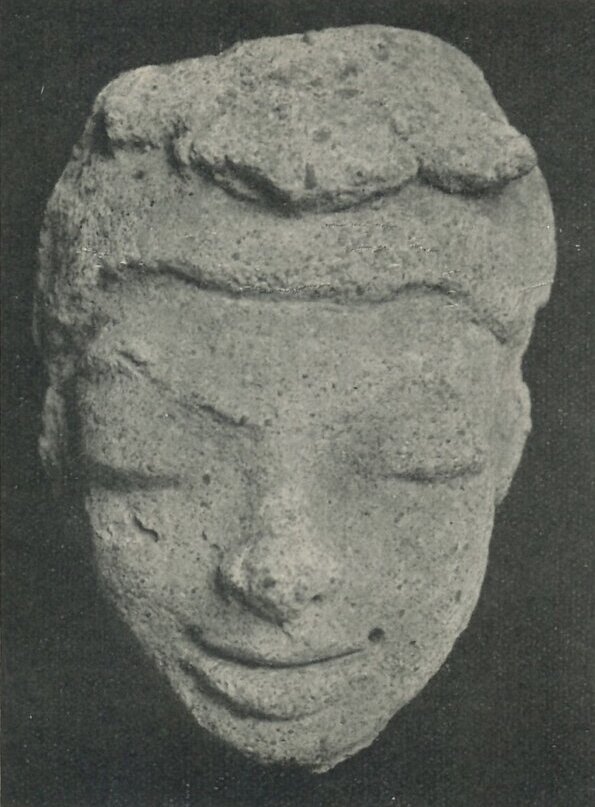
Man mask (?), Dvāravatī style. Pl. XIV (11-3).
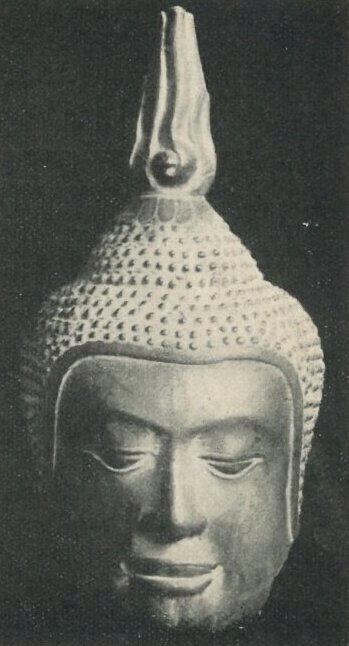
Head of Buddha, Ũ-T’ông style. Pl. XIV (12-1).
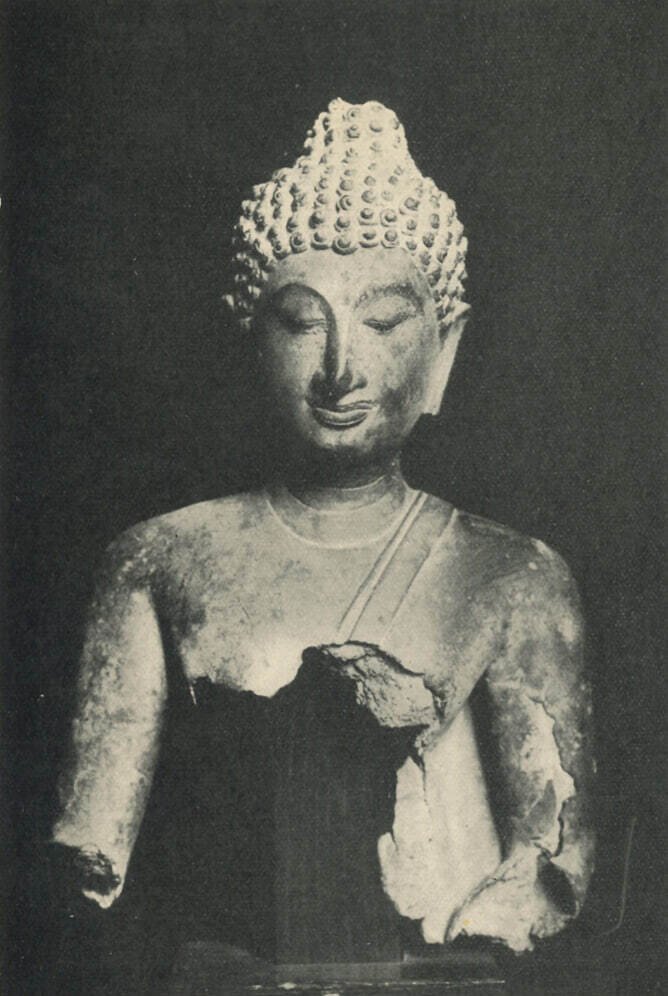
Bust of Buddha, Sukhodaya style (?). Pl. XV (13-1).
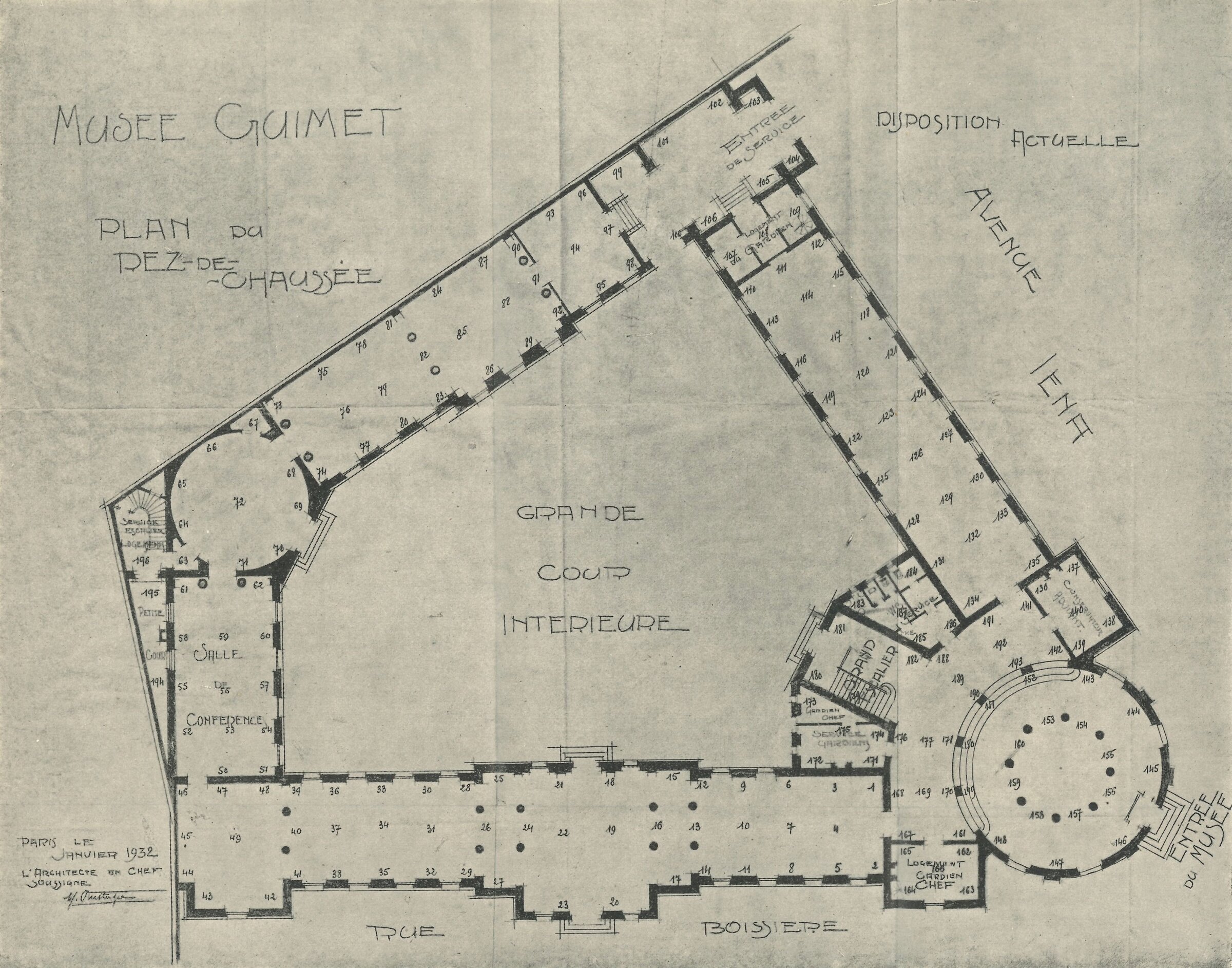
Guimet Museum, Salles des collections indochinoises [Halls of Indochinese Collections], groundfloor, 1934.
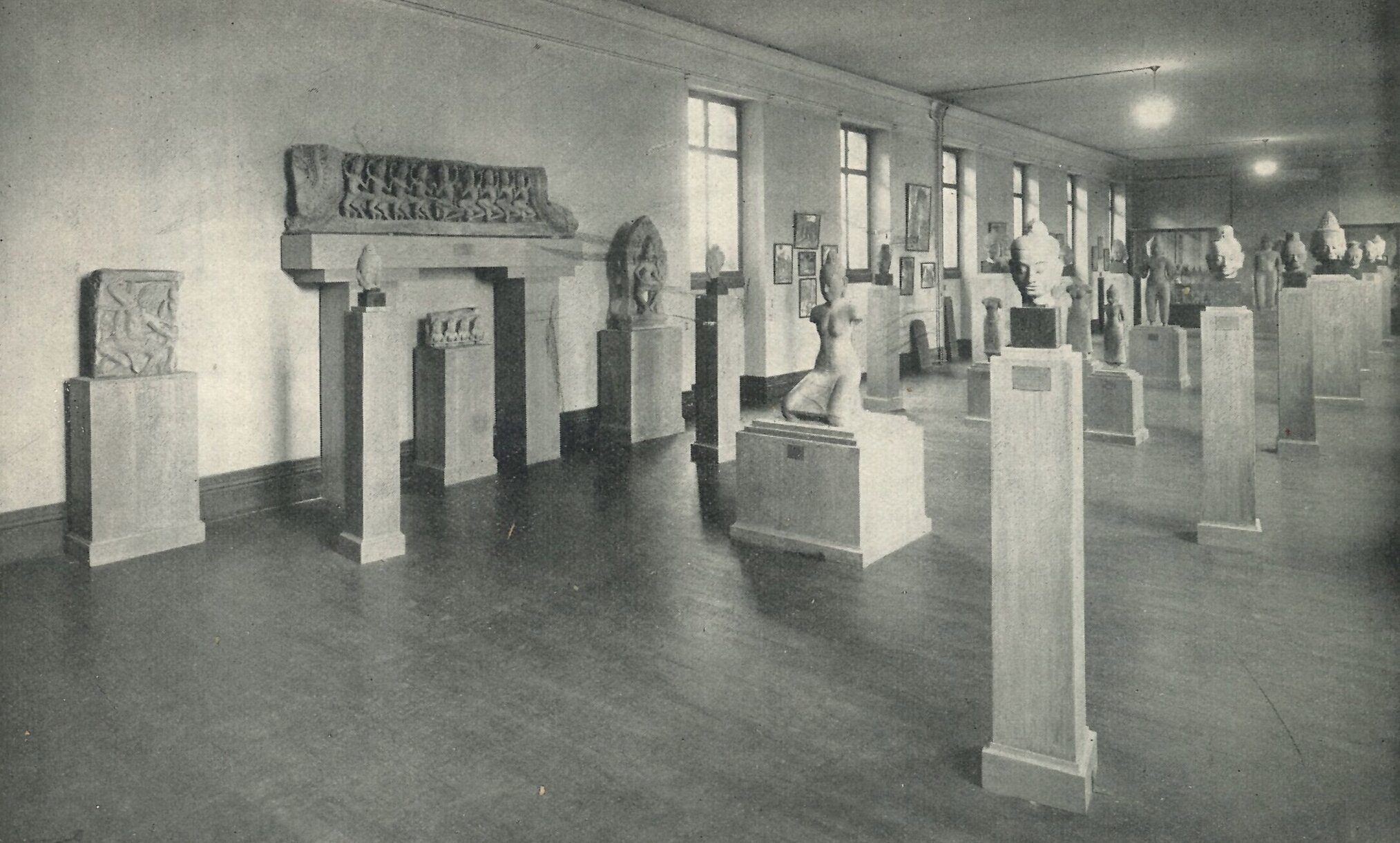
Musée Guimet, Salle du Bàyon. Pl-II.

[CGX] refers to numbering in the ADB photo collection.
14880. Ronde-bosse. Grès poli. H. : 0 m. 92.
Statue masculine bouddhique debout.
Position hanchée. Vêtement à contours et détails simplement incisés, moulant le corps jusqu’aux chevilles; ceinture visible par transparence; drapé à plis verticaux sur le devant. Par-dessus (?), cīvara découvrant l’épaule droite, enroulé autour du corps et ramené sur l’épaule gauche en un pan drapé descendant jusqu’à la taille. Plis concentriques autour des jambes, également incisés et peut-être rajoutés, ainsi que le pan sur l’épaule (Ph. STERN).
Statue non bouddhique à l’origine, modifiée ultérieurement. Tête, avant-bras et pieds brisés. Traces de nombreuses retouches. Provenance inconnue.
[14880. Roundabout. Polished stoneware. H.: 0 m. 92.
Standing Buddhist male statue.
Contrapposto [1]. Garment with simply incised contours and details, hugging the body down to the ankles; belt visible through transparency; draped with vertical pleats on the front. Above (?), cīvara revealing the right shoulder, wrapped around the body and brought back over the left shoulder in a draped section reaching down to the waist. Concentric folds around the legs, also incised and perhaps added, as well as the panel on the shoulder (Ph. STERN).
Originally non-Buddhist statue, later modified. Head, forearms and feet broken. Traces of numerous retouching. Origin unknown.]
Mission AYMONIER (?) 1882 – 1883. M.E.T., 1886 (?); M.G., 1890.
Bibl. : COEDÈS, n° G. 78, 42. — PARMENTIER, A.K.P., I, 325, fig. 114 B.
[1] ADB Note: The counterpoise position, which appeared in Ancient Greek statuary as early as 5th century BCE, was adopted in European Gothic sculpture only from the 13th century.
18095 (T. 337). Ronde-bosse. H. : 1 m. 05.
Statue féminine debout.
Position hanchée. Chevelure incisée relevée en coiffure cylindrique à mèches retombantes. Arcades sourcilières non jointes et en relief. Yeux à fleur de tête. Caroncules lacrymales indiquées. Iris en relief, pupilles indiquées par un point. Bouche charnue. Lèvre supérieure bordée. Demi-sourire. Plis au cou. Vêtement féminin légèrement évasé à plis concentriques incisés; sur le devant, drapé à plis verticaux incisés et poche drapée en relief. Étroite ceinture unie. — Socle rectangulaire.
Lobes des oreilles percés. Bras droit el avant-bras gauche brisés. Provenance : Popel (Romduol).
[18095 (T. 337). In the round. H.: 1 m. 05.
Standing female statue.
Contrapposto. Incised hair raised in a cylindrical hairstyle with falling locks. Unjoined and raised eyebrow arches. Eyes on the head. Tear wattles indicated. Iris in relief, pupils indicated by a dot. Fleshy mouth. Upper lip lined. Half smile. Pleats at the neck. Slightly flared feminine garment with incised concentric pleats; on the front, draped with incised vertical pleats and raised draped pocket. Narrow plain belt. — Rectangular base.
Pierced earlobes. Right arm and left forearm broken. Origin: Popel (Romduol)]
Mission AYMONIER, 1882 – 1883. M.E.T., 1886 (?); M.G., 1890.
Bibl. : COEDÈS, n° T. 3, 7. — AYMONIER, I, 252. — LUNET DE LAJON-QUIÈRE, I.K., I, fig. 45. — PARMENTIER, A.K.P., I, 245, 322. — GROUSSET, B.A., n° 16, fig. 4. — HACKIN-GROUSSET, 22.
14910. Ronde-bosse. Grès poli. H. : 1 m. 75.
Statue de Hari-Hara à quatre bras, debout.
Sur le côté droit (Çiva), chevelure relevée en chignon cylindrique à mèches tressées retombantes, portant le croissant lunaire sur le devant. Demi-cil frontal, à iris rendu par un cercle incisé. Trident. Autour de la hanche, dépouille du fauve, dont la tête et une patte sont indiquées en très léger relief. — Sur le côté gauche (Vişnu), haute tiare cylindrique lisse. Frange de cheveux sur le front et longues boucles enroulées sur la nuque. Roué dans la main supérieure gauche. Autour de la hanche, vêtement à plis concentriques incisés, noué devant par torsion (P. BELLUGUE); chute d’étoffe drapée devant; pan plissé ramené derrière entre les jambes et repassé dans la ceinture. — Visage doré. Yeux à fleur de tête. Iris rendus par un double cercle incisé. Rotules des genoux légèrement marquées. — Are encadrant le corps et venant prendre appui derrière la coiffure.
Lobes des oreilles percés. Tête et bras gauche rescellés. Bras supérieur et avant-bras inférieur droits, main inférieure gauche, pieds, manche du trident et une partie de l’are d’appui brisés.
Provenance : Àsram Mahà Rosěi (Prei Krabàs).
[14910. Roundabout. Polished stoneware. H.: 1 m. 75.
Statue of Hari-Hara with four arms, standing.
On the right side (Shiva), hair raised in a cylindrical bun with falling braided locks, bearing the lunar crescent on the front. Frontal half eyelash, with iris rendered by an incised circle. Trident. Around the hip, remains of the beast, whose head and one leg are indicated in very light relief. — On the left side (Vişnu), tall smooth cylindrical tiara. Fringe of hair on the forehead and long curls curled at the nape of the neck. Wheel in left upper hand. Around the hip, garment with incised concentric folds, tied in front by twisting (P. BELLUGUE); fall of fabric draped in front; pleated panel brought back between the legs and ironed into the waistband. — Golden face. Eyes on the head. Iris rendered by a double incised circle. Slightly marked kneecaps. — Are framing the body and coming to support behind the hairstyle.
Pierced earlobes. Head and left arm resealed. Right upper arm and lower forearm, left lower hand, feet, trident handle and part of the support are broken.
Origin: Àsram Mahà Rosěi (Prei Krabàs).]
Mission AYMONIER, 1882 – 1883. M.E.T., 1886 (?); M.G., 1890.
Bibl. : COEDÈS : n° G. 3, 31. — C. 1897, 49; 1900, 76; 1905, 50; 1908, 1; 1910, 50. — AYMONIER, I, 200. — DE MILLOUÉ, 117, fig. 118. — LUNET DE LAJONQUIÈRE, I.K., I, 14, fig. 54. — PARMENTIER, A.K.P., I, 245, fig. 110. — GROUSSET, B.A., n° 16, fig. 1. — GOLOUBEW, E.A., I, 285. — HACKIN-GROUSSET, 22. — MIGEON, E., I, 1, 53, fig. 2. — GROUSSET, C.O., II, 197, fig. 132.
18217. Relief. Grès. H. : 2 m. 45.
Linteau représentant Vişnu sur Garuda.
Branche centrale légèrement sinueuse, terminée à chaque extrémité par un nāga tricéphale couronné qui repose sur un socle décoré d’un lion en atlante. La branche est scindée au milieu et, de chaque côté, à mi-distance. Les tronçons du centre se terminent chacun par un nāga du même type que ci-dessus. — La scène centrale représente Vișnu assis à la javanaise sur les épaules de Garuda, l’un et l’autre de face. Vişnu est dans un encadrement polylobé à décor floral : diadème; coiffure à étages; collier; quatre bras; bracelet au haul de chaque bras; attributs indistincts sauf la roué. — Garuda porte une coiffure à étages, avec une rosace au-dessus de chaque oreille : arcades sourcilières en relief stylisées; yeux exorbités; bec d’oiseau; pendants d’oreilles; plis au cou; buste humain; collier; ceinture orfévrie sur le buste nu; pattes d’oiseau très stylisées. — De chaque côté, aux coupures, tête de monstre à bras humains tenant une grosse pendeloque. Dans les rinceaux, autour des personnages, figurines d’apsaras et de garuda. (INDOCHINE. — 1933. — J. 109.)
Style de Rolùos.
Quelques cassures.
Provenance: Pràsàt Kôk Pô (Ankor, Siem Rap).
[18217. Relief. Sandstone. H.: 2 m. 45.
Lintel depicting Vişnu on Garuda.
Slightly sinuous central branch, ending at each end with a crowned three-headed nāga which rests on a base decorated with an Atlantean lion. The branch is split in the middle and, on each side, halfway. The central sections each end with a nāga of the same type as above. — The central scene represents Vișnu seated Javanese style on Garuda’s shoulders, facing each other. Vişnu is in a polylobed frame with floral decoration: tiara; layered hairstyle; necklace; four arms; bracelet on the top of each arm; indistinct attributes except the wheel. — Garuda wears a layered hairstyle, with a rosette above each ear: stylized raised eyebrow arches; bulging eyes; bird beak; drop earrings; neck creases; human bust; necklace; gold belt on the bare bust; Very stylized bird legs. — On each side, at the cuts, a monster’s head with human arms holding a large pendant. In the scrollwork, around the characters, figurines of apsaras and garuda. (INDOCHINA. — 1933. — J. 109.)
Rolùos style.
Some breaks.
Origin: Pràsàt Kôk Pô (Ankor, Siem Rap).]
Fouilles É.F.E.-O. (dépôt d’Ankor, n° 43). Envoi G.G.I.-M.G., 1931.
Exposition Coloniale, Paris, 1931. N° 64.
Bibl.: PARMENTIER, B.É.F.E.-O., XIX, 1919, 44 – 45, pl. VI. — Chronique, B.É.F.E‑O., XXXI, 1931, 647 (n° 64).
18099 (T. 358). Ronde-bosse. Grès poli. H.: 1 m. 35.
Statue masculine debout, à tête de cheval : Yakşa, Kalki ou Balāha (?).
Coiffure sculptée, à étages, fixée sur une sorte de casque dont une partie très ornée couvre la nuque. Diadème orné, noué derrière. Oreilles de cheval au pavillon stylisé décorativement. Plis au cou. Vêtement masculin plissé, avec drapé en poche sur la cuisse gauche; chute d’étoffe plissée, drapée devant en double ancre; pan passé entre les jambes, et noué en coque, devant et derrière à la ceinture. Ceinture unie, nouée en coque, à gauche et à droite (P. BELLUGUE). — Cette pièce a été identifiée soit avec le dixième avatar (équestre) de Vişnu (Kalki) [Ph. STERN, d’après un texte tantrique], soil avec la forme secourable et chevaline d’Avalokiteçvara (Balāha) [V. GOLOUBEW, loc. cit. ]. On remarquera que le n° 2 – 7, qui représente vraisemblablement Vişnu, porte le même casque et la même coiffure. Celle-ci se retrouve par ailleurs sur de fréquentes figurations khmères et čames de Garuda. Peut-être n’est-ce qu’un simple «génie à tête de cheval» (yakşa açvamukha), du type que les Hindous modernes attribuent aux gandharvas, tel, par exemple, que Tumburu qui figure régulièrement dans le cortège de Çiva (A. FOUCHER).
Style de Rolùos.
Une partie du diadème et bras droit rescellés. Avant-bras droit, bras gauche et pieds brisés.
Provenance : Sambuor (Kompon Svày).
[18099 (T. 358). In the round. Polished stoneware. H.: 1 m. 35.
Standing male statue with horse’s head: Yakşa, Kalki or Balāha (?).
Sculpted, layered hairstyle, attached to a sort of helmet, a very decorated part of which covers the nape of the neck. Ornate tiara, tied behind. Horse ears with decoratively stylized flag. Pleats at the neck. Pleated male garment, with draped pocket on the left thigh; scrap of pleated fabric, draped in front in a double anchor; section passed between the legs, and tied in a shell, front and back at the belt. Plain belt, knotted in a shell, on the left and right (P. BELLUGUE). — This piece has been identified either with the tenth (equestrian) avatar of Vişnu (Kalki) [Ph. STERN, according to a tantric text], is with the helpful and equine form of Avalokiteçvara (Balāha) [V. GOLOUBEW, loc. cit. ]. Note that number 2 – 7, which probably represents Vişnu, wears the same helmet and the same hairstyle. This is also found on frequent Khmer and came representations of Garuda. Perhaps he is only a simple “horse-headed genius” (yakşa açvamukha), of the type that modern Hindus attribute to gandharvas, such as, for example, Tumburu who regularly appears in Siva’s procession (A. FOUCHER).
Rolùos style.
Part of the tiara and right arm resealed. Right forearm, left arm and feet broken.
Origin: Sambuor (Kompon Svày).]
Don A. LECLÈRE. M.I.T…, 1896; M.G., 1927.
Bibl. : COEDÈS, n° T. 15, 9. — AYMONIER, I, 372. — M.l., pl. 61. — LUNET DE LAJONQUIÈRE, I.K., I, XCVII, fig. 47, 233. — PARMENTIER, A.K.P., I, 245. — GROUSSET, B.A., n° 16, fig. 5. — HACKIN-GROUSSET, 27. — GOLOUBEW, B.É.F.E.-O., XXVII, 1927, p. 234, fig. 10. — MIGEON, E. 1, 53, fig. 6. — GROUSSET, C.O., II, fig. 137.
18098 (T. 311). Ronde-bosse. Grès. H. : 1 m. 10.
Statue de Brahmā à quatre bras, assis en virāsana.
Quatre têtes identiques accolées par la nuque. Partie antérieure de la coiffure distincte pour chacune. Diadème orné, portant une rosace au-dessus de chaque oreille. Chevelure relevée en chignon cylindrique à mèches retombantes avec rosace sur le sommet et cercle de perles à mi-hauteur. Pointe de cheveux sur chaque tempe. Arcades sourcilières jointes, droites et tranchantes. Yeux bordés. Iris rendus par un cercle incisé. Moustache. Lèvres bordées. Barbe stylisée en pointillé sur les joues el en stries sous le menton où elle forme une pointe. Plis au cou. Pendants d’oreilles. Collier. Bracelets au haut de chaque bras et à chaque poignet. Rosaire dans la main supérieure droite. Deux ceintures orfévries entourant le torse nu. Vêtement masculin plissé, avec bord demi-circulaire à plis curvilignes rabattu devant; pan plissé ramené par derrière entre les jambes et noué en coque à une ceinture unie. — Socle rectangulaire orné de pétales en relief.
Style de Koh Ker.
Larges surfaces désagrégées par érosion. Deux avant-bras inférieurs et main gauche supérieure brisés. Quelques cassures à la seule main qui subsiste.
Provenance : Baset (Bàttamban).
[18098 (T. 311). In the round. Sandstone. H.: 1 m. 10.
Statue of Brahmā with four arms, seated in virāsana.
Four identical heads joined together at the nape of the neck. Front part of the hairstyle distinct for each. Ornate tiara, bearing a rosette above each ear. Hair pulled up in a cylindrical bun with falling locks with a rosette at the top and a circle of pearls at mid-height. Point of hair on each temple. Superciliary arches joined, straight and sharp. Rimmed eyes. Iris rendered by an incised circle. Mustache. Lips lined. Stylized beard dotted on the cheeks and streaked under the chin where it forms a point. Pleats at the neck. Drop earrings. Necklace. Bracelets at the top of each arm and on each wrist. Rosary in the upper right hand. Two gold belts surrounding the bare torso. Pleated masculine garment, with semi-circular edge with curvilinear folds folded down in front; pleated panel brought back between the legs and tied like a shell to a plain belt. — Rectangular base decorated with petals in relief.
Koh Ker style.
Large surfaces disintegrated by erosion. Two lower forearms and upper left hand broken. A few breaks on the only remaining hand.
Origin: Baset (Bàttamban).]
Don FUSTIER. M. I. T., s.d.; M. G., 1927.
Bibl. : COEDÈS, n° T. 156, 29. — FOURNEREAU, pl. 103. — AYMONIER, I, 403. — M.I., pl. 61. —STERN, 151, pl. 18. — HACKIN-GROUSSET, 26. — MARCHAL, M.A., 184, fig. 10. — GROUSSET, C.O., II, 203, fig. 136.
18220. Relief. Grès. D. : 1 m. 10 X 0 m. 55.
Linteau représentant Garuda.
Branche centrale horizontale et rigide, décorée de rinceaux, terminée à chaque extrémité par un nāga tricéphale portant de hautes coiffures et reposant sur un socle décoré d’une figure masculine en atlante. La branche est scindée au centre et les deux tronçons amincis sont tenus par un Garuda très semblable à celui de 2 – 1. De chaque côté de Garuda, lotus dressés, et à mi-distances, au-dessus de la branche, ascète barbu portant un long collier et assis en yogasana.
— Le long du bord supérieur, frise à décor floral; le long du bord inférieur, frise de pétales.
Style de Kòh Ker.
Provenance : Kapilapura (Ankor, Siem Rãp).
[18220. Relief. Sandstone. D.: 1 m. 10 x 0 m. 55.
Lintel representing Garuda.
Horizontal and rigid central branch, decorated with scrolls, ending at each end with a three-headed nāga wearing high hairstyles and resting on a base decorated with a male Atlantean figure. The branch is split in the center and the two thinned sections are held by a Garuda very similar to that of 2 – 1. On each side of Garuda, erect lotuses, and in the middle distance, above the branch, bearded ascetic wearing a long necklace and seated in yogasana.
— Along the upper edge, frieze with floral decoration; along the lower edge, frieze of petals.
Style by Kòh Ker.
Origin: Kapilapura (Ankor, Siem Rãp).]
Fouilles É.F.E.-O. (dépôt d’Ankor, n° 535). Envoi G.G.I.-M.G., 1931.
Exposition Coloniale, Paris, 1931. N° 109.
Bibl.: MARCHAL, G.A., pl. X. — Chronique, B.É.F.E.-O., XXXI, 1931, 648 (n° 109).
17488. Relief. Grès. D. : 1 m. 70 X 0 m. 80.
Linteau représentant Çiva et Pārvatī sur le taureau Nandin.
Branche centrale sinueuse, ornée de rinceaux et de feuillages, et scindée au centre où chacun des tronçons, rabattu vers le bas du linteau, se recourbe et aboutit à une main de monstre à‑bras humains, qui le porte à sa bouche. Au-dessus de celui-ci, Çiva vu de face, assis à la javanaise sur Nandin et tenant Pārvatī sur sa jambe gauche. Çiva porte un diadème et un mukuța conique; œil frontal; ceinture orfévrie autour du buste nu; vêtement masculin plissé à bord rabattu devant sur la ceinture. — Tête et vêtement de Pārvatī indistincts. — Nandin, de profil, avec la tête de face, portant un collier et un caparaçon, marche de la gauche vers la droite, les deux pattes droites soulevées.
Style du Bàphuon.
Diverses cassures.
Provenance : Vat Kralan (Ankor, Siem Rấp).
[17488. Relief. Sandstone. D.: 1 m. 70 x 0 m. 80.
Lintel representing Çiva and Pārvatī on the Nandin bull.
Sinuous central branch, decorated with scrolls and foliage, and split in the center where each of the sections, folded towards the bottom of the lintel, curves and ends in the hand of a monster with human arms, which carries it to its mouth. Above it, Çiva seen from the front, sitting Javanese style on Nandin and holding Pārvatī on his left leg. Çiva wears a diadem and a conical mukuța; frontal eye; gold belt around the bare bust; Pleated men’s clothing with a folded edge at the front on the belt. — Head and clothing of Pārvatī indistinct. — Nandin, in profile, with his head facing, wearing a collar and a caparison, walks from left to right, both right legs raised.
Bàphuon style.
Various breaks.
Origin: Vat Kralan (Ankor, Siem Rấp).]
Fouilles É.F.E.-O. Envoi G.G.I.-M.G., 1922.
Exposition Coloniale, Marseille, 1922. N° 2.
Bibl. : E.M., 43 (n° 2)- — MARCHAL-MIESTCHANINOFF, Frontispice.
14914. Ronde-bosse. Grès. H. : 0 m. 76.
Statue masculine à quatre bras debout.
Diadème orné, noué derrière. Mukuța conique orné et bordé.
Chevelure à mèches tressées verticales très serrées et stylisées en forme d’écailles, bordée d’un liseré sur la nuque. Pointe de cheveux sur chaque tempe. Arcades sourcilières jointes, sinueuses et en léger relief. Yeux et lèvres bordes. Plis au cou. Vêtement masculin plissé, avec drapé en poche très stylisé sur la cuisse gauche; chute d’étoffe plissée, drapée devant en double ancre; pan passé entre les jambes, se nouant en coque à la ceinture, devant et derrière. Ceinture décorée de deux rangs de plaques rectangulaires, nouée devant, à droite.
Tête rescellée. Bras droits, avant-bras gauche et pieds brisés.
Provenance inconnue.
[14914. Roundabout. Sandstone. H.: 0 m. 76.
Standing four-armed male statue.
Ornate tiara, tied behind. Conical mukuța decorated and lined.
Hair with very tight, stylized vertical braided strands in the shape of scales, bordered by a border on the nape of the neck. Point of hair on each temple. Conjoined eyebrow arches, sinuous and in slight relief. Rimless eyes and lips. Pleats at the neck. Pleated masculine garment, with very stylized pocket drape on the left thigh; scrap of pleated fabric, draped in front in a double anchor; section passed between the legs, tying into a shell at the waist, front and back. Belt decorated with two rows of rectangular plaques, tied in front, on the right.
Head resealed. Broken right arms, left forearms and feet.
Origin unknown.]
Mission AYMONIER (?), 1882 – 1883. M.E.T., 1886 (?); M.G., 1890.
Bibl. : COEDÈS, n° G. 58, 39. — G. 1908, fig. 1.
14906. Ronde-bosse. Grès. H. : 0 m. 82.
Statue féminine debout.
Diadème orné, noué derrière. Mukuta conique orné. Chevelure faite de mèches verticales à tressé stylisé, bordée d’un liseré sur la nuque. Arcades sourcilières jointes, sinueuses et légèrement saillantes. Yeux et lèvres bordés. Tris rendus par un cercle incisé. Collier à longues pendeloques. Bracelet orfévri au haut de chaque bras. Vêtement féminin plissé; bord rectangulaire à plis rectilignes rabattu devant sur la ceinture; longue chute d’étoffe décorée, en forme de «queue de poisson», drapée sur le devant. Ceinture décorée de plaques rectangulaires sur deux rangs.
Tête rescellée. Lobes des oreilles, bras et pieds brisés.
Provenance inconnue.
[14906. In the round. Sandstone. H.: 0 m. 82.
Standing female statue.
Ornate tiara, tied behind. Ornate conical mukuta. Hair made of stylized braided vertical strands, bordered by a border on the nape of the neck. Superciliary arches joined, sinuous and slightly projecting. Lined eyes and lips. Tris rendered by an incised circle. Necklace with long pendants. Gold-plated bracelet at the top of each arm. Pleated women’s clothing; rectangular edge with rectilinear folds folded down in front on the belt; long fall of decorated fabric, in the shape of a “fish tail”, draped on the front. Belt decorated with rectangular plaques in two rows.
Head resealed. Broken earlobes, arms and feet.
Origin unknown.]
Mission AYMONIER (?), 1882 – 1883. M.E.T., 1886 (?); M.G., 1890.
Bibl. : COEDÈS, n° G. 74, 42.
17483. Ronde-bosse. Grès. H. : 1 m. 03.
Statue de Buddha assis en dhyāna-mudrā et paryankāsana sur le nāga heptacéphale.
Tête de même type que 3 – 31. Petites boucles lisses et plates (presque quadrillées), bordées d’un étroit liseré. Arcades sourcilières non jointes et en saillie très aiguë. Pas d’ūrnā. Moustaches et barbiche rendues par un trail incisé. Sorte de losange sur la paume droite. Vêtement serrant la taille en arrière et sur les côtés, et découvrant une partie du ventre, indiqué à la taille et au-dessus des chevilles par un léger relief. Ceinture unie. Tibias légèrement saillants. Plante du pied droit marquée d’un cakra. Nāga enroulé trois fois sur lui-même; capuchon orné de petits cakra, relevé en écran au-dessus du Buddha; corps recouvert d’écailles en faible relief; épine dorsale à peine indiquée. — Cette pièce, d’un type fréquent vers l’époque d’Ankor Vat et dont certains caractères sont inconnus précédemment dans l’art khmèr, paraît attester une influence religieuse et artistique venue de l’extérieur. On remarquera que ce Buddha né porte aucun bijou. En outré, le buste, quoique nu, est taillé de manière à faire bloc ave le bras gauche, tandis que le bras droit reste dégagé. Cette incompréhension né peut s’expliquer, semble-t-il, que par l’évolution antérieure d’un modèle bouddhique portant le cīvara enroulé autour de l’épaule gauche et laissant le côté droit de la poitrine découvert.
Lobe de l’oreille droite, majeur de la main droite du Buddha, et grande partie du capuchon du nāga brisés.
Provenance: Bàyon (Ankor, Siem Rãp).
[17483. In the round. Sandstone. H.: 1 m. 03.
Statue of Buddha seated in dhyāna-mudrā and paryankāsana on the heptacephalus nāga.
Head same type as 3 – 31. Small smooth and flat curls (almost squared), bordered by a narrow border. Superciliary arches not joined and very sharply protruding. No ūrnā. Mustaches and goatee rendered by an incised trail. Kind of diamond on the right palm. Garment hugging the waist behind and on the sides, and revealing part of the stomach, indicated at the waist and above the ankles by a slight relief. Plain belt. Slightly protruding shins. Sole of the right foot marked with a cakra. Nāga coiled three times on itself; hood decorated with small cakra, raised as a screen above the Buddha; body covered with scales in low relief; backbone barely indicated. — This piece, of a type common around the time of Ankor Wat and of which certain characteristics are previously unknown in Khmer art, seems to attest to a religious and artistic influence coming from outside. Note that this Buddha does not wear any jewelry. In addition, the bust, although bare, is cut so as to form a block with the left arm, while the right arm remains clear. This incomprehension can only be explained, it seems, by the earlier evolution of a Buddhist model wearing the cīvara wrapped around the left shoulder and leaving the right side of the chest uncovered.
Lobe of the right ear, middle finger of the right hand of the Buddha, and large part of the hood of the nāga broken.
Origin: Bàyon (Ankor, Siem Rãp).]
Fouilles É.F.E.-O. Envoi G.G.J.-M.G., 1922.
Exposition Coloniale, Marseille, 1922. N° 3.
Bibl.: E.M., 43 (n° 3). — GROUSSET, B.A., n° 16, fig. 25. — HACKIN-GROUSSET, 32. — GROUSSET, C.O., Il, fig. 153. — PRZYLUSKI, pl. IX.
17486. Fragment de ronde-bosse. Grès. H. : 0 m. 50.
Tête de Buddha.
Ușnīșa conique et chevelure lègèrement «gonflée», recouverts de grosses boucles en spirales et en relief. Chevelure bordée par un liseré, dessinant une légère pointe sur chaque tempe. Yeux mi-clos, bordés, allongés vers les tempes. Paupières supérieures incurvées. Iris rendus par un double cercle incisé. Nez large, busqué et en faible saillie, aux ailes cernées d’un trait. Lèvre supérieure arquée. Lèvres bordées. Coins de la bouche relevés. Plis au cou.
Pièce présentant de nombreuses caractéristiques thaïes.
Sommet de l’ușnīșa et oreilles brises.
Provenance : Bàyon [?] (Ankor, Siem Rãp).
[17486. Fragment in the round. Sandstone. H.: 0 m. 50.
Head of Buddha.
Conical Ușnīșa and slightly “puffy” hair, covered with large spiral and raised curls. Hair bordered by a border, drawing a slight point on each temple. Eyes half-closed, lined, elongated towards the temples. Curved upper eyelids. Iris rendered by a double incised circle. Nose broad, hooked and slightly projecting, with wings surrounded by a line. Arched upper lip. Lips lined. Corners of the mouth raised. Pleats at the neck.
Piece with many Thai characteristics.
Top of the ușnīșa and broken ears.
Origin: Bàyon [?] (Ankor, Siem Rãp).]
Fouilles É.F.E.-O. Envoi G.G.I.-M.G., 1922.
Exposition Coloniale, Marseille, 1932. N° 7.
Bibl. : MARCHAL-MIESTCHANINOFF, Pl. XIV. — E.M., 44 (n°7). — STERN, B.A., N° 12, 185. — GROUSSET, B.A., N° 16, fig. 16. — GROUSSET, C.O., II, fig. 144.
17482. Fragment de ronde-bosse. Grès. H. : 0 m. 39.
Tête de Buddha.
Ușnīșa conique bas à rangs superposés de pétales de lotus et extrémité tisse. Chevelure à boucles plates en spirales de tailles diverses, bordée par un large liseré plat. Yeux fermés obliques. Nez épaté. Lèvres non bordées. Type ethnique (?).
Cassure à l’oeil droit et aux oreilles.
Provenance : Ankor (Siem Rãp).
[17482. Fragment in the round. Sandstone. H.: 0 m. 39.
Head of Buddha.
Low conical ușnīșa with superimposed rows of lotus petals and woven end. Hair with flat spiral curls of various sizes, bordered by a wide flat border. Eyes closed obliquely. Flat nose. Lips not lined. Ethnic type (?).
Broken right eye and ears.
Origin: Ankor (Siem Rãp).]
Fouilles É.F.E.-O. Envoi G.G.I‑M.G., 1922.
Exposition Coloniale, Marseille, 1922. N° 4. — Exposition de Cologne, 1926. N° 14.
Bibl. : GROUSSET, B.A., n° 16, fig. 17 – 18. — SALMONY, A.A.K., 11 (N° 14). — SALMONY, A.K., 26, pl. 17, 1. — GROUSSET, H.E.-O., II, pl. XXXII. — GROUSSET, C.O., II, fig. 140 – 141. — E.M., 44 (n° 4).
18219 (T. 51). Relief. Grès. D. : 0 m. 60 X 1 m. 90.
Linteau représentant Vişnu.
Au centre, Vișnu à quatre bras, debout, de face, sur un lotus; attributs indistincts, sauf la massue. A ses côtés, trois personnages de profil, agenouillés, en adoration. Au-dessous, tête de monstre : gueule ouverte à deux mâchoires; bras ayant l’aspect de pattes d’animal, portant une sorte de crête (poils ?) jusqu’au coude. A droite el à gauche, dans la partie inférieure du linteau, larges rinceaux à enroulements inversés remplaçant la branche centrale. Dans la partie supérieure, feuillages. — Le long du bord supérieur, décoration de perles (?).
Figures assez effacées. Quelques cassures.
Provenance : Bàyon (Ankor, Siem Rãp).
[18219 (T. 51). Relief. Sandstone. D.: 0 m. 60 x 1 m. 90.
Lintel representing Vişnu.
In the center, Vișnu with four arms, standing, facing, on a lotus; indistinct attributes, except the club. At his side, three figures in profile, kneeling, in adoration. Below, monster head: open mouth with two jaws; arms having the appearance of animal legs, bearing a sort of crest (hair?) up to the elbow. To the right and left, in the lower part of the lintel, large foliage with inverted scrolls replacing the central branch. In the upper part, foliage. — Along the upper edge, pearl decoration (?).
Fairly faded figures. Some breaks.
Origin: Bàyon (Ankor, Siem Rãp).]
Mission DELAPORTE, 1873 – 1874. M.C., 1875; M.I.T., 1878; M.G., 1931.
Bibl. : COEDÈS, n° T. 116, 33. — DE CROIZIER, D° LIII, 119. — FOURNEREAU, pI. 59.
18043. Ronde-bosse. Grès. H. : 1 m. 10.
Statue féminine agenouillée : Tară ou Prajñāparamitā (?).
Coiffure conique bombée à rangs superposés de pétales de lotus et extrémité lisse, portant un Dhyāni-buddha auréolé sur le devant. Chevelure à rangées verticales de boucles stylisées bordée d’un liseré uni. Arcades sourcilières en très léger relief, non jointes el allongées vers les tempes. Yeux clos. Lèvres légèrement bordées. Bouche allongée, non bordée et non arquée. Plis au cou. Seins très peu développés. Vêtement féminin arrêté aux genoux, incomplètement décoré de fleurettes et portant une lisière ornée sur le bord inférieur; chute d’étoffe en zig-zag à large bord très orné. Ceinture portant sur le devant des pendeloques et décorée d’un motif représentant un fleuron inscrit dans un carré. — Socle constitué par une masse de grès fruste.
Pièce vraisemblablement adossée à un monument : partie postérieure du vêtement et de la ceinture non décorée. Pieds à peine ébauchés. Tête rescellée. Bras brisés.
Provenance : Práh Khằn (Ankor, Siem Rãp).
[18043. In the round. Sandstone. H.: 1 m. 10.
Kneeling female statue: Tară or Prajñāparamitā (?).
Domed conical hairstyle with superimposed rows of lotus petals and smooth end, bearing a haloed Dhyāni-buddha on the front. Hair with vertical rows of stylized curls bordered with a plain border. Brow arches in very slight relief, not joined and elongated towards the temples. Eyes closed. Slightly lined lips. Mouth elongated, not bordered and not arched. Pleats at the neck. Very underdeveloped breasts. Women’s clothing stopped at the knees, incompletely decorated with flowers and with an ornate selvedge on the lower edge; zig-zag fall of fabric with a wide, very decorated edge. Belt with pendants on the front and decorated with a motif representing a fleuron inscribed in a square. — Base consisting of a mass of rough sandstone.
Piece probably attached to a monument: rear part of the garment and the undecorated belt. Barely outlined feet. Head resealed. Broken arms.
Origin: Práh Khằn (Ankor, Siem Rãp).]
Fouilles É.F.E.-O., 1927 (dépôt d’Ankor, n° 4034). — Envoi G.G.L.-M.G., 1931.
Exposition Coloniale, Paris, 1931. N° 12.
Bibl. : Chronique, B.É.F.E.-O., XXX, 1930, 225; XXXI, 1931, 641, 645 (n°- 13). — GOLOUBEW, I.A., 1931, pl. IV. — GOLOUBEW, S.L.I., pl. XL. — S., 2 – 4‑1932; 12. — O. BRUHL, G.B.A., 5 – 1932, fig. 4. — E. JOLICLER, I.A.L., VI, I, 1932, pl. VI dr. — I., 9 – 4‑1932, 436. — E. LÉVY, B.M., 7 – 1932, fig. A, face p. 32. — FINOT, B.C.A.I., 1917 – 1930, 32, pl. II B.
14941. Fragment de ronde-bosse. Grès. H. : 0 m. 30.
Tête de Prajñāpāramitā (?).
Coiffure conique bombée à rangs superposés de pétales de lotus et extrémité lisse, portant un Dhyāni-buddha auréolé sur le devant. Chevelure stylisée en rangées verticales de croissants, bordée d’un liseré. Arcades sourcilières non jointes et d’un modelé très doux. Yeux clos et obliques. Bouche horizontale aux coins relevés. Stylisation trilobée du cornet des oreilles. Expression souriante. Plis au cou.
Extrémités du nez et du menton, lobes des oreilles, une partie du cou brisés.
Provenance inconnue.
[14941. Fragment in the round. Sandstone. H.: 0 m. 30.
Head of Prajñāpāramitā (?).
Domed conical hairstyle with superimposed rows of lotus petals and smooth end, bearing a haloed Dhyāni-buddha on the front. Hair stylized in vertical rows of crescents, bordered by a border. Brow arches not joined and very softly modeled. Eyes closed and oblique. Horizontal mouth with raised corners. Trilobed stylization of the ear turbinate. Smiling expression. Pleats at the neck.
Tips of nose and chin, earlobes, part of neck broken.
Origin unknown.]
Mission AYMONIER (?) 1882 – 1883. M.E.T., 1886 (?); M.G., 1890.
Bibl. : COEDÈS, n° G. 49, 38. — GROUSSET, H.E.-O., II, Pl. XXXI. — GROUSSET, C.O., II, fig. 136.
18059. Haut-relief. Grès. H. : 0 m. 41.
Pièce d’accent décorée d’un lion dressé.
Lion debout, vu de face, avec la jambe postérieure droite de profil. Forte stylisation de la tête. Crinière rendue par quatre plaques triangulaires superposées, de dimensions croissantes, et par de longs traits ondulés. Sourcils en mèches décoratives. Yeux exorbités. Gueule ouverte. Pattes de devant dressées a hauteur de la tête. Vêtement couvrant le corps jusqu’à mi-jambes, laissant à découvert le sexe et la queue. Plis ou sorte de plastron formé par deux lignes concentriques, sur les épaules et la poitrine.
Provenance : Trà-kiệu (Quảng-nam).
[18059. High relief. Sandstone. H.: 0 m. 41.
Accent piece decorated with a standing lion.
Lion standing, seen from the front, with the right hind leg in profile. Strong stylization of the head. Mane rendered by four superimposed triangular plates, of increasing dimensions, and by long wavy lines. Eyebrows in decorative highlights. Eyes bulging. Mouth open. Front legs raised at head height. Garment covering the body up to mid-legs, leaving the genitals and tail exposed. Folds or sort of plastron formed by two concentric lines, on the shoulders and chest.
Origin: Trà-kiệu (Quảng-nam).]
Fouilles É.F.E.-O., 1927 – 1928. Envoi G.G.I.-M.G., 1931.
Exposition Coloniale, Paris, 1931. N° 107.
Bibl.: Chronique, B.É.F.E.-O., XXVII, 1927, 468 et suiv.; XXVIII, 1928, 578 et suiv.; XXX, 1930, 184, 210, 489; XXXI, 1931, 648 (n° 107). — CLAEYS, R.A.A., VII, I, pl. XXXII.
18057. Haut-relief. Grès. H. : 0 m. 75.
Métope décorée d’un danseur.
Pose hiératique rappelant l’art indien. Caractères ethniques du visage (?) : traits aplatis, nez court, lèvres épaisses. Multiples anneaux aux oreilles. Tête et buste de face, bras gauche incurvé et ramené en travers du corps, bras droit légèrement levé au-dessus de la tête et tenant une écharpe. Vêtement en relief couvrant les hanches, apparenté au vêtement khmèr avant toute stylisation, avec drapé en chute sur le devant, et poche drapée sur la cuisse gauche; longue chute d’étoffe, derrière.
Pied gauche brisé.
Provenance: Khương-my (Quảng-nam).
[18057. High relief. Sandstone. H.: 0 m. 75.
Metope decorated with a dancer.
Hieratic pose reminiscent of Indian art. Ethnic facial features (?): flattened features, short nose, thick lips. Multiple rings on the ears. Head and torso facing forward, left arm curved and brought across the body, right arm slightly raised above the head and holding a scarf. Raised garment covering the hips, related to Khmer clothing before any stylization, with falling drape on the front, and draped pocket on the left thigh; long fall of fabric, behind.
Broken left foot.
Origin: Khương-my (Quảng-nam).]
Fouilles É.F.E.-O., 1927 – 1928. Envoi G.G.I.-M.G., 1931.
Exposition Coloniale, Paris, 1931. N° 4.
Bibl., Chronique B.É.F.E.-O., XXX, 1930, 184, 210, 489; XXXI, 1931. 645 (n° 4). — CLAEYS, R.A.A., VII, II, pl. XXXII. — O. BRUHL, G.B.A., 5 – 932, 302.
18060. Haut-relief. Grès. H.: 0 m. 35.
Métope décorée d’une tête de Çiva.
Haut chignon à tresses verticales liées horizontalement (?) avec chute de cheveux à droite et à gauche; liseré assez bas sur chaque tempe dessinant une large échancrure pour découvrir le front. Sorte de diadème (?) descendant devant les oreilles. OEil frontal rendu par un losange en relief. Arcades sourcilières jointes, sinueuses et en relief. Yeux ouverts. Forte moustache (?). Bouche large. Gros pendants d’oreilles. Plis au cou. Caractère ethnique de l’ensemble. Traits exagérément aplatis.
Etat assez fruste. Nez brisé. Cassure à la lèvre inférieure.
Provenance : Quà-giang (Quãng-nam).
[18060. High relief. Sandstone. H.: 0 m. 35.
Metope decorated with a head of Siva.
High bun with vertical braids linked horizontally (?) with hair fall on the right and left; Edging quite low on each temple creating a wide indentation to reveal the forehead. Sort of tiara (?) going down in front of the ears. Frontal eye rendered by a diamond in relief. Conjoined, sinuous and raised eyebrow arches. Eyes open. Strong mustache (?). Wide mouth. Large drop earrings. Pleats at the neck. Ethnic character of the whole. Exaggeratedly flattened features.
Quite rough condition. Broken nose. Break in the lower lip.
Origin: Quà-giang (Quãng-nam).]
Don BOUASSE-LEBEL. M.G., 1931.
18130 (T. 312). Ronde-bosse. Grès. H. : 1 m. 65.
Statue de Çiva à dix bras, assis en vīrāsana.
Çiva est adossé à une plaque en ogive, posée sur un socle mouluré. Haut chignon (?) conique à mèches très stylisées, portant le croissant, bordé d’un liseré orné de perles, et dessinant une légère pointe au-dessus de chaque tempe. OEil frontal à iris incisé. Arcades sourcilières en relief et non jointes. Paupières inférieures ramenées à une ligne horizontale. Iris incisés. Bijou en forme de tête de lion inséré dans le lobe de chaque oreille. Plis au cou. Au haut de chaque bras et au-dessus de chaque coude, bracelet orfévri orné d’un fleuron. Anneaux aux poignets. Serpent en sautoir figurant le cordon brahmanique. Ceinture orfévrie ornée d’un large fleuron, entourant, à hauteur de la taille, le buste nu. Vêtement très orné, descendant des hanches aux genoux, portant devant un long pan en , partiellement décoré et à plusieurs épaisseurs. Interprétation čame (?) du paryankāsana: genoux exagérément écartés et situés dans le même plan que la face antérieure de la statue; les chevilles seules sont effectivement croisées, la plante du pied apparente. — Siège décoré de pétales divergents, disposés sur deux rangs. — Le modelé est remarquable, mais les nombreux avant-bras sont maladroitement placés, certains greffés sur l’épaule même. La première main droite, reposant sur la cuisse droite, et la cinquième main gauche, tenant le crâne, sont seules intactes.
Une partie de l’ados, le sommet du chignon, le nez, quatre avant-bras droits, un avant-bras et trois mains gauches brisés. Traces de peinture.
Provenance : Tours d’argent (Bình-Định).
[18130 (T. 312). In the round. Sandstone. H.: 1 m. 65.
Statue of Siva with ten arms, seated in vīrāsana.
Çiva leans against a pointed plaque, placed on a molded base. High conical bun (?) with very stylized locks, bearing the crescent, bordered with a border decorated with pearls, and drawing a slight point above each temple. Frontal eye with incised iris. Brow arches raised and not joined. Lower eyelids drawn into a horizontal line. Incised irises. Jewel in the shape of a lion’s head inserted in the lobe of each ear. Pleats at the neck. At the top of each arm and above each elbow, gold bracelet decorated with a fleuron. Rings on the wrists. Snake in a saltire representing the Brahmanical cord. Gold-plated belt decorated with a large fleuron, surrounding the bare bust at waist height. Very ornate garment, reaching from the hips to the knees, with a long, partially decorated and several-layered panel in front. Came (?) interpretation of paryankāsana: knees exaggeratedly apart and located in the same plane as the front face of the statue; only the ankles are actually crossed, the sole of the foot visible. — Seat decorated with divergent petals, arranged in two rows. — The modeling is remarkable, but the numerous forearms are awkwardly placed, some grafted onto the shoulder itself. The first right hand, resting on the right thigh, and the fifth left hand, holding the skull, are the only ones intact.
Part of the teenager, the top of the bun, the nose, four right forearms, one left forearm and three left hands broken. Traces of paint.
Origin: Silver towers (Bình-Định).]
Don NAVELLE. Transporté en France vers 1884 – 1886. M.L., s. d.; M.I.T.,s. d.; M.G., 1927.
Bibl. : NAVELLE, E.R., XIII, 1888, N° 29, 144 – 147. — LEMIRE, E.R., XIV, 1889, N° 32, 214. — LEMIRE, T.M., 25−13−1894, 410. — FOURNEREAU, pl. 106. — PARMENTIER, I.C., I, 164, 577 (Trocadéro E). — GROUSSET B.A., N° 16, fig. 31. — HACKIN-GROUSSET, 37.
17813. Fragment de ronde-bosse. Grès. H. : 0 m. 27.
Tête de Buddha.
Chevelure à grosses boucles en spirales. Sur le front, ürnā incisée (cf. 3 – 31 et 3 – 32). Arcades sourcilières jointes, sinueuses et en relief. Yeux saillants, mi-clos, allongés vers les tempes. Pau pières supérieures incurvées. Iris et pupilles rendus par un double cercle incisé. Nez large. Bouche épaisse. Demi-sourire.
Style de Dvāravatī I.
Arrière et côté gauche de la tête, plusieurs boucles, une partie du nez et du menton brisés.
Provenance inconnue.
[17813. Fragment in the round. Sandstone. H.: 0 m. 27.
Head of Buddha.
Hair with large spiral curls. On the forehead, incised ürnā (cf. 3 – 31 and 3 – 32). Conjoined, sinuous and raised eyebrow arches. Eyes protruding, half-closed, elongated towards the temples. Curved upper eyelids. Iris and pupils rendered by a double incised circle. Wide nose. Thick mouth. Half smile.
Style of Dvāravatī I.
Back and left side of the head, several curls, part of the nose and chin broken.
Origin unknown.]
Acquisition M.G., 1930.
Bibl. : DUPONT, B.M.F., 3 – 1932, 37, fig. 1.
17812. Ronde-bosse. Pierre. H. : 0 m. 14.
Masque d’homme (?).
Coiffure enroulée (?) autour de la tête avec une bande retombant par-devant. Arcades sourcilières en relief, jointes et sinueuses. Yeux mi-clos. Globes légèrement creusés. Bouche large aux coins relevés. Demi-sourire.
Style de Dvāravatī II (?).
Etat d’ensemble médiocre.
Provenance : Brah Pathamacetiya (?).
[17812. In the round. Rock. H.: 0 m. 14.
Man’s mask (?).
Hairstyle wrapped (?) around the head with a band falling in front. Raised eyebrow arches, joined and sinuous. Eyes half-closed. Slightly hollowed globes. Wide mouth with raised corners. Half smile.
Style of Dvāravatī II (?).
Overall poor condition.
Origin: Brah Pathamacetiya (?).]
Acquisition M.G., 1930.
17848. Fragment de ronde-bosse. Bronze. H. : 0 m. 135.
Tête de Buddha.
Uşnīşa surmonté d’une flamme, et chevelure à boucles en « bossettes » espacées. Liseré entourant la chevelure, incurvé au-dessus du front. Arcades sourcilières modelées sans schématisme. Yeux bordés mi-clos, légèrement tirés vers les tempes. Paupières supérieures presque horizontales. Bouche large. Demi-sourire. Lèvre supérieure hordée. Menton bifide. Développement horizontal du visage encore nettement khmèr.
Style d’Ũ-T’ông (XIVe siècle ?).
Arrière de la tête brisé.
Provenance inconnue.
[17848. Fragment in the round. Bronze. H.: 0 m. 135.
Head of Buddha.
Uşnīşa topped with a flame, and hair with curls in spaced “dimples”. Edging surrounding the hair, curved above the forehead. Brow arches modeled without schematism. Eyes rimmed half-closed, slightly drawn towards the temples. Upper eyelids almost horizontal. Wide mouth. Half smile. Crushed upper lip. Bifid chin. Horizontal development of the face still clearly Khmer.
Ũ‑T’ông style (14th century?).
Back of head broken.
Origin unknown.]
Acquisition M.G., 1931.
Bibl. : DUPONT, B.M.F., 3 – 1932, 38, fig. 2.
17980. Fragment de ronde-bosse. Bronze. H. : o m. 35.
Buste de Buddha.
Uşnīşa et chevelure à boucles serrées, en spirales et en relief, dessinant une légère pointe sur le front. Arcades sourcilières arquées et soulignées. Yeux mi-clos, allongés vers les tempes. Paupières supérieures incurvées. Nez très légèrement busqué. Bouche assez large. Lèvres épaisses. Plis au cou. Buste large. Cīvara laissant l’épaule droite découverte. Longue écharpe sur l’épaule gauche, se prolongeant devant et derrière.
Art thaï, style de Sukhodaya (?). — La stylisation en une longue écharpe du pan de cara anciennement ramené sur l’épaule gauche interdit cependant d’assigner à cette pièce une date très ancienne. L’important serait de déterminer à quelle époque une telle stylisation prend forme.
Provenance inconnue.
Flamme surmontant l’usnīșa (?), lobes des oreilles et avant-bras brisés. Bas du buste en grande partie brisé.
[17980. Fragment in the round. Bronze. H.: o m. 35.
Bust of Buddha.
Uşnīşa and hair with tight curls, in spirals and in relief, drawing a slight point on the forehead. Arched and highlighted eyebrow arches. Eyes half-closed, elongated towards the temples. Curved upper eyelids. Very slightly hooked nose. Fairly wide mouth. Thick lips. Pleats at the neck. Wide bust. Cīvara leaving the right shoulder uncovered. Long scarf on the left shoulder, extending in front and behind.
Thai art, Sukhodaya style (?). — The stylization in a long scarf of the pan de cara formerly worn over the left shoulder, however, prevents us from assigning a very old date to this piece. The important thing would be to determine when such stylization took shape.
Origin unknown.
Flame surmounting the usnīșa (?), broken earlobes and forearms. Lower bust largely broken.]
Acquisition M.G., 1931.
Bibl. : DUPONT, B.M.F., 3 – 1932, 39, fig. 5. — NEUGASS, A., 4 – 1932, 171.
Tags: museology, museums, Khmer art, statues, reliefs, archaeology, 1930s

greek "askēsis" originally "physical practice, athletic training".
A sage who practices austerity.
In various Indian philosophies from Shaktism to Ayurveda, the concept of Tapas (तपस्), "penance", "ascetism", "austerity", "practice of self denial" is essential.
In Khmer religious philosophy, អនង្គណ angkana is the state of being without defilement, a person without defilement, pure. ព្រះពុទ្ធអរហន្ត The Buddha Arahant is the great blessing of having all defilements removed.
sk अवतार avatāra lit. "descent", "persistence", "form".
Avatāra in Sanskrit refers to "descending into a form", or "incarnation" - "avatar" in modern Indo-European languages.
Initially used specifically for the incarnations of Mahāviṣṇu, it is also one of the names of Krishna.
In the Purana, there are three kinds of incarnations of a deity - avatāra (full supranatural power), āveśa (power limited to the present time) and aṃśāvatāra (partial incarnation).
In modern English, an "avatar" is "a graphical or physical manifestation of a person, idea, or deity." [Merriam-Webster Dictionary].
sk. बलह ; tib. བ་ལ་ཧ་
Balaha, emanation of bodhisatva Avalokitesvara (Lokesvara) as a flying horse rescuing the trader Samhala and his five companions from a shipwreck (or from being held captive by a group of Rakshasa. Part of Buddhist Valahassa Jataka.
In Tibet and Nepal, Balaha is represented as the Wind Horse on Buddhist prayer flags. In Cambodia, the Balaha stone statue at Prasat Neak Pean was restored and identified in the 1920s. A copy of the sculpture was erected at the entrance of former Siem Reap International Airport.
sk चक्र chukruh “discus”
Cakra or Chakra is a Sanskrit term referring to a discus as the round shape of a disc or as a weapon.
While in Saisism it refers to the "inner mandala" of a person, Cakra in Buddhism (in particular Mahayana] is the wheel, as a symbol of cyclical lives and reincarnations.
IT contrapposto, "counterpose" | ENG contrapposto or hanchement from FR hanchement.
Contrapposto or hanchement is an artistic posture ainting and scultpure) in which the figure's weight is shifted onto a single, stiffened leg, causing the hips and shoulders to tilt and the other leg to be spared of supporting effort.
This effect appeared in Ancient Greece sculpture around 480 BCE and became widely used by Rinascimento (Italian Renaissance) artists. Less radical than the 'S-Curve', contrapposto suggests that the figure was visually captured within an ongoing movement.
The French term "hanchement", first attested in 1867, refers to a position or movement making on hip jut out to the side.
chs 洞 dong, "cave" | 峒 tong, "dong"
Dong is an ancient Chinese term for a mountain valley community, especially in the southern and soutwestern regions abutting to 'historic' mainland China.
In Korea, dong 동 has come to refer to a neighborhood or an administrative sub-district.
sk गरुड Garuḍa | pl गरुळ Garuḷa | kh គ្រុឌ Krud
Garuda is described as an eagle-like sunbird deity, the king of birds and, in Hindu mythology, the vehicle (vahana) of Vishnu. "Lord of the garudas" is also one of the epithets of Shiva.
In Vedic tradition, personification of courage, a potent creature who can stop the spinning of the worlds its wing flapping, the younger brother of Aruna, the driver of sun god Surya. Garuda is the one attempting to stop Rāvaṇa from abducting Sītā, as described in the Rāmāyaṇa and the Viṣṇu Purāṇa.
In Cambodian tradition, the powerful bird, a companion of Vishnu (ព្រះនារាយណ៍, Preah Neareay), fights the evil forces, its image protecting temples and houses. He is the one who moved Mount Mandara and stole the amrita for the benefit of the gods in the Churning of the Sea of Milk, an essential part of Khmer mythology. Initially an enemy of the nagas, the image of the Khmer garuda evolves into a mythical creature embracing the nagas, a fusion denoting its "evolution from Vishnu's vahana to a protective figure of Khmer Buddhism" (J. Boisselier 1951).
sk उष्णीष ushnisha "worn round the head". | ch 佛頂 fú dǐng “buddha-peak” | kh ឧណ្ហីស unheis "ushnisha".
Uṣṇīṣa or ushnisha in Ancient India referred to any head ornament worn round the head such as turban, diadem, crown.
By derivation, it is the Buddhist term for the topknot of curly hair crowning the head of the Buddha, a bun or any kind of protuberance at the top of the head seen as a mark of wisdom and sanctity. This attribute has undergone various adaptations in Southeast Asian visual arts, as the symbol of royal status (crown) was combined with those of sanctity. This is particularly obvious in Angkorian sculptures at the time of Jayavarman VII.
In modern Khmer, it is often called ឧណ្ហីស [transliteration of ushnisha]. The National Museum of Cambodia (NMC) Glossary defines it as the "protuberance from the skull crowning the head of Buddha".
sk यक्ष yakṣa 'semi-god' | th ยักษ์ yok 'ogre, ogress' | kh យក្ស yoksa, yeak 'giant'
Yakṣa or Yaksha:
1) semi-godly inhabitants of Brahmanic Heaven, a type of Upadevas, the third class after Devas and Gaṇadevas. Among Upadevas, there are Vidyādharas, Apsaras, Yakṣas, Rākṣasas, Gandharvas, Kinnaras, Piśācas, Guhyakas, Siddhas and Bhūtas.
2) a class of demons, followers of Rudra (Śiva), their overlord, led by Kubera, a group of 'supernatural beings that cause illness' in Saivism; sometimes similar to Asuras.
3) in Buddhism, originally malevolent spirits or ghosts who came to protect the righteous, the attendants of Vaiśravaṇa, the guardian of the northern quarter.
4) In Cambodia and Thailand, as male or female supranatural beings with bulging eyes, they are often represented as guardians of pagodas. In Cambodian village festivities, the yeak are scarecrow-like figures or disguised people designed to ward off evil spirits. As they are meant to be 'big and ugly', they were often represented with European traits in the past.