Charles de Gaulle's Speech - Phnom Penh Stadium, 1st Sept. 1966
by Angkor Database
Author
Angkor Database
Publication
ADB Resarch Doc DG/01091966
Published
September 1st, 2026
Language
English
Sixty years after the historic speech given by Presidentof France Charles De Gaulle (22 Nov. 1890 – 9 Nov. 1970) ) at Phnom Penh National Sports Complex(Olympic Stadium), how do we read what was seen in Cambodia as a validation of Prince Norodom Sihanouk’s firm stance in favor of non-alignment and military de-escalation, in France mostly as a vain gesticulation of anti-American propangada, and around the world as one exemplary, yet ultimately doomed to fail call to reason?
As the historic figure of the leader of French Resistance against Nazism and statesman is getting publicly reasserted thanks to numerous publication and a popular biopic — La Bataille de Gaulle (2026), a two-part epic biographical drama film directed by Antonin Baudry and co-written with Bérénice Vila, with French-Armenian actor Simon Abkarian in the leading role -, it seems appropriate to go back to the speech itself, its Phnom Penh setting, and its significance for Cambodia and the world at large.
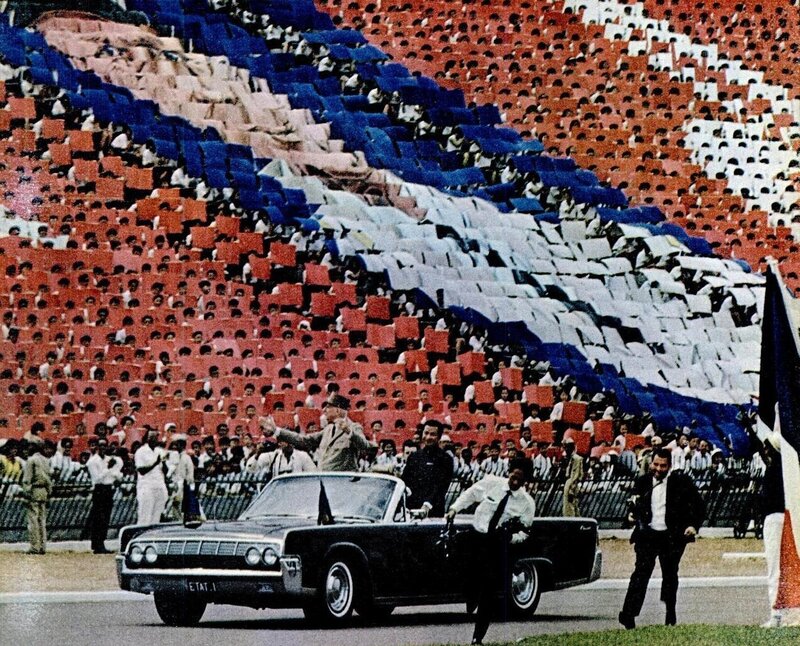
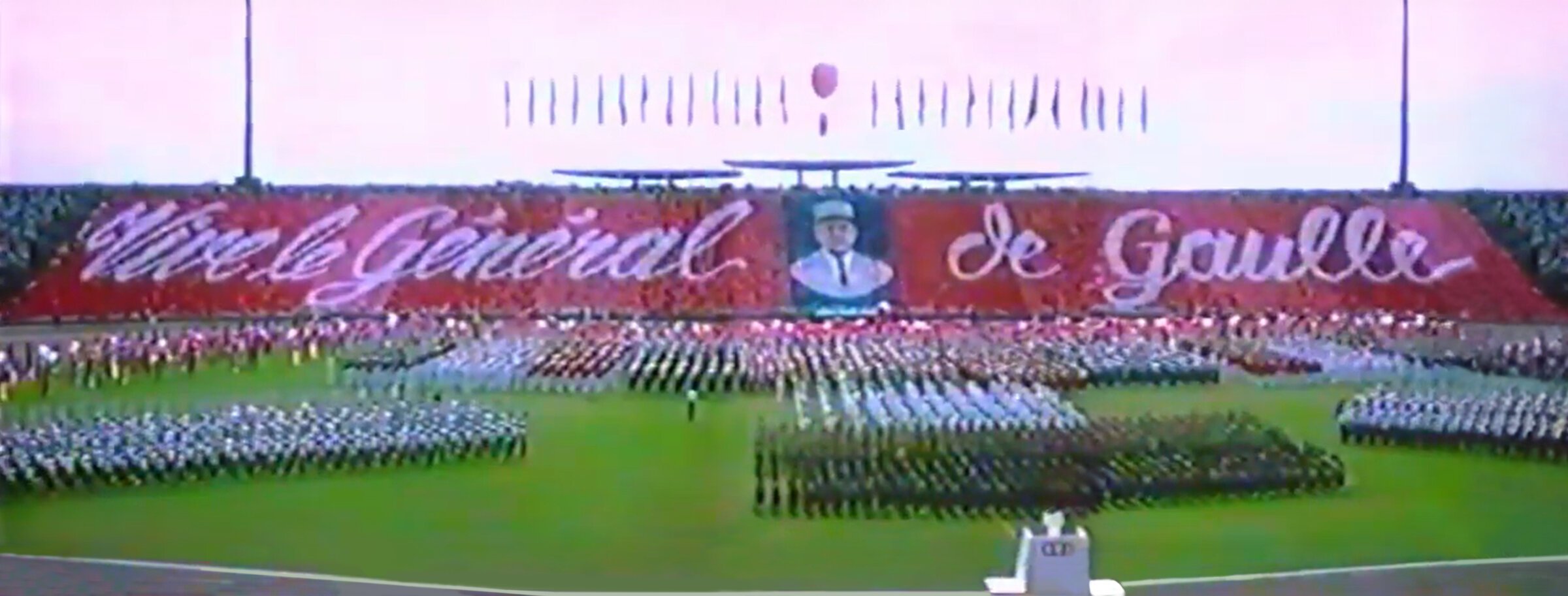
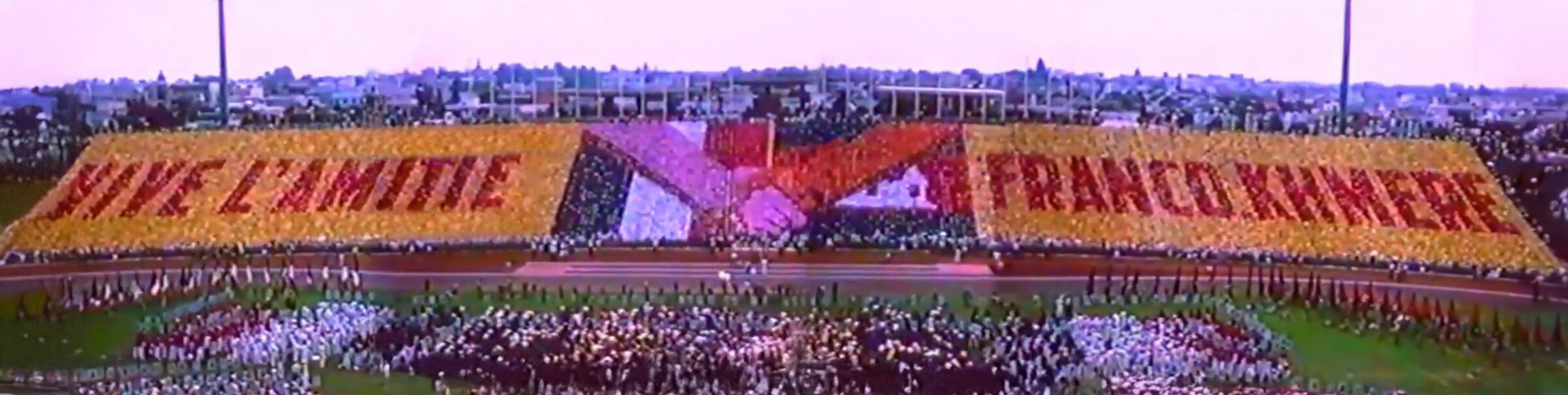
Two of the numerous giant shifting placard compositions during de Gaulle’s Phnom Penh speech at National Sports Complex, 1966. Twenty thousand schoolgirls and boys had been trained by two experts in mass art installation (one from North Korea, one from Royal University of Fine Arts) to swiftly move the panels in perfect coordinations [wide-angle screen captures (from a Cambodian/French 1967TV documentary) edited by graphic designer Tieng Satya for ADB, 2025].
Two of the numerous giant shifting placard compositions during de Gaulle’s Phnom Penh speech at National Sports Complex, 1966. Twenty thousand schoolgirls and boys had been trained by two experts in mass art installation (one from North Korea, one from Royal University of Fine Arts) to swiftly move the panels in perfect coordinations [wide-angle screen captures (from a Cambodian/French 1967TV documentary) edited by graphic designer Tieng Satya for ADB, 2025].
Two of the numerous giant shifting placard compositions during de Gaulle’s Phnom Penh speech at National Sports Complex, 1966. Twenty thousand schoolgirls and boys had been trained by two experts in mass art installation (one from North Korea, one from Royal University of Fine Arts) to swiftly move the panels in perfect coordinations [wide-angle screen captures (from a Cambodian/French 1967TV documentary) edited by graphic designer Tieng Satya for ADB, 2025].
De Gaulle’s Phnom Penh Speech
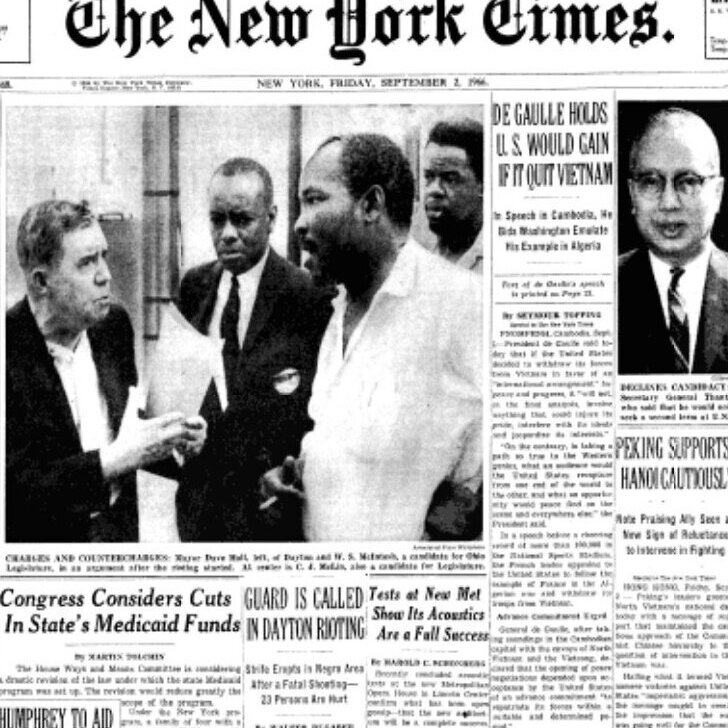
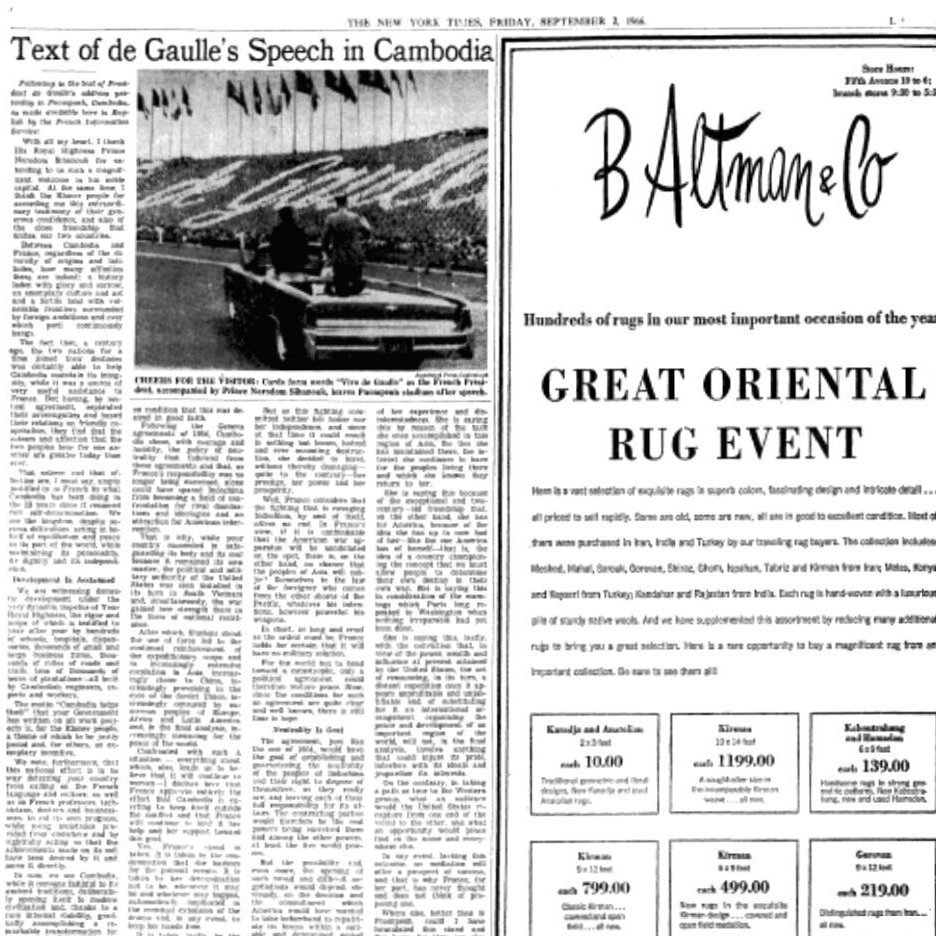
On 2 Sept. 1966, The New York Times carried the English translation of De Gaulle’s Phnom Penh Speech full text, as provided by the French Presidency Information Service [French media only published short excerpts at the time] [1]. The dispatch by Seymour Topping made the frontpage under the (diplomatic) title “DE GAULLE HOLDS U.S. WOULD GAIN IF IT QUIT VIETNAM”, developed with “In Speech in Cambodia, He Bids Washington Emulate His Example in Algeria,” adding that “General de Gaulle, dressed in a tan summer military uniform, spoke with emotion while he URGED U.S. WITHDRAWAL” [from Indochina]. [Massive bombing US campaigns over Eastern Cambodia, under codename ‘Operation Breakfast’, had started in 1965 unbeknowst to the US Congress and the general public].
De Gaulle in Phnom Penh as seen in The New York Times [2 Sept. 1966, p. 1, 13, detail].
De Gaulle in Phnom Penh as seen in The New York Times [2 Sept. 1966, p. 1, 13, detail].
De Gaulle in Phnom Penh as seen in The New York Times [2 Sept. 1966, p. 1, 13, detail].
While we do not know who the speechwriter was, especially for the English version, De Gaulle’s own characteristic writing style, which he developed since its early works in the 1910s and 1920s, is easily identifiable :
With all my heart, I thank His Royal Highness Prince Norodom Sihanouk for extending to us such a magnificent welcome in his noble capital. At the same time, I thank the Khmer people for according me this extraordinary testimony of their generous confidence, and also of the close friendship that unites our two countries.
Between Cambodia and France, regardless of the diversity of origins and latitudes, how many affinities there are indeed: a history laden with glory and sorrow, an exemplary culture and art and a fertile land with vulnerable frontiers surrounded by foreign ambitions and over which peril continuously hangs! The fact that, a century ago, the two nations for a time joined their destinies was certainly able to help Cambodia maintain its integrity, while it was a source of very useful assistance to France. But having, by mutual agreement, separated their sovereignties and based their relations on friendly cooperation, they find that the esteem and affection that the two peoples bear for one another are greater today than ever.
That esteem and that affection are, I must say, amply justified to us French by what Cambodia has been doing in the 13 [ADB: here the print was altered, probably to correct a mistake in the original press release] years since it resumed full self-determination. We see the kingdom, despite serious difficulties, acting in behalf of equilibrium and peace in its part of the world, while maintaining its personality, its dignity and its independence.
[‘Development Is Acclaimed’: subheader from NYT newsroom (ADB note)] We are witnessing domestic development under the very dynamic impetus of Your Royal Highness, the vigor and scope of which is testified to year after year by hundreds of schools, hospitals, dispensaries, thousands of small and large business firms, thousands of miles of roads and trails, tens of thousands of acres of plantations, all built by Cambodian engineers, experts and workers. The motto “Cambodia helps itself” that your Government has written on all work projects is, for the Khmer people, a theme of which to be justly proud and, for others, an exemplary incentive. We note, furthermore, that this national effort is in no way deterring your country from calling on the French language and culture, as well as on French professors, technicians, doctors and businessmen to aid its own progress, while using assistance provided fmm elsewhere and by rightfully acting so that the achievements made on its soil have been desired by it and serve it directly.
In sum, we see Cambodia, while it remains faithful to its ancient traditions, deliberately opening itself to modern civilization and, thanks to a rare internal stability, gradually accomplishing a remarkable transformation for the good of all its children.
Why must it be that, at its frontiers, the war is provoking a great wave of massacres and ruins that threaten its own future?
The Khmer head of state had foreseen these calamities, but he had also indicated in time what he thought should be done to avert them, on condition that this was desired in good faith. Following the Geneva agreements of 1954, Cambodia chose, with courage and lucidity, the policy of neutrality that followed from these agreements and that, as France’s responsibility was no longer being exercised, alone could have spared Indochina from becoming a field of confrontation for rival dominations and ideologies and an attraction for American intervention.
That is why, while your country succeeded in safeguarding its body and its soul because it remained its own master, the political and military authority of the United States was seen installed in its turn in South Vietnam and, simultaneously, the war gained new strength there in the form of national resistance. After which, illusions about the use of force led to the continual reinforcement of the expeditionary corps and to increasingly extensive escalation in Asia, increasingly closer to China, increasingly provoking in the eyes of the Soviet Union, increasingly censured by numerous peoples of Europe, Africa and Latin America and, in the final analysis, increasingly menacing for the peace of the world.
Confronted with such a situation — everything about which, alas, leads us to believe that it will continue to worsen — I declare here that France approves entirely the effort that Cambodia, exerting to keep itself outside the conflict and that France will continue to lend it her help and her support toward this goal.
Yes, France’s stand is taken. It is taken bv the condemnation that she harbors for the present events. It is taken by her determination not to be, wherever it may be and whatever may happen, automatically implicated in the eventual extension of the drama and, in any event, to keep her hands free. It is taken, lastly, by the example that she herself set not long ago in North Africa by deliberately putting an end to sterile fighting on a ground that, nonetheless, her forces unquestionably dominated, that she had directly administered for 132 years and where more than a million of her children were settled. But as this fighting committed neither her honor nor her independence, and since at that time it could result in nothing but losses, hatred and ever mounting destruction, she decided to leave, without thereby damaging — quite to the contrary — her prestige, her power and her prosperity. [ADB: Algeria had acceeded to hard-fought-for independence on 8 May 1962].
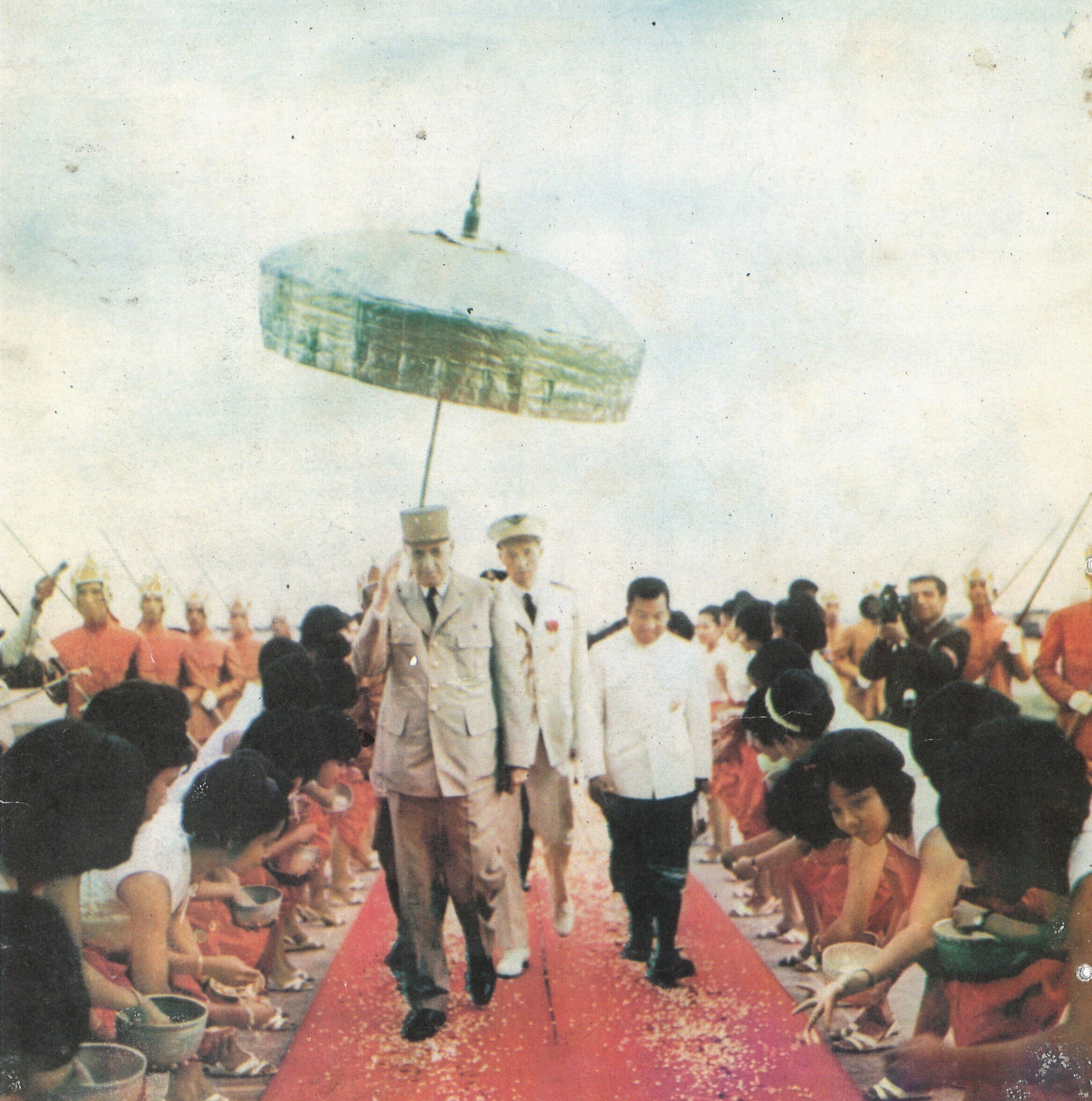
President Charles de Gaulle’s arrival at Pocheuntong for his historic visit, welcomed by Head of State Prince Norodom Sihanouk and rows of Cambodian young women offering flowers [Sangkum Information Service, 1966].
President Charles de Gaulle’s arrival at Pocheuntong for his historic visit, welcomed by Head of State Prince Norodom Sihanouk and rows of Cambodian young women offering flowers [Sangkum Information Service, 1966].
Well, France considers that the fighting that is ravaging Indochina, by and of itself, offers no end. In France’s view, if it is unthinkable that the American war apparatus will be annihilated on the spot, there is, on the other hand, no chance that the peoples of Asia will subject themselves to the law of the foreigner who comes from the other shores of the Pacific, whatever his intentions, however powerful his weapons.
In short, as long and cruel as the ordeal must be, France holds for certain that it will have no military solution. For the world not to head toward a catastrophe, only a political agreement could therefore restore peace. Now, since the conditions for such an agreement are quite clear and well known, there is still time to hope.
[‘Neutrality Is Goal’:subheader from NYT newsroom (ADB note)] The agreement, just like the one of 1954, would have the goal of establishing and guaranteeing the neutrality of the peoples of Indochina and their right to dispose of themselves, as they really are, and leaving each of them full responsibility for its affairs. The contracting parties would therefore be the real powers being excercised there and among the other powers, at least the five world powers.
But the possibility and, even more, the opening of such broad and difficult negotiations would depend, obviously, on the decision and the commitment which America would have wanted to take beforehand to repatriate its forces within a suitable and determined period of time. Without a doubt, such an outcome is not at all ripe today, assuming that it may ever be. But France considers it necessary to assert that, in her view, there exists no other, except to condemn the world to ever-growing misfortunes.
France is saying this out of her experience and disinterestedness. She is saying this by reason of the task she once accomplished in this region of Asia, the ties she has maintained there, the interest she continues to have for the peoples living there and which she knows they return to her. She is saying this because of the exceptional and two-century-old friendship that, on the other hand, she has for America, because of the idea she has up to now had of her — like the one America has of herself — that is, the idea of a country championing the concept that we must allow people to determine their own destiny in their own way.
She is saying this in consideration of the warnings which Paris long repeated to Washington when nothing irreparable had yet been done. She is saying this, lastly, with the conviction that, in view of the power, wealth and influence at present attained by the United States, the act of renouncing, in its turn, a distant expedition once it appears unprofitable and unjustifiable and of substituting for it an international arrangement organizing the peace and development of an important region of the world, will not, in the final analysis, involve anything that could injure its pride, interfere with its ideals and jeopardize its interests.
On the contrary, in taking a path so true to the Western genius, what an audience would the United States recapture from one end of the world to the other, and what an opportunity would peace find on the scene and everywhere else! In any event, lacking this outcome, no mediation will offer a prospect of success, and that is why France, for her part, has never thought and does not think of proposing one.
Where else, better than in Pnompenh [Phnom Penh], could I have formulated this stand and this hope, for they are also those of Cambodia, since the kingdom — in the middle of a torn Indochina — stands as a model of unity and independence; since the active friendship of our two Governments and of our two peoples is today more alive than ever; since this is the unforgettable proof of it. Long live Cambodia!
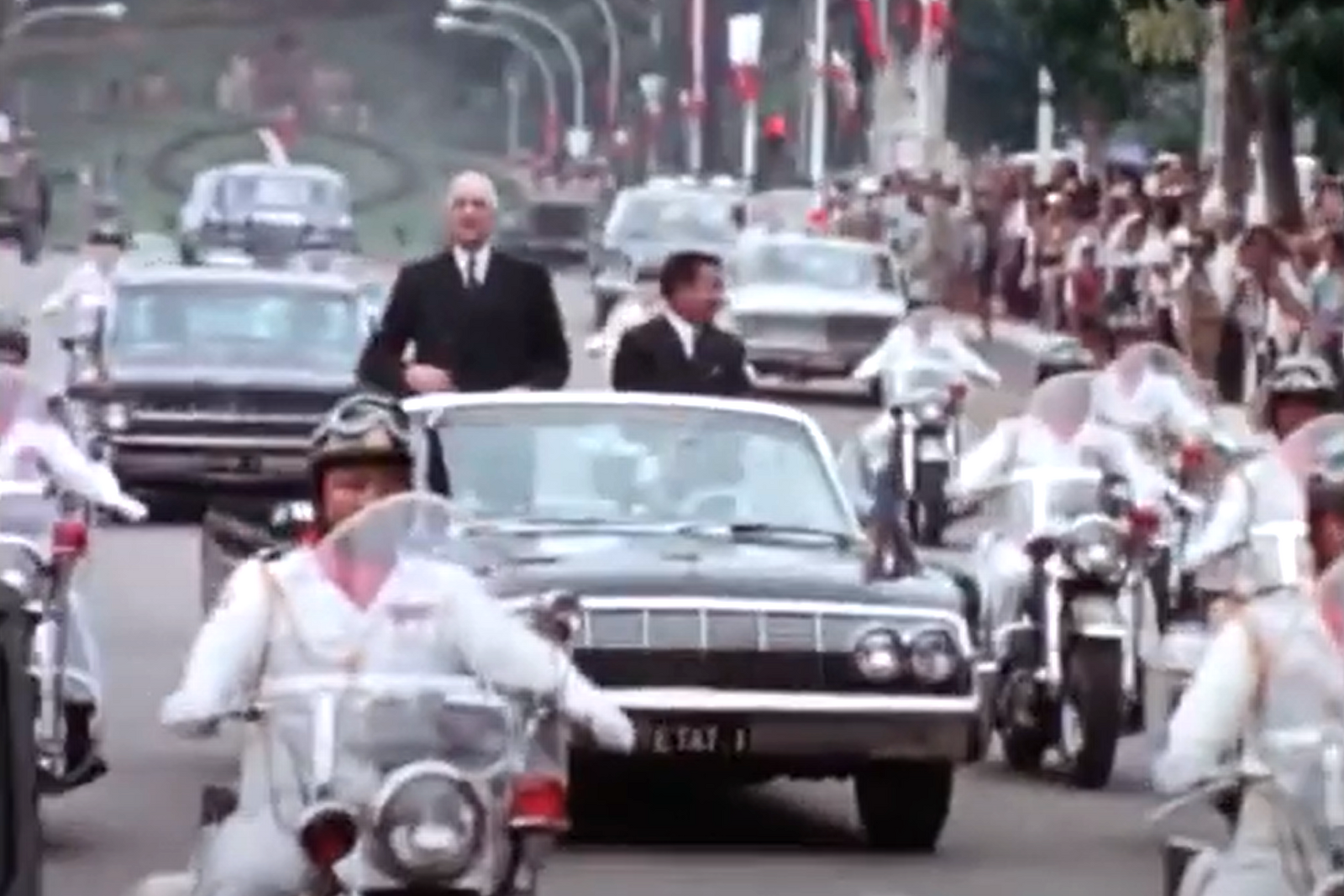
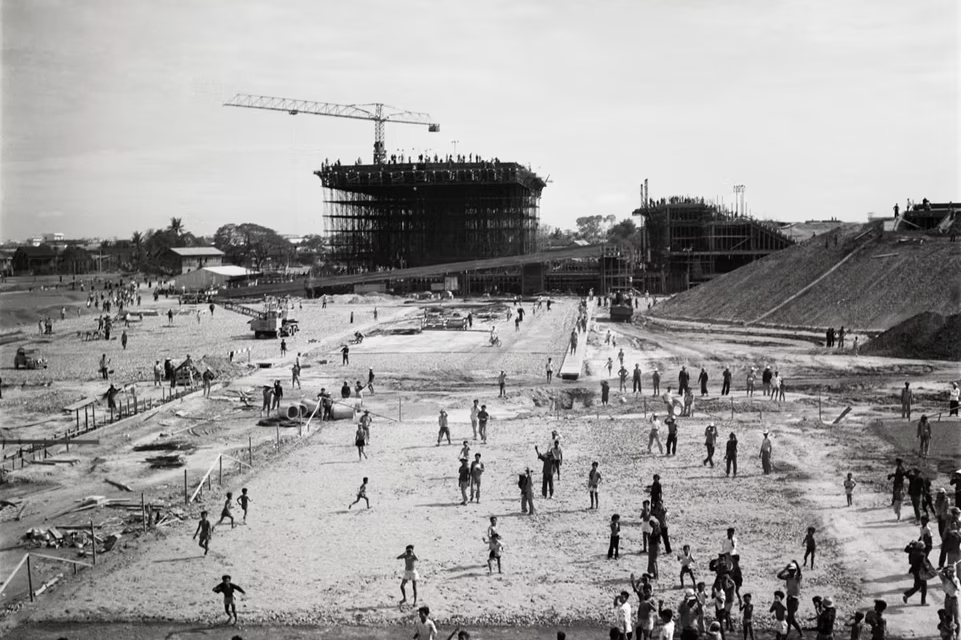
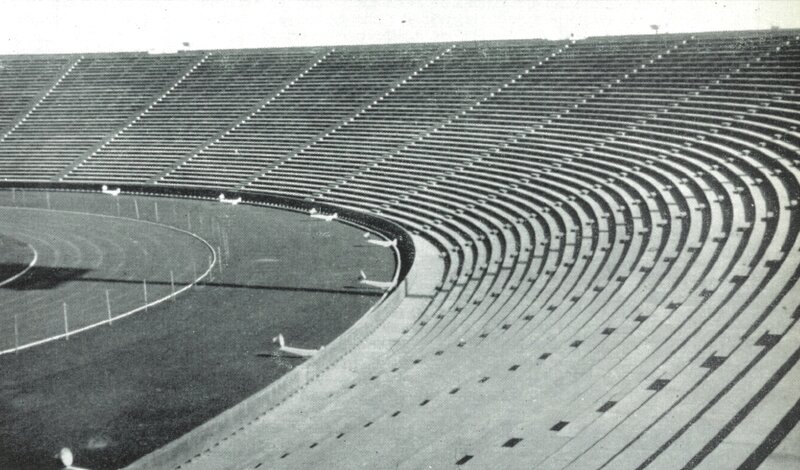
1) Prince Norodom Sihanouk and General de Gaulle driving through a jubilant Phnom Penh on their way to the National Sports Complex (Olympic Stadium), where the French president was to deliver his historic speech [screen capture from a 11 min. newsreel, 1966, via INA]. 2) Thestadium, a feat of Modern Khmer architecture and engineering conceived by Vann Molyvann, had been completed in 1964 as a symbol of thriving Cambodia [photo of the working site by Micheline Dullin, 1963].
1) Prince Norodom Sihanouk and General de Gaulle driving through a jubilant Phnom Penh on their way to the National Sports Complex (Olympic Stadium), where the French president was to deliver his historic speech [screen capture from a 11 min. newsreel, 1966, via INA]. 2) Thestadium, a feat of Modern Khmer architecture and engineering conceived by Vann Molyvann, had been completed in 1964 as a symbol of thriving Cambodia [photo of the working site by Micheline Dullin, 1963].
1) Prince Norodom Sihanouk and General de Gaulle driving through a jubilant Phnom Penh on their way to the National Sports Complex (Olympic Stadium), where the French president was to deliver his historic speech [screen capture from a 11 min. newsreel, 1966, via INA]. 2) Thestadium, a feat of Modern Khmer architecture and engineering conceived by Vann Molyvann, had been completed in 1964 as a symbol of thriving Cambodia [photo of the working site by Micheline Dullin, 1963].
Impact of the Speech
In hindsight, this lofty condemnation of US military recklessness in Vietnam (and against collateral victims, Cambodia and Laos) stands out as one of the few examples of a significant statesman convincingly invoking morality and fundamental human rights against abuse of power. If the depiction of Cambodia as ‘unified’ behind the neutralist politics of Prince Sihanouk was certainly too rosy, de Gaulle’s personal committment to a negotiated end of the brutal onslaught gave a brief respite to the non-aligned forces worldwide.
It didn’t make the American administration waver even slightly, however. At that point, the warmongers in Washington were becoming more vocal than ever, and the increase of Vietnamese acts of resistance from 1967, in particular the Tet Offensive, didn’t bring the US military-industrial complex to reason. In reaction to ‘the General”s proclamation in Phnom Penh, the puppet Republic of Vietnam (South Vietnam) broke diplomatic relations with France.
The Chinese leadership wasn’t swayed in its ‘double jeu’ with Vietnam, nor even impressed. China only paid lip service to the Vietnamese insurgency, and banked on the thawing of its relations with the US, paving the way to the President Richard Nixon’s historic visit to Beijing in February 1972. Consequently, pro-American factions in Phnom Penh felt emboldened in their criticism of Prince Sihanouk’s non-aligned stand, which led to the March 1970 anti-Sihanouk coup.
As for the French domestic front, de Gaulle’s vision and worldview came to renewed criticism by the opposition. In an op-ed to that same New York Times, François Mitterrand, his tenacious opponent, wrote:
How can Charles de Gaulle continue to dominate a country in which there is such powerful opposition to him? […] France today is no longer a democracy in the sense that term is understood in the U.S. and Britain. The Gaullist régime is run by a single man who has made it his own private property, isolating himself not only from his political adversaries — naturally enough — but also from his personal friends. On many occasions during the past eight years we have seen supreme decisions taken at the Elysée Palace — and not even the ministers concerned were informed. Foreign policy and military decisions have been made almost whimsically by one man in the privacy of his study without even discussing the problems with anyone else. To cite a recent example, the decision to withdraw from NATO was announced during the General’s last press conference and was submitted to the Premier and two other ministers just the day before. The rest of the Cabinet was not even informed. [NYT, 29 May 1966, p. 224 – 6].