Guy Porée (1902−1985) was a French writer, ethnologist and photographer who explored Cambodian culture after getting close to researcher Eveline Maspero at Paris Institut des Langues Orientales [Oriental Languages Institute] where they were both studying Chinese language in the mid-20s, and living in Cambodian with her as a married couple from 1934 to 1950.
A relative of famous French writer André Gide (1859−1951), Guy Porée entered the world of Paris avant-garde theater in his young age, working on costumes and translations of English playwrights such as William Congreve and Shakespeare. Fascinated with Chinese theater, he and fellow student in Chinese culture Eveline Maspero married in 1928, and he followed her after the birth of their son in 1934 to Cambodia, where she spent her youth.
Employed by the Banque Française de l’Indochine and connected to the Messageries Maritimes, hejoined Eveline in her ethnological exploration of the country, taking photographsand contributing to a research that culminated with the publication of Mœurs et Coutumes des Khmers (1938), a work praised by George Coedès and Paul Pelliot and soon translated into English and Japanese.
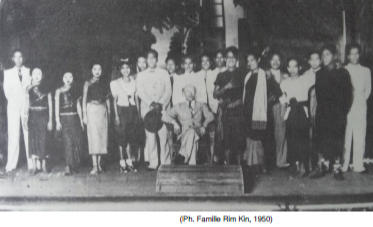
Keeping alive his passion for performing arts, Guy Porée studied Cambodian performing arts and befriended numerous proponents of the vibrant theater scene in Cambodia. As a cultural advisor to young King Norodom Sihanouk, he was instrumental in the foundation of the theater company Lakhon Niyeay (New Theater) a few years before the Independence, the precursor of the Lakhon Cheat (National Theater) launched in 1957 – 8 even if some critics found Porée’s troupe too linked to the French ‘bourgeois’ theatrical form. The 1950 photo below was given to famous author Rim Kin’s family to researcher Khing Hoc Dy, who published it in his undated biographical note on Guy Porée:
Guy Porée with Cambodian theater actors and actresses in Phnom Penh, 1950
Guy Porée with Cambodian theater actors and actresses in Phnom Penh, 1950 [from Khing Hoc Dy, ‘ហើយប៉ូរេ POREE Guy (1902−1985) ដោយ បណ្ឌិតសភាចារ្យ ឃីងហុកឌី’, Bulletin de l’AEFEK, nd].
Selected Publications
“Rites de la danse au Cambodge”, France-Illustration 190, special issue ‘Indochine’, 4 June 1949.
ល្ខោនខោលl'khon khol, 'Masked theater', with a repertoire from the Reamker. In Cambodian masked theater, derived from ancient royal dance, each character bears a specific color: green for Ream (Rama), yellow for Preah Leak (Lakshmana), red for Seyda (Sita), white for Hanuman and its 18 monkey warriors, brick red for Krong Reap (Ravana), blue for Tupi (King of Buffaloes).
ល្ខោនគែនl'kon ken, a theater and dance form developed during the first reign of King Sihanouk (1945-195), in which the ken, a traditional Mon-Khmer and Laotian reed music instrument, played a central part.