

Books
Découvertes sur la danse
by Fernand Divoire
by Guy Porée
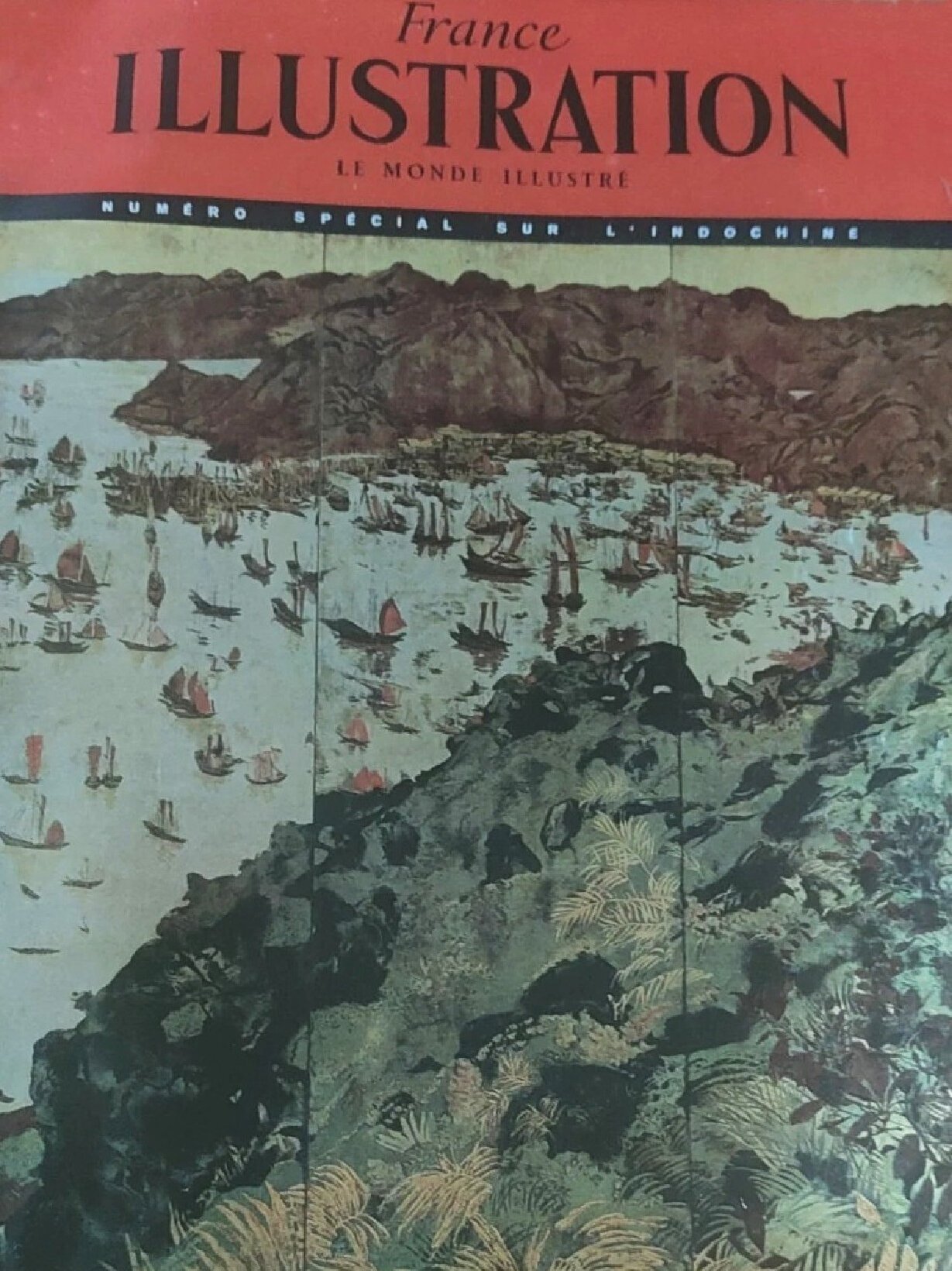
Devotional Dance observed at Angkor a few years after the end of World War II, just before the rejuvenation process initiated by Queen Kossamak in the 1950s.

pdf 9.5 MB
This short article is particularly valuable as
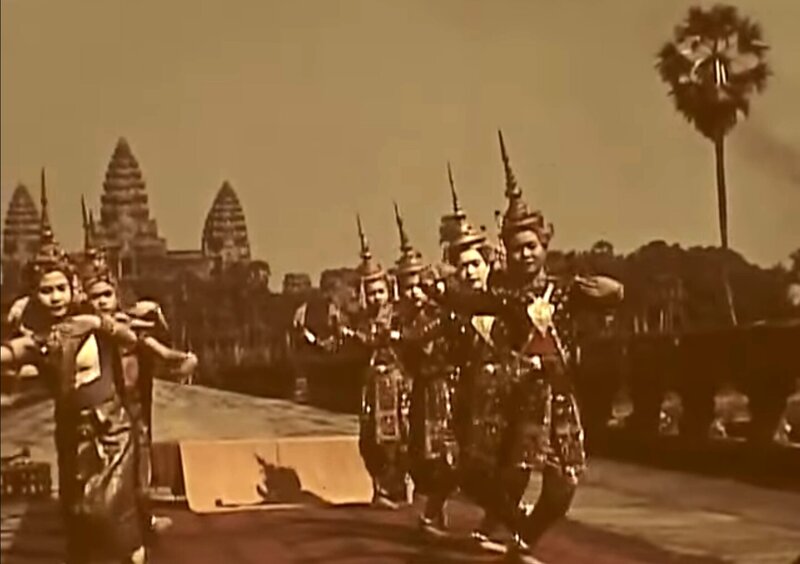
Also of interest, the fact that Khmer court dance is here mostly considered as a tourist-oriented art form [“tourist tradition”] at Angkor. On that note, it is worth to link this contribution to the stunning short film showing a “Victory Dance” at Angkor Wat circa 1945, and to photographs taken taken by French Army photographers at the same period. Were these dancers actually from Phnom Penh Royal Palace, or the surviving elements of the Siem Reap based Classical Dance Company initiated by Princess Say Sangvann អ្នកម្នាង សយ សង្វាន?
La tradition touristique veut que certains soirs on évoque le faste de la cour d’Angkor en animant les ruines de danseuses. Les étoffes lamées, l’or des coiffures effilées et des masques, les bijoux, les bras souples luisent sur fond de nuit, dans l’éclat des projecteurs, avec, en arrière-plan, l’ombré du temple scintillant d’innombrables torches. Le poète se plaît alors à confondre les ballerines modernes avec les personnages féminins des bas-reliefs et, se croyant encore aux temps du brahmanisme, parle avec enthousiasme de « danses sacrées », de « petites prêtresses mystérieuses ».
De nos jours, en effet, le rôle sacré des danseuses royales se borne à représenter des divinités, agenouillées autour de l’urne des funérailles ou dansant un ballet de souhaits de bonheur. Et si les danseuses demi-nues, aux riches diadèmes, aux gestes rituels peu variés, des bas-reliefs d’Angkor étaient vraisemblablement vouées au culte de divinités brahmaniques et affectées au temple dès leur jeunesse, il existait également, comme le fait remarquer Groslier, des danseuses profanes. Le roi Yaçovarman « apprenait à danser aux princesses en leur donnant la mesure » et l’usage était, déjà, de lui offrir les plus jolies enfants pour son corps de ballet.
Il y a seulement quelques années les danseuses royales vivaient recluses au palais. Illettrées et dociles, elles apprenaient sans comprendre, sous la baguette de rotin des maîtresses qui leur serinaient gestes et rôles ; puis, à leur tour, devenues trop vieilles pour danser, elles s’appliquaient à transmettre aux jeunes les gestes rituels et les coups reçus. Ce mode d’enseignement, compte tenu des intrigues, n’était pas sans danger. Il appartenait à S. A. R. la princesse Suramarit de reprendre la tradition et de la fixer par des méthodes d’enseignement plus modernes. Les danseuses né sont plus cloîtrées au palais. Elles vivent dans leur famille, mais chaque matin se rendent au Conservatoire royal. Comme autrefois elles débutent par la demi-heure d’exercices d’assouplissement, puis elles répètent ; le soir, elles vont à l’école apprendre à lire et à écrire. De plus, un cadre d’enseignement technique a été créé où l’on forme des maîtresses spécialisées.
L’entraînement est fort dur et doit être Il commencé vers l’âge de huit ans. s’agit de donner au corps de la jeune fille la souplesse d’un arc. Ses reins, ses bras, ses doigts et même ses orteils doivent s’incurver avec aisance. Il lui faut gagner en tous ses membres un équilibre parfait, car le symbolisme des gestes exige une rigoureuse coordonnance. De l’avis des danseuses, les photographes et même les modeleurs de statuettes sont comiques par leur maladresse et leur ignorance de la danse, au point de né savoir saisir un geste qu’à contre-temps, de n’en reproduire le plus souvent que la préparation, ou le moment où, déjà se défaisant, il en annonce un autre.
La danse cambodgienne, qui semble n’être que souplesse très liée, se décompose en une série de petites saccades à peine marquées, mais très précises, scandées par le claquement des baguettes noires des choristes. Impassible, impersonnelle, la danseuse dessine une suite de gestes et de poses, signes invariables au sens connu, qu’elle s’appliqué à tracer nettement par le jeu parfait de tous ses membres. Groslier la compare à une calligraphe. Rien de spontané, et, si on l’immobilise à chacune des étapes par lesquelles passé son geste, elle apparaît toujours comme une statue en parfait équilibre ; mais le geste n’a de signification qu’au moment précis où il est achevé, le temps d’un battement.
On conçoit que cet art exige un apprentissage assez long, un entraînement minutieux et que les trois qualités primordiales, par ordre d’importance, soient la précision des gestes, la beauté, la vertu aussi, puisqu’une vie tant soit peu dissipée « abîme le rythme du corps ». Exécutés par une danseuse expérimentée, les exercices d’assouplissement semblent un jeu harmonieux, mais ce n’est pas exactement un jeu pour les débutantes. Tantôt jambes croisées, les pieds repliés sur les cuisses, elles se courbent lentement en avant, creusant les reins, touchant du front le sol. Tantôt, comme on casse une branche en la ployant sur une pierre, posant le coude sur un genou, elles plient leur bras en arrière, pesant dessus pour en forcer la jointure. Tantôt elles se retournent simplement les doigts sur le dos de la main. La maîtresse veille à ce qu’elles n’y aillent pas trop doucement. Souvent elle les aide et, d’une torsion plus précise, améliore l’assouplissement. Chaque matin, après ces exercices, les danseusesétudient les gestes de leur rôle réparties en quatre groupes : yaks (ogres), dieux et princes, déesses et princesses, singes. Chaque groupe est dirigé par deux maîtresses et deux répétitrices pour les débutantes. Seuls les singes n’ont qu’une maîtresse.
Dès l’apprentissage les danseuses sont spécialisées selon leur physique. Tailles sveltes, figures rondes : les princesses ; tailles fortes, figures ovales : les princes. Les yaks et les singes doivent être, avant tout, robustes ou souples et leur beauté indiffère, dit-on, puisqu’ils ont un masque. Assises à terre, les jambes repliées sur un côté, le buste droit, les danseuses regardent la maîtresse décomposer un mouvement, puis elles s’efforcent de l’imiter aux battements d’un rotin qui scande la mesure. Il y a des gestes de base par lesquels commencent les débutantes, comme celui de la grande salutation, l’anjali, qui s’achève mains jointes à hauteur du front. Il y a des mouvements qui sont purement de la danse, sans mime, sortes de cadences pour servir de liaison. Il y a surtout des attitudes classiques, où chaque groupe se distingue par un style particulier. Ainsi l’expression de la tristesse. Pour tous, le bras gauche se replie vers le front penché, mais la main qui frôle les yeux reste horizontale, les doigts délicatementrecourbés chez la princesse ; elle est pendante, les doigts réunis, chez le singe, et pour le yak c’est son poing fermé.
Même sans masque ni costume on peut reconnaître chacun, dit notre servante, mais elle ajoute aussi que les jeunes maintenant se trompent parce qu’ils connaissent mieux Tarzan. A vrai dire, malgré la richesse du spectacle, il est difficile de l’apprécier pendant des heures si l’on né comprendque le thème fie l’histoire. L’action — le plus souvent quelque épisode du Réamkér, version cambodgienne du Râmâyana — comporte des éléments presque immuables : princesse enlevée, géants combattant, poursuites, scènes de séduction, arme magique offerte par l’ermite au héros… L’originalité des scènes importe moins que leur enchaînement et le fini de l’exécution. Seul un canevas composé par une personne très au courant de la chorégraphie, guidant la maîtresse, permettra ces touches de détail qui, aux yeux des connaisseurs, marqueront la qualité. L’ancienne danseuse né se contentera pas alors de faire mimer, avec un académisme parfait, l’action déclamée par la récitante, chantée par le choeur et soulignée par l’orchestre. Elle ajoutera de-ci de-là, en quelques mesures, un détail plus vivant, tel celui de la suivante qui, après avoir cueilli une fleur à une branche invisible, stylise le geste de chasser les fourmis tombées sur ses bras nus. Il va de soi que l’invention né saurait être poussée trop loin, sous peine de rompre le style, ce qui arrive malheureusement aussitôt qu’on veut « faire théâtre » pour être mieux compris du public moderne. Certaines troupes de baladins, où le mélodrame s’agrémente de danses prétendues traditionnelles, nous ont déjà montré ce que peut devenir, par exemple, le geste de « sacrifier sa chevelure » lorsqu’on ajoute, pour le faste, des ciseaux de coiffeur, une queue de cheval et un fond sonore de quelques coups de cymbales.
La musique des danses n’a pas de ces éclats. Scandée par le battement des tambours à peau de boeuf, elle poursuit le rythme saccadé de ses xylophones et petits gongs, auxquels se joint, par moments, une sorte de hautbois. L’instrument conducteur, le sampho, tambour renflé comme un tonneau et posé, horizontal, sur double pied, est fort vénéré. Les danseuses déposent dévotement devant lui, le jour de leur initiation, l’offrande d’une tête de cochon. L’orchestre souligne le drame, chanté et mime, par l’éxécution d’airs ayant un sens précis : annonce de l’arrivée d’une divinité, marche des dignitaires, puissance des géants, sommeil des princes, maniement de l’arc, capture du cheval, air de voguer sur l’eau… et tous les airs de transition pour les déplacements, dont celui, au rythme plus précipité, qui annonce la fin de la danse.
Le même rituel s’appliqué également aux costumes, aux bijoux et aux masques. La pointe de la coiffure d’or d’un prince est plus haute que celle d’une princesse. Elle est incrustée de diamants ; celle de la princesse est seulement ornée de « fleurs d’or tremblotantes ». Le nombre des pièces d’un costume, le nombre de bijoux propres à chaque personnage est scrupuleusement fixé suivant une hiérarchie sévère. Tel a droit à quarante grains d’or en sa quatrième paire de bracelets, tel n’a droit qu’à vingt grains d’argent doré. L’intendante des joyaux, secondée par deux gardiens, veille à l’exacte répartition des bijoux. L’intendante des costumes et le mandarin préposé aux masques ont également de sérieuses responsabilités. La parure d’un prince — une dizaine de pièces en velours brodé de pierreries ou en lamé d’or véritable, une vingtaine de bijoux, hors les diamants de sa coiffure d’or effilée, le « mokot » — vaut une petite fortune.
Le costume d’une princesse est déjà plus modeste. Celui d’Hanuman, le singe blanc, est d’une élégance princière, en satin blanc rehaussé de dessins d’or stylisant les poils, mais, du fait qu’il s’agit d’un singe, il n’a pas de brillantes épaulettes en ailerons ni de pointe au mokot. La hiérarchie est marquée jusque dans la présentation des masques. Ils sont alignés sur trois rangs en un ordre immuable, quoique, pour les personnages secondaires, certaines questions de préséance soient assez chaudement discutées.
Au premier rang, au centre, le masque vieil or de l’ermite Maha Eysei, personnage redoutable, doué de puissance, auquel on rend un véritable culte. A sa droite, le masque vert de Râma, puis les riches mokots de princes et de divinités. À la gauche de l’ermite, Râvana, le seigneur aux dix visages, puis le yak « queue de coq », puis Ngoh, masque noir de l’homme sauvage sous lequel se cache un prince. Au deuxième rang, au centre, Garuda, le roi des oiseaux, l’ennemi des serpents, tenant en son bec crochu la boule qui rend invisible. A sa droite, Hanuman, le singe blanc, puis le singe noir, puis les gibbons. À la gauche de Garuda, le cheval, le lion, le chevreuil doré, le merle et le perroquet. Enfin, au troisième rang, l’éléphant et le fantôme, le naga et les accessoires magiques : la boule précieuse que la déesse Mékhala lance en l’air et rattrape et dont les feux représentent les éclairs ; la hache que le yak Réam Eisaur jette vers Mékhala et qui frappé les nuages, créant le tonnerre ; la courte épée que le singe blanc manie comme une batte d’arlequin ; le grand bâton noueux de l’ermite ; l’arc doré, sans corde, avec lequel le prince tire d’invisibles flèches ; les courts bâtons brillants des yaks et la canne étincelante de Ngoh.
La danse de Ngoh, l’une des plus longues à apprendre, se complique du maniement d’une grande canne incrustée d’éclats miroitants, accessoire magique d’où le prince déguisé tire sa force prodigieuse et son pouvoir de voler. Les masques exigent des rites et, tout d’abord, une fois l’an, celui des Grandes Salutations, que dirige un maître des cérémonies. Sur une estrade recouverte d’étoffe blanche les masques ont été disposés dans leur ordre hiérarchique et, devant eux, diverses offrandes. J’en évite l’énumération précise, n’écrivant pas ici un article d’ethnographie. Qu’il suffise d’imaginer, posés à terre sur des nattes, des bouquets rituels en tronc de bananier découpé, des vases d’eau parfumée et d’eau bénite, des dizaines de plateaux contenant des poulets, des canards, les uns cuits, les autres crus, des têtes de cochon cuites et crues, des poissons, des cocos, du sésame moulu, de la canne à sucre, des gâteaux, des confiseries, des fruits et, fichés çà et là, suivant les rites, de minces bougies et des baguettes d’encens. D’autres offrandes sont étalées près de l’orchestre, devant le tambour Sampho.
Maîtresses et danseuses sont assises à terre, face à l’estrade des masques. Et, tout d’abord, l’ermite Maha Eysei se matérialise. Le maître des cérémonies a mis le masque vénéré et revêtu la robe jaune. Marchant courbé, aidé de sa canne noueuse, il s’avance jusqu’à l’estrade et se tourne vers l’assistance qui chante. Puis il dépose le masque au centre de l’estrade et, après être allé s’habiller de blanc, il commence les invocations. Les danseuses font alors le geste d’offrande aux quatre directions de l’espace, invitant les génies. Pour les honorer, tandis qu’invisibles ils goûtent les plats, elles exécutent un ballet.
L’officiant met ensuite aux meilleures danseuses les masques de leurs rôles, puis les retire. C’est alors le rite des «popils», où l’assistance, encerclée par un fil de coton, se passé de main en main trois bougies fixées à la pointe de feuilles de métal. Aussitôt après vient l’onction. Mêlant du parfum et de la poudre, l’Officiant trace une marque ronde au front des maîtresses et chacune marque de la même façon les élèves de sa classe. Enfin, après aspersion des instruments de musique et des musiciens, le maître des cérémonies attaché au poignet des danseuses un fil de coton trempé d’eau bénite et leur souhaite bonheur et succès.
Les Grandes Salutations annuelles, dont je n’ai fait que résumer les rites, étaient autrefois complétées par des Petites Salutations tous les jeudis. Mais les danseuses se contentent maintenant, en cours d’année, d’offrir aux masques
quelques fleurs odorantes et, avant d’en mettre un, d’allumer simplement trois baguettes d’encens.
[Tourist tradition dictates that on certain evenings, the splendor of the Angkor court is evoked by performing dancers among the ruins. The shimmering fabrics, the gold of the flowing headdresses and masks, the jewelry, and the supple arms gleam against the night sky, illuminated by spotlights, with the shadow of the temple sparkling with countless torches in the background. The poet then delights in conflating modern ballerinas with the female figures in the bas-reliefs and, imagining himself still in the time of Brahmanism, speaks enthusiastically of “sacred dances” and “mysterious little priestesses.”
Nowadays, in fact, the sacred role of the royal dancers is limited to representing deities, kneeling around the funeral urn or performing a ballet of wishes for happiness. And while the half-naked dancers, adorned with rich diadems and performing a limited range of ritual gestures, depicted in the bas-reliefs of Angkor were likely dedicated to the worship of Brahmanical deities and assigned to the temple from a young age, there were also, as Groslier points out, secular dancers. King Yaçovarman “taught the princesses to dance by giving them the rhythm,” and it was already customary to offer him the prettiest children for his ballet corps.
Only a few years ago, the royal dancers lived secluded in the palace. Illiterate and docile, they learned without understanding, under the rattan wands of their mistresses who drilled them with gestures and roles; then, in turn, when they became too old to dance, they devoted themselves to passing on the ritual gestures and the blows they had received to the younger generation. This method of teaching, given the intrigues, was not without its dangers. It fell to Her Royal Highness Princess Suramarit to revive the tradition and solidify it through more modern teaching methods. The dancers are no longer confined to the palace. They live with their families, but each morning they go to the Royal Conservatory. As in the past, they begin with half an hour of stretching exercises, followed by rehearsals; in the evening, they attend school to learn to read and write. Furthermore, a technical training program has been established to train specialized teachers.
The training is very rigorous and must begin around the age of eight. The goal is to give the young girl’s body the suppleness of a bow. Her back, arms, fingers, and even toes must bend with ease. She must achieve perfect balance in all her limbs, as the symbolism of the movements demands rigorous coordination. According to the dancers, photographers and even statuette sculptors are comical in their clumsiness and ignorance of dance, to the point of only being able to capture a gesture when it’s off-beat, most often only reproducing its preparation, or the moment when, already unraveling, it signals another.
Cambodian dance, which seems to be nothing but highly fluid, fluid movements, is broken down into a series of small, barely perceptible, but very precise jerks, punctuated by the snap of the choristers’ black sticks. Impassive, impersonal, the dancer traces a series of gestures and poses, signs invariable in their known meaning, which she strives to trace clearly through the perfect interplay of all her limbs. Groslier compares her to a calligrapher. Nothing is spontaneous, and, if she is frozen at each stage of her movement, she always appears as a statue in perfect balance. but the gesture only has meaning at the precise moment it is completed — a heartbeat.
Clearly, this art requires a fairly long apprenticeship, meticulous training, and the three essential qualities, in order of importance, are precision of movement, beauty, and virtue, since a life even slightly dissipated “disrupts the rhythm of the body.” Performed by an experienced dancer, the stretching exercises seem like a harmonious game, but they are not exactly a game for beginners. Sometimes, with legs crossed and feet tucked up onto their thighs, they slowly bend forward, arching their backs and touching the floor with their foreheads. Other times, as if breaking a branch by bending it against a stone, they place their elbow on a knee and bend their arm backward, pressing down to force the joint. Sometimes they simply curl their fingers onto the back of their hands. The teacher makes sure they don’t go too slowly. Often she helps them and, with a more precise twist, improves their flexibility. Each morning, after these exercises, the dancers study the gestures of their roles, divided into four groups: yaks (ogres), gods and princes, goddesses and princesses, and monkeys. Each group is led by two masters and two instructors for the beginners. Only the monkeys have just one master or mistress.
From the very beginning of their training, the dancers are specialized according to their physique. Slender figures and round faces: the princesses; fuller figures and oval faces: the princes. The yaks and monkeys must be, above all, either robust or supple, and their beauty is irrelevant, it is said, since they wear masks. Sitting on the ground, legs folded to one side, torsos upright, the dancers watch the master break down a movement, then they try to imitate her to the beat of a rattan drum that marks the rhythm. There are basic gestures with which the newcomers begin, such as the grand bow, the anjali, which ends with hands joined at forehead level. There are movements that are purely dance, without mime, a kind of rhythmic cadence used for connection. Above all, there are classical poses, where each group is distinguished by a particular style. For example, the expression of sadness. For everyone, the left arm folds towards the bowed forehead, but the hand that touches the eyes remains horizontal, the fingers delicately curled in the princess; it hangs down, fingers together, in the monkey; and for the yak, it is a closed fist.
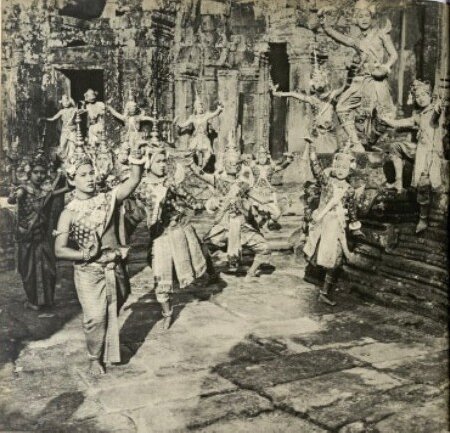
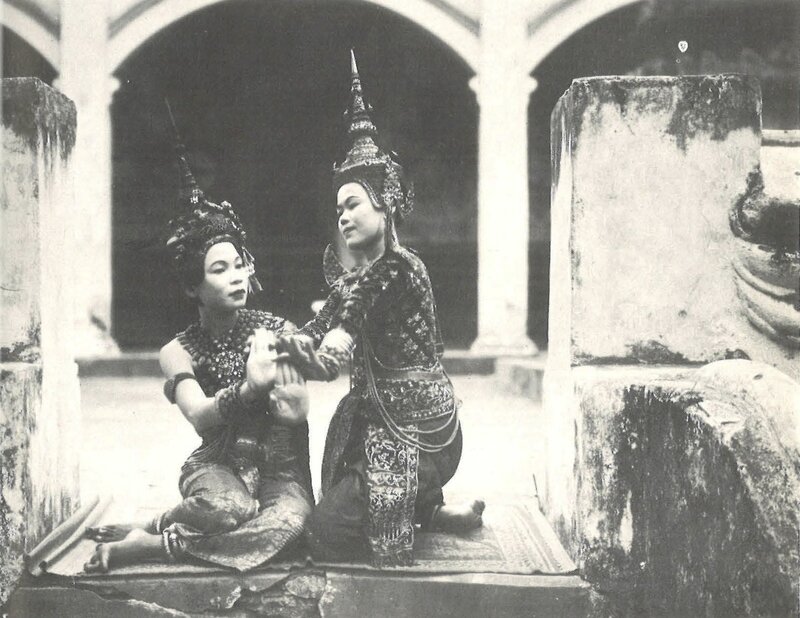
Royal Ballet dancers at Bayon [photo by Guy Porée, France-Illustration special issue, 4 June 1949].
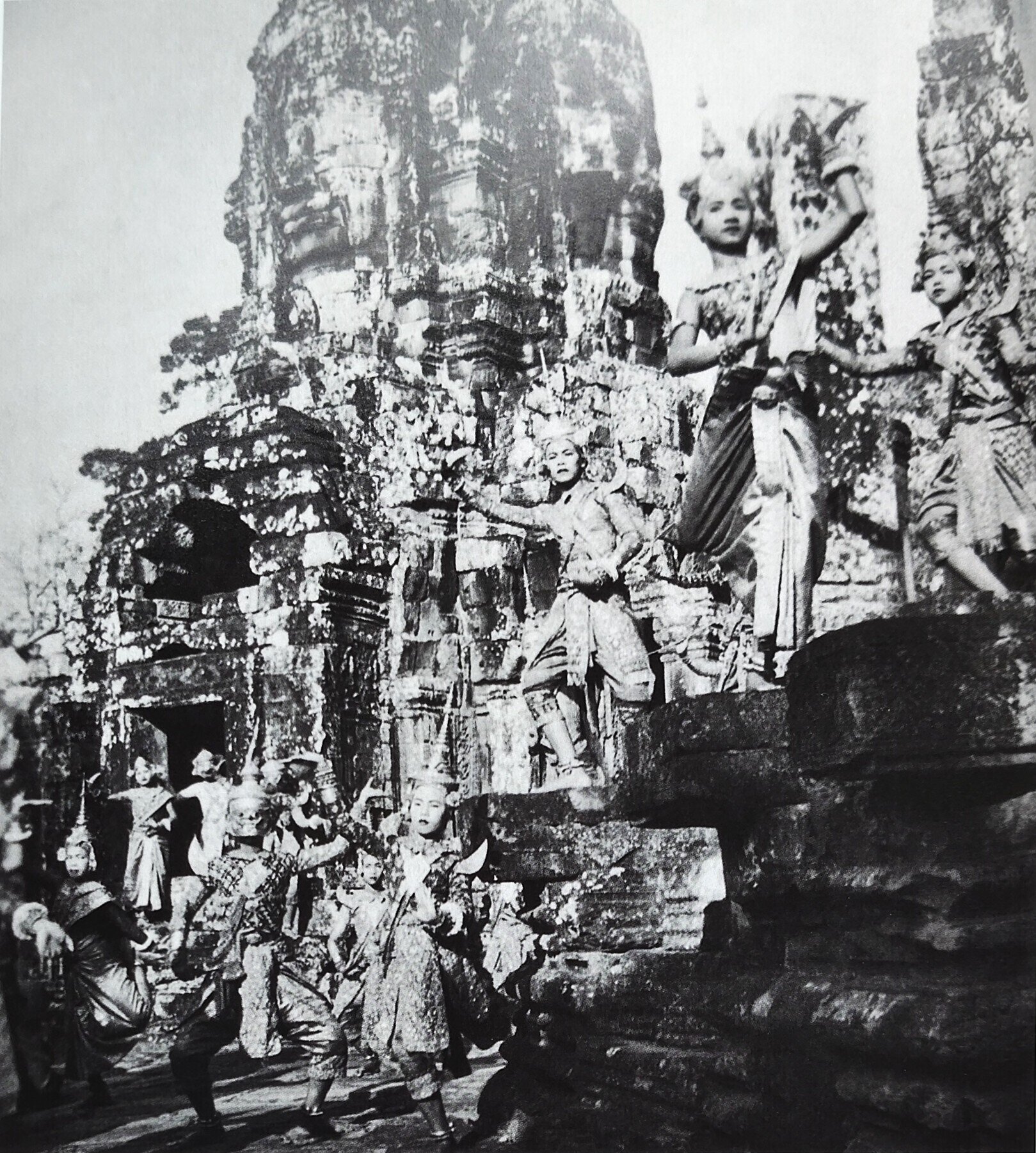
by photographer Ruppeckt (SFI/SPI, ECPAD)
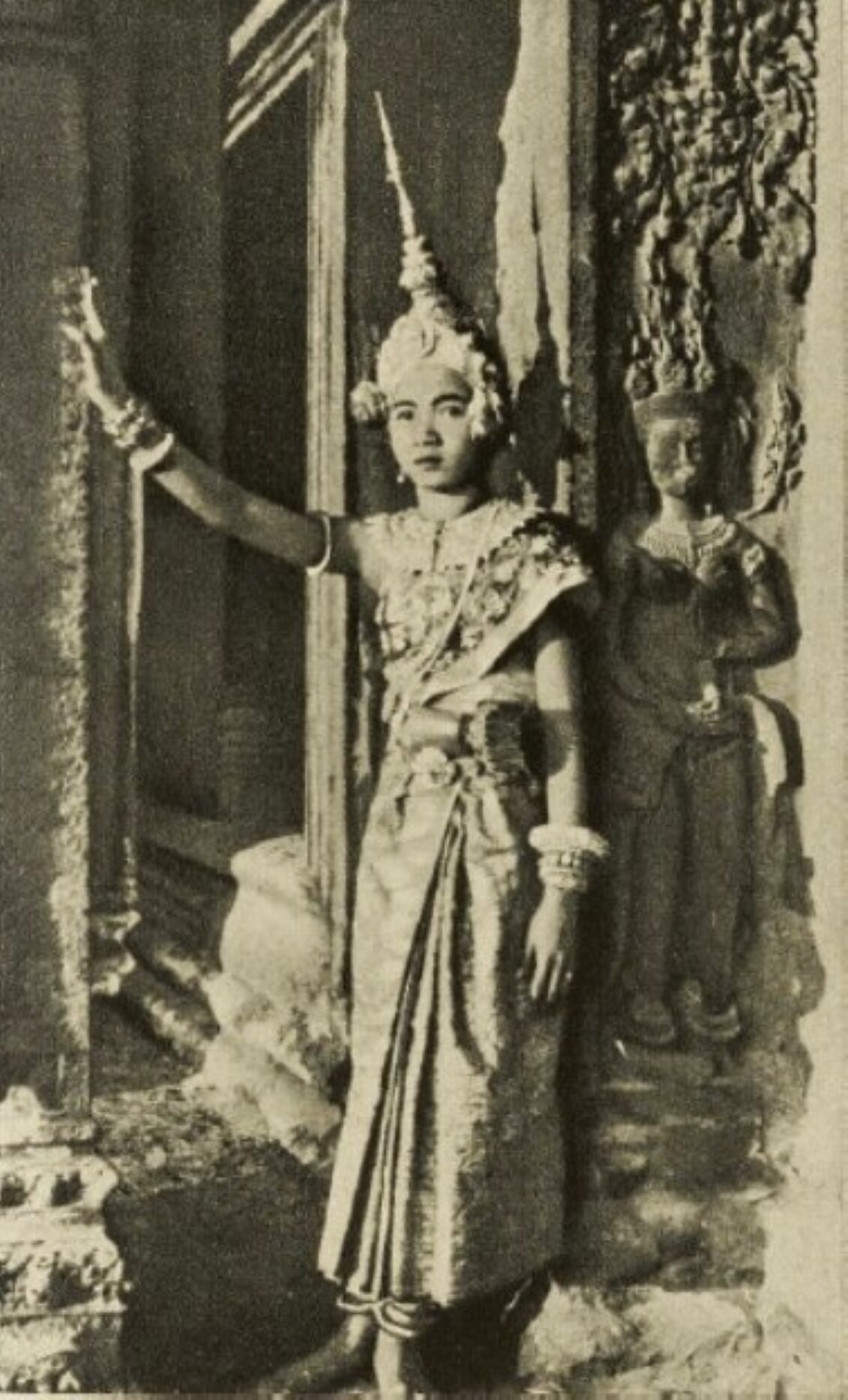
Mlle Bunah, first Royal Ballet dancer, 14-year old, at Bayon [photo by Guy Porée, France-Illustration special issue, 4 June 1949].
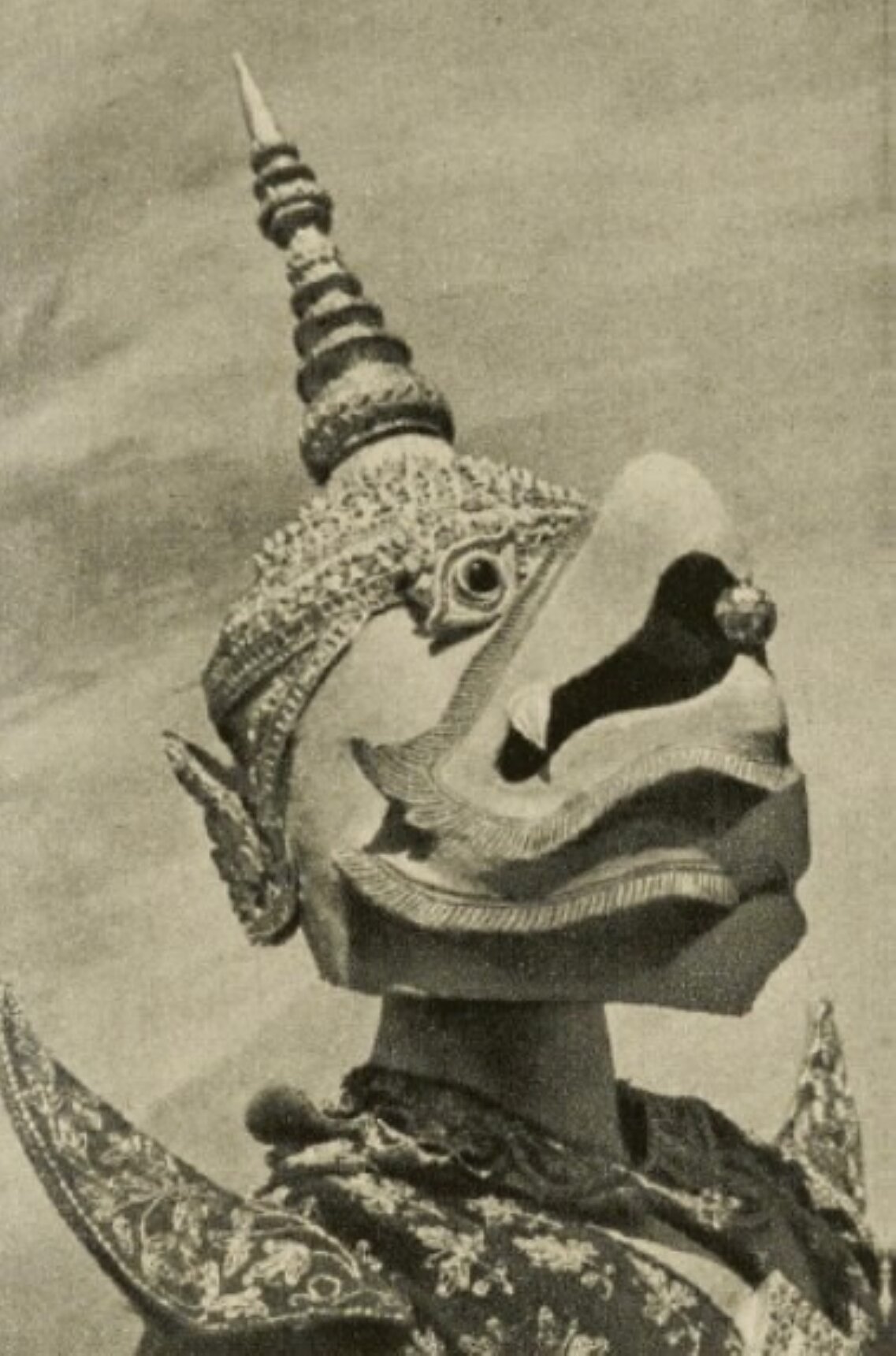
Royal Ballet dancers at Bayon, Garuda (King of Birds) mask [photo by Guy Porée, France-Illustration special issue, 4 June 1949].
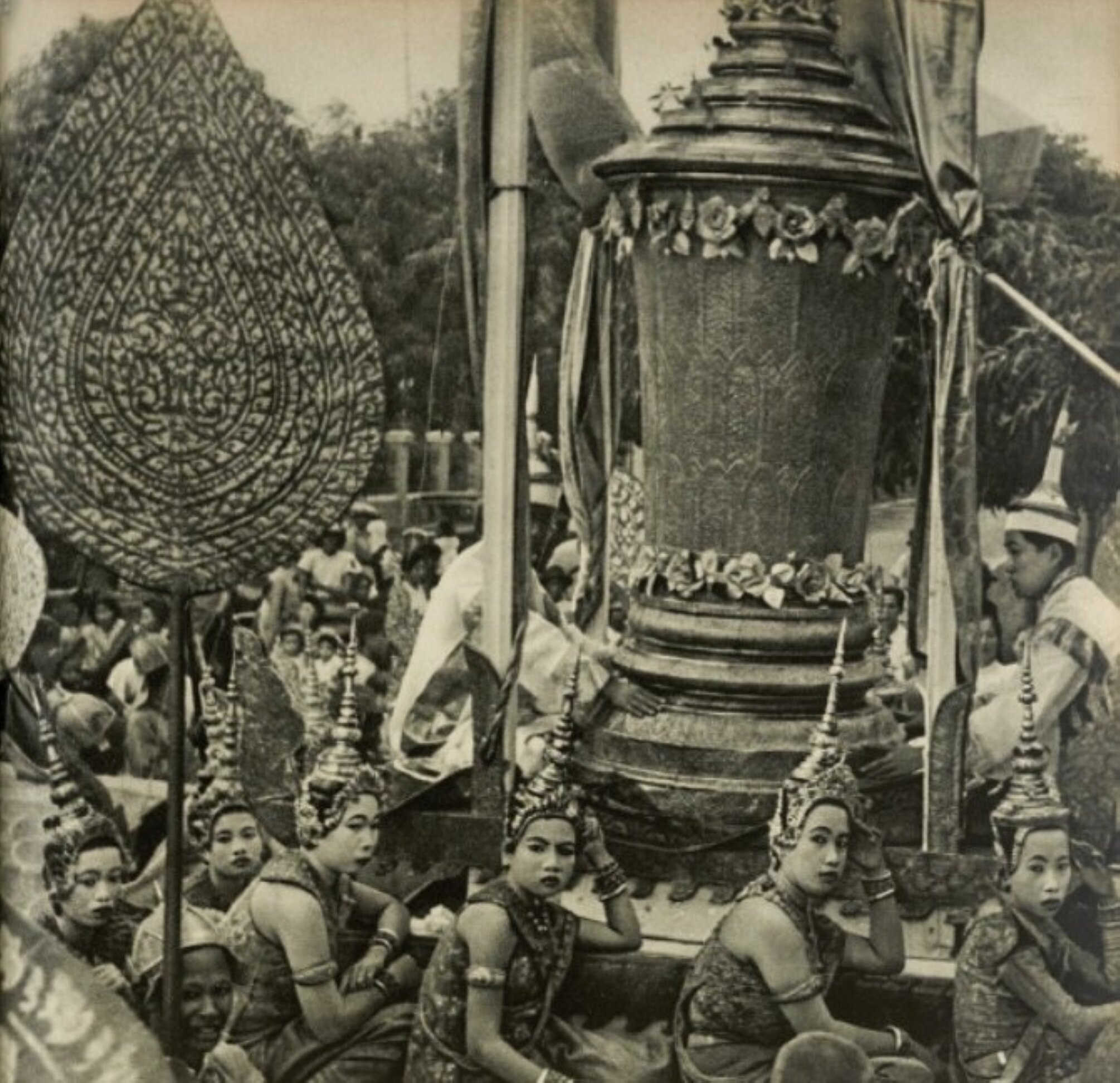
Dancers surrounding funerary urn [photo by Guy Porée, France-Illustration special issue, 4 June 1949].
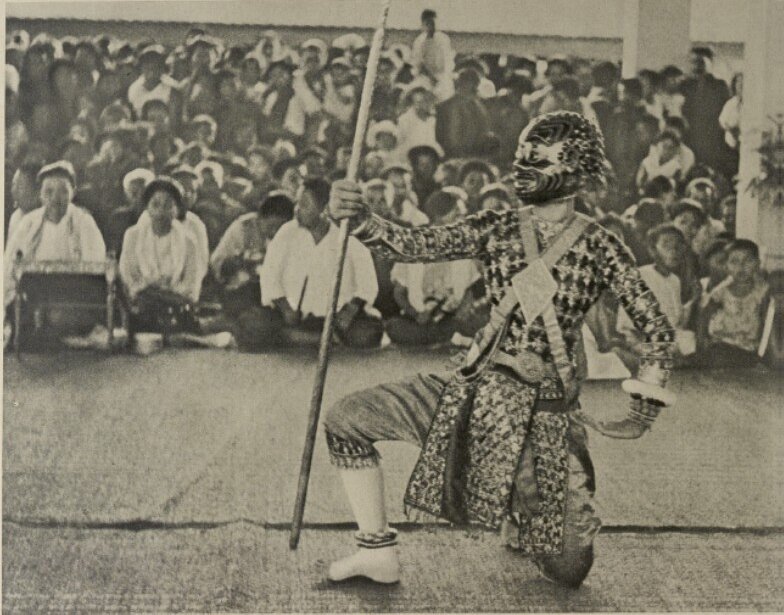
Ngoh Dance [photo by Guy Porée, France-Illustration special issue, 4 June 1949].
1) Royal ballet dancers at Bayon Temple. 2) Seemingly the same dance company pictured at the same spot at Bayon by French army photographer Ruppeckt, 5 – 7 Feb. 1949 [SFI/SPI-ECPAD, reproduced in Images du Cambodge 1900 – 1993]. 3) ‘Mlle Bunah, first dancer, 14 years old’. 4) ‘Garuda, king of birds’. 5) Royal ballet dancers around a funerary urn. 6) Ngoh dance. [2 last photos presumably taken at Phnom Penh Royal Palace; all photos except 2 by Guy Porée, France-Illustration special issue, 4 June 1949].
Even without a mask or costume, one can recognize each character, says our servant, but she also adds that young people today are mistaken because they know Tarzan better. In truth, despite the richness of the performance, it is difficult to appreciate it for hours if one only understands the theme and the story. The action — most often an episode from the Reamker, the Cambodian version of the Ramayana — contains almost immutable elements: a kidnapped princess, giants fighting, chases, scenes of seduction, a magic weapon given by the hermit to the hero… The originality of the scenes matters less than their sequence and the polish of the execution. Only a framework composed by someone very familiar with the choreography, guiding the mistress, will allow for those touches of detail which, in the eyes of connoisseurs, will mark quality. The former dancer will not simply have the action, declaimed by the narrator, sung by the chorus, and underscored by the orchestra, mimed with perfect academic precision. She will add here and there, in a few bars, a more vivid detail, such as that of the attendant who, after picking a flower from an unseen branch, stylizes the gesture of swatting away the ants that have fallen on her bare arms. It goes without saying that invention cannot be pushed too far, lest the style be compromised, which unfortunately happens as soon as one tries to “make it into theater” in order to be better understood by a modern audience. Certain troupes of traveling players, where melodrama is embellished with supposedly traditional dances, have already shown us what can become, for example, of the gesture of “sacrificing one’s hair” when, for the sake of pomp, hairdresser’s scissors, a ponytail, and a background sound of a few cymbal crashes are awkwardly added.
The music of the dances lacks such flourishes. Marked by the beating of ox-skin drums, it follows the staccato rhythm of its xylophones and small gongs, to which is occasionally added a kind of oboe. The lead instrument, the sampho, a drum swollen like a barrel and placed horizontally on two legs, is greatly revered. On the day of their initiation, the dancers piously place a pig’s head before it as an offering. The orchestra underscores the drama, sung and mimed, through the performance of tunes with specific meanings: the announcement of a deity’s arrival, the march of dignitaries, the power of giants, the sleep of princes, the handling of the bow, the capture of the horse, the aria of sailing on water… and all the transitional tunes for the various movements, including the one with a more rhythmic tempo.
The same ritual also applies to costumes, jewelry, and masks. The tip of a prince’s gold headdress is higher than a princess’s. It is encrusted with diamonds; the princess’s is adorned only with “trembling gold flowers.” The number of pieces in a costume, the number of jewels specific to each character, is meticulously fixed according to a strict hierarchy. One prince is entitled to forty gold beads in his fourth pair of bracelets, another to only twenty gilded silver beads. The steward of the jewels, assisted by two guards, ensures the precise distribution of the jewels. The steward of costumes and the mandarin in charge of masks also have serious responsibilities. A prince’s finery — about ten pieces of velvet embroidered with precious stones or of real gold lamé, some twenty jewels, not counting the diamonds in his tapered gold headdress, the “mokot” — is worth a small fortune.
A princess’s costume is already more modest. The mask of Hanuman, the white monkey, is princely in its elegance, made of white satin enhanced with gold designs stylizing the fur. However, because he is a monkey, he lacks the glittering wing-like epaulettes and pointed mokot. The hierarchy is even reflected in the presentation of the masks. They are arranged in three rows in an immutable order, although, for the secondary figures, certain questions of precedence are quite hotly debated.
In the first row, in the center, is the old gold mask of the hermit Maha Eysei, a formidable and powerful figure to whom a veritable cult is dedicated. To his right is the green mask of Rama, followed by the rich mokots of princes and deities. To the hermit’s left is Ravana, the lord with ten faces, then the yak with the “rooster’s tail,” and finally Ngoh, the black mask of the wild man beneath which a prince is concealed. In the second row, in the center, is Garuda, the king of birds and enemy of snakes, holding in his hooked beak the ball that grants invisibility. To his right are Hanuman, the white monkey, then the black monkey, and then the gibbons. To Garuda’s left are the horse, the lion, the golden deer, the blackbird, and the parrot. Finally, in the third row are the elephant and the ghost, the naga, and the magical objects: the precious ball that the goddess Mekhala throws into the air and catches, its sparks representing lightning; the axe that the yak Ream Eisaur throws toward Mekhala, striking the clouds and creating thunder; the short sword that the white monkey wields like a harlequin’s bat; the hermit’s long, gnarled staff; the golden, stringless bow with which the prince shoots invisible arrows; the yaks’ short, shining staffs; and Ngoh’s glittering cane.
The Ngoh dance, one of the most difficult to learn, is complicated by the handling of a large staff encrusted with shimmering shards, a magical accessory from which the disguised prince draws his prodigious strength and power of flight. The masks require rituals, the first of which, once a year, is the Grand Salute, led by a master of ceremonies. On a platform covered with white cloth, the masks are arranged in their hierarchical order, and various offerings are placed before them. I will refrain from a precise enumeration, as I am not writing an ethnographic article here. Imagine, laid out on mats on the ground, ritual bouquets made from cut banana trunks, vases of perfumed and holy water, dozens of trays containing chickens and ducks, some cooked, some raw, cooked and raw pig heads, fish, coconuts, ground sesame, sugarcane, cakes, sweets, fruit, and, placed here and there according to the rituals, thin candles and incense sticks. Other offerings are displayed near the orchestra, in front of the Sampho drum.
The mistresses and dancers sit on the ground, facing the platform of the masks. And first, the hermit Maha Eysei materializes. The master of ceremonies has donned the revered mask and the yellow robe. Walking hunched over, leaning on his gnarled cane, he advances to the platform and turns toward the singing audience. He then places the mask in the center of the platform and, after dressing in white, begins the invocations. The dancers then make the gesture of offering to the four directions of space, inviting the spirits. To honor them, while the spirits, unseen, taste the food, they perform a ballet.
The officiant then places the masks of their roles on the best dancers, then removes them. Next comes the “popils” ritual, where the audience, encircled by a cotton cord, passes three candles attached to the tips of metal leaves from hand to hand. Immediately afterward comes the anointing. Mixing perfume and powder, the officiant makes a round mark on the foreheads of the teachers, and each teacher marks the students in her class in the same way. Finally, after sprinkling musical instruments and musicians, the master of ceremonies ties a cotton thread soaked in holy water to the dancers’ wrists and wishes them happiness and success.
The annual Grand Salutes, whose rites I have only summarized, were formerly supplemented by Small Salutates every Thursday [1]. But now, throughout the year, the dancers simply offer the masks a few fragrant flowers and, before putting one on, light three sticks of incense.]
[1] Siamese treatises on dance dating back from the Sukhotai Kingdom refer to more salutes to the spirits of dance.
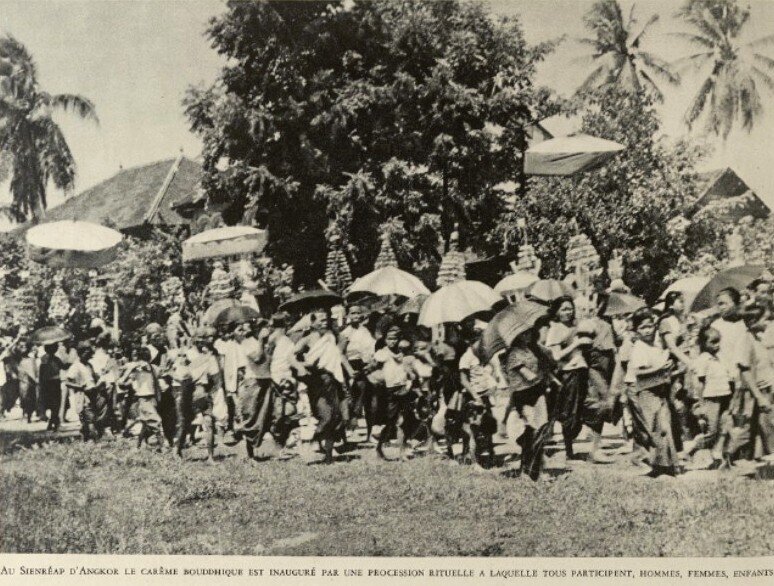
In the section devoted to the religions in French Indochina, this uncredited photo pictured a procession in Siem Reap at the start of the “Carême bouddhique” [Buddhist Lent], Chol Vossa ចូលវស្សា, the Rainy Season Retreat from July to October.
In the section devoted to the religions in French Indochina, this uncredited photo pictured a procession in Siem Reap at the start of the “Carême bouddhique” [Buddhist Lent], Chol Vossa ចូលវស្សា, the Rainy Season Retreat from July to October.
The son of a French consul in Chongqing (Yunnan) and Shanghai, French star reporter Lucien Bodard (9 January 1914 – 2 March 1998), editor of the special issue, contributed with a nostalgic escapade to the frontier provinces of Điện Biên, Lai Châu, and Sơn La, horse-riding to the mythical town of ‘Pongtho’ [Pong Tho, Lai Chau District] and its fabled White Thái [người Thái] women, part of the Tai Dón indigenous group. Escapism, or last attempt to reconnect with a rapidly vanishing world of hill people seemingly immune to the political turmoil of the lowlands? Suddenly, some untold connection between the Cambodian Royal Ballet and these faraway girls in a remote valley springs out of the glossy pages of the French magazine. Zomia gets closer to Angkor, and we somehow get closer to the source of unwritten, essential, shared codes:
Voici que la route s’effondre sur une énorme vallée, une sorte de tranchée entre des à‑pics de 2.000 mètres sur lesquels le crépuscule répand lumière couleur une de cendre bleue. Tout en bas, le long du fil de la rivière, j’aperçois la cité de Laichau. Merveilleuse est la première image des femmes. Soudainement le chemin est comme barré par trois chapeaux parasols ; mais à peine ont-ils été renversés que je distingue des visages empreints de la grâce sereine des statues bouddhiques. Pourtant aucun hiératisme religieux, aucun symbole : la race thaïs est la plus athée du monde. Tout le secret de ces apparitions délicieuses consiste dans l’accord des formes et des couleurs — le boléro blanc aux boutons d’argent coupé de l’étroite jupe noire par une ceinture écarlate. Les corps, aux jambes longues et presque sans hanches, sont faits pour la cadence et le rythme ; au-dessus de tout cela plane toujours un sourire un peu étonné — il est dans la courbure légère de la bouche et dans la fente des yeux.
Les filles de Laichau — des Thaïes blanches — sont célèbres. La cité est au confluent des Trois Rivières, et là, sur un éperon rocheux, au milieu des eaux emportées, se dresse le farouche Yames (c’est-à-dire château) du Très Grand et Très Puissant Deo Van Long, à l’autorité suprême sur les montagnes et les vallées de près de cent lieues de pays. Au delà de la barque du passeur, un chemin-escalier dans le goût chinois mène jusqu’à l’imposante demeure marquée par ces deux spécialités aristocratiques : des sentinelles trop sanglées et des prisonniers, ces prisonniers déguenillés de l’Orient, en train de construire une nouvelle enceinte à meurtrières. S. E. Long, actuellement dans la pleine force de l’âge, me conduit d’abord devant le portrait d’un merveilleux mandarin chinois, tellement imposant, tellement sage, tellement vieux ; il s’agit de son célèbre et redoutable père, Déo Van Try, qui assiégea Tuyen-Quang, défendu par le sergent Bobillot, qui mit à sac Luang-Prabang aux mille pagodes, qui accomplit maints autres exploits avant de s’incliner devant les pieds nus et la barbe blanche de Pavie. Mais Deo Van Long a aussi le secret du gouvernement efficace. […] Surtout, S. E. Long est le technicien de la politique matrimoniale : peu à peu il marie ses filles — des princesses merveilleusement belles — et ses fils aux rejetons des autres chefs thaïs. Ce sont alors de magnifiques cérémonies. Au bas du yamen sont ancrées des pirogues de la parenté battant oriflammes ; et, cependant que dans la nuit la grève en face est toute jonchée des feux de joie, au palais même se déroule le festin rituel, où le chum est servi dans des cornes de buffle.
Au delà de Laichau, vers la vallée heureuse de Phongto, il n’est plus de route. Trois jours durant, juché sur un petit cheval local, j’ai suivi une piste de cauchemar à travers la montagne de 200 mètres, dans le puzzle des pitons et des précipices. Le chemin est à peine une traînée de terre perdue dans la toute-puissance de la nature, qu’il soit en encoche sur des flancs à pic ou se prélasse sur les hauts plateaux exubérants de la senteur des fleurs — il y a des bancs de lis, des buissons de roses, des forêts de rhododendrons et jusqu’à des parterres de fraises sauvages. D’autres fois on plonge dans les arborescences de la jungle aux fougères géantes et aux lianes tordues comme les mille bras de quelque dieu hindou. Cependant, parmi les éboulis de rochers et les troncs centenaires, la petite caravane, précédée d’un partisan d’honneur qui arbore un fusil à pierre.
Au crépuscule du troisième jour la jungle a brusquement cédé devant des jardins. Nous traversons à gué un torrent et voilà, dans un écrin de collines, Phongto, la cité fabuleuse du vieux Deo Van Anh. Il me semble lire quelque récit d’autrefois : après avoir franchi au galop je né sais combien d’enceintes nous arrivons dans une sorte de caravansérail rempli de tout le grouillement de l’Asie. Que de races étranges, quel chatoiement! que de costumes fabuleux ! Voici des montagnes de turbans qui écrasent les têtes, voici des poignards ciselés accrochés aux ceintures, voici les suppliants, les serviteurs, les concubines, les dignitaires, et la marmaille et les cochons arrogants. La cour est dominée par un château sur pilotis en boue séchée et planches mal équarries. Pendant que je grimpe l’escalier-échelle à claire-voie mes tympans sont déchirés par les coups douloureux d’un énorme gong — j’aperçois de dos le domestique qui frappé sur l’instrument suspendu comme un saucisson. Mais voici le maître lui-même— un vieux monsieur en costume chinois, avec des moustaches tellement blanches, tellement recourbées, tellement effilées…
Deo Van Anh est le patriarche ; il a eu treize femmes et cinquante enfants, à peu près. La cinquième épouse — la préférée — était morte récemment : « Il n’y a pas de jour faste pour l’enterrement avant trois mois », avait décrété le sorcier chinois. «Allons, allons, réfléchis bien, avait ordonné Anh ; autrement cela me ruinerait » — en effet, les réjouissances doivent durer jusqu’à la mise en terre. Le sorcier, dûment chapitré, avait alors indiqué une date convenable, à deux semaines du décès. Ce jour-là il fallait voir le vieux Ahn à cheval, sous un parasol, flanqué d’innombrables drapeaux et ayant arboré sa tenue moderne avec décorations ! La cité n’était qu’un champ d’oriflammes.
Cependant le vieux chef a des soucis : ses propres fils n’aiment pas les traditions : « Que se passera-t-il à ma mort ?», gémit-il. Car le secret de sa popularité réside dans le respect des coutumes des innombrables peuples de Phongto, étagés sur la montagne comme les locataires d’un gratte-ciel ; Deo Van Anh est le père non seulement des Thaïs blancs ou noirs, mais aussi des Laos, des Lolos, des Kouchous, des Niangs, des Méos de toutes les couleurs, des Mans issus du chien céleste Plan-Hou ; sa sollicitude s’étend jusqu’à une peu plade adonnée à l’anthropophagie. Sa justice est un peu celle du roi Pausole ; presque toujours il pardonne au contribuable rétif, au soldat déserteur, au fonctionnaire prévaricateur.
Néanmoins il né badine pas pour les affaires sérieuses, la danse, par exemple : est punie de prison toute pensionnaire du corps de ballet qui manquerait une seule répétition. La chorégraphie est institution d’Etat réservée aux filles nobles. Presque chaque soir le bon peuple se rassemble dans la cour, et Anh, bien calé dans le fauteuil d’honneur, surveille l’exécution des mouvements. Dans la petite cour de Phongto les danseuses apportent le sens de la tragédie. Cependant qu’en moi-même je souhaite que les épreuves de l’immense Asie soient épargnées à ces vallées isolées du pays thaï, ces vallées qui sont peut-être les derniers refuges du simple bonheur de vivre.
[Suddenly the road tumbles into an enormous valley, a kind of trench between 2,000-meter precipices where twilight casts a blue-ash-colored light. Far below, along the river, I glimpse the city of Lai Chau. The first image of the women is marvelous. Suddenly, the path seems blocked by three parasol hats; but no sooner have they been overturned than I discern faces imbued with the serene grace of Buddhist statues. Yet there is no religious hieraticism, no symbol: Tai people are the most atheist in the world. The entire secret of these delightful apparitions lies in the harmony of forms and colors — the white bolero with silver buttons cut from the narrow black skirt by a scarlet belt. Bodies, with their long legs and almost no hips, are made for cadence and rhythm; Above it all hovers a slightly astonished smile, contained in the slight curve of the mouth and the narrowing of the eyes.
The girls of Lai Chau — White Tai women — are famous. The city lies at the confluence of the Three Rivers, and there, on a rocky spur amidst the rushing waters, stands the formidable Yames (that is, castle) of the Great and Powerful Deo Van Long, who holds supreme authority over the mountains and valleys of nearly a hundred leagues of land. Beyond the ferryman’s boat, a staircase-path in the Chinese style leads up to the imposing residence, marked by those two aristocratic traits : heavily strapped sentries and prisoners — those ragged prisoners of the Orient — building a new wall with loopholes. His Excellency Long, currently in the prime of life, first led me to the portrait of a magnificent Chinese mandarin, so imposing, so wise, so old; it was his famous and formidable father, Deo Van Try, who besieged Tuyen-Quang, defended by Sergeant Bobillot, who sacked Luang Prabang of the thousand pagodas, who accomplished many other exploits before bowing before the bare feet and white beard of [Auguste] Pavie. But Deo Van Long also held the secret of effective government. […] Above all, His Excellency Long was a master of marriage policy: little by little he married his daughters, marvelously beautiful princesses, and his sons to the offspring of other Tai chiefs. These were magnificent ceremonies. At the foot of the yamen were anchored canoes of the kinship, flying pennants; And while, at night, the beach opposite is strewn with bonfires, the ritual feast unfolds within the palace itself, where chum is served in buffalo horns.
Beyond Lai Chau, toward the happy valley of Phongto, there is no longer a road. For three days, perched atop a small local horse, I followed a nightmarish track through the 200-meter-high mountain, through a jumble of peaks and precipices. The path is barely a strip of earth lost in the omnipotence of nature, whether it cuts into sheer slopes or basks on the exuberant high plateaus fragrant with flowers — there are beds of lilies, rose bushes, rhododendron forests, and even patches of wild strawberries. At other times, one plunges into the dense thickets of the jungle, with giant ferns and vines twisted like the thousand arms of some Hindu god. However, amidst the boulders and ancient tree trunks, the small caravan, preceded by an honorable partisan carrying a flintlock rifle, made its way through the landscape.
At dusk on the third day, the jungle abruptly gave way to gardens. We forded a stream, and there, nestled among hills, laid Phongto, the fabulous city of old Deo Van Anh. It seemed to me I was reading some tale from long ago: after galloping through countless enclosures, we arrived at a kind of caravanserai teeming with all the diverse peoples of Asia. What strange races, what a dazzling array! What fabulous costumes! Here were mountains of turbans crushing heads, here were finely crafted daggers hanging from belts, here were the supplicants, the servants, the concubines, the dignitaries, and the children and the arrogant pigs. The courtyard is dominated by a castle on stilts made of dried mud and roughly hewn planks. As I climb the openwork ladder-like staircase, my eardrums are torn apart by the painful blows of an enormous gong — I glimpse the servant from behind, striking the instrument suspended like a sausage. But here is the master himself, an old gentleman in Chinese costume, with such white, curled, and pointed mustaches…
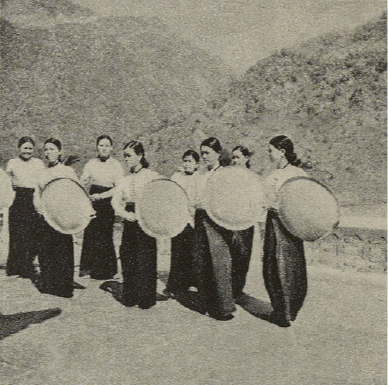
Phong Tho Dancers with their shields
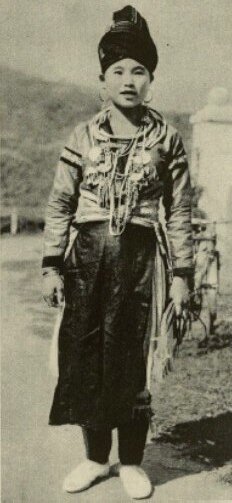
Meo noblewoman in Phong Tho, Vietnam
1) Lai Chau women ceremonial dance with shields. 2) A Meo noblewoman in Phong Tho.
Deo Van Anh is the patriarch; he has had thirteen wives and roughly fifty children. His fifth wife — the favorite one — had recently died: “There is no auspicious day for the burial for at least three months,” the Chinese sorcerer had decreed. “Come now, think carefully,” Anh interjected; “otherwise it will ruin me” — indeed, the festivities must continue until the burial. The sorcerer, duly instructed, had then indicated a suitable date, two weeks before the death. On that day, you should have seen old Ahn on horseback, under a parasol, flanked by countless flags and sporting his modern attire, complete with decorations! The city was nothing but a field of banners.
However, the old chief has worries: his own sons dislike traditions: “What will happen when I die?” he laments. For the secret of his popularity lies in his respect for the customs of the countless peoples of Phongto, perched on the mountainside like the tenants of a skyscraper; Deo Van Anh is the father not only of the White and Black Tais, but also of the Lao, the Lolo, the Kush, the Niang, the Hmong of every color, and the Man, descending from the celestial dog Plan-Hou; his concern even extends to people given to cannibalism. His justice is somewhat like that of King Pausole; he almost always pardons the recalcitrant taxpayer, the deserter, or the corrupt official.
Nevertheless, he does not trifle when it comes to serious matters, such as dance: any female member of the ballet corps who misses a single rehearsal is punished with imprisonment. Choreography is a state institution reserved for noblewomen. Almost every evening, the good people gather in the courtyard, and Anh, comfortably seated in the chair of honor, oversees the performing. In the small courtyard of Phongto, the dancers bring a sense of tragedy. Meanwhile, I secretly wish that the hardships of vast Asia might be spared these isolated valleys of Tai country, these valleys that are perhaps the last refuge of the simple joy of living.]
We found some similarities between these dancers and the ones represented in this rare, undated film. Both documents could be related to a Buon Suon ceremony marking the end of World War II and the return to peace at Angkor, performed by the Siem Reap classical dance company and some dancers from the Royal Ballet who had come from Phnom Penh.
Four years before Dien Bien Phu, this special issue glorifying French Indochina featured a last-ditch plea for a lost cause by former Governor-General (1912−1914 and 1917 – 1919), Minister of the Colonies and twice Prime Minister of the French Third Republic Albert Sarraut (28 July 1872, Bordeaux – 26 Nov. 1962, Paris, France). Sarraut, who had tried to compose with pro-Nazi Maréchal Pétain in 1940, appeared to almost resign himself to the ineluctable in these tired, gloomy remarks:
Il n’est pas de domaine, en vérité, où l’oeuvre française en terre indochinoise né porte le sceau de ce sens d’humanité qui est le caractère même de notre tradition nationale. Que cette oeuvre eût, comme toute oeuvre d’hommes, ses lacunes et ses imperfections, qu’elle eût besoin d’être complétée et parachevée, loin de moi la pensée de le contester. Elle n’en reste pas moins une oeuvre admirable, une noble et grande oeuvre d’humanité.
Et cependant il y a en Indochine, à cette heure, et depuis près de trois ans, la guerre contre nous ! Pourquoi ? Et comment se fait-il que le drame tragique et douloureux qui se déroule là-bas témoigne à la tutelle française la désaffection de certains de ceux qu’elle entoura de tant de soins ? Cette contradiction n’est incompréhensible qu’à ceux, malheureusement trop nombreux encore parmi nous, qui font preuve d’une vision bien courte en considérant ces agitations sous l’angle purement local, c’est-à-dire en les isolant d’un phénomène d’ensemble dont elles né sont qu’une des incidences.
Ce phénomène général, c’est l’immense mouvement de ressac d’un continent asiatique qui, longtemps plongé dans la torpeur, mais pénétré de jour en jour plus profondément par le génie de l’Occident, s’est éveillé au contact du progrès moderne et demande aujourd’hui à son dynamisme les moyens d’une réaction d’émancipation dont les effets se font partout sentir. L’Indochine est au milieu d’un foyer de commotions ou de séismes qui se sont successivement exprimés par l’indépendance de la Birmanie, celle des Philippines, la libération de l’Inde anglaise, les révoltes de l’Indonésie, les frémissements des Etats malais, sans parler du chaos prolongé qui secoue, tout à côté de notre péninsule, une Chine gigantesque de 500 millions de vivants. De toutes parts, autour de l’Indochine, brasillent des incendies. Etait-il conjecturable que par une exception miraculeuse elle dût être préservée des flammèches qui tourbillonnaient, et depuis longtemps, dans l’air torride d’Extrême-Orient ?
[There is truly no area where French effort in Indochina does not bear the mark of that sense of humanity which is the very essence of our national tradition. That this work, like all human endeavors, had its shortcomings and imperfections, that it needed to be completed and perfected — far be it from me to dispute this. It remains nonetheless an admirable work, a noble and great work of humanity.
And yet, in Indochina, at this very moment, and for nearly three years now, there has been a war against us! Why? And how is it that the tragic and painful drama unfolding there demonstrates to the French authorities the disaffection of some of those whom they surrounded with such care? This contradiction is incomprehensible only to those, unfortunately still too numerous among us, who demonstrate a very short-sighted vision by considering these upheavals from a purely local perspective, that is, by isolating them from a broader phenomenon of which they are merely one manifestation.
This broader phenomenon is the immense surge of an Asian continent which, long immersed in torpor but increasingly permeated by the genius of the West, has awakened through contact with modern progress and now demands from its dynamism the means for an emancipatory reaction whose effects are being felt everywhere. Indochina is at the heart of a series of upheavals and seismic events, successively manifested in the independence of Burma and the Philippines, the liberation of British India, the Indonesian revolts, and the stirrings of the Malay states, not to mention the prolonged chaos shaking, right next to our peninsula, a gigantic China and its 500 million inhabitants. All around Indochina, fires are blazing. Was it conceivable that, by some miraculous exception, it would be spared the flames that had been swirling, for so long, in the scorching air of the Far East?
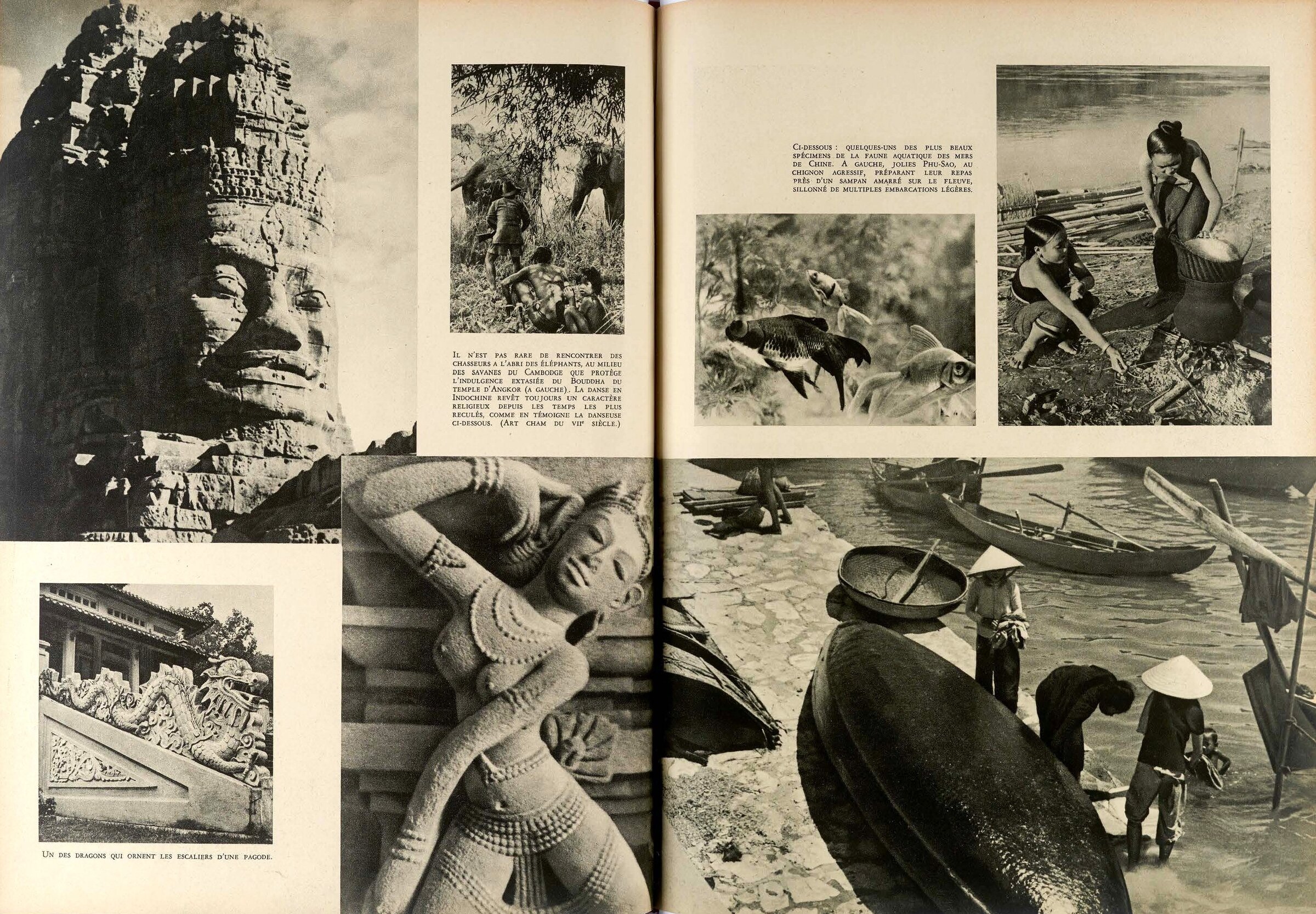
A tourist wet dream? A fantasmatic Indochina mixing the Angkorian smile, “lovely Phu-Sao girls and their gorgeous bossoms”, imitation sculptures of Cham goddesses, dragons and exotic fish [photo composit illustrating Xavier de Cristen’s article, “Beauté d’un accueil au pays des fleurs” [Beautiful Welcome to Flower Country].]
A tourist wet dream? A fantasmatic Indochina mixing the Angkorian smile, “lovely Phu-Sao girls and their gorgeous bossoms”, imitation sculptures of Cham goddesses, dragons and exotic fish [photo composit illustrating Xavier de Cristen’s article, “Beauté d’un accueil au pays des fleurs” [Beautiful Welcome to Flower Country].]
Final remarks by Léon Pignon (19087−1976), Haut-Commissaire de France en Indochine [France’s High Commissioner in Indochina], went along the same lines:
Je sais bien que des patriotes peuvent prendre ombrage de la présence sur leur sol des armées de l’Union française. C’est peut-être la malchance des peuples de l’Indochine que de voir s’éveiller leur nationalisme au moment précis où, sous la pression de la nécessité, partout se regroupent les forces, se resserrent les alliances, tandis que fait son chemin dans les esprits l’idée d’un gouvernement mondial. Je né doute pas que des intelligences aussi subtiles que celle des Vietnamiens, par exemple, né nous feront pas longtemps grief des inconvénients d’une solidarité qui est moins notre faute que celle des circonstances. Ils comprendront à quel destin les mènerait une solitude qui né saurait être, d’ailleurs, de longue durée. Dans les luttes de Titan qui se déchaînent aucun cas né saurait être réglé indépendamment des autres. Il né sera point de victoire ou de défaite isolée. C’est le sort de la civilisation qui est en jeu. Toutes les nations qui s’en réclament se sauveront, comme le prophétisait Gandhi, ou périront ensemble.
[I am well aware that some patriots may resent the presence of the French Union armies on their soil. Perhaps it is the misfortune of the people of Indochina to see their nationalism awaken at the very moment when, under the pressure of necessity, forces are being regrouped everywhere, alliances are being strengthened, and the idea of a world government is taking root in people’s minds. I have no doubt that intellects as subtle as those of the Vietnamese, for example, will not long hold against us the drawbacks of a solidarity that is less our fault than that of circumstances. They will understand the fate to which a solitude that, moreover, cannot be long-lasting would lead them. In the titanic struggles that are raging, no case can be resolved independently of the others. There will be no isolated victory or defeat. The fate of civilization is at stake. All the nations that claim it will either save themselves, as Gandhi prophesied, or perish together.]
Photos: A.E.C. S.C. A. Haut commissariat pour l’Indochine, Atlas-Photo, Guy Porée, intercontinentale, U. P., A. P. | CE NUMÉRO A ÉTÉ RÉALISÉ PAR NOTRE ENVOYÉ SPÉCIAL LUCIEN BODARD AVEC LE CONCOURS DES SERVICES DU HAUT COMMISSARIAT DE FRANCE EN INDOCHINE, DE LA DÉLÉGATION DU HAUT COMMISSARIAT A PARIS, DE S. E. PHAM VAN DINH, SECRÉTAIRE PARTICULIER DE S.M.BAODAI ET DÉLÉGUÉ DU GOUVERNEMENT CENTRAL PROVISOIRE DU VIET-NAM A PARIS, AINSI QUE DE S. E. THONN OUK, CONSEILLER DE L’UNION FRANÇAISE. | LA PRÉSENTATION EST DUE A MARC-RÉAL, DIRECTEUR ARTISTIQUE DE « FRANCE-ILLUSTRATION ».
Tags: dance, Khmer dance, dancers, Siem Reap, tourism, 1940s, 1950s, French literature, colonialism, Vietnam, Laos, Yunnan, hill people
Guy Porée (1902−1985) was a French writer, ethnologist and photographer who explored Cambodian culture after getting close to researcher Eveline Maspero at Paris Institut des Langues Orientales [Oriental Languages Institute] where they were both studying Chinese language in the mid-20s, and living in Cambodian with her as a married couple from 1934 to 1950.
A relative of famous French writer André Gide (1859−1951), Guy Porée entered the world of Paris avant-garde theater in his young age, working on costumes and translations of English playwrights such as William Congreve and Shakespeare. Fascinated with Chinese theater, he and fellow student in Chinese culture Eveline Maspero married in 1928, and he followed her after the birth of their son in 1934 to Cambodia, where she spent her youth.
Employed by the Banque Française de l’Indochine and connected to the Messageries Maritimes, he joined Eveline in her ethnological exploration of the country, taking photographs and contributing to a research that culminated with the publication of Mœurs et Coutumes des Khmers (1938), a work praised by George Coedès and Paul Pelliot and soon translated into English and Japanese.
Keeping alive his passion for performing arts, Guy Porée studied Cambodian performing arts and befriended numerous proponents of the vibrant theater scene in Cambodia. As a cultural advisor to young King Norodom Sihanouk, he was instrumental in the foundation of the theater company Lakhon Niyeay (New Theater) a few years before the Independence, the precursor of the Lakhon Cheat (National Theater) launched in 1957 – 8 even if some critics found Porée’s troupe too linked to the French ‘bourgeois’ theatrical form. The 1950 photo below was given to famous author Rim Kin’s family to researcher Khing Hoc Dy, who published it in his undated biographical note on Guy Porée:
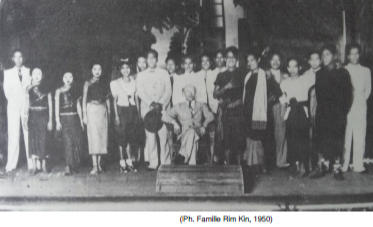
Guy Porée with Cambodian theater actors and actresses in Phnom Penh, 1950
Guy Porée with Cambodian theater actors and actresses in Phnom Penh, 1950 [from Khing Hoc Dy, ‘ហើយប៉ូរេ POREE Guy (1902−1985) ដោយ បណ្ឌិតសភាចារ្យ ឃីងហុកឌី’, Bulletin de l’AEFEK, nd].
sk गरुड Garuḍa | pl गरुळ Garuḷa | kh គ្រុឌ Krud
Garuda is described as an eagle-like sunbird deity, the king of birds and, in Hindu mythology, the vehicle (vahana) of Vishnu. "Lord of the garudas" is also one of the epithets of Shiva.
In Vedic tradition, personification of courage, a potent creature who can stop the spinning of the worlds its wing flapping, the younger brother of Aruna, the driver of sun god Surya. Garuda is the one attempting to stop Rāvaṇa from abducting Sītā, as described in the Rāmāyaṇa and the Viṣṇu Purāṇa.
In Cambodian tradition, the powerful bird, a companion of Vishnu (ព្រះនារាយណ៍, Preah Neareay), fights the evil forces, its image protecting temples and houses. He is the one who moved Mount Mandara and stole the amrita for the benefit of the gods in the Churning of the Sea of Milk, an essential part of Khmer mythology. Initially an enemy of the nagas, the image of the Khmer garuda evolves into a mythical creature embracing the nagas, a fusion denoting its "evolution from Vishnu's vahana to a protective figure of Khmer Buddhism" (J. Boisselier 1951).
from zomi, "highlander" in Tibeto-Burman languages spoken in Burma, India, and Bangladesh.
Zomia is a geographical term coined in 2002 by Dutch social scientist Willem van Schendel of University of Amsterdam to refer to the highlands of Asia in a global, macroscopic, transnational perspective.
Developing the proposition by Clifford Geerz that research fields in history and anthropology should be more thoroughly combined, the term ‘Zomia’ was applied to the geographical space known as Southeast Asian Massif by research James C. Scott in his 2009 reference study (The Art of Not Being Governed) on an area including parts of Northeastern Cambodia and characterized by low population density, historical isolation, political domination by surrounding states and no state formation process whatsoever.
While Zomia's limits have varied amongst authors - encompassing highlands overlapping parts of spme 10 countries (southwest China, Northeast India, eastern Bangladesh, all the highlands of Myanmar (Burma), Thailand, Vietnam, Laos, Cambodia, Peninsular Malaysia, and Taiwan), with a total population of around 100 million, the Tibetan world was not included in this area, due to its specific political logics.
