Angkor Vat: India's Contribution in Conservation 1986-1993
by B. Narasimhaiah
Author
B. Narasimhaiah
Publisher
New Delhi, South Asia Books [Memoirs of the Archaeological Survey of India n. 91].
Published
1994
Pages
165
Language
English
ISBN
9780836430677
Formats
ADB Physical Library, hardback
In the preface, the author, directly associated with the Indian effort of restoration in Angkor (1986−1993) remarkeded:
Angkor Vat temple-complex in Cambodia, symbol of Khmer genius in creating a micro-cosmic universe is world famous, and has rightly been inscribed on the list of World Heritage Monuments by the UNESCO. However, due to innumerable reports appearing in the western media appreciating as well as criticising the principles and methodology adopted by the Archaeological Survey of India in conserving the great heritage of Cambodia. Angkor Vat has been in limelight again particularly since 1986, the year from which the Archaeological Survey of India started the conservation of the monument as part of the bilateral agreement between the Governments of India and Cambodia. Unfortunately, however the work undertaken by the Archaeological Survey of India has been misunderstood rather than appreciated. This is obviously due to lack of effort on the part of the Archaeological Survey of India to counter the criticism by giving wide publicity to the conservation works carried out by the ASI in Angkor Vat. One could perhaps understand this since the Archaeological Survey of India in its long history of more than one hundred and thirty years has never tried to give publicity to the enormous and varied works done for the conservation and preservation of the monumental heritage of India. This has obviously been due to the feeling that the systematic and sustained work being carried out by it will speak for itself. However, it is now necessary, under the present circumstances, to document the works and publish it, not only for silencing the critics, but also as a document for the posterity. [p. xiii]
The tone was set — like other well-intentioned international initiatives from India during the Cold War era, the contribution to Angkor restoration was not kindly received by Western governments and monument conservation experts. Unesco, with its headquarters in Paris, was inclined to follow EFEO recommendations rather than the ASI empirical solutions. The Indian authorities distrusted the new régime in Cambodia, seen as too close to Vietnam and USSR — India’s time-honored alignment with Moscow started to be challenged by Indian politicians right after the end of the American war against Vietnam -, while the Western media related to the Indian contribution with criticism. Thirty years later, this page of Angkor modern history is still bitterly commented by Indian researchers, for instance Saudiptendu Ray in a 30 July 2024 column titled“India’s Role in the Conservation of Cultural Heritage in Southeast Asia” on the website of the Vivekananda International Foundation:
India’s presence in Angkor Wat was seen negatively by the western world, which was still reminiscing about the colonial era. The French, who controlled Indo-China, were the most aggrieved. The French had been the colonial masters that had overseen conservation in Angkor for over a century till the conflict in the 1970s forced them out. Thus, the restoration activities of the Indian archaeologist in Angkor were extensively criticized by the western media. Philip Shenon from TheNew York Times expressed his personal displeasure with the following statement: “Armed with hard brushes and buckets of a solution of ammonia and water, hundreds of unskilled Khmer labourers, working at the Indians’ direction, vigorously rub over the delicate stonework as if it were a dirty kitchen floor.” [“Washing Buddha’s Face,” The New York Times Magazine, 21 June 1992]. This barrage of criticism did not take into account the challenges the small team of Indian archaeologists faced due to the festering Khmer Rouge insurgency. Despite the dangers, ASI patiently worked along with the Cambodians in the Angkor region.
Controversial contribution, challenging context
Fact is the working conditions in the Angkor area at the end of the 1980s and beginning of the 1990s were challenging, even if a rare Russian-Cambodian photo-albumfrom that time show that, contrary to the alarmist reports in the Western media, Cambodian people were eager to visit their heritage sites.
The author, an archaeologist himself who had worked or was to work on Heritage List sites in South India, avoided polemical statements in the book, opting for demonstrating through some 80 color photography plates the impressive results obtained with the chemical mix applied to the Angkorian sandstones. As the detractors had censured AIS for keeping secret the composition of this chemical compound, the book quite candidly stated:
The method used by the Archaeological Survey of India, in chemical cleaning and preservation of this magnificent and beautifully carved temple complex, Angkor Vat, was very simple. In the first instance, the surface was moistened with water by spraying. Then the area was cleaned with 1 to 2 percent solution of liquid ammonia, used only to neutralize acids secreted by the hyphae of the micro- vegetation, mixed with teepol, a non-ionic detergent, and by brushing gently with nylon brushes or tooth brushes or soft coir brushes, as the situation demanded. The surface was therefore cleaned thoroughly with water. The area thus cleansed was treated with 2 percent solution of polycide, biocide and zinc silico fluoride seperately. Finally, after complete drying of the area, it was preserved by applying a coat of 2 percent of polymethyl methacrylate in toluene.
Almost the entire monument covering an area of nearly 200,000 sq. m has been chemically cleaned and preserved. It is heartening to know that the chemical treatment on the surface of the stones has not only exposed the original colour and texture of the building material of the monument, but has also brought back the expressions on the faces of sculptured human and animal figures, which were not to be seen by any one and appreciate the supremacy of the Khmer sculptors over their proud art. The torana decorations of the second enclosure are the mute testimony of this good work.
However, the cryptogamous growth is reappearing within a few years on the surface of the stones. This is only due to the reasons that the growth is deep rooted and is not possible to eradicate in one or two process of chemical cleaning. Therefore, the process will have to be repeated several times to bring the cryptogamous growth under complete control. [p. 80 – 1]
Here below are some samples of this matter-of-fact, “before and after” demonstration:
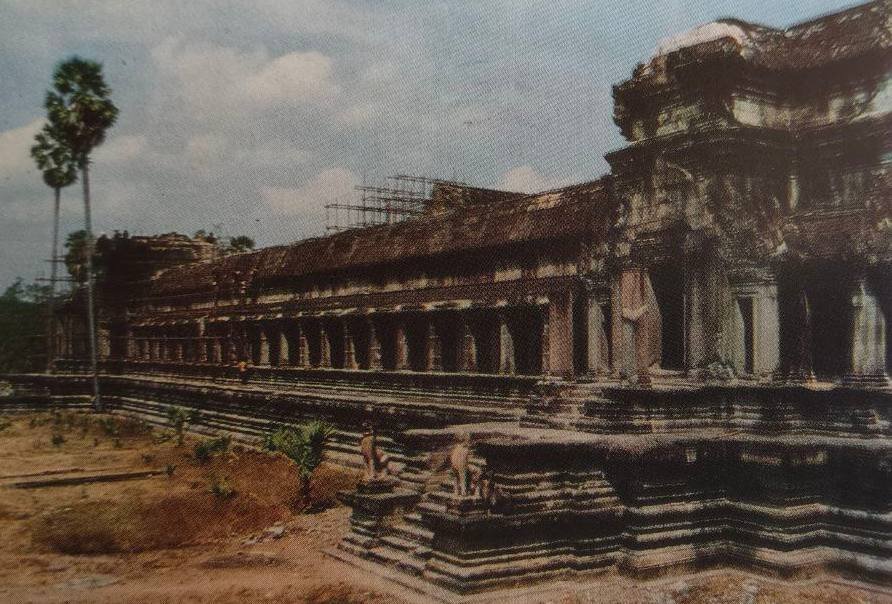
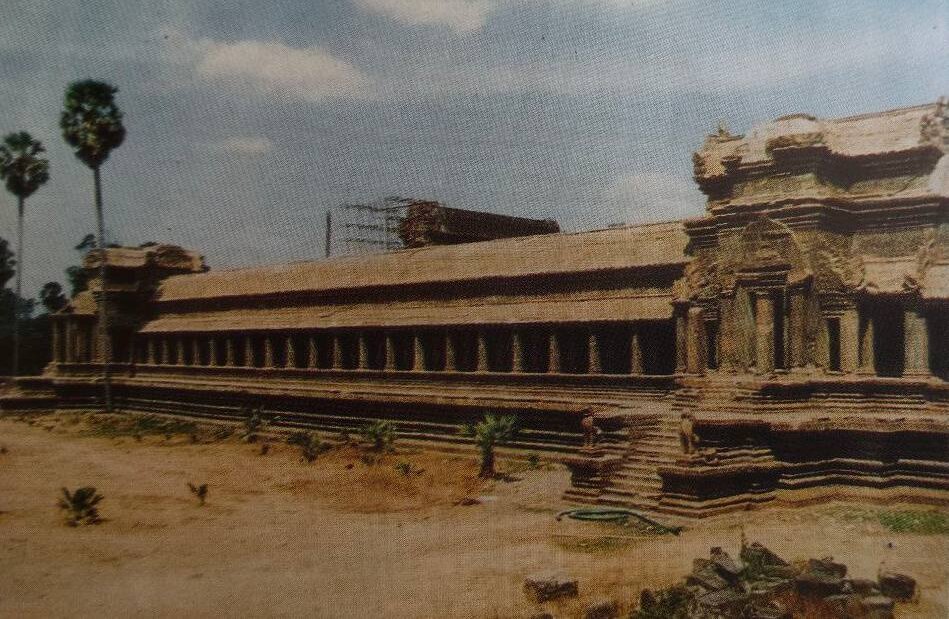
Angkor Wat — Third enclosure: Northern Gallery on western side, A, before and B, after conservation and chemical treatment. [Plate 76]
Angkor Wat — Third enclosure: Northern Gallery on western side, A, before and B, after conservation and chemical treatment. [Plate 76]
Angkor Wat — Third enclosure: Northern Gallery on western side, A, before and B, after conservation and chemical treatment. [Plate 76]
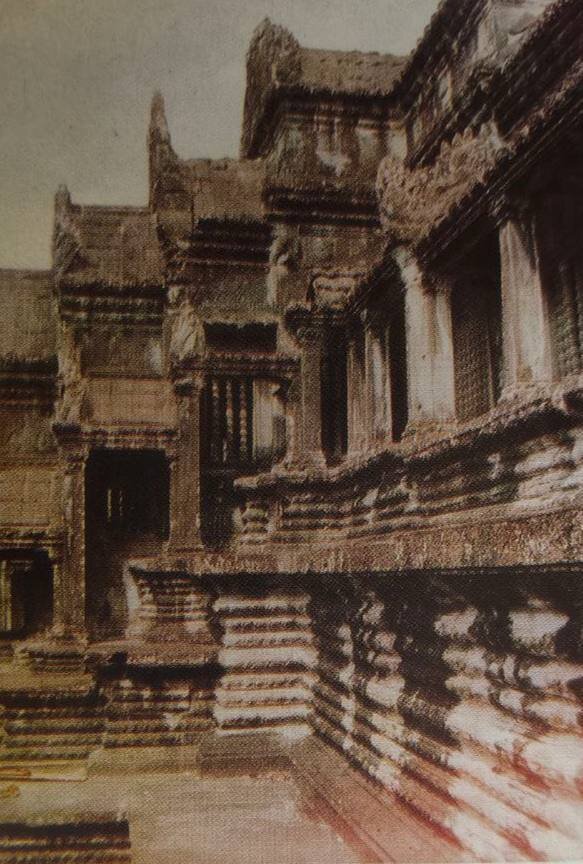
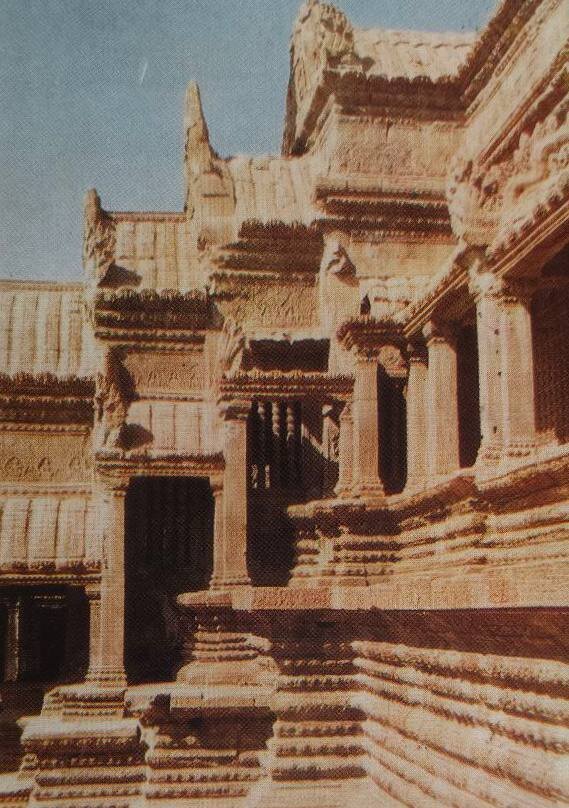
Angkor Wat — “Antechamber: galleries, A, before and B, after chemical treatment.” [Plate 77]
Angkor Wat — “Antechamber: galleries, A, before and B, after chemical treatment.” [Plate 77]
Angkor Wat — “Antechamber: galleries, A, before and B, after chemical treatment.” [Plate 77]
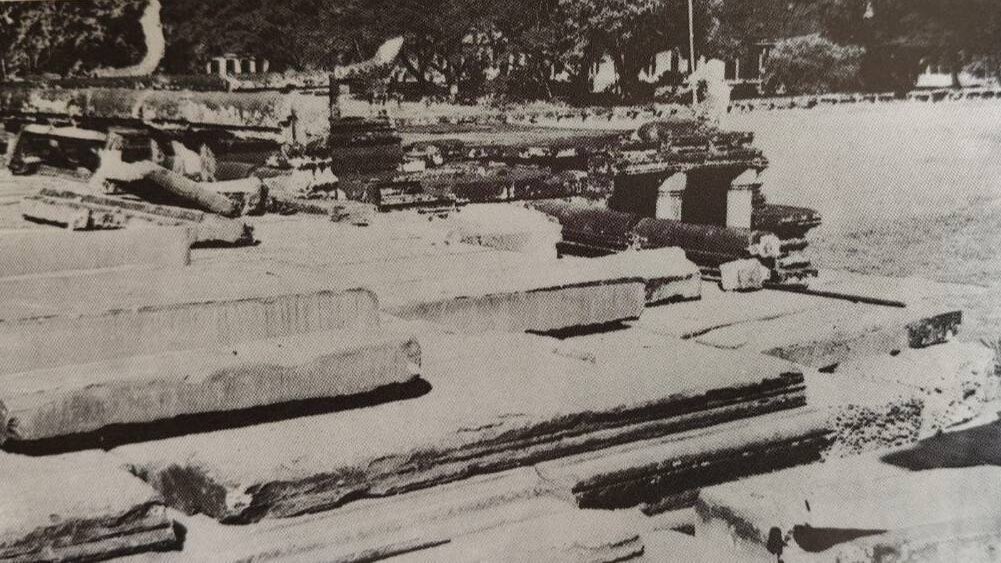
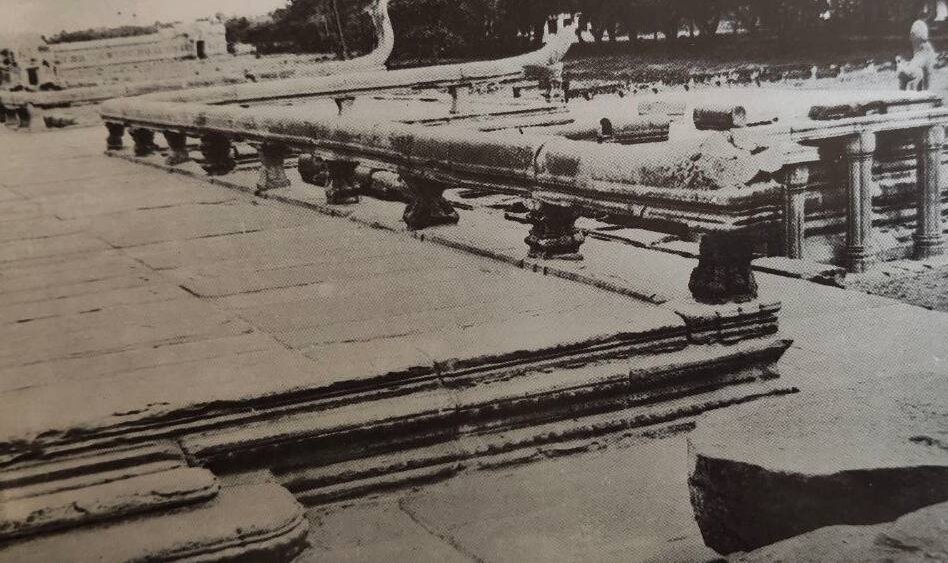
Angkor Wat — “Esplanade (Ranga Mancha): flooring, A, before and B, after conservation.” [Plate 22 in the book]
Angkor Wat — “Esplanade (Ranga Mancha): flooring, A, before and B, after conservation.” [Plate 22 in the book]
Angkor Wat — “Esplanade (Ranga Mancha): flooring, A, before and B, after conservation.” [Plate 22 in the book]
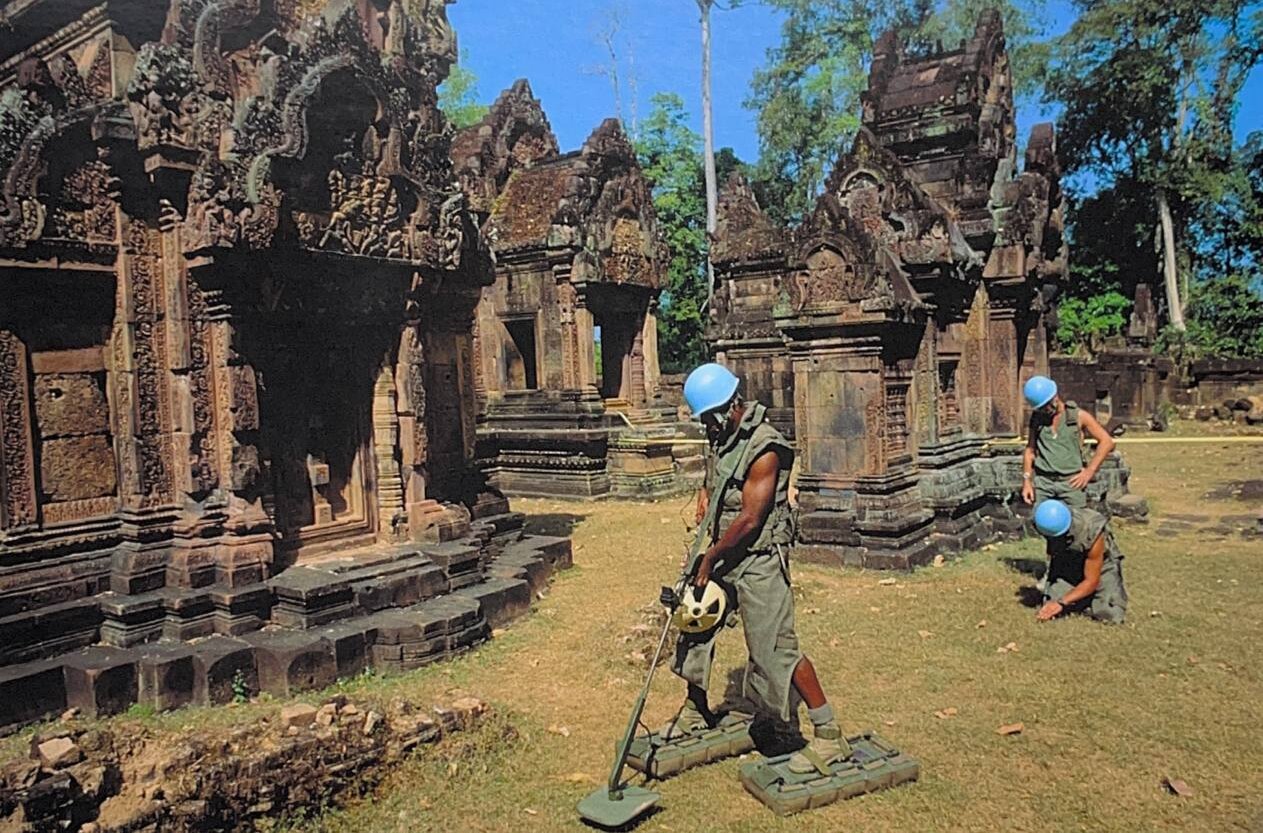
And the fact also is that some areas near Angkor remained highly dangerous well into the 1990s, as seen in this photograph from the French Army Information Service:
Demining of an area of Banteay Srei Temple by UN Blue Helmets from the French 17th Parachute Engineer Regiment, 7 Dec.1992. [photo by Michel Riehl/ECPA/ECPAD, fromImages du Cambodge 1900 – 1993, p.102]
Demining of an area of Banteay Srei Temple by UN Blue Helmets from the French 17th Parachute Engineer Regiment, 7 Dec.1992. [photo by Michel Riehl/ECPA/ECPAD, fromImages du Cambodge 1900 – 1993, p.102]
In his 1992 article for the New York Times Magazine quoted earlier, Philip Shenon was indeed more nuanced, noting for instance:
The Indian team’s restoration work, begun in 1986 and scheduled to go on for at least two years more, has sparked one of the angriest debates of modern art conservation. Depending on the expert asked the question, Angkor Wat is either being restored to a lost glory or is being irreversibly damaged.
The Indians insist they are removing vegetation that is slowly eating away at the monument, while carefully rebuilding collapsed stone structures. Their critics say that the Indians are using outdated cleaning techniques and dangerous, abrasive chemicals to scrub away detail on some of the best-preserved statuary of the ancient world, while pouring cement with reckless abandon on a structure that was originally built without mortar. […]
The furious dispute over the restoration of Angkor Wat is part of a larger argument among scholars and diplomats over how, and whether, outside nations should cooperate in preserving the complex of more than 70 major temples spread across 25 square miles of the ancient Khmer capital. The United Nations — through its Educational, Scientific and Cultural Organization, or Unesco — is trying to come up with a blueprint for conserving all of the great stone monuments of Angkor.
Unesco’s hope is to save the temples from the ravages of nature, of looting and of unrestrained tourism. But its work has been hampered by shortage of money and by bickering among outside experts over who should do the work and who should serve on an international advisory panel that is being formed to counsel the Cambodian Government on the restoration. Unesco’s immediate goal is to secure for Angkor Wat and the other Angkor temples a place on its World Heritage List, a designation that would allow the United Nations to assume a more formal role in overseeing — and raising money for — the restoration work.
While the Angkor temples are indisputably worthy of inclusion on the list, they cannot be added unless the Cambodian Government offers up a formal, highly detailed plan for maintaining and policing Angkor. “This Government is in such chaos it’s hard to imagine them coming up with a grocery list, let alone a detailed plan to restore an archeological wonder like Angkor,” says a Western diplomat in Phnom Penh. Nevertheless, Unesco’s local representative in Cambodia, Richard A. Engelhardt, an American archeologist, is patiently working with Cambodian Government officials in hopes of submitting the plan later this year.
Pich Keo, the director of Cambodia’s national museum, is one of the few Cambodian experts on Angkor – the ancient capital of the Khmer empire and home to Angkor Wat — to have survived the Khmer Rouge terror of the 1970’s. Pich Keo says he appreciates the fact that in the early 1980’s, when Phnom Penh made an international appeal for help in restoring the Angkor monuments after a decade of neglect, only India responded, offering the assistance of its 130-year-old Archeological Survey, one of the world’s largest and most experienced art-conservation services. But he makes clear that he is appalled at what the Indians have done to Angkor Wat. There are areas of the temple, he says, where the stone has clearly been damaged by the restoration efforts, and he fears what will become of the monument over time because of the Indian team’s mysterious mix of chemical cleaners and preservatives. “I see this work and I think, no good,” he says.
World famous Cambodian architect Vann Molyvann (1926−2017), who would have turned 100 on 23 November 2026, was the first Director of the institution in charge of the preservation of Angkor, APSARA National Authority (ANA), appointed by King Norodom Sihanouk in 1995 after his return from exile in 1991. As such, he had a comprehensive view on what had be done and what remained to be done in order to save the Angkorian monuments. In a series of personal conversations with Yvon Chalm in 2009, one of the first young French architects to settle in Phnom Penh at the end of the 1990s, Vann Molyvann allowed that, from photo reports in Angkor, he could conclude even before his return to the country and a first visit of the site as expert advisor to UNESCO that AIS restoration work had been “extrêmement mal fait” [“extremely poorly done”]. Consequently,
J’ai demandé une entrevue à S.E. Chea Sim et S.E. Hun Sen et je leur ai demandé si je pouvais notifier au gouvernement français, et à l’Ecole d’Extrême-Orient que l’UNESCO était prêt à revenir [à Angkor]. J’ai eu l’accord du Premier Ministre Hun Sen pour faire revenir EFEO. C’est ce processus qui a conduit ensuite à la fondation APSARA Authority.”
[“I requested an interview with H.E. Chea Sim [then President of the Senate, ADB] and H.E. Hun Sen [then First Prime Minister, ADB] and asked them if I could notify the French government and the École d’Extrême-Orient that UNESCO was ready to return [to Angkor]. I obtained Prime Minister Hun Sen’s agreement to bring the EFEO back. This process subsequently led to the establishment of the APSARA Authority.” [created by the Royal Decree of 19 February 1995, ADB] [unpublished conversation on 25 April 2009, courtesy of Yvon Chalm.]
Since the 1986 – 1993 contribution
There was a one-decade lapse before AIS came back to Cambodia, this time under the 2002 Cambodia-India agreement for the restoration of Ta Prohm temple, with India providing long-term technical assistance, materials and funds. Ten years later, the program was partly completed, in particular with the installation of wooden walkways and railings to protect the stones from foot traffic, as Prasat Ta Prohm was a touristic highlight since its appearance in the blockbuster Lara Croft: Tomb Raider (2001) — the same preventive contraption was later deployer at Beng Maelea. Ta Prohm renovated ‘Hall of Dancers’ was officially inaugurated in November 2022.
In 2018, a memorandum for the restoration of Preah Vihear temple was signed by the two countries. The 11th-12th magnificent structure had been inscribed as a UNESCO World Heritage Site on 7 July 2008 and AIS worked along other international cooperation programs for the preservation of a site that has been again damaged in the 2024 – 2025 military confrontation on the Thailand-Cambodia international border unilaterally contested by Bangkok.
In parallel, the AIS has been involved from 2014 to 2023 in conservation and restoration programs at the Cham temples of Mỹ Sơn (Vietnam), gravely damaged by US bombs in August 1969. Prime Minister Narendra Modi, in a display of India’s soft power, also approved the AIS involvement in the conservation of Bagan stupas (Myanmar) damaged by the 2016 earthquake on that historic site, and from January 2020 in the restoration of ancient Buddhist pagodas at Bagan, including the 12th-century Ananda Temple, where the completed restoration site was visited by Prime Minister Modi in person in 2018. Earlier, ASI undertook the survey for the restoration of the 11th-century Khmer Vat Phou temple (Laos) in 2005, with the first phase of restoration work starting in 2007, and the second in 2018.
These conservation initiatives are clearly inscribed in India’s ‘Act East Policy’, established in 2014 as an extension of the ‘Look East Policy’ dating back to the early 1990s. After Prime Minister Jawaharlal Nehru’s (1889−1964) active involvement in diplomatic efforts to defuse the tension in French Indochina in the 1950s — and his historic visit to Cambodia in October 1954 -, India had for long been quite remoted from Southeast Asia, and in hindsight the 1986 – 1993 fiasco in Angkor had also revealed a lack of international vision. The contextualisation of the 2014 turn by Amb (Retd) Anil Wadhwa in his August 2019 paper ‘India’s Act East Policy’ [on India’s Ministry of External Affairs website] is worth reading:
Although India has enjoyed close historical links with South East Asia, its inward turn following independence, severely undermined its influence in the region. Although some in South East Asia in the 1960s saw India as a natural strategic partner and a potential security guarantor; consistent with its principles of non-alignment, india did not participate in any proposed regional security arrangements. During the latter years of the cold war, India’s relationship with the Soviet Union and its support for Vietnam reinforced India’s political estrangement from a region predominantly under the influence of the United States. It is only in the last three decades that India has really sought to comprehensively engage with South East Asia. […]
In the early 1990s, India introduced the ‘Look East Policy” – a novel concept that aimed to turn the country’s North East into the gateway to the IndoPacific region and to help build stronger ties with India’s extended neighborhood. The policy remained India’s pivot for successive governments. While dividends of theLook East Policy can be debated, the Modi government, after its landslide victory in the 2014 parliamentary elections, had different plans altogether for the oil rich and tea growing region of India’s north east, located at the strategic junction of China, Bangladesh, Bhutan and Myanmar. Addressing the East Asia Summit in Nay Pyi Taw, PM Modi told the audience comprising several world leaders that his government had accorded high priority to turn India’s look East Policy to Act East Policy. The Act East Policy is meant to serve the tin purposes of stronger trade and business ties with South East Asia and other Indo Pacific countries and to create development opportunities for the North East States of India. Commerce, Culture and connectivity – the three Cs- are therefore the pillars of India’s current Act East Policy. […]
This Asean vision of the Indo Pacific has been recently adopted in June 2019. In fact countries like Australia, France, India and Japan had also come up withtheir own individual visions and strategies for cooperation in the Indo Pacific region and therefore some countries in the Asean like Indonesia, Thailand did not want the south east Asian region to be sidelined and left out of this new geopolitical construct. The Asean vision envisages centrality of the Asean, the aim is not to create any new mechanisms, but rather to strengthen existing Asean led mechanisms such as the East Asia Summit as platforms for dialogue and implementation of Indo Pacific cooperation. Besides, the Asean vision impinges upon a rules based order anchored upon international law, openness, transparency, inclusivity. And commitment to advancing economic engagement in the region. In this regard four areas of cooperation – maritime cooperation, connectivity, UN Sustainable Development Goals 2030 and economic development have been put forward for engaging with other countries in the Indo – Pacific.
India approaches the region from an overarching vision. PM Modi, speaking at the Shangri-La Dialogue in May 2018 spoke of this vision, highlighting a free and inclusive Indo Pacific. This is a region where some of the largest and smallest nations of the world have coexisted in harmony. This harmony exists because of economic cultural ideological and civilizational commonalties.[…]
In the conclusion, the author mentioned about the looting of the Conservation d’Angkor campus and the evacuation of local residents to Angkor Wat for shelter following attacks by the Khmer Rouge:
We may recall here an incident which took place in the month of February that had a bearing on the working conditions of the team. On the night of 9 February, around 0130 hours we were woken up from our sound sleep by the thundering sound of rockets launched at the Conservation D’ Angkor campus, in which the residences of the Team are situated. The gate of the campus was broken and nearly twenty persons fully equipped with rocket launchers, AK-47 rifles etc., entered the campus. The guards on duty ran for their safety, leaving the whole campus at the mercy of the attackers. Fortunately, the gunmen straightaway went to the Museum building, broke the entrance door open launching a rocket, and then collected 11 good pieces of sculptures and walked away. No doubt, it was a very well planned attack, because, simultaneously the other groups had attacked the UNTAC Bangladesh camp, UNTAC Hospital and a strategic road cross from where either military or Police of the State of Cambodia had to pass through to come to the campus. However, the operation was over within half an hour or so.
This was a shattering experience for the team members. It was a nightmare. However, as the days passed on, the life had become almost normal, though we were hearing the rumours that the gunmen may attack once again in the month of March. But March was fairly peaceful. But there was one more attack on the night of 6 April. This time the method of attack was extremely peaceful. They noiselessly opened the eastern gate, which is not in use. Then they rounded up the guards one by one without making any sound. After making sure that they had rounded up all the guards, they asked them to march towards the museum. They made the guards cut the locks and open the door, and selected good pieces, and ultimately carried the sculptures to the road side, from where the gunmen walked away carrying the sculptures. Once again, they showed that they could come at any time and do whatever they wanted to.
By the time the gunmen attacked a third time on the night of 22 April, the local authorities had posted policemen and had equipped the guards. However, this time the gunmen entered through the western gate which is also not used frequently and is also very close to the museum. Unfortunately for them, the guard near the museum could see their entry in time and started firing at them. They responded by cross firing. Meanwhile, the police persons who were guarding the main gate on the south and residences of the team started moving towards the museum. Noticing this movement the gunmen fled.
After this incident, rumours were rife that Khmer Rouge will attack Siem Reap and Angkor Vat to capture them. It did happen. In the early hours of 3 May, four groups attacked Siem Reap simultaneously from four sides. One of the groups entered the city along the river Siem Reap on the east of the campus. The group was trying to cross the river near the campus. The policemen on duty in the campus saw this and tried to stop the gunmen. Ultimately, around 0730 hours the gunmen succeeded in crossing the river and were very close to the campus. Seeing the danger, the policemen went out of the campus, not worrying about the rocket and rifle attacks. They simply rushed towards the attackers blasting their AK-47s. This sudden and brave onslaught, the gunmen had not anticipated. In fact, one gunman was injured. Therefore, they retreated. After making sure that the gunmen had really retreated, the policemen returned to the campus. It was 0940 hours. But the fighting on other three fronts continued, as they had closed in at Market place. Ultimately, the Khmer Rouge had to withdraw around 1015 hours, leaving behind 15 dead and one captured.
Though they withdrew from Siem Reap, their activities continued for three more days in the peripheral villages, and there was every danger of their returning. Except for launching some rockets at Angkor Vat, as the temple was being guarded by Military and the Police, there were no fresh attempts on Siem Reap. But the rumours were making rounds that the Khmer Rouge will definitely attack with vengeance.
While we were facing all these problems, one more cropped up in the form of drying up of moats and wells around the monument from which water was being taken for the chemical preservation work of the monument. There was absolutely no water in the moat by the end of April. Therefore, it was decided to sink a bore-well in the premises for water for chemical cleaning and also for the tourists after our leaving Siem Reap. A bore-well was sunk. Water was in plenty. But, we could not use a drop of it. Because on the day the bore-well became operational, the Khmer Rouge attacked the villages nearby, and hundreds of families took shelter in the temple premises. Our bore-well.was the only source of water for those families. We did not want to put the families in difficulty. Obviously, we had to think of other alternative that was to transport water from the river on the truck. That is what we had to do and we did, to keep the work in progress.
In spite of all the tensions and hurdles, the Archaeological Survey of India continued the work till 17 May 1993, and returned to India safely. Thus the third phase of conservation at Angkor Vat, the co-operation work between the Governments of India and Cambodia, came to end, two months before schedule. [p.83 – 84]
Table of contents
Foreword
vii
Preface (p.xiii)
xiii
List of Plates (p.xix)
xix
List of Figures (p.xxiii)
xxiii
I
Chapter I: Introduction conservation
1
II
Chapter II: Principles and Methods
11
III
Chapter III: Structural Conservation
17
Stepped Embankment of Moat
17
Fourth Enclosure on western side (Main Gateway)
18
Southern and Northern Libraries between Third and Fourth Enclosures
20
Southern Library
20
Northern Library
21
Esplanade (Ranga Mancha)
22
Third Enclosure
23
Southern and Northern Libraries between Second and Third
49
Antechamber (Cruciform Gallery) between Second and Third Enclosures
55
B. [for Barkur] Narasimhaiah (b. 1938, Karnataka State, India)was a field archeologist, a member of the Archaeological Survey of India(ASI) from 1964 to 1996, when he retired, and the head of the Indian Restoration Mission in Angkor, First Phase, from 1986 to 1993.
With a MD in Indology from University of Mysore [Mysuru] in 1960, a PG Diploma in Archaeology from ASI School of Archaeology in 1963 and a PhD in Archeology from the University of Pune [Poona] in 1977, B. Narasimhaiah engaged in the exploration and excavation of ancient sites across Karnataka and Tamil Nadu, of Harappan and pre-Harappan remains at Kalibangan, as well as archeological field research in theWorld Heritage Sites at Hampi, Tanjavur, Pattadakal, Darasuram, Gangaikondacholapuram and Mahabalipuram.
In addition to revising various ASI guidebooks of sites in India, he published about his research in India and his mission at Angkor Wat (1986−1993), which remained controversial.
Publications
Neolithic and Megalithic Cultures in Tamil Nadu, Delhi, Sundeep Prakashan Pub., 1980, 257 p. ASIN B0DLT7TM1B.
Metropolis Vijayanagara, significance of remains of citadel, Delhi, Book India Pub. Co, 1992. ISBN 9788185638003.
sk तोरण toraṇa, “arches”, "entrance canopy", "festoons", "doorway".
Torana refers to stylized decorative framework surrounding sculptural and painted figures in Indian art specifically and Asian art in general.
A torana can be described as a gate, gateway, arch, throne-back, backrest, or decorative niche surrounding a deity, god, buddha, bodhisattva or religious hierarch, teacher or saint.
Toranas are often employed to decorate temple doorways or windows as found in Nepal. In Pali language, Torana refers to an arched portal.