Publications
Kauṇḍinya, Preah Thaong, and the "Nāgī Somā": Some Aspects of a Cambodian Legend
by Rüdiger Gaudes
by H.B. Sarkar
Revisiting the essential love story at the origin of Cambodia: the Nagi princess (Neang Neak or Soma?) and the Indian traveler who also married an Indian girl?

pdf 8.3 MB
We give here access to the 1986’s study by renowned Indian epigraphist H.B. Sarkar on the essential founding couple of Kambuja and the Khmer nation, perpetuated to these days as Preah Thong and Neang Neak ព្រះថោង នាងនាគ in the Cambodian wedding ceremony. Further references and comments were added while editing the text.
The main thesis of this novel, stimulating paper was that Kaundinya from Kanchi married a local princess when he ventured to Funan, and then another woman when he came back to India. And in the process, it can be said that he initiated the process of culturally unifying India, as legends from the Tamil South and from the Ganga Valley started to fuse into syncretic (Hindu-Buddhist-Jain) traditions. The story of Soma សោមា and/or Neang Neak នាងនាគ remains the pillar of matriarchal traditions supporting numerous principles and laws in modern Cambodia.
The paper was initially published in the excellent Journal of the Institute of Asian Studies published in Madras [mod. Chennai] in the 1980s-1990s. [NB: For clarity, we have made page footnotes into end notes. Numbered notes from the author, lettered [a] ones from ADB.]
It has sometimes happened that when scholars develop a sense of consensus on some naughty problems and set up theories to match the phenomena, long usage or recognition of such theories makes them appear as if these are actual facts of history. In the present paper, I shall take up two such cases: one refers to the almost universal belief, that the Kaundinyas migrated to Funan from the region of Mysore in India. The second one refers to the seemingly conflicting reports about the marriage of Kaundinya I with Lieou-Ye (Willow-Leaf Lady”)[1], according to Chinese sources, and with the Nāga princess Somā, according to Sanskrit epigraphic text from Campa, as if the two marriages by the same king are incompatible. None of the views generally held now in respect of these matters can be treated as valid. I shall first of all deal with the problem regarding the homeland of Kaundinya I, the founder of Funan.
B.R. Chatterji has already drawn our attention [2] to the fact that the Kaundinyas were “very influential in southern India” in the second century A.D. In this connection, he drew our attention to a second century Mysore inscription of a Cutu Satakarni king [3] and a fourth century inscription of a Kadamba king, which record grants of land, in connection with a Siva-Shrine, to the Brahimins of the Kauedinya gotra.
Now, the earliest inscription cited by Chatterji has been dated in the second century A.D.; this has possibly to be post dated by at least fifty years, to judge by the palaeography of the said inscription. Now, since this inscription and the second one come long after the foundation of Funan, it is obvious that we cannot postulate the view that the Kaundinyas of the Mysore region were responsible for the foundation of Funan towards the close of the first century A.D. or the beginning of the second. Apart from this chronological difficulty the other hurdles are that Mysore is an inland-territory with no maritime tradition and that there was no port of international stature on the Coromandel coast in the first or second century A.D. The Periplus of the Erythraean Sea, composed sometime in the second half of the first century A.D., and Ptolemy’s Geography, composed towards the middle of the second century AD. underline this position. So the homeland of the migrating Kaundinyas has to be sought for elsewhere.
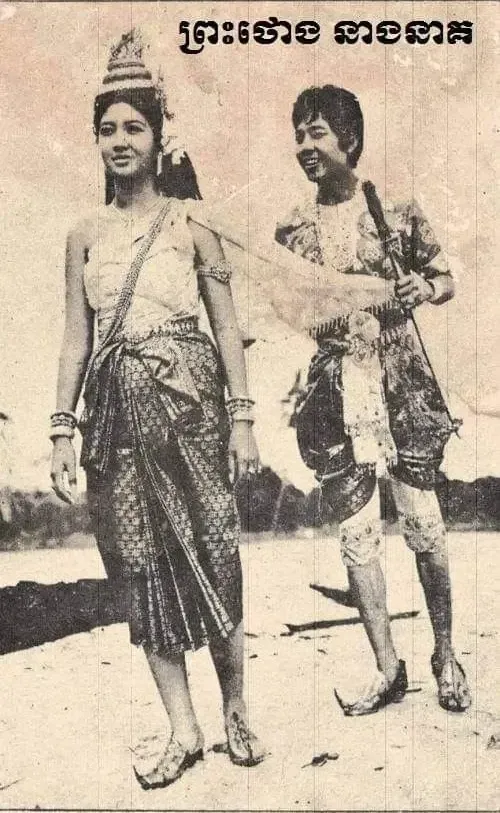
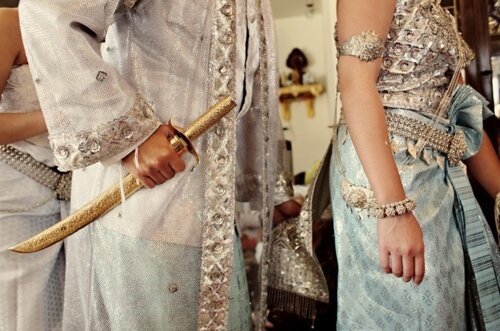
In the ពិធី ព្រះថោងតោងស្បៃនាងនាគ Pithi Preah Thong taung sbay Neang Neak, “ceremony of Preah Thong holding Neang Neak’s scarf,” an important part of a Cambodian wedding celebration, the bride’s ស្បៃ sbay is often said to represent the Naga Princess’ tail Kaundinya had to grasp when he dived in the sea after her. Strikingly, the couple’s position is the reverse of the Indian wedding tradition, where the bride follows the groom [Photo: date and source unknown].
In the ពិធី ព្រះថោងតោងស្បៃនាងនាគ Pithi Preah Thong taung sbay Neang Neak, “ceremony of Preah Thong holding Neang Neak’s scarf,” an important part of a Cambodian wedding celebration, the bride’s ស្បៃ sbay is often said to represent the Naga Princess’ tail Kaundinya had to grasp when he dived in the sea after her. Strikingly, the couple’s position is the reverse of the Indian wedding tradition, where the bride follows the groom [Photo: date and source unknown].
It is well-known that the traditional homeland of the Kaundinya Brahmins was at Kaundinyapura, lying in the Chandur Talug of Amraoti (i.e. Amaravati) in Vidarbha [b]. It comprised modern Berar and a large part of the territory lying within Wardha (Varada) and the Waingangi. In the north, it reached the Payoşni, a tributary of the Tapti. This Kaundinyapura lay on the river Wardha, a tributary of the river Godavari, which is deemed by Hindus all over India as one of the seven sacred rivers of India [4]. Apart from this, Vidarbha is an important locality in the political and cultural history of both southern and northern India.
Vidarbha is first mentioned in the Altareya Brahmana (VII. 34). In the Vaijayantiekosa, Chap. III and IV, which have some geographical particulars of puranic type. Maharashtra, in which Vidarbha lay, has been equated by some with Dandaka. This Dandaka was famous in the days of the Ramayana as an area of primeval forest, which extended right across the peninsula from the hills of Orissa to the source of the Godavari, but the puranic Janapada or inhabited tracts of Daņdaka probably referred only to the valley of the Indravati, a left-bank tributary of the Godavari. In the Kalpadrumpkosa (Dakaprakanda 1), however, the term Vaidarbha has been understood in the sense of Kundin, i.e. Kaundinyapura.
A look at the map showing the distribution of forest areas of India in ancient times will indicate that the region comprising Andhra in the south, Kalinga in the north and the plateau of the Deccan in the west, the basins of the lower Godavari and the lower Krşņā [vulgo: Krishna anglicised as Kistna] (excluding their deltas and the Pennar), formed a vast geographical entity largely covered by a forest umbrella. Within the régime of this forest, the river valleys with fertile plains provided not only the possible lines of communication with the outside world, but also supported communities or groups of population.
A scrutiny of the map will also indicate that the sources of the two great rivers, namely the Godavari and the Krsnā [Krishna], lie about 100 miles apart from each other in southern India. Within the valley of these two rivers lie such world famous places as Ajantā, Elurā and Amaravati, connected with art and architecture. The first impulse for migration to South-East Asia came no doubt from northern India, as appears from pre-Christian literary references, but the second impulse, more formidable and of longer duration, came from the zone I am discussing here. It comprised Vidarbha, parts of Kalinga (Orissa) and a large segment of Andhra. This area was washed by three great rivers, namely, the Mahanadi in the north, the Godavari in the central part and the Krishna in the south.
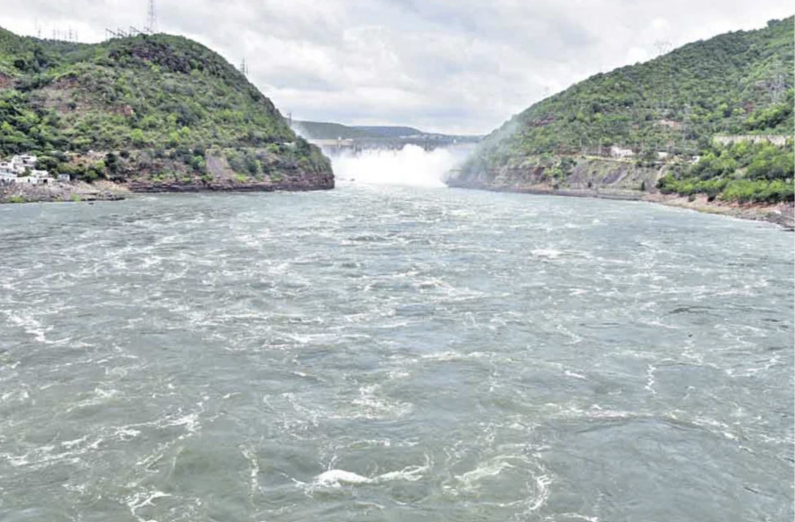
The Krishna River [undated photo, Banasri Tourism India].
The Krishna River [undated photo, Banasri Tourism India].
Politically this region had been under various ruling dynasties during the period I am speaking of, namely, the Early Sātavāhanas (с. В.С. 235‑A.D.50), the Ksaharatas (c. A. D. 35 – 90) and the later Satavahanas (c. A D. 90‑c. 200). The empire then disintegrated into five parts, and a period of considerable political turmoil ensued. The first migration of the Kaundinya and the Kalinga people to various places of South-East Asia seems to have taken place on account of the military disturbances caused by the encounters between the Ksaharatas and the Satavahanas between c. A.D. 50 and 150. One can suppose that these migrant Kaundinya Brahmins sailed down the Varada and and the Godavari or the river Krishna and reached the river-mouth on the Bay of Bengal. They could have then sailed for the port of Palura on the Orissan coast or the port of Tamralipti on the Gangetic delta. It is true that the port of Palura is not mentioned in any document from the first century A.D. [8] but since international ports do not grow up suddenly out of nothing, it is a valid conjecture that its origin has to be placed not later than the second half of the first century A.D. The flourishing condition of this port in the days of Ptolemy (c. 140 A.D.) envisages such an earlier start.
I have already drawn attention to the fact that Kaundinyapura of Vidarbha was located in the subdivision called Amaravati, popularly called Amraoti. In the lower deltaic region of the Krishna, there was another Amaravati, which gave rise to the famous Amaravati School of Art. A. Foucher had long ago suggested [9] that there was a port at the mouth of the river Kistna, which “seems to have been one of the great ports of embarkation, from which Graeco-Buddhist influence was exported to Indo-China”. The expression Graeco-Buddhist is no longer fashionable, in spite of the Greek influence in the folds of the drapery: it has been replaced by the expression Amaravati type of sculpture. It is very likely that the port for the despatch of the specimens of this art was from Palura. There is hardly any doubt that the wide dispersal of the specimens of this art to Dong-duong (Viet Nam) [10], Korat Plateau (Thailand) [11], Sempaga (Celebes) [12], Jember (East Java) [13] and Palembang (Sumatra) [14], is due to the joint or separate colonizing activities of the Vidarbhan Kaundinyas, the K’um-L’un or Kalinga people [15] and the dispossessed scions of the Iksvaku princes of the lower Kistna-valley in various places of South-East Asia [16].
The dislodgement of a large segment of the Kaundinya clan from the Amaravati tracts of Vidarbha seems to have started in pre-Christian centuries and traces of their movement towards the South are attested by the establishment of mini-Amaravatis in their trek. One such Amaravati was located in Southern Orissa, not far off from Bhuvaneswar, marked by mound now, but not yet excavated by the Archaeological Survey of India: it is believed to be medieval. but I have not been able to shake off the idea that at lower levels, it might reveal an ancient stage. Further south lay the famous Amaravati, now called Amraoti like its name-sake in Vidarbha. It lay on the river Krishna, about 18 miles from Guntur and about the same distance from Bezwada. It seems probable that the migrating clan of the Kaundinyas to Funan went from the Andhra Amraoti and not from Kaundinyapura in Vidarbha. There are two grounds for this supposition. First, the specimen of an Amaravati sculpture found at Dong-duong is not far off from Da-nang, which means Amaravati in native parlance; it was then under Funan. Similarly, the toponym Binh-dinh, which means Vijaya, is a reminiscent of its name-sake in the Krşņā Valley. Second, B. R. Chatterji [17] has drawn our attention to a Chinese passage which alludes to the name of the home-country of the Kaundinyas in the Ki-country, while another chronicle refers to it as the Kia‑o country. In view of what I have stated earlier, it may not be too rash to throw out the suggestion that ki-stands for Krşņā, vulgo Kisna, on whose bank stood Vijaya-pura, a famous capital-city mentioned in inscriptions [18], and Kia‑o stood for Kaun (dinyapura). The indication of toponyms and personal names by their abbreviation had become quite popular in India in later days, as the Aryamañjuśrimulakalpa attests [19].
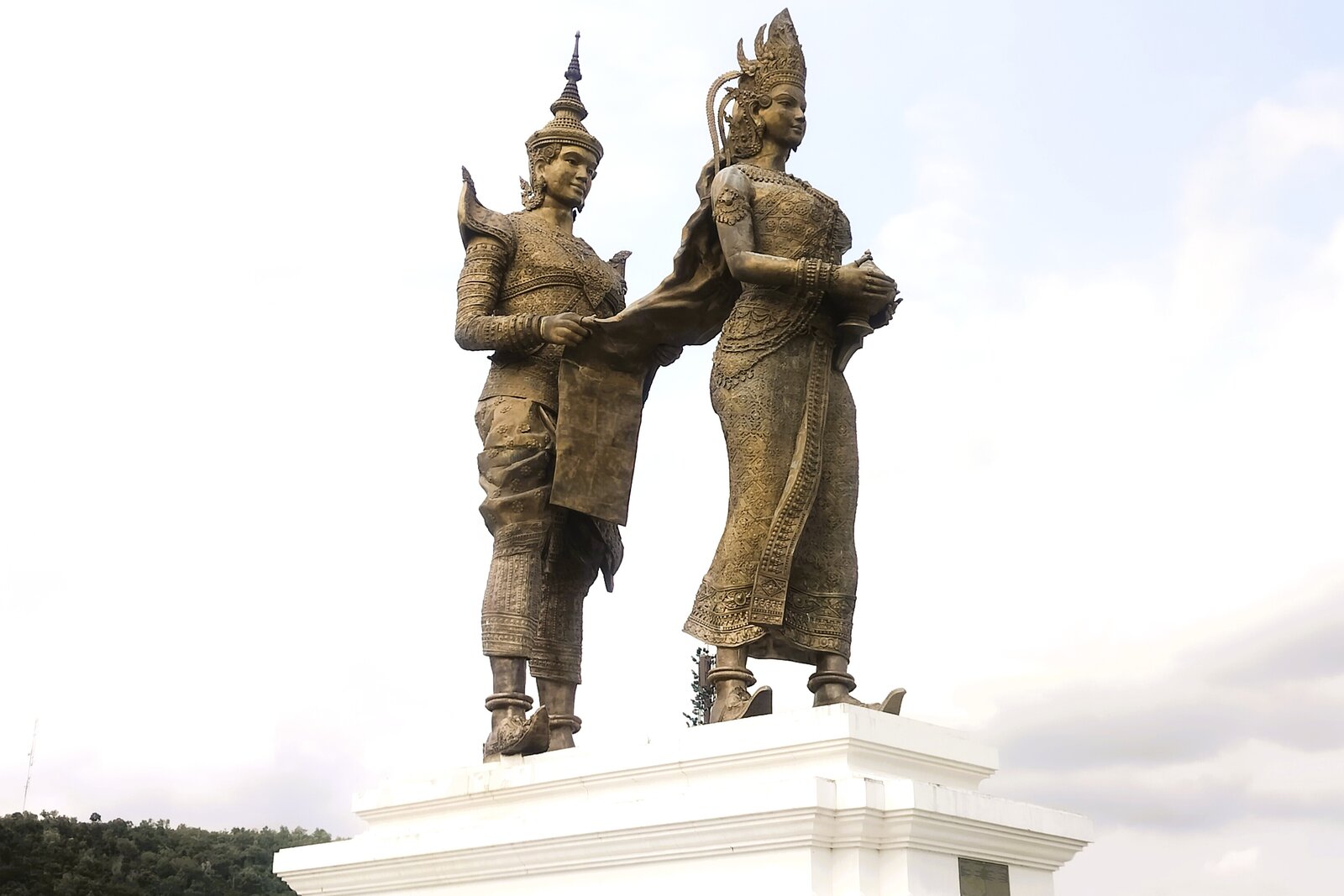
Preah Thong and Neang Neak ព្រះថោង នាងនាគ, the giant copper statue of the founding couple facing the ocean at the entrance of Sihanoukville (Kompong Som). At 21-meter tall and weighing 60 tonnes, erected in 2021, it is the largest copper copper statue in Cambodia [photos ADB, 2025].
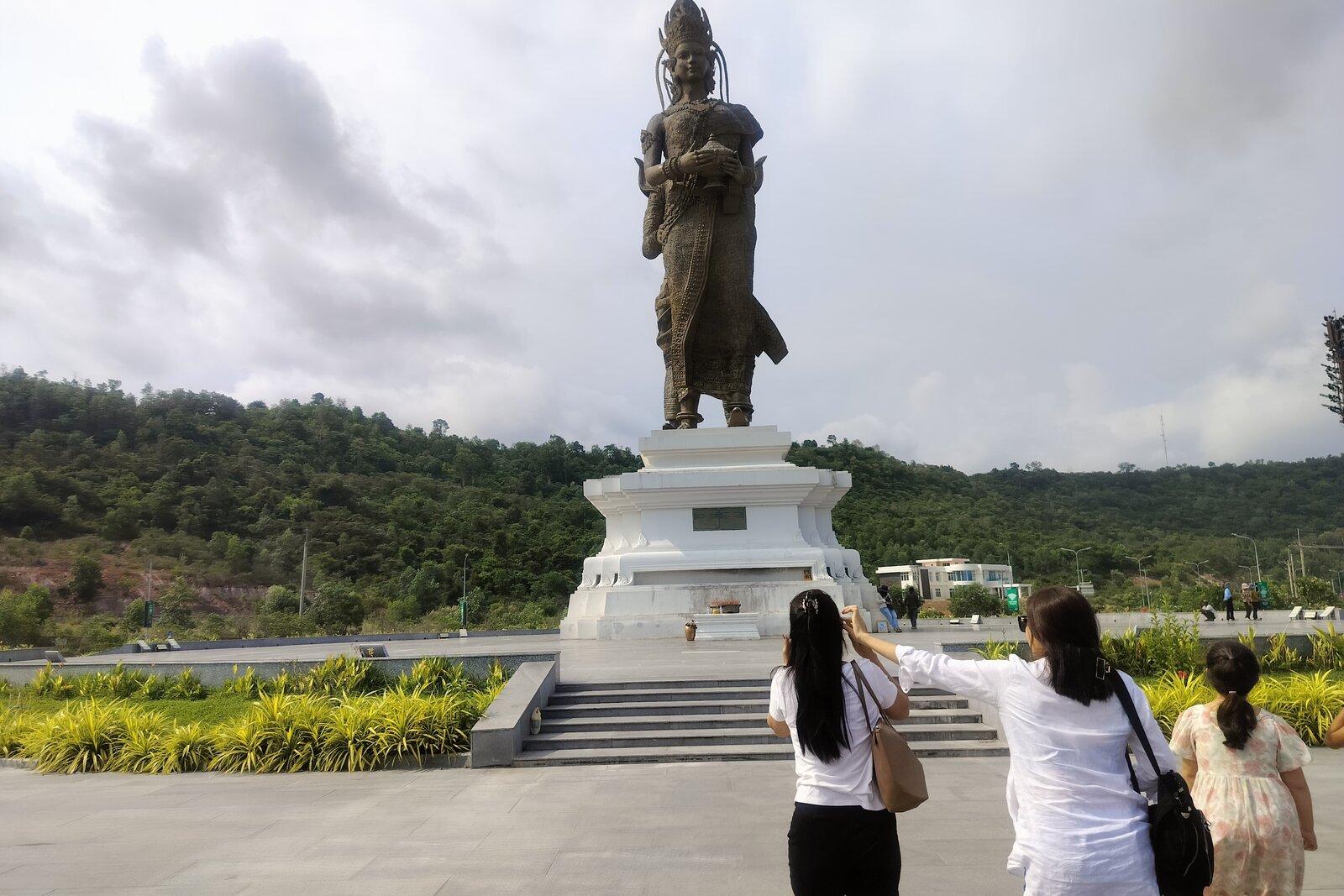
Preah Thong and Neang Neak ព្រះថោង នាងនាគ, the giant copper statue of the founding couple facing the ocean at the entrance of Sihanoukville (Kompong Som). At 21-meter tall and weighing 60 tonnes, erected in 2021, it is the largest copper copper statue in Cambodia [photos ADB, 2025].
Preah Thong and Neang Neak ព្រះថោង នាងនាគ, the giant copper statue of the founding couple facing the ocean at the entrance of Sihanoukville (Kompong Som). At 21-meter tall and weighing 60 tonnes, erected in 2021, it is the largest copper copper statue in Cambodia [photos ADB, 2025].
I shall now discuss the circumstances connected with the advent of the Kaundinyas in Funan and the foundation of the first royal dynasty in that country. It has appeared to me that the account of the Chinese text bearing on Lieou-ye (“Willow-leaf Lady”) and the inscriptional evidence on princess Somā of the Nāga royal family, both of whom are said to have married Kaundinya I are not contradictory or anomalous. In fact, it is possible to sort out matters in the light of Hindu laws and rituals connected with the coronation of a Hindu monarch. Let me explain. The Chinese text which makes the earliest reference to the subject has narrated the course of events thus:
Formerly this country had for sovereign a woman of the name of Lieou-ye. Then there was a man of the country of Ki, Houen-t’ien, who saw in a dream that a god gave him a bow and bade him embark on a junk and go out on the sea. Houen-t’ien went to the temple of the god in the moming and found there a bow. Thereafter he embarked on a junk and sailed towards Funan. Lieou-ye saw the junk and had her troops stand up against him. But Houen-t’ien raised his bow and shot an arrow which pierced the side of a boat, struck down somebody inside. Lieou-ye was frightened and surrendered herself. Houen-t’ien married her. He covered her with a piece of cloth, as she had no clothings on [20].
Now, it has been stated that Houen-t’ien is an exact transcription of Kaundinya. I shall now try to show that the kernel of the story is not fictitious at all. By all accounts, the Kaundinyas belonged to a vedic clan: it is obvious therefore that his “marriage” with a non-Aryan, non-Hindu woman could only be treated as a marriage with a Sudra woman. In the Hiranyakesin Grhyasutra, it has been ordained that, in the marriage of a Brahmin, the girl should not only belong to the same caste, but should also belong to the same country. The Manusamhita, which held great sway in south and South-East Asia, says (X, B) that a Brahmin can marry such a girl, but the issue of such a mixed marriage can only be a nişāda [nishada], i. e. hunter. It is well-known that the nişadas constitute a hunters’ sub-caste in the social hierarchy of the Hindus. So this story sounds the first ring of truth in the Chinese account described above. This inference is confirmed by the name of the first capital of Funan: it is called T’e-mu, i. e. Vyadhapura or the Hunters’ Town [c].
Now, the marriage of the Brahmin Kaundinya with the Willow-Leaf Lady barred their descendants from royal succession in terms of Hindu laws and sacramental rites. The Munasamhita (IX, 153) clearly states that the son of such a woman is not entitled to his father’s property as a matter of right, except to the extent “whatever his father may give it to him”. More serious were religious prescriptions, which guided the twice-born, particularly the Brahmins from birth to death. The Manusamhita states (III. 16 – 18) in unambiguous terms that such a marriage makes a Brahmin an outcaste [16], consigns him to hell [17] and “the manes and the gods will not eat the (offerings) of that man who performs the rites in honour of the gods, of the manes, and of guests, chiefly with a (sūdra wife’s) assistance, and such (a man) will not go to heaven [18]”.
So, under the compulsion of these circumstances and in connection with coronation, the Brahmin Kaundinya had to marry the Ksatriya princess Somā of Nāga lineage, apparently from Kañci. An echo of this second marriage is to be found in an inscription of Campä dated A.D. 658 in connection with the foundation of Bhavapura, the capital of Kambuja [33] We read there:
It was there that Kaundinya, the greatest of the Brahmins, planted the javelin which he had received from Aśvatthaman, the son of Droga. There was the daughter of a Nāga king of the name of Somā who founded the royal race on this earth. The great Brahmin Kaundinya married her for the accomplishment of the rites.
The significance of the last sentence has been lost by all: it is that Kaundinya had to marry her for the sacramental rites, not only for the coronation and connected rituals, but also to save him from being cast into hell. The latter was a very potent factor for an aristocratic Brahmin connected with the vedic rsis. A parallel case has been preserved in the Sithhalese tradition. It may be remembered that prince Vijayasimha, after reaching Simhala, married a yakşa-lady named Kuvanna, and begot on her a son and a daughter After a kingdom was founded by this Ksatriya prince, the ministers demanded that Vijaya be consecrated a king, but Vijaya replied, “unless a maiden of a noble house were consecrated as queen (at the same time)”, he was unable to accept the proposal. So the ministers went to Madhura (modern Madura), and its king being agreeable to the proposal, the marriage was celebrated between the prince and the princess of equal status and varga. There are logical procedures in early Hindu marriage, when the social restrictions were severally rigid. The Willow-Leaf Lady had therefore to give the palm of honour to Somā, the princess of the Nāga family. Now, who was this Nāga princess?
As the Kaundinyas went to Funan from the upper part of peninsular India, it will be reasonable to search for the homeland of the Nilge princess in that part of the world, as she, as queen-elect of Funan will have to perform certain sacramental rites in terms of Hindu laws and rituals. Our expectations are more than fulfilled, as similar marriage between Brahmin and Nāga families prevailed among several royal dynasties of southern India. The dynastic tradition of the Pallavas indeed embodies in the Rayakoța copper-plates a tradition which states that Asvatthäman, the Brahmin founder of the dynasty, married a Nāga woman and had by her a son called Skandafisya. Other copper-plates mentioning the name of Skandaśişya grant him the status of an eponymous king Pallava after whom the family came to be known as Pallava. It is generally believed that the Pallavas, like the Kadambas of Banavāsi, so the Nolambas of Mysore, the Matsyas of Oddavadi (Vizagapat-am district), among others, were the products of mixed Brahmin and Dravidian marriages, as the stories of their origin indicate.
I have said earlier that the Kaundinyas had migrated from a region where the Satavāhanas held sway for a long time. Now, these Sätavähanas were also “Brähmaņas with a little admixture of Nāga blood” [33] In fact, the Dvatrimsat-putialika represents Sälivahana (Prakrit form of Satavahana) as of mixed Brahmana and Nāga origin. “33 Although one guess may be as good as another, the discovery of the Dong Duong Buddha of the Amaravati-style from a vassal state of Funan seems to indicate that the Kaundinyas maintained close contact with the deltaic region of the Kistna where Amarävati lay. Not far off from Amaravati lay the terrain where the Pallavas came to power. D.C. Sircar has stated, “There is epigraphic reference to the marriage of Asvatthaman, a descendant of the gotrarşi (Bharadvāja) of the Pallavas and Brahmaņa progenitor of the family, with the apsaras Madani, while the Velurpāļaiyam inscription distinctly says that an early member of the dynasty named Virakürcha obtained the insignia of royalty along with the hand of a Nāga princess. Although these are mere legends, the Nāga association of the Pallavas may be adduced from Ptolemy’s evidence”.
Leaving aside these accounts, which naturally remind one of those in Cambodia,s another fruitful line of enquiry will be the contemporary and near-contempoary evidence of the Periplus and the Geography of Ptolemy. In the days of the Periplus, there was an inland terrain in the Cola country called Argalu (sec.59) or Argaru, which has been equated with Uraga-pura, i.e. “the city of Serpents, apparently the capital city of a Nāga ruler. Not long thereafter, in the days of Ptolemy, we find two Nāga principalities firmly established in the region called by Ptolemy Arouapnoi (Aruvanadu), which may be deemed for all practical purposes to be the district around Kanci. It was located in a bigger political canvas called Colamandala. A king called Sor-nāga ruled over Colamandala proper, while the northern sector of the said Cola kingdom called Aruvänādu was ruled over by Basaro-nāga. From the available details, it is possible to postulate the view that towards the close of the first century A.D. and the beginning of the second, there were some Nāga ruling families in the Colamandala and that Kaundinya I married the Nāga princess Somā, apparently of Aruvānādu or Kānci, which was about 275 English miles south from the mouth of the river Kistna. This is perhaps the best explanation that I can offer regarding the marriage of Kaundinya I and Somā. In passing, I should like to state that the marriage of Kambu and Merā does not concern us in an historical sense as it was devised to explain the names of Kambuja and Khmer respectively. The traditions regarding the union of the Cambodian king with the Serpent maiden [38] [d] are equally ridiculous, at least in a biological sense: the mischief was inherent in the Nāga epithet, which seems to have totemistic association.
In the preceding pages, I have tried to show that the Chinese texts bearing on the foundation of Funan are generally trustworthy, but our troubles have hitherto been that we have not been able to comprehend them properly due to some lacunae in our perspective-study of the whole subject. I therefore, conclude, at least tentatively, that the Kaundinyas came to South-east Asia from Kaundinyapura of Vidarbha that they set sail along with the K’un-Lun or Kalinga people from the port of Palurā and landed in the upper part of the Malay peninsula. Here some of the Kalingans stayed on to found the kingdoms of Tun Sun and P’an-P’an, while others ventured afield. Of such adventurers, a segment of the Kaundinyas went to Funan under the leadership of Kaundinya, who first married a native woman and then the Nāga princess Soma, apparently from Kānci [e]. Kaundinya and Somā thus became the founders of the first royal dynasty of Funan.
_________
[1] A. Christie has however translated the name in Chinese transcription by “Cocoanut”, vide H.B. Sarkar (ed), R.C. Majumder [sic for Majumdar] Felicitation Volume (1970), p. 8.
[2] Indian Cultural Influences in Cambodia, Calcutta, 1964, pp. 261 – 62.
[3] Ibid. p. 261. An inscription of Cuțu Satakarni (full name: Haritiputra Visnukada Cuṭukaḷānanda Satakarni, which means Satakarni, the son of Hariti, of the Visnukada branch locality, (who was) a delight of the Catu family” has been dated by some scholars to AD 200 (Vide Indian Antiquary, 1885, p. 331); E.J. Rapson, British Museum Catalogue of the Coins of the Andhra Dynasty, Western Kşatrapa Dynasty, the Traikutaka Dynasty and the Budhi Dynasty, pp.iii-iv), but D.C. Sircar in K.A. Nilakanta Sastri (ed). A Comprehensive History of India (1957), p.337, has assigned the Vanavāsi inscription of the said ruler “to the first hall of the third century, as its palaeography resembles that of the iksvaku inscriptions”[a].
[a] More recent research shows that the Chutu dynasty’s kingdom lasted from c. 125 to c. 345 CE and was centered around Banavasi, a city in modern Karnataka. Chutu “Cuṭukaḷānanda” has been corrected in Cuṭukaḷānaṃdasa (“of king Chutukalananda”) [ADB] Kāñcī - Kanchipuram or Kāñcīpura (काञ्चीपुर), also known as Kanjeevaram, a city corporation in the Indian state of Tamil Nadu in the Tondaimandalam region, 72 km (45 mi) from Chennai, the capital of Tamil Nadu. Known as the City of Thousand Temples, Kanchipuram is known for its temple architectures, 1000-pillared halls, huge temple towers, and silk saris. It was once the centre of Buddhism in South India and was one of the places of pilgrimage visited by Hiouien Thsang. He mentions that during his stay there three hundred monks came to Kancipura from Ceylon. [Wikipedia].
[4] When water has to be sanctified for religious purposes, a pious Brahmin will chant the following mantra: Oum! Ganga ca Yamunecaiva Godavari Sarasvati/ Narmada Sindhu Kaveri Jale’hsmin sannidhim kuru// (From S.M Bhattacarya, Purohita Darpana, 1368 B.S., 33rd edn., p. 26) Tr: “Aum. O Ganga, Yamuna, also Godavari and Sarasvati, as also Sindhu (Indus) and Kaveri, (deign) Ye to assemble in this water.”
[b] Vidharba, eastern part of the modern State of Maharashtra. The Mahabharata states that Rukmini, the wife of lord Krishna, was born to Bhishmaka, the king of the Vidarbha kingdom. [ADB]
[5] S.M. Ali, The Geography of the Puranas (New Delhi, 1966), p.157.
[6] Ibid, fig. 12.
[7] K.A. Nilakanta Sastri (ed.), A Comprehensive History of India, II (Calcutta 1957), pp. 324 ff.
[8] The main document bearing on the subject from the first century A.D. is the Periplus of the Erythraean Sea, but it does not mention Palura, although this argumentum silentio cannot be held to be a valid argument in all cases. Schoff, in his introduction to the translation (pp.7 – 15) placed its date to A.D. 60, but later on revised it to the close of the first century A.D. (Vide JARS, 1917, p. 827). On the basis of the data strewn in different parts of the work, scholars have suggested various dates ranging from A.D. 40 to 110 – 15. It will not therefore be unreasonable to assign this work to the second half of the first century A.D. for all practical purposes.
[9] L’Art greco-bouddhique du Gandhara II (Paris, 1900), p. 617.
[10] Reginald le May, A Concise History of Buddhist Art in Siam (Tokyo, 1963), photo no. 5.
[11] Ibid, photo no. 4.
[12] Tijd. Bat. Genoot., LXXIII (1933) pp 495 ff. [?]
[13] W. Cohn, Buddha in der Kunst des ostens (Leipzig, 1925) p. 28.
[14] F.M. Schnitger, The Archaeology of Hindoo Sumatra (Leiden, 1937) pl. 1.
[15] H.B. Sarkar, Cultural Relations between India and South-East Aslan Countries, (1985) pp. 172 – 73; H. B. Sarkar, “South India in old-javanese and Sanskrit inscriptions”, in Bijdr. Kon. Inst. [Bijdragen tot de Taal‑, Land- en Volkenkunde (BKI)]125 (1969), pp. 198 – 204.
[c] See for instance A. L. Basham (1954):
The type of marriage known to anthropologists as hypergamous, when the husband is of higher class than the wife, was by no means disapproved of; on the other hand hypogamous marriage, when the wife’s status was higher than that of the husband, was always frowned on. The former was “in accordance with the direction of the hair” (anulomg), smooth and natural, while the latter was “against the hair”, or “brushing the wrong way” (pratiloma). This distinction is to be found in other societies; for instance in Victorian England the peer who married an actress rarely incurred the same scorn and ostracism as the lady who married her groom.
Certain classes of outcastes or untouchables seem to have gained their unenviable position through the growth of the sentiment of nonviolence— for instance the nifdda, who was a hunter, the fishing caste called kaivarta, and the leather worker (kdrdvara). The pukkusa, who appears as a sweeper in Buddhist literature, may have fallen in status because members of his class made and sold alcoholic liquor. More difficult to account for are such base classes as the basket-maker (vena) and the chariot-maker (rathakara). In early Vedic times the latter was a most respected craftsmen, but soon fell to the status of an impure vrātya or outcaste. [The Wonder that was India, A survey of the history and culture of the Indian sub-continent before the coming of the Muslims, 1954 (1st. ed.), p. 147 – 8]
[16] “The Kings of Śri Sailam and the Foundation of the Sailendra Dynasty of Indonesia”, in Bijdr. Kon. Inst. 141 (1985) pp. 323 – 338.
[17] Indian Cultural Influences in Cambodia (1964) р. 2.
[18] D.C. Sircar, Select Inscriptions I (1965) p. 235.
[19] K.P. Jayaswal, Imperial History of India, (1934) pp. 33, 35, 39 etc.
[20] For this passage, vide P. Pelliot, “Le Fou-nan”, in BEFEO (III, 1903) p. 256.
[21] C1. Manusamhita, III. 5, 12, 15 ff.
[22] Vide H.B. Sarkar, Literary Heritage of South-East Asia, S.V. Manusamihita. Regarding its sway in Cambodia, vide Ibid, pp. 107 – 110.
[23] It has been suggested that the tradition about the marriage of Kaundinya and Somā passed from Kambuja to Campä after the marriage of princess Sarvāņi, daughter of King isanavarman of Kambuja (616‑C. 635), with prince Jagaddharma of Campa.
[24] Vide L. Finot, Les inscriptions de Mi-son (no. III) in BEFEO IV (1904) p. 923 and G. Coedès, Inscriptions du Cambodge IV, (Paris, 1952), p. 88. Although the epigraphic reference ta Kaundinya and Somā is rather late, literary reference seems to pertain to the time of K’and T’at in the middle of the third century A,D, Vide Adhir Chakravorty, Royal Succession in Cambodia, (Calcutta, 1982), p. 8 and Wang Gungwu, “The Nanhai Trade’ in Journ, Mal. Br. Royal As, Soc. xxi, pt.2 (1958), p. 33, note 10. It would have been very interesting to examine whether the progeny of the Willow-Leaf lady and that of Soma through their common husband Kaundinya created rivalries in regard to royal succession. Kaundinyas of India seem to have followed a patrilineal line of succession.
[25] The Mahavis, chapter VII.
[26] Ibid, VII. 47.
[27] Ibid. VII, 71−74.25. The Mahavis, chapter VII.
[28] Epigraphia Indica V (1898−99), p.52.
[29] K.V.S. Aiyer, South Indian Inscriptions, vol. II (1933), p 353, verses 16 – 17.
[30] J.F. Fleet Dynasties of the Kanarese Districts, p. 286 and footnote 2.
[31] B.L. Rice, Mysore and Coorg from the Inscriptions (London, 1909) p. 55.
[32] Vide in this connection D.C. Sircar in R.C. Majumdar (ed). History and Culture of the Indian People III (1954) p 275 and The Early Pallavas (Lahore, 1935) pp. 8 – 13.
[33] Vide K.A. Nilakanta Sastri, I.c., p. 300.
[34] D C. Sircar in R.C. Majumder, 1.c., p. 275.
[35] Similar stories of co-habitation between a king and aa serpent maiden were also current in Bengal and have been reported by Lama Taranath. Vide Lema Chimpa and Alaka Chattopadhyay. Taranatha’s History of Buddhism in India’ (Simla, 1970) p. 258.
[36] D.C. Sircar, The Early Pallavas (Lahore, 1935), p. 6.
[37] The story is first mentioned in the epigraphy of Rajendra Varman II (944−58). Hence the tradition is very late.
[38] Chou Ta-Kuan relates a story to the effect that, according to native tradition, the king of Cambodia slept at the top of the Phimeanakas with a nine-headed serpent, which “appears every night in the form of a woman. It is with this spirit that the King first sleeps and unites himself”. The memoirs of Chou Ta-Kuan have been translated by P. Pelliot under the title ‘Memoires sur les coutumes du Cambodge’ in BEFEO II (1902), pp. 123 – 77. [d]
[d] The author was not aware of Pelliot’s revised translation, and alas unfinished notes, published posthumously in 1951 by G. Coedes and Paul Demieville. In any case, we refer here to the more accurate (and less prudish) English translation of Chou Ta-Kuan [Zhou Daguan]‘s observation by Peter Harris, chapter 2 (“Residences”) of his testimony: “Inside the palace there is a gold tower, at the summit of which the king sleeps at night. The local people all say that in the tower lives a nine-headed snake spirit which is lord of the earth for the entire country. Every night it appears in the form of a woman, and the king first shares his bed with her and has sex with her. Even his wives do not dare go in. At the end of the second watch he comes out, and only then can he sleep with his wives and concubines. If for a single night this spirit does not appear, the time has come for this foreign king to die. If for a single night he stays away, he is bound to suffer a disaster.”
[e] As did Tamil tradition Manimekalai, whom Sudhamati described as a maiden from Bengal who with her father — a Brahmin who tended fire [Vedic] — they came to the south on a [Hindu] pilgrimage towards Kanyakumari, related to the journey of Rama in the Ramayana. There she joined a Jain monastery. Her father joined her, but as one day after an accident her father was bleeding badly, the Jains kicked them both out, afraid that the blood will pollute them. Canto XXVIII: ‘Manimekalai visits Kānci, meets her mother and Aravana Adigal’. There is not one single tradition about the origin of the Pallava dynasty, amongst dozens of them, that doesn’t mention a marriage with a Naga princess, either from the Chutu-Naga or the Chola-Naga or from Manipallavam, as a way for the founder of said dynasty to “acquire simultaneously a wife and a kingdom.”
Mr, Rasanayagam who does not agree with the views and conclusions arrived at by the Professor [Jouveau-Dubreuil] seeks to find the home of Pallavas in the south in the region known as ManipalIavam to the early Tamils. According to him Killi’s son Ilam [?] Tiraiyan through the Naga princess mentioned in the early Tamil work Manimekhalai was really the first Pallava king. In this work he is described as the son of Killi by Pilivalai, a daughter of Valaivananan, the Naga king of Manipallavam. He was lost in a shipwreck and was found washed ashore with a coil round his ankle of a twig of the Tondai-Creeper (Caphallandra Indica). Hence his name Tondaman-Ilam-Tiraiyan. Ilam-Tiraiyan was therefore the first to become an independent king and progenitor of the Pallava dynasty. His period is fixed as the third quarter of the second century AD. The dynasty was called the Pallava designated after the mother’s native place Manipallavam. The titles such as Ankura and Pottaraiyan which were assumed by Pallava kings are synonymous with the word Pallava and remind us of the origin of the name from Manipallavam. [see Gopalam History of the Pallavas of Kanchi, p 21]
Sarkar’s contribution can be usefully compared to George Coedès’ study, “La légende de la Nagi” [“Legend of the Nagi”] (“Etudes cambodgiennes”, BEFEO XI‑3/4, 1911: 391 – 406).
Starting from a study by Louis Finot on the fouding wedding of an Indian prince and a Nagi princess in the Cambodian Royal Chronicles [“Sur quelques traditions indochinoises”, Bulletin de la Comm. archéologique de l’Indochine, 1911, p. 32 sqq.] Coedès went back to two Indian inscriptions from the Ganga-Pallava dynysta (c. 9th century):
The EFEO researcher also perused the corpus of Tamil epic poetry related to Chola kings and princes who married daughters of the Naga king. In both instances, the Kaundinya of the Khmer tradition is a Pallava of Kāñci, and the Nagi princess (Somavamsha in the Khmer tradition) is the real founder of a new dynasty. There is another point which is of importance for researchers in Cambodian history — the theme of the Nagi princess appearing in the ancient Tamil tale of Manimeggalai, and Manimekhala early becoming an essential Khmer Buddhist female character.
Tags: wedding, Khmer wedding, Funan, Indianization, legends, Cambodian dynasties, Pallavas, Cholas, founding myths, foundation legends, women, naga
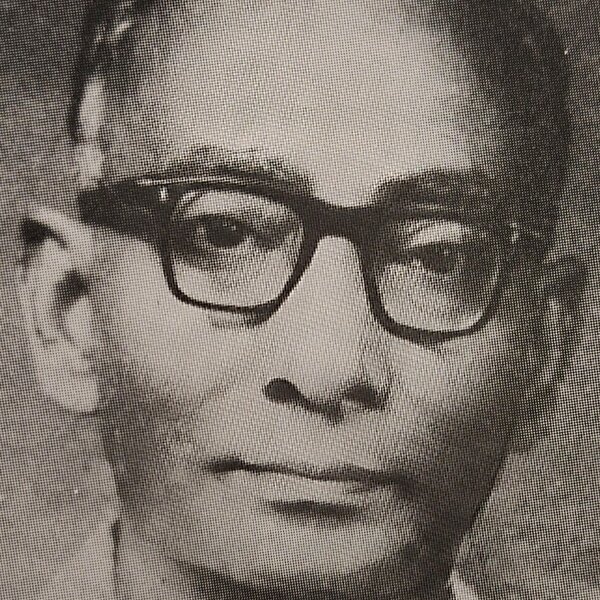
Himansu Bhusan (H.B.) Sarkar (1905? — 1990?) was an Indian historian and epigraphist specializing in South India, Southeast Asian and Indonesian studies, a disciple of Rabindranath Tagore and R.C. Majumdar, an epigraphist and history researcher with Dacca University — modern times Dhaka University ঢাকা বিশ্ববিদ্যালয়, Bangladesh, established in 1921 and the oldest active university -, and with University of Calcutta, whom the late EFEO director Denys Lombard called “the last survivor of the ‘Greater India Society’, so to speak” [“Review of H.B. Sarkar, Cultural Relations between India and Southeast Asian Countries, Archipel 45, 1993, p. 198 (in French)].
Even if George Coedès found “useful yet a tad superficial” his first published book, Indian influences on the Literature of Java and Bali, H.B. Sarkar’s contribution to Southeast Asian studies from an Indan perspective remains important. Along with B.R. Chatterjee, he became an authority in that field, in particular Javanese ancient inscriptions — see Yorim Spoelder ed., Visions of Greater: India Transimperial Knowledge and Anti-Colonial Nationalism c.1800 – 1960, Cambridge University Press, 2025, 346 p., ISBN 978 – 1009403191 -, and was recognized as such by his international colleagues, especially when he acted as Secretary the XXVIth International Congress of Orientalists, New Delhi 1964, South East Asia Studies section.
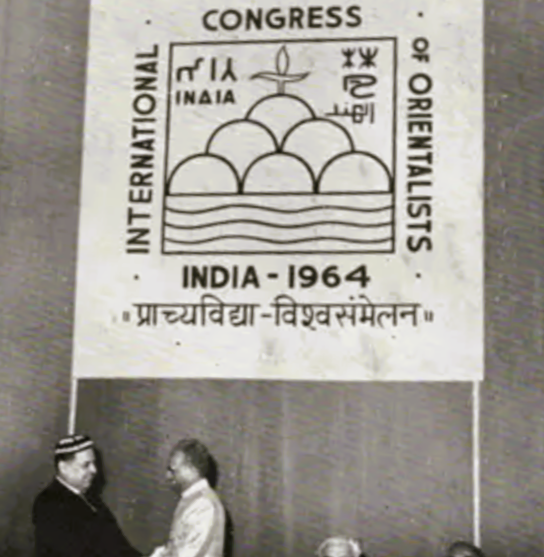
H.B. Sarkar co-organized the 1964 International Congress of Orientalists in Delhi, India.
H.B. Sarkar co-organized the 1964 International Congress of Orientalists in Delhi, India.
At that time, he had retired from his position of Principal and Professor of History of Kharagpur College, West Bengal, where students with highest marks at finals are nowadays awarded the “Principal H.B. Sarkar Merit Medal”. The felicitation volume he edited in tribute to his professor, R.C. Majumdar Felicitation Volume (1970) attracted many outstanding contributions. His paper on “Kaundinya I of Funan” (1986), often referred to by scholars yet difficult to access, is now available on Angkor Database.
Photo: H.B. Sarkar at the 25th International Congress of Orientalists, 1964, New Delhi (via ExoticIndianArt)
sk तैलङ्ग Tailaṅga "the Tailanga country" | sk तैलङ्गः tailaṅgaḥ "inhabitants of Tailanga" | persian سلطنت كرناتک saltanat-i-kratanak "the Sultanate of Karnatak' | tml ஆற்காடு நவாப் āṟkāḍu navāp "the Nawab of Arkot"
chs 洞 dong, "cave" | 峒 tong, "dong"
Dong is an ancient Chinese term for a mountain valley community, especially in the southern and soutwestern regions abutting to 'historic' mainland China.
In Korea, dong 동 has come to refer to a neighborhood or an administrative sub-district.
sk कम्बु) kambu, “one who has three lines or marks in neck”; elephant.
sk क्षत्रिय, "rule, authority" | kh ក្សត្រ ksaatr, "king", ក្សត្រិយ៍ ksaatre, "queen" | ch 剎利 and 剎帝利 sha di li, or 或 Rajanya
Kshatriya: one of the four varnas of Hindu society representing warrior aristocracy, along with Brahmins, Vaishyas, and Shudras. An administrator or a warrior.
Paul Pelliot has argued that the kings of Chenla, who were kstariya, could not directly descend from Kaundinya [Preah Thong], who was a brahmin. In Vaishnavism it is stated that the kstariya, ruling class, must govern the world in accordance with the rules and regulations enacted by great brāhmaṇas and saintly persons.
In Cambodia, there was a frequent mix of warrior and priest/scholar classes, a blend that led to a new group called Brahmakshatriyas. For instance, the K. 359 inscription from the 6th century reports the union of Brahmin Somasraman to a sister of King Bhavavarman I, himself a ksatriya. Several kings of Chenla bore the title Ksatriya in their ruler name, and the term came to mean "king" or "queen" in Khmer language.
sk निषाद nishada "forest dweller", "hunter", "hill people", "from a lower caste".
Niṣāda, Nishada refers to a mixed caste in Ancient India - the son of a Kṣatriya (warrior) with a Śūdra (शूद्र) woman, Sudra being the fourth social order (working class) in the traditional Vedic social system.
Nishadas were held as 'hunters', 'close to the forest', distinct from the four main social orders (castes) - brāhmaṇas, kṣatriyas, vaiśyas [वैश्य, merchant or agricultural class], sūdras [serving class].
sk यक्ष yakṣa 'semi-god' | th ยักษ์ yok 'ogre, ogress' | kh យក្ស yoksa, yeak 'giant'
Yakṣa or Yaksha:
1) semi-godly inhabitants of Brahmanic Heaven, a type of Upadevas, the third class after Devas and Gaṇadevas. Among Upadevas, there are Vidyādharas, Apsaras, Yakṣas, Rākṣasas, Gandharvas, Kinnaras, Piśācas, Guhyakas, Siddhas and Bhūtas.
2) a class of demons, followers of Rudra (Śiva), their overlord, led by Kubera, a group of 'supernatural beings that cause illness' in Saivism; sometimes similar to Asuras.
3) in Buddhism, originally malevolent spirits or ghosts who came to protect the righteous, the attendants of Vaiśravaṇa, the guardian of the northern quarter.
4) In Cambodia and Thailand, as male or female supranatural beings with bulging eyes, they are often represented as guardians of pagodas. In Cambodian village festivities, the yeak are scarecrow-like figures or disguised people designed to ward off evil spirits. As they are meant to be 'big and ugly', they were often represented with European traits in the past.