

World Travel: An Irreverent Guide
by Anthony Bourdain & Laurie Woolever

- Authors
- Anthony Bourdain & Laurie Woolever
- Publisher
- New York, Ecco Press
- Published
- 2021
- Book Edition
- Kindle Edition
- Pages
- 472
- Language
- English
- ISBN
- 978-0062802774
- Formats
- e-book, Kindle
The genesis of this quite off-putting book was detailed in a New York Times article by Sebastien Modak a few days before its release in 2021:
In March 2017, Anthony Bourdain had an idea for a [new] book, but no time to write it. Since he started traveling and eating on camera with the Food Network’s “A Cook’s Tour” in 2000, the chef, frequent dropper of f‑bombs and insatiable eater of delicious things had spent the majority of his time in the field, most recently for his CNN show “Parts Unknown.” Mr. Bourdain and his team decided he would carve out some time to write in the summer of 2018, when he would have a few rare continuous weeks at home during a break in filming. That, of course, never happened, as Mr. Bourdain died by suicide in June 2018. Nevertheless, […] almost three years after his death, and after a pandemic that almost completely shut down international travel, Ecco will publish “World Travel: An Irreverent Guide” by Mr. Bourdain and his longtime assistant (or “lieutenant” as he often referred to her), Laurie Woolever. [Sebastien Modak, “How Do You Write an Anthony Bourdain Book Without Anthony Bourdain?”, The New York Times, 13 April 2021.
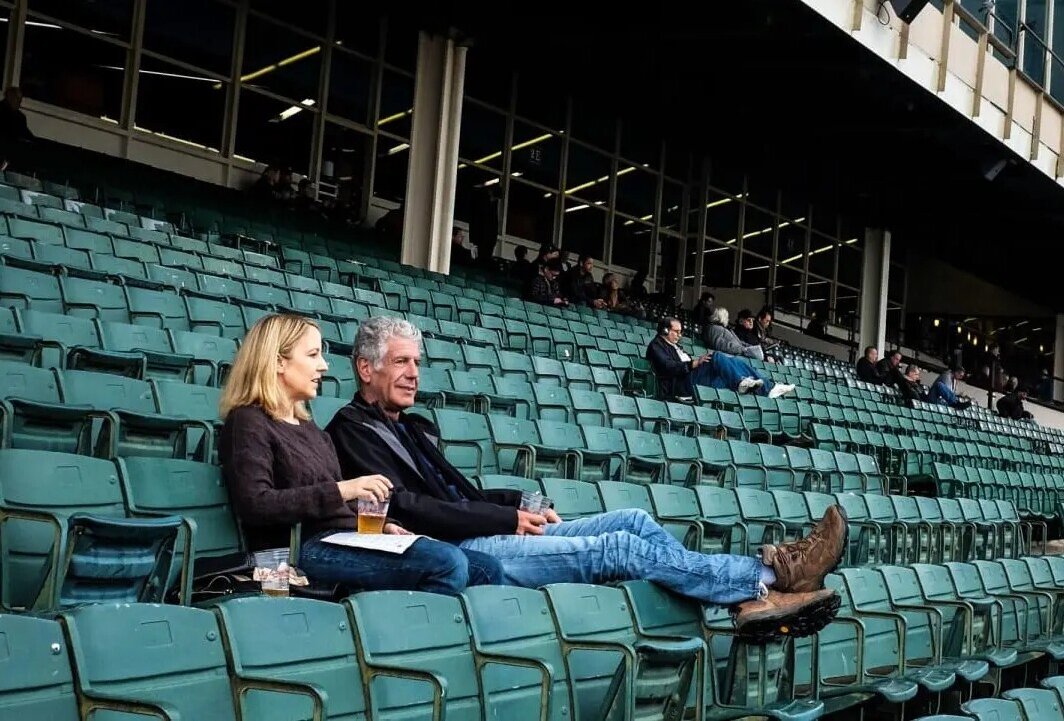
Anthony Bourdain and his longtime “lieutenant” and co-author Laurie Woolever at Aqueduct racetrack in Queens in 2016. [photo CNN reproduced in New York Times, 13 Apr. 2021.]
Anthony Bourdain and his longtime “lieutenant” and co-author Laurie Woolever at Aqueduct racetrack in Queens in 2016. [photo CNN reproduced in New York Times, 13 Apr. 2021.]
The flamboyant food traveler-writer-storyteller always disliked travel guides and yet, in the process of sequencing and organizing his wild amount of traveling, the projected book materialized after his death into some Bourdainesque puzzle. The structure is deceptively straightforward — 43 countries, from Argentina to Vietnam, with a big chunk devoted to the US. Notices were hastily crafted. See Cambodia, for instance [p. 39 – 42]:
Cambodia — beautiful, wild, with an extraordinarily painful recent history of unimaginably horrific genocide — is a place about which Tony expressed both awe and rage. He was passionate and well read about the US government’s disastrous involvement in Southeast Asian politics of the Cold War era, both the overt Vietnam War and the covert bombing campaigns in Laos and Cambodia. Tony first visited Cambodia in 2000, for A Cook’s Tour, and then a decade later with No Reservations [2010]. “Since my last visit to Cambodia, I’ve been to nearly every corner of the globe, and I’m not going to say — as much as I’d like to believe it — that I’ve gotten any smarter. After a while, even the most beautiful scenery threatens to become moving wallpaper — background — but other times, it all seems to come together: the work, the play, all the places I’ve been, where I am now, a happy, stupid, wonderful confluence of events. Rice paddies whipping by, the music in our skull just right. If something profound ain’t happening, at least it feels like it is. […]
“These streets weren’t paved last time I was here,” he observed in 2010. “In 2000, it was wilder and far more dangerous, a place still reeling from the days when this city was reduced from a population of two million to just a few Khmer Rouge officials. Clerks, office workers, taxi drivers, cooks were marched into the country and forced to farm. Anyone unfortunate enough to be a doctor, a lawyer, a professional, multilingual, even if they only wore glasses, they were killed. “Once you’ve been to Cambodia, you’ll never stop wanting to beat Henry Kissinger to death with your bare hands,” Tony wrote in 2001 in A Cook’s Tour, the companion book to his TV series of the same name. “You will never again be able to open a newspaper and read about that treacherous, prevaricating, murderous scumbag . . . without choking. Witness what Henry did in Cambodia — the fruits of his genius for statesmanship — and you will never understand why he’s not sitting in the dock at The Hague next to Milošević.”
[…]“This is more of the way I remember Cambodia — the smell of jackfruit, woodsmoke, dried fish, raw chicken, and breakfast. Ka tieu, a phở-like noodle soup with chicken, pork meatballs, and greens in a vibrant-looking and tasty broth, is always the expressway to my heart.”
As for the ‘guide’ part of it, it was obviously improvised and hastily slapped there: for hotels, Raffles Le Royale [sic] in Phnom Penh, Raffles Grand Hotel d’Angkor and Jaya House Riverpark in Siem Reap; for dining, Phnom Penh Central Market [Psah Thmei], the foodstalls at Angkor and Kep Crab Market. As the previously mentioned review in The New York Times noted, “it isn’t exactly the list of hole-in-the-wall spots with no addresses that fans of Mr. Bourdain may be hoping for.”
Still, there are some endearing asides that tell more about larger-than-life Bourdain than any painstaking compendium of his journeys: “At Angkor Wat, the centuries-old seat of power of the Khmer empire, I gave up taking photographs of my travels. How could any lens capture the scale, the grandeur of a kingdom that once ruled this part of the world and then inexplicably crumbled into the jungle?”
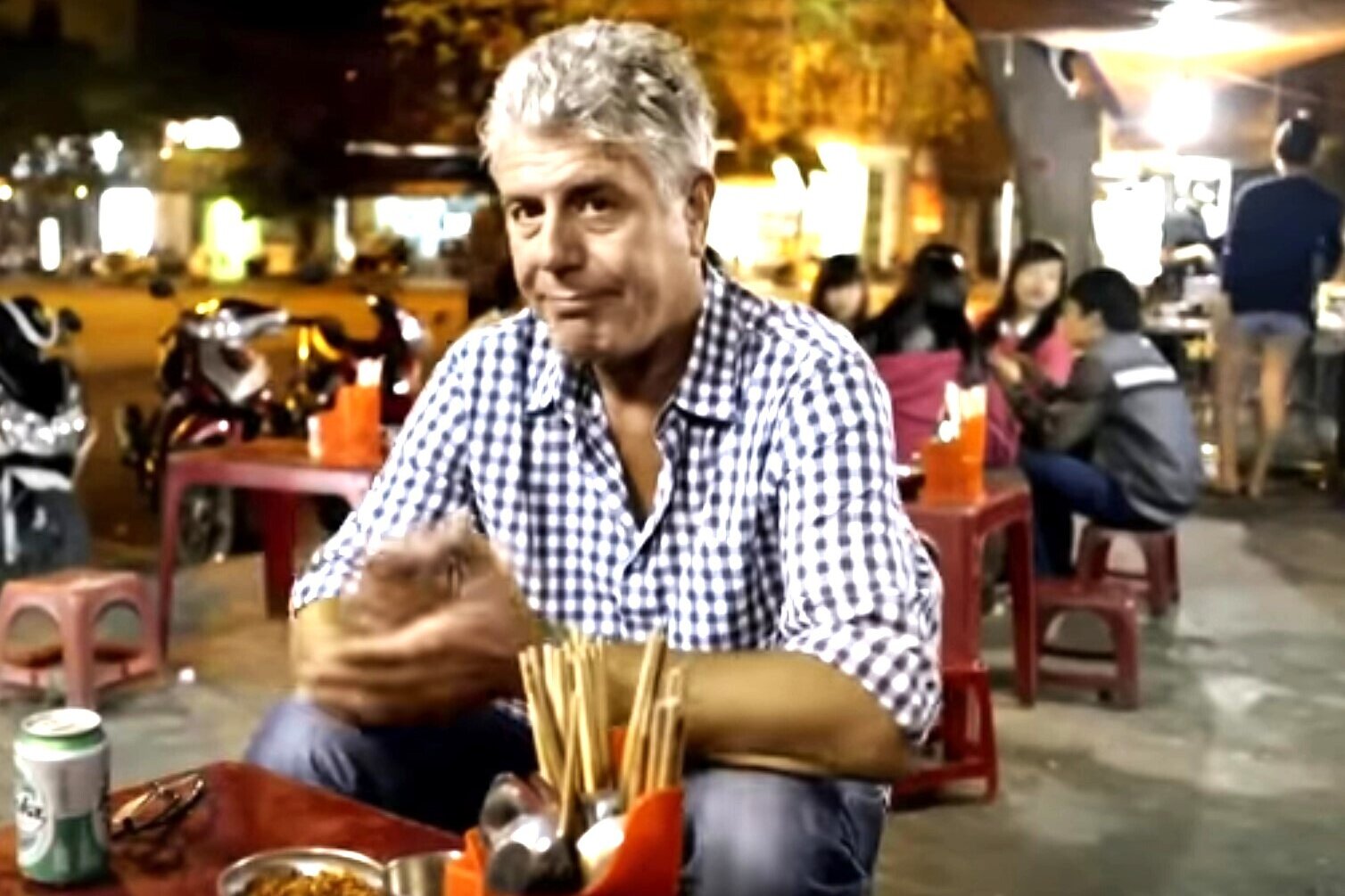
1) In Vietnam, Anthony Bourdain’s absolute favorite place to eat [screenshot from Parts Unknown 2015.] 2) During his travels, he would pick locations for highly personal, whimsical reasons, like this bar in Tokyo’s tourist-clogged Golden Gai neighborhood [screenshot from Parts Unknown 2017.]
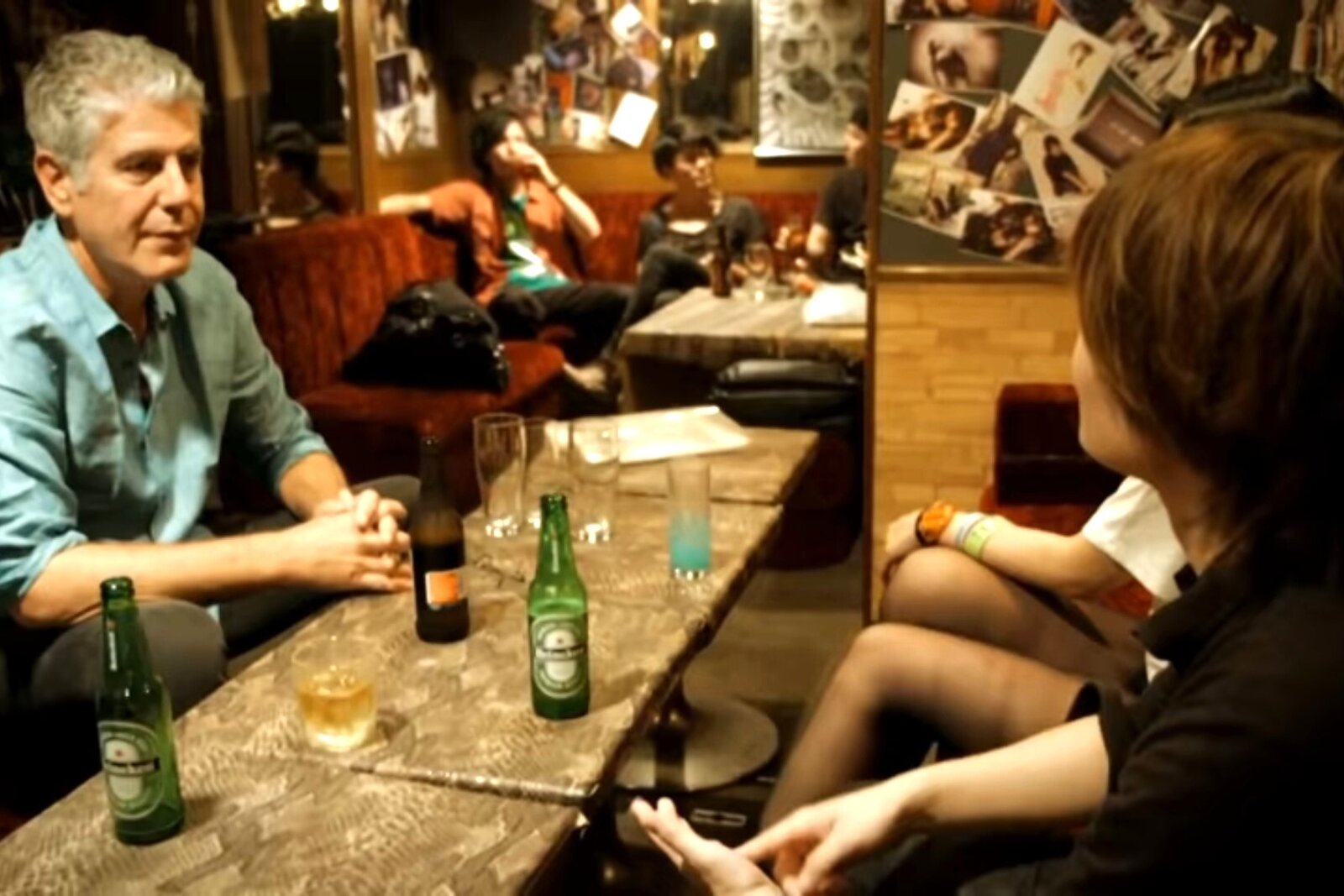
1) In Vietnam, Anthony Bourdain’s absolute favorite place to eat [screenshot from Parts Unknown 2015.] 2) During his travels, he would pick locations for highly personal, whimsical reasons, like this bar in Tokyo’s tourist-clogged Golden Gai neighborhood [screenshot from Parts Unknown 2017.]
1) In Vietnam, Anthony Bourdain’s absolute favorite place to eat [screenshot from Parts Unknown 2015.] 2) During his travels, he would pick locations for highly personal, whimsical reasons, like this bar in Tokyo’s tourist-clogged Golden Gai neighborhood [screenshot from Parts Unknown 2017.]
ADB: Revisiting Anthony Bourdain’s TV shows on Cambodia and Southeast Asia
While the ginormous CNN series ‘Parts Unknown’ opened in 2013 with Myanmar, and the author devoted in-depth episodes to Thailand, Vietnam, Indonesia, Manila (Philippines), Singapore and Japan (in Okinawa, he openly referred to his “past addictions, cocaine, heroin, prostitutes…”), Cambodia was not considered in this sleekier, more general-public oriented production. Vietnam, foremost “Vietnam owns me. From my first visit, I was helpless to resist,” he wrote in his foreword for Graham Holliday’s Eating Viet Nam in 2015. [About Bourdain’s special bond with Vietnam, read this Vietnam Coracle post.]
In his famous apartés, Bourdain noted that he had initially found Cambodia “frightening”, and even “the last place on earth I guess I really wanted to go’. However, he covered the Kingdom of Wonder with gusto in the films detailed below. At the time he first visited in Cambodia (for the program ‘A Cook’s Tour’) — in 2000, “in search of new tastes and extreme emotions” as he stated in voiceover -, the author had not yet fully developed his street food expertise, and it is only a dinner at the posh Grand Hotel d’Angkor (now Raffles) restaurant in Siem Reap that, he noted, “gave us the sense of the possibilities inherent in Khmer cuisine”.
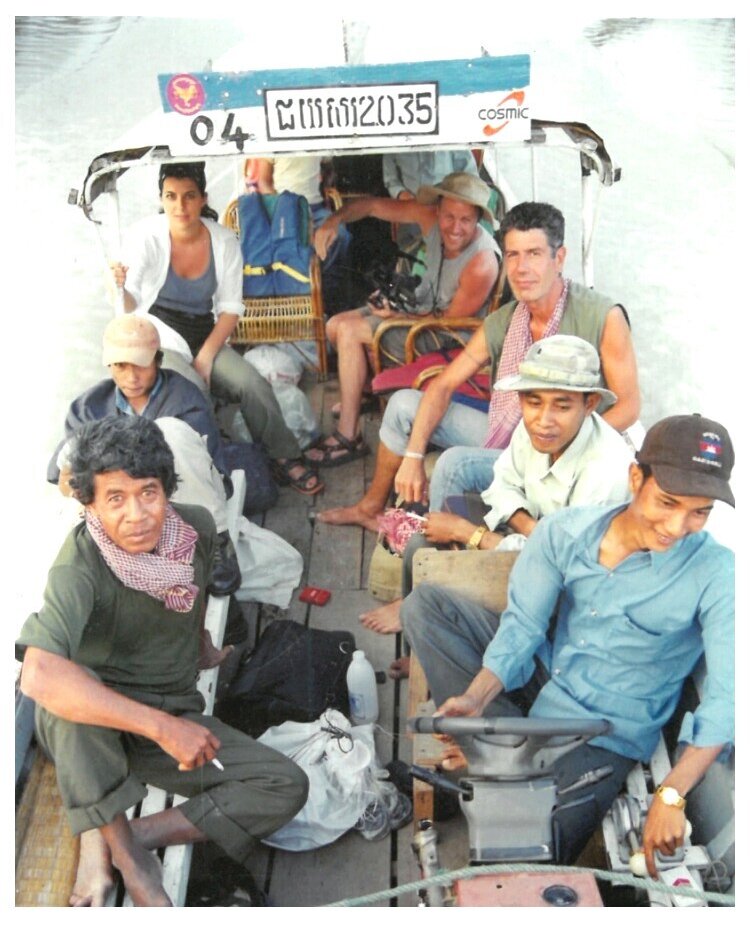
Lydia Tenaglia, Christopher ‘Chris’ Collins, Anthony Bourdain and the local crew on the Sangkae River near Battambang during the shooting of A Cook’s Tour, 2000. [photo courtesy of Ottavia Busia-Bourdain reproduced in the book World Travel (2021).]
Lydia Tenaglia, Christopher ‘Chris’ Collins, Anthony Bourdain and the local crew on the Sangkae River near Battambang during the shooting of A Cook’s Tour, 2000. [photo courtesy of Ottavia Busia-Bourdain reproduced in the book World Travel (2021).]
A Cook’s Tour — Wild Delicacies Season 1, Episode 5
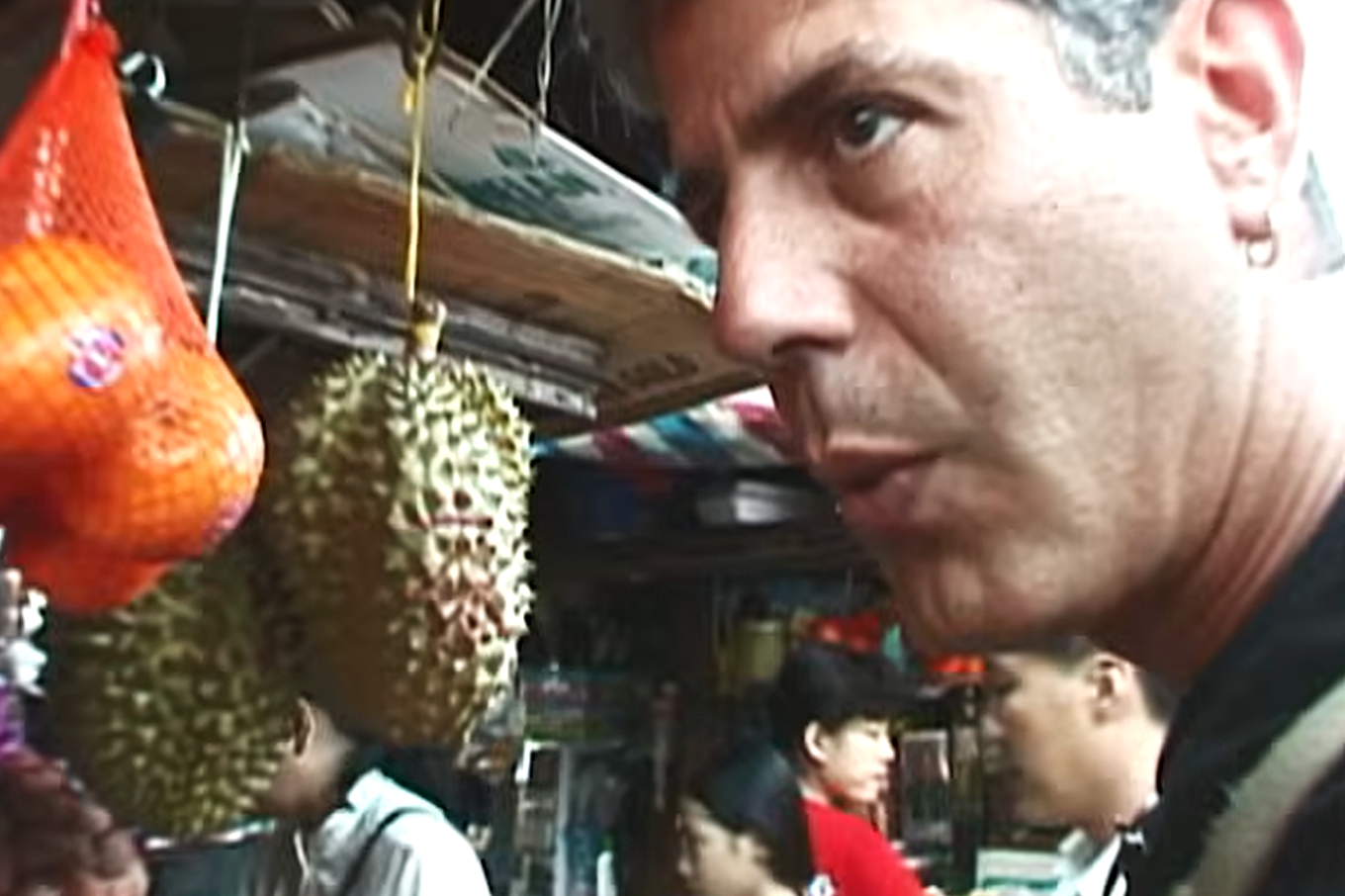
Bourdain found Cambodia ‘slightly frigthening, intimidating but slowly growing on you’, the people “lovely” the cuisine “both complex and accessible”, even “mind-opening”. At the infamous Heart of Darkness bar in Phnom Penh, a foreigner had told him to ‘always wear condoms’ and ‘stay away from durian’, so he goes on a hunt for the smelly fruit, encoutering crickets on his way through Psah Thmei Central Market (‘good, tastes a little bit like French fries and beef jerky’), finding a nice-sized durian — 12 pounds — and carving it on a public bench by the river: “It actually tastes really good, though it stinks to high heaven”.
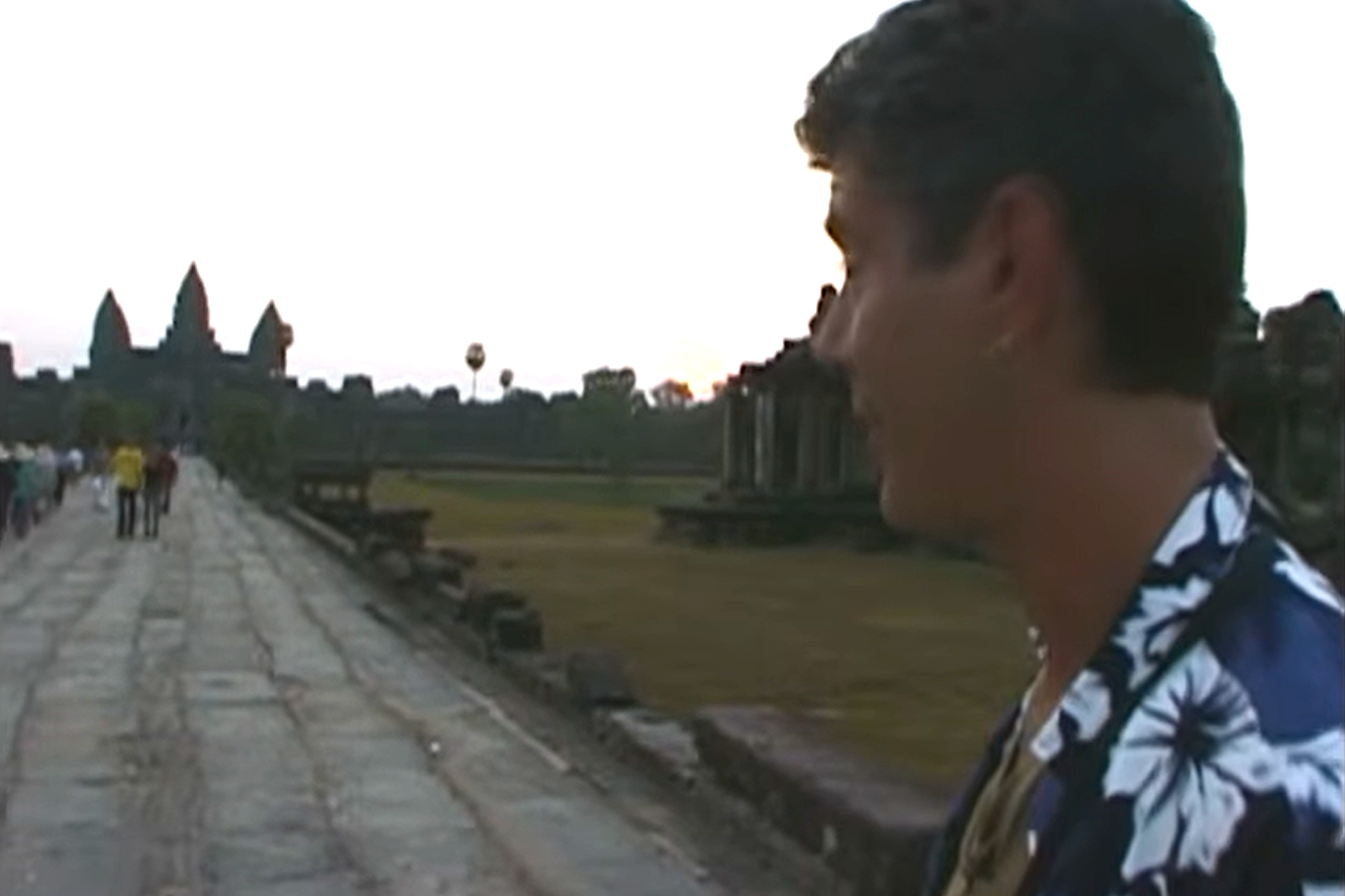
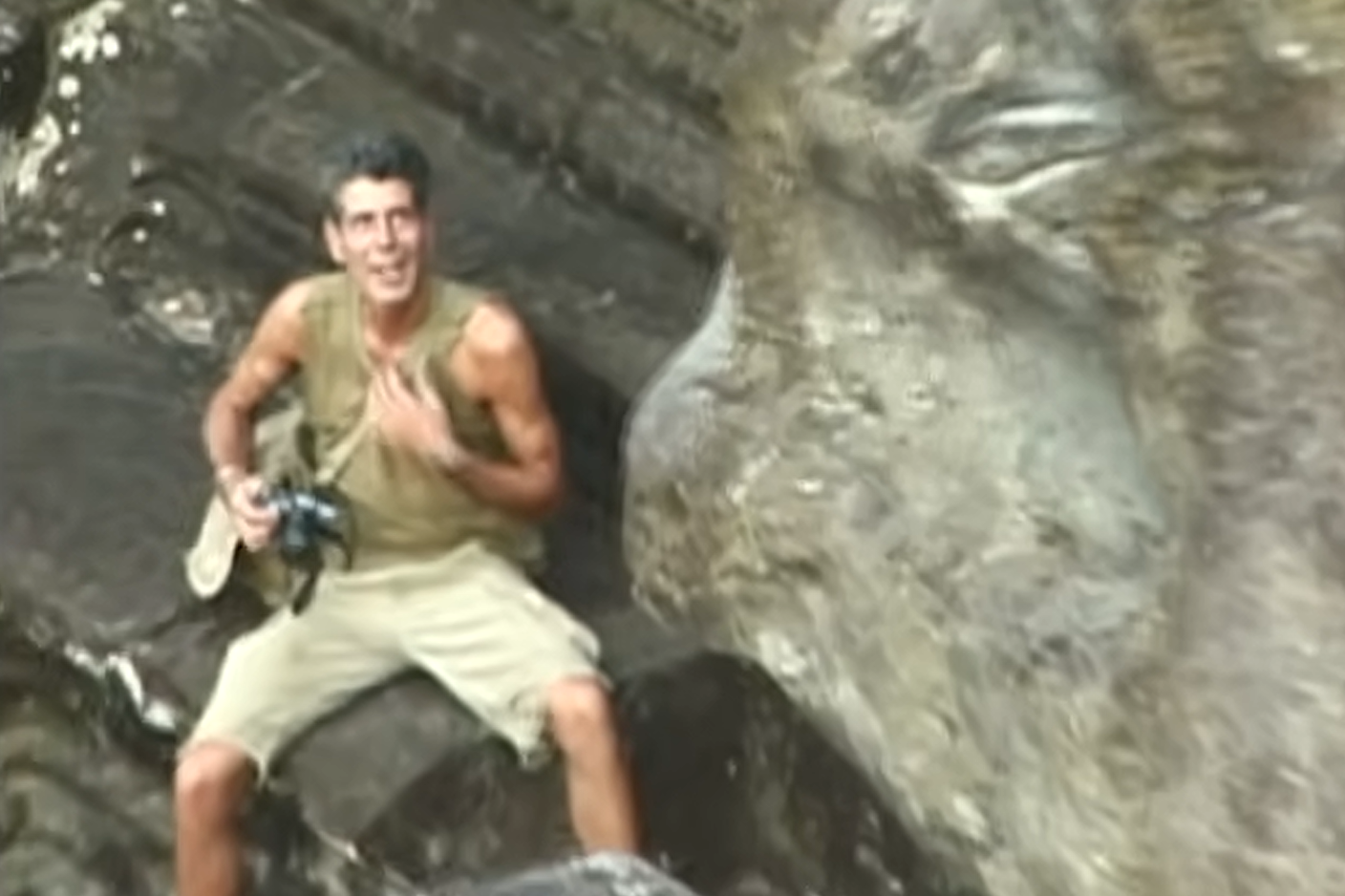
After breakfast and some shots at Prok Loan Shooting Range [The Gun Club], he joins his travel companion to taste some “weird-colored jellies”, some “tripe from unspecified animals”, before riding a boat to a floating village on the Tonle Sap [river or lake, hard to say from the film], where the two chefs share a meal with a fisherman’s family. Then, they reach Angkor, ‘a child’s dream’, and Bourdain climbs the stairs of the Bakan gibbon-style. Earlier, he has broached on a theme that would haunt him all through his career and life — “why do shame and pleasure always go together?” — but now, sitting on top of Angkor Wat central tower, he looks genuinely, unmitigatedly happy. That night a dinner of Khmer haute cuisine at the Grand Hotel d’Angkor takes them back to more familiar grounds. The End.
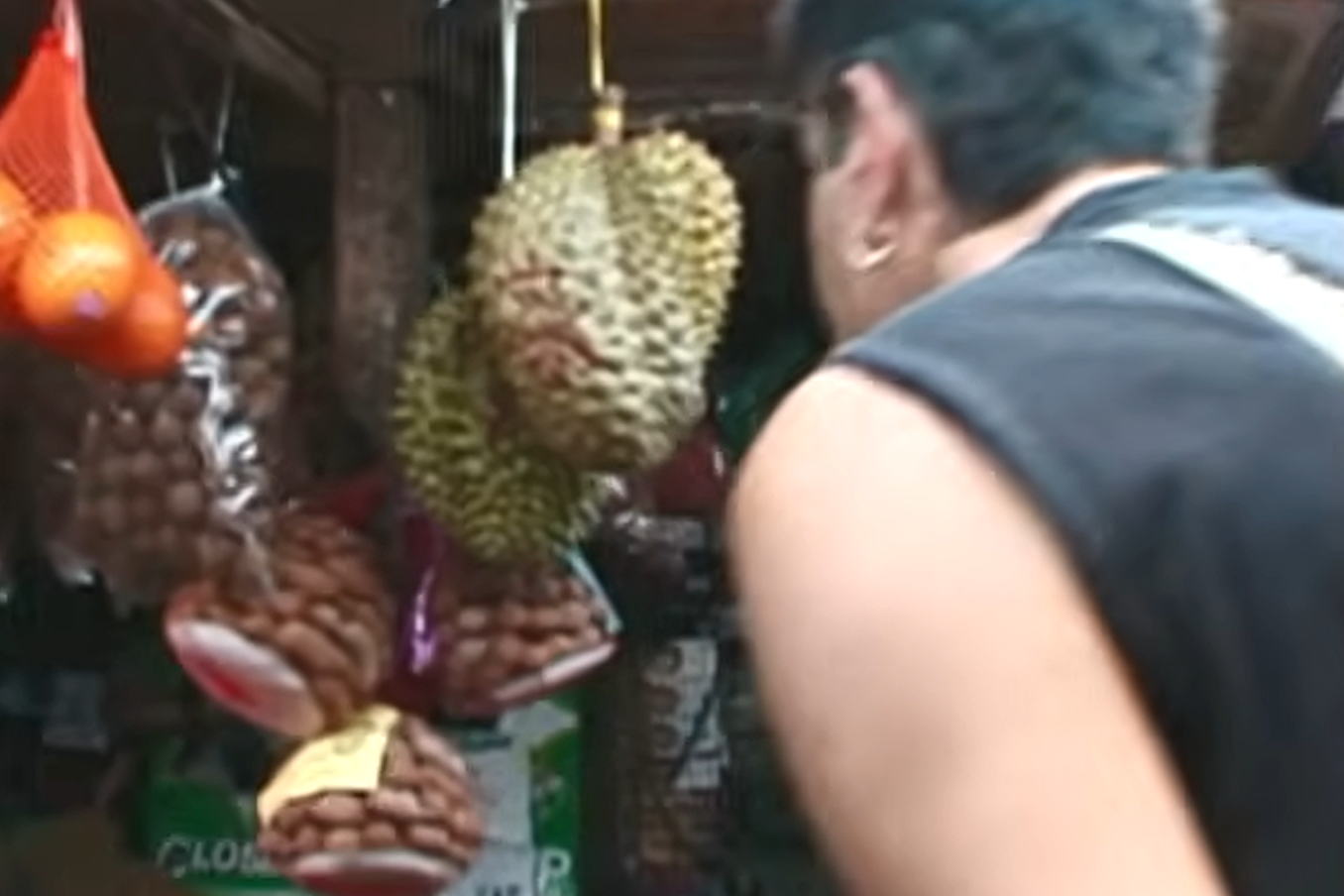
1,2) Chasing and finding durian at Central Market, Phnom Penh. 3,4) “A child’s dream”: seeing Angkor in Year 2000. [Screenshots from ‘The Cook’s Tour’, Cambodia episode released in 2002].
1,2) Chasing and finding durian at Central Market, Phnom Penh. 3,4) “A child’s dream”: seeing Angkor in Year 2000. [Screenshots from ‘The Cook’s Tour’, Cambodia episode released in 2002].
1,2) Chasing and finding durian at Central Market, Phnom Penh. 3,4) “A child’s dream”: seeing Angkor in Year 2000. [Screenshots from ‘The Cook’s Tour’, Cambodia episode released in 2002].
1,2) Chasing and finding durian at Central Market, Phnom Penh. 3,4) “A child’s dream”: seeing Angkor in Year 2000. [Screenshots from ‘The Cook’s Tour’, Cambodia episode released in 2002].
1,2) Chasing and finding durian at Central Market, Phnom Penh. 3,4) “A child’s dream”: seeing Angkor in Year 2000. [Screenshots from ‘The Cook’s Tour’, Cambodia episode released in 2002].
A Cook’s Tour: Tonle Sap Floating Village (2001) [excerpts from the previous program].
No Reservations Season 7, Episode 2
[40 mn, released on 7 March 2011. 19 min. rushes posted on Vimeo in 2013 + 2 min. excerpt posted by 402HK on YouTube. In 2026, the full episode has been made available on Apple TV, but it is not accessible from Cambodia].
Ten years after his first visit, the image and sound quality has noticeably improved on that series. And Anthony Bourdain was grown up from the young, wild-eyed New York sous-chef deciding to go explore the world at the turn of the millenium into a food expert and caustic observer of the ways of said world.
Only excerpts are available online, like the one about Cambodian Happy Pizza (cannabis-infused pizza). Bourdain focused on Kep and Kampot, on history and politics, while sampling river crab sauteed with Kampot peppercorns. He met with Dr Pung Chhiv Kek, first Cambodian female physician, founder of opposition party Licadho and instrumental in the national reconciliation. She showed him the Crab Market in Kep, and the ruins of her family villa on Kep hills — both her parents, Pung Peng Cheng and Mme Siv Eng Tong, had served as ministers before the civil war -, destroyed by the Khmer Rouge along with dozens of summer mansions built by the Cambodian wealthy class in the 1950s and 1960s.
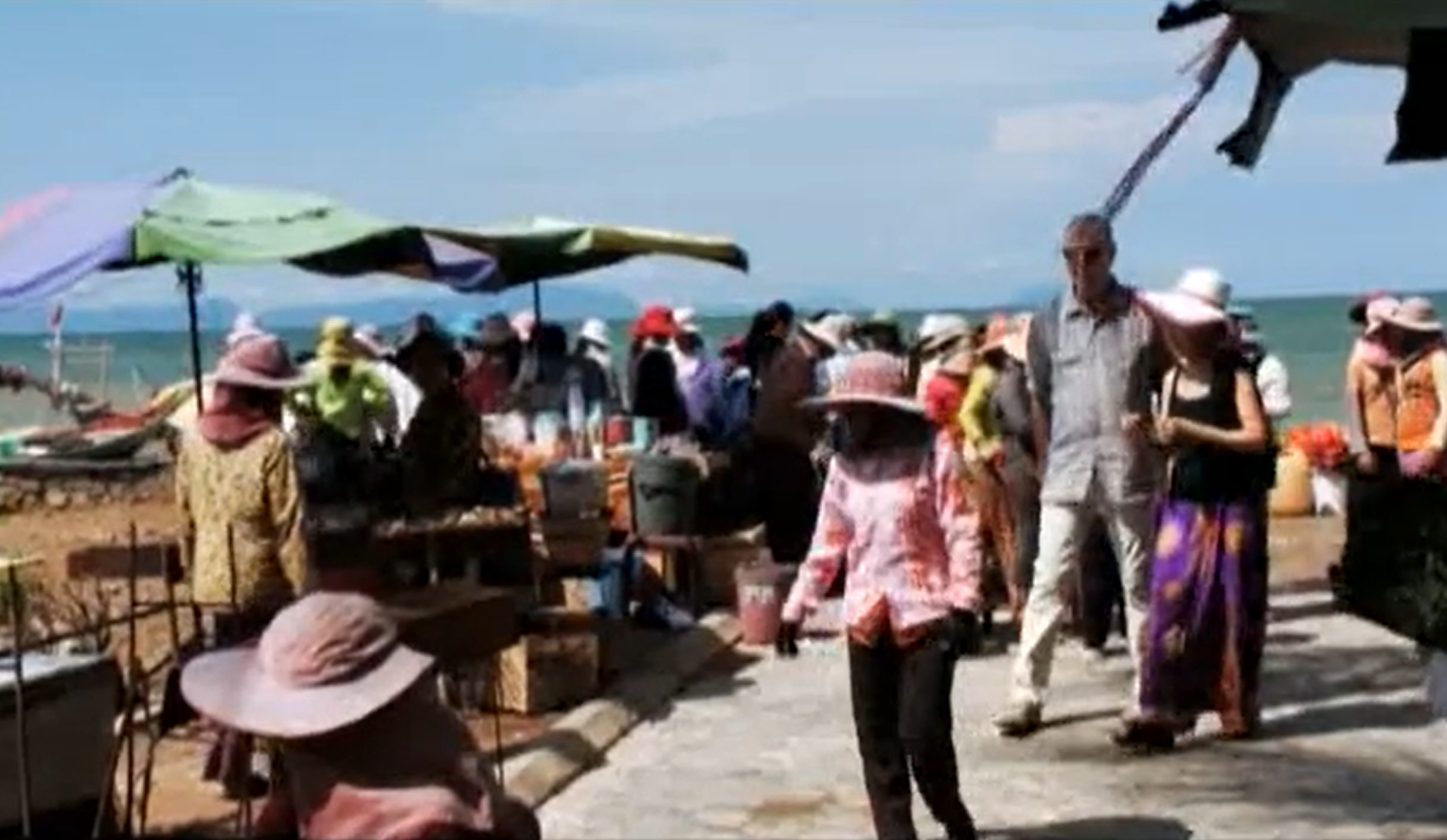
Anthony Bourdain and ‘Madame Kek’ (Pung Chiv Kek ពុង ឈីវកេក, b. 4 Oct. 1942) walking the Crab Market in Kep, 2011. Kek Galabru, as she was known after her marriage with French diplomat Jean-Jacques Galabru, she was among the influential figures who convinced Prime Minister Hun Sen and Prince Norodom Sihanouk for talks that eventually led to the 1991 Paris Peace Accords, and the establishment of the Second Kingdom of Cambodia on 24 Sept. 1993. [screenshot from the episode].
Anthony Bourdain and ‘Madame Kek’ (Pung Chiv Kek ពុង ឈីវកេក, b. 4 Oct. 1942) walking the Crab Market in Kep, 2011. Kek Galabru, as she was known after her marriage with French diplomat Jean-Jacques Galabru, she was among the influential figures who convinced Prime Minister Hun Sen and Prince Norodom Sihanouk for talks that eventually led to the 1991 Paris Peace Accords, and the establishment of the Second Kingdom of Cambodia on 24 Sept. 1993. [screenshot from the episode].
A Cook’s Tour: the real travelogue according to Anthony Bourdain
Most of the ‘Bourdain fans’ have forgotten that his first book, A Cook’s Tour: in Search of the Perfect Meal (2001) opened with a letter sent to first wife Nancy from a shabby guesthouse in Pailin, Cambodia, “about as far away from you as I’ve ever been”.
While World Travel reproduced part of Bourdain’s famous tirade against Henry Kissinger’s criminal acrimony againt non-aligned Cambodia in the 1960s, A Cook’s Tour probably gives a better perspective on Anthony Bourdain’s view of the world, its miseries and promises. There was more than ‘siding with the underdog’ in his approach to Cambodia slowly emerging from a nightmarish decade in 2000. For years to come, Cambodia (and Ethiopia, to some extent) reminded him of the humility and bravery of survivors — and of the excesses of the nouveau-riche capitalists.
Between A Cook’s Tour (2001) and World Travel (2021), Bourdain had changed — and ultimately decided to opt out in 2018. Yet the world had changed, too, perhaps even more. To quote New Yorker contributor Patrick Radden Keefe [1]:
Bourdain always had a salty vernacular, a jaded sense of humor, and an eye for the telling detail. Apart from childhood trips to France and a few vacations in adulthood to the Caribbean, he had never seen much of the world until he reached his midforties. In that respect he was not so different from most Americans; more than half of all Americans do not own a passport. When he first started going abroad, he turned out to have an uncanny ability to capture a place and its people in a few deft strokes. He was always an enthusiast, [but] he also had an uncanny ability, developed in his fiction writing, to select the vivid, indelible detail. […] For all the swagger of his persona, Bourdain’s writing was also imbued with great humility. One of the paradoxes of his life was that he was so closely associated in the public mind with chefs and restaurants and cooking, but as he would be the first to admit, he was never a great chef himself. […]
One night in October 2017, about nine months before his suicide, we had a public conversation in Manhattan as part of the New Yorker Festival. We talked about his concern that in some ways the prevailing mood in the United States seemed to have turned against his way of seeing the world. In America and in many places abroad, tribalism and xenophobia were on the ascendant. This was a function of politics — but not exclusively. It also had something to do with social media, and the ways in which societies become atomized when everybody spends so much time on their phones. Tony spoke about how his decades in restaurant kitchens had given him an appreciation and respect for immigrants of every stripe. To him, difference was not something to fear or resent, but something to celebrate and be inspired by. [..] But I think there’s more to it than that. Bourdain was very taken with How to Live, Sarah Bakewell’s 2010 book on Michel de Montaigne. He got a tattoo on his forearm, in Greek, of Montaigne’s motto: “I Suspend Judgment.” In the breaking of bread, he found a way to close the distance between himself and strangers the world over, often people whose lives might have seemed unbridgeably different from his own.
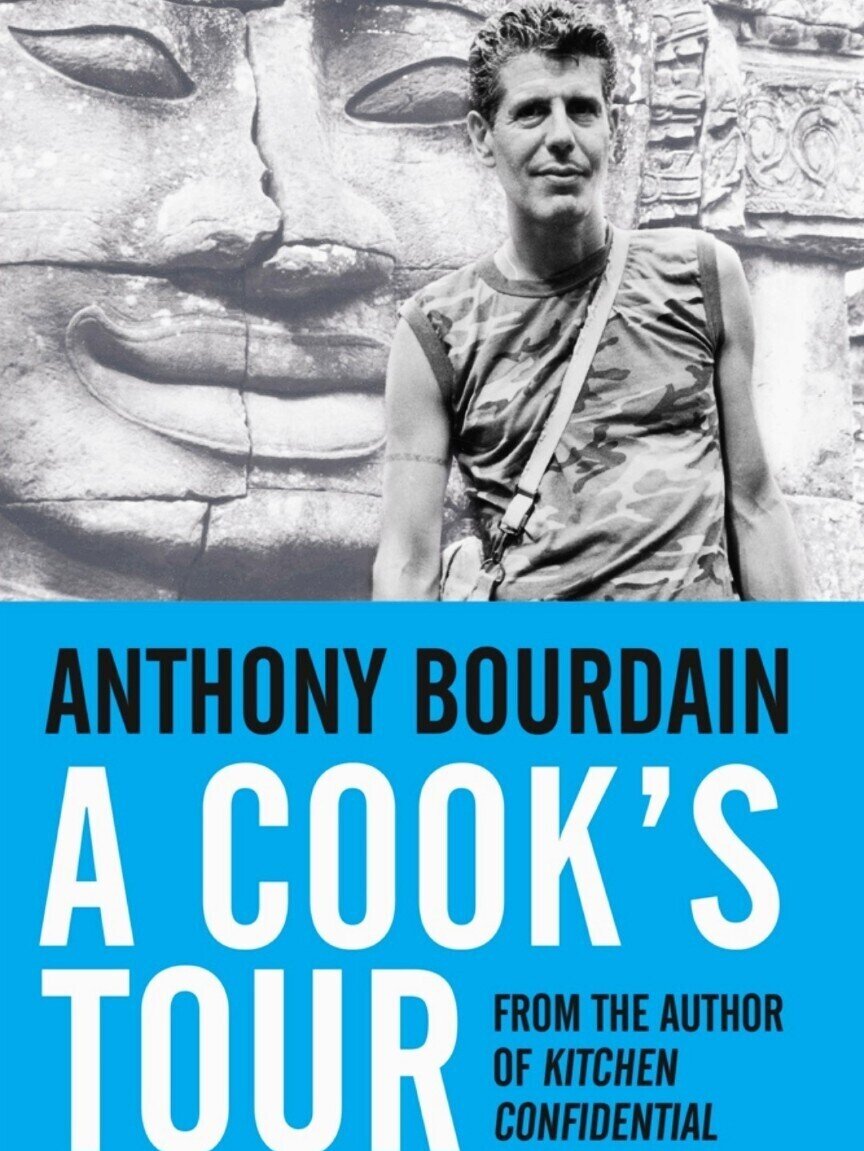
Angkor on My Mind — The cover of A Cook’s Tour original Kindle edition (1) and the updated layout in 2026 (2). [photos Amazon]
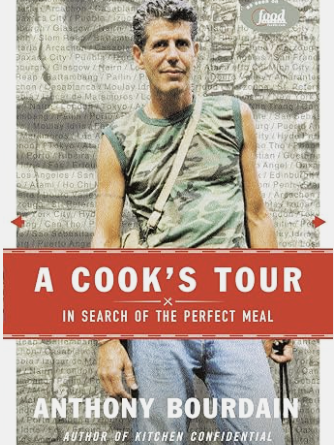
Angkor on My Mind — The cover of A Cook’s Tour original Kindle edition (1) and the updated layout in 2026 (2). [photos Amazon]
Angkor on My Mind — The cover of A Cook’s Tour original Kindle edition (1) and the updated layout in 2026 (2). [photos Amazon]
_____
[1] Foreword to The Anthony Bourdain Reader: New, Classic, and Rediscovered Writing, Kimberly Whiterspoon ed. [she was his literary agent and friend for over 20 years], New York, Ecco/HarperCollins, 2025, 503 p. ISBN 13 978 – 0062863973. Kindle Edition.
Tags: American writers, American travelers, 1970s, 1990s, 2000s, 2010s, 2020s, culinary, Cambodian cuisine, travelers, travel books, tourism, Vietnam, Modern Cambodia, Japan, Singapore, TV celebrities, films, Pailin, Kep, Kampot, Second Kingdom of Cambodia, Khmer Rouge, hotels
About the [posthumously]
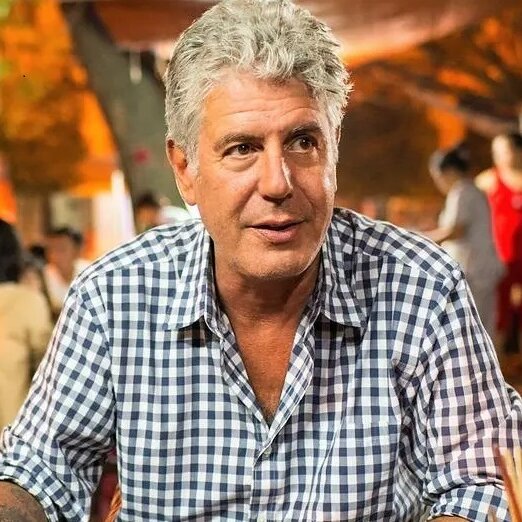
Anthony Bourdain
Anthony Michael “Tony” Bourdain (25 June 1956, Manhattan, NYC, USA — 8 June 2018, Kaysersberg-Vignoble, France) was an acclaimed food and travel writer, food explorer, ex-prep cook and ex-chef, who portrayed the planet, its people and their culinary habits (or quirks) while relentlessly traveling the world for his TV shows (200 days on the road per year, at the peak of his activity).
Unafraid of raising political issues — he foresaw the 2022 military invasion of Ukraine ordered by Russian potentate Vladimir Poutine –, nor poking fun at American TV “celebrity chefs”, he often addressed his personal demons in his CNN show ‘Parts Unknown’ — a series that ran from 2013 to his death by suicide while he was shooting one more episode in France with his time-honored friend, Chef Eric Ripert –, openly referring to his past drug addiction and his bouts of depression. Some parts of the world, or the specifics of its inhabitants, triggered highly emotional response, like when he consulted a psychoanalyst in Buenos Aires, or when he discovered that some tourist operators in Sicily threw frozen cuttlefish in the sea to give tourists the illusion that they were actually fishing when scuba diving.
In the Parts Unknown episode about Jerusalem, he commented on his Jewish identity (“not a religious but an ethnic one”, as her mother was Gladys née Sacksman, from a non-religious Ashkenazi family), while in the episode on Paraguay he attempted to track back one of his ancestors, Jean Burden or Bourdain, who emigrated from France — as did Bourdain’s paternal grand-parents to New York — and vanished there in the second half of the 19th century. Remarking that his own father had passed away when he was 52, he wondered if he would last much longer. On his last TV interview (with Fast Company, released 9 June 2018), he noted that “the biggest failure of our show has been not to give enough exposure to women’s worldview and experiences.”
With a long-lasting fascination for Asia, in particular Vietnam and Japan, he made sure to visit Angkor, “a child’s dream” at the start of his wandering musings about food, in 2000. In fact, the book A Cook’s Tour: in search of the perfect meal (2001), opened with a letter sent to first wife Nancy [Nancy Putkoski (m. 1985 – 2005)] from Pailin, Cambodia, where he was tracking the last hideouts of the remaining Khmer Rouge insurgency. Asia was also the first destination of his first TV food travel series, ‘A Cook’s Tour’ [Food Network, 2001 – 2010]. It was followed by ‘No Reservations’ [Zero Point Zero Production, 2010 – 2013], and ‘Parts Unknown’ [CNN, 2013 – 2018].
On the personal life front, he married 2 years after his divorce with Nancy Ottavia Busia, with whom he had one daughter. They separated in 2016, when he became romantically involved with Italian actress and filmamker Asia Argento (born Aria Maria Vittoria Rossa Argento, 20 Sept. 1975), who was one of the first women to publicly accuse producer Harry Wenstein of sexual abuse, a stance Bourdain firmly supported.
While his family and educational background pushed him towards French cuisine — his portrait of Paul Bocuse and other renowned Lyon chefs was a monument in reverential and loving admiration –, he was eager to explore as many cultures as he possibly could, with a particular fondness for Vietnam. His exploration of Americana was equally passionate and critical, and in his report on the decay of Detroit as a city and the symbol of industrialist optimism he drew comparison between the decline of ‘Motor City’ - or ‘Motown’ — and the fate of the Angkorian empire and city.
Author of several books devoted to food and food culture — Kitchen Confidential: Adventures in the Culinary Underbelly (2000) and Medium Raw (2010) were New York Times bestsellers, he also authored works of fiction, such as crime novels Gone Bamboo and Bone in the Throat. His life has inspired several biographies and biopics, in particular Matt Johnson Tony (2026, 106 min), about his early years in Provincetown, Massachusetts, with Dominic Sessa as Anthony Bourdain.
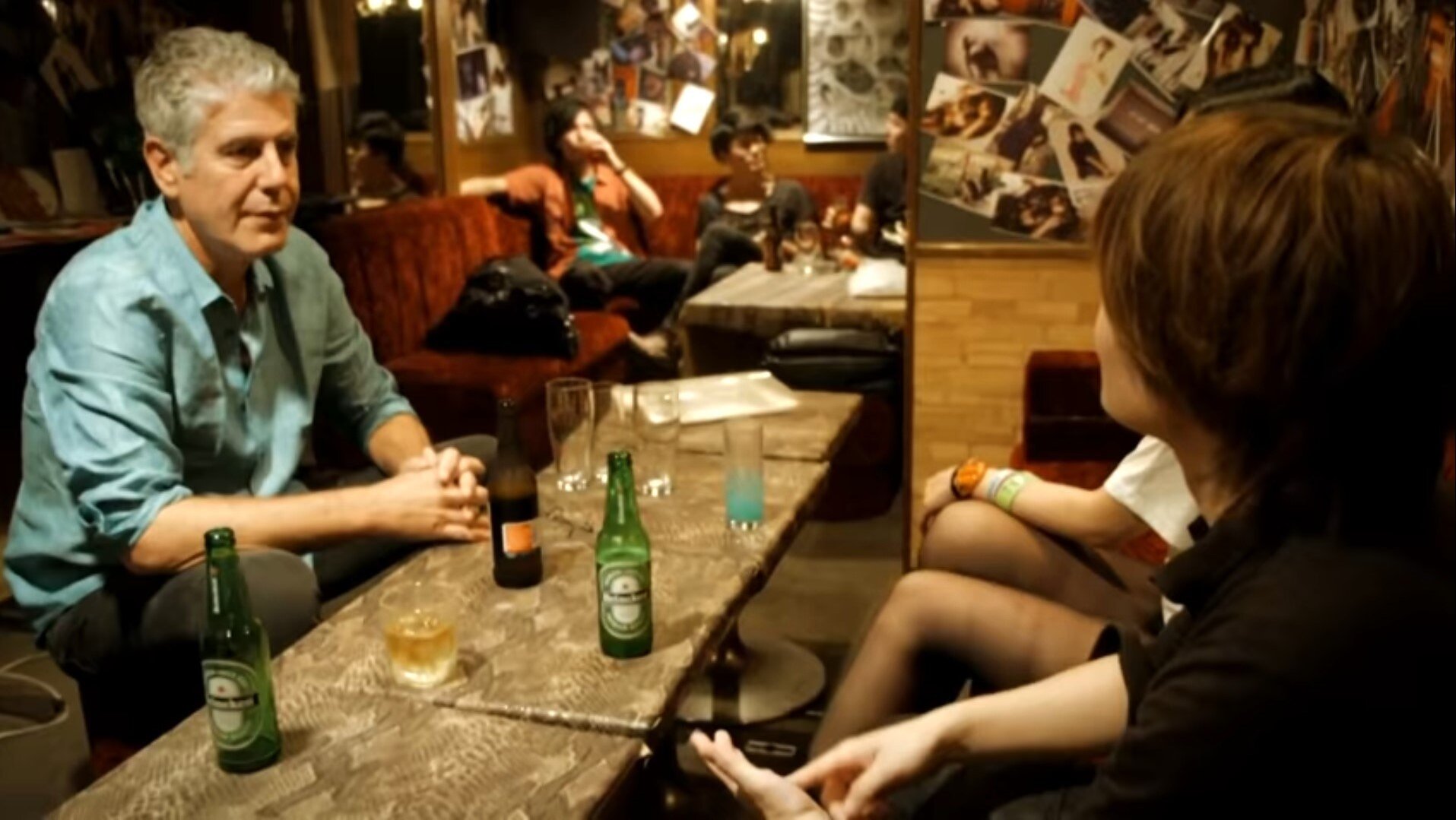
In Tokyo with Japanese hard rock musicians, 2015. [screenshot from ‘Parts Unknown’, Tokyo Episode.]
In Tokyo with Japanese hard rock musicians, 2015. [screenshot from ‘Parts Unknown’, Tokyo Episode.]
Publications
- “The Young Caremians”, ZAT magazine num. 2, 1984 [probably the first published writings by A.B., repr. in Kimberly Whitherspoon (ed.), The Anthony Bourdain Reader: New, Classic, and Rediscovered Writing, 2026.
- [unpublished short story] “Wet Affairs,” repr in Kimberly Whitherspoon 2026, op. cit., p. 315 – 26.
- [fiction] Bone in the Throat, New York: Villard Books, 1995. ISBN 978−0−679−43552−5.
- [fiction] Gone Bamboo: A Novel, 1997, New York, Villard Books; repr. Bloomsbury USA, 2008, 302 p. ISBN13 978 – 1596917262.
- “Don’t Eat Before Reading This,”, The New Yorker, 12 April 1999.
- Kitchen Confidential: Adventures in the Culinary Underbelly, New York, Bloomsbury Publishing, 2000, repr. 2010, 351 p. ISBN13 978 – 14088208582010 ; Kindle Edition, 2018, 2026.
- A Cook’s Tour: In Search of the Perfect Meal, New York: Bloomsbury. 2001, 288 p. ISBN13 978 – 1582341408. Kindle Edition 2018, 2026.
- Typhoid Mary: An Urban Historical, New York, Bloomsbury, 2001, 160 p. ISBN13 978 – 1582341330. Kindle Edition, 2010.
- [fiction] Bobby Gold, Edinburgh: Canongate Crime, 2001. ISBN 978−1−84195−145−4.
- Anthony Bourdain’s Les Halles Cookbook: Strategies, Recipes, and Techniques of Classic Bistro Cooking, New York, Bloomsbury, 2004, 304 p. ISBN13 978 – 1582341804.
- The Nasty Bits: Collected Varietal Cuts, Usable Trim, Scraps, and Bones, New York: Bloomsbury. 2006.
- No Reservations: Around the World on an Empty Stomach, New York: Bloomsbury. 2007.
- [fiction] Medium Raw: A Bloody Valentine to the World of Food and the People Who Cook, New York, Ecco/HarperCollins, 2010, 288 p. ISBN 978 – 0061998065.
- [comics] [with Joel Rose & Langdon Foss] Get Jiro!, DC Comics, 2012. ISBN 9781401228279
- [comics] [with Joel Rose & Alé Garza] Get Jiro: Blood and Sushi, DC Comics, 2012. ISBN 9781401228279.
- Foreword to Graham Holliday, Eating Viet Nam: Dispatches from a Blue Plastic Table, New York, Ecco, 2015.
- Appetites: A Cookbook, Ecco Press. 2016.
[comics] [with Joel Rose, Alberto Ponticelli, Irene Koh & Paul Pope] Hungry Ghosts, Berger Books, 2018. ISBN 978 – 1506706696. - [posthumous, ed. by Laurie Woolever] World Travel: An Irreverent Guide, New York, Ecco, 2021.
See also: The Anthony Bourdain Reader: New, Classic, and Rediscovered Writing, Kimberly Whiterspoon ed. [she was his literary agent and friend for over 20 years], Patrick Radden Keefe (Introduction), New York, Ecco/HarperCollins, 2025, 503 p. ISBN 13 978 – 0062863973. Kindle Ed.
About the Author
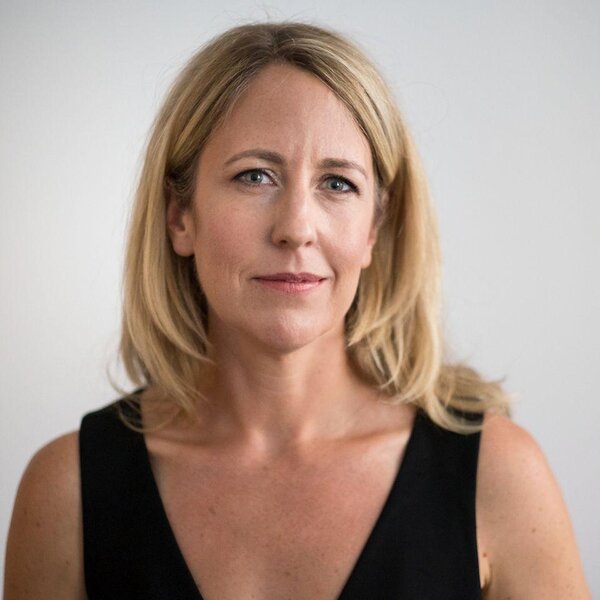
Laurie Woolever
Laurie Woolever is an American writer and editor, and spent nearly a decade assisting Anthony Bourdain, with whom she coauthored the cookbook Appetites in 2016. She has written about food and travel for the New York Times, GQ, Food & Wine, Lucky Peach, Saveur, Dissent, Roads & Kingdoms, and others, and has worked as an editor at Art Culinaire and Wine Spectator.
After Bourdain’s death in 2018, Laurie Woolever decided to complete the book the famous food and travel writer had in mind, a guidebook to his favorite places around the world. She had first met Bourdain in 2002, through New York celebrity chef Mario Batali, later to become his editorial assistant and friend. Enriching the notes left by Bourdain with his own words from episodes of No Reservations and Parts Unknown, and calling on his closest friends to round out the rest, she got World Travel: An Irreverent Guide published in August 2021. One month later, she also published Bourdain, The Definitive Oral Biography (Harper & Collins, New York).